The Nigerian experience is physical, emotional, and sometimes international. No one knows it better than our features on #TheAbroadLife, a series where we detail and explore Nigerian experiences while living abroad.
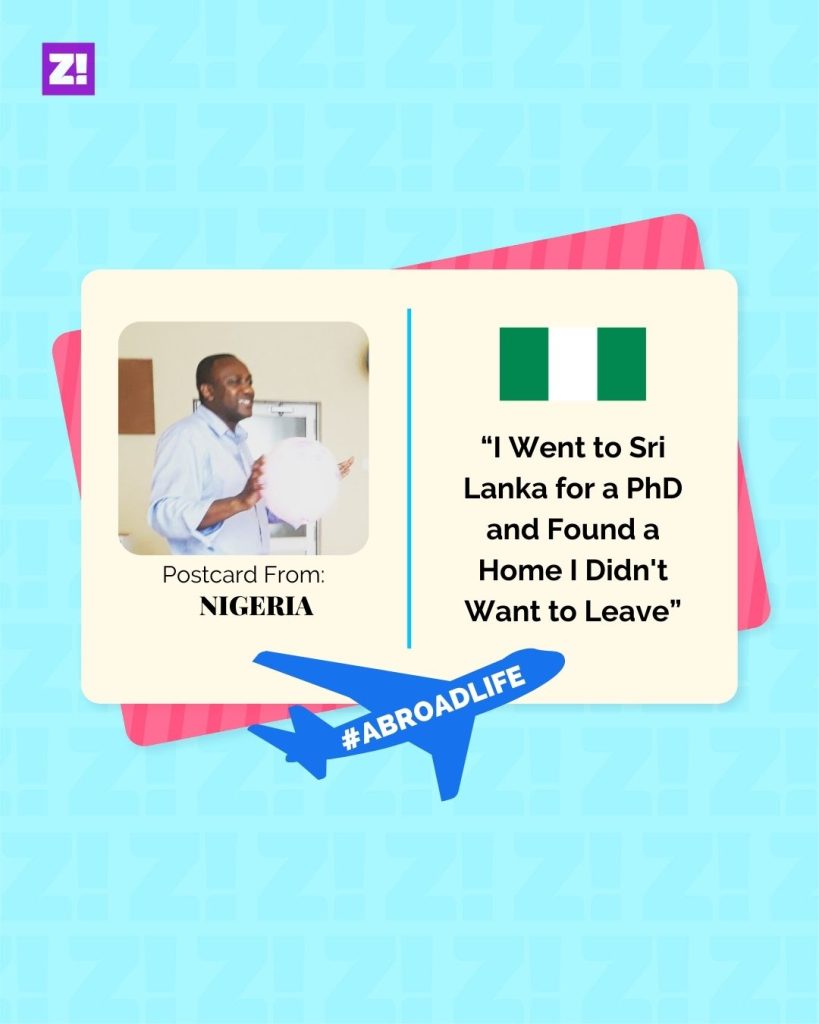
Iliyasu (52) spent four years in Sri Lanka getting his doctorate before returning to Nigeria in 2018. In this story, he talks about the initial culture shocks, the best and worst parts of life on the island and why he was reluctant to leave his new home when it was time to return to Nigeria.
Where do you currently live, and when did you leave Nigeria?
I moved to Sri Lanka in 2014, but I currently live in Taraba, Nigeria.
You’re back in Nigeria?
Yes. I travelled to study for a doctorate. After my studies, I returned to Nigeria in 2018.
Was that the first time you had left the country?
Yes, that was my first time leaving Nigeria.
What inspired you to make that move?
I wanted to have my doctoral studies outside Nigeria, so I explored foreign study opportunities. I even got accepted and was on the waiting list to study at the University of Zululand in South Africa. But then, I also had an option to leave for Sri Lanka because my dean, with whom I had worked earlier at the university where I taught, was from Sri Lanka. That was how I got that move.
What were you up to before you left Nigeria?
I was a lecturer. Before that, I had been in the private sector working for a supply chain company that dealt in petroleum products between 2003 and 2007. But I had this feeling that I wanted to teach. I had more money in the private sector and what you could call a more comfortable life. But it was this passion for teaching that drove me to leave that life to become a lecturer.
South Africa and Sri Lanka are sort of odd choices for Nigerians. It’s usually the UK and the US. Why were these the places you considered?
You know, they say a bird in hand is worth more than ten in the bush. In making these decisions, there’s a lot one has to consider. Also, having contacts in these countries played a big part in my decision. In South Africa, I had someone there who was already doing some groundwork to help me settle on arrival. It was similar for Sri Lanka. I was introduced to the opportunity through the dean I told you about. Having that contact was important to me.
Did you plan to move permanently, or did you always have the aim of returning to Nigeria?
No, I wasn’t. It probably has something to do with my background being from the north. There’s less of a desire for immigration amongst northerners than there is in the southern parts of the country. At least that’s been my experience. All my colleagues who went abroad, even to the United Kingdom and the United States, came back. Those who stayed abroad permanently weren’t northerners.
So I wasn’t excited about moving permanently. I just wanted to experience life outside the country and then come back. It might also be because at that time in 2014, Nigeria was not as bad as it is now.
So you feel differently now?
I do to a large extent. When I started this job, I basically started from the bottom as a graduate assistant and worked my way up. But even at the start, I didn’t struggle financially. But now, even as a professor, I struggle financially. I think that shows how things have changed over time. The Nigerian dream seems to be a nightmare now due to the decline in economic power. I was much better off then as a junior staff member than I am now.
Wow. Let’s talk about Sri Lanka. What was it like?
I was like a newborn child getting to Sri Lanka. I felt that based on my background, I would settle easily because I was used to moving. Having moved from Lagos where I was born and spent my early years to the North where I went to secondary school, university, and eventually married, I was used to making friends quickly and making myself feel at home in new environments.
I had also read about Sri Lanka before getting there, and my dean and his wife told me a lot of stories. But hearing stories is not the same as being in the story yourself.
I immediately got my first culture shock at the airport. I forgot I read that they don’t drive on the same side as in Nigeria. So I put my luggage in the airport taxi, rushed to open the front door, and found a steering wheel staring at me.
There was a bit of a fear factor for me as a newcomer. But there were fellow Nigerian students on the ground, and the University of Colombo really tried to make me comfortable, so that really helped me overcome any fear and settle in.
I think I got used to the country after one year. By the time I was leaving in 2018, I wanted to stay longer. I had found community in church and among my Sri Lankan colleagues. My doctoral class had about fifty of us or more, with some foreigners and then local Sri Lankans. These were relationships I had built over time that made me feel very much at home in Sri Lanka.
You mentioned being married. Did your wife go with you?
I went alone. My wife was on a programme at the time. It was at a point where she couldn’t leave. Apart from that, we were constrained financially to cover ourselves and the kids, because we had four of them. So it was cost-effective for me to go alone and always connect through calls. I also visited Nigeria every year until I returned, except for 2017.
Was that difficult for both of you?
It must have been hard for her, running around alone with the kids. But we went through it, and it was something we found ways to manage. It was difficult, but I think it was worth it.
Zikoko’s HERtitude is back this April 2026. Grab your tickets here.

What was life like for you in Sri Lanka?
Well, there was a bit of a language barrier. Sri Lankans speak Sinhala, and it’s the only country where that language is spoken. The second language they have is Tamil. But it’s a Commonwealth country, so quite a number of them speak English.
What’s actually shocking is that it’s the older people in the country who are more likely to be English speakers. A lot of the younger ones typically only speak Sinhala. I learned that it was due to an old policy decision to make Sinhala the only language in the country.
For food, they eat a lot of rice. Lucky me, rice is my best meal. The only food-related shock for me was their use of sugar. They use too much in their teas, and they add sugar to their stew and spices.
The weather is a lot like Lagos, very humid with a lot of rain. The taxi services were very efficient, and there were air conditioners even in the buses. One discouraging thing is installing air conditioning in a room, which I tried twice. It was very, very expensive. The money to do that alone could pay your rent here in Nigeria.
The country is very organised. Electricity and water were not issues compared to Nigeria. We drank directly from the tap over there. Then the same thing with their currency; they kept it controlled. Nigeria is richer than Sri Lanka on paper, but they’ve kept their currency controlled so it doesn’t fluctuate as much as ours. The situation there is just far better than it is in Nigeria.
Let’s talk about affordability. How did you afford your trip and stay?
My trip was sponsored by the Tertiary Education Trust Fund (TETFund). On the visa, it clearly states you cannot work. If you do, you’ll be sent back home. So covering expenses was difficult; I had to depend on Nigeria almost totally and the goodwill of people to make up for it.
My supervisor also took an interest in me and got to know that we were not allowed to work. So he let me edit his work and gave me a little stipend for it to help me survive.
What were your best experiences in Sri Lanka?
There were a few.
The first one was about my studies. It was a bit difficult getting my money from Nigeria at one point because the Nigerian government stopped our cards from working. But the University of Colombo was very understanding. Some of my colleagues chickened out and went back to Nigeria, but I didn’t.
I once went to see the Dean of the Faculty of Postgraduate Studies, to check if I’d be allowed to defend my doctoral thesis even though I had not finished paying my fees due to the Nigerian situation. She’s a woman I like to describe as an “iron lady,” but I managed to find a way around this. When I got to her office, I found out it was her birthday, and they’re a pretty big deal in Sri Lanka. I hyped her up, telling her how nice it was to hear that it was her birthday. She was so excited that I was celebrating with her. She told me, “Don’t worry, you’ll be the next person to do your defence.” And truly, they allowed me to defend before completing my fees.
The second was at a think tank called the Institute for Ethnic Studies. My supervisor told me to attend seminars there. On one of those occasions, I met an American who eventually became my landlady. She had been in Nigeria because her dad was an ambassador. As an adult, she had worked in Bayelsa state and was now working for the U.S. Agency for International Development (USAID) programme in Sri Lanka. We bonded over her love for food and my love for cooking. She eventually rented a space to me in their diplomatic compound.
Another one: on the day I was signing off, my supervisor gave me a gift. In Nigerian universities, lecturers don’t give you gifts; it is the other way around. But my supervisor brought out a statue of an elephant, one of Sri Lanka’s national animals. She told me, “You have lived in Sri Lanka, and you have done well. I pressed you a lot, and I thought you would run back to Nigeria.” She was impressed with my work ethic, and that was her way of appreciating me.
It really had an impact on me and how I go about interacting with my own students now. It showed me things can be different from how we normally do it in Nigeria.
There was also the church. I had the privilege to be trained by Calvary Church in Colombo. An elderly man I met in church persuaded me to join their training, the Calvary Seminary. It was an uphill task for me as a doctoral student, but it was a turning point.
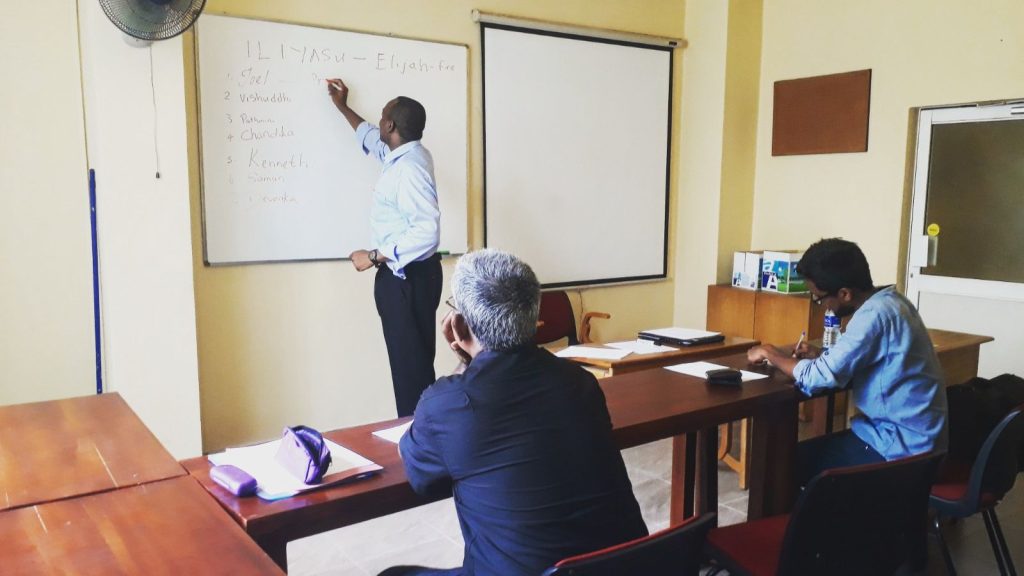
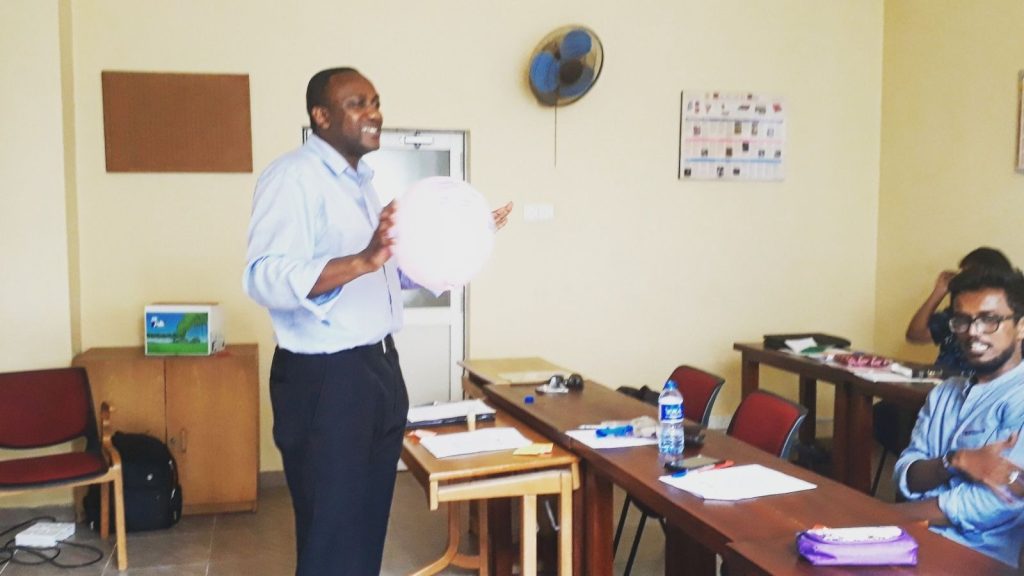
I met quite a number of people I ordinarily would not have met. The church was sending me to do relief duty for their pastors. It afforded me the opportunity to travel around Colombo and outside, and most times it wasn’t at my own expense. I had one of the first times in my life preaching using an interpreter. Being a Black African preaching in their church was really great for me. That was one of the greatest things that happened to me.
What were your favourite things about Sri Lanka?
My favourite thing was how the system there just works. My doctorate studies finished at the right time, unlike in Nigeria, where strikes could have made it as long as 10 to 14 years. Everything in Sri Lanka is just far more organised. The people and system are fair; if you deserved something, they gave it to you.
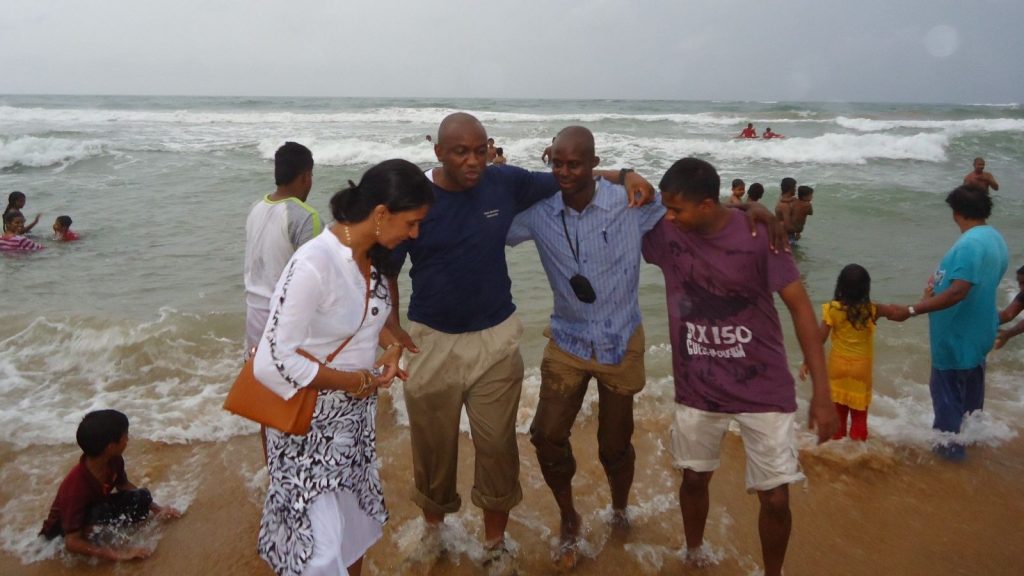
For leisure activities, I loved the beaches. You could even go at night without feeling unsafe, unlike in Nigeria, where you might get robbed. Security there is very good. They respect their police. The police hardly carried weapons; they only had whistles, and everyone obeyed the whistles.
Sounds like a great place, but what didn’t you like?
The buses are often overcrowded. If you get on at the wrong time, you are in for it. The high humidity could make it a really bad experience. I learned to always hustle for door seats so I could easily get out when I needed to. Also, some of the few tuk-tuk (keke) drivers try to cheat foreigners by messing with the rates on their meters.
There’s also some level of racism there, whether on the bus or when meeting with people. When I arrived, I found that many of the fellow Nigerians just kept to themselves in their own little community.
But on the whole, I had a positive experience, and I would go back if I got the chance.
So the racism did not impact your view of the country?
It’s all about your mindset. I mean, is it any different from the religious biases and tribalism we have in Nigeria? There’s a saying I like that says if you respond to every dog that barks at you, you will never get to your destination. This world is not perfect. When there is racism, you must have a way to deal with it—brush it off, move on, and focus on your goals.
You mentioned wanting to go back. Are you exploring immigration opportunities to Sri Lanka or elsewhere?
Yes, I am. Apart from Sri Lanka, I’m also looking elsewhere. I’m exploring the talent option for the UK. The US was on my list as well until their recent political shifts. But now I’m focusing on Europe, Australia, and New Zealand.
I think Sri Lanka is a great place to live. As a professor, I usually have to be a surety for people going abroad for doctoral studies, and I always encourage them to go to Sri Lanka and stay back if they get the opportunity. Many Americans and Europeans even go to Sri Lanka when they retire because it is a good place to live and get value for their money. I encourage people to explore those opportunities.
On a scale of one to ten, how happy were you in Sri Lanka?
I would say eight point five. It was a great experience.
Do you want to share your Abroad Life story? Please reach out to me here. For new episodes of Abroad Life, check in every Friday at 12 PM (WAT).
Click here to see what other people are saying about this article on Instagram