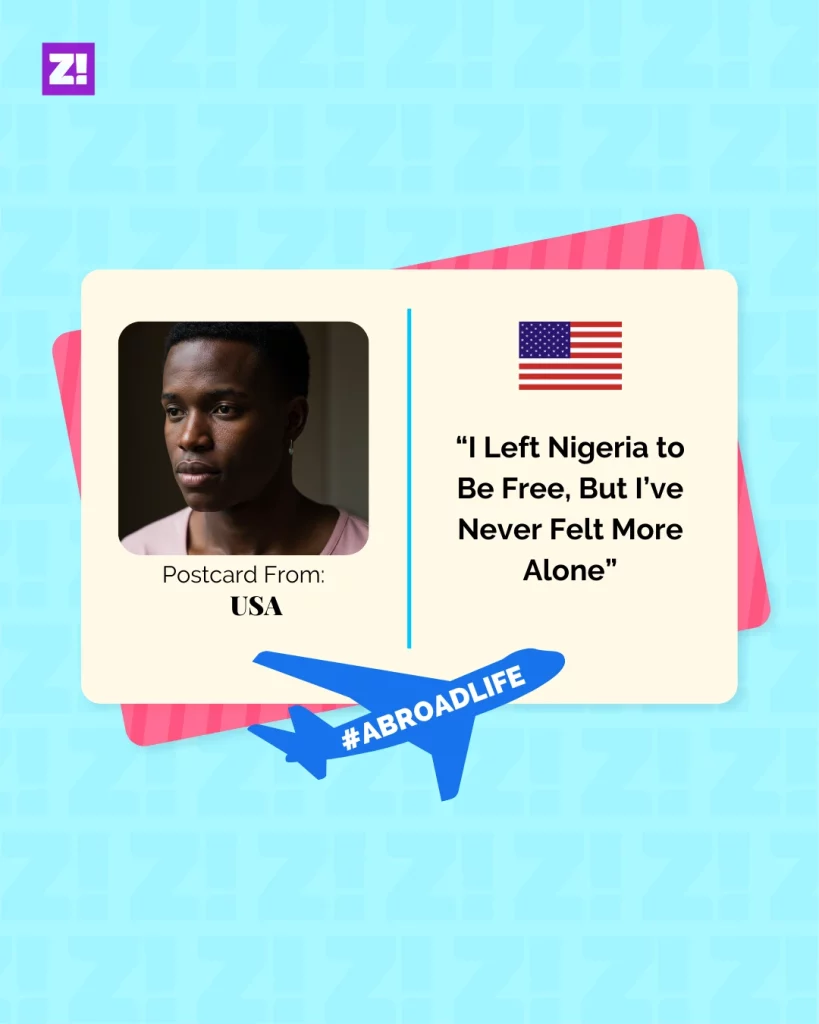
Gabriel* (31) moved to the US to live freely as a queer man. In this story, he shares how loneliness, discrimination, and the toxic culture of the queer community turned out to be a very different reality than he expected.
Where do you currently live, and when did you leave Nigeria?
I live in the US, and I left Nigeria in 2021.
What inspired you to leave?
I left for graduate school. I wanted to do my master’s abroad.
Why the US?
I wasn’t particular about it being the US. I just wanted to leave Nigeria and be as far from home as possible. I considered other countries, Canada, for example, but I got admitted to a university in the US, so I went with that. I just wanted to be anywhere but home.
Why did you want to be anywhere but home?
I wanted to go somewhere I’d be allowed to be myself, to live as a queer man without fear. It’s affected my relationship with my family because I’m always trying to stay away from them, just to have some independence and privacy. So when the opportunity to leave Nigeria came, I grabbed it.
Does your family not approve of your sexuality?
They don’t know.
They might have their suspicions, but I haven’t come out to them yet. I’ve heard my parents talk about other queer people in a homophobic way, so I have a good idea of how they’d react.
I might come out to them eventually, but I don’t know when. Maybe soon, but I’m not quite ready yet.
How was life as a queer man in Nigeria?
During my undergraduate years, I really got to be myself. My university was in a different state from where we lived, so my parents couldn’t visit. I had the freedom to live my life as a queer person. I also had supportive friends. Some were queer too, and even straight ones who were allies.
How did you find the experience in the US?
Surprising and uncomfortable. I’m not having fun here. I’m learning what it means to be a queer Black person, and the experience is entirely different from Nigeria. It hasn’t been pleasant.
You said it’s been surprising. What were your expectations, and what’s the reality?
I think you’ll agree that in Hollywood films we watched back in Nigeria, the US is always shown in a glorious light.
It always looks like everyone lives freely, people having abortions, homosexual and transgender people just everywhere, flaunting their sexuality on the streets. All of that is a bloody lie. It’s just propaganda. It’s really not all that when you get here.
So, you’re experiencing discrimination?
Yes. Homophobia, racism, and xenophobia because I’m an immigrant. It’s just too much. And because I’m effeminate, even being in public is difficult. I live in what they call a “Red State,” which means it’s mostly Republican and very conservative. Some people stare at me.
This current administration is attacking what little freedoms queer people used to have. In some cities, there used to be rainbow-coloured crosswalks as symbols of queer freedom and reminders that homophobia shouldn’t exist. Now they’re repainting them black and white. They remove queer flags wherever they’ve been put up. They’re trying to erase anything supportive of queer rights.
Do you still see your future in the US?
I’m done with my master’s now, and I want to do a doctorate at some point. If I get the chance to do it elsewhere, I’ll take it.
I’d love to go somewhere with better healthcare, better public transport, and where you’re allowed to live your life as a queer Black man. But for now, I’m just trying to survive this administration. I don’t know what my future in the US will look like.
Any chance of a return to Nigeria?
No.
I love my country. I love my people, my heritage, and where I come from. But no.
Do you visit, or have you visited since you left?
No, I haven’t. There’d have to be a serious reason to visit, like if my family really needed my presence for something. But that hasn’t happened since I got here.
I can’t even go right now because Trump is introducing new immigration laws, and I’ve heard people are getting stuck back home when they visit. I don’t want to risk it.
So what’s your connection like with Nigeria?
I have my family, of course. I also have friends in Nigeria that I still talk to. Some of them are planning to come to the US for studies too.
Do you have a support system in the US?
I’d say I have a fair support system. I have friends, but I’m an introvert, so it’s not like I have loads of them. The few I do have are very supportive. Some are classmates, and some are people I met randomly.
But it still gets really lonely sometimes.
You feel lonely?
I think it’s part of being an immigrant. You’ve been transplanted into this new culture that makes you feel like an alien. Americans are very individualistic, so it’s not communal like Nigeria, where you can bond with someone just because you’re neighbours.
I’ve tried being friends with more Nigerians here, but many of them are homophobic, so I can’t. For example, there’s this African Student Association I used to be involved with, but I’m not anymore because they’re a bunch of homophobic, transphobic, and sexist people.
Like I said, I’m visibly feminine, so I’ve had experiences where I’m just minding my business, and a fellow African student will stare at me with disgust. It’s made me very self-conscious, and I’d rather keep to myself.
But sometimes, loneliness creeps in.
Are there any Nigerians in your friend group?
Yes, I have Nigerian friends here, the ones who aren’t homophobic, transphobic, or sexist.
What about romance? Could you compare your experience dating as a queer man in Nigeria versus the US?
The main difficulty with dating in Nigeria is not being able to be public about it. You can’t truly be yourselves.
Dating in the US has its own challenges. The queer community here can be toxic, especially for someone like me who’s an immigrant. People fetishise you. Someone I was seeing once told me they enjoy dating “international people.” What does that even mean? They started listing all the countries their exes were from, like they were ticking off nationalities on a checklist. It felt very strange.
You also meet people who discriminate against you because you’re an immigrant. I’ve even had African-Americans mock my accent. You constantly feel like an outsider when you’re around them.
Even the dating apps aren’t helpful. Most people on there just want to hook up and move on. But I’m a lover boy. I’m looking for a real, monogamous relationship. I’ve had my share of fun in the past; now I just want something committed.
The queer community here can also be very vain. It’s all about appearances. People care about how rich you are, how good you look, what kind of car you drive, or whether you have a six-pack. I’m not someone who’s moved by material things.
Also, even within the queer community, there’s this disdain for effeminate men. So dating here has been difficult and unpleasant for me.
What are the biggest culture shocks you’ve experienced?
You know how Nigerians don’t mind their business? That doesn’t happen here. I barely even know my neighbours. Everyone just keeps to themselves. Sometimes I think it’s nice, other times, I find it unbearable. We’re human, and humans are social creatures. We should try to get to know one another.
Another shock was the lack of public transportation. It’s better in the bigger cities, but where I live, you either have your own car or enough money to use rideshare services. It’s not like Nigeria, where you step outside and there are buses, taxis, tricycles, and motorcycle options to pick from.
The monthly rent system here was also a surprise.
What has been the highlight of your experience in the US, and what has been the lowlight?
The highlights have been the times I’ve met friends from Nigeria here in the US. It’s always great when we link up and have fun.
The low points are when I feel lonely and miss home. It’s the little things that trigger it, like remembering I haven’t eaten yam in years. That’s something I could easily get back home, but it’s too expensive at the African stores here.
I miss my family. The best I can do is talk to them on the phone, but it’s not the same as being there in person.
On a scale of one to ten, how happy are you in the US, and why?
I’d say six. I’m happy because I’m finally independent from my parents and I can be myself. I wear whatever I want, go clubbing, and love whoever I want. But I’m hopeful that better days are ahead. I want to meet more people who’ll make me feel less lonely. And I hope I find the love of my life, too.
Do you want to share your Abroad Life story? Please reach out to me here. For new episodes of Abroad Life, check in every Friday at 12 PM (WAT).
Click here to see what other people are saying about this article on Instagram