The Nigerian experience is physical, emotional, and sometimes international. No one knows it better than our features on #TheAbroadLife, a series where we detail and explore Nigerian experiences while living abroad.
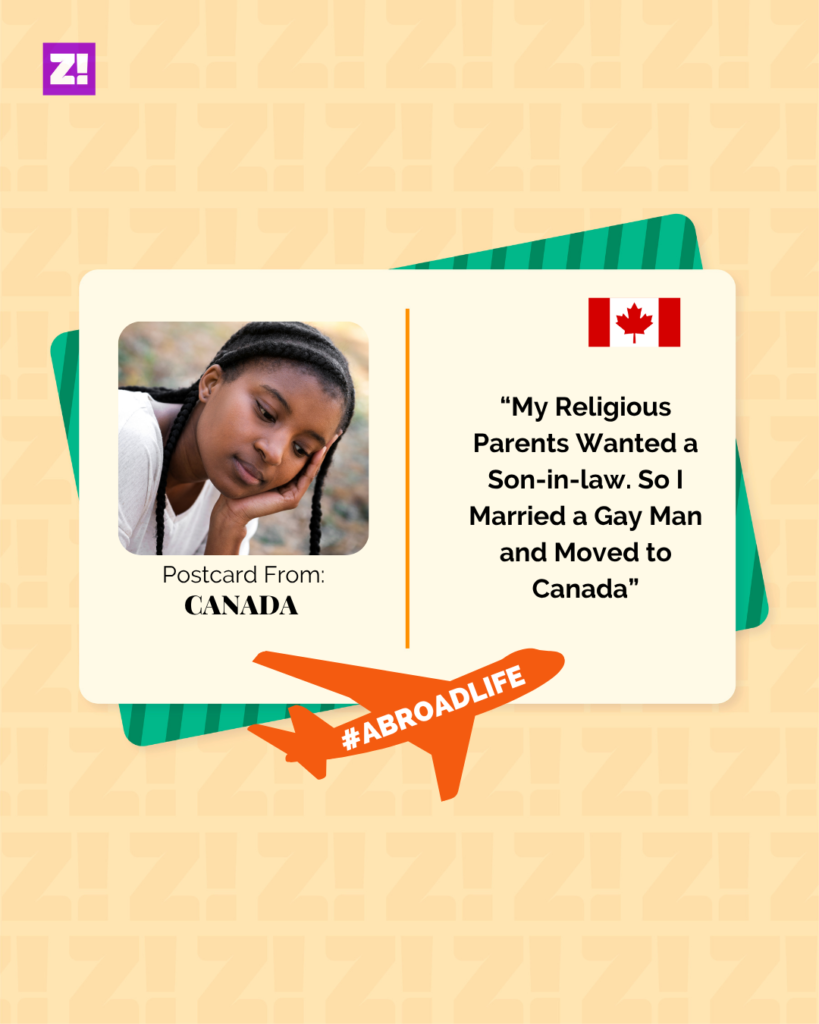
Fathia* (31) lived 26 years in a highly religious family, pretending not to be queer and agnostic. But when her parents started pressuring her to marry a nice Muslim man, she knew she had to escape. In this story, she shares how she entered a lavender marriage and escaped Nigeria.
Where do you currently live, and when did you move out of Nigeria?
I currently live in Canada. I moved out of Nigeria in 2023.
What made you want to leave the country?
I’ve always wanted to leave Nigeria and explore other places, mostly because I never really felt like I belonged there. I’m agnostic, and I come from the northern part of Nigeria, where my parents and really, most of my family are very religious Muslims. It felt like the only way I could truly be myself was to leave that environment.
Can you tell me more about your life in Nigeria?
I already had my BSc before I left, so I was settled academically. Socially, I’m introverted, so I kept a small circle of close friends. I was very picky with friendships because I knew my life choices weren’t typical. Being agnostic in such a religious environment meant I constantly had to pretend to be someone I wasn’t, especially at home. And it didn’t help that I had to live with my family even though I didn’t want to.
Did you ever consider moving out?
In the north, you’re not really allowed to move out until you’re married, so I had to live with my parents. And as an introvert who’s always home, that meant I never got the time or space to be myself truly. My supposed “alone time” was spent pretending. It was exhausting, and I had spent over 20 years pretending already.
You grew up in a Muslim household; when did you realise you were agnostic?
That was around 2019. I’ve never told my parents. They’re extremely religious. Even when I casually question a religious idea, they get super defensive. I don’t think I’m ready to risk my relationship with them over it, so I’ve kept it to myself.
That’s tough. How did you end up leaving the country?
I had a friend who’s a lesbian, and she was under a lot of pressure to get married. She once told me about lavender marriages, which are marriages of convenience. At the time, she was considering it with a gay guy she met.
I initially did not consider the arrangement, but I also started feeling serious pressure to get married sometime later. The pressure was so intense it it started affecting my mental health.
Given my lifestyle and beliefs, I knew that my parents wouldn’t make it easy even if I met someone I liked, especially if they weren’t from the north. And truthfully, I hadn’t met anyone with my mindset in northern Nigeria.
Unable to deal with the pressure, I contacted that friend and asked about the guy she was considering for the lavender marriage. I learned that it didn’t work out for her, so I asked if she could connect me with him, and she did. We talked, discussed expectations, and it made sense.
He lives in Canada, and we agreed to support each other while living our separate lives. My parents really liked him because I didn’t inform them of his sexuality, and his parents accepted me, too. If my parents knew the full details, they definitely wouldn’t have accepted it. Everything went smoothly, and that’s how I moved.
Do you and your partner identify similarly in terms of sexual orientation?
Sexuality is kind of fluid. I used to identify as bisexual, but now I’d say I’m more heteronormative. I mostly lean towards men, but occasionally feel romantic attraction toward women.
Was it hard to leave home?
That’s complicated. I’ve never been the kind of person who misses people deeply, maybe because of my introversion. Eventually, I started missing more of my friends than my family. I talk to my family often, but with friends, the distance hit me.
How did it feel settling into Canada?
It was liberating, but also challenging. On one hand, I was finally free to be myself. On the other hand, I struggled with building a social life here. I got depressed for a while, partly because of the significant life changes I had made and partly because I didn’t have friends. But I made an effort to put myself out there, joined community activities, and now I have great friends. I’m even dating someone now, so things are much better socially.
That’s amazing. Does Canada meet your expectations, or are there other countries you’d still like to explore?
Canada has mostly met my expectations, except for the job market, which has been rough. Overall, the experience has been close to what I imagined. The job market is a broader issue here. It has been awful since around 2023. A lot of people I know are struggling to find work, too.
I’m sorry about that. What are the best parts of living in Canada for you?
The freedom. Social services are here to support you in different ways, and the diversity here is impressive. Healthcare is decent, too, but it has its issues. For example, getting assigned a family doctor or psychiatrist can take months, unlike in Nigeria, where you can just walk into a private clinic if you’re desperate; things are slower here unless it’s an emergency.
Is there anything you still miss about Nigeria?
I really miss the food. In Canada, I have to plan and search for Nigerian food or cook for myself. Back home, it was so easy to get whatever you were craving. Also, everyone’s busy, so even when you have friends, you have to schedule and plan just to see them.
On a scale of one to ten, how happy would you say you are in Canada, and why?
I’d say a seven. I finally have my freedom. I’m getting to experience adulthood in a way many northern Nigerian girls don’t. Going from your parents’ house straight into a husband’s house is the norm back home.
Even though it’s not always fun to be by myself here, it’s necessary. I’ve grown so much and learned about different cultures. Most importantly, I get to be myself, and that’s a significant source of happiness for me.
Do you want to share your Abroad Life story? Please reach out to me here. For new episodes of Abroad Life, check in every Friday at 12 PM (WAT).