The Nigerian experience is physical, emotional, and sometimes international. No one knows it better than our features on #TheAbroadLife, a series where we detail and explore Nigerian experiences while living abroad.
Melody (27) got interested in Korean culture through K-dramas and K-pop. That fascination led to a master’s scholarship in South Korea. In this story, she shares the experiences, difficulties, culture shocks, how three years in Korea have changed her, and how she misses Nigeria’s signature chaos.
Where do you currently live, and when did you leave Nigeria?
I currently live in South Korea. I left Nigeria in 2022.
What inspired you to leave?
I came here to do my master’s.
But why South Korea?
I have been interested in South Korea for a very long time. Of course, it started through K-dramas and K-pop. I found the language fascinating, and I started studying it.
I decided I wanted to pursue a master’s in International Studies with a focus on Korean Studies. And where better to do that than in Korea? So I started looking at study opportunities and got a scholarship.
Was that your first time leaving Nigeria?
Yes, that was the first time I ever left Nigeria.
What was it like arriving in this country that you’ve been fascinated with for so long?
It was like a dream come true. I was very happy. There were a couple of minor niggles, but I feel like the happiness overshadowed any negatives.
I lived in Nigeria for the first 24 years of my life, and staying here in Korea for just three years has completely changed the way my brain works. Getting to see how effective things can be in terms of transportation and quality of life is eye-opening. I’m not trying to throw Nigeria under the bus, but it’s just so different.
I visited Nigeria last year, and I was shocked by the state of the airport. But regardless of its shortcomings, going back to Nigeria always warms me. Here in Korea, it sometimes feels like nobody cares about you, but Nigerians are friendlier. I’m not saying Koreans aren’t friendly; they need to have a reason to talk to you, like being in the same school or going to the same church. I don’t even really know my neighbours yet.
It’s a bit different from older Koreans, though. They are more approachable and more willing to engage in conversations with strangers, unlike the younger ones, who will never approach you first. If you do approach them, though, most of the people I’ve met are really nice.
Anyway, I realised I missed the people in Nigeria. Even the food. I really missed yam. And to an extent, I would say I miss the small gbas gbos that happen in Lagos. My first time on a bus when I got back, they started fighting in the bus and I was just like, “I have missed this.” Everything is so calm in South Korea.
Were you fluent in Korean when you first arrived?
No, I was not. I’d done a bit of self-study before coming. I had also taken classes at the Korean Cultural Centre in Abuja. But I still experienced a bit of a language barrier when I first arrived.
The first year of my scholarship programme included one year of Korean language training. But most of my classmates are also foreign nationals, so we would communicate in English.
The language barrier really became a problem when I actually started my master’s. It’s one thing studying the language, it’s another thing studying in the language. Sometimes I felt like crying during my first semester. I had to do extra studying because I’m basically translating from Korean to English and then trying to understand it back in Korean. It was really difficult for me at first.
Aside from academics, how did the language barrier affect day-to-day life?
It wasn’t a problem. My understanding of the language was enough to get through daily life easily. Also, the country is set up so you barely have to speak to anyone to get anything done. And even if you do, and you’re missing some vocabulary to say what you want, there are translation apps you can use.
How was the experience settling in socially?
I’m not very good at making friends. So most of the friends I made were either schoolmates or from church. There were other Nigerians who got the same scholarship, and we made a group chat and tried to stay connected. That made it easy to feel settled.
What are your plans for the future?
I don’t have any plans set in stone. I’m currently job hunting, but I’m also considering pursuing a doctorate degree. I’m just trusting God’s guidance and instruction for my life.
What would be an ideal job for you?
I’ve been applying for roles in marketing, social media management, and overseas sales. But I’m open to any job that fits my skills.
Do you see yourself returning to Nigeria permanently at some point?
Nigeria will forever be home to me. I have family and friends in Nigeria. But about coming back to settle permanently, I honestly cannot say right now. Of course, I’ll always visit.
How do you have fun in South Korea?
Well, I got interested in swimming, so I’ve started taking swimming classes. I also go to the gym. Or sometimes I’ll go to a café. I like going to the beach, visiting museums, and sightseeing. But I think my favourite fun activity is travelling. I really love travelling. Apart from the actual travel, I even love just planning trips.
When you say travelling, do you mean within South Korea?
Within Korea and also trips out to other countries. Being in Korea has given me opportunities to travel that I never had in Nigeria. From here, it’s much easier to get visas, especially to other Asian countries.
Interesting. What countries have you visited?
I’ve been to Thailand, Vietnam, Malaysia, the Maldives, and Qatar.
Nice. Which was your best trip?
I went to Malaysia and the Maldives on the same trip. In 2024, when I started taking these trips, I went as part of a group, but on this trip, it was just a friend and me. It was sort of a vacation, and we did a lot of activities. We went island hopping, did water activities like snorkelling, and visited museums. The Maldives was so beautiful it felt surreal. I’d never seen bodies of water look that clear. That trip was just so fun, I can barely express it in words.
The Qatar trip was interesting too. It was my first solo trip, so I was a bit worried, but it ended up being great. On my first day, I went on a safari trip, and I met some Nigerians and people from other countries, too.
Sounds like you had a great time. What culture shocks did you experience when you first arrived in South Korea?
I did a lot of research, so I was already quite familiar with the culture before I came here. But a few things did surprise me. For example, timing, let’s just say I was used to “African time.” If an event is scheduled to start at 2 PM, I’m aiming to get there at 2:30 or even 3 PM. But it’s not like that here. If they say it’s 2 PM, it’s starting at exactly 2 PM.
Another shock was the weddings. Back in Nigeria, when you attend a wedding, you know that’s all you’re doing for that day. Here, they have strict time slots for the weddings, so it’s very short, very quick. But what I find most fascinating is the gift-giving. They don’t buy gifts; they just give money.
They have these counters, and as you come in, you go there, put the money in an envelope and hand it over to the people there. Then they’ll give you a ticket. If you don’t gift money and get the ticket, you can’t eat at the wedding. It’s very different from how we do weddings in Nigeria. But I think I prefer the system here, because the newlyweds can use the money to buy whatever they need.
One more shock was the public displays of affection (PDA). There is a lot of that here, and I feel the K-dramas lied to us about that. You don’t see a lot of it in those shows. The main characters might not kiss until the very end. But coming here, I was like, you guys should get your room. What’s wrong with all of you?
You sound like you’ve had an amazing time in Korea, but what has been your worst experience?
I was once hanging out with a Korean friend and another friend from Myanmar. We were at a mall, and we saw this massage chair open for use. Before we walked up, we saw a white couple testing it. And when we got there, they told us foreigners weren’t allowed. We pointed out that we had just seen two foreigners test it; they appeared to relent. They let my friends test it, but when I wanted to, they wouldn’t let me.
I still think about that experience once in a while.
Sorry that happened. Have you experienced other instances of racism and discrimination?
Nope. But to be fair, I’m a really open-minded person, and unless it’s really in my face, I wouldn’t notice stuff like that.
Okay. What has been your best experience so far?
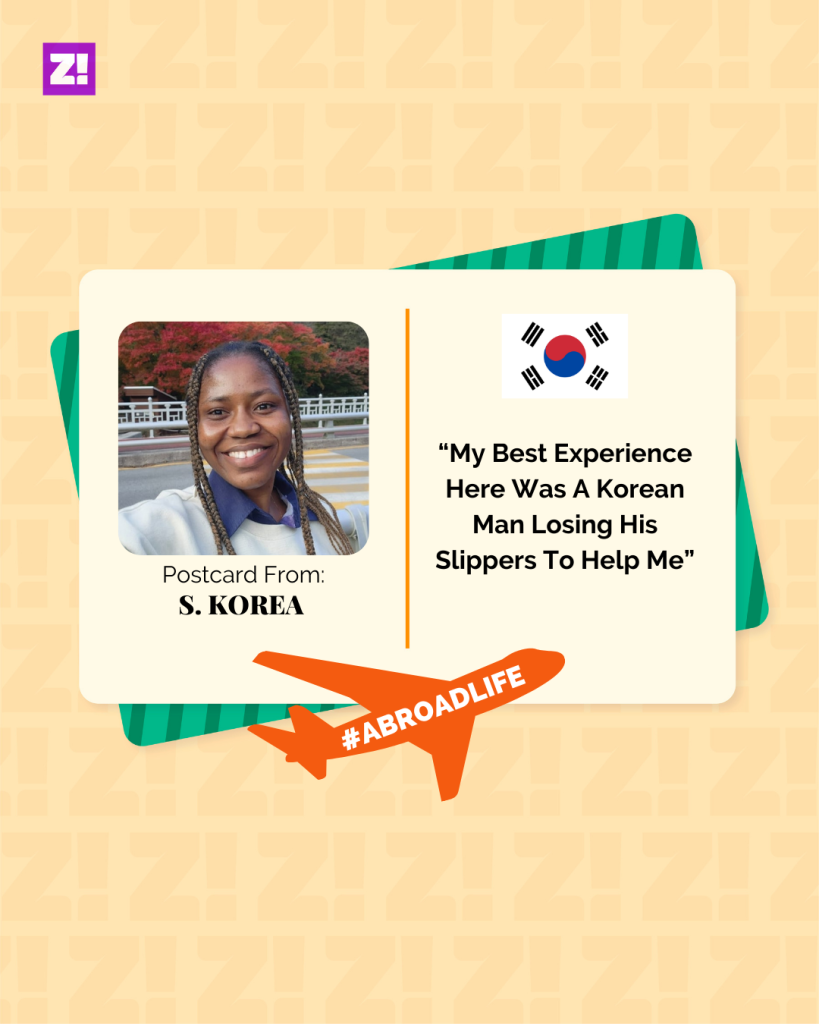
I’ve had a lot of great experiences. I could start from the day I arrived here. I left Nigeria with one wheeled travelling bag and one Ghana-must-go bag. When I arrived, I had to catch a train. Going to the train station, I had difficulty dragging the Ghana-must-go while wheeling the box. And a Korean woman just came and assisted me in dragging the Ghana-must-go until I got to the elevator taking me down to the boarding platform.
When I got out of the elevator, the train was almost leaving. An older couple saw me struggling and came to help. The man was running and dragging the Ghana-must-go until he lost his slippers. It all just felt so welcoming. Like that was literally my first day in Korea, and people were helping me like that. That was a very memorable experience for me.
On a scale of one to ten, how happy are you in South Korea, and why?
I think I’m going to give it seven. Ten is for God, nine is for me… I’m just joking.
I’m going to give it a strong eight. My life here is way better than it was in Nigeria. Even in terms of opportunity.
I love the travel opportunities being here has given me. And South Korea has literally been a home away from home for me. Most people I’ve met here have been welcoming. Life here is not that hard. Things work. There’s constant electricity, transportation works, healthcare works, and so does everything else. It’s not a ten yet because I’m still searching for a job.
Do you want to share your Abroad Life story? Please reach out to me here. For new episodes of Abroad Life, check in every Friday at 12 PM (WAT).
Before you go, help us understand how you and other young people feel about the 2027 general elections by taking this 10-minute survey.
Click here to see what other people are saying about this article on Instagram