The Nigerian experience is physical, emotional, and sometimes international. No one knows it better than our features on #TheAbroadLife, a series where we detail and explore Nigerian experiences while living abroad.
Adedotun (27) left Nigeria for the UK in 2023 to pursue a master’s degree. In this story, he shares how he worked as a bartender, waiter, steward, and cleaner to keep up with bills while studying, and how the UK now allows him to work at a higher level as a software engineer than he could back home.
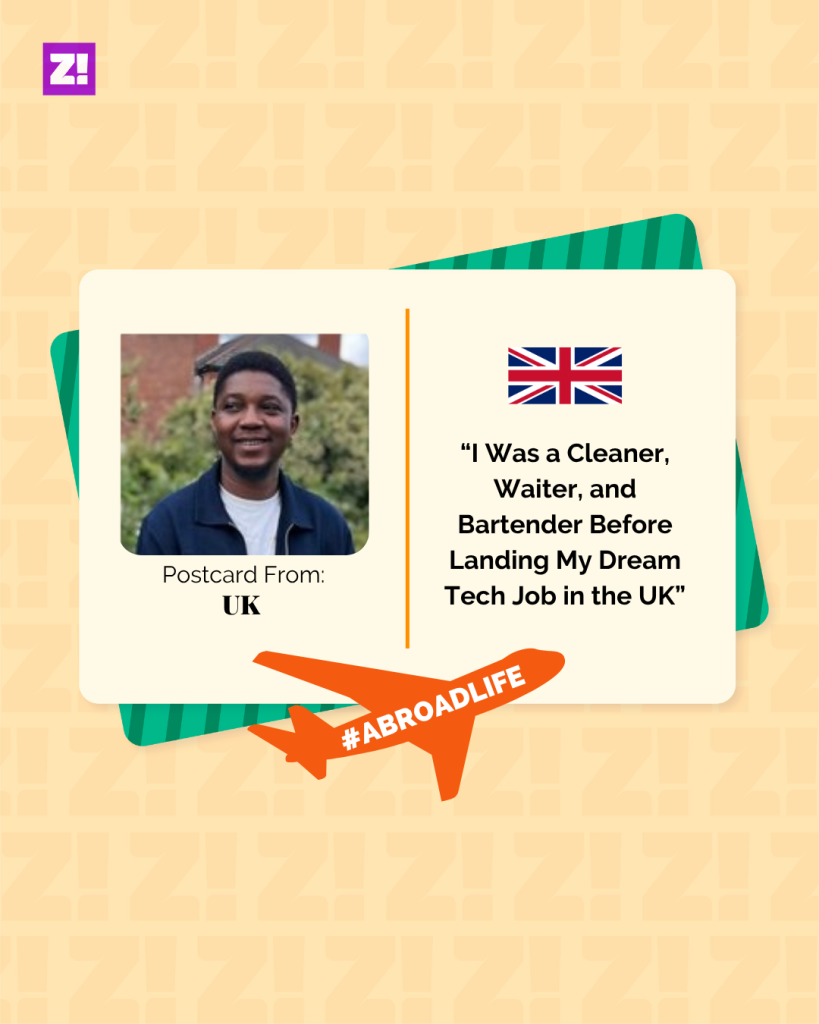
Where do you currently live, and when did you leave Nigeria?
I live in Scotland now. I left Nigeria in 2023.
What inspired you to leave?
Leaving Nigeria was always part of the plan. When I was in secondary school, my elder brother travelled after his National Youth Service, and he’s now a Canadian citizen. The idea was for me to follow a similar path.
I considered Canada like my brother, but I eventually chose the UK because it’s closer to Nigeria.
So how did you travel?
I got admitted to a master’s programme. I was already applying to schools during my youth service. I got multiple offers and accepted the one from the University of Salford in Manchester.
I was supposed to resume in September but deferred till January. I finished service in June 2022 and left Nigeria in January 2023.
What was it like when you got to the UK?
Luckily, I had a support system waiting for me in Manchester. My dad did his doctorate at Salford, so he had friends there. I also have a distant uncle who lives in Manchester. So I already had a small community to support me, and I’m really grateful for that.
I’m also grateful that my parents could pay my school fees in full and cover my rent for the first six months. But I knew I had to get a job because after that, I’d need to start paying my bills myself.
How did you manage that?
A family friend showed me how to apply for part-time jobs. When I saw the types of jobs available, I was hesitant. They were mostly in hospitality or care; in Nigeria, I was already working professionally as a software engineer, so I wanted to continue doing that in the UK.
But as a student, you can only work 20 hours a week. You can’t take on a full-time job. Sadly, I couldn’t get a part-time software engineering gig.
After several rejections, I accepted my reality and applied for hospitality jobs.
What kind of jobs did you do?
I was a waiter, bartender, cleaner, and steward.
Wow. That’s a lot. So how did that work?
There are job agencies with apps you can download. You basically pick different shifts during the week. It’s first come, first served, so once the shifts drop, you have to be fast to grab the ones you want.
Like I said, you can’t work more than 20 hours on a student visa, so you’re just trying to stack shifts without crossing that limit. You might do eight hours bartending, five hours stewarding, three hours cleaning, and four hours waiting tables—all in one week. Just make sure it doesn’t go past 20 hours.
What was it like doing these jobs?
Bartending was the most fun. I don’t drink, but it was nice learning how to mix drinks and pour a pint of beer. There’s an art to it, and I enjoyed learning that.
I also got to meet lots of people. The job involves a lot of talking, and I really enjoyed the conversations.
Stewarding was mostly standing. Funny enough, even though those shifts were the shortest, I always felt more exhausted after them.
I was on my feet a lot while bartending, but I was moving around. With stewarding, you’re just standing in one spot, and that felt more straining to me.
You meet people too, but there’s less time to chat because you’re focused on the crowd. You’re scanning tickets, doing crowd control, and sometimes giving directions, which was hard for me because I didn’t know my way around well enough yet. You also have to stay alert because of the security aspect. We got training on how to spot suspicious activity.
Stewarding was a mixed bag. I still remember scanning tickets in the cold for so long that when it was time to sign out, my hands were trembling so much I couldn’t write my signature.
I only did the cleaning job twice. The second shift was wild. The place was so dirty, so messy, I don’t even have the words to describe it properly.
It was supposed to be a four-hour shift, but we spent seven hours and still couldn’t get the place spotless. When I got home, I just lay down and started thinking about my life. I asked myself, “What did I actually come to this UK to do?”
But it was an eye-opener. I always knew it, but that experience really helped me internalise that there’s dignity in labour. So when I was doing those jobs, I wasn’t sad. I knew it was temporary. I just had to hold on till I finished school, then I could chase the career I really wanted.
So what do you do now?
I’m back to working as a software engineer.
To finish my master’s, I had three options: internship, entrepreneurship, or dissertation. I chose the internship route because I wanted UK work experience. Luckily, I landed an internship with an amazing company. It was unpaid, but I was just happy to have something solid to put on my CV.
Even after I graduated, I asked the CEO if I could keep working unpaid until I got a job. He agreed. Eventually, I got my current job, which moved me to Scotland, where I live now.
So you’ve worked as a software engineer in Nigeria and the UK. Can you compare the experiences?
Working in the UK is way better. Here, there are proper processes and standards.
In Nigeria, I worked with some cool startups, but I also had some rough experiences.
I remember telling a CEO I worked for that I’d just lost my sister and my brother was in intensive care, so I wouldn’t be able to work for a few days. He told me to use work as a distraction instead.
There are a lot of founders in Nigeria who aren’t genuine. They’ll say they want to build a fintech app to change the world, but really, they just want to make quick money. They’ll stress you, have you working day and night, barely sleeping. But when it’s time to pay, they start telling stories.
But I also met some great people. So I’m not saying the whole startup scene in Nigeria is bad. It’s a mix. You meet amazing people, and you meet people who just want to use you.
In the UK, you don’t see things like that because there are actual rules and regulations. You can’t just talk to someone anyhow. If you mess with someone’s mental health, they can sue you or report you to a regulatory body.
So it’s not that the people here are just good people; it’s that even if someone wanted to be bad, they can’t afford to. The system here holds people accountable.
There was a time when I finished a task and messaged my CTO around 2 a.m. to say I’d just wrapped it up. He was awake and replied, “Oh, thank you. Please get some sleep.” He hadn’t asked me to work that late; I just wanted to finish it. But he still told me to rest. That’s the kind of difference you see here.
Do you plan to live in the UK permanently, or is there a possibility of coming back to Nigeria?
Even if it’s not permanent, I’ll be here for a long time. I want to establish myself professionally, and for that to happen, I need an environment that doesn’t slow me down.
In Nigeria, I’d have work to do, and the internet would be down because the telecom companies are unreliable. Sometimes there’d be no light, and once my laptop battery dies, that’s it.
Here, I don’t have to worry about those things. And those little things add up to make a huge difference. The environment here allows me to push myself and work at a higher level than I could in Nigeria.
It’s not easy being away from your family, the people you’ve lived with your whole life. But I’m trying to be more intentional about seeing them.
I really miss my parents. My dad and eldest brother visited in 2024 for my graduation, but I still miss them. I haven’t been back to Nigeria since I moved.
It helps that we talk often. My mum calls me every morning and evening without fail. I speak to my dad and brothers every week. But I’m working towards going home soon to see them.
There’s been a rise in anti-immigration sentiment in the West. Does that make you feel uncomfortable?
Yeah, it does. Sometimes it’s upsetting. But I think about the people around me; the locals I know here are fine. I don’t get bad vibes from them.
It’s the stuff in the news and on social media that’s disturbing. There’s so much misinformation. You hear people saying the government is giving immigrants apartments while citizens are waiting for social housing. That’s just not true.
Immigrants here aren’t entitled to public funds. So when you see immigrants in nice houses, it’s because they worked hard to get them.
They say immigrants are taking their jobs. How? You apply, I apply. We go through the same interview process, and the best person gets the job. And there are even jobs, like care work for example, that you mostly see immigrants doing because the citizens don’t want to do them.
Recently, they’ve been talking about making the rules stricter and making sure immigrants speak English before coming in. That’s part of the misinformation. If you’re coming for school, you already have to prove you were taught in English. If you’re coming for work, you write the IELTS exam to get visa points.
So why are you saying you’ll enforce something that’s already in place? Why are you saying immigrants won’t be entitled to benefits when we were never entitled to them in the first place?
Unfortunately, a lot of politicians don’t bother correcting the misinformation because they want to use public sentiment to get votes.
That’s really unfortunate. Let’s lighten the mood. What kind of activities do you do for fun?
I’m not really an outside person. I mostly play video games or scroll through social media. But one time, I decided to be intentional about having fun. I invited my colleagues over and cooked for them. I also go bowling sometimes. But yeah, I’m mostly indoors.
What culture shocks did you experience when you moved to the UK?
The Scottish accent threw me off at first. It’s very different from the regular English accent.
I don’t know if this counts as culture shock or just how things work in a functioning society, but it took me a while to stop feeling like if I didn’t buy something immediately, the price would go up next time. I’ve realised that’s just a Nigerian thing.
Another shocker was the food; UK food is bland. They don’t use spices like we do in Nigerian food, so I play it safe and cook most of my meals myself.
I knew the winters were supposed to be cold, but it was still colder than I expected. I arrived in January 2023, right in the middle of winter. My mum gave me a really good winter jacket, but I had this suede jacket I loved.
So when I first arrived, a friend was taking me to the bank to set up my account, and I wanted to show off, so I wore the suede jacket. I couldn’t believe the cold that hit me that day. Since then, I’ve been using the winter jacket.
Oh, and another shock: banks are open on Saturdays.
Let’s talk about highlights and lowlights. What have been your best and worst experiences in the UK?
My worst experience was definitely the cleaning job.
My best experience was graduating with distinction. Another high point was getting my job. That period was tough, so I was really happy when it came through.
I’d gotten loads of rejections and done interviews that led nowhere. Funny enough, I thought the interview for this job didn’t go well, but it ended up being the one that worked out.
On a scale of one to ten, how happy are you and why?
I’d say eight. I’m finally doing the things I’ve always wanted to do, both professionally and personally. I’m exploring other interests like music and 3D animation. I just have more control over my life now. I feel free, like I can take my life into my own hands and make something out of it.
It’s not a ten because I’m still trying to break out of my current routine.
Do you want to share your Abroad Life story? Please reach out to me here. For new episodes of Abroad Life, check in every Friday at 12 PM (WAT).
Before you go, help us understand how you and other young people feel about the 2027 general elections by taking this 10-minute survey.
Click here to see what other people are saying about this article on Instagram