The Nigerian experience is physical, emotional, and sometimes international. No one knows it better than our features on #TheAbroadLife, a series where we detail and explore Nigerian experiences while living abroad.
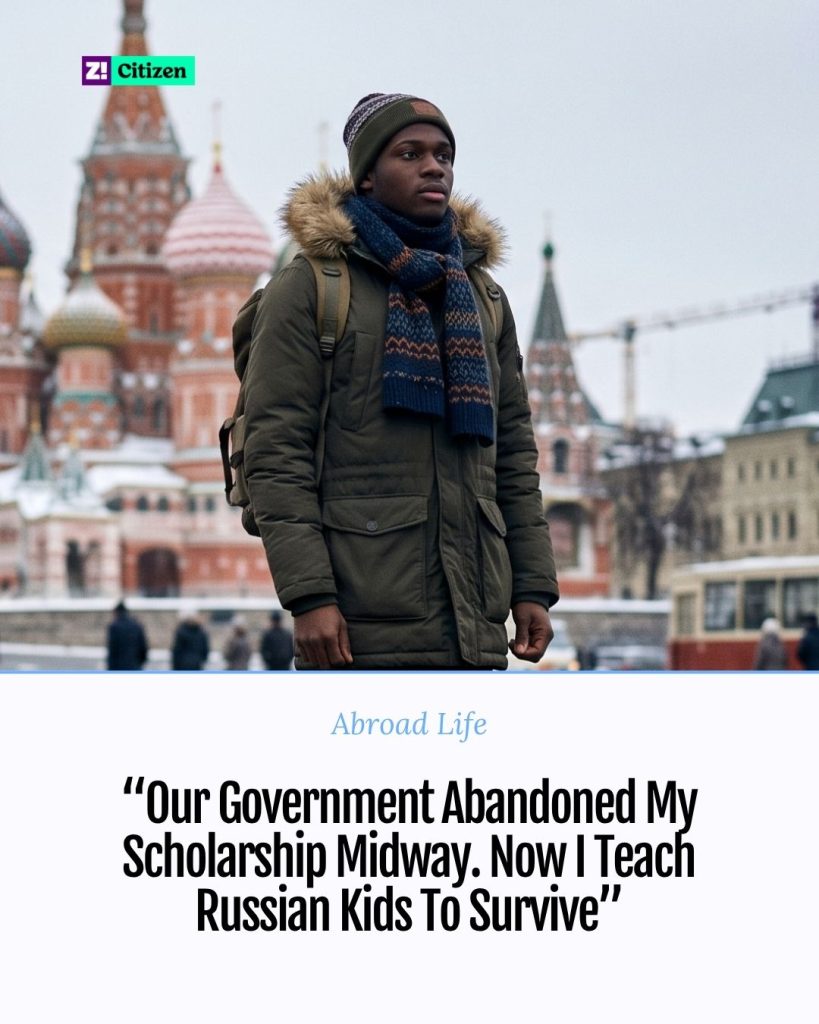
Kelechi (21) left Nigeria at the end of 2023 on a fully funded scholarship to study medicine in Moscow, only for it to be discontinued. In this story, he compares life in Russia to Nigeria and shares how he makes ends meet after being left financially stranded by the Nigerian government.
Where do you currently live, and when did you leave Nigeria?
I live in Moscow, Russia. I left Nigeria in late 2023.
What inspired you to leave Nigeria?
Honestly, I didn’t have a particularly strong reason to leave. I just got an opportunity, and I took it. I had already gained admission into the University of Lagos (UNILAG) to study medicine, but then the scholarship for Russia came through, and I chose that instead.
How did you get the scholarship?
It was a government scholarship—a bilateral education agreement between Russia and Nigeria. Russia covered the tuition in full, and Nigeria was supposed to handle transport and upkeep for the duration of the studies.
However, the programme is officially dead as of 2026. They’ve cancelled it and issued official press releases saying they won’t be accepting new applicants. Those of us already here can finish our studies since the Russian government handles tuition. But the stipends for upkeep from Nigeria have basically stopped.
They picked students from each state, and selection was based on their grades in the West African Examination Council (WAEC) exams.
So, what were the first few weeks in Moscow like?
The weather hit me hard. I wasn’t prepared for it. We were warned that the temperature went to negative figures, but knowing and feeling are two completely different things. It was my first time seeing snow, my first time experiencing that kind of cold. It was almost painful, but eventually, I got used to it.
The other thing was how individualistic everyone is. People just mind their business. They respect each other’s space and just get on with their lives. Coming from Nigeria, that’s very different.
What about the language? How did you get around that?
So, the government actually accounted for that. None of us spoke Russian, so we were enrolled in a mandatory one-year Russian language programme. Nine months of actual instruction and three months of summer break. It was after that year of Russian studies that we started our first year of university. It wasn’t optional; you had to do it. I speak above-average Russian now.
When you eventually started university, what surprised you most about the academic environment?
The lecturers, honestly. Some of them actually love their jobs, and you can tell. It’s not hard to reach them; their email addresses and contact information are accessible, and they’re willing to help. The resources are also on another level compared to what I expected coming from Nigeria.
In Nigeria, access to a cadaver is a big deal—like a once-in-a-blue-moon situation. In Russia, we have cadavers, 3D life-size anatomical models, robotic parts, AI-assisted abdominal models, and photo-realistic brain models. When we studied rat anatomy, every single student got their own rat brain to dissect. Every student got their own histology specimen. In physiology, we had Electrocardiogram (ECG) machines and heart rate monitors that everyone could use.
The class sizes are capped at 20 students, so there’s always enough space and resources for everyone.
When are you expected to graduate?
If things go according to plan, 2029.
Does the scholarship have any academic performance requirements?
Yes. Your GPA cannot fall below 3.0. The Russian government is paying your tuition, and it’s not cheap; it is about ₦20 million. So if your grades drop below that point, you get expelled and lose your student visa. You’ll need to leave the country.
Are your classes taught in Russian or English?
I study in Russian, but some students in the programme study in English; it depends on what you choose.
Let’s talk about money. What did the Nigerian government stipend look like?
The programme had been running for over 15 to 20 years. I heard from people who have been here for a while that they originally got a consistent $500 monthly stipend. But as Nigeria’s economic situation worsened, the payments began to decline.
By the time I got there, they’d unofficially cut it by about 60 per cent, and it wasn’t just the amount; the frequency dropped too. Instead of monthly, they were paying every six months, every eight months, sometimes once a year, and even then, it was almost never in full.
In my first year, they paid us in full, the stipends for all twelve months, all at once. After that, it was less and less frequent until they stopped altogether. At this point in 2026, I’m not expecting any more payments; that’s just my honest read of the situation.
Is $500 a month even enough to live on in Moscow?
If they paid it properly and consistently, it would be doable. You’d still have to be very disciplined with money, though. You can’t be careless, eating at restaurants every week, but it’s manageable for a student.
The problem is that as they reduced it and made it irregular, it became nowhere near enough. It began forcing people to take on extra work to make ends meet, which in turn started affecting academics, which is the main reason we’re here.

The Naira Life Conference is returning on August 22, 2026, in Lagos! Come learn from finance experts and industry leaders, and partake in unfiltered conversations about building wealth and diversifying your income stream in a country like Nigeria. Real stories, expert advice you can actually use, and a community ready to build wealth together. Secure your spot here.
That’s so sad. So, what kind of jobs were students taking on?
Restaurant jobs, delivery, call centres, your typical part-time stuff. But the one I’d say is the most useful, and the most viable for Nigerians specifically, is teaching English. Almost every Nigerian can teach English, and if you pick up enough Russian to communicate, you can teach English to Russian kids and actually make money. That’s what has worked for me here.
And how do you balance that with medical school?
The balance is almost non-existent. Medical school doesn’t give you that kind of breathing room. Some people work just enough hours to cover the minimum for the week and keep their grades intact. Others sacrifice academic performance to work more and be more comfortable. It’s a choice nobody should have to make, but that’s where we see ourselves now.
Has the Russia-Ukraine war had any impact on your daily life in Moscow?
Not really. The war is in Ukraine; it’s not something you feel in Moscow the way people outside might imagine. The scholarship programme itself didn’t end because of the war. Other countries that also have issues with Russia are still bringing students in. It’s purely Nigeria’s situation that ended our programme.
The one thing I’ll say is that the cost of living has gone up a bit. Meat, for example, used to be really, really cheap here; now it has tripled in cost. Milk too. But these are not life-threatening changes. We can still afford to eat. It’s just not as cheap as it used to be.
Have you experienced racism in these three years?
I feel like racism is non-existent in Moscow. I think bias exists everywhere and in everyone. But Moscow is a proper metropolis. There are enough Africans who have lived here long enough that the locals are used to having us around. You’re not a new thing; you’re on the same level as everyone else, and that’s how they treat you.
The only time you feel any kind of friction is when there’s a language barrier. If you can’t communicate with someone as well as they’d like, that creates awkwardness. But that’s a language issue, not a race issue.
After your studies, do you see yourself coming back to Nigeria?
Of course. Nigeria is my country. I love home. After I graduate, I want to come back and contribute by using what I’ve learned here to do something useful back home. But that doesn’t mean I’m closing the door on Russia either.
If I can get documents like the Vid na Zhitelstvo (VNZh), which is like a permanent residence card, that would let me move freely between both countries, I’d want to do that. I’m keeping all my options open. But home is home.
On a scale of one to ten, how happy are you in Moscow?
I’d say a nine. It’s a modern city with working infrastructure and an incredible transport system. If the train app says you’ll be somewhere in two hours, you’ll be there in exactly two hours. It has everything: good education, flexible work, opportunities, and new experiences. The only reason it’s not a ten is the war.
Do you want to share your Abroad Life story? Please reach out to me here. For new episodes of Abroad Life, check in every Friday at 12 PM (WAT).
Click here to see what other people are saying about this article on Instagram