The Nigerian experience is physical, emotional, and sometimes international. No one knows it better than our features on #TheAbroadLife, a series where we detail and explore Nigerian experiences while living abroad.
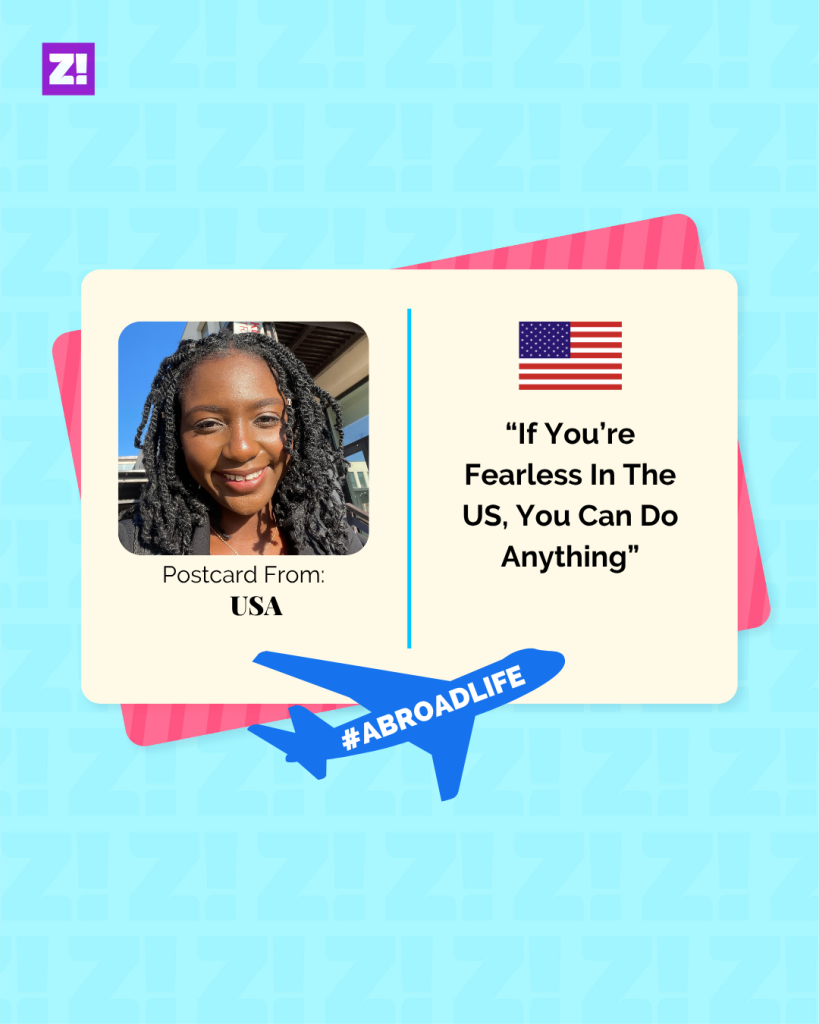
Aladi Akoh (30), a Nigerian data engineer and YouTuber, moved to the US in 2018 after two visa denials. From three tries at a H-1B visa to dating, marriage, culture shocks and homesickness, she shares the highs and lows of her life abroad, and how she has learned to live fearlessly in the US.
Where do you currently live, and when did you leave Nigeria?
I live in the United States of America (US), and I left Nigeria in 2018.
What inspired you to leave?
I wanted to get a master’s degree abroad. I actually wanted to go to France at first. I did my bachelor’s degree in Benin Republic, and France felt like the natural destination for my master’s degree. That was where most of my coursemates were heading. So I applied to universities in France, but also to other countries, including the US.
I got an offer from the US for a Graduate Teaching Assistantship (GTA) with partial funding for my tuition and a stipend. I liked the offer, so I accepted it, and that was how I ended up in the US.
But it was not as easy as it sounds.
How so?
Well, first of all, I was denied a US visa twice, so it was on my third attempt that I got it. I went to do my master’s, and as I was concluding my studies, I had to find a job that would sponsor a H-1B visa so I could remain in the country.
As an international STEM student, I had three years after graduation to get the H-1B visa, which is gotten through a lottery system that happens once a year. I had between 2021 and 2024 to get the visa. I started working in March 2021, but my company missed the window to submit my name for the lottery that year.
They registered me in 2022. I was not selected. Then in 2023, which was my final year before my time would be up, they put my name in again for the lottery, and I was still not selected.
However, the US government flagged some fraudulent applications, which opened up some opportunities, so they had an unexpected lottery. That was how I got my H-1B visa.
Incredible. What do you do?
I work as a data engineer. I am also a YouTuber. I discuss issues about immigration and life as an international student on my YouTube channel, basically sharing lessons and tips I have learnt from my own migration journey.
What has your experience in the US been like?
It has been bittersweet, to be honest. It is nice here, but being away from home is difficult. You miss home, the food, your family’s support—everything.
One of the things I really like about living in the US is how you can plan your day and it goes exactly the way you planned it. You can set up routines because you know everything just works. You know the train will be on time, you know other people will be on time. So if I plan something, I know that it is going to be that way.
I also enjoy meeting people from different cultures. I think the US is one of the most diverse places in the world. You can meet people of every nationality. I have met people from countries that I did not even know existed until I met them.
When I was in school, we used to have something called International Student Nights, where we would all come and socialise and share food from our respective cultures. It was there I had Thai food for the first time.
Interesting. Have you seen a lot of the country?
I have lived in South Dakota and Utah. South Dakota was where I went to school, and I relocated to Utah for work. But I have been to other cities in the US too.
Do you have a favourite city in the US?
I like Los Angeles. I love the beach life there.
Let us talk about Nigeria. Do you visit?
Absolutely. I am actually planning a surprise visit to my family in Nigeria, so hopefully I will already be there before this comes out. I last visited in 2023.
Is there a possibility of moving back to Nigeria at some point?
I had plans to come back when I was single, but now I am married, it is a decision for two people. We will see.
What would have to change for you to come back?
Healthcare in Nigeria. I really worry about healthcare in Nigeria. I have an eye defect, and I was going to eye clinics in Nigeria as far back as I can remember. I got my first pair of glasses in JSS1. All that while, none of the doctors there was able to diagnose me properly.
The first test I went for when I came to the US, I was diagnosed and referred to a specialist. I had a procedure earlier this year to reduce my eye pressure because if the pressure kept rising, I could go blind.
It made me think about people in Nigeria you will hear who just went blind suddenly, and I wonder if it could be a similar situation to mine, but they never get properly diagnosed and treated. So healthcare is a really big thing for me.
What lessons has migration taught you?
It has taught me many lessons. I think the most important lesson is around fear. I have learnt that fear just holds you back. I feel like in the US, if you are fearless, you can do anything.
I have also learnt to be okay with being told “no.” Personally, I used to fear rejection. Like when I was applying to different schools, it was a friend that advised me to apply for funding. So I emailed the professor in my college and asked if they had funding for international students. That was how he told me about the graduate teaching assistantship. If I had not asked, I would not have received.
So a major lesson for me is to always ask for things, even if you think you might be rejected. Do not shut your mouth—always ask.
There has been a lot of anti-immigrant sentiment in the West recently, especially in the US with Trump. Are you worried?
I think I have gotten to a point where I do not care anymore. I know some people have not gotten to the same place I have mentally because I have friends who are panicking. But I have told myself that my immigration status does not define me.
I was denied a US visa twice. It was on the third attempt that I got it. It also took three attempts to get my H-1B visa. I believe that if one path closes, you should go for the next path. So I think I am now numb to it all. I just take it one day at a time.
I remember when Trump made the announcement about H-1B being $100,000, I was out shopping and my husband texted me. I just texted him back that I would read it later and continued what I was doing. At this point, it feels like they say something new every day. So I have stopped caring. If they say we should go home, then fine.
What is your support system like in the US?
I have my husband and my amazing friends. Unfortunately, my friends live in different cities, but we are always talking on the phone. I also have my church as a source of support. I still communicate a lot with my family. We do family video calls, we have a group chat. Really, thank God for technology.
Congratulations on your marriage. But what was dating like in the US, especially compared to Nigeria?
In my opinion, Nigeria is the better place when it comes to dating. There are more organic and natural options in Nigeria. It was easier, to be honest. Men approach you in church, at work, everywhere. I think during my NYSC service year, that was when I got the most attention.
But I was not in the right headspace for that at the time. All my focus then was to travel out for my master’s degree. So I was not trying to tie myself down to anybody. I was not ready to be married, and I had really internalised that typical advice of not dating until you are ready to get married. I took it very seriously and I did not want to waste anyone’s time. So I did not really date intentionally until I was in the US.
And what was that like?
Well, I tried dating people on campus when I was in school. I had positive experiences, but nothing worked out. Then I tried dating apps.
I took it very seriously. My reasoning was that if it was a school I was applying to, I would take it seriously. So something as important as relationships and potentially marriage also needed to be taken seriously.
I paid for premium features on the apps so I had access to all the features. I set all my preferences. A number of the people I met through the apps did not turn into romantic relationships but actually good friends that I am still in touch with today.
I did meet one guy I dated, but it was not a good experience and I eventually got rid of all the dating apps.
What happened?
He cheated. After we started dating, he stayed on the apps. I found out because he was talking to a friend of one of my friends. It happened by accident. I showed her his picture and she was like, “Wait, I know this guy!”
Wow. So if you got off the apps, how did you meet your husband?
I went to a friend’s housewarming party and one of her friends approached me. She asked me if I was single and told me about her friend who was looking to date. She showed me his Instagram page.
I was reluctant because at the time I did not want any more relationship drama. But she still told him about me and he reached out to me on Instagram. And as they say, the rest is history. We got married about six months after we started chatting.
Wow. That quick?
I always had in mind what I wanted. And he checked most of the things on my list. When I talked to him, I was really attracted by his kindness and empathy. I also love how important family is to him because it is very important to me.
I felt at peace with him in a way I had not with all the other people I had dated. We share so many similarities so everything just felt natural. I did not have to explain myself too much—he just got me. So when he started talking about marriage, I did not feel any anxiety.
That is awesome. It seems you were both very intentional about marriage. So how are you finding married life?
It has been good. There are good days, and there are bad days. But overall, it has been good.
It is great having someone at home to welcome you after a long day. Someone to make you food, someone to calm you when you are angry, someone to just do life with.
That does sound great. What were the biggest culture shocks for you in the US?
Something I had to get used to here is calling everyone by their first name. You know how it is growing up in Nigeria, you call older people “uncle,” “auntie,” “sir,” or “ma.” I have gotten used to it now, but when I first came, it felt so strange having to call all these much older people by their first names.
Something I found very surprising was the rural areas in the US. The town I lived in during my master’s is a very rural town. I was shocked when I first arrived because it is so different from the areas of the US that are usually portrayed in the media.
But I have been to places like New York and Los Angeles so I understand the difference now. Those cities are usually the ones portrayed, but not all of the US looks like that.
I was also shocked by the amount of homelessness in the US. Then there is the food. They put too much salt and sugar in everything. I do not think I will ever completely get used to it.
Let us talk about highlights and lowlights. What has been your worst experience in the US and what has been your best experience?
My lowest point was when I was put on academic probation. I saw it coming. I knew there was a possibility it would happen because I took this four-credit course on robotics in my first semester and I knew nothing about robotics.
It was a rollercoaster of a class. The professor was really nice though. He supported me through it and everything, but eventually I was put on academic probation. Though I was expecting it, when I got the official letter, I shed tears.
Another low point was when I had to find a job. When I was about to conclude my master’s, I started feeling so stressed because you have to find a job or continue schooling. So if I could not get a job, I had to either go for a doctorate or go back home. Mentally, I knew I was not ready to do more years in school, so I just started preparing to go back to Nigeria. That was a really stressful time for me.
My best experiences were getting a job and then my H-1B visa. I got my job offer before my graduation and it felt so good. And after three tries, getting my work visa made me so happy. I think I called everybody in my life that day to share the news.
I really celebrated the work visa because it gave me the opportunity to travel back home to see my family.
That must have felt great. On a scale of one to ten, how happy would you say you are in the US, and why?
It is so hard to choose between seven and eight. Maybe I should go with seven point five. I would have said a nine or ten if we had our families here with us—my husband’s and mine.
I would love to have that support around us because I feel like life is more enjoyable with family around. But even just bringing them over to visit is so difficult with all the visa wahala.
I already talked about the food. I would love to have access to more diverse options, but that probably has to do with the city I live in. I also worry about the gun laws here. You hear the news of school shootings and you realise that it could be your own child. That scares me a lot. So these factors are why I cannot give it ten.
Do you want to share your Abroad Life story? Please reach out to me here. For new episodes of Abroad Life, check in every Friday at 12 PM (WAT).
Click here to see what other people are saying about this article on Instagram