The Nigerian experience is physical, emotional, and sometimes international. No one knows it better than our features on #TheAbroadLife, a series where we detail and explore Nigerian experiences while living abroad.
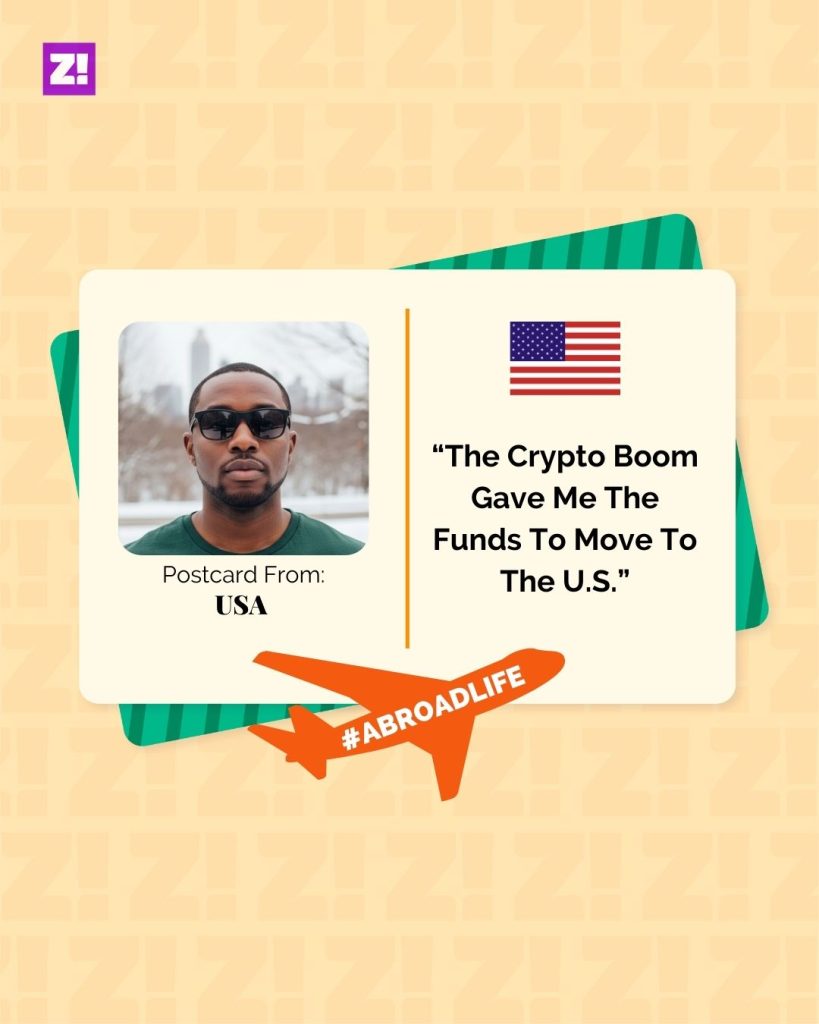
Timilehin* (30) left Nigeria for the US with just a desire for better opportunities and no long-term plan. In this story, he shares how trading cryptocurrencies gave him the funds for his trip and how he ended up in the US Navy.
Where do you currently live, and when did you leave Nigeria?
Currently, I live in Atlanta in the United States. I left Nigeria in 2021.
What inspired you to leave?
A friend I went to school with inspired me, and two other things served as a trigger, or push, if you would. While we were in school, my friend always said we should find a way to leave Nigeria so we could do our master’s abroad. It stuck with me.
After we graduated, we couldn’t make that wish a reality because we couldn’t afford it and weren’t doing much. I personally couldn’t get help from the family front because we didn’t have the money: My dad was a teacher, so going to school on his salary had been a struggle. I did all sorts of jobs to make some cash, including satellite TV installations, which I took on during my National Youth Service (NYSC) year.
All the while, the idea of going abroad for my master’s had stuck with me. But the trigger for leaving was the astonishing lack of opportunities. Even as a graduate, most of us couldn’t secure jobs with our certificates. The EndSARS protests capped it all off. Seeing the government kill so many young people and deny it, made us want to get out. So when we got the opportunity to do our master’s in the US, we took it. I wasn’t married and had no children or strong attachments other than my immediate family, so it was not a difficult decision.
How did you afford the move?
Around 2018 to 2019, crypto started blowing up. Some friends and I got into cryptocurrency, buying and selling Bitcoin and doing Non-fungible Tokens (NFTs). We started getting a little money, and it was that money we used to process our exams like the Graduate Record Examination (GRE), pay application fees, and fund the move abroad.
The money was really useful because, for an average Nigerian, it can be difficult to afford application fees, which can be in the hundreds of dollars. For someone struggling to eat, it’s a lot to spend on what is basically trial and error, because the schools you apply to may not admit you.
What was it like when you arrived in the US?
It wasn’t the smoothest experience. I had to spend my first days in a hotel, and it was so expensive; I was worried I was going to end up spending all the money I’d come with. Also, there were a lot of culture shocks.
What were some of these shocks?
First was the food, which was very different from what I was used to in Nigeria. They also have too many options, making it difficult to figure out their food.
Let’s say you try to get a burger. You would expect it to be straightforward. But you’ll say you want a burger and they’ll ask you something like if you want cheese. Okay, you tell them to add the cheese, then they’ll ask you what type. I didn’t even know there were different types of cheese back then. It just goes on like that, answering so many questions before you get your food.
Another thing is just how large the US is. It feels like most places are not close by. Everything is at least thirty minutes from where you are. Having a car is not a luxury; it’s just a necessity if you want to get anywhere. I got a bicycle that I used to ride around. But I guess I got too comfortable, and I wouldn’t lock it when I left it outside. One time, I travelled, and when I came back, it had been stolen. I found it surprising because it wasn’t even an expensive one. It cost about $70, so I didn’t expect it to be stolen.
Another shock was the school culture. All the professors are completely fine with you calling them by just their first names.
Then there’s the attitude towards hosting. In Nigeria, when a birthday celebrant invites people to a restaurant, they’ll handle the bill, but here, everyone is expected to pay for themselves.
What was the settling-in process like socially?
I don’t go out a lot. I didn’t have much of a social life even in Nigeria, so I have little to compare it with. But in my daily interactions with Americans, I found that most of them think I am Black American when they first meet me, until I tell them I’m Nigerian. They find it difficult to pronounce my name, so I just tell them my name is Tim or Timmy. That’s easier for them.
How did you find education in the US compared to Nigeria?
The volume of assignments is a lot. You might do only three courses, but the amount of work, presentations, and assignments is massive. It is harder than in Nigeria, but eventually, I figured it out.
What is your support system like in the US?
I don’t really miss Nigeria in terms of friendships or my support system because most of my friends are here. My brother is here too. He joined me a year after I arrived in 2022. I also came along with many of my friends, and many of my classmates from the university in Nigeria are here now. I have almost all my support system here—people I’ve known for about twelve years now. The only person I have left in Nigeria who would make me come around to visit is my mum.

Zikoko’s HERtitude is back this April 2026. Grab your tickets here.
Have you visited Nigeria since you left?
No, I haven’t been back. I intend to go, but I haven’t found the time with the way my work is structured. Some of my friends intend to go for two months, but I feel I’d probably stay only for a week or two if I go, and then it feels like a waste of money for such a short trip.
Do you see the US as a long-term plan, or do you intend to return to Nigeria?
I am very conflicted about that. I want to go back, but then I see what is happening in Nigeria, and I am discouraged. You see the reports online of things like kidnappings or trucks falling on people. These people didn’t even do anything wrong. It’s just a case of being in the wrong place at the wrong time. There’s nothing they could have done differently that would have taken them out of that scenario.
So it makes me think: “Do I want to just leave my life to chance in a place where the chances are not good?” It feels like in Nigeria, everything is just set up to go the wrong way. I’m hesitant to leave the US, which has a system that works, for one that doesn’t work. But I’m not ruling out the possibility of a return.
Do you like the city you live in?
Yes. Atlanta is actually my favourite city. There is a large Black community here. I’ve briefly stayed in Houston, which feels exactly like you are in Nigeria because of the weather and the amount of Nigerian food, but Atlanta is a perfect blend of Nigeria and America. My least favourite was Chicago because it is extremely cold. That’s where I did my training for the Navy, and learning to swim in the Chicago cold was one of my worst experiences here.
You’re in the US Navy?
Yes. I joined the Navy last year. The process was fun at times, but also a little depressing. I didn’t know how to swim very well when I joined. I struggled to learn how to swim in the cold, which is why I said I don’t like Chicago. At the end of the day, I survived and passed.
What made you choose to join the Navy?
Well, it’s not like how it is in Nigeria. Here, joining the military is very encouraged; you get lots of benefits like tuition waivers and free education for your children. You can also get access to no-interest loans. And, if you are not a citizen, you become eligible for citizenship.
My brother joined the US Army first. But I chose the Navy because I saw it as slightly less physical than the Army.
Interesting. So you’re a US citizen now?
Yes, I am.
Did you have any longer-term plans when you left Nigeria for the US?
No, I didn’t really have a plan. It was just a case of getting in and figuring out how to go about it once I arrived. We got here and then looked for opportunities to change our status. But now, career-wise, I hope to just keep growing and hopefully, down the line, run a business that’ll allow me to retire.
There has been a lot of anti-immigrant talk in the US recently. Does that make you uncomfortable?
Not really. People have a right to vote, and they voted for whoever is in power. Nothing happening right now is a surprise because this was basically the manifesto of the current administration. It’s what they campaigned on. I am not affected because I am already a citizen. But I’ll just say that we are getting what was voted for.
Have you felt discriminated against due to your race or nationality?
I’ll give you a recent example. I was bringing up my new 75-inch TV in the elevator, and a white man came in. He saw me with the TV and asked why I was delivering it there. He thought I was the delivery man.
Things like that happen a lot. When people here see a Black person in certain situations, they make silly assumptions like that. If they see you in an expensive car, they might assume you’re just the driver.
I told the man the TV was mine and I didn’t let it affect me personally, but I see how it could be disappointing for others who experience things like that.
What has been your worst experience in the US?
My worst experience was in Chicago when I was struggling to pass my swim qualification for the Navy. Others had graduated, and I was left behind, feeling stuck. It made me start wondering why I even came.
Other than that, the US has provided me with opportunities I never would have thought of. It is a level playing ground. The son of nobody can become somebody here.
What has been your best experience?
I’ve had some really good ones. Graduating from school, getting a job, and becoming a US citizen have been really good experiences. Generally, it’s a really great feeling doing so well for myself and seeing that all my friends are doing well too.
On a scale of one to ten, how happy are you in the US?
I’ll say nine out of ten. I’m not saying ten because nothing is ever perfect.
Do you want to share your Abroad Life story? Please reach out to me here. For new episodes of Abroad Life, check in every Friday at 12 PM (WAT).
Click here to see what other people are saying about this article on Instagram