The Nigerian experience is physical, emotional, and sometimes international. No one knows it better than our features on #TheAbroadLife, a series where we detail and explore Nigerian experiences while living abroad.
Tope* (33) decided to abandon her ₦35 million salary in oil and gas after the EndSARS protests to leave Nigeria for the US. In this story, she shares her experiences of marriage, finding love and building a new family, and how she managed to purchase a house in the US after just three years.
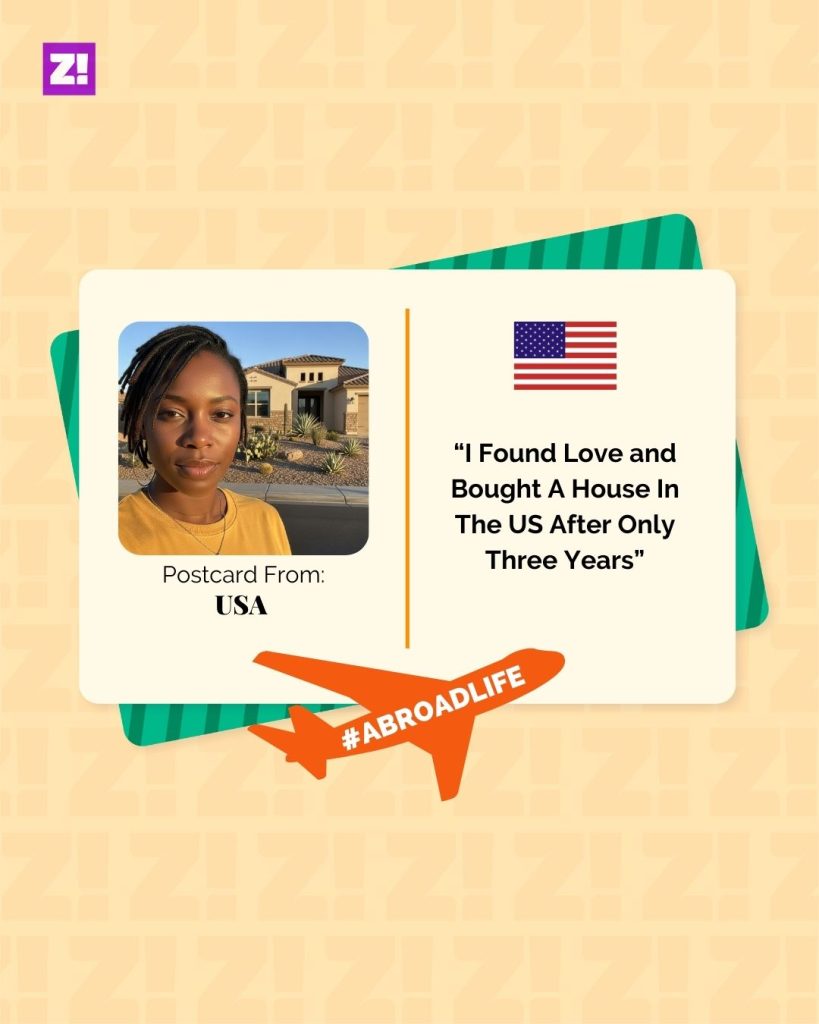
Where do you currently live, and when did you leave Nigeria?
I live in the United States. I left Nigeria in 2022.
What inspired you to leave?
There were a few reasons. I’m queer, so moving somewhere I could live freely was always on my mind. Many of my friends had already left or were planning to leave. But what really pushed me was the EndSARS protests.
How so?
I was working in oil and gas, earning good money. My job was offshore, so I had a one-month-in, one-month-out schedule. That meant I could literally spend a whole month at home without doing much before heading back to the field.
Life felt easy. I could pay people to handle chores, and my salary meant I could afford most things I wanted. I travelled whenever I liked for holidays, but I didn’t really see myself living abroad.
But then I had friends—male colleagues—who would get picked up by police just because they looked a certain way, drove certain cars, or had laptops and phones. We made good money, so we could afford these things, but that made us targets. They would have to pay to be released, even though they could prove their income was legal.
It didn’t happen to me directly. They mostly targeted the guys. But I saw it up close one day. I was on a road trip with friends, driving through Calabar, when the police stopped our bus. They picked on one of my friends simply because he had two laptops.
The police said they would hold him for investigation and told the rest of us to continue our journey. I got down and insisted we weren’t going anywhere without him. I had to make a scene, which is very unlike me because I’m not a confrontational person. After a lot of back and forth, they finally let him go.
That experience showed me that the problem affected everyone. We weren’t exempt just because we had money. So when the protests started, I was really invested. So when it ended the way it did, I knew I had to leave.
So your sexuality didn’t play into your decision to leave? You didn’t face discrimination?
Well, I wasn’t open. Nobody who would discriminate against me knew I was queer. I did tell one colleague—a subordinate I felt close to—but he reacted by trying to preach to me, like older Nigerian men often do.
My siblings know, some of my cousins know, but my parents don’t. I only tell people I think will be okay with it. I avoid situations that could cause drama.
So I didn’t face discrimination directly, but being in the Nigerian gay community, you hear about kito cases. It’s scary and sad. Also, the secrecy makes dating toxic.
What kind of toxicity?
For example, you’ll be with a girl, but she’ll also be with a guy as cover. I know many gay women who married men, and I understand why. Life is already hard as a single woman in Nigeria. Some landlords won’t even rent to you if there’s no man. No matter how comfortable you are, as a single woman in Nigeria, there’s still a level of disrespect.
So I get why some women married men and still wanted girlfriends on the side. But I always knew I wasn’t going to do that. I’ve always wanted to marry a woman.
So how did you travel?
I applied for a master’s degree. One of my brothers was already living in the US, so I applied to universities in his city. I figured I would live with him and save on things like rent. It wasn’t a scholarship; I paid all my fees myself.
How did you afford that?
My base salary was about ₦35 million a year. But when you’re out in the field, they give you an allowance. So during my off months, I lived off the allowance and didn’t touch my base salary.
A friend taught me about investing in stocks, so I did that too. Stock prices were down during the COVID-19 pandemic, allowing me to buy them cheaply. When I was ready to travel, I cashed out some mutual funds to cover tuition and other expenses. I still have most of my stock. I sold some again last year when I bought my house here, just to make up the down payment.
Are you still studying?
No. It was a one-year programme. After that, I got a job with an automobile company, but I was there for less than a year. I hated that job, but luckily, I got poached by my current employer.
What do you do now?
I’m a lead engineer at a research facility.
What made you hate your previous job?
The culture was terrible. There was this toxic competitiveness where everyone was trying to prove they were working harder than the next person.
Do you like your current job?
Absolutely. Since they wanted to poach me, I was able to negotiate things like a flexible schedule. I’m respected and valued. Everyone’s impressed with my work, and I’m not even stressed.
Can you compare working in Nigeria with your current job in the US?
My situation in Nigeria was sort of different. I joined the company through a graduate trainee program, so this meant I was moved around different teams to learn. After that, I was thrown into the field to supervise and manage teams of technicians. This was particularly challenging, partly because of my age and largely because of my gender.
Now, in my current job in the US, I’m also the only woman on the team, leading blue collar men and even though they’re pretty much the same (in terms of attitude, sense of humour, and being lewd), they show me more respect here because they don’t have a choice. I’ve never had to report anyone to HR, but I know if I did, there would be real consequences.
The culture allows them to look beyond the fact that I’m a woman and see my years of experience, knowledge, and skills.
What was it like coming to the US?
Honestly, the first few months sucked. I moved in with my brother, and his city was predominantly white. He had Nigerian friends, but they were mostly straight tech guys. It just wasn’t my crowd. Even though they invited me to hangouts, I felt alone.
I went on a couple of dates, but they didn’t work out. I was unintentionally celibate for six months. Then I met my wife, and we just clicked.
That sounds nice. How did you meet?
We started talking online, but it was on our first date that we really connected. It was at a café. I was late, so she was already inside waiting. I had to parallel park, and the car I was driving was bigger than what I used to drive in Nigeria. My parking was very embarrassing.
I walked in thinking, “I hope this girl didn’t see me.” So I said, “I hope you didn’t see me parking.” She replied, “Nope.” Then burst out laughing. I laughed too. Obviously, she had seen it. But it was such a great way to start, connecting through laughter.
It just felt easy. You know when you meet someone and you vibe instantly? Every day since has been laughter with her.
That sounds truly amazing. But what’s your support system like in the US?
I have some family here. Two of my siblings live in the US, though in a different city now because I had to move for work. My brother was actually the witness at my wedding. I’m hoping to eventually move back closer to them. Right now, we’re about an hour’s flight apart.
I live with my wife and my mother-in-law. I get along really well with my wife’s family. Everyone lives in different states, but we try to get together once or twice a year.
I also have a lot of friends. Even when we can’t meet in person, we talk virtually.
Do you feel any type of way about having a relationship with your wife’s mum, when she can’t with your own parents?
Definitely. It’s something I’m really struggling with right now. We’re thinking about having a child, and I don’t want to confuse the kid or send mixed signals. If my Nigerian family wants to be part of that child’s life, they’ll have to accept that I’m gay.
I’ve been trying to talk to my dad about these things. I haven’t told him I’m gay, but I already know where he stands. This is a man who once told me he likes Trump because “he will stop gay people.”
I always try to see things from other people’s perspectives, so I understand Nigerian Christians being homophobic. But you have to think critically. You have three children in the US, three immigrant children. How does hating queer people outweigh immigration policies that could see your children deported?
I can’t even engage my mum in these conversations because she goes straight to emotional blackmail. I got a dog recently and showed it to her. I said, “You’re a grandma now.” She immediately replied, “No o! I’ll be a grandma to human children.” Then she started talking about finding a husband.
I own my house. I bought it in my third year here. I had to remind my mum that she hadn’t even told me she was proud of me for achieving that. It’s sad comparing that to my mother-in-law, who tells me she loves me every day and is always saying how proud she is of me.
I understand my parents are worried about the shame of family members knowing and what pastors will say. I empathise with them. I know it’ll be very difficult for them, and I feel sorry for them. But I’m going to come out next year whether they like it or not.
Wishing you the best of luck with that. I hope they find their way to accept it. Let’s change gears a bit. What do you do for fun?
Sometimes we go out to shows and concerts. There are nice restaurants around, too. But I’m more of an indoor person now. In Nigeria, I used to enjoy going to strip clubs. When I see people clubbing online, I miss it, but I’m old now, please. If I go out till 11 pm, I need an entire day to recover.
So we do more indoor activities. We each have a hobby room in our house. My wife is into science fiction media and games, so that’s what you’ll find in her space. She’s always trying to get me to play games with her, but I’m not a gamer.
In Nigeria, I learnt to sew while I was in university, so I use my hobby room for that. I’m always creating new designs. I also take care of my house plants. I have over seventy of them, so something always needs watering or pruning.
It’s definitely not like Nigeria. It’s more boring. I miss things like Detty December so much. But this is fun in its own way.
Speaking of Detty December, have you been to Nigeria since you travelled?
Unfortunately, not. I just need to sort out my immigration status. Hopefully, next year, my papers will be sorted and I’ll come down for a visit.
Fingers crossed. Would you consider settling in Nigeria at some point in the future?
No. I’m married to a woman.
There’s a version of events where we move away from the US because we don’t feel comfortable here with everything happening. But we’ll likely end up in Europe. Wherever we go, it has to be somewhere our marriage will be recognised. That’s the most important thing.
Let’s talk about culture shocks. Were there any you experienced when you moved to the US?
The major thing for me was the food. Honestly, I found the food disgusting. There’s sugar in places you don’t expect sugar to be.
Have you gotten used to it, or do you just cook Nigerian food?
I cook Nigerian food. But it’s expensive. For example, I can’t find goat meat locally, so I have to have it shipped every time.
How does your wife find Nigerian food?
Okay, I guess. She doesn’t like a lot of it, but she’ll eat some.
Being here has made me realise some things about our food, though. For instance, how it all looks the same. I’ll ask my wife to help me take out my egusi from the fridge, and she’ll say, “Which one is that?” I’ll reply, “The brown one.” Then she’ll say, “They’re all brown!” And when you think about it, it’s true. They’re all brown.
Also, it never occurred to me how pungent things like iru and ofada are. The smells fill the whole house. Anyway, she eats some of my food, I eat some of hers, and if I don’t like what she’s made, I always have something Nigerian in the fridge.
Let’s talk about highlights and low lights. What has been your worst experience in the US?
The job with the automobile company. Nothing crazy happened, but the culture was off. You’d see people on the 8 am to 4 pm shift working till 2 am.
I was there for less than a year and had four different managers. Some were fired, some quit. They would literally fire people and walk them out of the building in the middle of a shift. It was just a weird place. Definitely my worst experience. I knew within three months that I was going to leave as soon as possible. That wasn’t the type of job I wanted at all.
That does sound toxic. What has been your best experience in the US?
Meeting my wife, getting married, and building this life for myself.
The reason I can even think about coming out to my parents now is because I’m in this safe relationship. If I didn’t feel like I was in something I’d have forever, I’d be afraid to come out. Because what if it didn’t work out?
But being safe in my marriage, knowing this is my family and the life I’m building, gives me strength. Never in my wildest imagination did I think I would have something like this as a lesbian woman. So yes, my marriage is the best experience of my life.
Sounds blissful. But let’s see if we can put a number to it. On a scale of one to ten, how happy are you in the US—and why?
I’ll say eight. In my personal life, it feels like a ten. Maybe even twenty over ten, to be honest. I feel so much safety, love, and acceptance.
But in the US as a whole, living as a black woman and an immigrant isn’t easy. I haven’t really suffered direct discrimination, and I’m fortunate to be able to apply for my green card through my wife. But I know people who got sponsored by their jobs only to be laid off and stranded.
Even if you’re not directly affected, you see and hear what’s happening to other Nigerians here. People detained by ICE, and partners creating GoFundMes to help them out. It all feels heavy.
It’s heavy being in this country. But I also feel like it’s not just here. Look at all the things happening in Nigeria this week. There’s a lot going on in the world right now. That’s why I say eight. My personal life is good, but there’s so much happening outside of that, and you can’t really isolate yourself.
Do you want to share your Abroad Life story? Please reach out to me here. For new episodes of Abroad Life, check in every Friday at 12 PM (WAT).
Before you go, help us understand how you and other young people feel about the 2027 general elections by taking this 10-minute survey.
Click here to see what other people are saying about this article on Instagram