Someone you know has left or is planning to leave. 1,000 Ways To Japa will speak to real people and explore the infinite number of reasons and paths they use to get to Japa
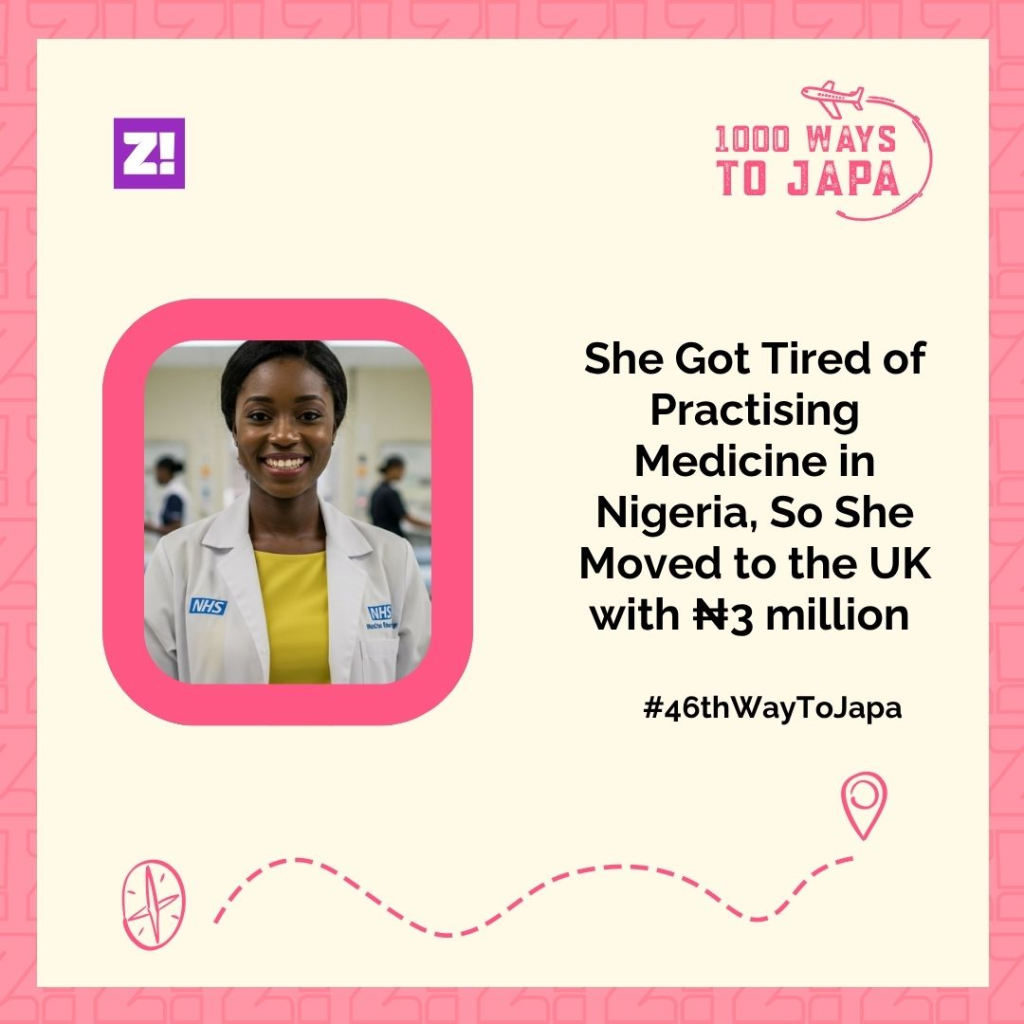
Ini (32) was tired of struggling to survive on a doctor’s salary in Nigeria, so she moved to the UK. In this story, she breaks down how she registered for and passed the PLAB 1 and PLAB 2 exams that made her relocation possible with less than ₦3 million.
Where do you currently live, and when did you move from Nigeria?
I currently live in the United Kingdom (UK). I moved from Nigeria in 2020.
Was there any particular reason why you felt like you wanted to move?
My husband and I are both doctors, but we felt like we weren’t getting the best opportunities in Nigeria then. We believed the UK would be a better location for career growth and long-term planning, so we moved.
How exactly were you able to make that move as a doctor in Nigeria?
It took about two years of saving our salaries before we could afford it. Luckily, we had seniors who had gone ahead of us and knew the process. They put us through and explained every step clearly. Once we had saved enough, we sat for our exams and applied for jobs.
Can you walk me through the step-by-step process?
First, I took the IELTS exam. There are many centres in Nigeria, like IELTS Nigeria, so this is pretty much easy to figure out.
After IELTS, I registered for the Professional and Linguistic Assessments Board (PLAB) 1. In Nigeria, you can only take PLAB 1 in a few centres in Lagos and Abuja. Once you pass PLAB 1, you then have to travel to the UK for PLAB 2, which can only be written in Manchester. After passing PLAB 2, you’re given a license to practice in the UK, and with that license, you can start applying for jobs across the country.
How did you prepare for the first exam, and what tips would you give others planning to take it?
There are a lot of resources online. For PLAB 1 specifically, most people, including myself, used a question bank platform called Pass Medicine. It has over 2,500 past questions with explanations. Honestly, if you go through all of them, you’re very likely to pass. Another tip I’d give is to prepare in a study group. There’s a chance you’d have a full-time job while preparing for the exam, which can be overwhelming. A group keeps you on track and holds you accountable when the process gets tough.
Let’s talk about cost. How much did the process cost you at the time?
The cost of PLAB 1 was about ₦120,000. I was living in Abuja then, but I couldn’t get a slot there, so I had to fly to Lagos. The flight cost around ₦150,000. Altogether, PLAB 1 cost me roughly ₦250,000.
For PLAB 2, I spent almost ₦2 million in total. The exam itself was about ₦500,000, flights were around ₦600,000, and the visa was about ₦150,000–₦200,000. There were also other costs: accommodation in the UK, COVID-19 tests at the time, and general miscellaneous expenses.
How easy was it for you to find a job after all that?
Honestly, it wasn’t easy at first. I was scared I wouldn’t get a job. It took me six months from when I passed my exam to when I finally relocated. During that time, I was constantly applying. After months of rejection, I finally got a job.
Compared to where you are now, is life in the UK exactly what you expected?
It’s a mix of good and bad. Career-wise, I’m happy. I’m training to become a general practitioner and am in a good professional position. But my personal life has gotten harder.
Earlier this year, I lost my mum. If I had known the last three years were going to be her final years, I would never have left. My job here helped me pay her hospital bills, but I couldn’t be with her as much as I wanted. She passed the same day I booked a flight to travel down to Nigeria to see her. That’s something I’ll always regret. But I’m grateful for my husband, daughter, and growing family. Overall, it’s been bittersweet.
That’s horrible. Sorry for your loss.
Thank you.
Many Nigerians abroad now say they wouldn’t advise others to move to the UK. Do you agree?
I do. The anti-immigrant rhetoric here has gotten stronger. I wouldn’t advise anyone to sell their properties in Nigeria to come here right now. These are uncertain times. I’m grateful I moved when I did, but I wouldn’t recommend leaving everything behind to come here in 2025.
Do you think people will look back in 2026 or 2027 and say, “If only I had moved earlier”?
It depends on who becomes the next UK Prime Minister after the 2029 elections. Immigration policy could change drastically then. It takes two to three years to really settle in here. Imagine still finding your footing when a new government unfriendly to immigrants comes in; that’s risky. So I’d say it’s uncertain.
Did you experience any culture shock?
The biggest one was the weather. I didn’t realise how much the cold and darkness could affect my mood until I experienced it. Also, in Nigeria, communities form naturally; you don’t have to overthink it. Here, you have to put in the effort to build your community from scratch.
From your experience, what are the biggest differences between working as a doctor in Nigeria and the UK?
The labour laws here are stronger. They regulate how many hours you can work at a stretch, and those laws are enforced. In Nigeria, rules are not respected. That’s why doctors there get overworked to dangerous levels, and some even die from it. The healthcare system here is also much more advanced and complex. There’s a strong social care component that makes sure vulnerable people are supported in the UK, but we don’t have that in Nigeria.
What would you say are some of your highlights since moving?
Definitely my church. It’s a Redeemed Christian Church of God, mostly Nigerians, and it feels like home. When I had my baby, they were incredibly supportive. They also supported me after I lost my mum. Apart from church, I’ve also found community through Nigerian gatherings, like birthday parties and summer hangouts. That’s been a big highlight for me.
On a scale of one to ten, how happy are you living in the UK?
I’d say a solid seven. I no longer worry about finances, which was a big problem in Nigeria. I’m with my family, and I’m grateful for that. The reason it’s not a ten is because of the uncertainty about the future here. But overall, I’d say 7.
Want to share your japa story? Please reach out to me here.