• Every week, Zikoko seeks to understand how people move the Naira in and out of their lives. Some stories will be struggle-ish, others will be bougie. All the time, it’ll be revealing.

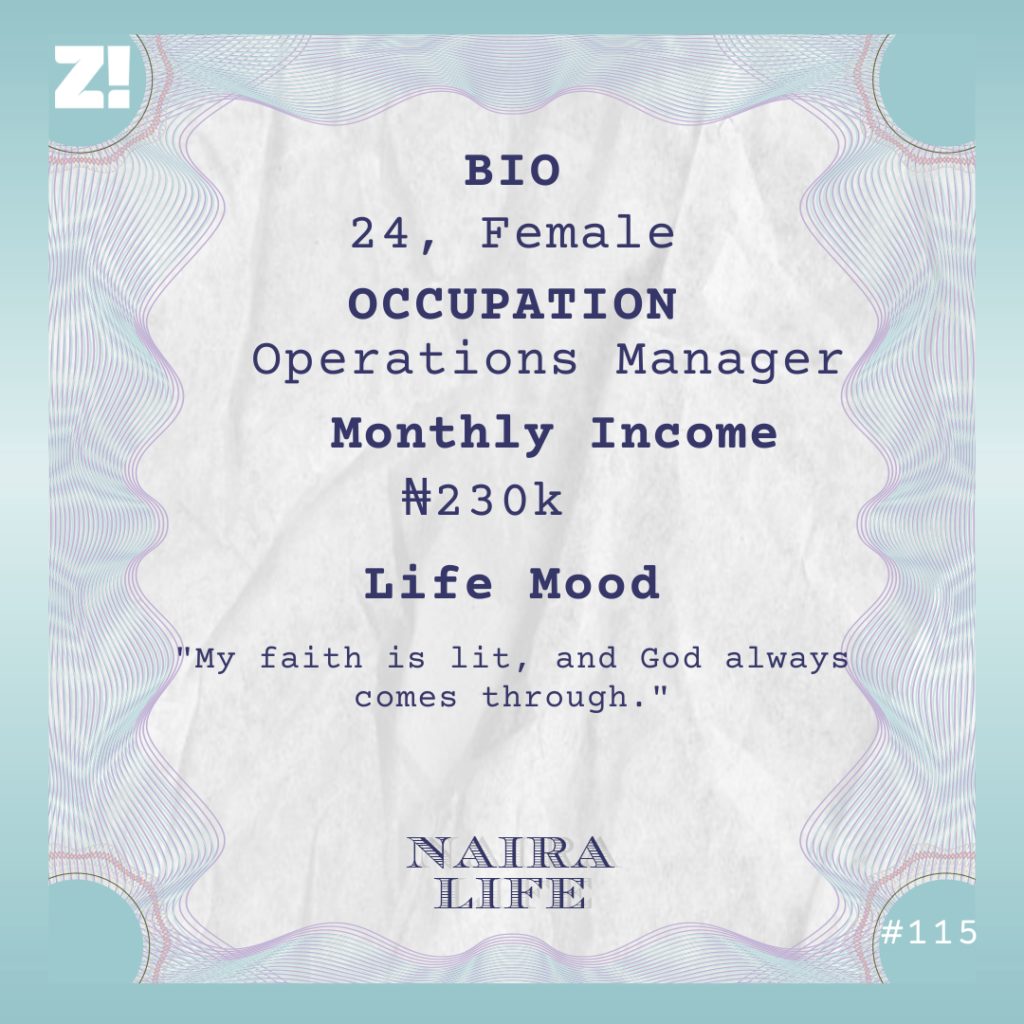
    At the beginning of the year, the 24-year-old subject in this story was working at a job she hated and barely making ends meet, and then things changed because of a tweet she responded to. Through her highs and lows, one thing remains unchanged: her faith in God. 
    What’s your oldest memory of money?

    That’d be taking money out of my mum’s purse to buy choco milo. This was 2002 or 2003, and I was six or seven years old at the time.

    I – 

    By JSS 1, I was stealing between ₦100 and ₦300 to buy fruits and ice cream. I was caught once, but I didn’t stop. I was caught again in JSS 3, and this time, my dad flogged the budding Anini out of me. Since that time, I’ve not taken anyone’s money. 

    Omo. Moving on from that. What was it like growing up?

    It was good at first. My dad sold trucks and other heavy-duty vehicles, and his business was good. We got everything we wanted, and my siblings and I went to good schools. I was in JSS1 when things first changed. 

    What happened?

    My dad was a womaniser, and a lot of his money went into that. There was a time he bought a house for his girlfriend and built another one for her family. It wouldn’t have been a problem, but he lost a deal he was hoping to get, then, he was scammed and lost a lot of money.  

    Omo. 

    It took him about three years to bounce back, and when he did, what did he do next? He returned to his old ways. A few years later, he lost all of his money again. He tried to float another business but it failed. Like that, we were broke again.

    Ugh. Where was your mum in all of this?

    I don’t think my dad was giving her money even though he was generous to other people. My mum worked hard to keep up appearances and maintain the status people thought we had. She had a restaurant, and that was where she spent most of her time. She wanted to own two to three outlets. The stress got to her, and she died in 2015. 

    I’m so sorry.

    Thank you. Her death hit my dad so hard that he took a year away from working. I was in my second year at university at this time. Before all of this happened, I was getting ₦15k-₦20k as my allowance. After everything, it reduced to ₦2k per month.

    What did that mean for you?

    I realised that I had to fend for myself. One of my friends worked as an usher for an event planner. One day, I asked if I could follow her to an event she was working at, and she agreed. She put in a word for me with her boss and said I could assist in serving food. My pay was going to be ₦2k. But I quickly spoke up and said I could be an usher too, even though I had no experience. She agreed to give me a try. At the end of the event, she paid me ₦4500. I gave my friend ₦500 and kept ₦4k.

    Was that the only time you worked for her?

    Nope. She called me two weeks after for another event and paid me ₦5k. It became a weekly thing. Every weekend, I had an event to work at. So I was getting paid about ₦20k every month. 

    Were you still getting an allowance from home?

    Yup. The ₦2k came without fail. It was a good thing that I got the job because I was able to maintain the life I lived before things became difficult at home. I held the ushering gig for 2-3 years, I also did other things for money.

    What else did you do?

    Sometime in my third year, I heard that recharge cards were moving. I put ₦25k into it and started selling recharge cards. I did that for only 2-3 months, but I had made my capital back and an extra ₦30k in profit.

    In my final year, I sold toast bread. It became as though I did blood money. 

    I’m listening. 

    This is how it started: one morning, I made toast bread and shared it with my roommates. Then they went, “Babe, you need to start selling this thing.” The next day, I bought two loaves of bread and six eggs. The cost of everything was ₦1800. The students next door bought everything, and I made ₦3500 that morning alone. In the evening, I decided to take it a step further — I bought a crate of eggs and loaves of bread. The students who had bought some earlier in the day spread the word that someone was making toast bread in the hostel. I got 55 orders and sold out that evening. Slowly, it became a thing. I increased the price to 150, and in a day I’d get up to 150 orders.

    How much were you making from this?

    ₦8k-₦10k in profit per day.

    Mad oh.

    I should add that I stopped doing this every day. I couldn’t keep up with the stress, so I was open three days a week. I was going for the ushering gigs too. The steady means of income meant taking care of my tuition and other expenses and having enough left to save. I saved ₦100k every month from what I made from both sources.

    What were your finances looking like when you left uni?

    I left uni a rich woman but ended up broke three months later. 

    What happened?

    I had between ₦650k and ₦700k when I graduated from university. But I went home and found out that my dad had sold our house to offset debt and had moved somewhere else. I didn’t like the state of the house he was living in and also didn’t want my sisters to come home from boarding school to that. I gave him ₦300k to renovate the new place. 

    I’m not sure how I spent the rest. I was reckless with money at the time, spending frivolously on food and hotels. I knew I was in trouble when I had run my chest down to ₦90k and I didn’t have an apartment. 

    Omo.

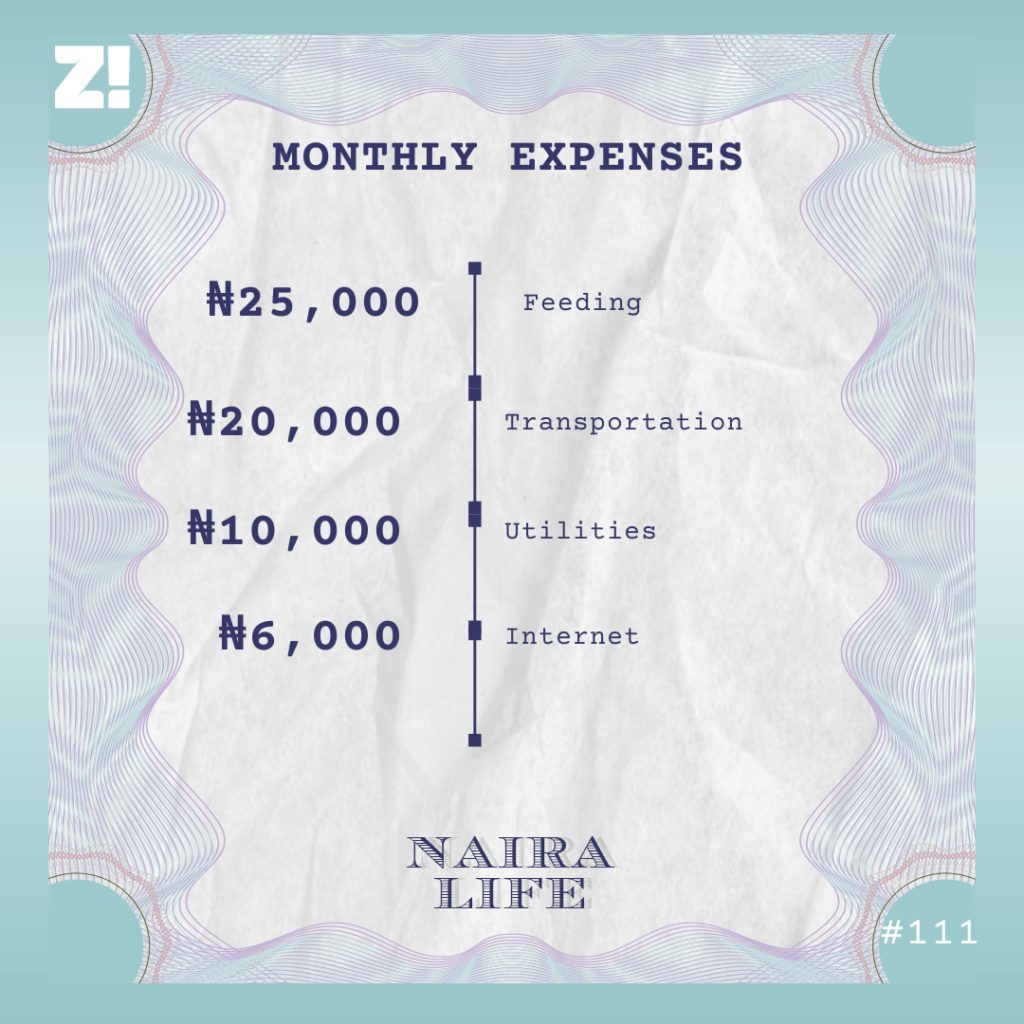
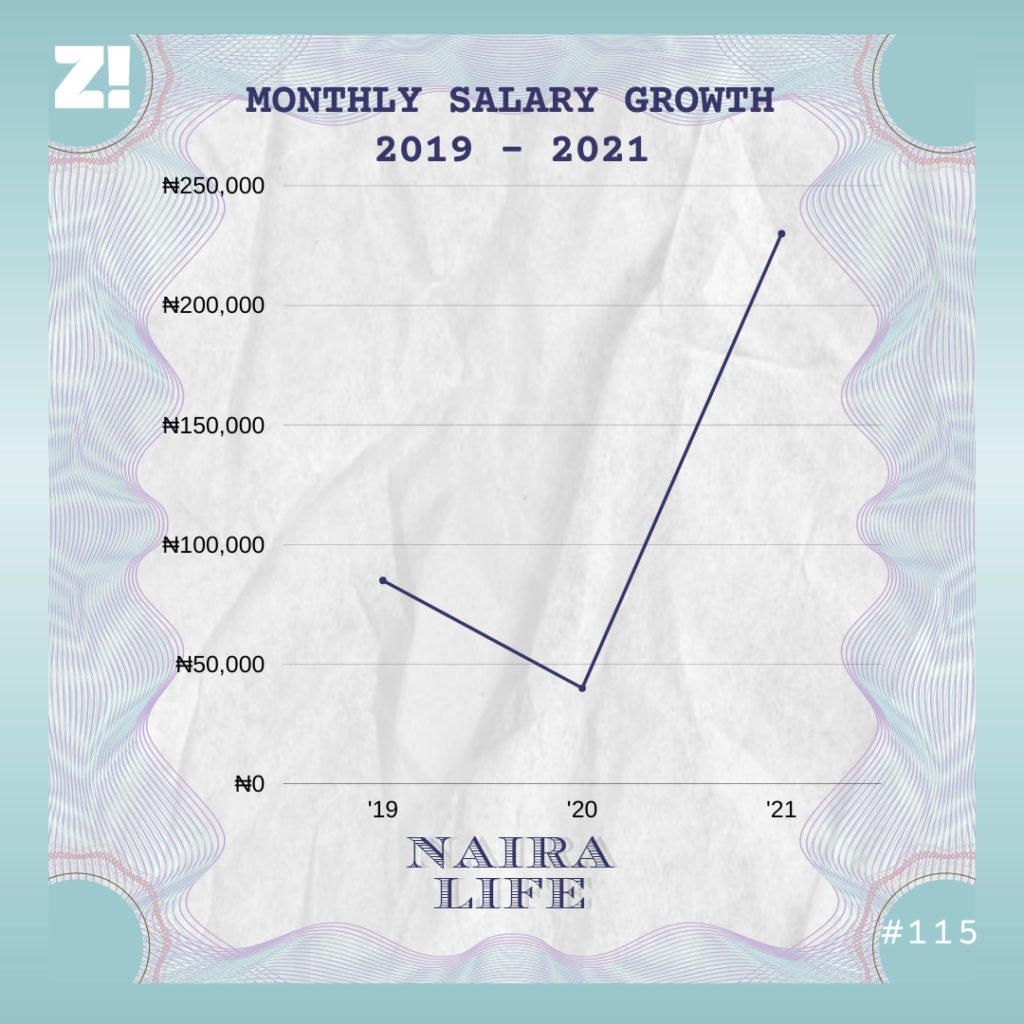
    I found a job as an attendant in a store, and the pay was ₦60k per month. Also, I found two roommates and we gathered our resources together and rented an apartment at ₦300k per year. 

    What was it like going from 700k in savings to almost nothing?

    I don’t think about money that way. True, I was reckless but I always knew I would bounce back. Once I realised my account was getting low, I was already praying to God to come through and started thinking about how to save the situation.

     I see. How long did you spend at the store?

    I was there between February and June 2019. I had to go for NYSC, but I had saved up ₦70k. A week after I left camp, I found another job as a front desk officer, and they offered me ₦85k. The federal government was also going to pay me ₦19,800. For the first time in a while, it looked like things were looking up again, but…

    But?

    But I quit eight months into the job. The owner of the place was moving mad. Eight people left the company on the same day. 

    Ah!

    I didn’t think this through, but I moved out and spent most of my savings — about ₦300k — on another apartment. I thought I would get another job as soon as possible. But Covid said hello. 

    How long were you unemployed?

    Six months. My allawee stopped coming in June when I finished NYSC. I had no support system or safety net, but God was with me, and I kept my faith in Him. Someone gave me ₦20k on Twitter in July and a friend gifted me ₦10k in August. I don’t know what I would have done with all of this. I lived on the money while being super prayerful.

    I eventually settled for a job in September 2020. It was a personal assistant job a friend referred me for, and my salary was ₦40k.

    That’s almost half your previous salary.

    Omo. It was better than nothing. But I realised how tiring the job was very quickly. I was just powering through each day, praying and hoping for a better job. I quit officially in January 2021 but worked till February. I wasn’t paid for either month. 

    Was a job waiting for you when you quit?

    There was no job, but God finally answered my prayers. It was like He was telling me, “You must have learned your lesson. Now let me say hello.”

    That sounds interesting. What happened?

    A few days after I finally cut ties with my previous boss, someone tweeted on Twitter: “Say what you want, you don’t know who is watching.” I quoted the tweet with “God should answer my heart desires.”

    A while after, someone entered my DMs and asked what my heart desire was. I told her that it was a good job. I didn’t know this at the time, but she posted our conversation on her IG story. Later that day, she hit me up again to tell me that someone was asking for my CV. She asked me to send them a DM, and I did. 

    I went for a test the following day and was invited to interview after that. Two days later, I got an offer letter. 

    Ghen Ghen. 

    I was hired as an operations manager. My new salary? ₦230k.

    That’s a significant raise, all things considered. 
    It is. And there are other great perks too. It was so unreal. It happened at the perfect time too. My rent had almost expired, and I didn’t have anything saved up. I didn’t care about a lot of things — I just didn’t want to be homeless. 

    Talk about a close shave. You’re earning ₦230k every month now, what do your running costs look like?
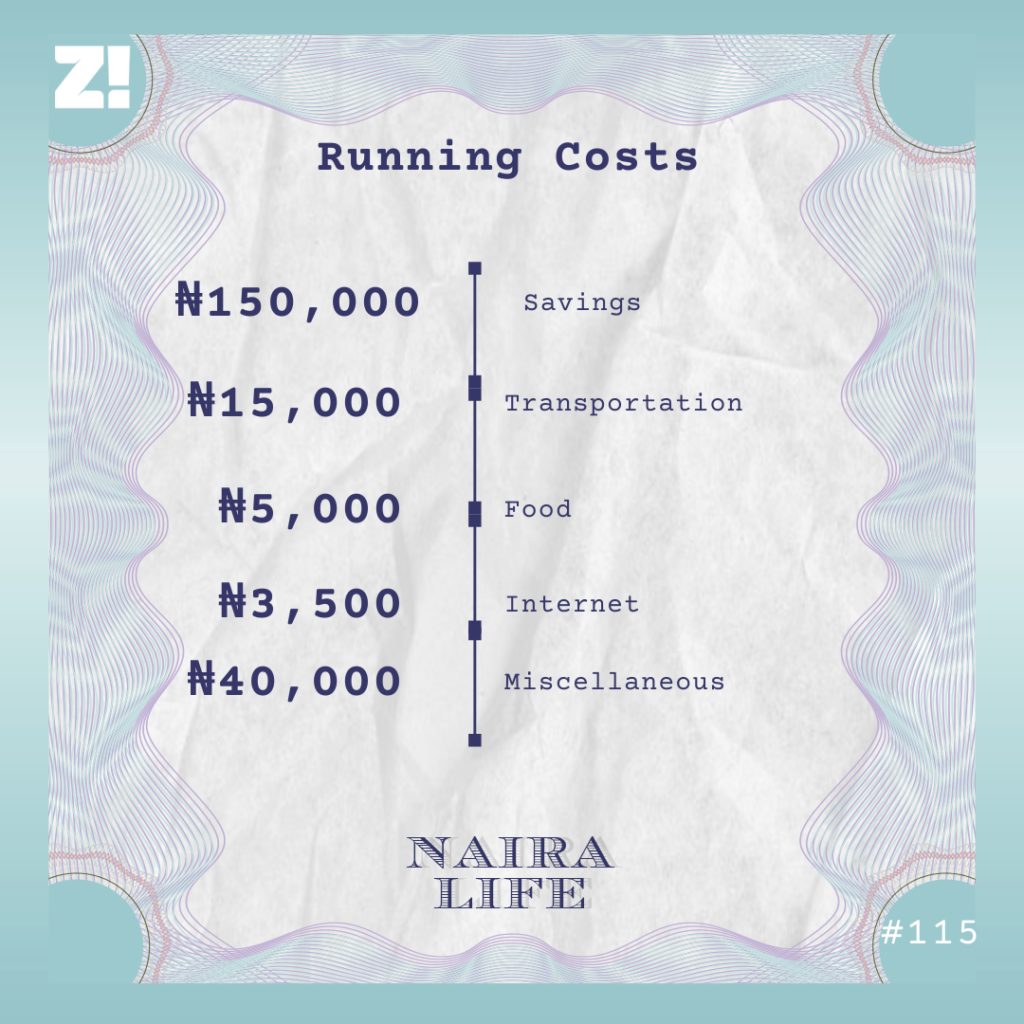
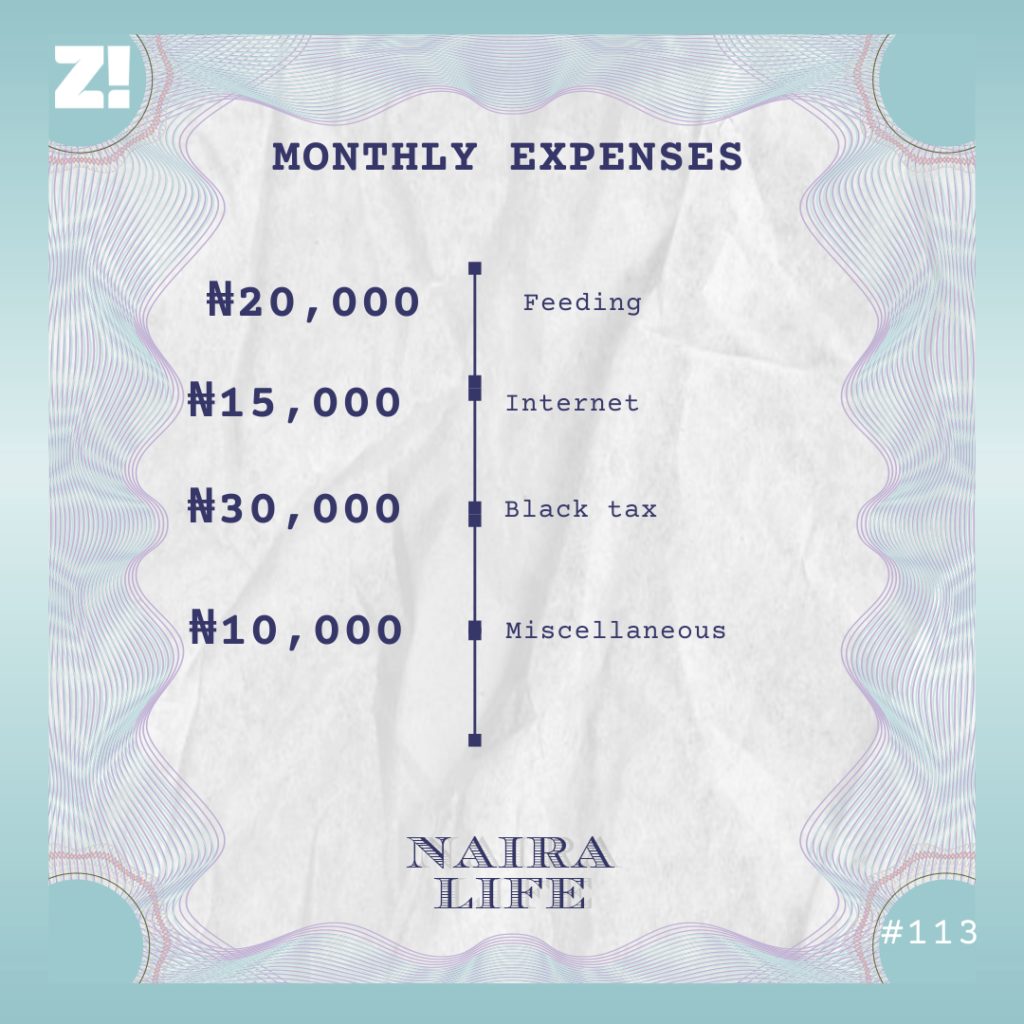
    I don’t spend a lot of money on food because the office takes care of my meals. About the miscellaneous: I send ₦10k each to my sisters. Also, I have an account I opened for my boyfriend, and I put ₦20k in it every month.


    Aww. What do you think you could be better at financially?

    I could do a lot better with how I manage my finances. There’s only so much I could do if I continue spending money —  which isn’t even a lot —  and hoping something else will come up. My faith is lit and God always comes through, but I should really be more responsible. I’m working towards that. I have to build my savings up first before considering other options.

    What’s something you want right now but can’t afford?

    A car. But it will have to wait because I’d be moving out of my apartment soon, and I also want to save enough to travel somewhere for a vacation this year. 

    Interesting. Anything you bought recently that improved the quality of your life?

    I’ve always been big on health and wellness, but I couldn’t afford the vitamins and other essentials I wanted to buy. Recently, I bought WellWoman and some other vitamins for ₦33k. You should have seen the smile on my face when I left the pharmacy. 

    Have you thought about where you’d like to see yourself in five years?

    If I’m still at this company, I hope to have made it to a managerial position. Also, I should have started and finished my MBA, and hopefully, be in a position where I can spend more on myself. And if I don’t have everything by that time, I’m happy the way I am. I just need to put my head in my job and keep my faith alive. 

    I’m curious, what do you think could have happened if your dad was still making enough money and your mum was still here?

    I definitely would have had it easier. I probably wouldn’t be in this country, and I would have finished my MBA. Oh God, I would have almost finished seeing the world. 

    Man. I wonder what your relationship with your dad is like these days?

    On some days, I’m angry at him for his mistakes. But I also love him so much I can’t stay mad at him for long. Besides, he’s trying his best to make us happy. It is what it is.

    On a scale of 1-10, how would you rate your financial happiness?

    I’m at a 7 now. I’m not crazy about building excessive wealth. I’m okay as long as I can afford the basics, and I’m in a better position to do that now. The only thing I want right now is to travel as much as I want to. There were many opportunities to do that when I was younger, but my father didn’t make it happen. Now, I can’t afford the places I would like to visit. This number will definitely shoot up once I can.
    This image has an empty alt attribute; its file name is Artboard-1-copy-6.jpg
  • Every week, Zikoko seeks to understand how people move the Naira in and out of their lives. Some stories will be struggle-ish, others will be bougie. All the time, it’ll be revealing.

    Do you remember the first time you knew what money meant?

    2005 or 2006. I went to a government secondary school and lived in a boarding house. My folks gave me just enough allowance to survive — about ₦2k per term. One day, my dad drove to my school and gave me ₦500, which I was supposed to survive on for 25 days. He probably thought I still had money and wanted to top it up. I lived on ₦20 a day, basically buying biscuits and a sachet of water. At the time, I was somewhat afraid to ask my parents for anything, so I didn’t say anything or ask them for more.  

    Omo. What was it like growing up, financially?

    My dad runs a couple of businesses and my mum has a nonprofit she manages. For as long as I’ve existed, my parents have worked for themselves. I was born around the time they were still getting on their feet. We weren’t very comfortable, but they managed to do the basic things. Things consistently got better over the years. We moved to more decent apartments and did. more than we used to. I mean, all of my parents’ kids went to university outside of Nigeria. I did mine in the UK.

    Oh. How did it happen?

    After my A-Level, everyone at my school was applying to universities in the UK. I told my parents I’d like to apply too, and they went, “We don’t have UK money oh.” But they let me try my luck with the application process. When they saw how good my A-Level results were, they relented, researched school fees and started planning. I continued the application process and got an offer to study law, and that was it. The tuition was £11k and my accommodation was £3600. The exchange rate was around ₦270 at the time.

    Fun times! So, how was uni?

    My parents gave me £200 every month, which was enough for me to get groceries, pay my phone bill, buy a nice dress once in a while, and purchase standard train tickets to neighbouring cities. 

    Lit. Do you remember the first time you worked for money?

    My first internship in 2013. I’d just finished my first year of university and came back to Nigeria for the holidays. I always knew I wanted to work in Nigeria, so it was important to build a network here. I got a job at a multinational company as a legal intern, and they paid me ₦30k per month. I spent a month and a half on the job before I returned to school. That meant ₦45k in total for the time I worked there.

    I graduated from uni in 2015, returned to Nigeria and went to law school. I went  through quite a number of recruitment processes immediately after completing law school, and I got a job at a law firm during my service year in 2016. They paid me ₦150k per month. The federal government paid ₦19800.

    You were balling, weren’t you?

    Well, all my expenses were capped at ₦50k, and the rest went into my savings. I didn’t always stay on the budget, but for the most part, I was easily saving ₦100k out of my salary. I didn’t touch my allawee at all. 

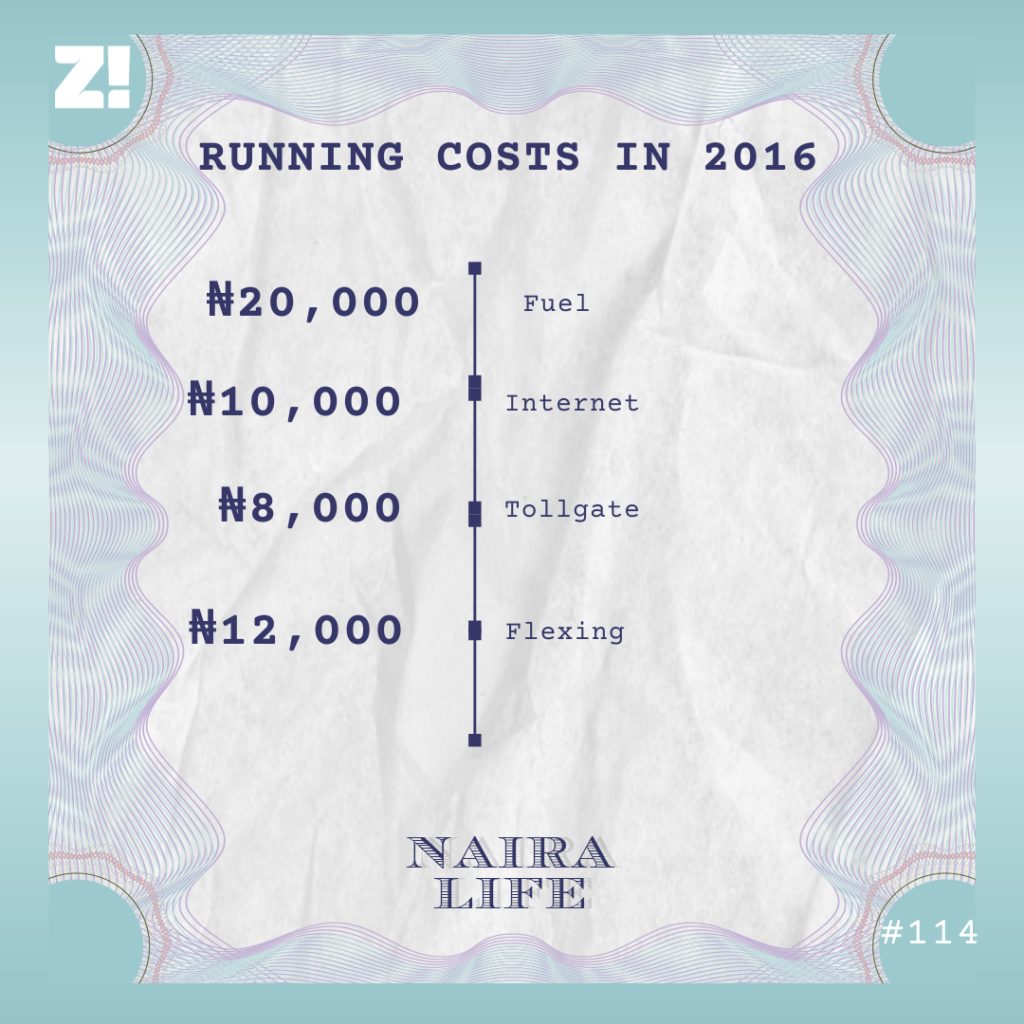
    What did your monthly running costs look like in 2016? 

    My idea of flexing was buying shawarma or dining out once a month.  I used to go out with my friends who were doing better than me financially and they’d foot the bill.

    What happened after NYSC?

    I was promoted to full staff at the law firm and my salary increased to ₦200k. My expenses didn’t change, so I added an extra ₦50k to my savings every month. By the time I left the job, I had saved about ₦2.5m. 

    Why did you leave the job?

    I was going back to school for my master’s. I got a full scholarship, so tuition was covered. But my savings went into every cost that was associated with going to the US — application fees, transcript processing, medicals, plane tickets, enrollment deposits, and all of that. I had about ₦500k left in my savings when I travelled. 

    Oh wow. How did it go in the US?

    My parents came through again and put me on an allowance of $400 per month. My running costs were about $200, and the other half went straight into my savings. My recurring expenses at the time was $120 for groceries and my $40 phone bill.

    Also, I picked up a job at the school kitchen to supplement my allowance, and the pay was $13/hour. I worked 5-hour shifts, three days a week. The first time I got my paycheck, I was like, “What’s this?”

    Why was that?

    Taxes. I was getting paid about $160 after tax. Anyway, it was still extra cash and it mostly went to shopping. I didn’t have guilty pleasures and I wasn’t one to splurge on things, but I could go to the store, see something I liked and buy it. 

    Ah, lit. When did you finish your masters?

    2019. I worked in the public service for a year after. My annual salary was $37k before tax, and I got about $2300 every month. My major expense at the time was rent, and it was $600. I consistently saved at least $1k every month. I knew I was going to come back to Nigeria, so I wanted to save as much as I could in dollars before I returned. I didn’t meet my $15k savings goal, but I was very close. Then I returned to Nigeria in 2020.

    How much was “close”?

    I had $13k right before I started preparing to return. But my travelling costs were expensive because of the pandemic and my account took a hit. I had $11k after everything was done. I took ₦300k out of it because I wasn’t sure how long it would take me to find a job here. The rest is still in my US account. 

    How long before you found a job in Nigeria. 

    Omo. It took about four months. I took some time to rest before I started job hunting.  I thought it would take one or two months because it didn’t take me that long to find my entry-level job. The joke was on me. 

    What were those months like?

    A lot of tears and second-guessing my decision to move back. Doing the right thing can be very painful sometimes. I applied to jobs, friends referred me to jobs, and headhunters reached out to me. I did multiple interviews and made it through various stages, but it wasn’t just clicking. 

    Money wasn’t coming in, what was that like?

    I lived on the  ₦300k I took out of my savings. I reduced my monthly running costs to ₦30k, which was great. I ran out of money last month, but thankfully, I had gotten a job in February. 

    Yay! How did you get the job?

    A friend referred me, and it is a multinational company. I made it to the final stage of their recruitment process and was offered a job in their legal department. 

    How much?

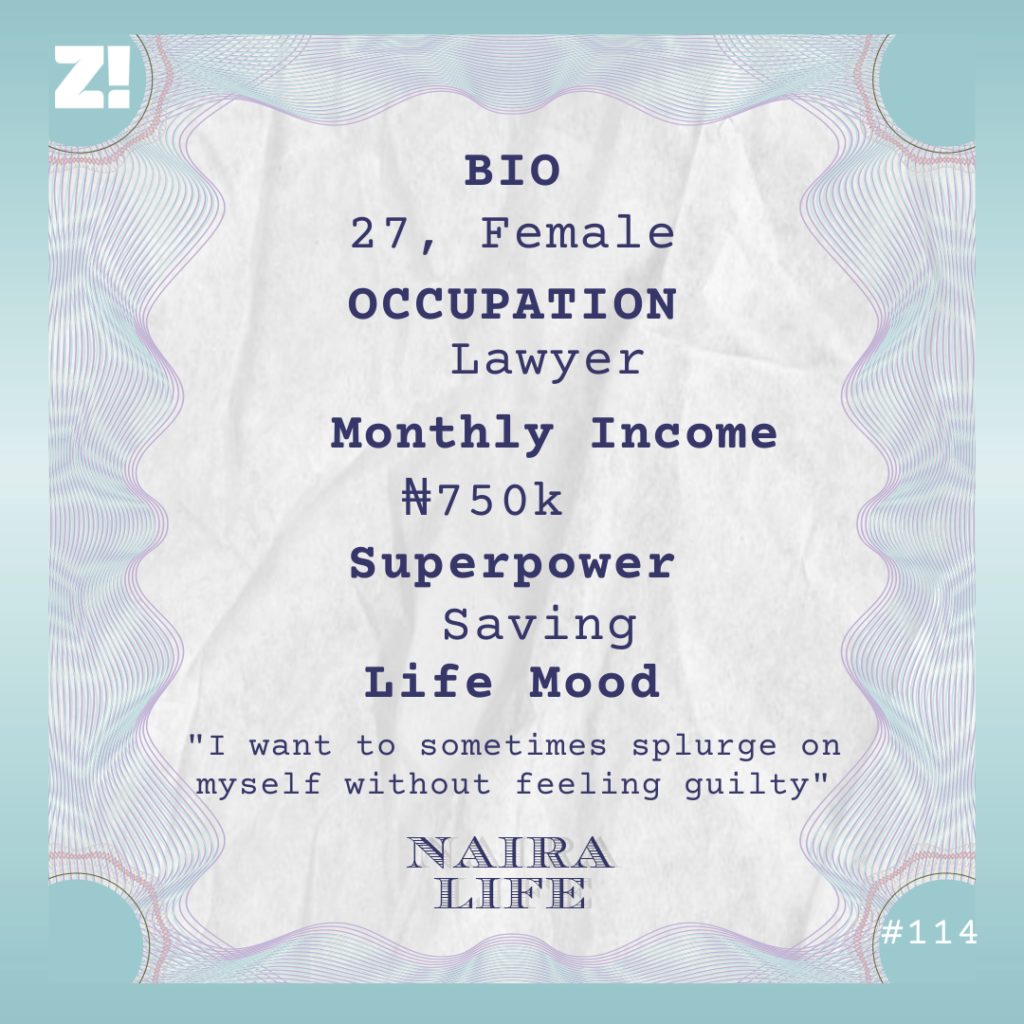
    ₦750k.

    Litttt! So what does an ideal month look like these days?

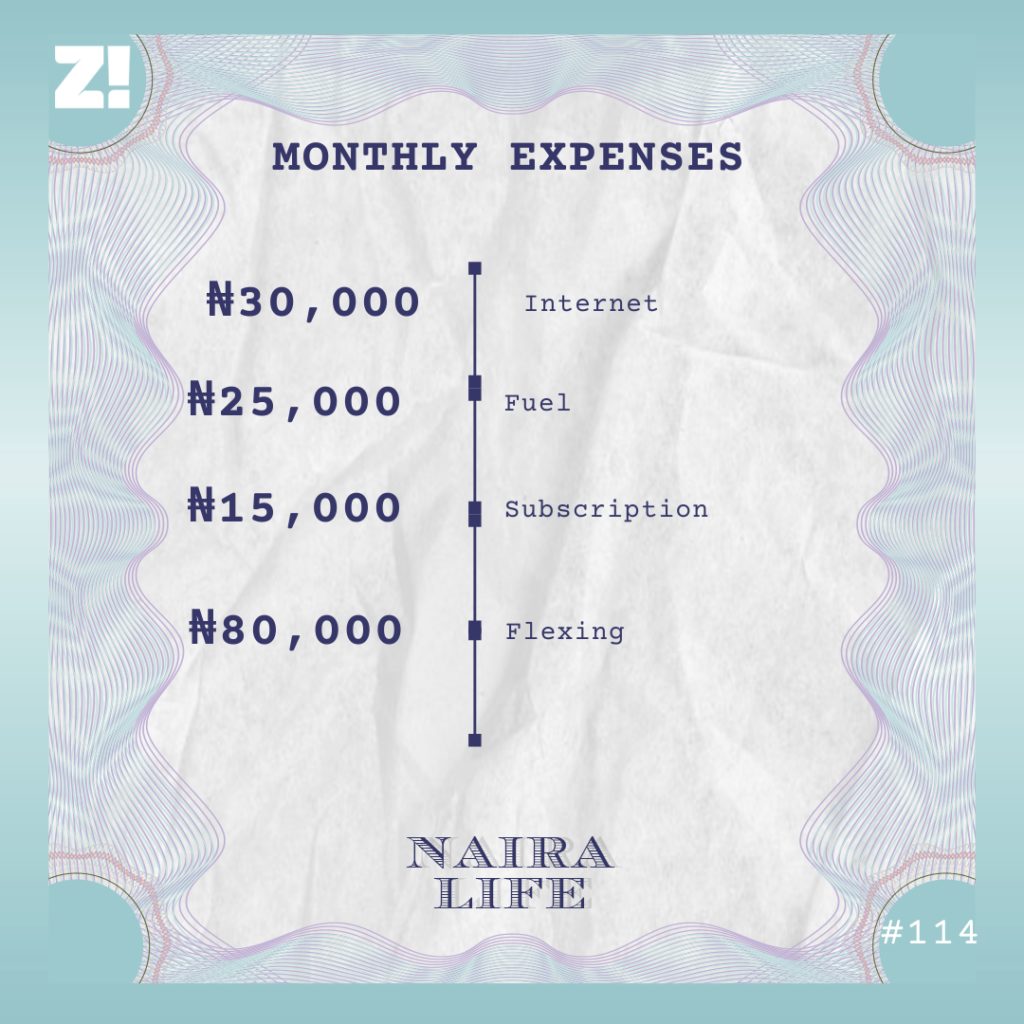
    I haven’t yet figured everything out but my expenses are pegged at ₦150k, and that’s even me being extravagant. I’m on track to save about ₦600k every month.

    The cable subscription is for my parents because I’m living with them and want to start contributing to the house bills in my little way. Flexing for me is still buying shawarma or going out to eat in restaurants. But I don’t eat out anymore because of the pandemic. Chances are that the ₦80k will still go back into my account. 

    Your spending power is relatively low compared to what you earn.

    I don’t know how to explain it, but I don’t get the urge to spend money. For starters, I don’t pay rent. I hardly buy clothes and shoes. Apart from a few work clothes and shoes I bought when I was moving back, I haven’t changed my wardrobe in a few years — my size has remained the same, and when making purchases, I focus more on buying quality items that last for years. 

    In an ideal situation, I could squeeze my monthly expenses to ₦100k if I wanted to, but spending ₦150k every month doesn’t sound bad, and it won’t affect my savings goal.  People have told me that I might be frugal. But I happily spend money on other people; it’s a problem to spend anything on myself because there aren’t a lot of things I like. 

    Ah, I see. What was the biggest amount you’ve spent on someone?

    About $300. I bought a phone for my partner at the time. 

    Where do you think this “frugality” came from?

    My parents never gave me the kind of money that afforded me the luxury of splurging for no reason. I couldn’t be living on £200 a month and buying Jimmy Choo shoes. Also, I truly don’t have guilty pleasures.  One of my siblings tells me all the time that when you earn more, your taste improves and you spend more. That hasn’t been very accurate for me.

    Mad!

    I’ll be honest and say that I’m probably pulling this off because I don’t worry about my parents’ finances, and that has taken a huge burden off my shoulders. What that does is motivate me to earn more money so I can spoil them. The best part is that I can pace myself and have enough time to plan for whatever I want to do for them. I’m also grateful that I get to live with them, and there’s mutual respect between us. I can move out if I want to but that’s an additional and unnecessary expense. Like, have you seen the price of curtains?

    Lmao. How do you think all of these experiences have shaped your perspective about money?

    I understand that money is a good thing to have although it’s not something to hold on tightly to. It’s also made me curious about investing and growing my money. I used to think that you need to have a certain amount of money saved up before you think of investing. Now I know that’s not true. I’m trying to get educated on the right options for my level of income. But maybe I’ll need to save a little less to pull it off. 

    Speaking of savings, how much do you have in your stash?

    About $12k. I’m very broke in Naira. I don’t have up to ₦50k in my bank account right now: I’ve sent the bulk of it into my savings account.

    Savings is the core of your personal finances, do you have a savings goal?

    I want to consistently save ₦5m every year for the next three years. Then I’ll see what next I want to do. That means I have to grow my income because I also want to have an investment goal, though I’m risk-averse and wary of putting money I can lose in anything. I’m trying to see if I can invest $2k in something every year. If I see the compounding effect of that in the next three years, I’ll be happy to increase my goal. Right now, I’m focused on growing my savings and gaining investment knowledge. Not something like, “They say agric is the hottest thing now, let me put money in it.”

    DFKM. What investment options are you looking at?

    At the moment, it’s stocks and real estate. I put $500 in my Risevest account. I’ll see how it does in the next six months and go from there. 

    Cool. How much do you think you should be earning to cater to your savings and investment plans?

    About ₦1.2m. I can conveniently save ₦1m every month if that happens.

    What needs to happen for you to unlock your next level of income?

    Promotion or a job change. But since I just started at this job and really like it, promotions are my best bet. In the next three years, my goal is to be earning at least double of what I’m currently earning. 

    What’s something you need but can’t afford?

    Would it be weird if I said a new phone? I’ve been using my phone for almost three years now, and it’s about to give up on me. I checked the prices of phones the other day and decided that I can’t afford it. I mean, I have the money, but I can’t bring myself to splash it on a phone. 

    What’s something you want but can’t afford?

    Something I want but I really can’t afford right now is a second passport. I want access to the world in a way that’s not limited by borders, so a passport that gives me access to 180+ countries will bang so much. It would be great to be able to afford citizenship by investment in such countries, but I’d need more than $100k for that. Omo.

    Haha. What’s something you wish you could be better at financially?

    Spending money on something without feeling like it’s an unnecessary expense. I almost feel like I have to justify spending money. The recurring question I ask myself is, “Do I have to?” I’m struggling to move between the different layers of comfort and finding the balance between planning my finances and living my best life. I want to sometimes splurge on myself without feeling guilty. But I understand that it’s a journey. 

    I have to ask, what’s something you bought recently that improved the quality of your life?

    Wait, it’s not recent but I bought an Amazon Echo Dot when I was in the US, and it’s improved the quality of my sleep. I was dealing with insomnia at the time, and it was the worst. That cost me $30. 

    Nice. How would you rate your financial happiness on a scale of 1-10?

    7. I don’t worry about money and I’m not in debt. I have good health insurance courtesy of my job, so I’m not worried about a health emergency. I’m in a good place to grow my savings. However, I still want to start investing in order to make my money work for me, earn more and save more. And more importantly, get to a place where I can actually start splurging on things without feeling any guilt. 


  • Do the words that come out of your mouth have a powerful effect on people? Let’s find out.

  • Citizen is a column that explains how the government’s policies fucks citizens and how we can unfuck ourselves.

    Elections have always been a big deal. But now, they are more important than ever. Many people may argue that the 2023 General Elections is still a few years away, but if Nigerians have learnt anything from the past elections, it’s that now might be the time to become more interested in these things and possibly run for a political office. 

    But first, let’s begin with the basic information. There are requirements to be met by candidates into political offices in Nigeria, and these are backed by Chapter VI, Part 1, Section 131 of the 1999 Constitution. Let’s talk about some of them.

    1. You must be a Nigerian citizen by birth

    For obvious reasons, only Nigerian citizens are allowed to run for political office. Your country of birth doesn’t exactly matter as long as one of your parents is a Nigerian citizen. Alternatively, being born within the territory of Nigeria when neither of your parents is Nigerian does not automatically grant you Nigerian citizenship.

    2. You must be of the minimum required age

    Up until 2018, the minimum age requirement for any political post in Nigeria was 30 years old. Enter the ‘Not too young to run bill’, which was signed into law by President Buhari. The bill was sponsored and signed into law to reduce the age qualification for president from 40 years to 30 years; governor from 35 years to 30 years; senator from 35 years to 30 years; House of Representative from 30 years to 25 years and State House of Assembly from 30 years to 25 years.

    3. You must have at least a school leaving certificate or its equivalent

    According to the Nigerian constitution, your secondary school leaving certificate is enough to qualify you for a political office in the country. It is what it is. 

    4. You must belong to a political party and be nominated by that party 

    There is no provision for independent candidates to run for an office in Nigeria. Everyone who desires a post has to be registered to a recognised political party. We wrote an explainer about how to set up a political party in Nigeria. 

    5. You must not be in prison or sentenced to death  for offences involving dishonesty or fraud

    This one is pretty explanatory.

    6. You must be of sound mind

    The condition states that every candidate for a political office must be in control of their senses and are capable of making sound decisions. Hmm.


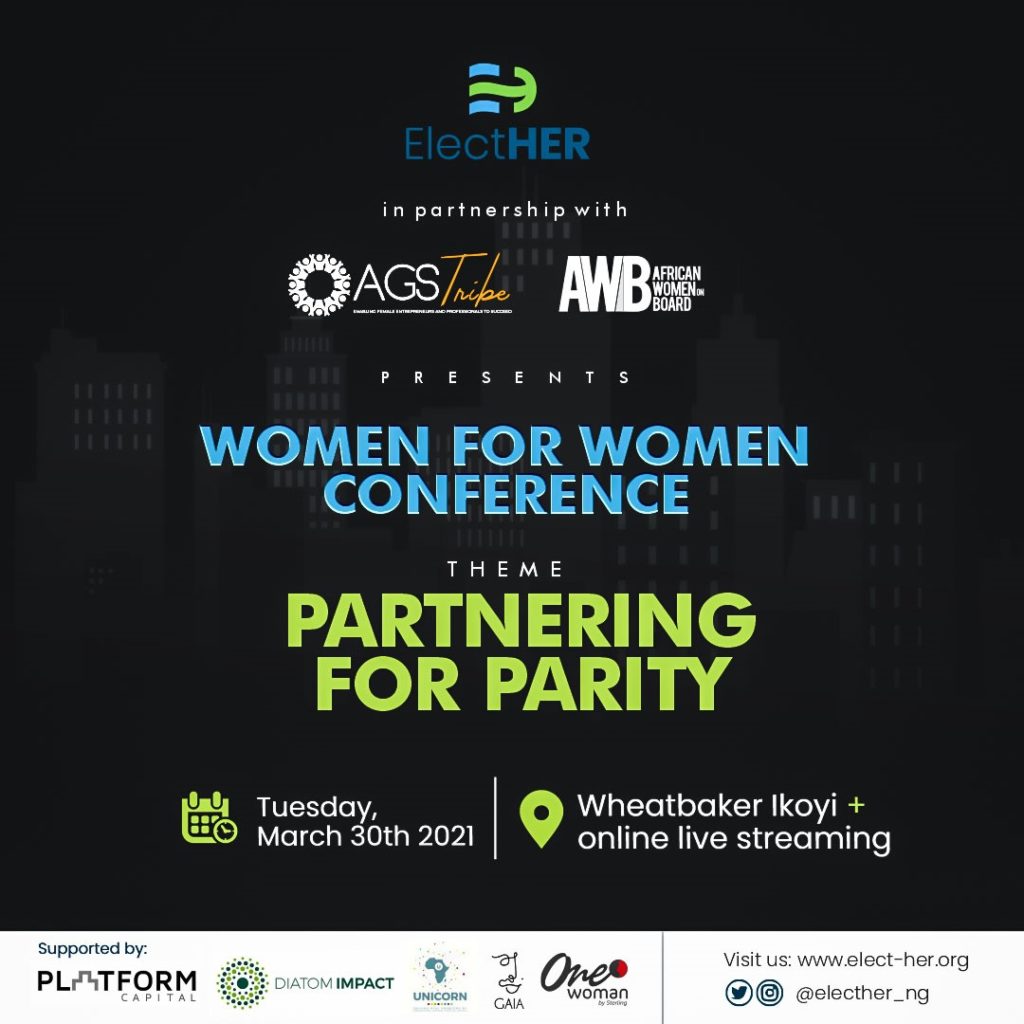
    Two leading female organisations, African Women on Board (AWB) and AGS tribe have partnered to organise the WomenforWomen conference. The event will comprise of panel sessions ranging from empowering women through financial inclusion, to mobilizing resources for women’s political leadership, and a digital crowdfunding initiative to mobilise  $1m from women, for women running for elective office in 2023.

    Find more details about the event below:

  • Every week, Zikoko seeks to understand how people move the Naira in and out of their lives. Some stories will be struggle-ish, others will be bougie. All the time, it’ll be revealing.

    Let’s begin with a throwback. Do you remember your oldest memory of money?

    I’d say it was the house-to-house visits during Christmas. I always looked forward to that every year, even though the money I got from them wasn’t a lot — about ₦800 at the end of the day.  It was a big thing because every kid my age was doing it. 

    Apart from that, it was watching how my parents managed money. My dad was a frugal parent. He believed his core responsibility was taking care of our education, and nothing more. My mum was the one who took care of the extra things. Nothing luxurious, but just enough to get us by. 

    What did luxury mean for you at the time?

    Let’s start with allowances. My friends in school were living large and bringing about ₦200 to school. I had ₦20 to spend. Also, video games. I wanted SEGA and PS1 at different points, but I didn’t get them. The only fancy things I remember us doing was going to restaurants, and those were far and in between. 

    This didn’t affect me in any major life-changing way — I always thought that I could do whatever I wanted when I started making my own money.

    Speaking of money, do you remember the first time you made some?

    My grandmother used to sell bread, and she bought it from a bakery close to the house. Sometimes, I put some of my money into it when I went to get a fresh batch. So, if I had ₦20 and invested it, I would make like ₦10 naira extra. 

    I also worked intermittently at the bakery from 2002 to 2005. The highest I made from the job was ₦500, but I ate a lot of free bread. I didn’t think the pay mattered because I was young and the job was fun. 

    That’s interesting. What happened after?

    In 2005, I moved in with my aunt in Lagos to continue school. It wasn’t a major change because I’d always visited her. At her house, I had some of the things my parents couldn’t give me. 

    Oh? What sort of things?

    A better allowance for starters. Also, my aunt worked at the port, so I got some of the things she brought in from the port. I even had a Gameboy at some point. You could say I was a little spoiled. 

    Lmao. What was that like?

    It was definitely a step up. It was nice having some of the things I thought were out of reach. The people she worked with thought I was her son and that brought in some additional perks.

    Like? 

    Making extra money. I always hung around the port every day after school and people started asking me to wash their cars and would give me about ₦500 when I was done. After a few times, I became more intentional about doing this and tried to wash as many as four cars in a day. On average, I made ₦10k every week. 

    Impressive. Do you remember what you did with the money?

    I saved most of it with my aunt’s daughter. If I needed anything, she bought it for me. I didn’t need a lot because I got whatever I needed already, so most of the money was hers.

    After secondary school, I taught at a private primary school for ₦6k per month. I quit and went to university when I got an admission offer later that year. 

    When was this?

    2011. Another change happened here: my aunt retired from the ports authority around the time I got into uni. I slowly realised I had to sort myself out for the most part. My allowance used to be ₦10k per month at first and I got it on time. Then it reduced to ₦5k, then it went down to ₦3k. At some point, nothing came for months. 

    What did that do to you?

    It spurred me to get a job. In my second year, I became a private tutor— six hours a week and I got ₦10k at the end of the month. In my final year, I did a bunch of things — typed projects for people or helped them with their research. The money I got wasn’t set in stone, but it was between ₦5k and ₦20k. 

    When did you leave uni?

    2016. But before that, I did this internship that changed the course of my professional life.

    Tell me about it.

    I studied a science course and was supposed to intern at a research institute or something that had a lab in my third year. But a friend called me and asked me if I wanted to intern as HR admin at an insurance brokerage firm. I thought to give it a try and applied for the role. There were concerns about what I was studying but I convinced them to give me an interview. The interview went well, and I got the job. They paid me ₦25k every month, but I was living at Apapa at the time and going to work at CMS. The commute took most of my money. I didn’t mind, I thought the job was giving me more value than what I studied could ever do. My internship ended after six months, and I returned to school with the knowledge that I wasn’t cut out for lab life. 

    I wasn’t doing a lot of courses during the second semester of my final year, so I asked them if I could come back to intern with them. They agreed, and I combined the job with school until I graduated.

    So, after uni?

    I got a job at another HR consulting company, which paid me ₦40k a month. I was there for a little over a year before I left in October 2017.

    Why did you leave?

    My boss was a pain in the ass. The company used a monthly performance review system to determine who got paid for a month. That wasn’t a problem, but my boss would delay the review until the 26th or 27th of each month. That meant we couldn’t get our salary until the first week of a new month. It wasn’t sustainable for me. So when I got a new offer, I left. The best thing about my time there was that I’d transitioned into sales too. I have the same boss to thank for that. 

    Inside life!

    I got a job with a fintech company operating in the payment space. They hired me as a business development executive. My salary when I started was ₦85k. Since it was a sales job, I had targets and was expected to bring 15 agents to the business. On average, I brought in 13 agents, and each agent was doing ₦3m-₦4m in volume every month. I wasn’t doing badly. After six months, I was moved to operations and became a team lead. I left the field and started managing a team on the field. My salary was bumped up to ₦135k.

    Nice. 

    The environment became somewhat hostile at some point though. Someone I used to report to on the team thought I was undermining them. Also, there was a problem with some transactions I was in charge of, and I got a series of queries for it. At the end, I left. This was December 2019.

    Ouch. 

    Yup. I had been looking for a way out too. Shortly after I left, a friend reached out and asked if I would be interested in a Head of Sales role at a new Edutech company. I applied for it, and I got it. ₦180K per month.

    A few months into the job, Covid happened. The company was building solutions for schools, and when the pandemic hit, schools stopped coming. The homeschooling product we tried to ship didn’t scale as much either because parents weren’t willing to pay. We got a 15% pay cut. Then salaries started coming late. Later, we were hearing talks about the founders shutting down the business and moving into something else. Nobody’s job was certain. 

    I was working a HR gig on the side while all of this was happening, and it was paying me ₦200k, so I didn’t feel the heat as much as I would have. 

    When did you finally leave the Edutech company?

    July 2020. I was home for a month before I got a new job as an e-commerce manager at a renewable energy company. They offered me ₦200k, but what did it for me was that they promised me up to ₦500k in commissions after my first six months on the job. 

    Did it happen?

    I didn’t spend up to six months. The system was flawed. First, the salary came on the last day of the month, which I wasn’t comfortable with. But that wasn’t the deal-breaker — they weren’t completely honest with where their products came from, and I was at the forefront of managing their displeased customers because I was the salesperson. To be fair, I always knew I wouldn’t stay there for long before I ran — there weren’t many chances of growth..

     When did this happen?

    January 2021. I had a defining moment when I was planning my exit. A friend I used to work with moved to Europe and started a YouTube channel. In her videos, she talked about the process of relocating and applying for remote jobs. That spurred me, and I was like, “Okay, I need to go all out about this remote job thing.” At the end of January, I had three remote sales jobs. 

    Wait. How do you go from being out of a job to landing three remote jobs?

    Information. My friend talked about Linkedin and one other site, which I didn’t find very useful. I started with Linkedin and followed the steps she talked about. It was as simple as typing “worldwide sales manager jobs” in search, and I got a list of options. I got my first remote job within a week of applying, but it didn’t work out. 

    Someone I follow on Twitter tweeted about another platform — angel.co. I signed up to the website and started seeing roles that were specific to my needs. I applied to a bunch of jobs, got matched with prospective employers, and interviewed with them. These three jobs came from that.

    Omo. Tell me about the jobs.

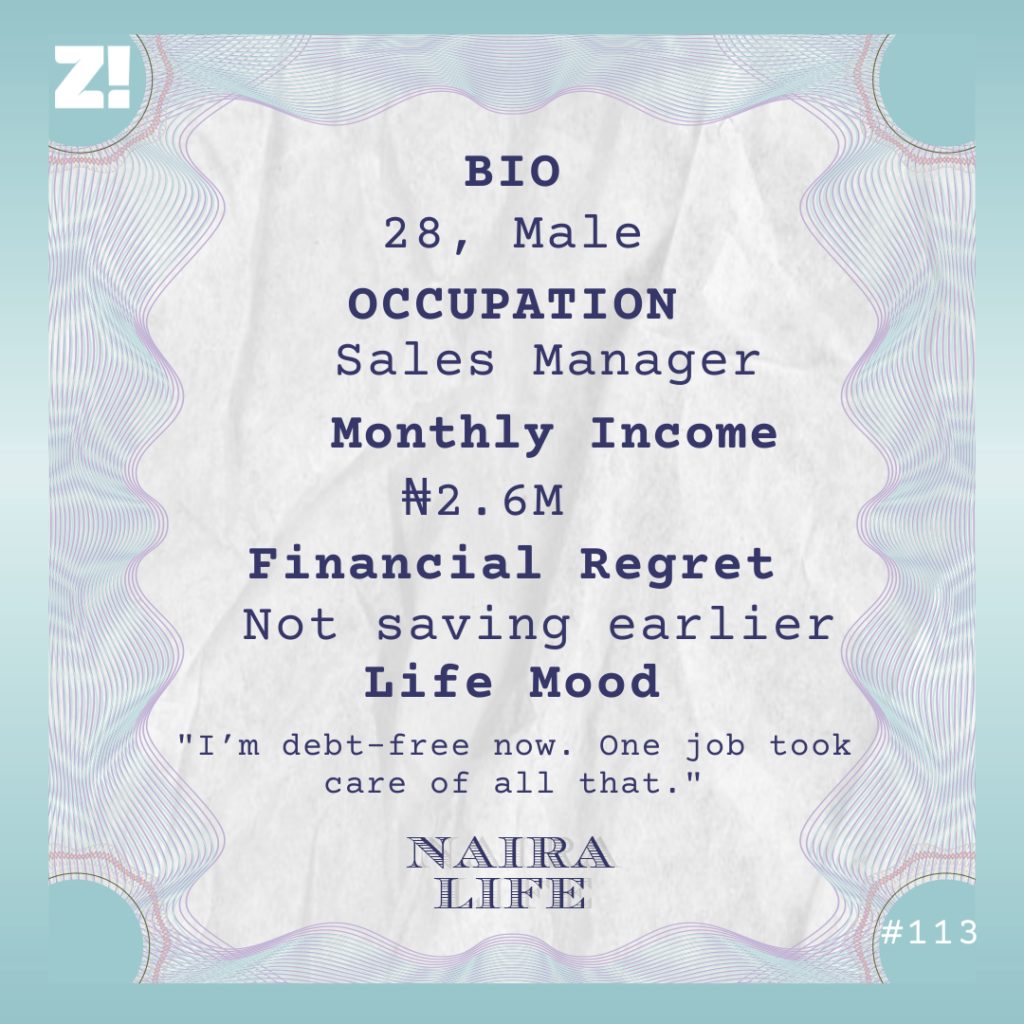
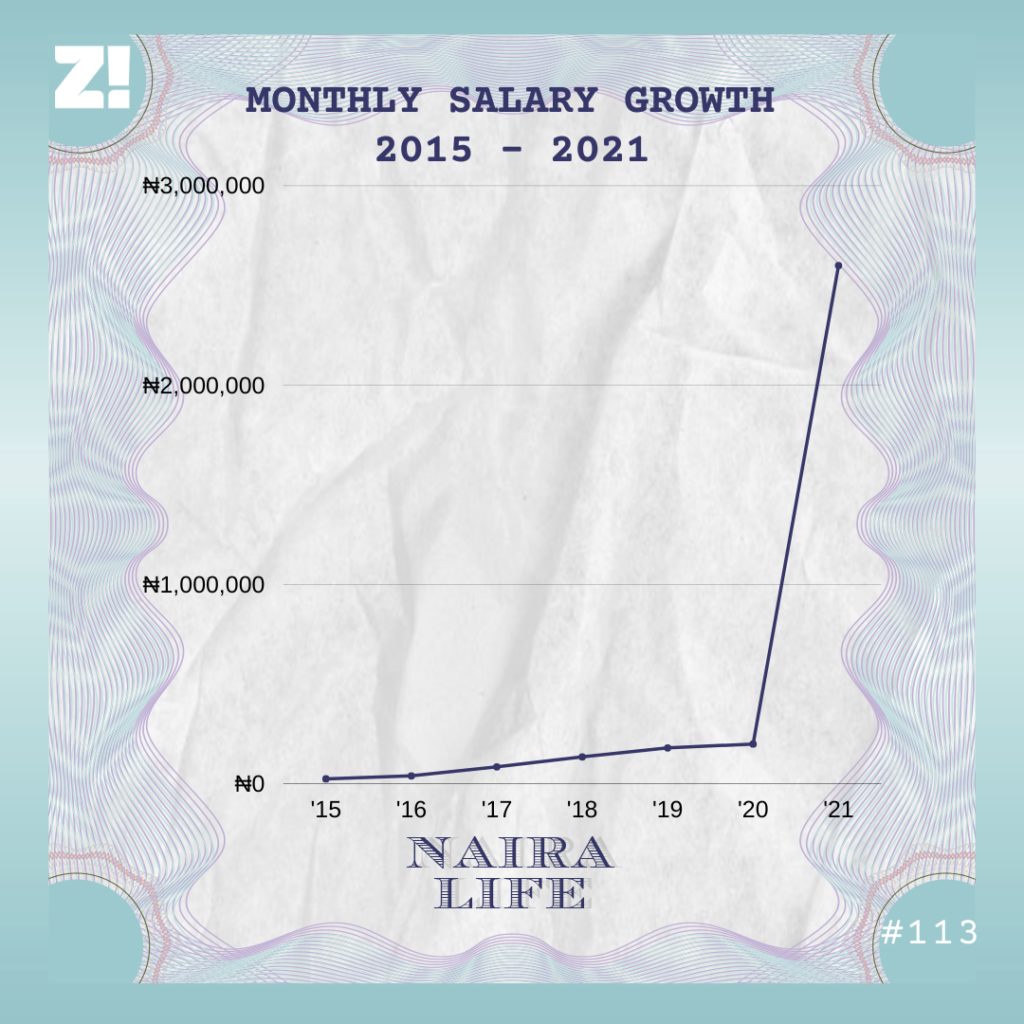
    Two of them are contract jobs, and they offered me 10% and 15% of my monthly turnover. The third one is a full-time job and I’m a country partner managing their markets in Africa and Europe. My gross salary is $8k per month.

    FROM 200K.

    Yup, it’s a massive difference. I started full operations in February, but I got $7k at the end of the month. Something about taxes. They are working on that since I’m not a tax resident in the country they work out of. But yeah, I’m currently earning about ₦2.6m from that job. 

    Mad. And the other two?

    I’ve not made anything from those ones. As I said, they are contract jobs and I’m only getting a percentage of whatever we sell. One of them is actually on hold right now because the company we were contracted to work for had some technical issues. 

    Omo. This is the part where we break down your monthly running costs. 

    I’m still living on my old salary. However, there are so many other bills to pay.

    I’m listening.

    Most of it revolves around family. There are projects that I’m expected to chest. And there are the additional emergencies that come out of the blue. My sister needed money for something recently, and I had to cough up ₦400k. I’ve never been able to save because of these things. When I was still earning my old salary, I used to save half of it at the bank and before the end of the month, I would have touched it. As a matter of fact, I only had ₦60k in my account a week before I got paid. 

    The first thing I did when I received my first paycheck at this new job was to clear all my debts, which was about ₦300k. Also, I spent ₦600k to take care of my traditional wedding expenses. 

    At least I’m debt-free now. One job took care of all that.

    That’s lit. Going forward, how do you imagine your personal finances will look?

    I have $3k left in my savings now. The plan now is putting 50% of my monthly earnings into that account and letting the money breathe. The other 50% will go into my monthly running costs and other projects. This means I can’t be chesting every little bill for my family anymore. I’m also starting my own family, and I have to think about that too. 

    Looking at your career now, how much do you think you should be earning?

    $15k. I’ve realised that I can’t take a job that pays in naira anymore. I expect to hit that figure soon because  I’m currently in talks with other companies. The plan is to get about two full-time roles and some contract gigs on the side. 

    That sounds like a plan. What do you think has made all the difference between the time you left your job and now?

    The quality of work I do. I’m all about the value I provide. Most of the jobs I got were through referrals. Also — and this is very important — the quality of information I had access to. I probably wouldn’t have thought of finding remote jobs that pay forex if I didn’t hear about them or the process involved from someone I knew and trusted. 

    That makes sense. What’s something you bought recently that changed the quality of your life?

    I spent ₦350k on a laptop and upgraded my iphone. Working has been a much smoother experience. 

    Haha. Anything you want but can’t afford right now?

    A car. My budget is ₦3.5m but I should raise that within three months.

    Do you have any financial regret?

    Maybe not saving as much as I should have tried to all these years. But I have an opportunity to remedy that now, and I will. 

    Rooting for you. On a scale of 1-10, how will you rate your financial happiness?

    At the beginning of the year, I was at a 2. I had more expenses than my salary could cater to, and it wasn’t healthy. But with everything that’s happened since that time and my new earnings, I can say I’m at a 9 ½ at the moment, and it’s the best feeling ever. Now we move to $15k per month. 

  • One recurring question everyone considering having kids asks is: how much does it really cost to have a baby. There are tons of hospital visits, tests and procedures. All of these things cost money and for the most part, a lot of Nigerians don’t have insurance. 

    For this aritcle, I spoke to six Nigerian parents and we attempted to break down what they spent on hospital bills and related expenses from conception to delivery. 

    Nike, 31

    “The hospital was okay but they were money-hungry and didn’t hide it. They billed us for medication even though we didn’t get them from their pharmacy. We spent close to ₦800k on hospital bills, and my husband and I paid for everything because neither of our employers provided health insurance. My babies are fine and healthy. No amount of money is too much for this kind of blessing.”

    Antenatal care: I registered at a public-private partnership hospital in Abuja and paid ₦60k to see a senior registrar. It would have been ₦40k if I saw a Medical Officer and ₦100k for a consultant. The fees covered the routine checks, basic urine tests and blood screening. I paid an extra ₦6k for an EKG.

    Childbirth: My twins were delivered through C-section, and the hospital charged ₦375k for that — it covered fees for the procedure, disposables, medication, and my four-day stay at the maternity ward. Before the surgery, we paid ₦12k to screen my husband’s blood to confirm it was okay for me if I needed a blood transfusion. I spent four days in the maternity ward, but my basic bill we’d paid took care of covered that.

    After the delivery, the kids were transferred to the NICU/Neonatal ward, and we paid ₦235k for their care. There were additional tests — I don’t remember the total bill for those but I know one of them ran into ₦15k. I spent four days at the nursing mum’s room while my babies were at the NICU, but I wasn’t charged for that because the hospital had overbilled me.

    Postnatal care: We didn’t spend extra at the hospital for postnatal care. The antenatal and delivery costs covered the 6-week postpartum routine checks, and I was fine. We would have had to pay for family planning, but I didn’t get on any birth control plan until much later. 

    Chinenye, 28

    “I feel privileged to experience pregnancy and childbirth. Every day was a learning curve, so I learned to cry when I felt like and celebrate the milestones and wins. “

    Antenatal care: I registered at a private hospital in Lagos. Registration was ₦10k. Each routine visit to the hospital after that cost me ₦5k — consultation and tests. There were 11 of those, so that sums up to about ₦55k. The drugs I used from conception to delivery cost about ₦46k. I also fell ill one or two times during the course of my pregnancy and had to go to the hospital, but I don’t remember how much went into those. 

    Childbirth: The delivery fee was ₦50k, which is fair for a private facility. The hospital gave me a list of supplies to bring with me and the total cost of that was about ₦20k. I spent five nights at the hospital after I had the baby, and bedspace was ₦5k per night, so that was ₦25k. 

    Postnatal care: We noticed mild jaundice in my baby and ran some tests, which cost ₦12k. In hindsight, that was unnecessary because it cleared within 3 days. 

    During delivery, I had lacerations and episiotomy, and that resulted in a lot of hospital visits for another year because the cuts didn’t heal as fast as they should have. 

    Also, I followed the immunisation schedule for two years. We weren’t charged for the ones given at birth. Subsequently, we paid for those, although the cost was subsidised. Each immunisation visit cost between ₦2 and ₦5k. This ran into about 45k. 

    Precious, 26

    “It was a peaceful journey. My family members were supportive and guided me through every step. It was also a rollercoaster of emotions.”

    Antenatal care: I registered at a private hospital in Lokoja, and the ₦40k fees covered my routine hospital visits and tests, two ultrasound scans and drugs. I bought 8 packs of Pregnacare at ₦5200 per pack, so that was ₦41,600.

    Childbirth: The hospital gave us a list of things to buy in preparation for delivery, and about ₦40k went into that. The delivery fee was ₦40k, but I paid an additional ₦50k for an epidural. 

    Postnatal care: We weren’t charged extra for this. The delivery fee covered for up to two weeks of postnatal check-up. Circumcision was bill, and we paid ₦5k for it.

    Juliana, 34

    “The whole experience took me by surprise. I always thought it couldn’t be that bad. But when I got sick in my first trimester, I realised that it was a big deal. My husband did his best, but I went through hell. I was the one who felt everything — the fear, the anxiety, and the love-hate relationship I had with the baby at that point.”

    Antenatal care: The registration fee at the first hospital was ₦160k. During the time I was there, I fell sick and my husband and I spent ₦92k on the treatment of Hyperemesis Gravidarum, Malaria, and Swelling. We left the hospital after three weeks because the staff was grossly unprofessional — one of the nurses pulled my husband aside and told him that she suspects that I may have cheated, and that was why I became ill.

    We spent ₦138k at the second hospital, and I was registered there for only a month. There were more complications and I wasn’t getting better. I couldn’t keep anything down and started losing a lot of weight. My husband was terrified and he thought it was best to transfer me to another hospital. The cost of hospitalisation, treatment of complications, monthly routine checkups and medication bills at the third hospital ran into ₦224k. My baby was delivered there. 

    Childbirth: ₦86k. We paid ₦15k for vaginal delivery. ₦30k for the episiotomy. ₦26,500 for supplies and ₦14,500 for medication. 

    Postnatal care: Post-natal care at the hospital cost us ₦0k. And there was an additional ₦7k for circumcision. 

    Charles, 31

    “Children are expensive.”

    Antenatal care: We registered my wife at a federal hospital and paid ₦50k for antenatal care and a ₦50k deposit. That was supposed to be it, but there were some complications around the time my wife was due and her blood pressure was high. The hospital wasn’t being serious about it, so we transferred to a private hospital. It was an emergency, and my wife’s and the baby’s lives are more important than money.

    Childbirth: The baby was delivered through C-section at the private hospital and the bill ran into ₦450k: ₦250k for the procedure, ₦100k for blood transfusion, and ₦100k for her 5-day stay at the hospital. There was also an extra ₦20k for an ultrasound scan. 

    Postnatal care: The baby had jaundice and we spent ₦50k on that. It was supposed to be ₦100k but the doctor gave us a discount. The first immunization cost ₦10k. After that, we returned to the federal hospital because most immunisation there are subsidised to the barest minimum in the first six months. Other rounds of immunisations since that time has ranged between ₦5k and ₦12k, and the total cost should be about ₦50k now. 

    Funmi, 27

    The whole experience was a mix of overlapping emotions for me — daunting, sad, exciting, overwhelming. 

    Antenatal care: I had just graduated from school when I got pregnant, and I had little income. I registered at a government hospital close to my parent’s house and that was ₦5k. It covered the registration card, routine checks, and drugs. The experience wasn’t great though — the service was slow and the nurses were shitty. The check-ups weren’t thorough, and if I complained about pain or discomfort, they dismissed it. Also, every time I went, I took ₦500 with me. I assumed that was for the medication I was given. 

    In my third trimester, there was a complication. I was having bad contractions and bleeding,  and it looked like my baby was going to be delivered prematurely. That would have been a disaster because I couldn’t afford the cost of incubators. I was eventually admitted to the hospital, and I spent ₦25k

    Childbirth: I was induced into labour. If the hospital hadn’t done that, my baby would have been delivered through C-section, and that was about ₦150k at the hospital. I paid ₦40k for delivery and medication. 

    Postnatal care: The vaccine at the hospital was supposed to be free, but they asked me to pay ₦500 for it. I stayed at the hospital for three days and paid ₦1k daily for bedspace. Three weeks after I left the hospital, I fell sick and returned to the hospital. I spent ₦11k this time. 

    QUIZ: How Many Children Should You Have?

    Take this quiz to find out.

  • As told to Toheeb

    I’ve been thinking about talking to a gambling addict for Naira Life for some time now, but I haven’t found someone who’s willing to share their story yet. Two weeks ago, while looking for people to interview for this article, a lady reached out to me. She wanted to tell me how she broke off her engagement with her fiance because he was a gambler. It’s not the Naira Life I’m looking for, but it’s the closest story I’ve gotten. So I had a long conversation with her and wrote this story.


    Jide* and I didn’t hit off when we started talking in 2012. We met on a social media group for prospective university students, and we were trying to get into the same university. On the group, we argued about something, and I thought his response was rude— I didn’t think we could ever be friends or that he would become the man I wanted to marry. 

    A few weeks after our spat, he got my BBM pin from a friend and texted me to apologise, which I didn’t see coming. We made up, and so our friendship began. We eventually got admitted into the same university we applied to, and we remained in touch in the following months until we resumed school. While nothing romantic was down the line, I thought he was really interesting. 

     We were in our first year the first time he told me he liked me, but I was in a relationship at the time. Things changed less than a year later. ASUU went on strike, and we got closer during that time, having more interesting conversations and texting more than usual. I had begun having issues with my partner. I was beginning to realise we wanted different things. I broke up with my partner in January 2014. 

    Jide still wanted more, and he didn’t hide it. He continued to ask me if I would be interested in a relationship with him. In February 2014, we started dating. 

    I liked Jide, but there were so many things I was oblivious to in the following years. 

    What I did know, however, was that he wasn’t as religious as I was. Also, he had a fraught relationship with his family. I’m big on family and religion, but I didn’t think they were dealbreakers. Besides, he knew how much I loved acts of service, and he pulled his weight in the relationship. When he graduated from university in 2017 — a year before I did — we had become so ingrained in each other’s lives and getting married was already on the table. 

    He served in the north and was hoping to be retained by the company he worked for. I had no plans to relocate, but I was open to the idea. We were going to get married after all. But he wasn’t hired as a full staff, so he returned home. 

    ***

    I graduated from university in 2018 and got a job immediately. I studied a medical-related course, so there was an internship waiting for me. After that, I went for my National Youth Service. I was working and had a steady flow of income, but Jide had nothing. The jobs he got offered so little, so he didn’t take them. 

    Everything was set for us to get married. The only thing that remained was a job.

    He finally got a job at a bank in the middle of 2019. He was accepted into a trainee program. As part of the requirements, he was supposed to get 10 new customers for the bank and had a target of ₦2m. He got 10 people to open accounts with the bank easily, but the problem was the money to put in these accounts. Family members helped, but he was still short of his target. 

    This was where I came in. My parents had opened an account in trust for me when I was young and had been putting money in it. I was older and had access to it now, so I took ₦700k out of the account and gave it to him. I wasn’t going to tell him about the money, but I thought the job was slipping away. Also, I got a friend of the family to loan him ₦200k. The plan was simple — he would spread the money across these accounts to meet his target and return everyone’s money when his appointment into the trainee program was confirmed. 

    When it was time to return the money, he didn’t. There was always some excuse about how there was a problem with the accounts and how he would have to go to a bank branch to sort it out, but he couldn’t because he risked losing his job if he missed a day at work. It didn’t make sense, but what could I do? 

    The family friend that loaned him ₦200k was on my neck to return the money, and when I couldn’t bear it anymore, I paid that debt myself. Now, Jide owed me ₦900k.

    The trainee program paid him ₦50k every month, but he said he couldn’t pay me out of it because of his financial responsibilities. His dad had died earlier that year, and he claimed his family now depended on him. According to him, he was paying his mum’s medical bills and also paying his younger sister’s school fees. This didn’t make sense because his older brother and sister had good jobs. But when he told me that they weren’t pulling their weight, I believed him. 

    On some level, I resented them for putting so much pressure on him. 

    Every month, he always called me for money even though he owed me close to a million naira. If his mum wasn’t sick, something else always came up. I wasn’t earning a lot — I got ₦19800 from the federal government and ₦25k from the hospital I worked at — but his obligations were costing me a lot of money. At this point, I was getting irritated, and I felt guilty for it.  

    Jide finished his trainee program in December 2019 and was promoted to full staff. His salary also increased from ₦50k to about ₦130k per month. This was supposed to be the moment everything got better, but it got worse. I continued to bring up the accounts he opened a couple of months earlier and the money he owed me. But he said that he couldn’t access those accounts yet. Again, I believed him.

    Things started to go downhill in January 2020. I was at work when he called me and started crying over the phone. He said he had a confession to make and would like to tell me to my face. We agreed to meet the following day at my house.  

    When we met, he first made a big speech about how he wanted to do right by me. Then said something about how he was in trouble and needed my help to get out of it. Finally, he went, “I’ve been gambling, and I owe some people money.”

    He told me that he started gambling after he finished his NYSC in 2018 and was out of a job. He had been borrowing money from his friends, and now, he was in more than ₦250k debt. 

    It was quite a revelation, but I gathered myself. The first thing I did was to grab my laptop and create an excel sheet. I got the details of everyone he owed money and made a plan about how to return their money from his salary. I was going to be in charge. The plan was to keep his interactions with them to a minimum. 

    That’s what we did in the first and second months. When he got his salary, he sent the money to me and I contacted the guys he owed and paid them. We cleared half of his debt in two months. I also signed him up to a free anti-gambling support group online and started reading up on psychotherapy, so I would know how best to help him. For the first time in a long time, it felt like we would actually make it. 

    ***

    Our families met each other officially in February 2020 to talk about our wedding plans. I was applying to schools abroad at the time and the plan was that if I got the offer, we would do a small wedding ceremony before I travelled. That didn’t happen because I didn’t get the offer. I didn’t know it at the time, but that was a blessing. 

    In March, the pandemic forced his employers to cut his pay, so we suspended paying back the money he owed. One morning, he called me, crying over the phone again.  He said that his friends were threatening to embarrass him at his place of work, so he took a ₦200k loan from a co-worker to clear that debt. I didn’t know what to make of that. His debt profile kept rising. I could’t believe it.

    Things came to a head in June. I got a call from his sister. He had been arrested by the police on his way from work for violating Covid-19 curfew. His family sent some money to him, but he was asking for more. When I called him, he said he was in the back of a police van and needed ₦30k, which I sent to him. 

    His sister was livid about what happened, so she lodged a complaint at his office. The bank launched an investigation as to why he was at work when he shouldn’t have been. What they found culminated into a tipping point that made me doubt everything he ever told me.

    The bank found some inconsistencies in his work. But the biggest thing they found was how he had been gambling with some of the bank customers’ money. He’d call them to tell them that they were eligible for an investment opportunity, and because he was their account manager, they trusted him. He would then send them a payment link and ask them to authorise the payment. He got away with it for so long because the money wasn’t running directly through his account. When the bank found out, they fired him. 

    The bank didn’t take further actions against him. One of those people he scammed arrested him, but he was released later. They agreed that his family would sell their home to offset the debt he owed. 

    More information started to come to light. I found out that he had been lying all this time about sending his family money. They never asked him for anything. Also, he had been asking one of my brothers for money and making it seem like I knew about it. There were other revelations too, and I realised I didn’t know a lot about him. 

    My parents took this harder than I did. I mean, this was the man their daughter was going to marry. They called his mum and told her that the relationship was over. That’s what I wanted too, so I broke off our engagement.

    After he lost his job, he was at a low point, sought out help himself and got a therapist. When the therapist heard the whole story, she insisted on speaking to me. I offered to remain in contact to get him through it. The therapist had told me that he was suicidal. 

    But I couldn’t. It was almost like I didn’t know him anymore. For starters, he was unapologetic about the mess he made. He was only sorry that he got caught. Also, he would call me randomly to make money demands even though he owed me money. He was being manipulative too, trying to make it seem like my parents broke our relationship and not all the things he had done in previous years. At the end of the day, the decision came down to me choosing between my sanity and the money he owed me. I chose my sanity and cut him off. 

    It’s been a few months since all of this happened. Right after it happened, I couldn’t bear the thought of a new relationship. In November, I met someone, and things are going really well. Sometimes I wonder what would have happened if we’d gotten married when we wanted to. It would have been messier, but I know that I would have used everything I had to leave the marriage. It was a good thing that everything came to light when it did, and I’m happier for it.

    QUIZ: How Good Are You With Money?

    Find out here.

  • Every week, Zikoko seeks to understand how people move the Naira in and out of their lives. Some stories will be struggle-ish, others will be bougie. All the time, it’ll be revealing.

    The lady in this story is quite young, but frankly, that’s not the most interesting thing about her. It’s how she started photography as a hobby and followed through till today.

    Five hard years, long YouTube hours, a couple of projects later, here’s what her #NairaLife looks like.

    Let’s start from the beginning. What’s your oldest memory of money?

    When I was in Primary 2, my dad started giving my siblings and me pocket money for school. He thought we were too young to handle money, but we begged. We didn’t need the money; we just thought it would be cool if we could join the queue to buy stuff from the vendors at school during the break period. He started with ₦5 and increased it over the years. 

    Haha. Do you remember the first thing you did for money?

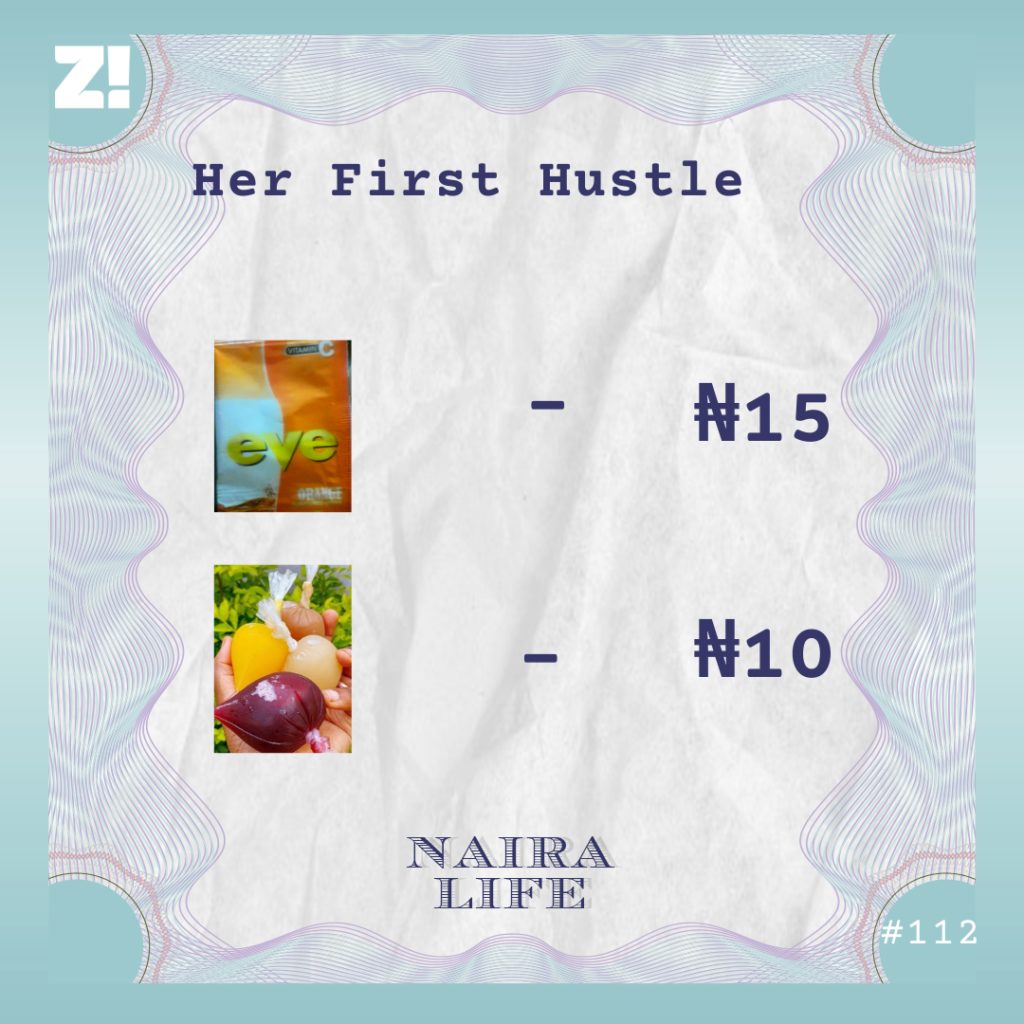
    In JSS 1, I started making this flavoured drink solution — Eve — and sold it to kids in my compound. I bought a sachet for ₦15 and sold a cup of the drink for ₦10. I made up to ₦200 from that.

    It was going well until my mum woke up one day and went “If you continue with this, you won’t be serious with your books.” She collected what I’d made to keep for me. Well, we know how that goes.

    Lmao. Speaking about your parents, what did they do?

    My dad had a printing business, but he left Nigeria for the UK when I was five years old. This was 2004, and we didn’t see him for about five years after that. One day, my younger sister told him on the phone that she wouldn’t recognise him if she saw him. This triggered him, and he took the next flight home. He’s into a bunch of things in the UK but he comes home at least once every six months now. 

    My mum sells clothes and other materials. At first, none of them wanted us to be involved in the business because they didn’t want us to mix with the crowd of people where her shop was. We moved into our home when I was in SS 1and my mum found a new shop close to the house, so we started helping out.  It was fun at first, but before I finished secondary school, I wasn’t so keen on helping her at the shop anymore. My younger sister was more interested in the whole thing and I didn’t hear the end of it. 

    What was the next thing you did for money?

    I don’t know if this counts, but I got a job as a teacher right after I finished secondary school. I didn’t last up to two days there.

    Haha. Why?

    Those children were stressful. They wanted to pay me ₦5k and they wanted me to be teaching all subjects. I wasn’t down for that.  After my second day, I told them I was done. 

    What happened after that?

    I went to university. My allowance was ₦10k at first, then it increased to ₦15k. In my first and second year, the only thing I cared about was my studies so I could graduate with a 2.1. It’s funny now because I was hardly in school in my third and final year.

    What changed?

    I found something more interesting. Photography.

    Let’s back it up, how did you get into this?

    In 2016, I met someone on Twitter and during one of our conversations, he asked if I had anything I was interested in. I told him I’d like to capture moments but I didn’t have a camera. He advised me to start with my phone. 

    I started taking photos with my phone and putting it out on social media. Slowly, my follower base grew. Later that year, the same friend asked me if I would be interested in working for a smartphone company. I would take pictures with their phones and share on social media. It was a micro-influencing kind of gig. Of course, I was interested. A month later, the company set up a meeting with me at their office. I was hired and offered ₦50k every month.

    Lit. 

    I decided to give professional photography a chance and see if it would work out. I saved for six months and bought my first professional camera — a used Canon 650d for  ₦150k. I had a community of photographer friends, and I put the word out that I was looking for gigs. I got my first job in less than 24 hours after I bought the camera. 

    What was it about?

    I assisted a photographer at an event and he paid me ₦25k. Immediately I got the money, I spent ₦16k on an external flash.

    Two weeks later, I got another job, which paid me ₦50k. Then other jobs started coming. The first photographer I worked with was a major plug. He always called me back for jobs until we shot at a wedding and lost all the pictures. 

    Omo.

    I still have no idea how that happened. It was a stressful experience. The client threatened to lock us up and all that. I would wake up in the middle of the night and start crying. I think the guy even travelled out of the city for a few months until it blew over. 

    We move.

    After that, I focused on portrait photography. Though event photography paid more, I was still in school, and it was a struggle going out every weekend to do a job. 

    With portrait photography, people were booking me to handle their birthday shoots and stuff like that. I charged an average of ₦6k-₦7k per look, but it was a lot of work for little money. If they didn’t complain about the price, they would have something to say about the pictures. I realised that I couldn’t make a lot from that. Shooting videos looked more promising, so I thought it would be cool to learn and combine both. 

    How did you learn how to shoot videos?

    I watched a lot of YouTube videos. Also, I was in my third year at this time and there was this long strike. I got a job as a behind-the-scenes photographer on a cooking show. Then their video guy travelled out of the country, and they asked if I would like to try shooting their videos. I took up the offer. That started my transition into videos.

    How much were you being paid for that?

    Nothing. But they gave me a chance to learn on the job and paid for the logistics. It didn’t matter if I was being paid because I was also doing photography on the side and making an average of ₦80k every month. 

    Ah, I see. 

    It didn’t take long before people noticed my work on the cooking show. I started getting small video gigs. I think the first one I worked on came from someone in the cooking show crew. They hired me to work on another project they were on and paid me ₦70k.

    The other video projects I worked on doing the time paid between ₦50k and ₦100k. But I wasn’t good at editing and was outsourcing it. The ginger to take video editing seriously came in 2018. I had shot an Independence Day video for the cooking show, but they couldn’t send the cuts to the regular editor. They asked me if I could just do it, and I downloaded Windows Movie Maker on my laptop. YouTube got me through it. Omo, I spent four hours editing a one minute video. In the end, they liked what I did. 

    Mad.

    The rest of 2018 was pretty much about sharpening my editing skills.I bought a new camera and upgraded my laptop in 2019. I also invested in a couple of other gear. In that year alone, I spent about ₦1m on gadgets. Once I got paid for a job, I made sure to buy something I needed for work. I’m not sure a lot happened in 2019 except that I graduated from university and went all-in on personal projects.

    I’m listening.

    I did a short film at first and spent about ₦500k on it, but it didn’t bang the way I thought it would. The next project I worked on was a documentary, which I co-produced with someone. That one did considerably better. It was selected for short film festivals, and we had private screenings. Suddenly, people were reaching out to me for interviews.

    Did you make any money from these projects?

    No. But they were worthy additions to my portfolio. Also, I made sure to share everything I worked on and tried to be visible online. 

    How did this affect your earnings in 2019?

    I was making an average of ₦150k on a project, though I was investing a lot of it back into my craft. At the end of the year, I had saved about ₦300k. 

    Impressive. 

    2020 was weird in the beginning. I went for a vacation in March and the country went into lockdown the week I returned. 

    That meant you couldn’t work.

    I couldn’t oh. A lot of brands weren’t even interested in video projects anymore. They pivoted into motion graphics. I was stuck at my parents house, broke and tired. I did something for an American brand during the lockdown in April  $500. That  was the only thing I worked on for about three months. I didn’t even get paid until July.

    How much did you have in savings before the lockdown?

    About ₦1.2m. However, I wanted to get an apartment and had sent ₦1m to a friend. 

    So I had ₦200k in my account. When the lockdown was lifted, I had only ₦70k left. Most of the money went into paying for food and the internet. 

    Luckily, I was hired to shoot and edit a TV commercial for a brand immediately after the lockdown and they paid me ₦400k. That kicked things off. I got a mini-flat for ₦750k in July 2020 and moved out of my parent’s house. I’ve spent an extra ₦600k on purchases and renovations since that time. Tears!

    Lmao. What happened in the second half of 2020?

    It was the best. The jobs kept coming in. A big brand here, a small business there. The interesting thing was that I didn’t have to spend money on logistics on some of the jobs I was getting — the companies that hired me took care of those, which was great for me because these logistics expenses always took a chunk from my earnings. I got one that paid me ₦750k and another one that paid ₦1.9m. 

    You were charging more to work on projects. How did this happen?

    The quality of my work had gotten better, and I had gotten better at self-promotion. I was sharing every project I worked on social media. That made the difference.

     I didn’t have to look for new projects to work on. Most of these new clients were referrals or people who had been following me for some time. I was getting emails like, “I think you might be interested in this project. Are you free to work on it?” I guess that gave me the leverage to negotiate what I wanted. 

    Of course, I was still investing in gadgets. I bought a drone for ₦600k in September. It was my biggest work purchase last year. 

    Nice! What did your finances look like at the end of the year?

    I had about ₦3.5m in savings. I took ₦2.6m out and bought a car.

    How did that feel?

    I felt proud of myself. I’d been planning to get one since the beginning of the year because I was spending about  ₦100k on Uber every month. I even had an Uber guy who drove me around whenever I had to go out, and I paid him ₦15k every day I needed him. 

    My parents were just beginning to accept that I wasn’t living in their house anymore when I bought the car. When I moved out, they were like, “Go and see the world and come back home.” They definitely didn’t expect that a car was the next thing for me. They were proud, but they were surprised too. 

    I get that. I think you’ve come a long way between 2016 and now. What’s 2021 looking like for you?

    I was working on a photography project for an American company at the beginning of the year. It was supposed to pay me $10k, but they suspended the project halfway. I only got $4500. I started working on other projects at the end of January. There was this four-day project I worked on that paid me ₦850k. I’m currently working for a production company, and I’ll be paid ₦1.1m for it. 

    I still get the ₦200k and ₦300k jobs, but they are far and in between. And when they come, I probably just pass them off to my assistants.

    I’m coming to accept that I deserve the money I charge. I know the work and I’m an all-rounder — I’m good with cameras and drones. I’m good at editing. Clients like to work with people who can do everything effectively. I’m that person. 

    Energy! Can we break down your monthly running costs?

    I started paying myself ₦120k as a salary at the beginning of the year to control my spendings. 

    I don’t pay black tax, but my parents could call me and ask me to buy something in the house or loan them money they won’t return. I spent about ₦400k in money gifts for my family in December last year. At the beginning of the year, I decided to see someone through school. I give her about ₦25k every month. 

    What about savings?

    I currently have $4500 in my domiciliary account and ₦1.5m in my savings account. The total should be about ₦3m-₦4m.

    Are investments your thing?

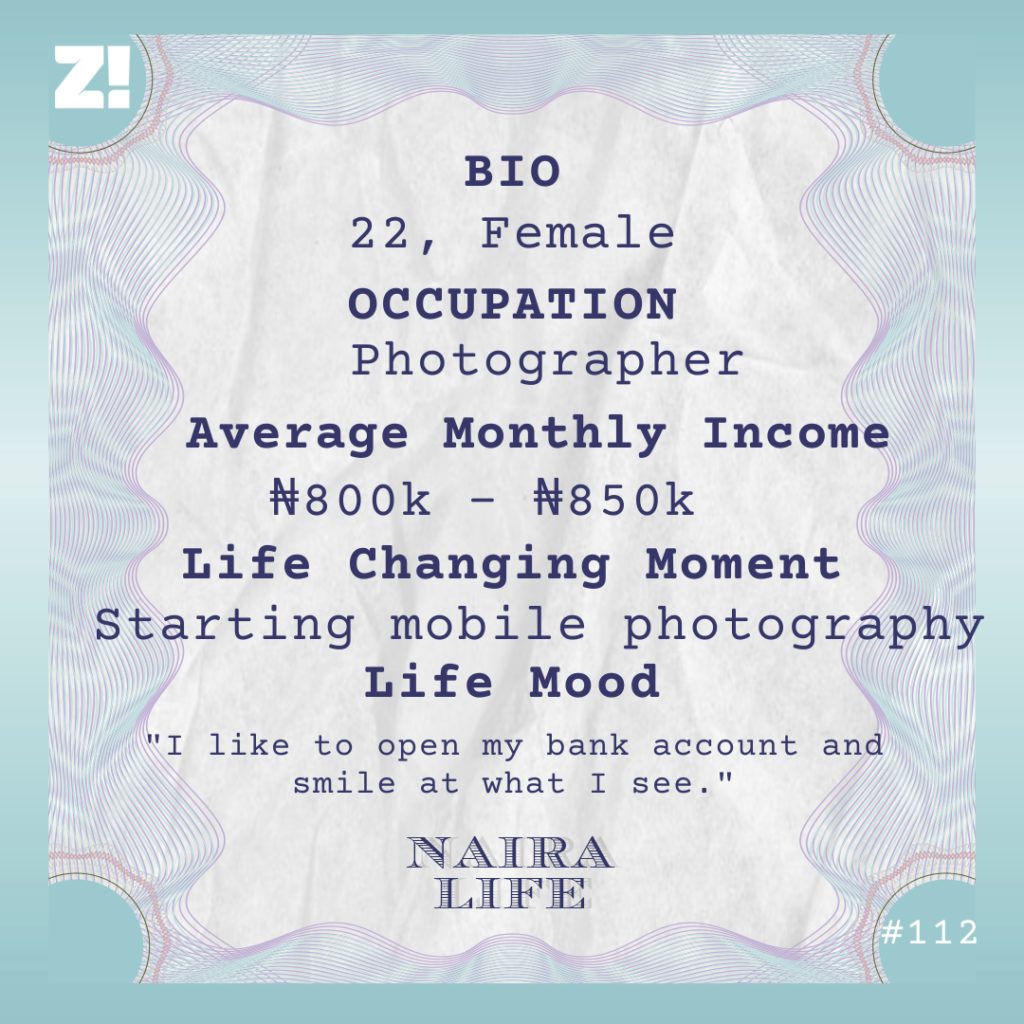
    Lmao. I invested ₦250k in cryptocurrency recently. The thing dipped the day I put the money in it, and it was like that for a week. The money is still there, and I won’t touch it. However, I like to open my bank account and smile at what I see. 

    What aspect of your finances do you think you could be better at?

    I could be more prudent at spending money. I’m a fan of “problem no dey finish”, but it would be great to stick to a budget. I could literally spend my last kobo on food or wine. 

    What’s the largest amount you’ve spent on food at a time?

    I took someone I liked on a date once and the bill was ₦40k. I’ve done that three or four times now. 

    What do you think the next five years will look like?

    I don’t want to be in Nigeria. I’d like to work with a company like Netflix and handle their post-production or working with a global production company. Also, I’d like to build my own production company. I registered it in 2019 but recently started putting some structure around it. So I have to work on classic projects and invest more in myself and other people. I love investing in people. I think it makes everyone’s lives easier in the long run. 

    Love it. Back to the present, what’s something you want right now but can’t afford?

    In the short term, a vacation. I spent ₦650k on my last vacation. I’m thinking of going to Europe this year, and my budget is ₦700k. I don’t have that kind of money at the moment, but I hope to raise it soon. I also want to go to film school — New York or Vancouver. The tuition alone is about $25k, so I imagine I need about ₦10m – ₦15m  to make it happen. 

    What’s the last thing you spent money on that significantly improved the quality of your life?

    My car. I also bought a new camera in January for ₦1m. Normally, I used to rent the camera for ₦25k per day when I needed it for projects. Now, I don’t have to. 

    On a scale of 1-10, how would you rate your financial happiness?

    It’s between 6.5 and 7. I have a lot of anxiety about when I’ll get my next job or if it will even come, which is funny because I have gone from charging ₦200k per project to at least ₦700k-₦800k in a few months. I’ll feel better when I work with all the brands I want to work with or execute foreign projects in Nigeria and get paid in dollars. Nobody deserves to be broke in this country. 

    How has your skillset evolved over the years?

    2016 — Started as a mobile phone photographer. Got my first gig with a smartphone company.

    2017 — Transitioned into professional photography.

    2018 — Started learning cinematography and editing. 

    2021 — I’m thinking of learning animation and design. I’m getting bored.

    Got it. Last question. How old are you again?

    22.

  • Conversations about money are not exactly fun. And I imagine that it’s harder for couples to have these conversations although they are very important. I was musing about how people in relationships navigate this and manage their finances, so I spoke to five people about it.

    Uche, 33, Male, Married

    I’ve been married to my wife for a year, and it’s still hard to have conversations about money. I earn more — about  $2000 every quarter — although my income at my research job is unstable. My wife grew up around money, but I’ve had to work for money all my life. She’s only just coming to terms now about how low her federal government job pays.

    There are people who believe in managing their finances with their partners. My wife isn’t one of them. She’s always like “My money is my money but your money is our money.” I would love that too, but I can’t afford to live that way just yet. Besides, it doesn’t follow the principles of the egalitarian family we’re building.

    Also, she has access to loans and I’d like us to deal with those first, even if it means cutting down on expenses. But my wife thinks living below a threshold is impossible. Deep down, I feel like she deserves a richer guy. Sadly, my priorities are not in maintaining any social status. This difference is fundamental to our financial disagreements, which are mostly heated arguments. 

    Things have been a little better since I decided that it’s better to let her spend her money the way she wants and I spend mine the way I want. I think there’s still a chance for us to find a middle ground. We’ve only been married for a year. Life will teach us. 

    Joy, 27, Female, In a relationship

    I’m just starting out, and there’s only so much my ₦50k salary can do. My partner earns about ₦300k every month and she works on other projects. The commission she gets from these things run into millions of naira.

    She’s generous to a fault. She could send me ₦200k out of the blue or randomly buy me a ₦50k perfume. This shouldn’t be a problem, but it is. I feel like I’m dependent on her, and it bruises my ego. It doesn’t help that I have to think of a gift to buy for her every month from my salary. 

    We fought and broke up a couple of times in the first six months of our relationship because of this. I couldn’t talk about the things I wanted without her assuming that I was using “style” to ask her to do them for me. I thought it was disrespectful that she would think that there was an undertone to half the things I said. But we always found our way back to each other after our breakups. 

    Things are much better now. She’s working on a personal project, and it’s sucking her resources. Don’t get me wrong: I want her to have money but I’m happy that she’s channelling her money into something that will benefit everyone in the long run. I give her moral support and help her make decisions about the project and we’ve never been happier. 

    However, I wish I could lower my shoulder pads and accept that it may be her love language. Most importantly, I wish to earn half as much as she does so that we can both spend money on each other. 

    Tunji, 37, Male, Married 

    I make between ₦400k-₦500k every month. My wife earns considerably less — about ₦80k. But it’s not a problem. I love taking care of the family’s financial responsibilities. I’ve been doing that since I was 18. 

    I don’t share bills with her or ask her questions about how she spends her money. Fortunately, we live in our own home, so rent is not a problem. I take care of the children’s bills and give her an upkeep every month. But I know that she augments what I give her from her purse. 

    Although she thinks I have millions locked away somewhere, we don’t argue about money a lot. This only happens when she spends money on unreasonable expenses like going over the budget for utilities or spending a lot of cash on children’s clothes that won’t fit in five months. I’m pretty respectful of money and the comfort it provides, so I’m uncomfortable and pissed when I think she’s not being careful with money. 

    My wife likes to go YOLO with her money, but I think it’s my duty to guide her and teach her how to manage her finances. I recently started teaching her how to save and invest. I’d like her to be more financially responsible. It’s a journey, and I think she’s making progress. 

    I love to provide for my family without necessarily asking my wife for help, but I won’t be raising my son that way. I’ll teach him to cut himself some slack and ask his partner for help if he needs to. 

    Adebola, 39, Male, Married 

    My wife is self-employed, so she doesn’t have a regular income. I place her on a monthly salary, which she gets when I get paid. Also, I stock the house with food and pay the monthly bills. I like her to spend what she makes on herself, and that’s why I take care of most of the bills. We agreed to this arrangement before we got married six years ago.

     I try to be honest as much as possible about money with her. If I need to do something that will negatively affect my finances, I let her know. Our relationship is all about communication and understanding. 

    We have little disagreements about money from time to time, especially when she’s broke and has an urgent responsibility to meet. It’s not good all the time. However, we talk about it and reach an agreement.

    Sometimes, I wish she has a good job and a regular stream of income so she can be in total control of her finances. This will actually make my life better too.

    Tokunbo, 24, Male, In a relationship

    My partner and I had different experiences of money growing up, and it affects the way we both manage our finances. I grew up with a silver spoon until my dad made some bad investments, and I had to adjust to a new reality. My girlfriend, on the other hand, grew up around market women, so she believes that you can always make what you spend, as long as you keep working. 

    I’m the planner in the relationship — I’m always thinking about how much we have to make before the end of the year and what we can afford to spend money on by that time. I also try to make her understand that we don’t need to spend money on what we don’t necessarily have to. She’s a nice person, and she likes to help people out a lot, so she’s prone to be taken advantage of.

    She’s not a big fan of how calculative I am, but man, I hate not having money. However, she listens and understands where my heart is — we both do. It would be great if I could plan less and do more and if she could be less generous with money. 

    QUIZ: How Rich Is Your Soulmate?

    Find out here

  • Every week, Zikoko seeks to understand how people move the Naira in and out of their lives. Some stories will be struggle-ish, others will be bougie. All the time, it’ll be revealing.

    The subject of this story first got published in 2004. A lot has happened since that time, and most of it is about employers and publishers not holding up to their end of the deal. Now he’s taking a crack at building his own publishing company. But how did he get here? 

    What’s your oldest memory of money?

    That would be the allowance I got from my parents growing up. But the awareness really came when I got into university and published two children’s books in my first year at university. I was 19 at the time. 

    How did you get into writing?

    I had friends that loved reading and writing. We were bookworms. I also got lucky. When I was 17, an extended family friend started a publishing company,  and someone in the family suggested that we worked together. The man asked me for a sample of my work, and I sent him some — which were terrible — but he liked them. After that, he gave me a story pitch and told me to write around it. He liked what I did and signed me to his publishing company. 

    Ah, great. Back to those books. 

     I published the two books in 2004 and got ₦8k in the first wave of royalties. My dad insisted that I bought shares at a bank and ₦5k went into that. I also paid ₦800 in tithes at my church. I’m not sure what happened to what I had left, but I remember that I bought gifts for my parents and my girlfriend at the time. 

    What came after?

    One of the books was selected by an international organisation for a project they were working on at the time. They bought 1000 copies and distributed them across libraries in Nigeria. 

    Interesting. How much did you make off the book in subsequent years?

    2005: ₦45,000

    2006: ₦25,000

    2007: ₦20,000

    2008: ₦10,000

    After the fifth payment, the publisher stopped paying me. The demand for the books had decreased, and he complained that people owed him money. In the middle of this, we had a fallout. He had some of my manuscripts he was supposed to publish that he didn’t, so I collected everything back. 

     That’s rough. 

    Yeah, I know. I finished university in 2008, went to serve in the north, and got a job at an insurance company. I got ₦30k from the company plus  ₦9,775 from the federal government. I worked in three departments — admin, IT, and marketing. But I enjoyed the perks of working in marketing. I made between ₦2,000 and ₦3,000 every week on commissions alone. 

    The company also gave me a furnished apartment. I lived on my commissions and put the remaining money in my savings.  By the time I finished service in 2009, I had saved about ₦1m. 

    That’s impressive.

    After NYSC, I got a job at an IT firm in a state in the south-west. They were supposed to pay me  ₦45k every month. I spent three months there and wasn’t paid once. Their excuse was that there were no sales, so they weren’t making money. 

    Omo.

    The only reason I stayed that long was because I wanted to learn more about system engineering and cable TV installation. After I left, I went out on my own and ventured into the same services the company provided. My dad has a company, and I’m a director there, so I used the company to get jobs, mostly cable TV installation. 

    How much did this bring in?

    In good months, I made nothing less than  ₦10k per week, especially if the cable TV companies were running a promo or a price slash. Things were even better during Christmas — I could conveniently make ₦10k  in a day. But when there was low activity, I could make the same ₦10k in a month. I made about ₦300k  in that year alone. 

    I got job offers in the following year, but I didn’t accept them because I was working on my first novel. It was published in 2011. 

    Lit. Tell me about that.

    It was a young adult novel. I self-published with a publisher in the UK, and the whole thing cost me about £600. I also submitted it for the Commonwealth Book Prize, and although I didn’t make the shortlist, I got a notable mention. 

    Aw.

    In 2012, I wanted to do an MFA in the UK or go for a postgraduate management course at a Nigerian university after that. I got both offers, but my dad didn’t agree to sponsor my MFA, so I went to the Nigerian university angrily

    I finished my masters in 2014 and got my next job as an admin officer at a security company. The salary was ₦50k, but when they didn’t pay me at the end of my first month, I jumped ship. I got another job immediately at a real estate company in the same building. My salary there was also ₦50k.

    Wait, same building?

    Haha, yes. My previous boss obviously wasn’t happy with it, but it was a good move for me — I actually had a job to do and was being paid for my troubles. 

    Oh, I also got a Nigerian publisher who was interested in publishing the Nigerian edition of my novel in the same year. We agreed to a part-publishing deal. 

    How does that work?

    The publisher splits the production cost and royalties with the writer. The production costs for my novel was ₦400k, so I brought ₦200k and he raised the other half. 

    I see. 

    The publisher made a lot of noise about his plans for my book, but he didn’t pull his weight. When I got tired of waiting, I stepped in and took the book to bookshops. My cousin gave me the biggest boosts — she worked at a bank and took copies of the book with her to work. A copy of the book sold for ₦1k, and I sold about 100 copies.

    There is a  digital edition of the book too. We built an app and hosted it on digital stores. ₦400 airtime unlocks the content of the app, and I get 70% off every purchase. I made about ₦50k in digital downloads in the first year.

    And the publisher?

    I have no idea how many copies he sold till today. We printed 1000 copies, so I took 500 copies off his hands and left the rest with him. 

    How much have you made on that book since 2014?

    About ₦250k, and I still get some ₦10,000 per year on digital sales. I stopped promoting the hardcover, so nothing comes from it anymore. 

    Got it. Back to your 9-5?

    I was at the real estate company until 2015. I was due for promotion and the general manager role opened at the time, but my boss passed me over and brought in a new person to fill the position. It didn’t sit well with me, and I resigned immediately. I didn’t work at another job until five months had passed. My next job was at an entertainment company, and it was also an admin role. They actually did a lot of things, but events and logistic management were their biggest drivers. Another division of the company handled Merchandise-In-Trade businesses. I was hired to work in both divisons. My salary was ₦60k.

    I’m curious, what’s Merchandise-In-Trade about?

    You see those branded trucks loaded with drinks you see on the road? There are companies who manage them on behalf of the bottling companies and ensure that the products are distributed. The company I worked for managed these trucks for a bottling company in a state in the south-west.

    Interesting. 

    When I started working there, I had 28 people under me. The job meant that I had to be on the road all the time to make sure everything ran smoothly. I also had to return as fast as I could to handle the entertainment division of the business. 

    That sounds like two jobs. 

    It was. The good thing was that I made more money in bonuses from the MIT job — an extra ₦100k – ₦120k every month. 

    How did your role evolve?

    The company had a very good year in 2016  and performed better than the other MIT companies working for the bottling company, so they gave us two more states. I was put in charge of those states, bringing the number of states I managed to three. The number of people I managed grew from 21 to 110.

    That was more work, but I didn’t get a raise, which was confusing. I requested for my payslip and found out that my basic salary was supposed to be ₦200k. I confronted my boss, and he tried to sell me a story about how there were more expenses than revenue. I didn’t buy it. I resigned from the job. It was about time too. 

    Why?

    I was working long hours from Monday to Sunday, so my writing suffered. I decided that I wouldn’t do another full-time job if it wasn’t related to writing. I didn’t get a job like that between 2016 and 2017. However, my experiences with managing events at my previous job came in handy during that time. People started reaching out to me to plan their events. 

    I charged clients 10% of the total cost of the event as my service fee. But at the end of each event, I usually got more than that because I had necessary contacts and vendors and leveraged these relationships to get discounts. 

    On average, how much did you make from each event you planned?

    It wasn’t a lot and depended on how big the event was. There was a time I made ₦200,000. There were also times I made ₦50,000 and ₦10,000 on a job.  My biggest payout was ₦900,000 from two events I did back to back. This got me my first car, which I bought for ₦650,000. 

    Lit. What happened after?

    In 2018, a friend called me and said he was starting a publishing company and was looking for writers to work on his first book project. After he explained what he wanted to do, I offered to come on board and help him kick things off the ground. I joined the company to manage a small team of four writers at ₦50k per month. I didn’t care about the pay because I had another stream of income. However, I didn’t know that I was making a mistake.

    What happened?

    He didn’t have a blueprint for his business or provide all the things he promised to ensure that the project ran smoothly. Then in April 2018, he decided on a whim that he wanted a break from the project, and that was it. Everyone on the team left. 

    Omo.

    I knew I wanted to set up my own publishing company, so I started the process soon as I left that job, and it took about four months. Later that year, the same friend reached out to me again and asked me to lead a bigger team. The direction had changed too. Now we would be ghostwriting academic books for other publishers. 

    Sounds interesting. How did this affect your salary?

    It increased from ₦50k to ₦70k. Things were more structured this time too. There were more people and more roles, which gave me room to focus on managing the other writers. It was exciting at first, then I started having problems with the boss when I got a publishing deal. 

     Let’s start with the publishing deal.

    I’d been in talks with the publisher for a few years. I sent the manuscript in 2015, but we agreed on a deal in 2018. So, I signed the book contract and got an advance fee. 

    How much was it?

    ₦50k.The deal was that the publisher would hold the rights to my book for five years. If a contract renewal doesn’t happen, the rights return to me and I can take it elsewhere. But in those five years, I’m entitled to 10% of the net sales as my royalty. 

    The deal was finalised in September 2018, and I had to go to a literary festival. My friend, who was now my boss, was not happy that I was going away for a week. When I came back, he started acting off. 

    I didn’t care so much about that until he started changing the direction of the business every week. 

    We could be working on a math textbook this week, and he would come in the following week and ask us to start working on a math comic book. It was a lot but I had just registered a company in an industry that isn’t very profitable. I stayed for as long as I did because I wanted to see how he made money from his business. 

    When did you leave?

    2019. I travelled for a book tour in August to promote my book. While I was away, my boss had a meeting with the staff. I don’t know what he said to those guys, but everyone turned in their resignation before I returned. When I heard the news, I knew I was done. I wasn’t even paid for that month. 

    Omo. But what about the book deal? How’s that going?

    In 2019, I got a royalty statement that stated that I made  ₦37k in royalties between October 2018 and November 2019. 2020? Nothing. When I asked for updates, the publisher was like, the people they were working with stole from them. So yeah, no money.

    Ah!

    I just started focusing on my own thing after that. I started operations at my publishing company in October 2019.  For my first gig, I ghost wrote four articles, and got ₦200,000 from it. An editing job, which paid ₦50,000 followed. The year had almost ended, so a lot didn’t happen in 2019.

    2020?

    I signed my first writer, and we published his first book in February. Right now, I’m working with 8-10 writers, and we have some new titles coming out. 

    I’m curious, what’s the cost of publishing a book?

    It costs between ₦400k and ₦600k  to get a small book out. The cheapest book we’ve done took about ₦200k, and it was a book of 40 pages. The author bears most of these costs, at least for now — I’m running a self-publishing company, so they bring the resources and I help them publish and market the books. 

    I see. How do you earn from this?

    I do editorial work on manuscripts and charge between ₦50k and ₦150k depending on how much work the manuscript needs. However, if the deal is to ghostwrite the book from scratch, I charge between ₦200k to ₦300k to get it done. Also, I get another 10% cut of the total publishing and printing cost. 

    It’s dicey understanding how money works in this business. I mean, I made ₦500k in a month last year from a project — ghostwriting, editing and printing. But there was another month I incurred an ₦80k loss.

    How much typically comes in every month now?

    Between ₦100k and ₦150k. I’ve not pushed a book out this year, so the money has been coming from ghostwriting jobs. 

    Let’s break down your monthly expenses:

    Do you have an emergency fund?

    I try to save as much as 70% of what I earn in a month, but I don’t always stick to it. However, at least 40% go into my savings, and that’s how I raise my ₦300k rent. I have about ₦1.3m in my savings account now. 

    What’s the last thing you paid for that required serious planning?

    My wedding. I got married recently, and by the time we were done, I’d taken about  ₦1.2m out of my savings to fund it. 

    Ah, Congratulations. What do you imagine the next five years will look like?

    I’ve realised that it’s easier for people to take advantage of you if you don’t have a big platform. I’m building that for myself now. I got a new publisher in the UK earlier this year, and while I’m not putting all my hopes on the deal, I know what it can do for me. I’ve taken my writing to the international space, and if it works out the way I hope it will, I’ll start getting capital publishing deals and publishers who will stick to their end of the bargain. 

    For my publishing company, I pushed out about 6000 copies of books this year. I’m hoping to do 40,000 copies this year. In five years, I should be able to do 2 million copies in a year. It sounds ambitious, but it’s really not. About ₦6M passed the company in production costs last year alone, and I made more than ₦1M in profit.

    You have quite the experience with publishers and employers, how has all of this shaped you?

    Well, I know money must be made. Nigeria has terrible labour and contract laws, and I’ve not had the best experience with publishers or employers, but is that the reason I should fail? No! I’d rather learn from it and find new ways to make my money.

    On a scale of 1-10, how would you rate your financial happiness?

    4. The income is not steady yet. I want a system where I know when I’m getting paid and how much to expect. But as it is now, people are always owing me money. I can go to a 7 when I’m working at optimum capacity and making at least half a million every month.