Every week, Zikoko seeks to understand how people move the Naira in and out of their lives. Some stories will be struggle-ish, others will be bougie. All the time, it’ll be revealing.

Hisa lets you buy and sell Nigerian and US stocks straight from your phone, all in one app. And with Hisa’s zero-commission campaign, new users who sign up before the end of 2026 can trade in both markets without paying trading commissions during the promotion. Ready to own a piece of the companies you know?
Download Hisa, create an account and start investing. Terms apply.
TW: Verbal abuse.
What’s your earliest memory of money?
It was when my dad died. I was six years old, so the memories of most things that happened around this period are really hazy, but one I’ll never forget is how my dad’s relatives treated my mum and us kids.
Before then, I often looked forward to my paternal uncles and aunts visiting because they were always so nice and brought gifts for my younger brother and me. But they became whole new people after my dad died. They locked my brother and me in a room with our grandma during the funeral proceedings, and only paid us any attention when they wanted to scream at us to stop crying. They treated my mum even worse.
After the funeral in the village, we returned to the city and started living in a one-room apartment, instead of our three-bedroom duplex. Suddenly, we were only eating once or twice a day, and my mum’s answer to every request was, “I don’t have money.”
I remember thinking maybe money was a thing that disappeared when fathers died.
I’m sorry about your dad. Do you know why your family had to leave the duplex?
I only realised this when I grew older, but the duplex was my dad’s, and his relatives seized it. They had accused my mum of causing my dad’s death and practically taken everything they could get their hands on.
It really annoys me to think about it. I sometimes wish I’d been older when it happened, so I’d have fought for my mum. She’s a very quiet woman who’s more likely to wait for God to fight for her. Me, I believe in fighting for yourself. But that one has passed.
What did your mum do for money?
She was a housewife when my dad was still alive. His income as a bank executive was enough to cover all our expenses. When the issue with his family happened, she had to start making money. She did every odd job imaginable.
My mum sold roasted plantain by the roadside, washed clothes for neighbours, and even took on cleaning jobs at schools and event centres from time to time. She really worked so hard to give us as close to the life we had with my dad as possible.
On multiple occasions, my brother and I would return from school to an empty house. We knew that meant mummy had gone to work, so we would lock ourselves indoors and wait. Several times, I would sleep off while waiting for her, only seeing her when she shook me awake the next morning for school.
I watched my mum go from the shapely, stylish woman she used to be to a thin person with haggard clothes and constantly bruised hands. Even as a young child, I was bothered by that. I just wanted to do something, anything, to make money too so she wouldn’t suffer like that. But my mum always refused to let me join her to hustle.
When did you get a chance to start earning money?
Immediately after secondary school in 2018. I was 16. My mum was going through a rough patch then. A local government task force had driven her away from the spot on the street where she roasted plantain, so she didn’t have a steady source of income. We couldn’t afford to pay for my JAMB exam, let alone other uni fees, so that was out of the question.
I had always known how to plait hair just by watching people, so I used to do my own hair, as well as my mum’s. A tailor on our street noticed I was good and allowed me to use a small plastic stool in front of her shop. I started braiding hair for primary school kids and neighbours. I charged ₦200 – ₦1k per head, depending on the style.
At the end of every week, I would make about ₦2,000 to ₦5,000. I would keep ₦1,000 for myself and hand the rest over to my mother for food. It wasn’t much, but it felt good to bring something home.
I did this regularly for about a year, until I met the guy who almost destroyed my life.
Hmm. Tell me more
He was a 22-year-old uni student who lived alone in a decent self-contained room in our area. We met at my church. He was also a graphic designer and often handled the church designs. He was pretty popular, so I felt lucky when he asked me out. I said yes immediately.
He also had money, and 17-year-old me looked at him like a saviour. He bought me clothes and regularly took me out to eat chicken and chips. He also randomly gave me pocket money; sometimes ₦5,000, sometimes ₦10,000, just like that. I felt loved and protected. I started relying on him for everything, and I even started giving my mum part of the money he gave me.
How did your mother react to the money?
At first, she thought it was from my hairdressing hustle. But when the money became too consistent, she sat me down and demanded the truth.
When I told her about the guy, she was furious. She said something like, “You are only 17. A 22-year-old man who gives you money like this will want to own you. End it now.” But I was stubbornly in love. I felt my mum was just bitter because of what her in-laws did to her. In my head, this guy loved me.
My relationship became a consistent source of arguments with my mum. A few months later, after another massive fight with my mum, I ran away from home and moved into my boyfriend’s apartment. At this time, he had moved to a different area, so she didn’t know where I disappeared to. That was incredibly foolish of me, but I guess it’s pretty obvious I didn’t have sense then.
How did living with him turn out?
Haha. That’s when my foolishness came back to haunt me, because our living arrangement became a nightmare within two weeks.
The sweet guy completely vanished, and he became really controlling. In hindsight, the red flags were there from the beginning. He never liked me talking to boys and would even raise issues about guys looking at me. This started before we moved in together, and I would always try my best to appease him. I used to think he was just jealous, and I even thought it was a sign of how much he loved me.
He showed his true colours after I moved in. He seized my phone, saying I wanted boys to be calling me. He also forbade me from going outside, even to braid hair. He would lock me inside the house whenever he had to go out. Whenever he was angry with me, either because I spoke back to him or didn’t cook on time, he would insult me for hours. His favourite insult was, “useless street girl from a poor family.”
He never hit me physically, but he broke my spirit completely. I was trapped indoors for close to three months.
I’m sorry you went through that. How did you survive those three months indoors?
He had a backup laptop that he only let me use to watch downloaded movies. Whenever he went out — which he did almost daily — he was comfortable leaving me with it because he always took his portable Mi-Fi, and there was no other way to connect to the internet.
However, about a month into staying at his house, I talked one of his neighbours into sharing his Wi-Fi password with me. So whenever my boyfriend went out, I’d connect to the Wi-Fi and browse Facebook. That was the only way I could chat with my brother. By then, I was thinking of returning home, but I was scared of how my mum would react to me running away in the first place. My brother kept begging me to tell her where I was, but I refused.
Sometimes, this neighbour would also go out, and I’d have no internet to browse. So, out of boredom, I started watching design tutorials that my boyfriend had downloaded on the laptop. At some point, I became interested in it and even started practising what I watched.
These days, I tell people I started designing out of boredom, but not many know I was also in an abusive relationship at the time.
How did you get out of that situation?
My brother eventually told my mum where I was, and she showed up one day with police officers. She actually told them my boyfriend had kidnapped me, haha. It seems funny now, but that woman was dead serious. He spent weeks at the police station before his family settled the police. We haven’t spoken since that incident.
You know the interesting part?
What’s that?
My mum didn’t say a word to me about why I ran away. She just hugged me and took me home, almost like a silent forgiveness. I’ll forever be grateful for that.
One thing I learnt from that relationship was how much power money could give. I got into that situation in the first place because of money, and I vowed to myself that I’d rather make my own money than let any man use it to control me again.
My younger brother had an old laptop he’d won through a church scholarship, and I borrowed it to practice design. If my ex could make money from it, I could too.
I also returned to my hairdressing hustle, using what I made to buy data and design through the night. I redesigned everything I saw, from album covers to church flyers and skincare posters. Then, I’d post my designs on Facebook and WhatsApp. I did this even more throughout the COVID lockdown.
We surveyed 5,000 workers across Nigeria’s formal and informal sectors to examine what Nigerians earn, where the money goes, and whether hard work actually translates to financial security. This is what we found. Download the Zikoko State of Income Report.
When did design start making you money?
Late 2020. A client’s friend, whose hair I plaited, needed a logo and menu card for her shawarma business. She asked who made my WhatsApp display flyer, and I told her it was me.
She paid me ₦3,500 for the logo and menu. From there, referrals started trickling in. By 2021, I was charging ₦10,000 to ₦25,000 for design and branding gigs. Fiverr was also popular then, and I often got subcontracted gigs from people on the platform. I was making around ₦80,000 a month combining hair braiding and design gigs. I bought my first laptop that year and paid for my brother’s WAEC fees.
In 2022, I fully dropped hairdressing to focus 100% on design. I also took some UI/UX design courses online to upgrade my skills, then joined Upwork. My monthly earnings climbed to about ₦200,000.
Love it for you. So you became a full-time freelancer?
For a short while. In mid-2023, a fintech startup saw a mobile app case study I posted on Twitter and invited me for an interview. That’s how I got my first 9-5 job as a junior product designer earning ₦350k/month. I was still occasionally taking on freelance gigs on the side.
In 2024, I got a raise to ₦400k, and side gigs often brought that to ₦600k/month. That same year, I rented a proper ₦1m/year two-bedroom flat for my family (I still live at home). That felt really symbolic for me. I went from getting kicked out of a house as a child, to getting locked in one against my will, and then using my own sweat and skills to secure a roof over my head. It felt powerful.
Inject it! What does your income look like these days?
I moved jobs in 2025 and currently earn ₦800k/month. I also still have freelance branding and product design gigs that bring in an extra ₦200k to ₦400k monthly. Sometimes, it can be more.
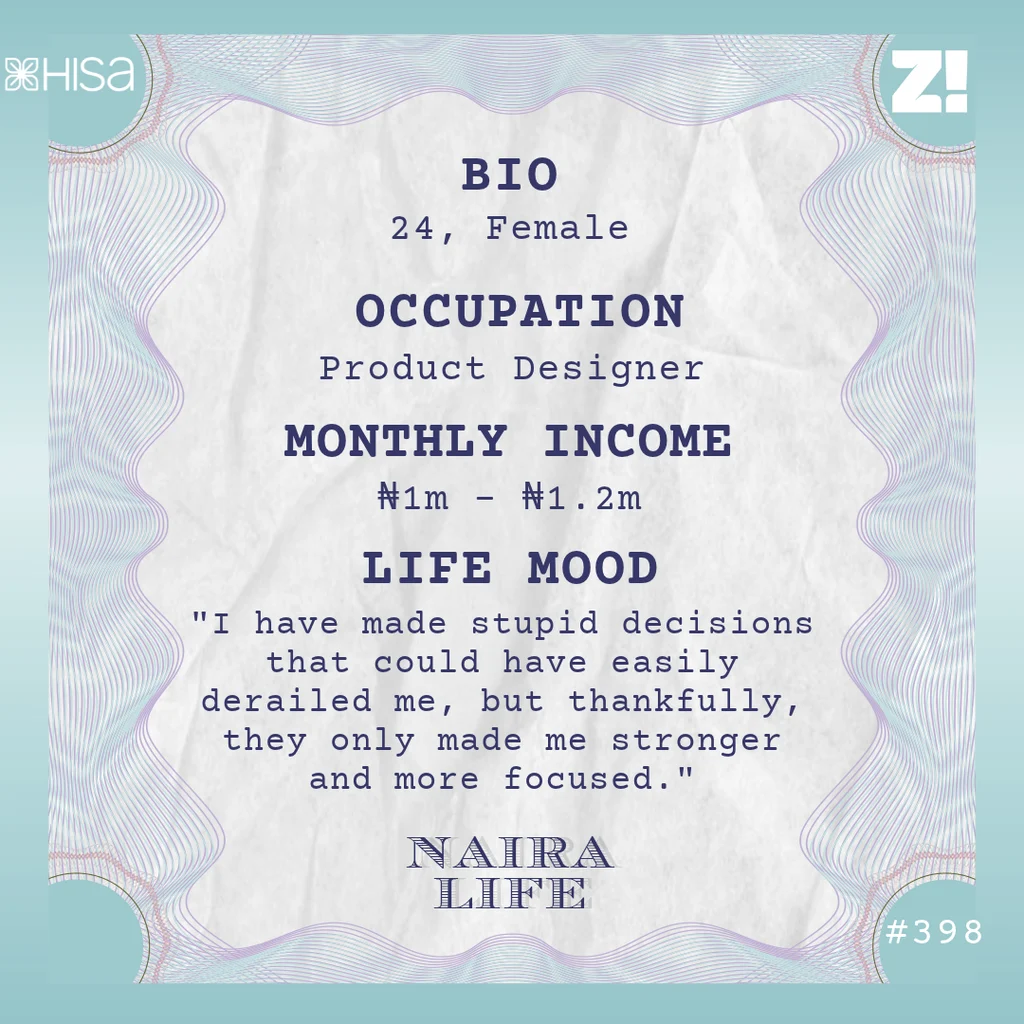
I feel incredibly grateful to be here. I have made stupid decisions that could have easily derailed me, but thankfully, they only made me stronger and more focused. Now, I’m planning for the rest of my life.
I read Naira Life stories of young people being intentional with managing their money and growing it, and I want that to be me too. After I changed jobs last year, I began consciously saving and investing at least 20% of my monthly salary, plus everything I earn from side gigs.
What does this breakdown look like in a typical month?
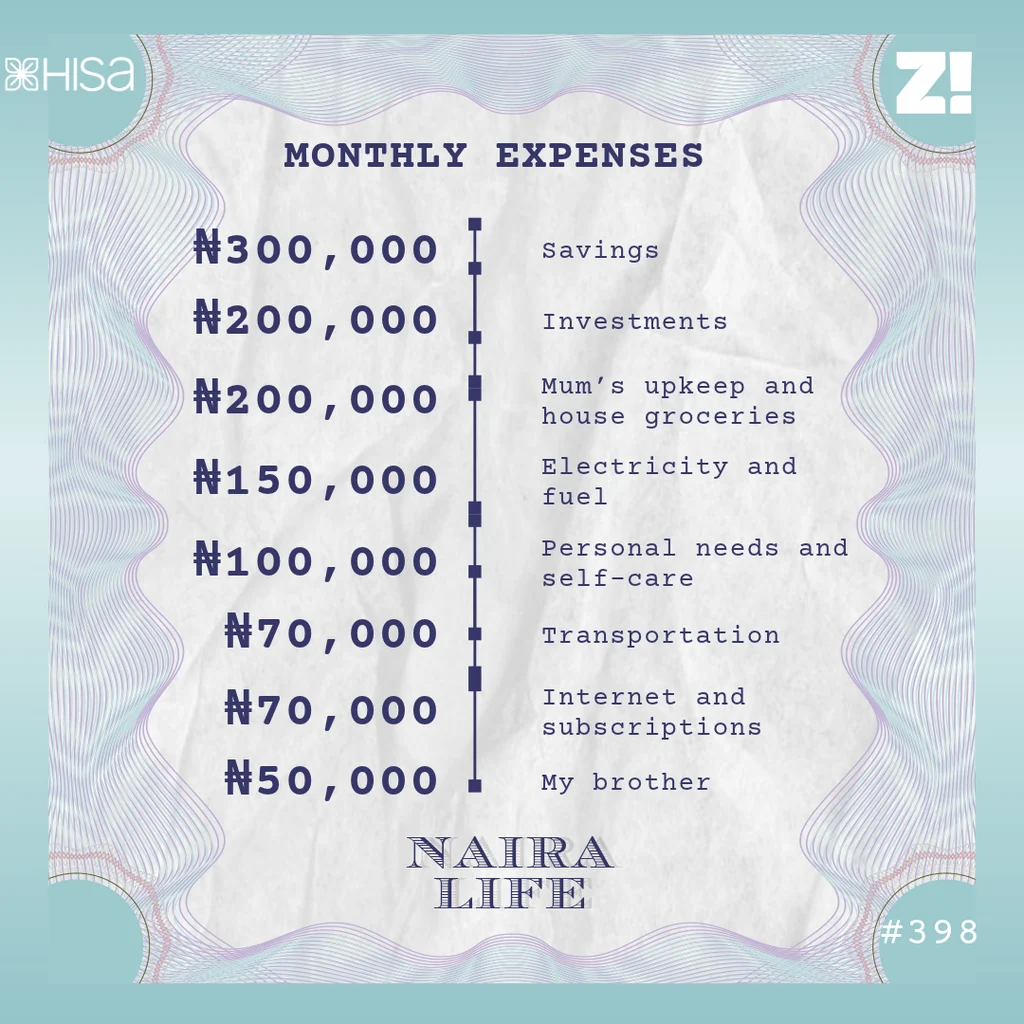
I currently have ₦4.8 million in my savings and ₦3.5 million in investments, mostly mutual funds and stocks. I chose both investment channels because I wanted my money to work for me and earn more than it would if I just left it in savings.
I use an investment app for my stocks, and it provides insights and groups stocks by performance and my interests, so I can make careful investment decisions. I believe my current portfolio is pretty healthy, but I’m always studying so I can do better and grow sustainable wealth.
Do you have a savings and investment goal?
I see my savings as an emergency fund, so I want to hit ₦15 million there. But my actual portfolio should be at least $50k by the time I’m 30. That’s my goal, and I believe it’s possible. I just need to keep earning more and manage my money well.
I also plan to get a degree at some point, and I’m looking to try an open university next year. I sometimes feel like it’s a huge fluke I’ve gotten this far without a degree. I don’t want to push my luck too far.
How would you describe your relationship with money today, and how do you feel about your future?
I’d say money to me is freedom. I’m free to do things without relying on people. I don’t even earn much yet, but I helped my mum open a frozen-food store last year. She doesn’t have to do odd jobs anymore, and she’s no longer haggard. I’m also supporting my brother at university. That’s what money can do, and I’m grateful I have it.
I feel very optimistic about my future. It can only get better from here. I’m already manifesting earning in foreign currency for my next job, and I believe it will happen. I’m only 24. Who knows? I could be a landlady by 30.
Rooting for you. How would you rate your financial happiness on a scale of 1-10?
7. That’s only because things can get better. I’m happy and thankful.
If you’re interested in talking about your Naira Life story, this is a good place to start.
Find all the past Naira Life stories here.