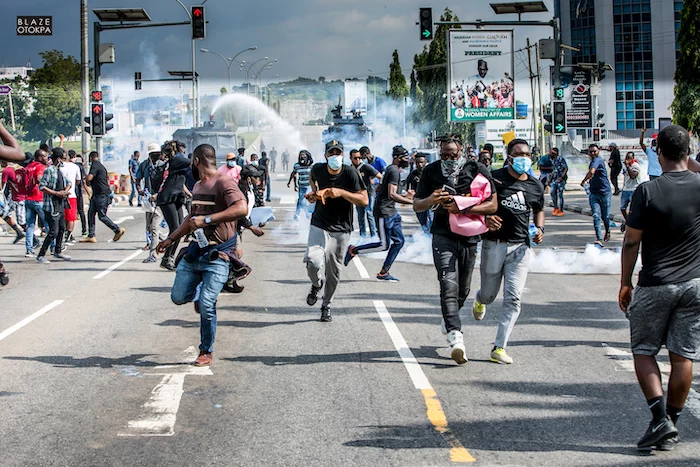
In October 2020, young Nigerians took to the streets to demand an end to police brutality and the rogue Special Anti-Robbery Squad (SARS).
On Tuesday, October 20, after an abrupt 24-hour curfew was declared in Lagos, security forces arrived at the Lekki Tollgate where unarmed protesters were sitting on the ground, waving Nigerian flags and singing the national anthem in the dark. Soldiers opened fire on the crowd.
The horrifying scene was streamed live to thousands of people around the world, shattering the illusion of safety for a whole generation. October 20 2020, became a generational turning point. For many Nigerians, that night was the exact moment their relationship with the country became irreparable.
Six years later, we asked Nigerians both at home and abroad where they were on the night of the Lekki Tollgate shooting, and what that moment changed for them.
We thought it was bangers until the hostel masters made us hit the floor — Tobi*, 22
We were just hanging out in the hostel when we heard gunshots; we had ignored it at first, thinking people were already throwing bangers ahead of Christmas.
Then we heard it again, this time faster and heavier; we got scared and jumped out of our beds. I looked out the window and saw a man with blood gushing from his shoulder being rushed to a hospital on an Okada (motorcycle). In little or no time, the hostel masters rushed in, yelling at everyone to drop flat on the floor
A few minutes later, they rounded us up and moved us to a block of classrooms right in the centre of the school compound. They kept us locked in those classrooms for about six straight hours; we didn’t fully know what was going on, but sitting in that room with my classmates was the first time I realised how quickly our reality could turn upside down.
I sat on the floor of my kitchen pantry, listening to gunshots outside my window — Funke*, 40
I didn’t go to work that day because of the sudden curfew, so I was at home with my son and daughter. Around evening, we started hearing distant gunshots, followed by people yelling and running outside in the streets.
My kids were scared, but before I could even process what was happening, they had gone to hide themselves in the kitchen pantry, begging me to come and stay with them.
I was so anxious, and I didn’t know what to do. I turned on the news, but I wasn’t even able to make sense of what was happening yet. I sat there in the pantry frozen in fear, holding my chest, unable to answer my children when they asked what was going on. The complete helplessness of that evening never left me till today.
I watched DJ Switch’s live stream from my dark living room — Dami*, 27
I had been at the protests in Ikeja all week, but the midday curfew forced me back to my apartment. By 7 PM, Twitter (X) was reporting that the billboard and streetlights at Lekki Tollgate had gone dark. Then DJ Switch went live.
I sat in my living room staring at my phone screen in disbelief. Hearing young people sing the national anthem while rapid gunfire echoed through the stream made my stomach knot up. I stayed up until my battery died at 3 AM. That was the night my faith in Nigeria completely disappeared, and I made sure to leave the country the following year.
I was studying in the UK and was deathly scared for my brother; I thought he had died — Ada*, 29
I had recently moved to the UK for school, but my mind was completely back home on this particular day. On the evening of the 20th, my phone blew up with messages from my friends to check Switch’s live stream.
I remember my younger brother telling me he was going to be out protesting on the Island that afternoon. I spent four hours redialing his number, but he wouldn’t pick up. I was in the library, completely numb and crying profusely; a friend of mine had come to pick me up, and I went to stay at her apartment for the night. At around 1 AM, he finally texted to say he was safe. I called him, and we both burst into tears. I felt like I had betrayed my brother by leaving him in Nigeria.
My mum and I started crying and praying in those moments — Kunle*, 31
I had been at the Tollgate almost daily from October 12th, helping to distribute food and water. On the 20th, when the afternoon curfew was declared, my mum called me crying, begging me to leave. I packed my bag around 4:30 PM. People around me encouraged me to stay back.
Leaving felt like betrayal at the time, so I stayed till 5 PM because my mom had been calling me endlessly. When I got home, I heard about DJ Switch’s live video, and what I saw broke my heart. My mum and I started crying and praying in those moments. It was so sad. Six months later, I submitted my Canada Express Entry application. I didn’t want to stay in a country that could kill its citizens.
October 20, 2020, remains an open wound in modern Nigerian history. For those who survived it, those who lost loved ones, and those who watched from afar, the memories are just as vivid today as they were six years ago.