Written by: Matilda Inioluwanimi Adegbola
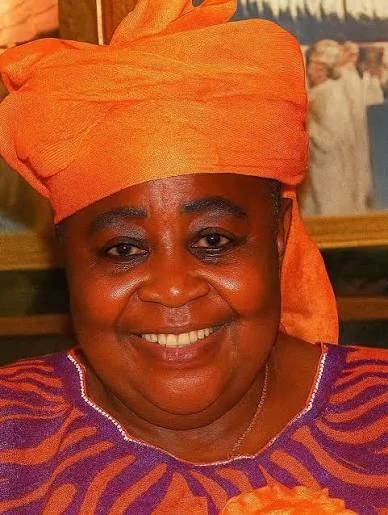
The most sustained bit of narrative around Hajiya Gambo Sawaba is her head being shaved with a broken bottle by the prison and police authorities, alongside being flogged and jailed several times in her lifetime. But Sawaba’s story is more than being a Nigerian woman who was a pain to custodians of societal structures in colonial Nigeria.
Born to a Ghanaian father and Nupe mother in Niger State in 1933, she was said to have been born into a family of historical warriors and was a fighter herself from a very young age. Some records hold that she was notable for always intervening on behalf of children losing in a fight, claiming to have bought their fight from them. After completing her primary education at the Native Authority Primary School in Tudun Wadaa, her academic journey ended prematurely following her father’s death in 1943 and her mother’s three years later. At the age of 13, she entered into an arranged marriage with Abubakar Garba Bello, a World War II veteran. He abandoned the marriage during her first pregnancy, never to be seen again, leaving her to give birth to her only child at the age of 16.
Sawaba’s political activism started to form following the events of her personal life alongside the political context of Northern Nigeria under British indirect rule. Colonial policies were executed through local and native authorities like the emirs and village leaders across the 12 northern provinces, while the Northern People’s Congress, a conservative party, led the government. However, by the time Sawaba became 17 years old, a shift began to happen through the action of one man.
Mallam Aminu Kano, in 1950, formed the Northern Elements Progressive Union, which was founded on the philosophy that women and girls deserved education and equal social and economic rights. The NEPU’s philosophy was strongly opposed and seen as anything but progress, as women were considered happy and none had complained that they wanted more.
For Sawaba, however, NEPU’s call resonated with her. Joining the party’s women’s wing early, Kano would become her political mentor, her resolve in the party strengthening with the national feminist rise through the actions of the likes of Funmilayo Ransome-Kuti and Margaret Ekpo. She was soon clashing with the establishment, as she began to engage women living in purdah in a grassroots door-to-door outreach. Her efforts scandalised the Kano Native Authority, which dragged her before the conservative Alkali court in 1952 on charges of inciting women to leave purdah, earning her a three-month prison sentence. This was her initiation into a long history of state oppression and the first of her 16 incarcerations by the state.
Her arrests became so predictable that she kept a designated blanket, stamped with ‘Prison Yard’, ready by her side for the next inevitable police visit. Sawaba’s in-laws resented her refusal to choose motherhood over political organising, prompting a peaceful split. As dictated by custom at the time, custody of her baby daughter was granted to her former husband’s family. By the end of 1952, Kano officials formally expelled her from the city, using local police to enforce her return to Zaria.
Yet exile only fueled her fight. She resumed her political organising amidst frequent prison sentences in prisons across Zaria, Kano, Kaduna, and Jos. Most notable in her historical impact, Sawaba and other women from the NEPU women’s wing staged a march in 1956 to the Kaduna office of Sir Ahmadu Bello, the Premier of the Northern Region, calling for women’s enfranchisement in future parliamentary contests. The premier offered a vague promise to evaluate the request, but no action followed.
Progress elsewhere made the Northern refusal glaring, as women in the South secured partial voting rights in 1951, with the Eastern and Western Regions formalising female suffrage in 1954 and 1959, respectively. Yet, as scholar Bonny Ibhawoh highlights, the Northern People’s Congress deflected demands in 1954 by asserting that women would receive the vote only in God’s time.
Northern women would eventually be granted the right to vote in 1976, a right which became concretized in the 1979 constitution. By this time, Sawaba was already in Zaria, serving as a key leader of the NEPU’s women’s wing.
Some records suggest that Sawaba was not her birth name, but one given to her by Aminu Kano after she was appointed president of the women’s wing of the Northern Elements Progressive Union (NEPU). Another account traces the name to an event at Jakara Market in Zaria, where a political rally featured a male politician known as Alhaji Gambo Sawaba. After she addressed the rally, the Alhaji reportedly acknowledged her as the first woman to address a northern political rally and declared that she would henceforth be known as Gambo Sawabiyya, the feminine form of his name.