Love Life is a Zikoko weekly series about love, relationships, situationships, entanglements and everything in between.
Chris (36) and Dara (34) met through Couch Surfing in 2021.
On this week’s Love Life, they talk about a squeezed taxi ride in Togo that changed everything, a “what are we” conversation that took months to turn into an actual relationship, and building both a marriage and a tour company across two continents.
If you want to share your own Love Life story, fill out this form.
What’s your earliest memory of each other?
Chris: 2021. I’d gotten a Nigerian visa right before the pandemic, valid for two years, and I never got to use it. With a few months left before it expired, I booked a short weekend trip to Lagos over July 4th. At the time, I was really into Couch Surfing, which is a website where you can meet locals and stay with them during your travels. That’s how I found Dara’s profile.
She’d travelled around West Africa and seemed passionate about exploring Nigeria too. I thought she was an interesting person. So I messaged her, introduced myself properly, and told her about my travels. Thankfully, she responded quickly enough and offered to host me at her home in Nigeria. She said she’d show me around Lagos, and we could even take a trip to Abeokuta. I was sold immediately.
Dara: That’s also my earliest memory of Chris. I’d been on the Couch Surfing website as a guest for about a year before I got my own apartment and started hosting. But Chris wasn’t my first guest. A few months earlier, I’d hosted another guy from Singapore.
Chris reached out in June, and I was really tickled when he mentioned that he’d been to over 130 countries. He also introduced himself properly instead of just asking to crash at mine. He shared in detail the last country he visited, why he’s interested in seeing Africa and why he wants to visit Nigeria. I was sold.
Coincidentally, I’d also just started a personal project to visit 30 Nigerian states before turning 30, so when someone said “come show me Nigeria,” I was thrilled to play tour guide.
Take me through his first visit. How did that go?
Dara: He arrived on July 4th. It was a Saturday morning. I picked him up from the airport, we dropped his bags at my place, and went straight to Abeokuta the same day. We didn’t waste time at all. We made it down to Olumo Rock in Abeokuta, visited the Olusegun Obasanjo Presidential Library, and I got him to try amala and okra.
I remember he was somewhat hesitant with the okra, so we swapped bowls, and he ended up loving my plate of amala. The next day, we were back in Lagos. He still wanted to see so many places, so we did the Nike art gallery and the beach. That was where he filmed his first viral video, joking that people had warned him not to come to Lagos because he’d die. It got about 5000 views in a day, which felt massive at the time. By Monday, I went to work and left him the keys to explore Lagos Island alone before his evening flight.
Curious, Chris. What were your thoughts on staying with a complete stranger?
Chris: I’d done Couchsurfing with plenty of people before, so I wasn’t overly anxious. I was just excited for the places we’d see, and Dara seemed like a genuinely nice person. There wasn’t much to worry about.
Dara: On my end, I always take safety precautions with male guests. I’d sleep in the living room on a spare duvet and lock the door separating it from my bedroom, just for my own peace of mind. Nothing strange happened at all.
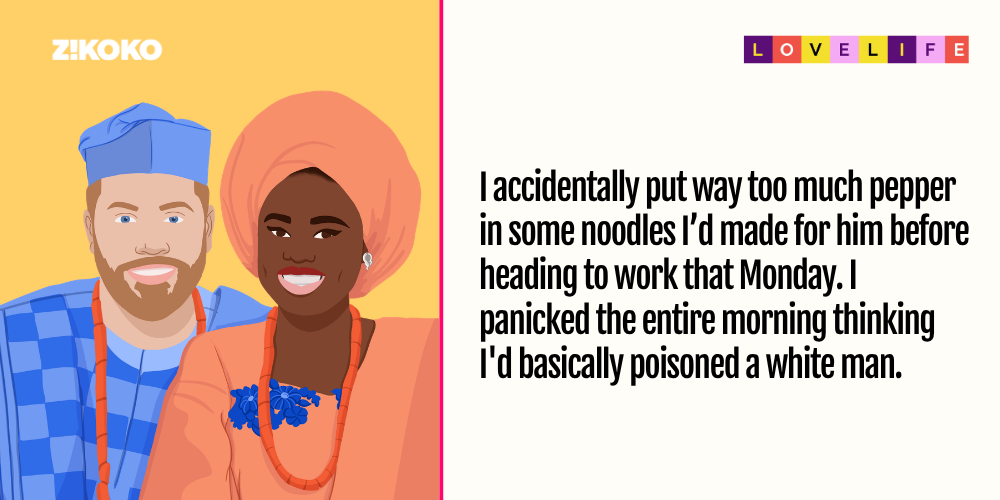
That first trip really stood out for a number of reasons. First, I was intrigued by the way he ate. Most foreigners are visibly cautious with their first bite of unfamiliar food, but Chris just dug in like he’d been eating Nigerian food his whole life. Second, and this one really got me, I accidentally put way too much pepper in some noodles I’d made for him before heading to work that Monday. I panicked the entire morning thinking I’d basically poisoned a white man. I didn’t know how to ask when I called to check on him, so I spent some time dancing around the question. When I finally asked if the noodles was too spicy, this man just said, “It was fine.” I’d always told my siblings I could never marry a man who couldn’t handle pepper, so that moment stuck with me.
Were either of you dating at the time?
Chris: I was single, doing a little casual dating, but nothing serious. I guess I was also looking, but I didn’t have a clear picture of what I was looking for. I remember going back to the US and briefly thinking about Dara. In my head, I thought, “That girl was really nice. Now, I have to find someone like her in the U.S.” I knew I didn’t want a long-distance relationship, so I wasn’t really seeing the vision with Dara at the time.
Dara: I was actually single too. I’d just stepped back from something that was starting to feel one-sided, so I was putting my energy into my travel goals instead.
Got it. What happened after Chris returned to the US?
Chris: It’s actually so funny because we both have different memories of how things played out back then. In my head, we stayed in touch for just a bit and that was it. But years later, while filing visa paperwork, we actually went back through some of our old messages and realised we’d been talking a lot more than either of us remembered.
She’d mentioned taking a trip to Benin, Togo and Ghana and I thought that was really cool. Those were countries I also wanted to visit. So we kept in touch until the next time we planned another trip together.
Oh. When was that?
Chris: I came back in September, two months after the Lagos trip. This time around, we did a trip to Benin and Togo together and spent about a week together.
Dara: Before that trip, we actually had a very direct conversation about room arrangements, which isn’t always easy for women to bring up without it sounding like an accusation. Chris offered separate rooms if I wasn’t comfortable sharing, which put me at ease.
That trip had its share of chaos, too. He got turned back at the Togo border, and we had to sort out special permits in Benin, so we spent a lot of time just waiting around and talking about our families, upbringing, everything.
Chris: That trip is really where we moved from acquaintances to actual friends. We talked so openly that I remember thinking, “This is someone I could see myself with,” but I kept reminding myself that we couldn’t be a thing because of the distance.
Dara: I remember this really funny moment during our taxi ride. His arm ended up around me, completely unplanned, and I could tell he was trying so hard not to invade my personal space. It felt like something straight out of a K-pop drama.
When we got to the airport, the hug we shared felt a lot more different from the first time he visited. It felt warmer, like I already knew I’d miss him.
Awwwn
Chris: After that visit, I think we agreed I’d come back in November for a friend’s wedding as her plus one. I remember asking her if I could come along because I’d heard so much about Nigerian weddings. It was also easier to plan the visits because I worked for an airline and there were daily flights to Lagos. So I could just jump on any flight at any time. Unfortunately, my mum passed away that October, so those plans fell apart.
That loss pulled me into my shell for a bit. I wasn’t really speaking to anyone.
Dara: He told me about it almost immediately; I was one of the first people he told. We didn’t talk much for about a month while he grieved, though I checked on him weekly. There was a moment he broke down on a call, and I remember wishing so badly I could physically be there for him. That’s when I realised he wasn’t just a random friend to me anymore.
Was this when things picked up between you again?
Chris: In a way. By December, I’d stepped out of my grief a little more and we were talking more again. I mentioned wanting to see rural Nigeria, especially somewhere outside Lagos. Then Dara mentioned her grandmother’s village in Ekiti state.
Dara: I told my dad I had a foreign client I wanted to bring to the village, which wasn’t entirely a lie; it was just easier to frame it that way at first since I didn’t want to explain that I was hopping on a trip with a random white man.
Anyway, we planned the trip and went to Ekiti in February 2022. We met my grandmother and step-grandfather, bought a live chicken at the market, and cooked over firewood outside, nothing fancy at all. He was enamoured by everything. These were things I considered pretty normal but they were new experiences for him, and he was just happy to witness it all. Chris still says that meal is still one of the best he’s had in Nigeria. Even though he also woke up in the middle of the night needing the bathroom because the food was so spicy for him.
Screaming. Was it still purely platonic at this point, though?
Dara: To be honest, I’d already confided in my sister and aunt that I might be catching feelings, so I’d been planning to bring it up myself at some point. But Chris beat me to it on the second night of the Ekiti trip, and I was so relieved. I’d been overthinking every delayed reply to my messages, wondering if I was being too obvious or too into him.
Chris: I asked her what she thought about us. I didn’t go in expecting us to declare ourselves a couple right there, I just felt like we needed to actually acknowledge that something was there instead of pretending otherwise.
Dara: We agreed there was something between us, but decided to keep things as they were, given how much distance stood between us, and just see where it went without putting a label on it yet.
Oh
Chris: Well, we didn’t have to stall for too long because we became official by August. There were a few reasons for the gap. I had visa complications ahead of a planned May visit, had to renew my whole passport, and missed that trip entirely.
Fortunately, Dara had a trip planned to Senegal with some of her clients, so we agreed to meet there. I joined her in Senegal for my birthday in June, and it was just yet another time spent bonding and getting closer. We still hadn’t made anything official.
I came back to Nigeria in August and Nike invited me to a friend’s wedding party. The night before the wedding, I told her something along the lines of “You know we should make this official and be a couple,” and that was it. We became a couple.
Sweet. What were the early days of the relationship like?
Chris: It didn’t feel that different, since we’d already built so much emotional closeness over the previous year. We just kept doing what we’d been doing, travelling together whenever possible. One trip that stood out was Spain; it was her first time in Europe after a couple of visa denials and an appeal. We did Madrid, Mallorca, Barcelona, and she continued on to France and Portugal after I flew back to the US.
Dara: Although communication was tricky sometimes in those early days. Our individual accents took some getting used to. He actually understands me better than his own family does, so he ends up constantly translating for them.
Chris: Something else that really shocked me was how she addresses elders. When Dara met my dad, I told her to just call him Brian, but she couldn’t bring herself to do it. She kept saying Mr Brian, since calling an elder by their first name felt deeply disrespectful in the Nigerian culture. But those were pretty much what the early days together felt like. Lots of learning about each other, particularly about our different cultures.
Got it. How did the relationship progress over time up to the point of marriage?
Chris: As I mentioned, we were really committed to knowing and understanding each other before committing to a life together. The idea of marriage itself built gradually over a lot of conversations. What really convinced me about Dara was her ambition, her work ethic, her humble background, and how well we worked as a team. We’d also talked about whether she’d be open to relocating, and she was genuinely excited about the idea, given how much she already loved to travel. I also wanted her to meet my family if we were going to get married, so we started planning how we could make that happen.
Your family already met Chris during the Ekiti trip. What did they think of the relationship, Dara?
Dara: My dad was incredibly receptive; way more than I expected. The Ekiti trip really won him over. Chris had asked to visit my paternal grandfather’s grave in his hometown, even though we hadn’t planned to. I sent my dad a photo of us by the graveside, and that meant the world to him. I remember he was also worried about fixing the toilet and a couple of other things, but he didn’t even have to do that because Chris was fine with experiencing us just as we were. I think that from that moment on, he had such a positive impression of Chris. He knew he wasn’t just being polite for show. Every time he called, he asked about Chris. So when I finally told him about our relationship, he smiled. He didn’t have any reservations at all. As for my mum and siblings, they’re all open-minded and since Chris is a likeable person, he didn’t have to do too much to win them over.
Let’s talk about meeting Chris’ family. How did that go?
Chris: Since Dara couldn’t get a US visa in time, we arranged for her to meet my family in Mexico for Thanksgiving instead, about nine months before the wedding. She flew in from a Europe trip to meet us in Puerto Vallarta, which felt like the easiest way to get her close to what life in North America might look like without dealing with the visa issue directly.
Dara: I was so nervous, I hid behind him at the airport when I saw his family approaching. I was completely shy. Still, the meeting was nothing like what I’d built up in my head. Everyone was super warm and friendly, even though they didn’t really understand some of the things I was saying. We’ve since travelled together as a family multiple times.
Chris: After that, I wanted to meet her father too, even though we still weren’t fully decided on marriage at that point. We had to keep it low-key, almost secretive, because once her mother or aunties found out, the whole extended family would start planning a wedding immediately. We met quietly at a family friend’s house so it wouldn’t raise suspicion. I really liked meeting him as well. He was warm and receptive once I shared my intentions.
While this was going on, we also had to talk to an immigration lawyer to figure out our options. He told us it made more sense to marry sooner rather than have a long engagement, so we could start the spousal visa process early.
That meant planning everything backwards, picking a date and telling our parents first, then figuring out the ring, the outfits, the food, all of it.
Right. When did you actually get married?
Chris: May 23rd and 24th, 2024. The first day was our traditional wedding at her family compound. The second day was a court wedding, done at the Airbnb where my family was staying, since officials can come to you for a fee instead of going to the courthouse.
What was that first year like, considering you still had to deal with the distance?
Chris: It was bizarre, honestly. We got married and then went right back to our separate countries, me in the US, her in Nigeria. It felt strange being legally married but not actually living together, seeing each other maybe once a month using flight benefits from my airline job.
Dara: I survived that first year by throwing myself into work. It was harder for him, since he had to fly back and forth constantly. At one point his work schedule nearly changed in a way that would have made visits almost impossible. We got through it by reminding ourselves that some long-distance couples go a full year without seeing each other, and we at least had monthly visits.
Chris: Not living together also meant there was little to nothing at all to fight about. So that had its little perks in a way. But I’ve been a lot more present in Nigeria in the past year, and we’ve been living together as a couple. That has taken some adjustment from both of us.
What do you mean?
Chris: New kinds of friction showed up. Different habits around the bathroom, the kitchen, bedtimes, and what to eat. Small things that become bigger when you’re constantly around each other.
Dara: The deeper issue was how differently we handle conflict. I’m confrontational, I’ll tell you immediately if something bothers me, even if it’s small. He tends to avoid it in the moment, but then it builds up until he suddenly brings up a whole list of things that annoyed him weeks earlier, all at once. That usually felt unfair to me, since I couldn’t address issues I didn’t even know existed.
Chris: I think it’s partly how I was raised, and partly cultural, too. Nigerians can be loud and direct in the moment but quick to move past it afterwards, whereas I tend to hold things in and process quietly, sometimes for too long. We’ve been actively working on it. I’m trying to speak up sooner rather than let things pile up into one big confrontation later, and Dara has had to learn to hear feedback from me without feeling like she’s being ambushed all over again.
Earlier, you mentioned that you work well together as a team. How did that come about?
Chris: We started a tour company bringing international visitors to Nigeria. I handle the big picture planning, the itineraries, and the vision for each trip. Dara is much better with the logistics, the budgets, the day-to-day details I tend to struggle with.
Dara: Working together has actually strengthened us as a couple. We’ve learned how to divide responsibilities based on what each of us is naturally good at, rather than trying to do everything the same way.
Neat. What’s the best thing about being with each other?
Chris: I’ve learned an enormous amount about Nigeria and about Dara specifically, things that will stay valuable for the rest of our lives together, even if we end up somewhere else entirely one day. It’s made us better partners and hopefully better parents eventually. I love how well we complement each other in practically all areas of our lives. Where I’m weak, she’s strong, and vice versa.
Dara: Chris genuinely feels like finding a puzzle piece that fits completely. I have no doubt that Chris is who I’m meant to do life with.
I like that being with him has amplified my love for travel even more, and we’ve both grown so much individually since coming together. I’ve also had to confront some of my own conflict-related habits from my upbringing, and I’m actively working to unlearn what isn’t helpful.
On a scale of 1 to 10, how would you rate your love life?
Dara: An 8. We’re friends first, which I think should be the foundation of any marriage, and we’re honestly inseparable at this point; we can barely handle short periods apart anymore. There’s still room to grow, but we’re getting there.
Chris: I’ll also say an 8. Nobody’s perfect, and because we work and live together constantly, we have to be intentional about keeping romance alive rather than letting everything become just about work. That’s the one area I think we can still be more deliberate about.
If you want to share your own Love Life story, fill out this form.