On paper, two years into President Bola Ahmed Tinubu’s administration, it looks like Nigeria is laying the foundation for a truly digital economy. But beyond policy documents, the reality is far more complicated, despite the number of ambitious programs launched.
Central to the policies and strategies unveiled is the idea of a technology-driven government that delivers services digitally from the start, where data drives decisions, and citizens can interact with public institutions as easily as they use their phones. The Digital Government Policy Framework (DGPF), an ambitious blueprint launched in 2020 for a smarter, more responsive state, outlines this vision across six pillars, with initiatives like Digital by Design and Proactive Governance. However, ambition alone doesn’t build systems; it requires execution.
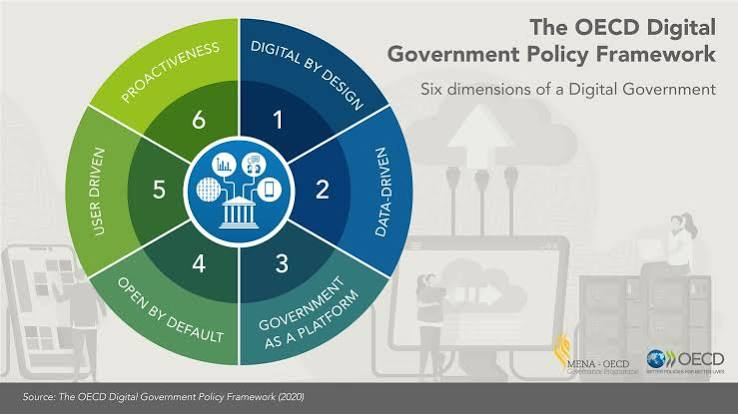
In theory, Digital by Design operates on the philosophy that government services should be created with technology at their core. In practice, progress has been slowed by fragmented regulations and uneven capacity across states. While some parts of the country are moving forward, others are playing catch-up, leading to a fragmented system instead of the unified digital experience that these innovations are meant to achieve.
A similar pattern is evident in the push for a data-driven public sector. There are indeed signs that the Nigerian government is beginning to take data governance more seriously. For example, in trying to achieve a geo-political system of equity and inclusion, all 36 states were reached through the Build-A-thon programme, with learning communities set up that focused on youths and female groups. But what’s missing is consistent, disaggregated data that reflects differences across factors like gender, geography, and income levels. Without this level of detail, policies run the risk of missing the people who need them most, and data can not be effectively used to create inclusive solutions.
The same pattern appears in Government as a Platform’s vision, which envisions an interconnected, efficient, and accessible public service. While infrastructure investments like the installation of 145,000km of fibre optic cable, which was laid, suggest that the foundation is being built, only 27% of rural LGAs are connected against a target of 60%, making the experience of navigating them still feel disjointed. The promise of seamless digital governance has yet to materialise.
Perhaps more telling is the lingering gap between openness and transparency. While the government has made efforts to engage citizens through consultations, signalling a willingness to be more transparent, limited visibility into program performance makes it difficult to assess how policies are actually working. This disconnect becomes even clearer in user-driven governance. In principle, citizens should help shape the services they use; in practice, feedback channels are often weak or inaccessible, particularly for rural areas or underserved communities.
On the brighter side, Nigeria appears to have made real progress in building its digital backbone with broadband infrastructure expansion and continued growth in the telecommunications ecosystem. However, only about 27 percent of local governments have reliable connectivity compared to their urban counterparts. This means that for millions of Nigerians, the digital economy still feels out of reach, a divide with real consequences.
Beyond infrastructure, a deeper structural challenge is coordination. Nigeria has a deep-seated challenge of aligning efforts across different agencies working toward similar goals. Policies are developed and launched in isolation, creating a system that moves while being pulled in different directions. The startup ecosystem, for example, boasts over 12,000 registered startups and billions in investment, but still lacks stronger institutional support, which means this growth may be difficult to sustain.
Yiaga Africa’s assessment report on President Tinubu’s Renewed Hope Agenda, legal and regulatory framework is described as transitional, with important tools like the National AI Strategy and the Digital Economy Bill still in development and facing delays in enforcement. The Federal Ministry of Communications, Innovation, and Digital Economy (FMoCIDE) has demonstrated leadership, but execution is uneven as a result of poor interagency cooperation and limited connections in local governments. According to the policy assessment brief facilitated by Yiaga Africa, more than 12,000 registered firms and ₦21 billion in investments raised in 2025, the Startup Ecosystem is referred to as emerging but is not institutionalised and threatened by issues including poor budgetary integration and sluggish tax incentive disbursement.
Similarly, the national Build-A-Thon STEM effort emphasises the importance of human capital development; nonetheless, inclusion mechanisms remain inadequate, particularly for rural areas, gender-specific data, and disability inclusion. Only 7.7% of young people with training are employed in northern states due to a lack of investments in digital infrastructure.

The path forward is one where rural connectivity must be improved through reforms like reducing right-of-way costs and investing in alternative power solutions. Policies like the Digital Economy Bill must move from draft to implementation, and coordination across different local governments must become more deliberate and unified. Ultimately, progress must be measured not just by policies announced, but by outcomes experienced by everyday Nigerians.
Read more on the #Fulfillit campaign by Yiaga Africa here