Ayodele Adio has a confession…he likes rabbit holes. Not the kind that involves spending three hours on YouTube watching conspiracy theories about whether the Titanic actually sank. His rabbit holes are usually about finding answers.
“I’m just a very curious individual,” he says. “I like to go down rabbit holes searching for answers.”

It is perhaps an appropriate description for someone who has spent years questioning authority, challenging conventional wisdom, and eventually deciding that complaining from the sidelines wasn’t enough. Now, he wants to get into the Lagos State House of Assembly.
Adio was born in Kano State but has spent most of his life in Lagos, with family roots in Lagos Island. He studied microbiology at Benson Idahosa University before going on to earn an MBA in marketing and communications and an advanced certificate in advertising and media from Pan-Atlantic University, Lagos State.
His professional life has mostly revolved around communications. He has written columns for Vanguard, participated in campus organisations such as the Association Internationale des Étudiants en Sciences Économiques et Commerciales (AIESEC) and later founded Adio Strategy and Communications, a media agency focused on policy and corporate communications. But working around politicians eventually became frustrating.
He watched people make decisions and saw how slowly things changed, and at some point decided that perhaps he should stop helping politicians communicate their ideas and try putting some of his own into practice. That transition also explains his politics
Adio, the serviceman
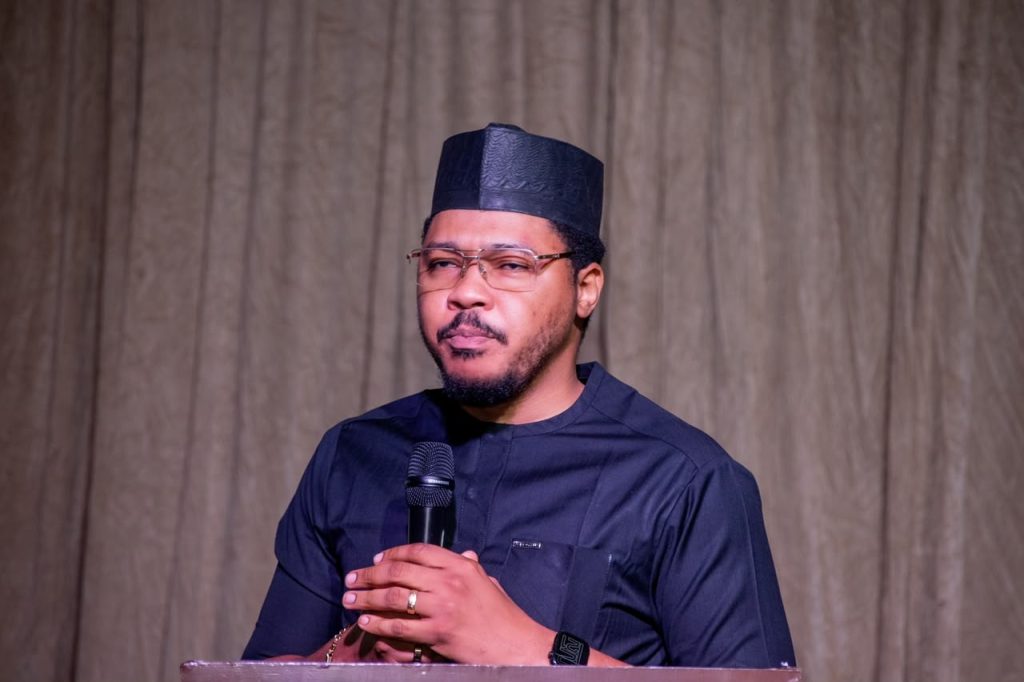
Adio describes himself as someone focused on reducing inequality and making public services more affordable. He talks about social housing, public transport and wealth redistribution, including his argument that wealth is heavily concentrated among a tiny proportion of Nigerians.
But there is one person who seems to have had a strong influence on how he thinks about governance. That’s the late Lagos governor, Lateef Jakande.
Adio says Jakande’s example changed his worldview. He had met him a few times to discuss housing policy and followed his legacy closely, including attending the Lateef Jakande lectures. What appears to have stayed with him was a combination of Jakande’s political thinking, ideologies and modest living that Adio associates with him.
Not too young to what?
In 2016, the Not Too Young To Run movement started pushing for a constitutional amendment to reduce the age requirements for running for elective office in Nigeria. Former President Muhammadu Buhari eventually signed the bill into law to make it possible for more young Nigerians to contest for political office.
As a young Nigerian under 40, Adio thinks “Not Too Young To Run” shouldn’t have been a demand in the first place.
He argues that young Nigerians already have enormous political power because people aged 18 to 45 make up the largest voting population. Yet the people with the most votes to give have the least representation at the decision-making table.
His solution isn’t to wait for older politicians to hand young people positions.
“Young people have to rediscover their political power and organise themselves better,” he says, arguing that they can force their way into office, particularly at the state and local government levels.
And he isn’t speaking entirely theoretically.
Adio was the National Publicity Secretary of the Youth Party. He also previously contested for chairman and came second. He says the experience shaped his values and taught him about party administration, but the party eventually struggled to compete because it lacked the resources and structure necessary to challenge bigger political parties. A prolonged legal dispute with INEC also cost the party years.
That eventually led him to the African Democratic Congress (ADC), which he saw as a bigger political vehicle capable of giving him the structure to compete against the APC.
But getting on the ballot is one thing. Paying for a campaign is another.
Adio admits Nigerian politics has become “very, very expensive,” arguing that the monetisation of elections has made it harder for ordinary people to enter politics.
The cost of contesting elections in Nigeria has risen sharply over the years. In 2027, the APC pegged its presidential nomination form at ₦100 million, while a PDP faction fixed its presidential form at ₦100 million as well.
Governorship forms can cost between ₦40 million and ₦50 million, while Senate, House of Representatives and State Assembly forms also run into millions of naira. For many young Nigerians and ordinary citizens, these prices make politics look more like an exclusive club than a public service.

“Who’s bankrolling you?”
According to Adio, youths don’t need a lot of money to contest elections. He says building networks and offering value can help the fight against the system built against them. Those relationships, he argues, can eventually become the people who help fund and organise a political campaign.
His own campaign is partly being funded that way. He says friends, family and people within his network are contributing amounts ranging from about ₦40,000 to ₦50,000 to ₦100,000, which collectively cover a significant portion of his campaign’s running costs.
What happens if Adio actually wins?
His first major priority is what we can all relate to: unregulated rent. Here’s how he intends to go about it:
- Establish a rent tribunal with court-like powers to enforce proposed regulations
- Seek to cap agency and legal fees at 2.5% each,
- Prevent rent increases on occupied buildings more than once every three years
- Tie increases to inflation

Heavy dreams
Beyond rent, he wants Lagos to invest heavily in social housing, with an ambition of delivering 100,000 housing units annually over eight years, alongside public transport subsidies to reduce the cost of getting around the city. We think these are heavy duties.
But for someone who started out questioning authority, maybe the next step was always going to be trying to get close enough to authority to change something.
For now, Adio is betting that young Nigerians don’t need another reminder that they are the future.
They need to organise like they actually want to become the present. That, more than anything, is the argument behind his campaign.