Ahmad* (59) and Godiya* (52) had a peaceful marriage for decades until the sudden death of their 17-year-old son changed everything. As they struggled to process the loss, their grief turned into blame and eventually drove them apart.
In this story, they share how they nearly lost their marriage and found their way back to each other.
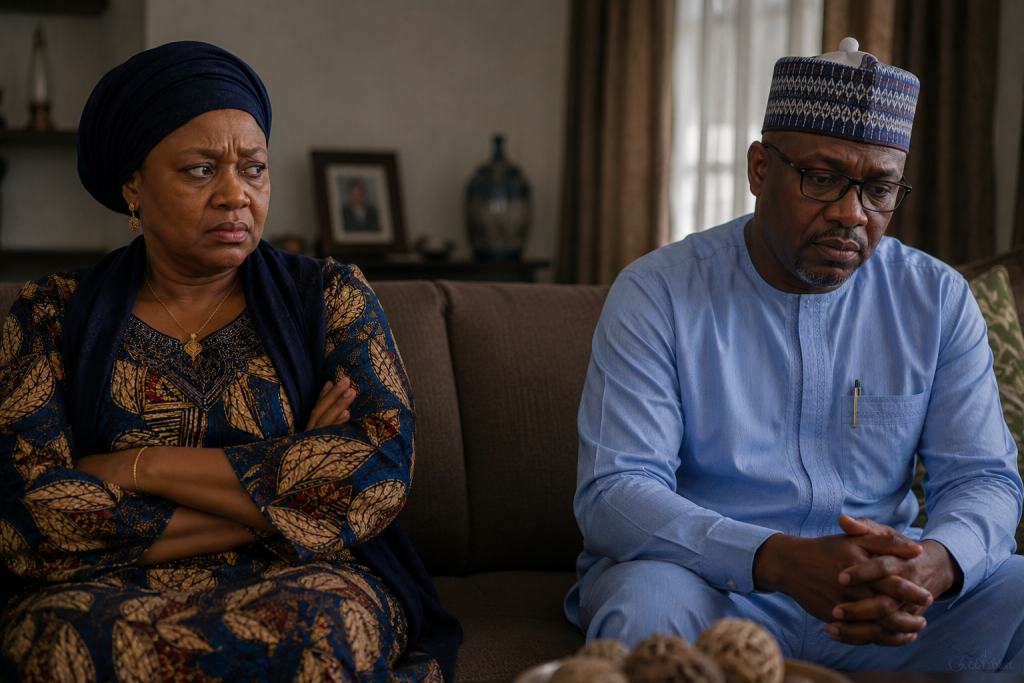
Ahmad: I first saw Godiya in 1998 at a wedding. I asked around and learnt she was the groom’s cousin. I didn’t approach her that day, but she stayed on my mind. When I found out she was studying at ABU Zaria, I drove there to visit her.
Godiya: I was in my third year at the time. My hostelmate told me someone was looking for me, and I wondered who it was. I’d never met this stranger, but he claimed he’d seen me before and wanted to get to know me. I wasn’t interested at first, but he was persistent. He visited often and always tried to get my attention.
Eventually, his persistence paid off and I developed feelings for him. He was a good man who seemed well settled in life.. My friends always teased me about finding a man who already had his own car and a good job. We got married in 2001, and our daughter was born the following year.
But after that joyful beginning, we went through a difficult period. I developed severe fibroids after my first pregnancy and suffered two miscarriages. For about five years, I underwent operations and treatments while people around us kept asking when we would have another child.
Ahmad: It was a very depressing period, especially for Godiya. I knew none of it was her fault, and I didn’t want her to feel pressured. Yet she was always too concerned by what people were saying.
Godiya: But it wasn’t just outsiders; his family pressured us too. By 2005, they suggested that Ahmad take another wife. Of course, that hurt me.
Ahmad: I’d promised Godiya I wouldn’t practise polygamy, and I meant it. But I also didn’t want to completely disregard my family, so I played along without actually giving in.
Godiya: And that was exactly the problem. His family openly disrespected me, and Ahmad didn’t do enough to protect me. At one point, they even asked a woman’s family for her hand in marriage.. Her parents visited Ahmad, and he received them well. He claimed it was just for show but he allowed things to go that far.
Ahmad: In the end, I made sure the arrangement fell apart. I just wish she’d trusted me enough. I was being diplomatic so my family wouldn’t hold my refusal against Godiya, but I never intended to marry that woman. My eyes never wandered.
Godiya: He could have told them from the start that he didn’t want another wife, even if it meant standing up to his family. His behaviour made it seem to outsiders that he blamed me for our inability to have more children.
I got pregnant again in 2007. I was afraid to get attached because I thought I’d lose the baby like the others, but this time, I carried to term. We welcomed our son, Farouk, without issues and had another daughter in 2010.
Our marriage was good from then on. Ahmad was ambitious,respected my career and supported me. We were also financially comfortable. My biggest concern was how he treated the children. He was harsh when with them.
Ahmad: I tried to find a middleground but I just didn’t believe in being too soft. My own father had been much harsher, and I wanted to raise our children well.
Godiya: Still, his parenting felt unnecessarily strict. In 2023, Farouk gained admission to a private university at just 15. He was an exceptionally smart kid and Ahmad had insisted on fast tracking his education.
I didn’t want him to go to university that early. He was too young to live away from home, especially because he had a history of ulcers and I was concerned about what he’d be eating. But I didn’t have much say in the matter. I eventually gave in. It’s a decision I still regret.
Ahmad: But Farouk wanted to go, and I believed it was in his best interest. Keeping him at home wouldn’t have helped him. To put Godiya’s mind at ease, we chose a school not far from Abuja city.
Godiya: Towards the end of 2024, Farouk’s ulcer worsened. He complained of stomach pains and very dark stools, so we took him to a hospital near our house whenever it flared up. We also kept in touch with the school clinic and had the clinician’s number.
In February 2025, during an official assignment in Kano, the school clinic called. Farouk had fainted from severe stomach pain and his roommates had rushed him to the clinic overnight. He was feeling better, but they couldn’t run the necessary tests and needed to transfer him to a better equipped hospital. I called Ahmad and asked him to pick Farouk up.
Ahmad: I’d just arrived at work and was about to go into a meeting when Godiya called. She insisted I leave everything and go for him. But when I spoke to Farouk, he said I didn’t need to come. He suggested I send money for an Uber so he could go directly to the hospital he’d been using. It seemed reasonable, so I sent him the money.
Godiya: The last time I spoke to Farouk, he was at the hospital. They’d given him medication and some IV fluids. The technician wasn’t around, so they sent him home and asked him to return later for the tests. He sounded perfectly fine.
Ahmad: By noon, Farouk told me he was back home, so I continued with work. Then, around 5:40 p.m., on my way home, our housekeeper called. She said Farouk was vomiting blood and clutching his stomach in pain. I could hear him screaming in the background.
By the time I got to the hospital, he was already in critical condition. I waited for almost an hour before the doctor told me he’d died shortly after arriving. He explained that the ulcer had eroded into his blood vessels, causing haemorrhagic shock. They couldn’t resuscitate him.
Godiya: While all of this was happening, I kept trying to reach someone at home, but neither Ahmad nor anyone else answered. After several hours, I knew something was wrong. Later that evening, Ahmad told Farouk’s older sister who was all the way in the UK that he’d been admitted to hospital and was sleeping. Ahmad still wouldn’t take my calls.
Ahmad: I didn’t have the courage to speak to Godiya. She would have known from my voice, and I felt it was better for her not to find out while she was away.
I contacted some of her older relatives because I was in shock and didn’t know what to do. In our culture, burial preparations happen quickly, and by the time I gathered myself, the family had already started making arrangements. I was advised not to tell her yet.
Godiya: My mind wasn’t at rest. Around 5 a.m. the next morning, my sister called and told me to start coming home. She wouldn’t tell me why, only that it had to do with Farouk. I got home past 1 p.m. Many people were at the house. Eventually, they told me Farouk was dead.
I couldn’t believe it. I kept asking them to take me to the hospital because I wanted to see my son. Then I learned they were making preparations to bury him within a few hours. It was the worst day of my life.
Ahmad: She was distraught. She grabbed my clothes and asked about our son. She wanted to go to the hospital and cemetery, but people held her back. I was grieving too, but I had to put on a brave face and handle the situation .
Godiya: I struggled to believe that Farouk was gone. They wouldn’t let me see his body or attend the burial. Even after I saw the death certificate and spoke to people who were there, I still couldn’t accept the truth.
I kept thinking about what might have happened if I’d stayed in Abuja. I would have realised how serious his condition was and never let him go to that hospital alone. We could have taken him somewhere better equipped and perhaps caught the problem earlier. I felt Ahmad could have done more.
But what hurt most was knowing he would have let them bury my child without my knowledge.
Ahmad: I understand why she felt that way, but Farouk was my son too. I wish I’d been with him in his final moments, but neither of us is a doctor.
Godiya also knows our customs. Farouk was already gone, and we had to bury him. Telling her wouldn’t have changed what happened. We had to follow the law and accept that life and death are ultimately in God’s hands.
Godiya: I had no closure. I blamed Ahmad for sending Farouk to university so young, for not telling me he was dead and for letting him go to the hospital alone. But more than anything, I stopped trusting him. He’d kept the biggest thing that had ever happened to us from me.
Ahmad: I understand how she felt. I even tried to take the hospital to court for negligence because I needed someone to hold responsible.
But Godiya put all her anger on me. She would erupt whenever I came near her. Eventually, her family took her away. We didn’t speak for weeks . Then I learnt she’d taken our youngest daughter out of boarding school to stay with her.
Godiya: I started wondering if something spiritual had happened and feared our daughter might be next. I needed her with me.
Ahmad: I understood why she was afraid, but I couldn’t agree with her decision. Our daughter was doing well in school, and the sudden change confused her. We argued about it, and Godiya said wanted a divorce and never wanted to see me again. At that point, I asked the elders in my family to step in.
Godiya: They pressured me to return home. Even some of my relatives said that leaving would be my loss because his family could marry Ahmad to a younger woman. Nobody seemed to understand why I was hurting. Instead, they made me look like the problematic wife. I refused to go back.
Ahmad: I didn’t want the marriage to end. I kept going to her family’s house, but she refused to see me. Eventually, I stopped pushing and gave her space. I kept praying she would change her mind, even as I started losing hope.
So when she finally asked to see me months later, I was surprised.
Godiya: I was still angry, but the anger began to fade with time. I started seeing things from Ahmad’s perspective and realised that holding on to my anger wouldn’t bring Farouk back. My faith also helped me through that period. I prayed, read the Qur’an and gradually accepted that Farouk was gone and that I had to leave the things I couldn’t control to Allah.
In October 2025, I listened to a teaching about forgiveness and felt moved to call Ahmad. I decided to give our marriage another chance, especially because our daughter was caught in the middle. I went home for a month to see if we could make things work. If we couldn’t , I could still leave.
Going back was frightening at first. That house held so many painful memories of Farouk. But slowly, things became easier. I’ve forgiven Ahmad, and we’ve both made compromises. I don’t want our daughter to return to boarding school, so she stays close to me. Ahmad has also adjusted his parenting style..
Ahmad: Losing Farouk changed the whole family, but I know Godiya carries the deepest pain. I’m gentler with her now, and I’ve learnt to accept where I could have done things differently, especially with the children.
There isn’t a day I wake up without thinking about Farouk. As a family, we’ve found some comfort in sharing the good memories we have of him.
Godiya: His death still feels like a dream sometimes. I still catch myself imagining that he might just walk through the door. But I have other children who need me, so I have to keep going. My comfort is knowing that Farouk is in a better place with Allah.
Read Next: Married Nigerian Women on the Crushes They Almost Acted On