Every week, Zikoko seeks to understand how people move the Naira in and out of their lives. Some stories will be struggle-ish, others will be bougie. All the time, it’ll be revealing.
What’s your earliest memory of money?
I attended a primary school that forbade students from buying snacks during break time. My parents would give my siblings and me money to buy our snacks before getting to the school gate. I also often got money gifts from relatives and family friends during festive seasons.
I don’t think I ever thought about money seriously until one time in primary school, when I noticed other students were being chased out of school for non-payment of fees.
I couldn’t relate to that because my family had money. I never got chased out, but that’s when I realised money was actually important for things like paying school fees.
Tell me more about your family’s financial situation
My dad was a successful businessman. My mum was a trader whose income contributed very little to the family’s upkeep because my dad’s income covered everything.
We lived in our own story building, and we had tenants. I went to one of the best schools in my state, and we had a driver who took us to and from school. I had everything I needed, really. I can’t remember wanting something and not getting it.
When was the first time you did something to earn money?
Back in secondary school, around JS 3 or SS 1, I helped my physical education teacher sell buns to other students. He didn’t force me to do it; I genuinely enjoyed doing it. The hustle only lasted a term, though, because the school authorities found out and shut it down.
So you didn’t actually do it for money
I honestly didn’t need money for anything. And I didn’t try anything else in secondary school.
I graduated in July 2007. By November of that same year, I was already in a private university studying law. After I wrote JAMB, my dad didn’t want to risk me wasting a year at home because getting public university admission for law is notoriously difficult if you don’t hit the exact cut-off mark, so he just paid for a private university.
What were your finances like in uni?
I received a consistent ₦10k/month pocket money from home the entire time I was there, and it was enough to keep me reasonably comfortable. My parents paid for my major needs directly, so the ₦10k was just for toiletries and minor things. If it finished before the month ended, I’d call home to top up.
I also sold some stuff in uni for a little extra money at some point, but it wasn’t a major entrepreneurial effort, and I honestly can’t remember what it was. I survived on my pocket money 95% of the time.
How about after uni?
I graduated in 2013. I had an extra year because of an issue with a lecturer. After graduating, I stayed home for about a year before getting into law school in 2014. My parents covered 100% of my financial needs throughout law school.
NYSC came next in 2015. I was initially posted to a State Ministry of Justice, but we were doing absolutely nothing there. Out of frustration, I walked into a private law firm and asked to join them. Because I wasn’t officially posted there by the government, they didn’t pay me a salary. They were essentially doing me a favour by letting me stay.
However, whenever I accompanied one of the firm’s lawyers or they sent me on an errand to court, they would give me a stipend of ₦2k to ₦5k. Sometimes, they’d buy me lunch too. The state government also paid corpers a monthly stipend of ₦5k, though it was highly irregular. That was in addition to the federal allawee, which was ₦19,800 back then.
The most money I made during my service year beyond allawee was from a land sale. I served in a Northern town where a neighbour bought a piece of land for ₦100k. I stepped in as his lawyer to draft the land agreement, deed of assignment, and power of attorney. I charged him a 10% professional fee.
It was the very first time I charged for my legal skills. I only made ₦10k, but it felt great.
The Naira Life Conference is returning on August 22, 2026, in Lagos! Come learn from finance experts and industry leaders, and partake in unfiltered conversations about building wealth and diversifying your income stream in a country like Nigeria. Real stories, expert advice you can actually use, and a community ready to build wealth together. Secure your spot here.
What came after NYSC?
I moved to another Northern town on the border of Abuja and joined another law firm in the city.
Again, there was no base salary, but I was entitled to appearance fees for every single matter I handled in court, even if I went with my boss. The fees ranged from ₦3k to ₦10k. Because I wasn’t earning a salary, I was always eager to go to court. I was a newbie and desperately wanted to learn. The firm was quite busy because my boss was an established lawyer with a solid client base, so I went to court three to four times a week.
How long were you at this job?
A year. I left in December 2017. I wanted to move from the outskirts into Abuja proper because my younger sister had moved there for a job. So, during a case I was handling, I approached the opposing counsel and asked if his firm needed a lawyer. He told me to come to his office for an interview, asked me a series of questions and hired me. I started working there in January 2018.
I pooled funds with my sister to pay for an apartment, and our dad also helped. I think the rent back then was ₦250k. My dad gave us ₦100k. He continued supporting the rent payment for the next few years, but his support ended at rent. No monthly allowance, and I didn’t expect that.
Did this job come with a salary?
Yes. It started at ₦30k/month. It increased from ₦30k to ₦32k in late 2018, then to ₦35k around 2019 or 2020, and finally, to ₦40k in May 2021. I also received appearance fees for office cases, ranging from ₦3k to ₦10k.
The biggest game-changer was that my boss encouraged me to run my private legal practice alongside my office work. 2018 was the year I truly started earning freelance money from law.
How did you find private clients as a young lawyer?
Purely through referrals.
In our profession, we aren’t allowed to advertise. It’s not like now, when social media is opening things up. Back then, it was strictly about delivery. If I handled a matter for a client, and they were satisfied with the job, they would refer their friends and family to me.
My income from private practice fluctuated a lot, though. Some months, it was ₦80k. Other months, it was over ₦100,000. On a few good occasions, it crossed ₦200k.
And how were things going at the firm?
There was a persistent issue with office expenses. I would frequently use my personal funds to cover upfront office expenses with the promise of reimbursement. But when I submitted my bills, it would turn into a long talk. My boss would claim he had already given me money for things he hadn’t actually paid for.
When I looked at the situation, the ₦40k salary wasn’t even covering my basic transportation and living expenses. I was essentially paying to work, and the trust was gone. I resigned in October 2021.
What did you do next?
I had already registered my own law firm in 2020, so the plan was to stay in private practice. But I briefly joined a friend’s law firm in January 2022.
They paid me about ₦50k monthly, but there was absolutely nothing to do there. I would go to the office, sit down alone, and face an empty desk. I didn’t want just to collect a salary for doing nothing, so I resigned in March 2022.
Since then, I’ve been on my own.
What has your income been like since going solo?
It is wildly unstable. These days, my monthly income typically ranges between ₦300k and ₦500k. But there are months I make like ₦200k, and months I make as high as ₦600k or ₦800k, or even over ₦1 million.
95% of this income still comes from referrals and existing clients. I’ve probably only mentioned my work in my WhatsApp status about five times.
Do you ever experience zero-income months?
A dry spell is rare, but it happens. This January (2026) was rough. I didn’t make up to ₦100k, which has never happened before. Thankfully, things picked up in February. There’s almost always something coming in.
What kind of lifestyle does your income afford?
₦100k often feels like ₦10k. I live in a wealthy area of Abuja, so my income only covers the basics: food, toiletries, and utilities.
I mostly work from home, making phone calls and drafting documents, so I save on daily commuting. But solo practice means my savings are irregular. I can go a week without making anything substantial, and when a big chunk of money finally enters my hand, I end up spending it to cover the backlogged expenses I deferred during the dry days.
I’m comfortable enough to eat and buy clothes occasionally, but I can’t hang out or have a social life. If I want anything extraordinary, I have to meticulously plan and save toward it.
How do you handle expenses like rent? Do you still share with your sister?
My sister relocated out of the country in 2018, so I’ve been paying 100% of the rent on my own. A friend moved in with me some months ago. She just got a job late last month, but for now, I am the breadwinner covering all our feeding, electricity, and household expenses.
My biggest saving grace is my landlord. He is an incredibly considerate person. He only increased my rent slightly for the first time last year. Right now, I pay ₦500k/year for a self-contained apartment in a secure, gated estate. To put that in perspective, other old tenants in my estate pay nothing less than ₦800k, and new tenants moving in are paying ₦1.4 million. I am incredibly lucky.
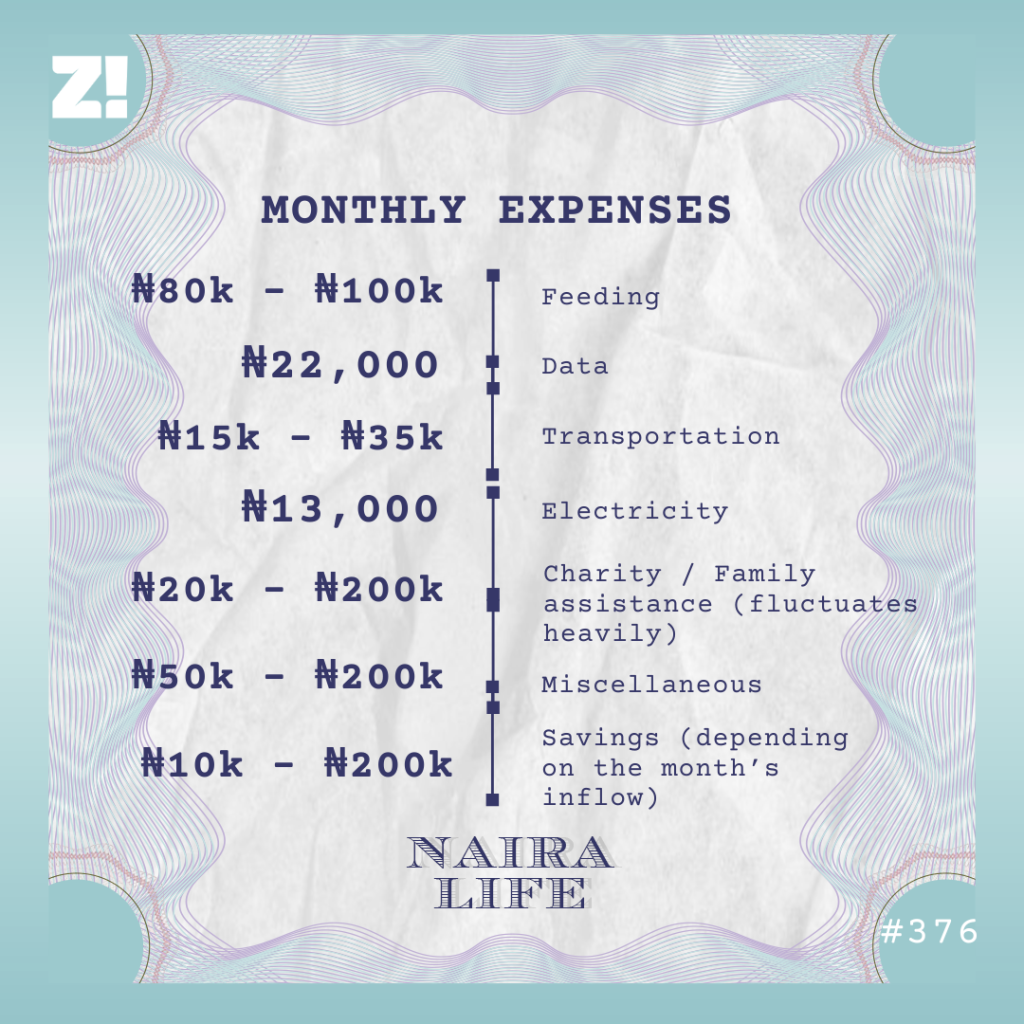
Let’s break down your typical monthly expenses
What does your savings portfolio look like?
I have about $300+ in US stocks. The value of the naira can drop at any time, so saving in a stable currency is the logical option for me. I’d love to diversify into money market funds and bonds, but I don’t have sufficient capital for that yet. I bought a piece of land in 2023 for ₦1.2 million, which literally used up all my savings at the time.
The beautiful and terrifying thing about law is its unpredictable nature. You could have zero naira in your account today, and tomorrow a single brief turns you into a multi-millionaire. I’m optimistic about hitting that net worth soon. In fact, I have a strong conviction that I’ll be wealthy. When that time comes, I’ll invest heavily in real estate and expansion.
Where does this strong conviction come from?
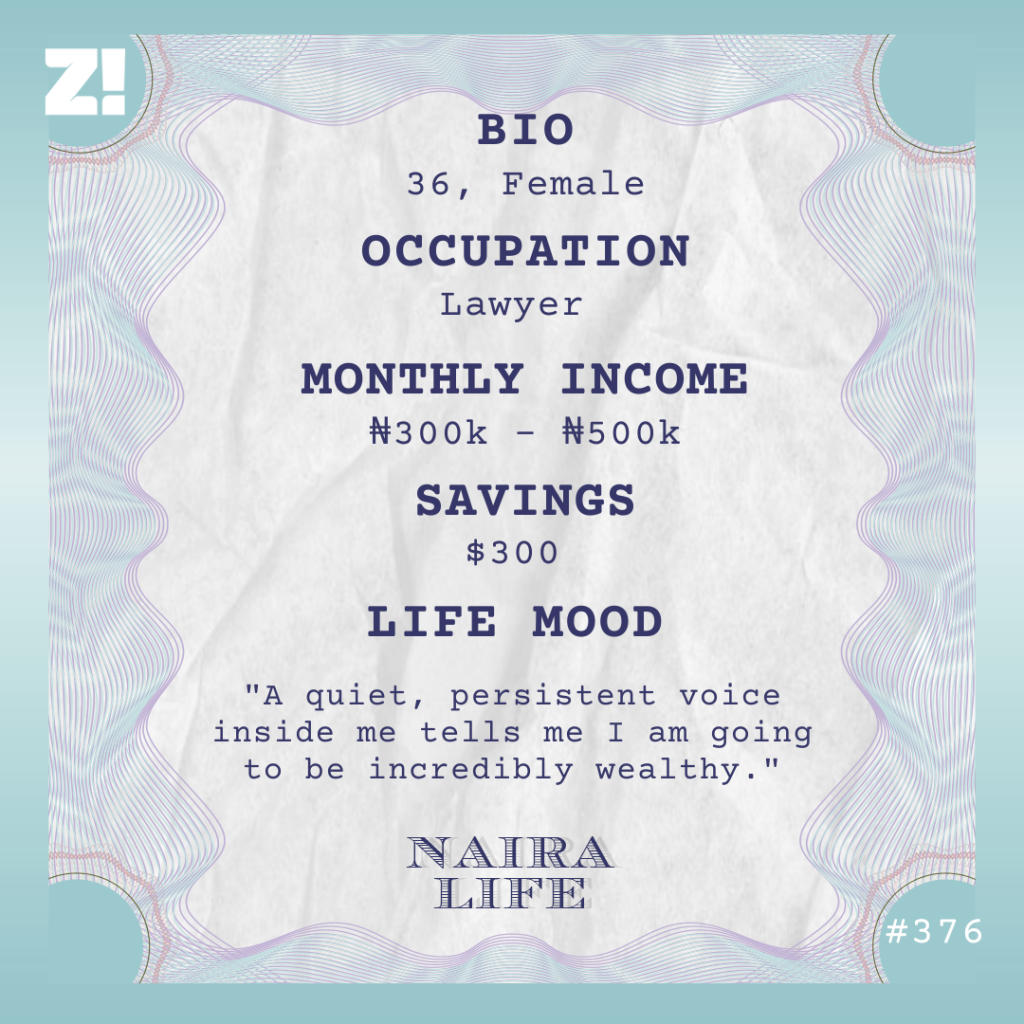
A quiet, persistent voice inside me tells me I am going to be incredibly wealthy. I don’t necessarily mean having billions in dollars, but at least millions. The kind of wealth where I can fly first class, go on luxury vacations, and fund major charity projects without blinking or losing sleep.
To prepare for that, I constantly invest in my academic upgrades and certifications because you never know where an opportunity will come from. I also rely heavily on my soft skills. I am excellent at maintaining relationships. I have friendships that have lasted over 20 years. People buy into who you are before they do business with you. I believe I have what it takes to become a multi-millionaire.
Do you see this wealth coming entirely from your law practice?
It will be a mix of law, strategic investments, and business. Law itself is a business, though many lawyers don’t treat it that way. I have a strong inclination toward entrepreneurship. I can’t pinpoint the exact industry yet because I have a lot of ideas floating around, but I know I will run a highly successful business in the near future.
I don’t plan to return to paid employment. The only exception I’d make is a short-term advisory contract, like three to six months, or a year at most. But permanent employment? I’m completely done with it.
How would you describe your relationship with money?
I’d say I have a good relationship with money. I’m not where I need to be financially, but I understand that money is just a tool to get the good things in life. So, I treat it that way. I don’t have a lot of it right now, but I always channel it to the right use, and I don’t regret any expense.
Is there an ideal amount you think you should be earning monthly?
Nothing less than ₦2 million. Even that figure should be in a bad month. It should be ₦2 million and above.
How about something you want right now but can’t afford?
A lot of things. I can’t casually buy a new car right now. I can’t afford a luxury vacation outside the country. But I know these things won’t be a problem for me in the near future.
I’m curious: How has the shift from growing up rich to grinding on your own affected you?
My dad was rich, but I wouldn’t say I was rich personally. They never gave me a ton of money; I just had enough to get by.
Looking back at where my parents were at my age, my dad had already built houses, my mum already had kids, and they were very comfortable. Looking at where I am now, it’s not something that makes me feel great, but I try not to dwell on it. I have a functioning practice, and I am putting in the work.
Do you still have a safety net at home?
Yes, and I am deeply grateful for it. When I had that terrible dry spell in January and made less than ₦100k, my family completely stepped in and carried me.
Right now, I want to upgrade my phone to a higher Samsung model. My brother in the UK is covering a significant fraction of the cost and bringing it home for me next month. My sister takes care of my clothes and toiletries. Earlier this year, my dad actually asked me if I wanted to relocate abroad, and if I had said yes, he would have funded 80% of it.
Why did you turn down the offer to relocate?
I don’t see myself living abroad permanently. I want to explore the world, but Nigeria is a beautiful place to live if you have money. Abuja is an incredible city if your finances are right.
As a lawyer, moving abroad means starting my career at the very bottom of the ladder. I don’t have the energy for that struggle again. I’d rather build my practice here, take on foreign gigs when they come, do short-term studies abroad, and come back. When the major money comes, I can just acquire citizenship by investment and travel effortlessly without the trauma of starting over from rock bottom.
How often do you lean on this safety net?
Hardly ever. I am fiercely independent, and my siblings know me for that. Since 2021, I have not asked my dad for a single kobo. Instead, I give him gifts during festive periods and on his birthdays, and I send my mum a stipend. I pride myself on standing on my own feet.
How would you rate your financial happiness on a scale of 1 to 10?
5. I don’t have to beg anybody to eat. My income covers my food, clothing, and shelter. I can afford the basics of life without compromising my dignity, and that’s something I am deeply grateful for.
What would make that number a 10?
Earning millions every single month. When I reach a point where I am bringing in ₦2 million, ₦5 million, or ₦10 million monthly, then it becomes a 10. At that level, everything I’ve been longing to do for myself and others will happen effortlessly.
If you’re interested in talking about your Naira Life story, this is a good place to start.
Find all the past Naira Life stories here.