There is a six-month-old article sitting on Billboard’s website. It was published in June 2025. It ranked Rema, one of the most important artists to emerge from Nigeria in the last decade, at number six on a list of the “25 Biggest One-Hit Wonders of the 21st Century.”
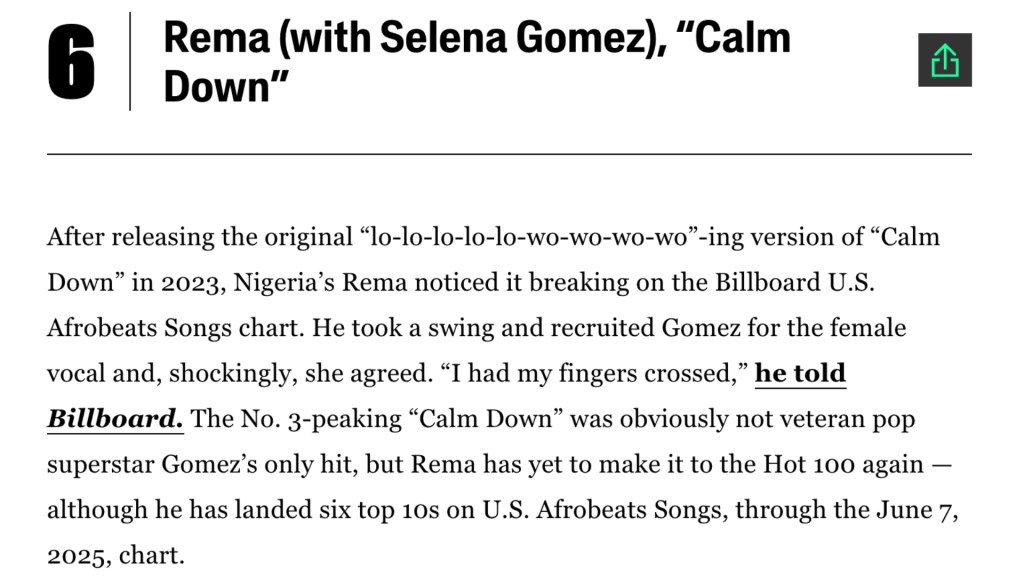
Nobody paid much attention. Then, on February 16, 2026, the article resurfaced on X and the Nigerian internet erupted.
Before we pick the point of the eruption itself, let us be precise about what Billboard actually said. The precision matters here, and the lack of it is part of the problem. Billboard’s methodology for this list is specific. The list includes artists who have logged exactly one Hot 100 hit in a lead role between January 2000 and December 2024. By that measure, Rema qualifies.
The reason? “Calm Down (Remix)” featuring Selena Gomez, peaked at No. 3 on the Hot 100, and he has not returned to that chart since. Though Billboard itself noted, almost sheepishly, that he has landed six top-10 entries in the U.S. Afrobeats Songs chart. The list is not a character assassination, as perceived by many Nigerians. It is a ledger. An American ledger.

While that’s one thing to understand to make sense of this entire conversation, it’s important to ask why a six-month listicle is triggering an industry or perhaps, a nation. This is beyond Billboard’s consistent ignorance. From their questionable Top 50 Afrobeats Songs of All-Time list and Rookie of the Year award, their coverage of African music has been erratic at best and embarrassing at worst. But even a broken clock is right twice a day, and our rage about the list shows this. It reveals that there’s a blind spot in the centre of “Afrobeats to the World.” It also shows that, for far too long, we’ve bought into the worldview that success is only real if America says so.
We went international, made noise and celebrated crossover metrics (still do). We dress and perform for that gaze. But when the Western gaze looks back at us and offers its own assessment, we’re shocked to find it cold and offended that it has opinions.
Subscribe to Zikoko Pop newsletter, The Feed, for the most important pop culture news
This “One-Hit Wonder” opinion is an outcome of using our lack as a superpower, at times due to a lack of choice. Other times, it’s because we fail to see what’s really important. There’s a real economic logic to the pursuit of foreign validation, and it deserves acknowledgement before it gets dismissed. The revenue is outside Africa. The streaming numbers that translate to generational wealth, recoupment and the kind of financial security that turns an artist into a legacy live in Europe and America. They’re in the markets where the dollars and the pounds are supreme.
Rema going to the United States, finding Selena Gomez and climbing to No. 3 on the Hot 100 was not vanity. It was business and strategy. In fact, it can be survival, and according to label head Motolani Alake: “if you haven’t chased it, you won’t know what it feels like. So it’s a necessity.”
But when Afrobeats pursues a market without properly carrying and protecting its identity, it begins to wear its flaws — its under-resourced music infrastructure, its crawling chart system, its streaming deficits — like armour. The flaws explain every slight. The amour powers every ambition. And sometimes that combination produces extraordinary art and extraordinary careers. But it also produces a peculiar weak spot where a recycled Billboard listicle can destabilise an entire industry’s sense of self for a news cycle.
That weakness has nothing to do with Rema. It’s a structural problem. It’s the result of a music ecosystem that has consistently prioritised Western crossover as the strongest proof of value, while treating its own charts and its own milestones as footnotes. When did you last see a Nigerian label purchase and display its own Turntable chart plaques with the same ceremony afforded to a Billboard placement? When did a No. 1 on the TurnTable chart, Nigeria’s standard chart, generate the kind of coverage, celebration and institutional recognition that a Hot 100 entry does? We build our own validating structures and refuse to validate them. Why are we surprised when foreign structures fill the vacuum with their own definitions of success?
READ NEXT: In Defence of Rema’s “HEIS”
Since Billboard’s list is partly a verdict on what happened after “Calm Down (Remix)”, it’s important to reiterate that “HEIS”, Rema’s sophomore work, is a good album. A bold one and, in fact, the best Nigerian album of 2024. “HEIS” is a deliberate artistic left turn from the pop sensibilities that made “Calm Down” a crossover phenomenon. It produced moments of genuine creative experiments.

It’s a statement album aimed at a Nigerian audience, steeped in rave energy and Benin references, the specificity of where Rema comes from. That’s not a flaw. In a healthier critical ecosystem, it would be a strength. But in the foreign media economy, “HEIS” is read as a local detour, and the window to consolidate international momentum, clearly by being Hot 100 regulars, remains a narrow and impatient one.
Billboard’s list is, in part, a record of that impatience. Rema’s stocks in the speculative eye of foreign media, whatever they were in 2023, had declined by the time this list was compiled. Their truth isn’t about Rema, but a mirror and the truth of our local music industry.
The Grammy conversation is similar to this. Every year, the frustration with the Recording Academy’s blind spots for African and Nigerian music resurfaces. Frustrations like wrong categories, truncated ceremonies and the belief that African music is invited to the table only to be seated at the corner. The outrage is legitimate. The treatment is often disrespectful. But the Grammys and Billboard are American institutions measuring American industry values. They are subject to the American gaze by design. That gaze will not stop being American because Nigerian X and music fans demand it. What it will respond to, imperfectly and slowly, is sustained commercial presence in American markets, which is exactly why the crossover pursuit is rational.
Two things can be true. Billboard, by its own methodology, is not wrong: Rema has one Hot 100 hit. Nigeria, by any honest assessment of his catalogue, cultural impact and commercial success, is right: Rema is not a one-hit wonder. These are not contradictory statements. The problem is that there’s a disagreement, and we keep forgetting which side of things we actually stand.
Nothing will change until Nigerian music accumulates the kind of sustained Hot 100 presence that makes the American categorisations feel inadequate. Achieving that means playing a long game. It requires institutional infrastructure, global distribution muscle, label investment and a willingness to play the market on its own terms for longer than one smash cycle.

In the meantime, it’s more urgent to build at home. We should celebrate the Turntable No. 1s with the same reverence we afford the Hot 100 entries. Purchase and display the plaques. Fund the critical infrastructure that contextualises Nigerian music on Nigerian terms. Build the ecosystem that makes an American listicle feel like what it is: a foreign publication’s assessment of our performance in a foreign market, rather than a verdict on our worth.
When we have that solid foundation, things like this Billboard article won’t hurt. Or maybe it will, but the way a stranger’s opinion stings: briefly and then fades away.
Until then, let’s learn to take a look in the mirror and proactively deal with what we see.