Someone you know has left or is planning to leave. 1,000 Ways to Japa speaks to real people and explores the endless reasons and paths they take to japa.
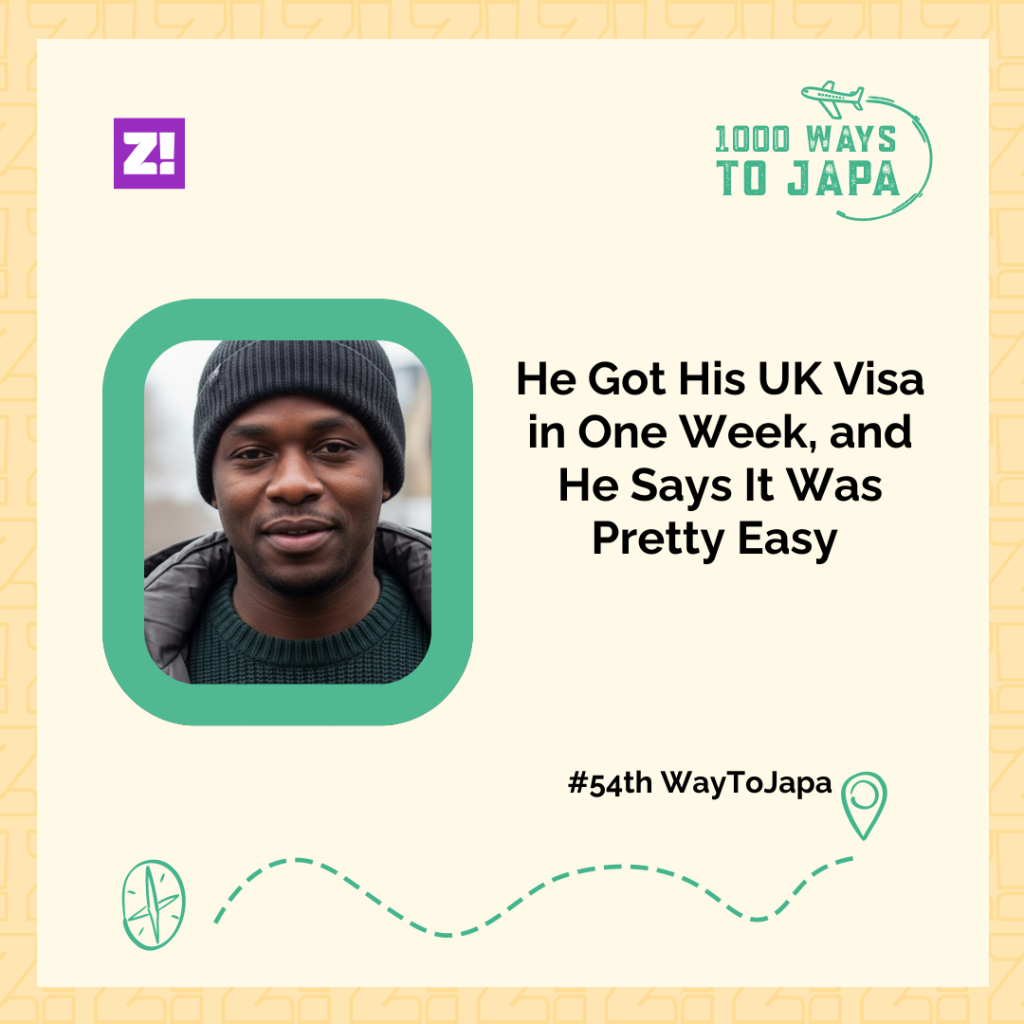
Joshua* (27) has always wanted to leave Nigeria to seek greater opportunities abroad. So when an unfortunate tragedy made him miss a scholarship from a prestigious Chinese university, he had to try his hand at a UK school. In this story, he shares how surprisingly easy it was to secure his visa, what his school was like and how happy he currently is.
Where do you currently live, and when did you leave Nigeria?
I live in the United Kingdom (UK). I moved here in the second half of 2024.
How did you leave?
I left through the study route for my master’s.
Congratulations! How has it been?
It’s been great. I did my Master’s in Global Healthcare Management, and I finished in 2025.
Nice. So, what inspired your decision to leave Nigeria?
I have always wanted to live abroad because I believe it opens one up to more opportunities. I wasn’t particular about the UK; It’d have actually been China, but circumstances said otherwise. I had gotten a scholarship in 2023 to study in one of China’s most prestigious universities— Nanjing Medical University— but I couldn’t travel at the time because I had just lost my mum. In late 2024, I had to make other plans; that was how I found myself in the UK.
I’m so sorry to hear about your mum
Thank you.
Did you win another scholarship for your studies in the UK?
No, it wasn’t a scholarship; it was self-funded. I applied for different scholarships, but didn’t get them, so I just had to fund it myself.
What’s the name of the University you studied at?
I studied at York St John University. I studied at their London campus, where they do a majority of their international master’s programmes. Their York campus, on the other hand, is where most of their undergraduate and postgraduate programmes are taught.
I had a lovely time at the University, so I advise anyone that wants to study in the UK apply to the school. One of the reasons I like York St John University is that they give you time. They know that you’re an international student and that it doesn’t have to be about studying all the time. I don’t think I studied for a cumulative eight months during my one-year master’s there. Each semester is made up of three months, and after each semester, we were given a break. I had time enough to sustain a job within the 20-hour weekly work limit.
What type of job did you do at the time?
I first worked at a bakery, then I got a job at a healthcare firm. I used that to cover the remainder of my tuition, my house rent, transportation and other expenses.
How much was your tuition?
We are required to pay £11,300 in total. But before I came into the country, I paid about £7000, with about £4200 outstanding. The school has a payment plan that allows you pay your tuition fee across three instalments.
What was the visa process like?
It was a pretty straightforward process for me. I was lucky enough to have a family friend in the UK who has an education agency recruiting students from all over the world; he helped me process my application. All I did was provide him with my documents, and he got me my admission and helped process my visa application. I got my visa within one week of applying.
Oh wow! Visa in one week? What did he do differently?
I don’t think he did anything extraordinarily different from what others are doing. I feel he just got it right with the documentation because presenting clearly understandable documentation to visa case workers makes their job easier and, in turn, your visa application. Sometimes, these visa case workers find it difficult to understand certain documents that you send to them.
It also helped that he advised me to apply in Abuja. There is less traffic and less hassle in the Abuja Visa Application Centre when compared to places like Lagos. In fact, I advise anyone who wants to move abroad, especially to the UK, to use the Abuja Visa Application Centre. Ever since I got mine, I have been spreading the gospel to anyone who cares to listen.
What documents did you present to the visa case workers?
The most important thing, of course, is your valid international passport. You will be asked for an English test, but because we are an English-speaking country, they will accept your WAEC result if you have a minimum of C4 in English.
You also have to provide the school with your WAEC scratch card to process it. You will also need your degree certificate, transcripts, and proof of funds. These are the basic documents that you need. During the application process, you will be asked to fill out a bunch of forms. That’s about it. The UK visa application process is pretty straightforward.
How much did it cost you to move?
I estimate it to be around ₦23 to ₦25million. I paid 70% of my tuition fee up front, which was about ₦15 million. My visa application fee and health insurance fee amounted to ₦3.2 million, my proof of funds cost ₦1.6 million, and my flight booking cost ₦1.2 million.
That’s a lot of money. How were you able to afford it?
My family was my main source of funding, but I also had savings that I put together because even though family was helping me, I also had to show some seriousness and commitment.
With my savings, I was able to pay some parts of my proof of funds and the money I used to relocate, which is my pocket money.
You saved quite well. Were you working before you left Nigeria?
Yes. We own a family business, and I worked there at the time. Prior to that, I worked at a Health Insurance firm for my National Youth Service Corps (NYSC) year. I actually worked simultaneously in both places at the time, so I had two streams of income. That’s how I was able to save a substantial amount of money.
Awesome. What’s the education system in the UK like in comparison to Nigeria?
You actually can’t compare the education system here to Nigeria’s. It’s pretty straightforward here. While the workload in Nigeria is quite overwhelming, it’s not so here; in fact, it’s structured in a way that allows students time to do other things rather than studying most of the time.
They’re also not insistent on exams over here. Instead of final examinations, which Nigerians usually take for a master’s certification, you could be given a seminar topic or research to carry out, after which you submit your findings. The exposure to students from different countries and walks of life also helps shape and improve your learning.
How has life been post-studies?
It’s been great. I continued working at the healthcare company I told you about, and I’ve done that for over a year now.
What’s the work culture in the UK like?
It’s honestly pretty good when compared to Nigeria. Here, you work for 11 months in a year because you get 28 days paid annual leave. There are also other incentives, discounts, and vouchers for things like your medical needs, as well as shopping. Sometimes, they even finance your car. I haven’t seen all of these in Nigeria.
The UK is family-oriented, so contrary to popular perception among Nigerians, work here is structured to give you a lot of time for your family; the reason migrants complain is that they have to take on extra hours to save up.
Bosses also respect employees’ boundaries here. Your boss won’t call you at odd hours or anything like that. In fact, some people have designated phones for work, and they turn them off the moment they’re closed for the day.
Do you have a support system here?
Yes, I do. I have a couple of friends from Portugal and some from Nigeria. I also met some really nice people in school, and I’ve remained friends with them since then.
Making friends is easier in Nigeria and much harder in the UK. Unlike Nigeria, where you can meet people almost everywhere, the UK, depending on your city, limits you to meeting people via social media and in churches. But I’m lucky to have met really nice people here. They have been my support system.
Love that for you. On a scale of one to 10, how would you rate your life in the UK compared to Nigeria?
Aside from family and food, which I miss, I’ll rate it a 9.5. I think I have more peace of mind here.
Want to share your japa story? Please reach out to me here.