A singer-songwriter and the first African to ever win the Swiss Blues Award, Justina Lee Brown came into the spotlight in 2008 with her hit song, Omo 2 Sexy, and over the years, her music has evolved from Afropop into funk, soul, blues, rock, and jazz. In this story, we trace Justina’s musical journey from Africa to Europe.
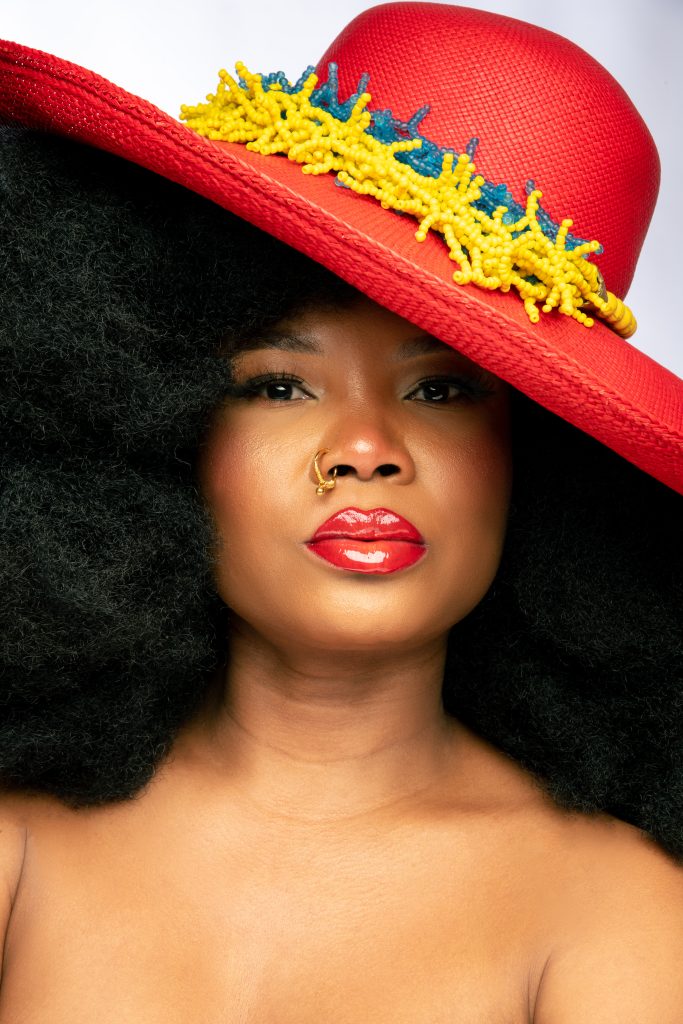
This is Justina’s story as told to Sofiyah
As a young child, poverty was my closest friend. My mum was a hawker who barely made enough to keep the household going, so eating three square meals a day was a privilege we didn’t have. Growing up in Nigeria under those harsh conditions meant that we had to pay heavily for the injustice that surrounded us, and I experienced the brokenness of the country firsthand. It was precisely this reason that led me to choose law as my first career option. I hated the idea of injustice, and I wanted to fight it, but poverty had different plans for me.
Instead of the career that I’d initially wanted to go for, I somehow found myself wrapped up in music completely by accident. My mother hawked ice water on the streets, and I was the one who had to keep watch over the plastic cooler where she kept it. While she hawked, I would get bored and get sticks so I could tap them against the plastic. I was probably around eight this time, so I was just making sounds to pass the time, but then people started giving me money.
At that age, I couldn’t fully comprehend what was going on. I didn’t even know what singing was. All I knew was that there was sound coming out of my mouth and people liked it enough to give money. It was then I realised. I added two plus two and calculated that if I kept doing this, people would give me money, and in turn, I could help my mum. I realised that if I made enough money, she wouldn’t have to hawk under the hot sun for hours because I was making more money from singing than she made from hawking. At first, my mother thought I was stealing the money, but after I sang in front of her, she immediately took me to the choir, and the rest is history.
I originally went into music because I realised it could give me money and help my family, but as time went on, I finally accepted it for what it was. It was a gift, and I knew I had to put my entire being into it. It made sense that my dedication to this craft paid off, resulting in my hit song, Omo 2 Sexy. After Omo 2 Sexy, it was only the top from there. My song became recognised all over West Africa, and I was touring, and everything was going well until the corruption side of the music industry finally introduced itself to me.
Music politics in Nigeria have always been so unkind to women. Producers tend to have this “scratch my back, and I’ll scratch yours” ideal, but right from the start, I’ve always identified as a headstrong woman who believes in the structure and discipline of your body, so I never gave them what they wanted. This resulted in getting a lot of doors shut in my face. African men don’t exactly like women who have a backbone. They want a woman who would accept whatever they throw at her, and I am simply not that woman.
Next Read: “I Felt Like My Body Was Not Enough” — 5 Nigerian Women on Their Postpartum Experiences
The politics of the Nigerian music industry played a significant role in my decision to move to Europe, an entirely different continent, where I chose to re-establish myself from the ground up. Another critical factor was the realisation that I didn’t want to present myself in a certain way just to be commercially accepted. This realisation became clear to me around 2009 when I was on tour in Nigeria, and when I saw how everything was going, I instantly became depressed. I didn’t want to be that kind of woman who had to expose her cleavage, style her hair in a certain way or wear heavy makeup just to appeal to my audience. That’s not who I am.
Moving to Europe was one of the hardest and depressing decisions I have ever made. It was scary because I knew I would have to start my career over, and even with the help of a German friend who helped me plan the move to Switzerland, the transition was far from easy. Relocating to an entirely different continent was financially taxing, and there were moments when the uncertainty felt overwhelming. Still, the move was very necessary. I wanted an audience that didn’t care about my appearance but only about my voice and my message. I wanted to explore my voice and deepen my craft. Europe offered that. In Europe, I found my voice in jazz, funk, soul and the blues, and I found an audience that just wants their spirits touched emotionally by my voice.
For a long time, I received a lot of backlash from my own people. Many believed I was trying to become European, but that was never the case. What they didn’t understand was that I was simply following my passion. I wasn’t trying to be European or anybody else. I was trying to be Justina, precisely as God created me, expressing the gift He placed inside me.
As a Nigerian woman in Nigeria, I felt like a foreigner in a place that should feel like home and as a Nigerian woman in Europe, I was often misunderstood. The passion in my voice was usually labelled as aggression, but what they fail to recognise is that it is part of my identity, not hostility. It is passion. It is nature. As an African woman, I was never seen as complete in many spaces.
The need to create my own space, occupy it, and live within it with dignity led me on a journey with my last album, The Lost Child. Coming home to Nigeria after six years of continuous touring made me realise something painful. I no longer fully belonged there. In the Western world, I was also a foreigner.
The Lost Child was an ode to me, the woman, who, already broken by circumstances, left her country for a better life. She thought she was heading to a green land, but when she arrived, it was not green at all. It is grey, and she has to make it green herself. She knows she cannot return to the land she left because if she does, it’s back to square one, so she continues to push forward in the new land. But even there, she is never complete. She’s never fully welcomed, and that leaves her in a permanent state of in-between.
Over time, I found a place of peace where my ‘Nigerianness’ didn’t have to satisfy everyone. I may never be Nigerian enough for all Nigerians, but I can be Nigerian enough for many, and that is enough. As for Europe, the reality is simple: I will never be European enough either. The only option is to remain who I am and keep doing the work.
The acceptance of this gave birth to Echoes of Home. The Lost Child was about displacement, but Echoes of Home revolves around homecoming and roots. The album shines a deliberate light on my identity as a Nigerian. It is about me embracing my roots and reinforcing my place as a voice that speaks without apology.
You’ll Love: How These 11 Nigerian Women are Monetising Their Hobbies