Someone said the early bird gets the fattest worm, and Nigerian politicians took it personally.
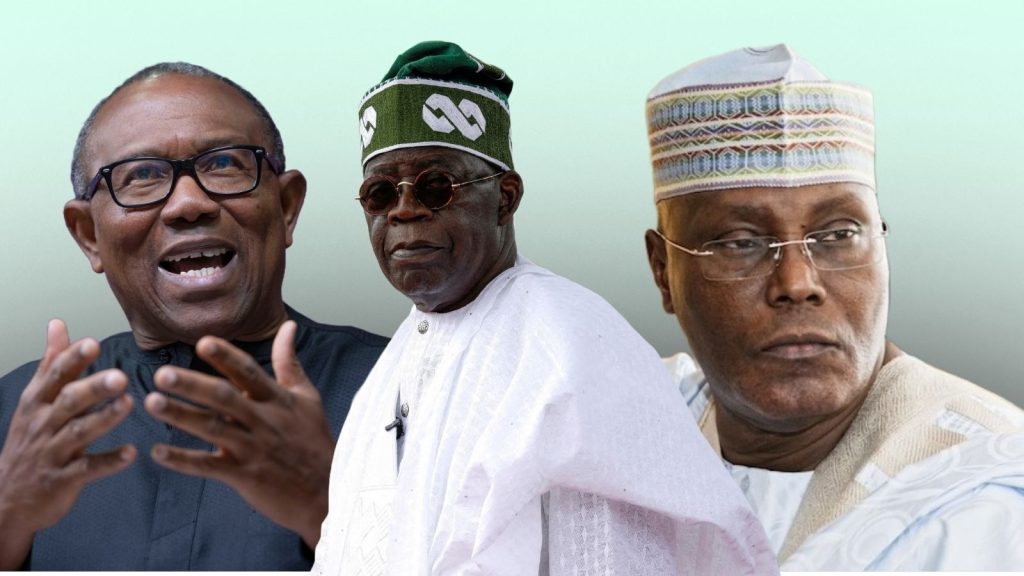
The next general elections are several months away, but Nigerian politicians are not wasting any time at all. We have already seen party endorsements and “unofficial” campaign posters as early as 2024. In 2026, we expect to see even bolder moves. Politicians are seriously getting prepared, and as voters, you should too.
The object in the mirror is closer than it appears
To be clear, there is no excuse for the clear illegality we have seen from politicians. The Electoral Act of 2022 states that parties and candidates cannot campaign publicly until 150 days before the election.
But it is possible politicians are acting so quickly because the next general elections may actually take place this year, 2026, instead of 2027.
This is because of a proposed change in the Electoral Act Amendment Bill of 2025. The change suggests making sure elections take place 185 days before the swearing-in ceremony. The reason for this is to make sure all post-election court cases are finished before anyone is sworn in.
We can all agree that the current system is a bit messy. President Tinubu was sworn in in May 2023, while the court only gave a final judgment in his favour in September of that year. So the change is welcome.
The only problem is that if it passes soon, it could bring the election forward from March 2027 to November 2026. Any parties planning for 2027 could find themselves at a disadvantage. But this is still no excuse for the premature campaigning we are seeing. There is jumping the gun, and then there is what Tinubu has been doing.
The early BAT gets the worm

As early as April 2025, campaign posters for Tinubu’s reelection started flooding the streets in various parts of the country, especially in Abuja.
In May 2025, some groups within the All Progressives Congress (APC) endorsed the president as the “sole candidate” of the party. These groups, which included the APC Progressive Governors’ Forum (PGF) and the National Working Committee (NWC), made this known at a party National Policy Summit. Of course, Tinubu graciously accepted, saying he would lead them to “That Promised Land.”
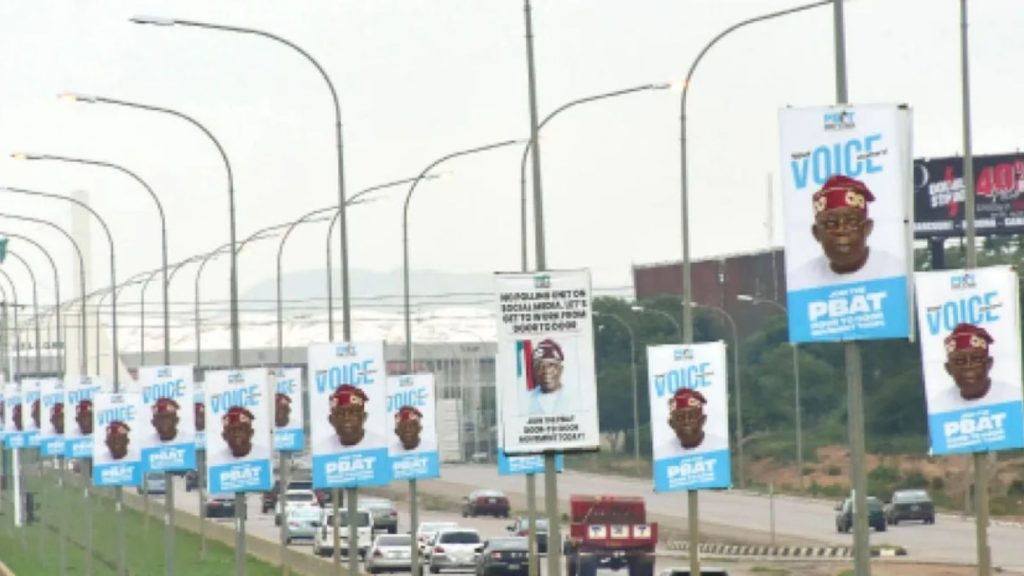
Dailytrust: Airport road, Abuja
The endorsement is clearly meant to bypass party primaries. This is not strange for people already in power: their parties usually just present them as candidates by “consensus” instead of organising primary elections. But the “sole candidate” tag led to talk that pro-Tinubu factions are trying to cut out Vice President Shettima.
ALSO READ: President Tinubu’s Reelection Campaign Has Started, And Not Even INEC Can Stop It
Many names were floated throughout 2025 as potential substitutes: from the National Security Adviser (NSA), Nuhu Ribadu, to the Deputy President of the Senate, Barau Jibrin, and even Rabiu Kwankwaso.
When asked about it, Jibrin said: “Whatever the President asks me to do, I will do it—one hundred per cent.” Meanwhile, Kwankwaso has said he is looking for a party and will only join if he is guaranteed at least a vice-presidential ticket.
Whatever the ticket looks like on election day, it is clear that Tinubu and the APC have been thinking about their strategy very early on. But Tinubu is not the only early bird.
The poster children
In May 2023, posters of Seyi Makinde, the current governor of Oyo State, started popping up in northern states like Kano and Jigawa. A month before the appearance of the posters, Makinde had said, “I do not have any doubt that I have the capacity to occupy the highest office in this land.”
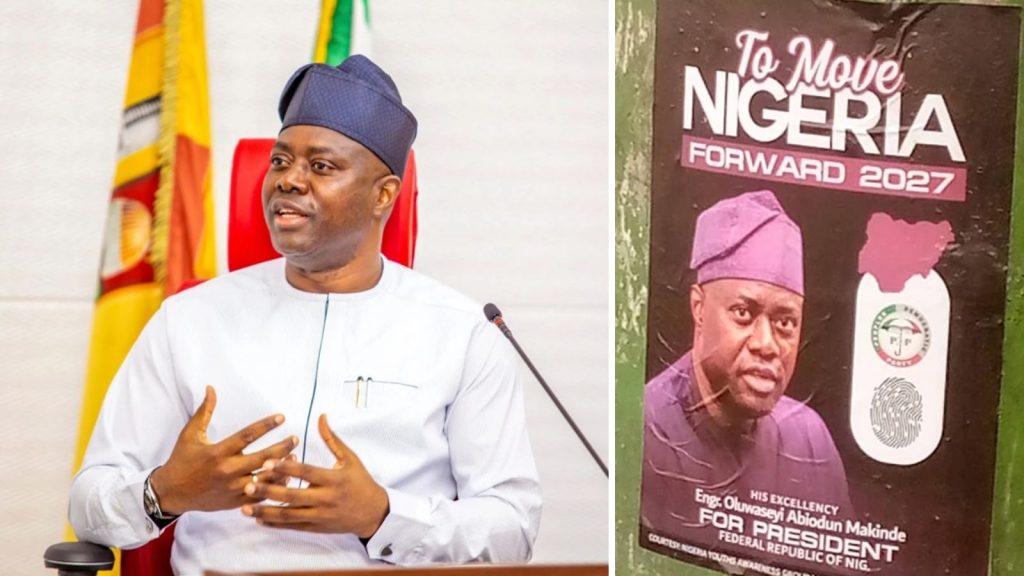
It appears he sees himself as a potential presidential candidate for the People’s Democratic Party (PDP). It is hard to predict how that will turn out since the party is basically imploding in real time. The party is currently split between competing factions with Makinde on one side and Federal Capital Territory (FCT) Minister, Nyesom Wike, on the other.
If you think Makinde and Tinubu were early, posters for former president Goodluck Jonathan were already showing up as early as December 2024.
ALSO READ: Wildcards & Outsiders: Potential Presidential Candidates for 2027 That Would Surprise Us
But how are these politicians getting away with campaigning outside the legal 150-day window?
Well, they claim they have nothing to do with it. They say the posters are put up by overzealous supporters without their knowledge. The Independent National Electoral Commission (INEC) on the other hand has basically said its hands are tied.
Victoria Etta-Messi, a Director at INEC, said the politicians are being “smart by half” by using third parties. She also pointed out that even when you can prove they are involved, the law does not state a punishment.
Basically, the law is currently toothless. Until it is fixed, we might have to get used to having campaign materials shoved in our faces three years before an election.
Avengers, assemble!
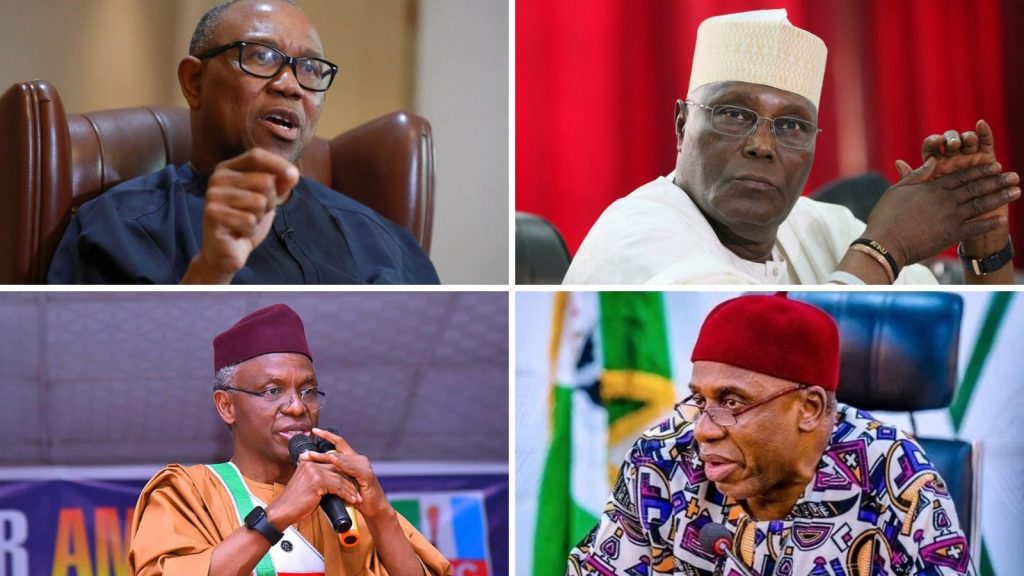
So the APC seems to be putting all its eggs in the Tinubu basket. But what is happening on the opposition side?
In 2023, Tinubu had to contend with Atiku Abubakar and Peter Obi. But as it stands, 2027 will likely be a much simpler choice: Tinubu or the rest?
In July 2025, a bunch of political bigwigs announced they were forming a coalition under the African Democratic Congress (ADC). This group includes multiple presidential aspirants including Rotimi Amaechi, Atiku Abubakar, Nasir El-Rufai, and Peter Obi.
A big question has hung over this coalition from the start: who gets the ticket?
There can be only one
In the end, each party can only present one candidate. If all the men who want to be president gather in one party, how do they settle it?
Rotimi Amaechi has promised ADC members that if they choose him, he will use his inside knowledge as a former member of the APC to take them down.
As the biggest challengers in 2023, an Atiku and Obi ticket seems like the strongest option. But it is hard to see Atiku, who was vice president from 1999 to 2007, competing for the same position again.
Obi has also made it clear he has no intention of being a deputy again. He said: “I am not travelling round the world to learn governance to be Vice President.” Despite this giant elephant in the room, they have all squeezed themselves into the ADC, with Peter Obi being the last to officially join on December 31, 2025.
Who even needs choices, right?
The ADC has been a confusing beast. There is really nothing in common between these politicians except they are not in power and they would like to be.
At the time of the announcement, many were still members of other parties. El-Rufai had recently left the APC for the Social Democratic Party (SDP), which later expelled him in July 2025 for flirting with the ADC. Atiku moved from the PDP to the ADC in November 2025.
Obi’s move on December 31, 2025, means that the two main opposition candidates from the last election are now in the same party. This is a common trend: a lack of clear ideology means candidates switch sides constantly to get ahead. The ADC coalition only seems united by a desire to remove the APC. We have seen this exact thing play out before.
The pioneers
Back in 2013, different parties were tired of failing to unseat the PDP. So the Action Congress of Nigeria (ACN), the Congress for Progressive Change (CPC), the All Nigeria People’s Party (ANPP), and the All Progressive Grand Alliance (APGA) came together to form the APC. They defeated the PDP in 2015 and have stayed in power since. It is a strategy that works.
The ease with which big candidates can join forces just to increase their chances of winning is exactly why Nigeria is at risk of becoming a one-party state. The 2023 election was special because Nigerians had three real options. If this coalition holds until 2027, Nigerians will have fewer choices.
As long as it remains the surest way to power, we are going to keep seeing these moves. And 2025 saw a lot of movement.
The movers and shakers
It is almost poetic that 2025 ended with Peter Obi’s defection, as the whole year was defined by party switching. From governors to lawmakers, politicians have been jumping ship to whichever party they think guarantees success in 2027.
The 10th Senate began with 59 APC senators and 50 in the opposition. Since then, we have seen a steady stream of senators move to the ruling party.
In October 2025, Senator Samaila Kila of Bauchi North moved from the PDP to the APC. His move took the APC to 73 seats out of 109. That gives them the two-thirds “supermajority” needed to pass major laws or amend the Constitution without any help from the opposition.
Though the APC says it is not trying to make Nigeria a one-party state, it has not stopped inviting more senators to join. Since Kila’s move, the following have also defected:
- Ahmed Aliyu Wadada (Nasarawa West) moved from the SDP to the APC.
- Sunday Katung (Kaduna South) moved from the PDP to the APC.
- Agom Jarigbe (Cross River North) moved from the PDP to the APC.
- Allwell Onyesoh (Rivers East) moved from the PDP to the APC.
- Barinada Mpigi (Rivers South-East) moved from the PDP to the APC.
So there are now 78 APC senators with the possibility of more joining before the elections.
For the party, convincing rivals to defect is easier than defeating them at the polls. For the politicians, it is a survival tactic. Their 2023 wins show they are popular in their constituency but many still don’t want to risk competing against candidates backed by the ruling party. This is exactly how one-party systems are built.
ALSO READ: Nigeria Is Shifting Towards a One-Party System. Here’s Why It’s Happening
The Governors
The APC has not just been collecting lawmakers; they have been collecting state governors too.
After 2023, the APC had 21 governors, while the PDP had 12. The Labour Party, NNPP, and APGA had one each. Since then, the PDP has lost eight of its governors. While Ademola Adeleke of Osun State left the PDP for the Accord Party, the others all headed to the APC:
- Sheriff Oborevwori of Delta State moved from PDP to APC in April 2025.
- Umo Eno of Akwa Ibom State moved from PDP to APC in June 2025.
- Peter Mbah of Enugu State moved from PDP to APC in October 2025.
- Douye Diri of Bayelsa State moved from PDP to APC in November 2025.
- Siminalayi Fubara of Rivers State moved from PDP to APC in December 2025
- Agbu Kefas of Taraba State moved from PDP to APC in December 2025..
- Caleb Mutfwang of Plateau State moved from PDP to APC in January 2026.
The APC now has 28 state governors out of 36, and they might be trying to get more. Bala Mohammed of Bauchi claims the APC is using the EFCC to pressure him into joining them.
The APC are not the only ones making moves, though. The ADC is courting the Labour Party’s only governor, Alex Otti of Abia, but he has said he plans to remain in the Labour Party for 2027.
From early campaigns to defections, politicians are hedging their bets ahead of 2027. This year, we are going to see even more of that, and as voters, we need to get ready too.
Get involved!
This is no time for apathy. Politics affects every aspect of your life whether you realise it or not.
Nigeria is one of the most dangerous places in the world to live due to factors like insecurity and a struggling healthcare system. We rank 148 out of 163 on the World Peace Index. And 84 out of 110 on the Healthcare Index.
These problems are political and can only be solved through good governance. You cannot afford to be a passive player when your life literally depends on it.
We say this a lot and we will keep saying it: go get your PVC and vote!
INEC started the Continuous Voter Registration (CVR) exercise nationwide in August 2025. It will continue until August 30, 2026, but you don’t have to wait until the last minute. Visit INEC’s Continuous Voter Registration Portal to start your online registration.
But as you get involved, you have to make sure you are making the right decisions. And good decisions depend on having the right information.
Avoid misinformation
As the elections approach, politicians are going to try to force-feed us a ton of misinformation. Advancements in Artificial Intelligence mean we can expect fake news reports, AI-generated images, and deepfake recordings. They will try to push misinformation to hurt their opponents and cause general confusion.
To protect yourself, it is important to maintain a level head. Do not believe—and most importantly, do not share—information until you have taken the time to verify it from a trusted source.
But stay informed
While avoiding misinformation, remember that ignorance can be just as dangerous. The first step to taking back your political agency is staying informed. Find reliable sources you can trust, like Zikoko Citizen, to stay up to date on political moves and how they will affect your life.
You can follow Zikoko Citizen on Instagram, X (formerly Twitter), and TikTok. Subscribe to our newsletter, The Big Daily, to get breakdowns of the biggest news directly to your inbox. Also, check the website regularly for long-form analysis on important issues in Nigeria.
Before you go, help us understand how you and other young people feel about the 2027 general elections by taking this 10-minute survey.
Ever had a moment where Nigeria’s systems made life harder—or unexpectedly easier? We want to hear about your personal experiences that reflect how politics or public systems affect daily life in Nigeria. Share your story with us here—we’d love to hear from you!