The Nigerian experience is physical, emotional, and sometimes international. No one knows it better than our features on #TheAbroadLife, a series where we detail and explore Nigerian experiences while living abroad.
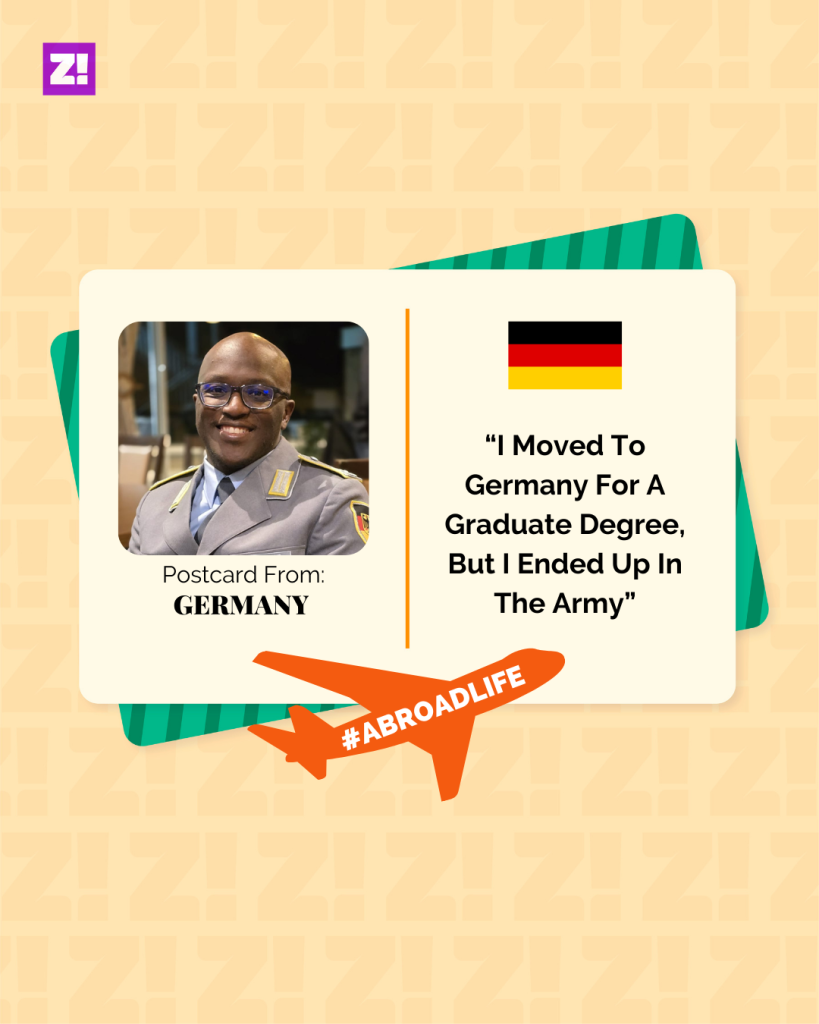
Ayodeji (33) moved to Germany in 2015 to pursue his graduate degree. From washing dishes to earning a PhD and eventually commissioning as a Major in the German Army, Ayodeji shares a story of perseverance and the power of intentionally building community as an immigrant.
Where do you live now, and when did you leave Nigeria?
I live in Germany. I left Nigeria in October 2015.
What inspired you to leave?
It was the same for me as it is for many young Nigerians: we feel like there aren’t enough opportunities to forge ahead at home. During my undergraduate years at UNILAG, we had three different strikes that turned my five-year course into seven.
I knew I wanted to pursue graduate degrees, and I couldn’t do that in such an environment, so I started researching opportunities abroad while still in school.
I really wanted to be a researcher, and Nigeria just wasn’t equipped for high-quality work. Many of our lecturers had doctorates from abroad, so what was I doing in Nigeria when the facilities didn’t exist? I knew I had to leave to get the access I wanted.
Why did you choose Germany?
I was considering the US, specifically the University of Illinois, but I made a German friend online who inspired me to look there. He helped me realise I could study in Germany basically for free.
Tuition in the US and UK would have been too expensive for my parents, but public universities in Germany are funded by taxes. It’s free even for international students; you only pay an administrative fee, which was around €150 per semester then.
I got into the Ludwig Maximilian University of Munich, completed my master’s degree and then did a doctorate programme too. I’ve lived here for ten years now.
Was it the first time you left Nigeria?
Yes. I had never left Nigeria before, not even to another African country.
How was it settling in?
It wasn’t easy. While many people speak English, the main language is German. Outside of the airports, everything, like signs on the streets or labels in the supermarkets, is in German. They expect you to understand it.
The culture shocks were huge. In Munich, stores close by 8:00 p.m. and are shut entirely on Sundays. If you forget something, you wait until Monday. Paying rent monthly instead of annually was also new. Also, Germans really mind their business. In Nigeria, strangers will happily talk to you on the bus; here, everyone goes their own way.
How were you funding life in Germany?
My parents supported me with funds when I left Nigeria, but I quickly realised it wasn’t enough. I started working in kitchens as a dishwasher. Many immigrants from Africa and Asia do these jobs—washing dishes in hotels or working in construction. I’d go to classes during the day, then work from 4:00 p.m. to midnight. I did that throughout my master’s and into my doctorate.
Did it pay a living wage?
Yes. On a student visa, my insurance and taxes were low, so I kept most of what I earned. It was enough to cover rent, semester fees, and food. It was more than enough to survive.
Was it difficult juggling classes with those shifts?
It was stressful. Sometimes morning shifts meant missing classes and catching up via classmates’ notes. But if you have a goal and you’re determined, you don’t stop. I wanted that doctorate, so I persevered.
I also eventually realised that I was washing plates largely because I lacked information. Once I got the right info towards the end of my doctorate studies, I stopped.
What was this information?
Around 2021, an older Nigerian mentor asked me, “Aburo, what are you doing apart from your PhD?” My doctorate was funded by a €1,000-a-month scholarship, but Munich is expensive, so I was still washing dishes to supplement. He said that was unacceptable for someone with a master’s. He helped me spruce up my CV and told me to check the university’s “Job Bank.”
Until then, I didn’t know it existed. People had convinced me that, as immigrants, our only choices were dishwashing or doing deliveries for Amazon. I went to the site, saw plenty of jobs, applied and got three offers. I chose a hydrogen consultancy and worked there until I submitted my thesis in 2022. That information changed everything.
You talked about having a goal that kept you determined. Did you have a specific career in mind?
Not exactly. I just knew I wanted to be successful in whatever I did. During my studies, I realised I liked quantitative fields and consulting, but since childhood, I’ve wanted to join the military. In Nigeria, my father discouraged it because he felt the Nigerian military was too corrupt. He said if I still had the dream in Germany, I should pursue it there.
In 2016, I was told I couldn’t join without citizenship and being able to speak German. I became a citizen in 2023. I was making good money as a consultant, but in 2024, I decided to finally go for it. I booked an appointment, submitted my documents, and it worked out. I quit my job to become an army officer. Because of my doctorate, I entered at the rank of Major.
Was that a good career move?
Definitely. I want to eventually work in security politics for organisations like the UN, EU, or NATO, and the military is a great path to that. Also, as a senior officer, there aren’t many Black people in the German Army. People look at me like a celebrity when I’m in uniform because it’s so uncommon.
Earnings-wise, it’s a secure government job with a good pension. As a soldier, you only pay taxes, not other social contributions, so my take-home pay is actually higher than it was in the private sector.
What kind of support system do you have?
I’ve built a very solid support system. From the dishwashing job, I met other Nigerians and Asians who are still my friends today.
In 2017, a friend and I realised there wasn’t a bubbling community of Nigerians here, so we kick-started a Munich chapter of NISG (Nigerian Scholars in Germany). We gathered students who were directionless and didn’t know where to make friends. We’d meet to grill, play football, and things like that. Now in Munich alone, we have around 600 members. We have WhatsApp groups for legal or academic questions. Communities like this exist in Berlin, Frankfurt, everywhere.
Even in my current circle, we meet once a month at each person’s house. There are Nigerian restaurants, bars, and Afro-parties. Nigerians are always at the centre of these things.
Has integrating with the Germans been smooth?
It’s been a mixed experience. Of course, I’ve experienced racism. But that’s not unique to Germany. And in my experience, racists are the minority. For example, I had an experience where some guys walked up to me at a bar and said, “Leave our country, stop taking our tax money.” But it was also a German guy who kicked them out of the bar.
Racism isn’t my daily story. I got my degrees and an award for best thesis from German institutions. I was accepted as a Black man into the Army. If you’re qualified, I don’t think you’ll be denied what’s yours.
Integration is what you make of it. These people have their own circles; you have to go to them. I buried a German friend this year—an older man I met at a coffee shop. I was the one who read his eulogy. If you stay in your house, nobody will knock on your door.
When you left Nigeria, was German citizenship always the plan?
No, I wasn’t thinking about it. I was young, and I just wanted to go out and get these degrees. In 2015, I don’t think “japa” was even a word yet. People were still enjoying Nigeria. I only realised the value of the passport after a year or two.
It was only after being here for a year or two that I realised the value of a German passport. I even thought of going to the US after my master’s in 2017 because my advisor had connections there, but I stayed to continue my life here in Germany.
Why did you choose to settle in Germany?
I like the strong social system here. Schooling is free from primary to university. When you pay for health insurance, serious surgeries and illnesses are covered.
I prefer the flexibility of the US or Canada in things like housing—it’s easier to buy a house there. In Germany and Europe generally, space is limited, and bureaucracy is heavy. Starting a business, buying or building a house, takes so many steps and regulations.
But I love how Germany values work-life balance. There are lots of holidays, and there’s great child support. It’s a slower-paced, peaceful life. You might not become a millionaire like in the US, but you have a very comfortable life here.
It sounds like you see Germany as home now. Do you see yourself returning to Nigeria?
Actually, I do. I love Nigeria. I’m not one of those people who bash the country online. I visit every year. I want to invest there because I believe Nigeria has huge potential. Eventually, I’d love to contribute my security expertise to the situation back home at some point. I see a hybrid life for myself where I spend months in Nigeria and months in Europe.
What were your biggest culture shocks?
The way Germans mind their business. In Nigeria, there’s a more communal life that I missed when I came to Germany, where people are more individualistic.
Also, gender equality is high. You see women in the same spaces you see men; nobody says “go and meet your husband,” or “I have your type at home,” and all those other things you hear in Nigeria.
Another shock was the speed of healthcare. I know an asylum seeker who didn’t even have documents yet, but when he had a medical emergency, they used a helicopter to airlift him to the hospital immediately. They really value life here.
The food was also a shift. German food is a lot of pork. If you don’t eat pork, it’s not easy here. But there are Turkish or Arab restaurants where you can get halal food. Also, Germans eat very hard bread—you need a knife to cut it. They take healthy living seriously, so lots of raw vegetables and fruits too.
The transport system is very effective. You don’t need a car. There are trains, trams, and buses that take you everywhere. You can plan your movement to the minute using an app. For only €50 a month, you can get a ticket that lets you travel across the entire country.
What are your favourite and least favourite things about Germany?
My favourite is that it’s a merit-based society; If you work hard, you’re rewarded. My least favourite is the individualistic culture. Because you don’t need your neighbour for anything to work, you can easily end up lonely if you aren’t intentional about meeting people.
What was your worst experience?
When I first arrived and couldn’t speak the language, I rented a basement room for €500 from a fraudulent lady. It smelled and barely had any windows. My Chinese roommate would lock her door whenever she heard me enter the apartment. I didn’t really think much of it at first, but later on I realised there was more to it.
One day, the landlady gave me a quit notice, claiming I had sexually harassed the roommate. I was terrified. I moved out and later messaged the girl. She said I had only tapped her shoulder once while we were talking, and she told the landlady about it. She said she hadn’t asked the landlady to kick me out, but the landlady was using it as an excuse.
I got a lawyer who assured me they had no case, but I still moved out without getting my deposit back. It was a terrible experience to be accused of something that serious while just trying to settle in.
ALSO READ: “I Can’t Raise My Daughter in Germany so I’m Moving Back to Nigeria”
What about your best experience?
Receiving my doctorate. I was the first African in my department to do so. I wore my full Yoruba traditional attire and told my African friends to wear theirs too. The hall was full of people from Nigeria, Ghana, and Kenya. We had Jollof rice and dodo. My professors said it was the biggest defence they’d ever seen. Every time I answered a question, my friends would clap. It was unlike anything they’d ever seen
Also, getting into the army. I was the only black man in the selection process. Getting that certificate was a wild moment. Overall, Germany has brought more smiles than tears.
On a scale of one to ten, how happy are you in Germany?
Nine out of ten. Merit counts here. Even as a Black person, if you fulfil the requirements, things work out. I only wish people were more open, but you accept that as their nature. When you make the effort, they welcome you.
Do you want to share your Abroad Life story? Please reach out to me here. For new episodes of Abroad Life, check in every Friday at 12 PM (WAT).
Before you go, help us understand how you and other young people feel about the 2027 general elections by taking this 10-minute survey.
Click here to see what other people are saying about this article on Instagram