The Nigerian experience is physical, emotional, and sometimes international. No one knows it better than our features on #TheAbroadLife, a series where we detail and explore Nigerian experiences while living abroad.
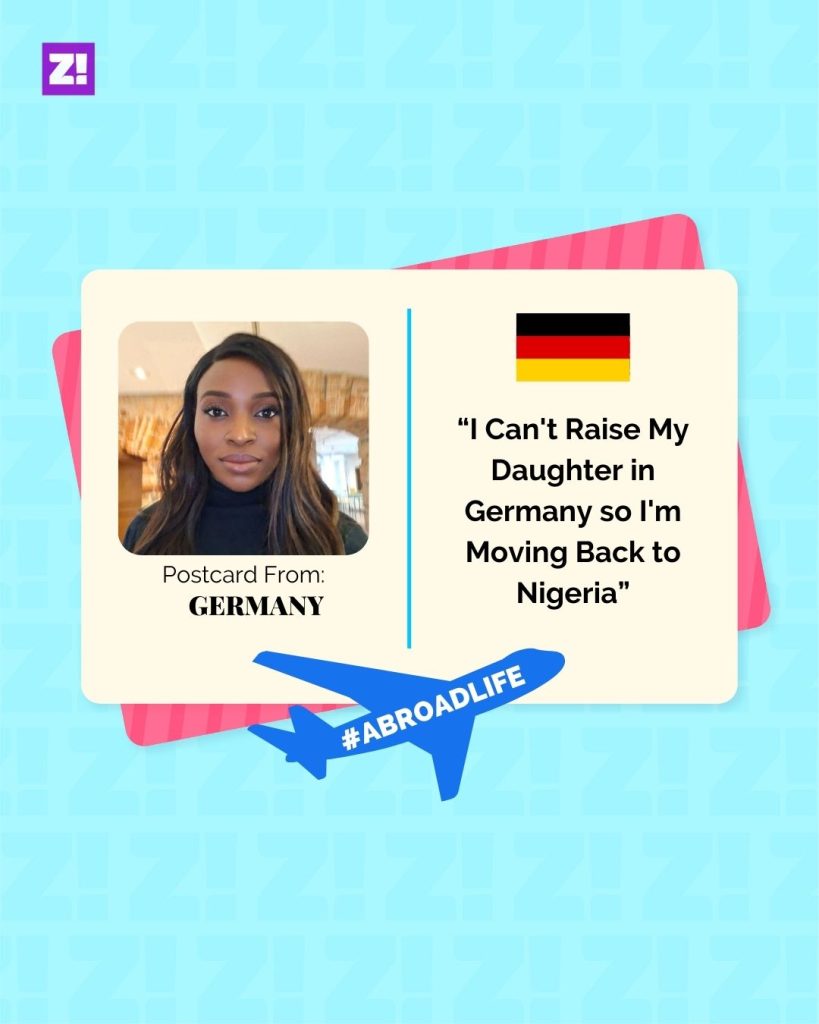
Bimpe (35) had a good life in Nigeria as a successful travel consultant. But when her three-year-old daughter started shouting “Up NEPA,” something snapped. Determined to give her child a better life, she moved to Germany in 2020. In this story, she shares her experiences with systemic racism, the reality of raising a Black child in Germany, and why she is finally moving back to Nigeria.
Where do you currently live, and when did you leave Nigeria?
I currently live in Berlin, Germany. I left Nigeria in 2020.
What inspired you to leave?
I think it was the same thing that inspires most young Nigerians to leave: the belief that there is no future for them in the country. As a single mother at the time, my biggest motivation was my daughter.
My work took me outside Nigeria often, so I had thought about migrating eventually, but it was not in my immediate plans. Then one day, I heard my three-year-old daughter shout, “Up NEPA!”
Those words hit me like a train. It was heartbreaking to think she was going to grow up in that same environment. To have another generation shouting “Up NEPA!” just like mine did felt like a generational curse. I could not stand the thought. I started making plans to leave immediately. In less than a year, we had moved to Germany.
You said you travelled often for work. What did you do?
I was a travel consultant. If there was a potential language barrier, I would escort clients to their destination to ensure they got through immigration processes without any issues. I loved my job. Apart from being away from my family, leaving my career was the hardest part of moving away from Nigeria.
So how did you leave?
I had built up many contacts in the travel business over the years. I let them know I was looking to move to Europe, though I had not even decided on a specific country. I certainly was not thinking about Germany. I had been all over Europe, but never there.
However, I had a business partner with a travel agency there, and they were the first to show serious interest. The initial plan was to work for them on a sponsored freelance visa and regularise my stay later.
Did it all work out?
It almost did, but then the pandemic happened, and everything fell apart.
We arrived in Germany just days before they shut the borders. Once in Germany, I started the onboarding process at my new job. Then the lockdowns began. It was not just the borders that were closed; everything was shut down. It was a terrible time for the tourism industry, and the agency had to downsize. Naturally, they started with the newest hires. Suddenly, I was without the job that had brought me to the country in the first place.
What did you do?
The money I had saved in Nigeria started to look like nothing once changed to Euros. Between feeding and rent, I was burning through my savings very quickly. It felt like my life was going up in flames.
Without the job, I lost my visa sponsorship. I started receiving letters from the German government asking me to leave as soon as the borders reopened. But I was not ready to go back. I felt I had already given up too much to get there. I had sold everything in Nigeria and referred my clients to colleagues. There was nothing to go back to.
I got a lawyer to help plead my case, and eventually, I was given what is called Duldung here. It means “Tolerated Stay Permit.” Essentially, they suspended my deportation and tolerated my stay for humanitarian reasons. The whole situation was not my fault. I came to the country legitimately and had a plan. The pandemic was unexpected and affected so many people.
This must have been a very anxious time for you. What happened next?
The tolerated stay was for one year. I spent that time thinking about my next move. I decided to learn German as quickly as possible so I could apply for a tuition-free university programme.
I could not afford English-taught programmes, which are quite expensive. But for the German-taught programmes, you have to reach a C1 level in German to be admitted. Learning a new language at thirty was not easy. But I studied hard, took the language exam, and just managed to pass. I was admitted to an MBA programme.
On the job front, I eventually found a remote marketing role with a Malaysian company. That covered my living expenses. Things started to look better financially, but juggling everything was still incredibly difficult. I often considered giving up and going home, but my family in Nigeria relied on me for assistance. The €100 or €200 I send back regularly goes a long way there.
That sounds like a lot to handle. How did it all turn out?
Fast forward almost six years, and things are finally stable. I have finished my master’s and secured a government job, though I still keep my remote marketing role. My daughter is older now, I have a son, and I am married. Things turned out okay eventually.
That is great to hear. So you must be happy with life in Germany now?
Not exactly. Honestly, the idea of raising my daughter here is something I’ve completely abandoned. That goal was defeated.
While I met my husband here and Germany has been good to me in that sense, I would not advise someone in my former situation to come here. If you have no job or prospects in Nigeria, then fine, come. But if you are creative, talented, or entrepreneurial, stay away.
Why would you not recommend it?
Nigerians have fire in their blood. We are hustlers who do not stay in one place. In Germany, they will quench that fire. This place is for people who prefer a quiet, solitary life. If you do not mind systemic racism or you just want to live on government benefits, then Germany might suit you. But if you want to “make it” in life, there is nothing for you here. Career-wise, it was a very bad choice.
You mentioned your daughter. How has it been for her?
The “Up NEPA” I was running away from was replaced by something much worse: racism.
Things were okay in kindergarten because the school was run by British nationals and had an international mix of staff and students. She did not feel out of place. She even picked up German faster than I did. Her integration looked seamless. She was happy and confident. But primary school has shown us the darker side of Germany.
My daughter is the only black child in her school. In Germany, social groups are very segregated. The Germans stay together, and other immigrant groups do the same. Since there are not many Africans, my daughter is basically isolated. Considering what I experienced at university with “educated” adults, imagine what a child goes through.
Can you give an example of the racism you faced during your MBA?
We had to interview people for our thesis. While my German classmates secured interviews easily, I could hardly find anyone willing to speak to me. The most glaring instance, however, was during a supply chain presentation.
Our professor was a Greek man who was a lifetime civil servant in Germany. Alumni had warned me that he gave Black and Indian students poor grades, but I forgot the warning because he was actually quite engaging in class. When the group work came, our white classmates grouped up quickly, so I and the Indian students were forced to form the only non-white group.
We presented a case study on Dangote. My classmates were shocked; they did not think Africa produced anything of that scale. During the presentation, one student even asked if Dangote was “pure Black.” They could not believe a Nigerian man built such a business; they assumed he must be mixed race. It was incredibly irritating.
How did the professor react?
He was clearly upset. Maybe he thought I was trying to prove something by using Dangote as the case study. He grilled us for ages with questions he did not ask the other groups. Everyone could see he was being biased and unprofessional.
Since he could not find fault with the content, he attacked the slide design instead. He claimed the colours did not match and spent ages scrutinising the references and looking for missing commas. He even suggested we had not made the slides ourselves.
I had to pick up my son, who was not even a year old, so I left after our presentation. I later found out through our WhatsApp group that the professor was furious I had left and threatened to give our group the lowest score. I fought back, emailing the administration with proof that I designed the slides myself and challenging his bias.
Did the school take any action?
They called me for a meeting, but the professor’s “solution” was to give the entire class a C-grade. He did this to turn my classmates against me for “playing the racial card.” That is how the system brings you down—if they cannot get you directly, they turn the crowd against you.
That sounds incredibly isolating. As a family, how do you find ways to have fun in Berlin?
I would not call it fun; I would call it “unwinding.” Fun usually involves human connection. Without my husband and children, I would be completely alone. We go to church on Sundays and sometimes to the playground. But even there, other children do not play with mine. It is a cold, detached place to raise Black children.
How did you meet your husband?
I met him on a dating app because I did not have time to socialise elsewhere. He is German, but he does business across Europe. Meeting him is the best thing that has happened to me here. He is a wise man, which is rare. Germans are smart, but many lack emotional intelligence. My husband is different.
How was your dating life in Germany before you met him?
There is just no comparison between Nigerian and German men. I went on dates where the man expected me to split a €10 coffee bill. I am a liberated woman, but if a man cannot pay €5 for my drink, we have no future. We cannot even be platonic friends, because I do not see why friends would split such a small bill.
When I met my husband, I asked his opinion on that “Berlin tradition” immediately. He laughed and said he would never make me pay. I got lucky.
How would you compare pregnancy and childbirth in Nigeria versus Germany?
The Nigerian experience was better, but it’s only because of the racism. As a Black woman, you are not always treated properly by white doctors and midwives. I received better, more empathetic care in Nigeria.
In Germany, the staff only behaved nicely when my husband was around. Honestly, if I have another child, I would prefer to have them in Nigeria.
Have you visited Nigeria since you left?
Yes, we visited earlier this year. I had mixed feelings. I was shocked by the cost of living. I spent ₦100,000 in Shoprite on just toiletries. I was changing foreign currency and still complaining; imagine those earning Naira. It was painful to see people looking so skinny and hungry.
But on the other hand, I loved seeing my family. Meeting my new nephews and nieces for the first time felt amazing. My daughter was so happy to finally have people to play with. Her cousins and the neighbours’ children were all over her. She has been asking to go back ever since.
My husband also had a great time. He’s been telling his colleagues how warm and bold the people in Nigeria are. He says he has had better conversations with Nigerian businessmen than he has ever had with Germans.
What does the future look like for you?
I plan to relocate back to Nigeria. It could be as soon as next year. I will gladly leave my government job, but I’ll keep my remote marketing role with the Malaysian company because I’ve enjoyed a fantastic five years with them.
When I return to Nigeria, I want to resume my travel business to help young people move with proper information. They need to know that as a first-generation migrant, you will likely struggle.
If I had known I could not comfortably raise my daughter here, I would have chosen another destination. So I want to help other Nigerians with the information that will help them make the best decisions.
Are you worried about a reduction in your purchasing power when you move back?
Not really. Earning foreign currency in Nigeria provides a very good life. My only real worry is insecurity. However, I want my children to have that Nigerian drive. In Germany, they will be mediocre because the system only wants them to be average. In Nigeria, they will learn to be tenacious.
What have been the major culture shocks for you in Germany?
They do not use email; everything is sent by post. Letters, letters, letters! We are drowning in paper in 2025. The banking is another shocker; transfers that are instant in Nigeria take three days here.
But one thing I like here is how your days pan out exactly as you plan them. People are punctual, and there’s no traffic, so those annoying delays you’ll experience in Nigeria don’t happen here.
What have been your best and worst experiences?
The worst experiences have been with the systematic racism here. In healthcare, you will call 30 doctors for an appointment and be told they are full, but if a white friend calls, they get in immediately. You cannot prove it, but you know it is happening. Every day is a battle.
My best experience was meeting my husband. Meeting him and having my son made the entire journey worth it.
On a scale of one to ten, how happy are you in Germany?
Taking my family out of the equation, I would give it a two. It is very depressing here.
Do you want to share your Abroad Life story? Please reach out to me here. For new episodes of Abroad Life, check in every Friday at 12 PM (WAT).
Before you go, help us understand how you and other young people feel about the 2027 general elections by taking this 10-minute survey.
Click here to see what other people are saying about this article on Instagram