The Nigerian experience is physical, emotional, and sometimes international. No one knows it better than our features on #TheAbroadLife, a series where we detail and explore Nigerian experiences while living abroad.
Collins (36) always believed in his potential. After he walked away from Igba Boy and put himself through University, he found that Nigeria stifled that potential, so he moved to the UK. In this story, he shares the differences between life in Nigeria and the UK, the culture shocks, and how childbirth and parenthood feel vastly different in the UK.
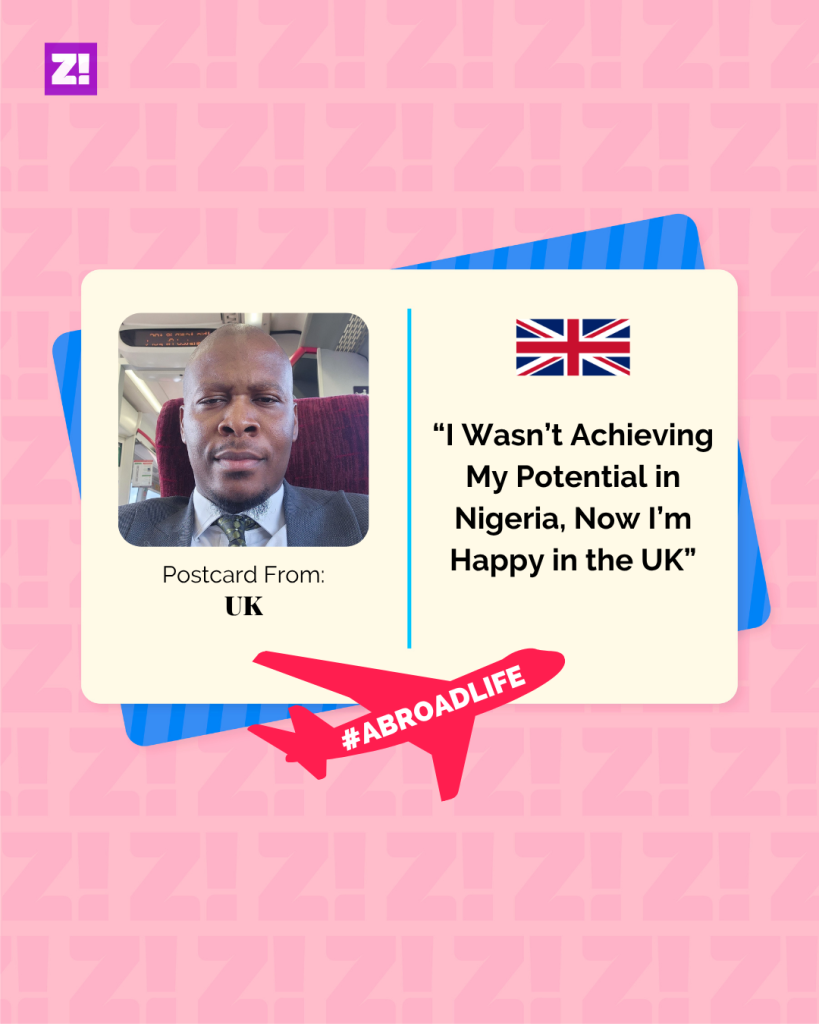
Where do you currently live, and when did you leave Nigeria?
I live in the United Kingdom now. I left Nigeria in 2022.
What inspired you to leave?
I just felt like I wasn’t reaching my full potential in Nigeria. I had an unconventional path, and I was determined to do better for myself. So when it started to feel like I couldn’t achieve the things I wanted back home, I decided to go where I could.
You said you had an unconventional path. Could you explain?
After secondary school, I didn’t go straight to university. I spent four years in the Igbo business apprenticeship system we call Igba Boy.
I still remember the night I finished my last secondary school exam. My dad sat me down and told me I wouldn’t be going to university. He just couldn’t afford it. So in 2005, I went to serve a master at Balogun Market in Lagos. I was there until 2009.
The usual agreement was to serve for seven years, after which your master would “settle” you with a fully stocked shop and some capital, about ₦2 million back then, which was a lot. But we had a falling out, so I left after four years.
What happened?
I’d managed to save about ₦38,000, and he found out. He said the money was his because, in his words, “whatever belongs to the boy belongs to the master.” I didn’t agree. So we parted ways. That meant I wouldn’t get the full settlement, but I’d already made up my mind. My heart was never really in it. I wanted to go to school.
In the end, he gave me ₦250,000. I added that to my savings and used it to put myself through school. I wrote the General Certificate of Education (GCE) and Unified Tertiary Matriculation Examination (UTME) exams and got into Obafemi Awolowo University (OAU).
That’s impressive. When did you start feeling like you weren’t meeting your potential?
Almost immediately after my National Youth Service Corps (NYSC) service year. I moved back to Lagos with some savings and stayed with a friend, but the money started running out fast. I was applying for jobs and getting nothing. It was frustrating. That wasn’t how I pictured my life.
I started thinking, “What if people laugh at me?” Like, I left Igba Boy to go to school, and now I’m unemployed. If I’d stayed, I’d probably have my own shop by now, with boys under me.
Eventually, I got a job at an insurance company in 2018. The starting salary was just ₦40,000. And from what I saw of the office politics, I knew I wouldn’t go far there.
At that same time, a friend got a job abroad with one of the Big Four. That was my lightbulb moment. I thought, “I need to leave this country.” So I started saving and applying to schools abroad.
How did that go?
I actually got into a German university on a scholarship. But it didn’t work out.
I did the first year remotely from Nigeria because of COVID-19 travel restrictions. By the second year, I was supposed to move to Germany, but even though the scholarship covered tuition, I had to fund my travel and show €10,000 as proof of funds. I didn’t have that kind of money, so I dropped out.
Luckily, I’d met my wife-to-be around that time. We were both planning to japa, so we decided to work on it together.
Did you get married in Nigeria?
Yes, we did. We even had our first child there. After the wedding, we agreed she’d go to school while I worked. She got a partial tuition fee scholarship to a UK university, so we moved, and I found a job.
What do you do now?
Finance. When we got here, we had mentors who advised us. I told them I had experience in programme management and insurance, and they said, “Go into finance. That’s where the money is.”
So that’s what I did. I’m working now and also doing my certifications. I’ve finished Association of Accounting Technicians (AAT) Level 2 and Level 3 certifications, and I’m currently on Level 4, working towards becoming a Member of the Association of Accounting Technicians (MAAT). That’s a designation that you’re a qualified accounting technician in the UK. Afterwards, I’ll start my Associate Chartered Accountant (ACA) certification with the Institute of Chartered Accountants in England and Wales (ICAEW) to become chartered.
Nice. Have you been back to Nigeria since you left?
Nope.
Any plans to return?
Maybe for a visit. But definitely not to stay.
So the UK is home now. What’s your support system like?
We have Nigerian friends around, but I was intentional about not relying only on the Nigerian community. We’ve made friends from other countries, too. Honestly, I’ve been let down more by Nigerians here than by others.
For example, I tried joining a group in my church, but it felt like we were always being asked to contribute money for one thing or the other. And it was just one guy pushing it. I got tired and left.
Are there many Nigerians where you live?
Oh yes. We live in one of the most diverse cities in the UK. There are lots of Nigerians and Indians, especially. So the Nigerian community here is big.
But one thing we noticed early on is that there’s this culture where Nigerians who’ve been here longer expect some kind of special respect from new arrivals.
So, you had a kid in Nigeria and another in the UK. How do those experiences compare?
They’re worlds apart. In the UK, it’s not just about the mother and baby; they actually care about the man too.
During antenatal visits, they ask the man, “How are you coping? How are you dealing with this? Do you need help? Do you need counselling?” They even gather all the men in one room to teach us how to support our wives. They ask about financial pressure and, if you’re struggling, they’ll tell you where to get free food like milk and eggs.
They also check if your house is suitable for a newborn. They’ll come around to inspect things like mold on the walls, and if they find any, they’ll contact the council to fix it.
Counsellors randomly call just to check in. At first, I found it invasive. But it really helps you prepare mentally. Having a child is a big deal. So it’s really great that there’s actual support to help men be in the right shape to then support their wives through it.
The biggest difference is the structure. As long as you have paid the annual NHS surcharge, all healthcare services, including childbirth, are covered. Each family gets their own suite. I was surprised when I followed my wife to the hospital and there was a couch-bed for me too.
They also offer after-birth support. They come to check on the mother and baby to make sure she’s not dealing with postpartum depression.
In Nigeria, once you’ve paid your bill and been discharged, that’s it. Goodbye. Let the next person come in. It’s like a factory. Come in, push out your baby, move on.
If I had to sum it up, I’d say Nigeria is still very far behind. So very far.
The UK childbirth experience sounds better. But what about raising the child?
That depends on what you’re looking at.
My wife and I both work. Here, the man gets about four to six weeks paid leave, and the mother gets around nine months to care for the child.
My mother-in-law came to help for six months, but she had to return before her visa expired. So we had to start taking the child to a nursery, which is very expensive. It’s not like Nigeria, where you can easily get help from your mum, sister, or a paid assistant.
But my eldest, who’s in school, goes for free. And if there’s any health issue, you just take the child to the hospital for free. Children under seven don’t pay for NHS services.
So yeah, it’s easier in some ways and harder in others.
They say it takes a village to raise a child. Does being far from extended family in Nigeria bother you?
Honestly, no. It does take a village, but I feel like we have that village here. It’s just made up of different people.
If anything happens to your child or someone reports something, that’s when you realise there’s a whole community looking out for them.
At school, teachers and counsellors don’t just talk about academics. They talk to the children about their welfare and home life. They reason with them like they’re adults.
So yeah, the community here is different. In Nigeria, the support system is family-based. Here, there’s a different type of family that doesn’t share blood with you, but they’re invested in your child’s wellbeing.
Recently, there’s been a lot of anti-migration talk in the West. Does that make you uncomfortable?
Yes and no. My wife has actually been worried. You come here with plans to stay long enough to get Indefinite Leave to Remain (ILR), and then you start hearing far-right people saying they might scrap it. It’s scary to think they can just take something away that you’ve spent time and money chasing.
But me, I’m not too bothered. When I first got here, a lot of people told me to go into care work. I refused. As a matter of principle, I will not come here and basically be a slave for white people after my ancestors were already brought here in chains. My ancestors didn’t wear shackles so I could come and wash infirm white people just to get ILR.
People said I had an ego. But it’s not ego. I just believe labour is capital. I want to develop myself to the point where I have the skills to be a global citizen. So I’m focused on becoming a chartered accountant.
Even if regular people don’t know it, the politicians do. They know they can’t survive without skilled migrants. If not, countries like China will leave them behind, and they’ll become irrelevant in the global economy.
They need skilled migration. All this anti-immigrant talk is just politics.
That may be true, but that kind of politics creates tension. Have you or your family experienced racism?
No, but I think that’s because we live in a very diverse city. I’ve heard stories from people who live in mostly white areas.
What were your biggest culture shocks when you moved?
People actually obey the law. I mean the small things like traffic lights. On buses, there are seats for old people, people with disabilities, or those carrying children. If you sit there and you’re not supposed to, the driver will stop the bus and tell you to stand up. You either find another seat or you stand and hold the railing.
Another shock was at work. In Nigeria, every superior is “oga” or “sir.” Here, you call your boss by their first name. You can correct their mistakes too. They actually expect and want you to. Try that in Nigeria and see what happens.
They also don’t care much about religion. As a Christian, I feel like the odd one out. In Nigeria, if you say “Jesus is not real,” people will look at you like you’re mad. Here, it’s the opposite. If you say “Jesus is real,” that’s when people will look at you funny.
I was also shocked by how open people are about their sexuality. I remember being in London and seeing two men kissing passionately in public.
Also, they don’t believe it’s only the man’s job to provide. I was talking to a colleague about mortgages, and he said, “Your wife lives in the house too, so she should pay her share.” They split bills and chores. If the woman does the dishes and laundry, the man takes out the bins and vacuums.
There’s this strong sense of responsibility. If you use something, you contribute. One time, I bought coffee for the office at Tesco. Next thing, people started dropping money on my desk. In Nigeria, they’d just watch you and label you the mugu who’ll keep giving them free coffee forever.
Another thing I noticed is that white colleagues will gist with you in the office about things like sports, weather, and family life, but never politics or religion. And in public, they act like they don’t know you. They’ll see you and look away.
I had to address it during a team meeting. I told them, “If I greet you in public and you ignore me, don’t bother talking to me in the office.” Since then, they greet me when they see me outside.
Going to church was another surprise. We’re Catholic. In Nigeria, mass is at least two hours. Our first mass here lasted just 45 minutes. We were shocked.
It sounds like a very different life compared to Nigeria. On a scale of one to ten, how happy are you in the UK—and why?
It’s a ten.
First, peace of mind. I remember calling emergency services for my child. Within minutes, an ambulance, two police cars, and a private car with a doctor showed up. Another time, my neighbour called about a fire, and four fire trucks came.
Second, this is a country that works. I’m not even a citizen yet, but I’m allowed to vote. I know my local representative. I have the number for their office, and I can call if I’m not happy about anything. I once wrote to the council asking for a breakdown of how my taxes were being spent. Two days later, they sent me a full report.
So yeah, I’m really happy here. It’s definitely a ten.
Do you want to share your Abroad Life story? Please reach out to me here. For new episodes of Abroad Life, check in every Friday at 12 PM (WAT).
Before you go, help us understand how you and other young people feel about the 2027 general elections by taking this 10-minute survey.
Click here to see what other people are saying about this article on Instagram