The Nigerian experience is physical, emotional, and sometimes international. No one knows it better than our features on #TheAbroadLife, a series where we detail and explore Nigerian experiences while living abroad.
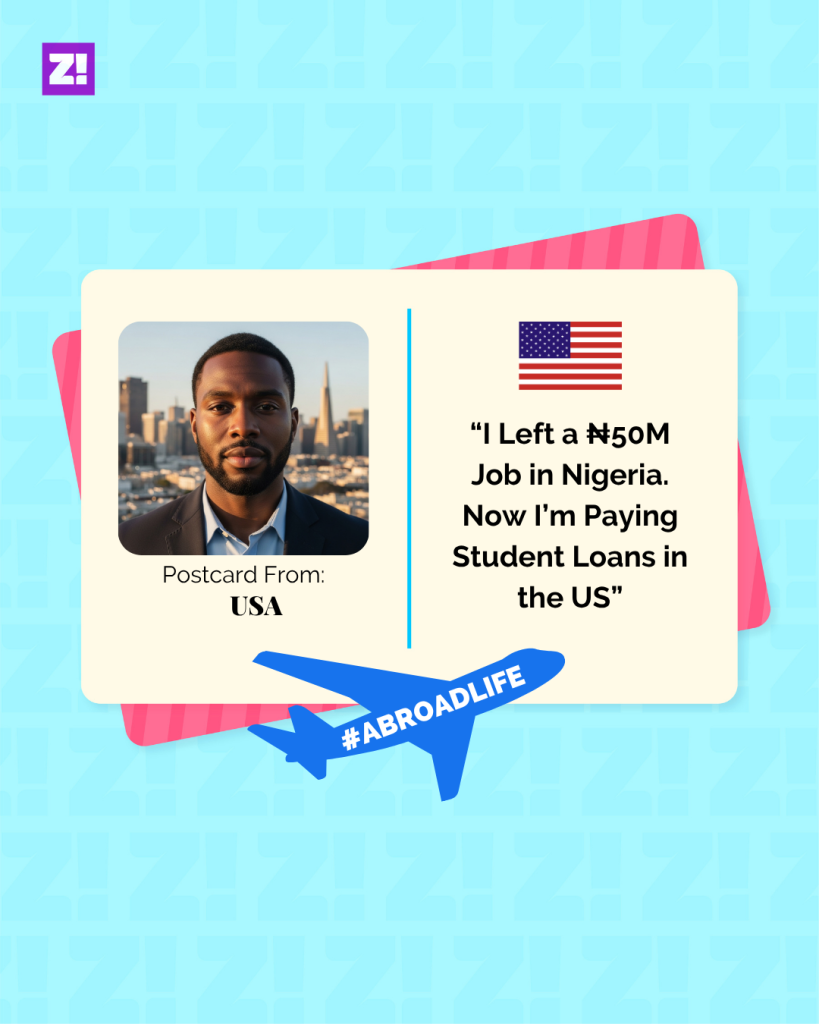
Dayo (34)* was bored with his job in oil and gas, so he left a ₦50 million salary to pursue a master’s in the US. In this story, he shares how the difficulties of settling in drove him to therapy, how he navigates subtle racism, and how the uncertainties of the Japa lifestyle are affecting his love life.
Where do you currently live, and when did you leave Nigeria?
I live in the United States (US), and I left Nigeria in 2023.
What inspired you to leave?
I wanted to get a taste of life outside Nigeria. I was getting bored with my job, even though it would be a dream job for a lot of people. I also wanted to earn in a different currency.
What did you do in Nigeria?
I worked in oil and gas. I was making over ₦50 million annually.
Wow. Leaving all that behind must have been a really big decision. How did your friends and family take the news?
My family was really supportive. My friends were really supportive too. Many of them were leaving Nigeria around the same time.
It was on the professional front that I got some negativity. I noticed my bosses at work started behaving funny; they stopped involving me in important projects during my last year in Nigeria. I guess they were considering me a flight risk.
You said some of your friends also left Nigeria. Did that play a part in your decision?
I don’t think so. Most of them moved to the UK, and I never considered the UK as an option. The type of schools I wanted to go to are not in the UK. So it was always going to be the US for me.
Maybe they played a small part in inspiring my journey, but I make my own decisions.
So you came to the US to study?
Yes. I am doing a master’s programme.
You said your friends moved to the UK. So what is your support system like in the US?
I am still building community. It has been tough because there are not a lot of Black people where I live. The first few months were really hard. It felt like I uprooted my life and had to start again in a new place where nobody knows me. I had to talk to a therapist for the first time just to process it.
But I am starting to build community now, and things are better compared to when I first got here.
Did therapy help?
Yes, it did. People talk a lot about mental health these days, but I did not know just how important it was until I moved to the US.
I was struggling to find my own people, struggling to find my way around. I did not have any friends here. I was trying to secure some professional opportunities, and that was not working out either. So I was having a really hard time.
In Nigeria, I would probably be in the top five or top two per cent of applicants for any job I applied for, but here, everyone is also super bright.
Back in Nigeria, I did not need to speak in a certain way, but here I have to modify how I speak for people to understand me. I was also never really aware of being a Black person until I got here.
It was all of these things that made me want to talk to someone, so I do not go crazy.
I talked to a life coach once in Nigeria after someone broke my heart, and it helped, so I just thought, since these resources are here, let me give it a shot. So I tried therapy.
Therapy helped me see things clearly and realise I needed to cut myself some slack. I made a big move, and I should just breathe more and give myself time to adapt. It helped me start to figure things out.
But I stopped after a while because I did not want to become dependent on it as a coping mechanism.
You said you are building a community now. What does that look like?
I have a few friends now that I get along with quite well. I can share my unfiltered thoughts with them without fear of judgment.
I think it is different for people coming here as undergrads. They are still in their twenties, still forming their views on life. They are more flexible. Coming here in your thirties, like I did, is not as flexible.
So I am really glad to have people who accept me. We are mostly in the same age range, and I do not need to change or fake a personality to be around them. I can be my authentic self, and I really like that.
Are your core group of friends Nigerians, or is it a multinational group?
Not Nigerians, but Africans. There are not a lot of Nigerians where I live. But I have noticed that with people, like poles attract. The people you easily mingle with are people who look like you.
I mean, of course, there are maybe Asians or Latin Americans I am friends with, but most people in my network are Africans. They are the ones who really understand my frame of reference and get my perspective.
Are you working alongside your studies?
No, I am not. The only type of work I would like to do is something that adds to my professional experience in my career. So it would have to be a white-collar role.
I say this with all humility and respect to people who are able to do it, but I do not think I can do any hospitality or care work or anything like that.
I cannot do any work that does not align with the career I am trying to build. I am an older guy now, and I already did that type of work when I was younger in Nigeria. So now, if it is not something that ties in with my career goals or maybe a research assistant role with a professor, I am not going to do it.
I have not found anything that fits what I am looking for yet, so I am not working. I am just studying.
What are your plans for after school?
There are a lot of uncertainties for me. I guess I could try to work here, but the job market is tight. The big companies seem to be making more cuts every day because of Artificial Intelligence (AI).
Packing up, and going back to Nigeria might also be hard because I have student loans to pay here. So it is all still in the air.
Have you visited Nigeria since you travelled?
I would have gone crazy if I had not.
Nigeria is literally the only place I can go to now where they will not ask me the purpose of my visit. It is the only place I can go to anytime I want. I do not need to have already booked a hotel or present one million documents first.
It is freeing. It is liberating. It is home. It is good for your mental health to go home once in a while.
So, yes, I was in Lagos for about a week last summer. And I will still go again very soon. The trip is expensive, but it is good for me.
Would you consider resettling in Nigeria permanently?
I plan to settle down in Nigeria, but not soon. Well, it depends on the opportunity. This probably will not be a popular take with your readers, but I am not crazy about getting a second passport. It is just not something I am really working towards.
I get that it is good to have. It gives you access to other parts of the world, but I think I am fairly well-travelled already, even with just my Nigerian passport. I hear people say it is hell to travel with a Nigerian passport, but that has not been my experience. Maybe I am not exactly an “average Nigerian.” I have valid visas for the countries I would want to go to.
But after my master’s programme, it is unlikely I will get an opportunity in Nigeria that pays the kind of salary I want. So I think I would need to work here, or maybe in Europe for a while, get my coins up, try to make a dent in my student loans, and then I can come home.
But while I am here, I will be visiting Nigeria as often as I can.
Does the uncertainty about your future affect your ability to plan or start long-term relationships?
That is a very good question. I actually wish I had settled down earlier before making this journey. It would be nice to be doing this with someone instead of on my own.
There is actually someone I am talking to in Nigeria at the moment. And when I think about the way things were for me in Nigeria, if I were still there, I could get married right now and know I would be able to provide a decent life for my family. But now it is really tough because I am not sure where I am going to be in the near future.
And if I do stay here, I am not ready to take on the cost of moving them out here. I am not sure I want to put all of that investment into it unless they decide to move on their own.
I think relationships work best if you are already married and you japa together. Otherwise, it can be difficult.
You mentioned becoming very aware of your race when you moved to the US. Was there a reason for that? Have you experienced discrimination?
From a professional standpoint, they discount your work experience from Nigeria. Some roles will clearly state that only applicants with US experience will be considered.
Other than that, I do not think I have experienced direct racism. Maybe the closest thing was when a classmate said I look dangerous. She caught herself afterwards and tried to apologise and be friendly. I do not have an intimidating physique, so I feel that just came from whatever prejudices she holds about people who look like me.
I have also noticed that immigrants like myself are not very good at spotting racism like the Black Americans, for example. They have been here all their lives, and they know all the subtleties, so they can spot racism even when it is passive and call it out.
What were the biggest culture shocks when you moved to the US?
I think it is that Black and White division. When applying for jobs, I make a point to look at companies’ websites. I don’t know what I expected, but the fact that white people are majorly at the top of the professional and social hierarchy here shocked me. I knew there were disparities here, but I did not expect it would be this big.
Also, the US is so big. You cannot get anywhere without a car. It is not like back home where you will just quickly enter danfo or keke. That was a real shock for a Lagos boy like me. If you do not have a car, you have to order Uber and that gets expensive pretty quickly.
Let us talk about highlights and lowlights. What would you say has been your worst experience in the US?
My first winter here was really depressing; I did not go anywhere. People travelled and I was just alone in my dorm room. I missed that sense of community that comes with living in Nigeria, where even if you do not have money or anywhere to go, at least one neighbour would do something for Christmas and you could just go there.
I did not really have that. I was mostly alone that Christmas. It was terrible. I do not want to experience that again.
What has been your best experience?
My best experience was when I was able to leave the US and travel back home. It was a really low point for me, so I really needed that. I visited Nigeria and some other African countries. It was great.
How would you sum up your experience in the US so far?
It has been humbling. It has been eye-opening. I am humbled because I realise I am no longer like a local champion. Now I feel like a small fish in a big pond. That was hard to adjust to mentally.
I know I am really good at what I do, but I have come to accept that here, there are many people who are just as good or better. So it has been humbling in that sense.
Do you regret leaving Nigeria?
I do not know, to be honest. I think it has certainly been a downgrade in my lifestyle. For instance, my place here is smaller than where I could afford to live in Nigeria. In Nigeria, I could hire people to do chores for me, like cooking for example.
Now I also have to start thinking about financing student loans. I never had to worry about something like that in Nigeria.
So it has been a downgrade. But I know that it is only temporary. So I would not say that I regret it. I would say it is too early to call. We will find out. Ask me again after I have been here for longer.
Maybe we will talk again sometime. How happy would you say you are on a scale of one to ten? And why?
If you had asked me during my first three months here, I would have said a two out of ten. Everything was so new and I think I was depressed. But now, I would say six out of ten. I have more of a community here now. And getting to leave the US and visit Nigeria made me feel recharged.
It is not a higher number because of the uncertainty around what is next for me after I graduate. I cannot tell you where I will be in the next nine months. I have always been able to predict a lot of what my journey would look like, but now I do not have any idea.
Do you want to share your Abroad Life story? Please reach out to me here. For new episodes of Abroad Life, check in every Friday at 12 PM (WAT).
Before you go, help us understand how you and other young people feel about the 2027 general elections by taking this 10-minute survey.
Click here to see what other people are saying