The Nigerian experience is physical, emotional, and sometimes international. No one knows it better than our features on #TheAbroadLife, a series where we detail and explore Nigerian experiences while living abroad.
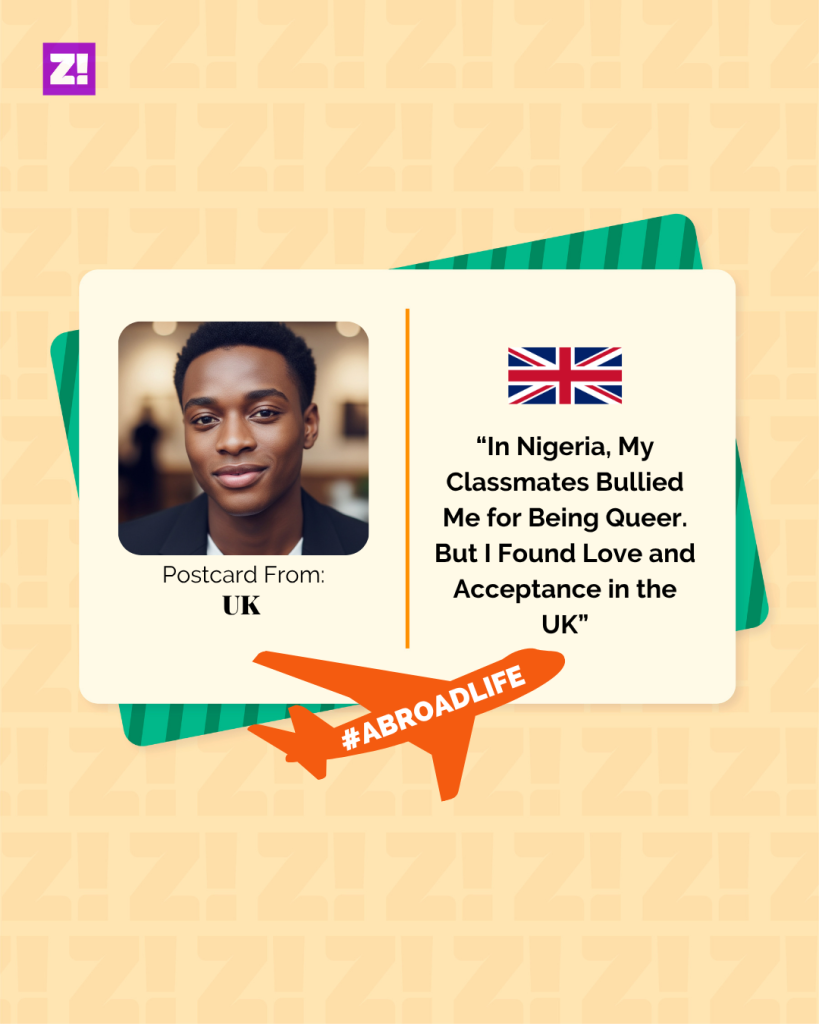
Peter* (28) left Nigeria to escape discrimination for his sexuality and find better career prospects. But he faced a tough settling-in period, including almost being evicted for owing rent. He shares how he found love, family and acceptance in the UK.
Where do you currently live, and when did you leave Nigeria?
I live in the United Kingdom (UK), and I left Nigeria in 2023.
What inspired you to leave?
Well, two things inspired me: my sexual orientation and the economic situation in Nigeria. I was bullied a lot because of my sexuality. My secondary schoolmates would call me by female names because I was effeminate.
I actually tried to leave immediately after secondary school, but that did not work out. I tried again in my second year of university, but that also did not work out.
After my National Youth Service Corps (NYSC) service, it was really hard to find a good job. I worked at a laboratory for a short period, but I quit because I was owed my salary and they were verbally abusive. After that, I got a job teaching at a government college, but that too was rough. We got daily doses of insults from the principal.
In the end, I just knew I would only be able to find my ideal life abroad.
Sorry you had to experience all of that. How did you finally leave Nigeria?
This was not straightforward at all. I initially got admission to do my master’s in Lithuania. All I had to do was pay some fees, but it happened during the cash crunch period in early 2023, so I ran into some complications as a result. My payment refused to go through, and even though the school extended the deadline for me to sort it out, the challenge persisted, and they could not wait any longer. So that opportunity slipped.
Before that time, I had also applied to some UK universities, but I was not really thinking about them seriously because I could not afford them on my own. For me, the UK was a last resort. But after I lost the Lithuanian opportunity, the UK became my only option. Fortunately, I was able to rely on my father and uncle to help me with funds.
But it was really difficult, especially the first year.
How so?
Academically, it was a bit confusing at the start. So my grades in my first couple of semesters were about average. But after that, my grades were mostly A’s. I love how you can just walk up to your lecturers and talk freely, ask questions about anything you do not understand. I found it really, really weird at first because it was not like that in Nigeria.
The easy access to lecturers helped, but things were still difficult for me because I had to juggle school with work. I missed a lot of classes. It was really tough. There was no time to rest. I barely slept.
What kind of work did you do?
I got two jobs to keep up with the bills. The first was a cleaning job at an event centre that would host weddings, holiday parties, book launches and so on. So I would clean on the weekends. The problem was that it was really far away from where I lived near my school. I had to take three buses to get there, so it could take me around four to five hours to get to work.
The second job was as a quality control officer at a car factory. I did this on weekdays. After classes, I would leave for work around 3 p.m. Then on the weekends, I would head to the event centre for the cleaning job.
The cleaning shifts were really long. I would typically work ten to twelve-hour shifts. I once did sixteen hours each day for three days. It was a brutal experience but I was grateful for that weekend because the bulk sum I got paid for it really helped me take care of my school fees debt.
It must have felt good to be able to offset your debts.
Yes, it did. The pressure was telling on me mentally and even physically. I was barely sleeping and was mostly surviving on spaghetti and rice, because that was what I could cook in bulk.
Do you still work the cleaning job?
I work in care at the moment, but I am working on getting a licence so I can get a laboratory job. I work with people with disabilities. I like my patients; we have a really good rapport. Many of them have a really good sense of humour. I also really like my coworkers. It is just a great environment. Sometimes I would even rather be at work than at home.
That sounds great. How would you sum up your experience in the UK?
Overall, it has been great. I feel like it has been in stages. Early on, you are trying to pay your fees and sort out school stuff, and maybe get a good job. But then if you get through all that, you can really start looking forward to settling down, getting a better job, getting your own house, getting your own car if you need it and stuff like that.
So, so far it has been great. At the moment, I feel like I am in this calm period where I am a bit settled and can now look forward to all of those things, starting with getting my licence and then getting a better job.
Have you visited Nigeria since you travelled?
No, I have not. But I speak with my parents almost every day.
What kind of support system do you have in the UK?
My partner and his family. I also consider my colleagues a sort of family, my work family. They are excellent.
You are in a relationship?
Yes, I am. We actually met on a dating app. I did not feel the connection at first. I went off the app for some time. When I came back, we started talking again and arranged to meet.
Meeting him has been the peak of my experience in the UK. It has really helped me settle in here. I realised that the problem was that I had no one here. I do not have any family members in the UK. I did not really have friends except maybe my roommates in my shared accommodation. So I did not really have anyone I was close to, and I think that is why a lot of people slip into depression.
It was really tough, but when I met him, everything became settled. I now had someone to talk to, someone to cry to, someone to rely on if I needed help. Once I met him, everything changed. I now have family because his family became mine.
Happy to hear you found such a connection. What is dating like in the UK?
I actually dated a few people here and there, but none of them lasted long. The problem with men in the UK is that many of them are not looking for long term relationships.
How does it compare to your experience in Nigeria?
Okay, so the main difference for me has been honesty. In the UK, especially with white men, they will tell you upfront that they do not want a relationship, that they are just looking to have some fun, no commitment.
Nigerians, on the other hand, both at home and even some in the UK, will lie that they are looking for a relationship when they too just want to have fun and go.
I prefer dating here because it is honest, and I quickly understood how it works. But I did have a few good relationships in Nigeria, and I also had one really bad one.
What happened?
While I was in university, I dated a Master’s student. He was older, but he was just dishonest about everything, while I was open. I let him know my house, but he would not let me know his. He kept promising to take me there and then dodging it with one excuse or the other.
In addition to these, he lied about his line of work and made a move on a guy I was mentoring. There was another guy he introduced to me as his brother, but I later found out they were dating. And even though I was still schooling and he was working, I was the one doing the spending in the relationship.
Wow. That sounds rough. Do you have any plans to visit Nigeria?
Yes, I intend to visit Nigeria with my partner soon.
Do you consider the UK home now, or is there a possibility of a permanent return to Nigeria?
The funny thing is that I do see the UK as home, but my partner sees Nigeria as our potential home in the future.
We actually just bought a property in Nigeria. We plan to have kids and want them to experience both countries and cultures. So we want to have homes in both Nigeria and the UK. And maybe in the future, when we are old, we might actually retire in Nigeria. That is the plan. I just worry about the medical services in Nigeria, it is just too poor. But we are hoping it will get better by then.
Fingers crossed. What kind of culture shocks did you experience moving to the UK?
Numbers one and two are really easy; they hardly drink water here, and they do not rinse their dishes. I do not let my partner wash the plates. I hope he does not see this.
The first time I visited him, he offered me juice, but I asked for water. He got me the cup of water, and as I drank it, I could taste soap. Now, I always get my drink myself, or I do the dishes.
Another thing for me is the pets. It is like everyone has a pet here — it could be a dog, cat, bird, or something. And they have insurance for them. Why are you paying £50 for insurance every month for a pet? How can a dog have free MRI scans? People in Nigeria do not even have that.
Also, the Christmas gifts. They really take it seriously here. Last year, our house was filled with gifts and cards. The office, overflowing with gifts. We had to tell people to just start picking their gifts from 1st December because there was no more space under the Christmas tree.
Let us talk about highlights and lowlights. What would you say has been your worst experience in the UK?
That has to be almost getting locked out of my apartment because I could not pay rent. So this was early on, just a few months after I came here, and I had not gotten a job yet. I was at the student accommodation. I was already going nuts worrying about the rent.
We use these keycards to open the doors, and once you are owing, your card deactivates. Luckily for me, the day my card deactivated, I had a shoe at the door, and it stopped the door from shutting.
I had to call my uncle. He sent me some money, and the church I was attending then helped me with the rest, so I was able to pay for three more weeks. Within those weeks, I was able to get a job.
But it was so scary because I just imagined what would have happened if that shoe had not been at the door. What if my uncle had not sent the money, or the church had not helped me out?
Glad it worked out in the end. What about your best experience in the UK?
I feel like there have been a lot of really good experiences. I think I would say going on my first proper holiday. This was late last year. So, you know, coming from Nigeria, going on holiday means going to one relative’s house. So this felt so different.
It was actually a recommendation from my partner’s mother. She told us about this island she thought we would have a great time at. And we did. It was for a week, and it was such a great time for me to reflect, think, and just recharge. All I had to do was see beautiful stuff, sing, visit museums, play games, go to the bar, karaoke, and just chill. I went to bed and woke up whenever I liked. It was just really fun.
Sounds awesome. On a scale of one to ten, how happy would you say you are in the UK, and why?
I would say nine because I strongly believe I have a future here. But it is not a ten because of the whole far right stuff we are starting to see.
Do you want to share your Abroad Life story? Please reach out to me here. For new episodes of Abroad Life, check in every Friday at 12 PM (WAT).
Before you go, help us understand how you and other young people feel about the 2027 general elections by taking this 10-minute survey.
Click here to see what other people are saying about this article on Instagram