On October 3, 2025, US Senator Ted Cruz made a post on X (formerly Twitter), claiming that Nigerian officials are helping with the “mass murder of Christians by Islamist jihadists.”
Since then, people have been arguing about whether there is actually a religious genocide happening in Nigeria.
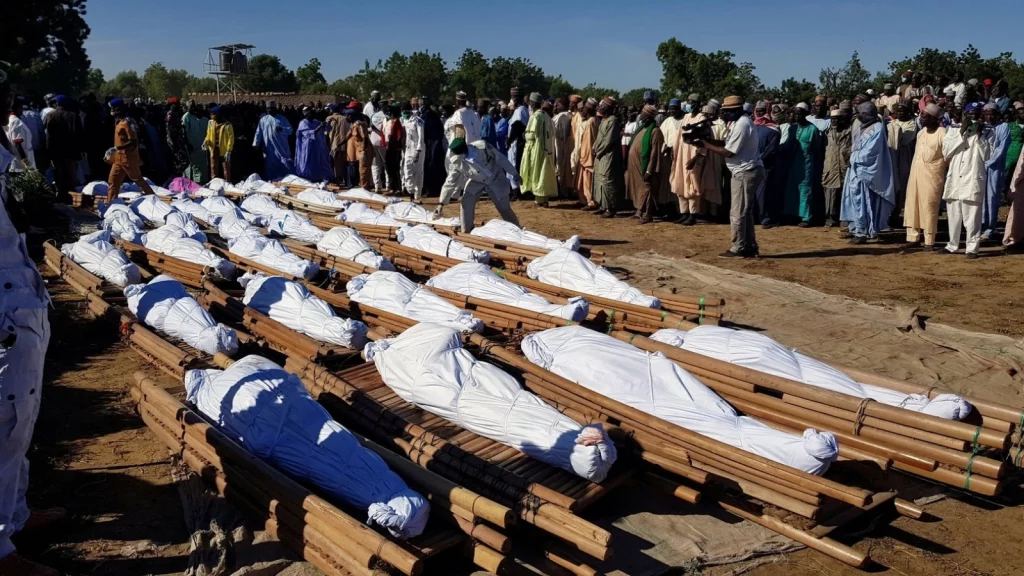
To be fair, Nigeria has been dealing with terrorism in the North for decades. Thousands of lives have been lost, and millions of people have been displaced. Then there is the farmer-herder conflict, especially in the North Central (Middle Belt) region, which keeps tearing communities apart.
But what is really behind these conflicts? And do they actually prove that Christians are being specifically targeted?
A history of violence
The religious terrorism of terror groups in Nigeria’s North is a complicated issue with deep historical roots. Analysts trace it back to unresolved resentments from the carving up of territory and the work of British missionaries during the colonial era.
Since then, different groups have popped up preaching an extreme form of Islam that rejects all Western influence. These groups are usually started and led by charismatic men with deeply conservative religious views.
There was Muhammad Marwa’s Maitatsine in the 1970s, then Mohammed Yusuf’s Boko Haram, which has evolved, splintered and had different leaders over time.
These leaders might genuinely believe in their doctrine, and many of their followers do too. But to really understand the nature of the violence in Nigeria, you have to look at how these groups recruit.
The root of all evil
In the 1970s, Marwa recruited most of his followers from poor members of the Kano population, especially the Almajirai. He drew them in by calling out the hypocrisy and flashy lifestyles of rich Northerners, who he said had been corrupted by Western influence. He tapped into a very real resentment that comes from wealth disparity.
Almajiranci is a system of Islamic education in which children, usually from poor families, leave their families to study with an Islamic teacher. They survive on alms earned through begging.
Years after Marwa led his followers in the Kano Riot of 1980, which killed over 4,000 people, including himself, Mohammed Yusuf showed up with a similar tactic.
Yusuf opened a school in his hometown in Yobe state, where poor families enrolled their children. This became a recruiting ground for Boko Haram members from the impoverished and alienated Northern population. He established micro-financing programs to loan small amounts of money to individuals, which created a large following of loyal youths for him.
It is the same pattern we are seeing now with the terror group known as Lukarawas, which burst onto the scene in early 2025, offering ₦1 million to new recruits as part of their recruitment drive.
This trend has played out in other parts of the country. The South has seen violence from armed groups in the Niger Delta, and the East from secessionists. Both are driven by feelings of economic and political dissatisfaction. People feel the government is not looking out for them, so they lash out.
Nigeria is a very poor country with a shocking wealth disparity. The poor are facing actual starvation, while the rich are loud and proud with their wealth. That is always a recipe for unrest.
Drought and a rain of bullets
Truthfully, the violence has been creeping further south for a while now. And as it moves from the majority-Muslim populations of the North to the majority-Christian populations in the South, it is getting a lot more coverage, with some communities alleging ethnic targeting. But the violence has more to do with climate change than religion or ethnicity.
The nomadic herdsmen of the Fulani ethnic group are being pushed further south by changing climate conditions. This has led to more clashes with the farming communities in those regions. The easy access to weapons—thanks to the terrorist conflict in the North and Nigeria’s loose borders—makes these clashes deadlier.
Niger, Benue, Plateau, and recently Edo state have been major flashpoints. But farmer-herder clashes have also been reported as far south as Enugu, Delta and Bayelsa.
Sadly, the cycle of violence has gone on for so long that it has taken on a more bigoted tone. An “us versus them” mindset. You can see this in the recent burning of a group of Hausa travellers by youths in Edo State.
But we must not lose sight of the real reasons behind these conflicts: scarce land resources made even scarcer by rapid climate change.
Cho cho cho! Ted, show working
After his initial post on October 3, Senator Ted Cruz made another post on October 7, claiming that 50,000 Christians had been killed since 2009. He did not provide any source for these numbers.
The numbers of casualties from the violence vary with sources with different sources claiming vastly different numbers. Also, there is an unfortunate trend in media coverage, especially in the west, is the underreporting of Muslim victimisation.
A 2020 Oxford Journal of Communication study which analysed Western media coverage of Boko Haram attacks in Nigeria found that Muslim victims received significantly less coverage than Christian victims.
Still, a 2014 African Studies Centre report estimated that two out of every three Nigerians who died in the conflict with Boko Haram were Muslim.
In 2021, the United Nations Development Programme (UNDP) reported that 35,000 people had been directly killed by terrorist activity in the North East (specifically Borno, Adamawa and Yobe), all Muslim dominated areas.
The report estimated there were around 315,000 more deaths due to indirect factors such as lack of food and other resources caused by the conflict. So, a total count of around 350,000 deaths due to the conflict between 2009 and 2020.
The report also projected that by 2025, the death toll would have risen to around 48,000 direct deaths and 674,000 indirect deaths.
We are all targets
An important point about the Boko Haram insurgency that is often left out of media reporting is the deliberate targeting of Muslims. So let us talk about the concept of takfir.
Takfir is the excommunication or declaring of a Muslim as an apostate, which is punishable by death.
The concept is used by Islamic terrorist groups as justification not just to discount the deaths of Muslims due to their actions, but also as justification for specifically targeting them. Boko Haram is a takfiri jihadist movement.
Abubakar Shekau, the leader of the group from 2009 until his death in 2021, was quoted as saying, “Even if a woman is praying and fasting, once she engages in democracy, I can capture her in a battle.”
Any Muslim who is not an active member of the group is considered an “apostate”, and for members of the group, it is not just acceptable to kill them, it is a duty.
No matter your religion, to fanatic terrorists, we are all targets.
Why now?
They say not to look a gift horse in the mouth, but we are not sure that saying makes sense here. In this situation, it is very important to ask, “Why now?” Why the sudden interest from the US government at this particular time? And why is it coming from the right wing of American politics?
Senator Ted Cruz’s first post on the issue came on October 3, 2025, just a little over a week after Vice President Kashim Shettima told the UN General Assembly that Nigeria supports a two-state solution in the Israel-Palestine conflict.
It is easy to see how pro-Israel voices might try to stoke Islamophobic sentiments in Nigeria to distract us from rightly empathising with the majority muslim population of Palestine.
Senator Ted Cruz is a fierce supporter of Israel’s interests. He receives campaign funding from the American Israel Public Affairs Committee (AIPAC), a pro-Israel political lobby organisation.
It looks like this particular gift horse has Israel lobby money in its mouth.
All I want to say is…
The reason we are so tempted to quote the King of Pop himself is because the attitudes towards insecurity in Nigeria give us very little hope that this new concern is coming from a good place.
In 2014, the US refused to help Nigeria fight Boko Haram, citing human rights violations by the Nigerian military. Then, on October 26, 2020, a US citizen was kidnapped at the border with Niger and held in Sokoto State. Five days later, US special forces rescued him with zero casualties.
So we have to ask: why has a country with the ability to carry out such a successful mission on Nigerian soil not offered more help earlier in the conflict?
In an X post, Cruz claimed to know the masterminds of the so-called Christian genocide. He wrote, “The United States knows who those people are, and I intend to hold them accountable.”
Again, we ask, “Why now?” How long has the US known the masterminds behind Nigeria’s violence? And why is it only after Nigeria has spoken against US and Israeli interests that Senator Cruz has decided to act?
In the words of Michael Jackson: “They do not really care about us.”
Following Ted Cruz’s lead, United States House of Congress member Riley Moore has called on the US government to sanction Nigeria over what he called “systematic persecution and slaughter of Christians.”
He asked for Nigeria to be declared a Country of Particular Concern (CPC) so the US can stop all sales of weapons and technical support to Nigeria. The irony of criticising the Nigerian government’s inability to protect its citizens by taking away even more of that ability.
The Nigerian military is not doing enough, but surely, when we take away their guns, they will finally defeat the militants.
We are not pawns
Nigerians must not allow themselves to be used as pawns in the US propaganda war. To these US politicians—who are far removed from the conflicts they stir up, whether in Gaza or Maiduguri—it might all feel like a game. But it is not a game to us, the people who live through the violence and its effects.
The stakes are too high for us to be dragged into a simplistic and bigoted version of a very complex issue. The genocide of Christians that Ted Cruz and his people talk about simply does not exist. The numbers do not support it. Saying otherwise ignores the countless Muslim lives that have also been lost.
What is true is that Nigerians, Muslims and Christians included, are being killed and displaced in huge numbers. And that is a problem that deserves our full attention until it is solved. But it can only be solved by working together, not by tearing ourselves apart along religious or ethnic lines.
How do we fix it?
A United States Institute of Peace report from 2014, “Why Do Youth Join Boko Haram?” listed the causes of the insurgency as “poverty, unemployment, illiteracy, and weak family structures.”
To weaken these armed groups, it recommended that the Nigerian government “strengthen education, job training, and job creation programmes; design robust programmes to aid destitute children; promote peace education; and embark on an anti-corruption campaign.”
The report concluded that fixing these issues would greatly reduce the strength of the insurgency or even wipe it out completely.
As a people, we need to come together and choose leaders who understand these problems and know how to solve them. That means getting involved in politics and using our democratic tools. Get your PVCs and vote!
What you can do right now is not let yourself be used to spread harmful propaganda. Do not share or repost those narratives on any platform. Instead, post messages that unite us, and share well-researched data, facts and figures that expose the lies.
Most importantly, we need to realise that our solutions are here, at home. The US is not coming to rescue us. We have to save ourselves.
Talk to us here. If you have had any experience when Nigeria’s systems made life harder or unexpectedly easier, we want to hear about it.
Click here to see what other people are saying about this article on Instagram