#NairaLife: This Product Manager Makes 3x His Salary From Side Gigs
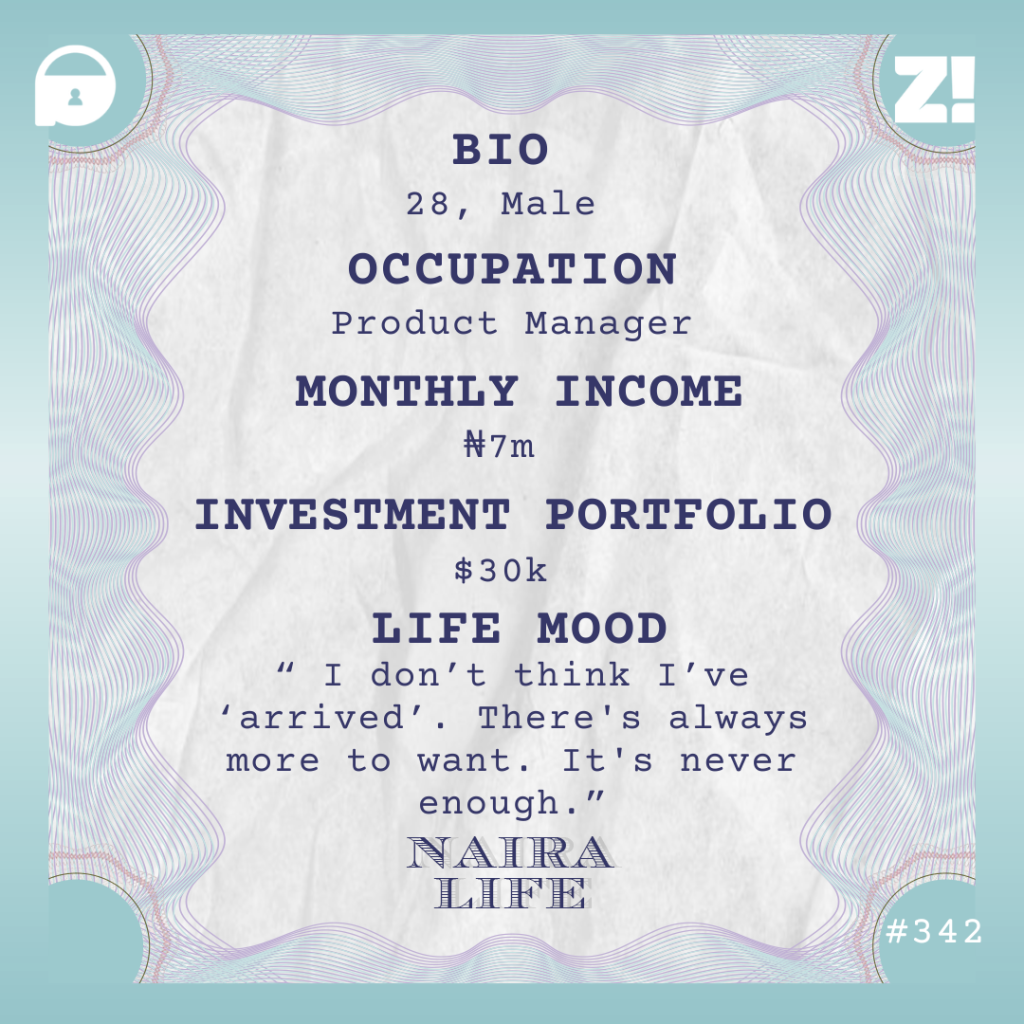
This 28-year-old’s #NairaLife started to do a 180 after he found freelance work in 2021. In four years, he’s gone from earning ₦150k to ₦7m/month. His side gigs pay him far more than his full-time job, but he’s sticking with the 9-5 life for the long term. Why?
Every week, Zikoko seeks to understand how people move the Naira in and out of their lives. Some stories will be struggle-ish, others will be bougie. All the time, it’ll be revealing.
Everyone’s financial journey is different; Piggyvest gives you the tools to plan, save, and invest, so you can create your own money story. Start now with as low as ₦1,000!
What’s your earliest memory of money?
After I completed junior secondary school, I participated in a programme that offered me the option to travel abroad to complete my studies. I had to write an exam, and if I passed, they’d sponsor my travel while my parents paid the fees.
I passed, but couldn’t go because the fees — about ₦2.5m — were too expensive for my parents. That was the first time I realised that money was something substantial and necessary.
Speaking of your parents, what did they do for money?
My dad was a contractor with an engineering firm, while my mum was a retailer and distributor for items like furniture and plastics. I used to think my parents were rich, but the school thing made me realise we weren’t as well off as I thought. We were comfortable, though. We had the basic necessities.
What was the first thing you did to make money?
I actively helped plan several uni communities, associations, and departmental events, most of which were tech and business-related. I drafted proposals and pitch decks to raise money, designed flyers and even hosted some of the events. Whenever we raised money, I got a small cut, around 10k or ₦20k.
I started doing this in 200 level, and noticed there was potential in it. Students wanted to attend life-changing events that provided value, so we could charge for tickets and also get sponsors. That’s how creating pitch decks became my hustle in uni. People knew me as the guy who drafted convincing proposals and designed graphics, and different communities often reached out to me for help.
How were you charging for your services?
I didn’t have a specific rate. The communities would usually say, “We want to raise this particular amount of money. If we meet the target, we’ll give you a particular percentage.” I usually made north of ₦30k when it worked out. I think the highest amount I made from one event was ₦500k when I was in 400 level.
It didn’t always work out, though. Sometimes, we didn’t reach the target. Other times, we raised money, but the cost of running the event exceeded what we raised. It was a win some, lose some situation, but at least I got extra cash here and there to supplement my ₦20k – ₦30k pocket money.
This was my major source of income until 400 level, when I went for the six-month Industrial Training (IT) experience. Interestingly, this period was also when I really discovered what I wanted to do in tech.
Before then, I regularly attended tech events with my friends and fantasised about building startups. I’d also attempted different coding languages and taken product management courses after realising I was better at strategy. I was still figuring out what I wanted to do, and IT gave me some clarity.
Tell me more about that
So, I studied mechanical engineering and did my IT with an FMCG company in 2018. They paid ₦80k/month, which wasn’t bad, but I realised I didn’t want to pursue a career in the industry.
The full-time staff didn’t earn much more, and they worked many night shifts. They had to stay overnight to monitor the power plant and HVAC system. Some didn’t even go home until Sunday. I didn’t think the pay was enough for that level of work and stress.
Since I was already interested in tech, I decided to pursue opportunities in the industry instead. I applied for an internship at a startup and got accepted as a product management intern.
At this point, I was four months into my IT at the FMCG company. There was a two-week period during which I had to combine both roles because the startup let me resume remotely. After two weeks, I had to resume on-site, so I cut short my time at the FMCG.
How much did the startup pay?
They paid me ₦100k/month, and I interned there for six months. When school resumed, I had to return to working remotely, and thankfully, my employers understood.
The internship basically launched my career in tech. After it ended, I kept applying for roles, and I got one at another tech company after I graduated in 2019. I worked in product growth management for ₦150k/month.
Was this good money?
Not really. It didn’t meet my financial needs at the time. I wanted to move out of my parents’ to kickstart my life, but I couldn’t afford to.
I worked at the company for a year. The environment and the work itself became too difficult to handle, so I quit and set my sights on international companies. I aggressively applied for full-time remote jobs. I must’ve sent about 2000 emails within three months. It was a painstaking process, as I had to make sure all my applications were quality leads. I received countless rejections and only seven responses.
Out of those seven, two led to an interview. I reached the final stage in one, and then the location issue came up. Apparently, they thought I was in the US, and when I revealed I was in Nigeria, they said, “We don’t typically hire Nigerians.”
Ah
Fortunately, my application impressed them, and they offered to work something out. Legally, they couldn’t hire foreign nationals full-time unless they sponsored their visa and relocated them.
They told me to find and register with a freelance contracting platform to work around the restrictions. I did that, and they hired me through the platform. So, all I had to do was log the hours I worked with them like a freelancer, and they paid me through the platform.
What was the pay like?
About $1500/month. I worked with them for three months, but the most interesting thing happened. Since I was already on this freelance platform and had done good work for my employer, a colleague referred me to another company that hired me on a freelance contract.
Then, I just kept getting gigs on the platform, making around $1500 – $2000 monthly. I even worked with one company that paid me $7200/month for almost a year. That’s the highest pay I’ve ever received. Contracting was sweet; I didn’t even want to work with a Nigerian company anymore.
I freelanced from 2021 to 2023. I was doing well financially, but I started feeling slightly dissatisfied with the arrangement. I didn’t feel like part of a team. Maybe it’s just me, but there’s this sense of ownership, purpose and job satisfaction that only comes with a full-time job.
So, in 2023, I joined a Nigerian Fintech.
Before you get into that, let’s not brush past you going from ₦150k to $7k. How did that feel?
I mean, it felt great. When I got the first foreign job, I changed my Android phone and old laptop to the latest iPhone and MacBook. I felt like I’d arrived. I finally moved out of my parents’ house in 2021 into a ₦3.1m/year apartment.
I worked with the guys who paid me $7200 between 2022 and 2023, and it was a really good year. I started my investment journey and did a number of things. I might have stayed there longer if they hadn’t tried to move me to their Nigerian team and heavily cut my pay to ₦1.2m. Can you imagine? From $7200 to ₦1.2m.
I joined the Nigerian Fintech at around the same time. At ₦1.4m/month, the pay was even competitively better.
Get More Zikoko Goodness in Your Mail
Subscribe to our newsletters and never miss any of the action
Were you still taking freelance gigs on the side?
Oh yes. I had built a strong reputation on the platform, so clients constantly contacted me.
I made about $70k from side gigs in 2024, but my health suffered for it. I had to cut my weekly hours from 40 to 20 when I realised I was severely burnt out trying to overdeliver. Also, I gained a lot of weight, and my social life was nonexistent because I didn’t have time to do anything besides work. I had to make serious changes.
What’s your income like these days?
I still work at the fintech, and my salary is now ₦1.7m. However, the bulk of my income comes from my side gigs.
My current rate is $45/hour, and I make around $3500 monthly, which is about ₦5.3m. I’d make more, but I try to stick to a strict 20-hour work week. Last month, I managed to work more hours and made $5000.
I understand why you’re doing it, but do you feel like you’re leaving money on the table by capping your side gig work hours?
I’m definitely leaving money on the table. I’ve questioned myself at several points to ensure I’m doing the right thing, but I understand my long-term goal. I want to work full-time and live a balanced, healthy social life.
I feel good about the work I do at my 9-5, too. It’s not just about the money. I feel like I’ve found a decent balance for all I do. I commit to my full-time work during working hours, dedicate at least an hour each day to my side projects, and then complete them on the weekends.
Sometimes, when I get tempted to take on more side gigs, I outsource to people. However, I’ve had cases where the people I outsourced to didn’t deliver, which made me lose clients. So, I just commit to doing what I can.
What kind of lifestyle does your income afford you?
I’m still far from my dream of financial freedom, but my income has helped me move a step closer to that goal.
I can afford most things I want. I’m not necessarily flamboyant, but I like good things. I also travel twice a year. Earlier this year, I visited two African countries. I plan to go to Asia before the year ends. I couldn’t think about this before, but now it’s within my reach.
My income has given me a new perspective on the affordability of things. For instance, I know everything is expensive now, but I don’t feel it as much as I would have years ago.
God, when? You mentioned financial freedom. What does that look like for you?
It would mean not worrying about bills or emergencies. It’s having enough wealth and cash flow to comfortably support my everyday needs and parents and live a stylish — not flamboyant — life without financial anxiety.
Earning $10k/month from a full-time role would be a massive step in that direction. I say “step” because I feel like when I get to that point, the goal will move again.
How has your income growth over the years impacted how you see money?
Money can never be enough. You’ll always think that if you have a certain amount of money, you’ll “arrive” and be comfortable. But that’s not the truth. Years ago, I used to think that if I earned what I do now, I’d solve all my problems. That’s not the case. I don’t think I’ve “arrived”. There’s always more to want. It’s never enough.
How would you describe your relationship with money?
Toxic. I’m a recovering impulse buyer. I used to want to spend money as soon as it entered my hands, and I learnt the hard way. I looked at my finances last year and realised there was a problem. A lot of money was coming in, but almost nothing went into my savings. I was deceiving myself by keeping money aside, only to return and spend it.
I now put all my dollar income into my investment portfolio and then save 20% of my naira income.
What does your investment portfolio look like?
I split my investments across multiple channels and further diversify with two main portfolios with different risk levels. The alpha portfolio is high-risk, with channels like stocks, ETFs, and crypto. The beta portfolio, which is medium to low risk, consists mostly of real estate and fixed income.
My savings mostly come from my full-time salary. 20% goes to my savings account, and I also have a 10% “spend and save” plan. This means that, for every expense I make, 10% of the amount enters my savings account. Then, I also do flexible savings for big expenses like rent and travel. I budget ₦6m for my trips.
My total investment portfolio is currently worth $30k, and my naira is about ₦12m. My naira isn’t a lot because I use it for immediate needs and expenses.
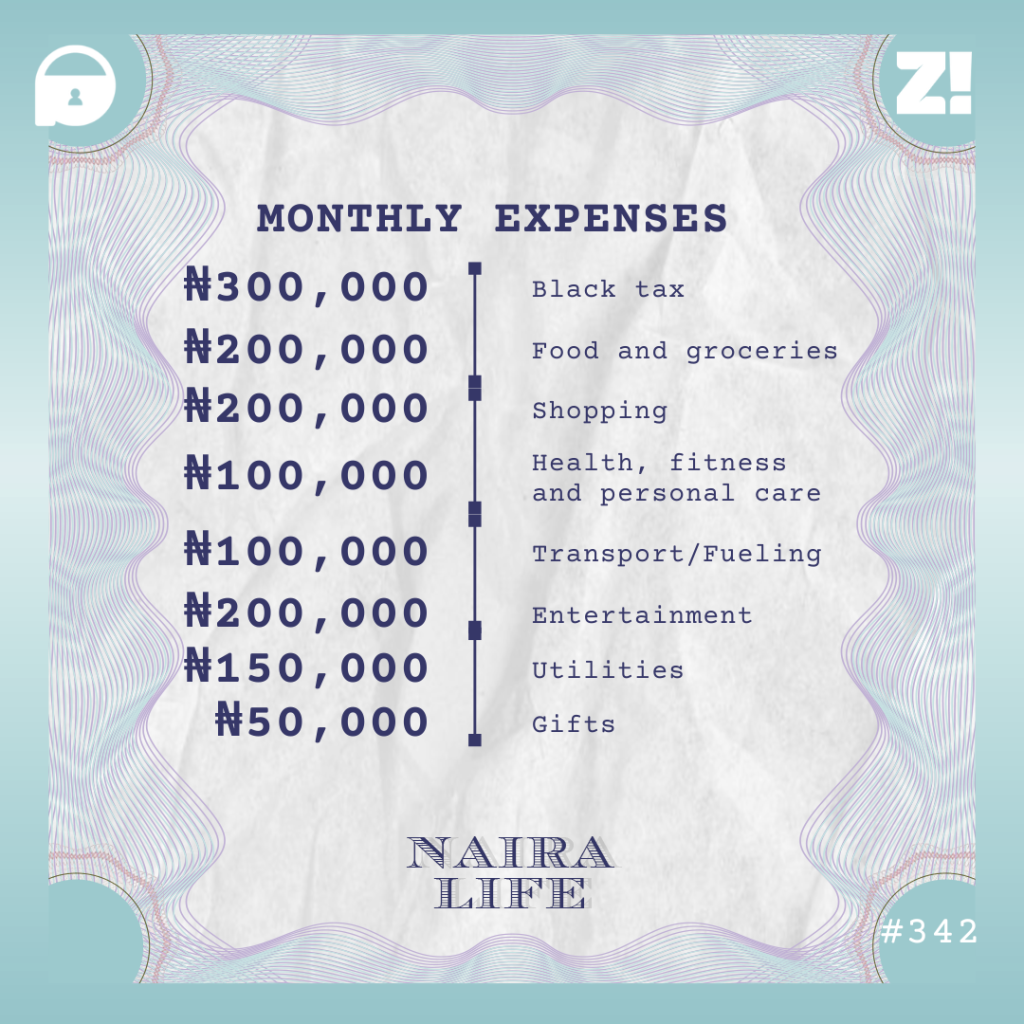
What do these expenses look like in a typical month?
Is there anything you want right now but can’t afford?
Many things, but an MBA is top of mind for me right now. It costs $120k, and I hope to get on it in the next two years.
What was the last thing you bought that made you happy?
I got a new car for my birthday last year. It felt really deserving. It cost me ₦23m, and I had to liquidate some of my investments to afford it.
How would you rate your financial happiness on a scale of 1-10?
7. I’m learning to give myself more credit for my progress, but I’m also honest enough to admit I’ve lost opportunities that could’ve taken me further. It also took me a while to find balance with my social life and mental health, but I’m getting there.
If you’re interested in talking about your Naira Life story, this is a good place to start.