Someone you know has left or is planning to leave. 1,000 Ways To Japa will speak to real people and explore the infinite number of reasons and paths they use to get to Japa
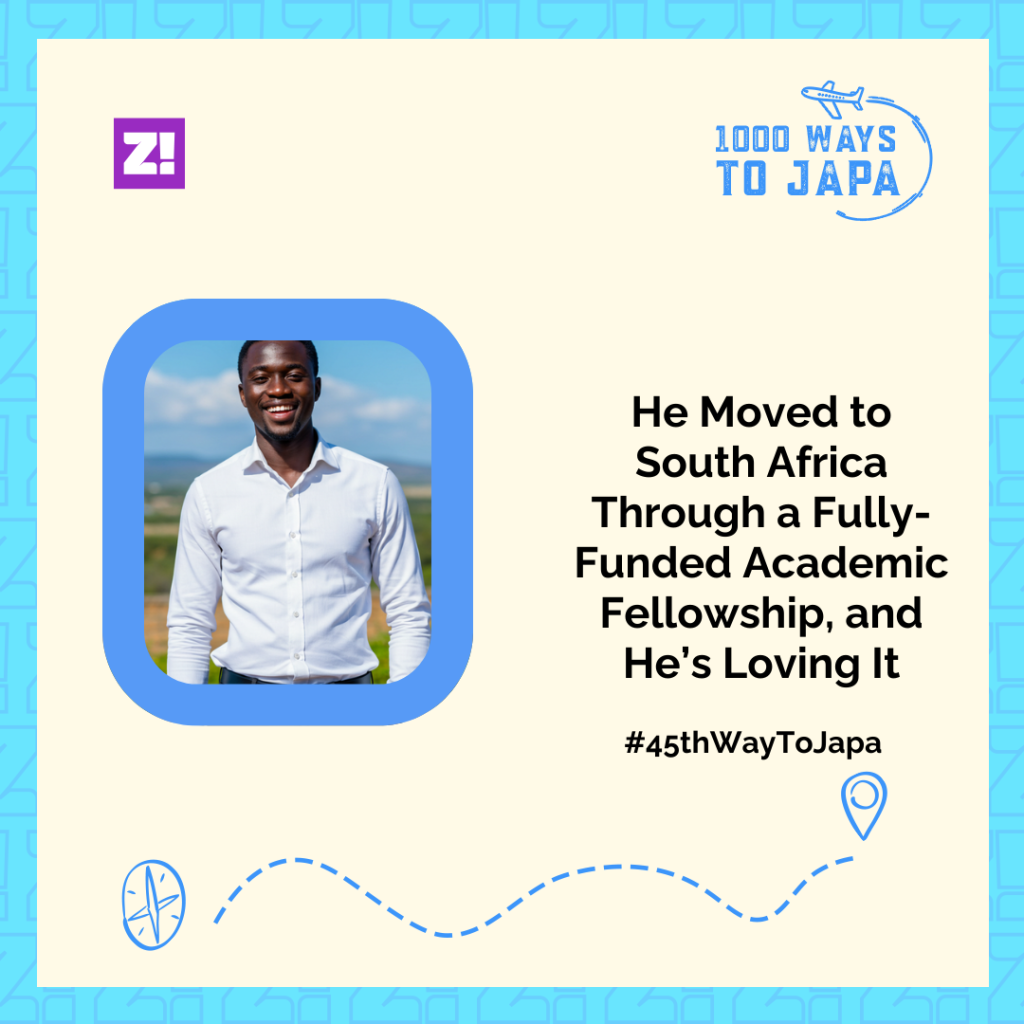
Akin (32) was sponsored to attend a South African conference, and his life changed because of it. In this story, he shares how networking, resilience, and 80 attempts at shooting his shot got him a fully-funded academic fellowship in the country.
Where do you currently live, and when did you move out of Nigeria?
I live in Johannesburg, South Africa. I’ve been in and out of Nigeria for a while, but I officially left in 2024 for postdoctoral research as a postdoctoral research fellow (PDF) at the University of Johannesburg.
South Africa is a unique choice for most Nigerians. Why South Africa?
I studied accounting in Nigeria, where I obtained my first, second, and third degrees. I am also a member of the Institute of Chartered Accountants of Nigeria.
South Africa came into the picture in 2022, when I submitted an application for a conference there but couldn’t attend due to some challenges. I tried again in 2023, and at that time, I got a sponsorship to participate in a conference at Daniels College of Business.
After attending that conference, I realised there were opportunities for PhD graduates to take on postdoctoral fellowships. If I hadn’t attended, I probably wouldn’t have known. That’s the power of conferences—you meet people, network, and get access to new doors. After that conference, I started applying, and by October 2024, I officially began my fellowship at UJ.
Congratulations! How is the fellowship going?
It’s very research-focused, but it’s going well.
How exactly did you apply for the fellowship?
I started applying when I got back to Nigeria. I sent out over 80 emails to professors and lecturers in my field. I faced many rejections, but I also got good feedback. Eventually, I secured offers from both the University of Johannesburg and the University of South Africa (UNISA). Since UJ gave me the first offer, I chose them and resumed in October 2024.
And is it a fully funded fellowship?
Yes, all expenses paid.
So, how can other Nigerians get similar opportunities?
You only need three things: determination, exposure, and networking. My own journey started with attending that conference. When I got back home, I began sending emails to professors. I attached my CV, introduced myself, and expressed interest. Consistency is key. You’ll face rejections, but if you keep pushing, you’ll get positive responses.
Also, start early. Postdoctoral fellowships usually require you to apply within the first five years of completing your PhD. So if you wait too long, your chances get slimmer. My advice to younger colleagues finishing their PhDs is: apply immediately, even before you officially finish. Also, publish as much as you can in international journals, not just local ones. In South Africa, for instance, there’s a list of accredited journals that count towards your credibility. Publishing there increases your chances.
You mentioned sending emails to 80 lecturers. How do you even find these lecturers to pitch to?
It’s simple. Go to university websites and check departments in your field. You’ll usually find lecturers’ profiles and email addresses. That’s how I reached out. My first offer came through networking at the conference, and the second came through cold emails. Both strategies work.
ALSO READ: She Got A Fully-Funded Scholarship After Sending 360 Cold Emails. Here’s How She Did It
Interesting. So, is this type of fellowship open to people without a PhD? Maybe master’s graduates or undergraduates?
For a postdoctoral fellowship, you must already have your PhD; that’s the minimum requirement. But South Africa also offers fully funded scholarships for MSc and PhD. In fact, many Nigerians are here doing their PhDs with funding. If you’re in the sciences or technical fields, your chances are even higher, especially if you can provide a good proposal and a host supervisor.
Do South African universities have a fixed application window, like the UK or US?
Yes. Applications usually open towards the end of the year, around October to December. By January or February, admissions are released. It’s better to start early. Do your homework by finding potential supervisors, reaching out, and getting your documents ready. The documents should include your passport (valid for at least three years), evaluation of your certificates, certified copies of credentials, medical documents, and a visa.
Great. You’ve shared a lot of tips already, but do you have any final advice for Nigerians who want to pursue these opportunities?
Yes. First, don’t get discouraged by rejections. It’s part of the process. Keep sending emails, keep networking, keep publishing, and keep pushing. Money can also be a challenge, but don’t let that stop you. Sometimes help shows up when you least expect it. For instance, someone sponsored my conference trip, which eventually led me to this fellowship.
Also, even while still in Nigeria, keep yourself active by publishing, collaborating, and building your CV. Opportunities sometimes come at the most random times, and if you’re not prepared, you’ll miss them. And finally, fellowships are life-changing. Beyond funding, they expose you to better research facilities, training, and networks. What takes me two months to achieve in Nigeria, I can finish here in two weeks. Unfortunately, our country doesn’t provide the same enabling environment, and that’s why many scholars leave.
But I’ll say this, Nigerians have so much potential. Being here showed me I could achieve far more than I ever imagined.
On a scale of one to ten, how would you rate your experience in South Africa so far?
Okay, I’d say around seven or eight. Life is great here.
Want to share your japa story? Please reach out to me here.