When Amanda* (24) thinks of her childhood, she remembers watching her mother raise three children alone, struggling to pay fees and keep food on the table while their father built a new life elsewhere. After her brother’s addiction pushed him back into their lives, she remains insistent on keeping her distance.
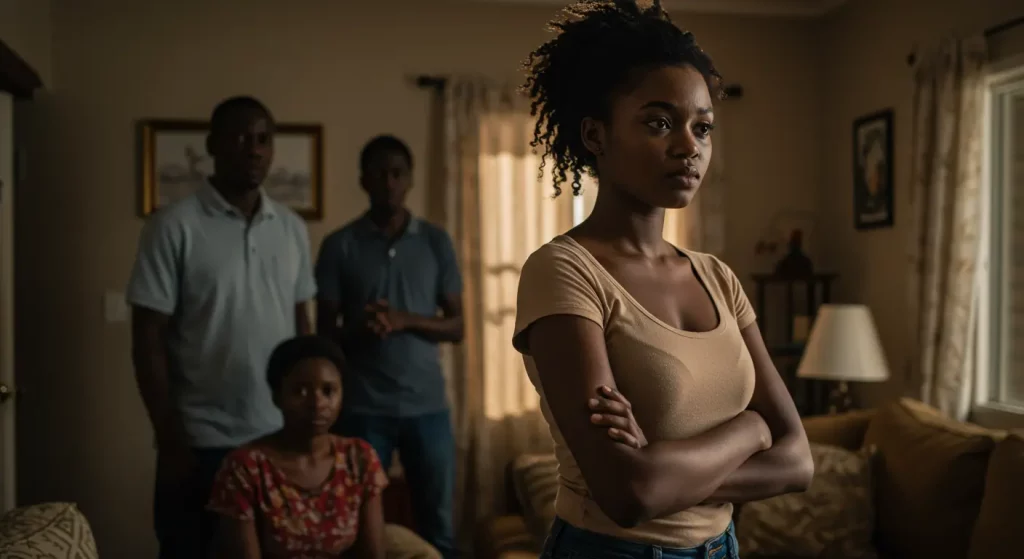
This is Amanda’s story, As Told To Mofiyinfoluwa
When my friend called to say my brother, Zion*, was beating our mum at her shop, I didn’t think. I abandoned the food I was cooking and jumped into the nearest keke. My hands shook the whole ride. I knew he could very well kill her.
By the time I arrived, the place was already in chaos. The biscuits my mum sold were scattered across the floor and even spilt onto the road. A small crowd had already formed, and from where I stood, I saw some people helping her up. She was crying and bleeding on her knee.
They’d somehow managed to pull my brother off her and bound him away.
As I made my way through, I could hear whispers. I imagined them saying, “Like father, like son.” They would be right. If my father hadn’t returned to our lives, maybe my brother wouldn’t have turned into this.
***
The first and only time I met him, I didn’t even know he was my father. I was four. My sister, Hannah*, and I were playing outside when someone knocked at the gate. Normally, we’d peep through the small hole before opening it, but that day, we were so carried away that we just pushed it open.
He stepped in, asked how we were doing, and if our mum was around. When we said no, he walked straight into our flat and went to wake my brother.
My heart jumped. I panicked and ran to the main house where my uncle’s family lived, just like I’d been taught to do if a stranger came. My older cousin shouted at him until he left.
It wasn’t until years later that I pieced together who he was.
I found out on my own. My mum kept some of his documents and pictures tucked away. I never asked her about them.
Sometimes in church, when we greeted elders after service, they’d remark about how much we looked like our father. Each time, I noticed my mum’s face twitch, but she never said a word.
My mum wasn’t a woman of many words, but I remember the first time I saw her genuinely angry. One church elder, still in contact with my father, slipped my brother a small piece of paper with his number and told him to keep in touch. My mum seized the paper the moment she saw it. Not long after, we stopped attending that church altogether.
We didn’t revisit the topic until around 2015, when my mum struggled to pay the fees for Hannah’s JSS3 exams. I remember watching her run around helplessly, trying to gather the money. As the exam date drew closer and we still hadn’t raised enough, my brother devised a plan. He had secretly kept our father’s number and said he would call to ask for help.
One day, while our cousin was charging his phone and no one else was around, we took it and dialled the number. My brother explained everything, but our father flatly replied that he didn’t have any money to give us and ended the call.
I was only ten, but I remember that moment clearly.
Around that time, I had also stumbled on court welfare documents that showed he was legally required to support us financially. Hearing him dismiss us so casually only confirmed what I was beginning to understand: he was an irresponsible man.
That day, I decided he wasn’t someone I wanted to know.
***
The man stayed tucked away in my mind until 2022, when I stumbled on my brother’s Facebook post. It was a picture of him holding hands with a strange man, captioned “Out in PH with my Dad.”
The last I knew, Zion was in Lagos, so I was shocked. I showed the post to my mum, who immediately tried to reach him. He ignored her calls for days, and when he finally picked up, he snapped at her, telling her to stop monitoring him like he was still a child.
A few weeks later, Zion called me. He told me about his Port Harcourt visit and how he reconnected with our father.
He discovered our father had remarried and never told the new woman about us. Word eventually got to her.
At first, she was furious, but later, she embraced him and even asked him to come spend some time with our four other siblings in Port Harcourt.
Zion wouldn’t stop talking about it. He said our father had been misrepresented all these years, then asked if I wanted to meet him.
I told him I wasn’t interested.
When I mentioned it to my mum, she finally opened up about what had really happened.
I already knew my parents were an intertribal couple, but I didn’t understand the weight of it until my mum explained. From the start, both families resisted their union.
Her family especially disliked him because he was deeply aggressive. He beat her often, yet she stayed. They were together for about ten years, though the relationship was always unstable. Each time he hit her, she would run back to her family’s house in Ibadan. After some time, she’d return, and the cycle would start again.
One of the worst incidents happened when I was about a year old. She had me strapped to her back when he beat her so badly she fell. I hit my head on the floor. The impact was so heavy that I bled. I survived without lasting damage, but for my mum, that was her breaking point.
She packed up, took her children and left for the last time. He tried to convince her to come back, but she refused. In the end, he abandoned us completely.
My mum tried to get him to support us financially. She even went through the courts, but he refused. After exhausting every effort, she gave up. That was when she cut him out of our lives for good.
After our conversation, she stood up and said we had the choice of maintaining a relationship with our father. Still, she made it clear that Zion’s sudden eagerness to reunite and his behaviour over time worried her.
I wasn’t surprised. Zion was no longer the sweet and innocent brother who once carried me on his back to school. He’d morphed into a version of himself that I didn’t recognise. A version who preferred partying in clubs and a version who adorned himself as the man of the house who made his own rules. I still remember when he graduated from school with a first-class degree. The academic success suddenly emboldened him. Suddenly, he wanted to move to Lagos and become a DJ. My mum wasn’t entirely supportive, but she gave him money to settle down and pursue his career in Lagos.
That relocation was the final blow to the death of our relationship. Our interactions were stripped of familiar warmth, reduced to plastic “thanks” whenever he sent money.
It didn’t help that we couldn’t ascertain the source of his wealth. I suspected Yahoo, especially by virtue of the company he kept. I also suspected drug use. Once, in a video shared on his Instastories, he downed a bottle of codeine. I tried to rationalise his behaviours, but my suspicions became reality by May 2023 when he suddenly decided he was tired of Lagos and returned to Ibadan.
Everything I’d tried to piece together suddenly became glaring: dreadlocked hair, bloodshot eyes, slurred speech. He was far from the brother who left Ibadan. This was someone else masquerading as our Zion.
The friend he lived with soon began complaining about his troubling behaviour. He’d mumble to himself for hours, then suddenly break into loud, incoherent songs in the middle of the night.
When Zion eventually moved back home, we were relieved. But living with him was a different chapter of chaos. He’d bang on the gates in the middle of the night and scream until the neighbours came out. Sometimes he went weeks without bathing, wandering around in the same clothes until everyone in the area labelled him a tout. By then, he’d stopped Yahoo, but the remnants of that life haunted him. Haunted us, too. People often came to threaten us over the debts he owed.
When Zion became too much to handle, my mum and her relatives scraped together enough money to send him to rehab. He stayed there for six months. When he got out, it didn’t even take three weeks before he relapsed.
This time, it started with small outbursts, a sharp edge creeping into his voice during casual conversations. I also began to notice frequent phone conversations with our father. He’d sit alone in the living room, muttering words like, “Do you even think mummy’s siblings like us? Do you think they want us to succeed?”
Sometimes, he asked us to say hello, but I refused completely. My refusal provoked him, and he soon started treating me harshly. Beating me, even.
It was so bad that my sister and I once fled the house during his fit of rage. He’d started with me and turned on her when she heard my screams. I remember calling my mum and sending her into a panic. She rushed home as soon as she could, but he’d calmed down by then.
After that day, things only got worse. He became more violent, more erratic. Sending chivers down our spines whenever he surfaced in the living room. My resentment towards him grew deeper with every incident.
When my mum realised the violence was becoming frequent again, she sent him back to rehab.
Zion spent most of 2024 moving in and out of different rehab centres. By Christmas that year, he returned home. But almost a year in rehab barely made any difference. Through it all, Zion maintained his relationship with our father. But it wasn’t my cup of tea.
When my mum saw that he was making little progress, she thought about sending him back to rehab, but her relatives advised against it.
Instead, they turned to prayer and deliverance. They took him to different churches and spiritual centres, and everyone offered their own diagnosis. They all agreed it was a spiritual attack from our father’s side.
One person even claimed that during Zion’s visit to Port Harcourt, my father’s new wife slipped something into his food that triggered his addiction. They said he needed special prayers from his father to be set free.
That December, when he beat my mum at her shop because she refused him money, my uncle finally gave in and reached out to my father. But his response was shocking. He insisted that Zion was fine, that they spoke regularly, and nothing seemed out of place. In reality, we were drowning in the troubles of his behaviour.
Out of desperation, my family members pressured my father to come. I was the only one who didn’t believe his presence would change anything. By then, I’d already left home for youth service, and the distance felt like a relief. The situation back home had been eating away at my mental health.
Then, one day, my mum called to say my father had finally agreed to visit. His only condition was that his children personally invite him. I was reluctant, but my mum begged.
When we spoke, I only asked why he abandoned us. He couldn’t answer. He rambled about how certain truths he’d shared with Zion had hurt him deeply and that he didn’t want to “damage” me, too. He insisted that we were “kept away” from him; he insisted he hadn’t abandoned us.
Of course, I didn’t believe his words. If he couldn’t answer my question directly, then he had nothing to say to me. If he was already dead to me, that moment was the nail in the coffin.
When he eventually came to Ibadan, nothing changed like the pastors had promised. Zion remained the same. Instead, relatives suddenly badgered us to forgive and forget. My mum was annoying, too. She insisted this same man, the one who’d put her through years of struggle, share the same roof with us. After my dad left, he kept in touch with my mum. They talk regularly now, almost like they’re back in a talking stage. I’m not in support, but I also cannot control her.
What I don’t understand is why they keep forcing this relationship down my throat. A few weeks ago, my father texted me, “My daughter, why don’t you join the moving train of forgiveness?” When I ignored him, he tried reaching me through my mum.
Last week, when I was really broke, I called my mum and she sent me ₦10k. It meant the world at that moment. I called to thank her, only for her to say it was from my father. I’ve never sent money back so quickly in my life.
My mum was upset and reminded me that, as a Christian, I’m to forgive and forget. When I pointed out that she seemed to have forgotten he still has his other wife and family, she brushed it aside and insisted we could make it work.
She insists I need my father, especially for milestones like marriage, but as far as I’m concerned, my life was better without him.
I remember when my mum poured everything she earned into raising us. We couldn’t even afford ₦10 for transport and had to walk long distances. Those memories don’t disappear simply because a man decides, decades later, that he wants to be a father again.
My family can call me bitter if they want, but I refuse to rewrite history just to make room for someone who erased us.
Read Next: 10 Wives, 1 Question: Would You Marry Your Husband Again?