You’ve heard of the ‘one-minute’ man and the man who just ‘can’t get it up’ on the internet, but not about women who can’t have sex.
To a lot of people, the worst problem a woman can have with sex is being bad at making it enjoyable for her partner or issues with her partner’s size. Contrary to this opinion, some women have bigger problems than being bad at sex. Many women cannot physically or mentally ‘get it up’.
For the average man dealing with sexual dysfunction, the height of his day-to-day problems is getting scammed with concoctions from vendors who promise that they can make him last longer in bed. It’s not as straightforward as that for women who struggle with sexual dysfunction.
For women with pain disorders like vaginismus, dyspareunia and vulvodynia, sexual dysfunction goes beyond low libido and an orgasm gap; it often means severe pain disguised as intercourse. But we don’t like to talk about the fact that many women have normalised painful sex.
In this article, we speak to Ella*, a 23-year-old woman on vaginismus, dealing with health-care providers and what difficulties with sex mean for her sex life. Alongside the pain of vaginismus, Ella also deals with recurring vaginal infections, and together these issues mean she spends nearly as much as Nigeria’s minimum wage just managing her sexual health.
When Did You First Notice That Something Was Wrong With Your Sex-Life?
I can’t say exactly when I noticed that sex was different for me. But before I started having sex, I noticed that putting my fingers in my vagina slightly hurt. I assumed it was because of fingernails and just decided to avoid finger insertion as much as possible.
What Was Your First Sexual Experience Like?
It hurt terribly, but I chalked it up to it being my first time. For me, the experience felt like something a woman who gave birth without the help of modern medicine would go through. It hurt that much.
I thought everybody had painful sex, and I kept wondering why there was so much hype about it. Why were women claiming to enjoy something that hurt so badly? Were we all just collectively lying to save face? As I continued having sex, I started doing my own personal research, and I discovered that it wasn’t supposed to hurt so badly.
Is That What Made You Decide to Talk to a Doctor About Painful Sex?
Not exactly. I was tired of trying by myself, and I wanted professional advice. Or at least a final solution that would end the suffering. It can be very frustrating to have a problem you have no idea how to solve. Plus, my partner and I joke that I’m a baker because yeast is plentiful at bakeries.
I get a vaginal infection every other month. Sometimes, I even know the bacteria/fungi causing it before I get the test done. I was tired of taking Levofloxacin (an antibiotic used to treat bacterial vaginosis) all the time, and I really wanted it to stop. All my friends (my body and I) hate Levofloxacin.
What Was Your First Doctor’s Appointment Like?
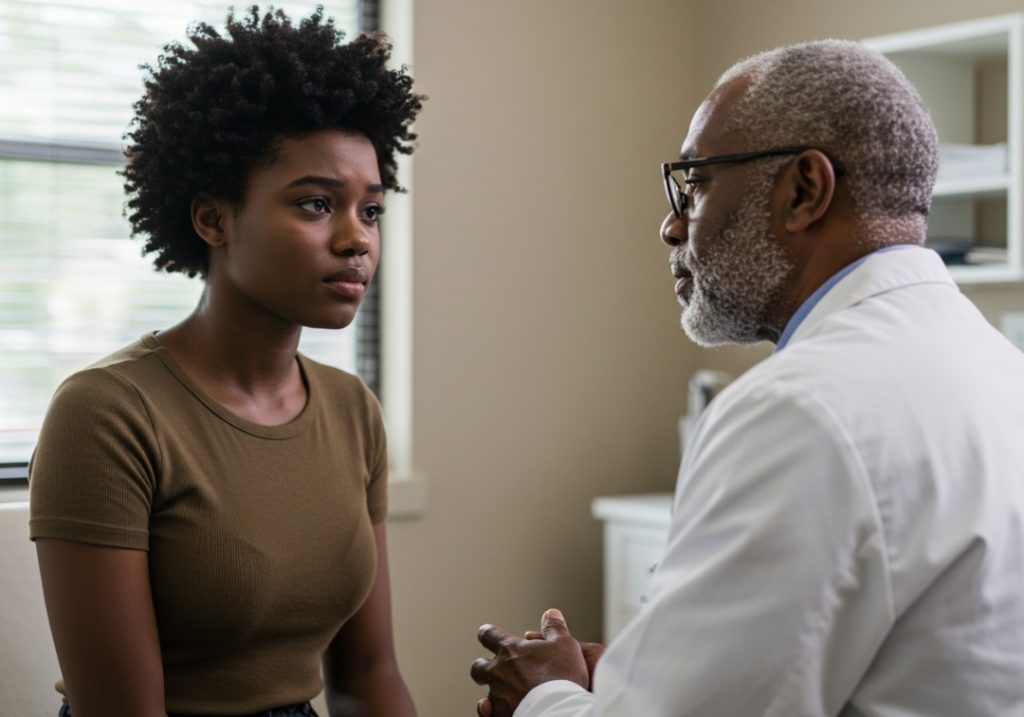
I went to a private hospital because public hospitals don’t take issues like this seriously. I first saw a regular doctor, who referred me to a gynae. When I came in, the gynae said he wasn’t informed, but that was the least of my problems that day. While he occasionally said insightful things, I could tell he was not listening to what I had to say. To him, since I’m a young, unmarried woman without kids, there was no reason for me to concern myself with sex. I left the hospital with my problems unaddressed.
Did You Come Back After That?
No. I didn’t go to that hospital again for sex related issues. I only went there for typical vaginal infections after that. I tried other hospitals, but the other healthcare providers were the same.
Apart from the ‘young unmarried and childless nonsense’, they kept insinuating that I have no idea what I’m doing. They outrightly said I’d be easier to handle if I was married and I’d brought my husband to the hospital for the doctors to discuss with. They kept implying that I didn’t know what I needed by recommending the same things I already said did not work for me. The entire encounter was exhausting. At some point, I asked if they had female gynaes so I’d have less chances of meeting less dismissive doctors.
What Were Those Things They Asked You to Try?
Condoms, lube, diaphragms, hormonal contraception (specifically pills), “taking a deep breath”, and abstinence. It must be my inner Nigerian child working because I don’t know how I kept a straight face and calm composure when I heard ‘abstinence’ from the doctor.
Wow. Do You Think Medical Help is Something the Average Nigerian Woman in Your Position Can Afford?
Honestly, I don’t think so. My bank account hates to see vagina problems coming. My major expenses are tests and drugs. In some months, I can get away with spending 30k, but in my budget, I’d say vaginal care takes up roughly 70k, depending on the severity. That is around the same amount as minimum wage. Sometimes I foot the bill, sometimes I frame it properly to ask for a bailout from my family, and sometimes I just suffer and hope it resolves itself.
That is Actually A Lot
It’s not only financially costly, but it also takes a lot from you mentally. Healthcare providers can be dismissive; not many women know about these things. Would they be able to make informed decisions instead of wasting their money on medical advice that won’t work for them, and would the average Nigerian woman stand up to judgemental professionals? I doubt it.
Has Vaginismus Affected Your Intimate Relationships in Any Way?
Not really, to be honest. Sex is one of the ways my partner and I bond, but it’s not really important to me. I’m on the aromantic/asexual spectrum, and I’ve seen people’s experiences in relationships where sexual libido is unequal. It made me decide that if I do decide to get into a relationship, my partner having a significantly higher libido than I would be a serious deal breaker.
On the flip side, sex is enjoyable or at least tolerable 5 out of 10 times. My partner is supportive, tries his best to take it slow, be understanding and find things that can help. If not for him, I wouldn’t have found out that glycerin in lube was making my situation worse. It still doesn’t mean I don’t wish I could close up my legs forever sometimes. Occasionally, sex repulsion comes out of nowhere.
Has It Affected Your Self-Confidence or Sense of Femininity?
I’d say it has made me more self-confident. I know what my body likes, and what it hates. I love the fact that I can make informed decisions. And I love that I can ignore or stand up to people that love to talk about things they know nothing about. But sometimes it is exhausting and I wish I didn’t have to do all that.
What Advice Would You Give Someone Who Has Just Discovered That They Might Have Vaginismus?
I wish more women knew they could say no to stuff they don’t want. It’s their body after all. You don’t owe anybody sex.
(*sighs)
Vaginismus is not from a lack of trying or ‘worrying too much’. Even if you can’t overcome it, it shouldn’t be something that reflects negatively on you. And it is not the end of the world. If you decide that you never want to be in a situation where you would feel that kind of pain again, that’s your right, and it isn’t selfish at all. Sex isn’t something that you should be dreading when you think about it. You’ll be just fine without it.
Next Read: What She Said: I See My PCOS as a Gift, Not a Medical Condition to Be Managed