Every week, Zikoko spotlights the unfiltered stories of women navigating life, love, identity and everything in between.
What She Said will give women the mic to speak freely, honestly and openly, without shame about sex, politics, family, survival, and everything else life throws our way.
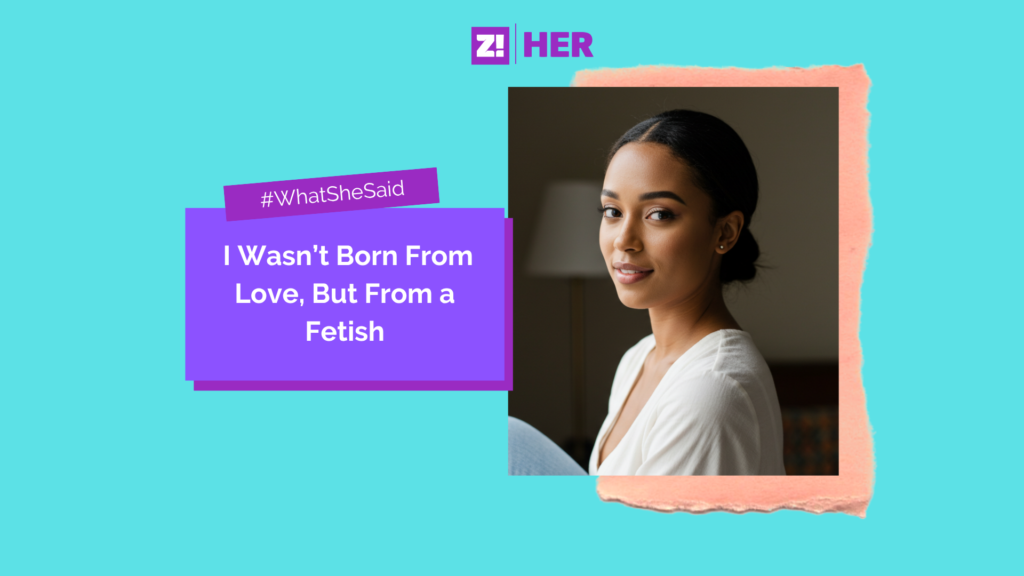
At 27, a Nigerian-Greek woman is finally unpacking a truth she’s carried her whole life: she wasn’t born out of love; she was born out of fantasy. Her father, a man from Imo State, specifically sought out white women like her mother to have racially ambiguous children. In this story, she reflects on what it means to be fetishised from birth, how that shaped her relationship with desirability and identity, and the lifelong weight of knowing she was created to look a certain way, not to be loved for who she is.
How would you describe your racial and cultural background?
My racial and cultural background is mixed. My dad’s from Imo State, so he’s Igbo, Nigerian. My mum’s from Crete, Greece. I’ve spent time in both places, and I feel deeply connected to each of them. But the older I get, the more I realise that feeling connected and feeling belonged to aren’t always the same thing.
When did you first realise you were mixed, or that people saw you differently because of it?
As a kid, I didn’t notice. I was just… me. But people would always say I looked Fulani, and because of how it was said, I took it as a compliment. In Nigeria, white features are constantly pedestalised. Even in childhood, I could feel that being lighter, or looking “foreign,” came with some kind of silent privilege.
It really hit in uni. That’s when I started clocking how obvious it was to others. One of our lecturers had an Indian wife, and I remember a coursemate saying something like, “She should come and carry me o.” When someone asked her why, she said, “Ehn, dem better pass us na.” It was meant to be a sort of joke, but it rubbed me the wrong way, and I kept my distance.
This idea is everywhere. Every ethnic group in Nigeria knows white or mixed people get treated better. Same with light-skinned people, it’s colourism. And I benefited from it. People complimented my hair, my skin. I was praised for things I hadn’t earned. Once, in secondary school, I was playing with a friend. He was really dark. The librarian screamed that he shouldn’t touch me, so I wouldn’t get stained. It didn’t fully click that it was because I was mixed at the time, but now I know better.
How did you find out your dad intentionally pursued white women to have biracial kids?
My dad had me and three of my siblings with my mum, and a son with another white woman; she’s Maltese. I don’t remember the exact moment it hit, but Nigerian parents have a way of exposing themselves during arguments. One day, he went on a tirade, and he said it himself: that he had been with a white woman before my mum, and when it ended, he asked someone to help him “find another white woman.”
That woman ended up being my mum. She was in her late teens. She wasn’t even that interested at first, but he took her out, bought her clothes, and things spiralled from there. It didn’t matter that they had a fifteen-year age gap. Later, he would casually talk about two other white women he had almost married before her. Like it was nothing.
Another time, I heard my aunty laugh and say, “Your papa no dey like Black woman. Na only foreign women wey dey fine.” And I remember asking my mum about it once. She said something I’ll never forget: “He liked the idea of you before he liked the idea of me.” That shook me.
What went through your mind when you realised your existence wasn’t about love, but about fantasy?
It made me feel… manufactured. Like I wasn’t born from love, but from a fetish. I wasn’t his daughter. I was his trophy.
It’s one thing to be fetishised by men, to be desired because you fit their fantasy. But when your own father does it? That does something to you. I remember how he’d talk about our skin, our hair. He’d say mine would “change” as I got older; get lighter, softer, more like my mum’s. I’m already light. But he still wanted more.
It made me question everything. Like, does this man actually love me? Or just the version of me that fits his aesthetic goal?
You’ll Love: 6 Women on The First Time They Loved Their Stretch Marks
Did he ever talk about your looks or racial ambiguity in ways that made you uncomfortable?
All the time. He’d talk about how we “took” from our mum; that’s why we were “so fine.” He got a kick out of being seen with us. He never had to say, “These are my mixed-race daughters.” His face said it all. That proud, smug smile. Like we were evidence of something. Like we were his prize.
He didn’t raise us like children. He raised us like projects. Our skin. Our eyes. Our hair in the sunlight. He fawned over it all. And somehow, none of it felt like love.
How has being mixed shaped the way people approach you romantically or sexually?
I’ve always felt watched. Even just walking down the street, people stare, shout, and approach me. It’s not about me. It’s about what I represent. Light skin. Curly hair. Foreignness. People don’t say, “You’re beautiful.” They say, “Na oyinbo be dis.”
I’ve had men tell me I must be “crazy in bed” because I look exotic. I can’t even count how many times I have been called the word exotic. I’ve had people say I’m “not supposed to be here,” like Nigeria can’t contain someone like me. Even a partner once told me that he had wanted to date a Greek girl, and getting with me felt like a win anyway.
Even in the mixed community, it’s wild. Mixed boys chasing mixed girls to make mixed babies. Like it’s a breeding programme. People have straight up said, “I want my kids to look like you.” It’s not admiration. It’s ownership. And it makes intimacy really hard. I never know if they want me or the fantasy.
Do you think your experience of desirability is more privilege or pressure?
Both, but heavy on the pressure. Yes, I benefit from colourism. I get served quicker. I skip queues. I’m treated better in certain places. But that “privilege” comes with expectations. People see me as closer to whiteness, and my Blackness becomes something they tolerate, not celebrate.
And it isolates me. People put me on a pedestal, but they also resent me for being up there. Sometimes they try to humble me, say something nasty, just to remind me I don’t belong. Even after I came out as queer, I noticed it from women, too.
And beneath all of that? I’m just… tired. People don’t see my mind. Or that I’m top of my class. That I have anxiety. Diagnosed. That being watched all the time makes it worse. Desirability is a spotlight and it fucking burns.
Have you ever felt like you had to perform a version of yourself to fit expectations?
Definitely. In Nigeria, we all go through a phase of trying to look “less African.” I straightened my hair so much that it thinned out. I practised speaking a certain way, not too Nigerian, not too Greek, just digestible. I was always trying to be what I thought people wanted.
It wasn’t until uni that I looked at myself and realised: I didn’t know who I was. I only knew how to perform.
Tell us your story here!
What helped you separate your identity from your father’s fantasy?
Therapy. No lie. I had to grieve the version of myself he dreamed up. Grieve the version I thought I had to become to be accepted. And then I started again.
I started learning Igbo, properly, intentionally. I went to Crete on my own terms. I stopped answering the question, “What are you?” unless I felt like it. I stopped letting people split me into halves.
Now, I say: I’m mixed. Nigerian. Greek. Not fractions. Whole.
If you could speak to the younger version of you who was confused or hurt by all this, what would you say?
You’re not a mistake. You’re not someone’s accessory. You don’t have to be grateful for existing just because you’re beautiful. You are real. Full. Worthy. Your brain matters. Who you are on the inside will always matter more than how you look. That fantasy people have of you? No be your responsibility. Set it down.
Click this to see what other people are saying about this article on social media
You’ll Also Enjoy: What She Said: She Gave Me the Child I Couldn’t Carry