Romantic relationships are complex enough when everyone involved fits into society’s narrow ideas of what’s “normal.” But for people living with disabilities, love can come with even more layers — from navigating societal bias and potentially ableist partners to confronting the quiet (and sometimes loud) fear of being a burden.
Still, for many disabled Nigerians, love is very much a possibility. It’s soft, generous, and joyful.
Zikoko spoke to five people about what it’s like to date while disabled, covering everything from choosing partners who don’t treat their conditions like inconveniences to the tiny, beautiful moments when they felt truly seen, understood, and loved for all that they are.
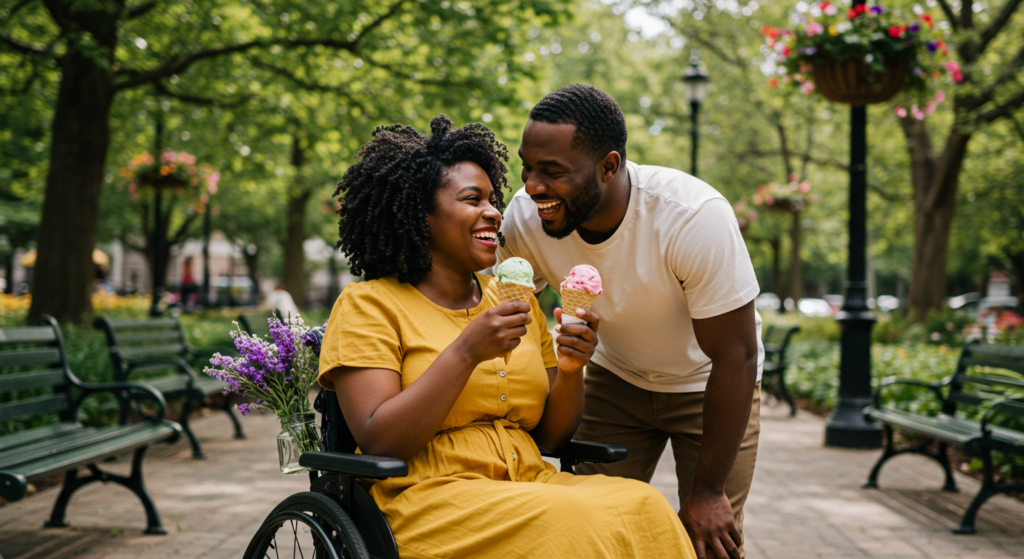
“Generally, I appreciate whenever I get caught struggling to do something, and my person catches me and immediately comes to my aid.” — Noah*(25), M, Limb Length Discrepancy
What challenges have you faced in romantic relationships because of your disability, and how did you deal with them?
None really. I’ve been pretty lucky to be involved with amazing people who have never made me feel weird or anything like that. I think I’m fairly discerning of people that might make me feel weird about my disability and steer clear of them.
How do you tell your partner what you need and what works for you, and how do those conversations go?
I’m pretty upfront about things concerning my disability. I constantly make jokes about my inability to do certain things as a way to banter myself more than anyone could. So it’s really, ‘Oh, could you help me do this?’ and they simply oblige, no weird reactions at all. Maybe because before I get romantically involved or even casually involved with people, I get a proper feel of their person first, to know if they’re cool.
Can you share a moment in a relationship when you truly felt seen, valued, and loved as a person with a disability?
There are a number of them across different relationships and people, so it’s difficult to pick one. Generally, I appreciate whenever I get caught struggling to do something, and my person catches me and immediately comes to my aid. I can be pretty stubborn and quite insistent on doing things that’ll be painfully difficult for me to complete. So whenever I get help without asking, I feel valued, loved and very much seen.
“One of the challenges I face is that I tend to meet extroverts who find it hard to adjust to the amount of quietness needed to be around me” — Mosope*(28), F, Hyperacusis
What challenges have you faced in romantic relationships because of your disability, and how did you deal with them?
Given the nature of my disability, I tend to isolate myself from people who have never witnessed me go through my episodes in person. This excludes everyone except my doctors and my five friends who were there during the early onset of my disability. This also means I mostly meet potential suitors online or through mutual friends.
Since my last relationship ended in 2021, I haven’t dated a lot. One of the challenges I face is that I tend to meet extroverts who find it hard to adjust to the amount of quietness needed to be around me, and the fact that we might not be able to do things they love together, especially if it involves a lot of noise and people.
How do you tell your partner what you need and what works for you, and how do those conversations go?
The last person I dated was quite understanding. Whenever I went to his place, he would ask me if the TV volume was quiet enough for me whenever we watched something together. We would play the movies or shows where I’d listen in with my headphones and he’d listen with the TV speaker, so it worked for us. Whenever we were in the car and he was driving, he’d let me take control of the music and the volume, which I found very considerate.
Usually, before I get into anything steady with anyone, I always make it clear that I have a sensory disorder, and I don’t mince my words so they don’t have the wrong idea that it’s not something too serious.
In my last relationship, the biggest challenge came during the early stages of my disability. I had just been admitted to the hospital and was still processing a series of heavy mental health diagnoses — Major Depressive Disorder, PTSD, and a few others. When I shared this with him, he felt I hadn’t been fully open about how serious things were. I explained that it was all still new to me too, and I was struggling to find the words.
At one point, he told me he had been researching my diagnoses to figure out if they were something he could “put up with” long-term. That struck the wrong chord. I was still in the hospital, trying to come to terms with everything, and it felt deeply inconsiderate. But eventually, we were able to talk it through.
Can you share a moment in a relationship when you truly felt seen, valued, and loved as a person with a disability?
It was on my 24th birthday. My then-boyfriend had colluded with my close friend, who was also my housemate, to plan a surprise birthday dinner for me. I remember my friend forcing me to get dressed and asking me to stay out of my room, not knowing she was cooking up something while I was in the bathroom. It was really nice and thoughtful because my relationship was long-distance at the time. They got food from my favourite restaurant, with a huge cake, and the scenery in my room was just serene and beautiful. He was on FaceTime, waiting for me to enter my room, and it was just really nice and cute.
“Sometimes my silence is mistaken for anger or disinterest, when in fact, I just need a different way to connect.” Demilade*(27), M, Deafness
What challenges have you faced in romantic relationships because of your disability, and how did you deal with them?
Not everyone wants to date a deaf person. There’s a stigma attached, and many people worry about how their choice of partner will be perceived. It’s often seen as “less than” to tell friends or family that your partner is deaf — as if admiration or approval disappears the moment you say it.
Because of this, deaf people often struggle to find hearing partners, which is one reason many end up dating within the deaf community.
Being deaf brought some unique challenges into my romantic relationships. One major issue is communication, especially at the beginning, when my partner is not used to my way of interacting or doesn’t know sign language. It can be frustrating when I have to repeat myself or when I feel left out during conversations, especially in group settings.
Another challenge is emotional misunderstanding. Sometimes my silence is mistaken for anger or disinterest, when in fact, I just need a different way to connect. Dealing with this has required a lot of patience from both my partner and me in any relationship.
What has helped me most is being open about my condition early on. I try to explain what I need, like making eye contact when speaking, using text when necessary, or even making simple gestures. I’ve also learnt not to shy away from lovingly educating my partner. The right person is willing to learn, and that makes all the difference.
How do you tell your partner what you need and what works for you, and how do those conversations go?
I believe honesty and clarity are essential. I try to tell my partner what I need in simple, calm ways. I might say, “It helps me when you look at me directly while speaking,” or “Texting me when I’m not looking your way makes communication easier.” These aren’t complaints, they’re just ways to make us understand each other better.
At times, those conversations can be awkward, especially if my partner is not familiar with disability. But I’ve found that most people appreciate it when I communicate my needs clearly and respectfully. Over time, the conversations become smoother, and they even bring us closer. It’s not about perfection, rather, it’s about effort and respect. When both of us are willing to meet in the middle, love becomes easier to express.
Can you share a moment in a relationship when you truly felt seen, valued, and loved as a person with a disability?
Yes, I remember one beautiful moment. I had just come back from a long, exhausting day at school, and I was feeling mentally drained. I didn’t say much. But instead of making me talk, my partner simply sat beside me, held my hand, and signed, “I’m here if you need anything.” It was simple, but deeply powerful.
That moment made me feel seen, not just as a deaf person but as someone who has emotions, needs, and value. It reminded me that real love is not about fixing someone or making them “normal.” Real love is about embracing the person fully, including their silence, their pace, and their uniqueness. In that quiet moment, I felt completely loved, not in spite of my deafness but with it.
“One of the biggest challenges I faced in my last relationship was the pressure to perform happiness” — Mariam*(29), F, Clinical Depression
What challenges have you faced in romantic relationships because of your disability, and how did you deal with them?
One of the biggest challenges I faced in my last relationship was the pressure to perform happiness. I got diagnosed with clinical depression in 2019, and it was a relief to understand that the perpetual despair and emptiness I felt had an identifiable reason. My major issue was that my ex just couldn’t understand why I was depressed when “nothing was wrong”. I got tired of pretending to be happy when I was with him and broke things off.
How do you tell your partner what you need and what works for you, and how do those conversations go?
With my current partner, it’s easy to express when I need space or when I feel horrible about myself because I was upfront about my condition to him when we first met. Conversations with him are so easy because when I tell him I’m feeling bad, instead of telling me to “cheer up”, he makes us go on a walk together or he sends me a short story he thinks I’ll love because I love to read.
At first, it was difficult for me to open up because I felt so judged and ungrateful for not being “happy” all the time. After a few years of managing my condition with therapy and medicine, it’s much easier to be factual and honest when discussing my symptoms or my needs with my partner.
Can you share a moment in a relationship when you truly felt seen, valued, and loved as a person with a disability?
During the lockdown, my cousin passed away, which triggered a terrible depressive episode for me. I was afraid I was going to hurt myself. My partner came to my house every single day throughout my mourning period with food and books.
He sat with me quietly, sometimes for hours on end. I can’t express how comforting his presence was. I was able to take my time with my grief, and by the end of it all, I felt very loved, safe and secure.
“With my current partner, I can speak as candidly as I want to without offending her” — Alani*(26), M, Autism/Attention Deficit Disorder
What challenges have you faced in romantic relationships because of your disability, and how did you deal with them?
A big issue for me in relationships is that I’m very forgetful. I may not remember facts or details my partner told me in the past, especially if I was doing another task while they were speaking to me. It can come off as inconsiderate or uncaring when what really happens is my brain shoves that information into another tab that I can only access randomly.
Voice assistants like Siri have been really helpful because I can set reminders or add new notes with whatever details I want to remember in the future, vocally. I’m glad that my current partner is considerate about my condition, but in the past, it has caused rifts in romantic relationships.
How do you tell your partner what you need and what works for you, and how do those conversations go?
With my current partner, I can speak as candidly as I want to without offending her, and it’s completely changed the way I see and experience romantic relationships. She understands that I’m not coming from a place of malice or trying to start a fight when bringing up certain topics. This space to be honest without consequences, has freed me from a lot of the overthinking I used to do when it comes to discussing my needs or concerns.
Can you share a moment in a relationship when you truly felt seen, valued, and loved as a person with a disability?
It’s not one single moment for me. I have a tendency to hyperfixate on special interests and hobbies. What I love is that my partner takes a genuine interest every time I pick up a new special interest. Whether it’s philosophy, art or digital marketing, she takes a genuine interest in whatever subject I’m fixating on and asks me interesting questions or organises a way to practice a new hobby together, even if we can’t be in the same space.
For instance, since I mentioned that I was interested in art, she makes sure we draw or paint together on FaceTime once every week. It feels like dating my best friend, and I feel seen and secure.
If you enjoyed reading this, you’ll also enjoy: Marriage Diaries: The Wife Who Can’t Believe Her Husband Chose Her