• Every week, Zikoko seeks to understand how people move the Naira in and out of their lives. Some stories will be struggle-ish, others will be bougie. All the time, it’ll be revealing.
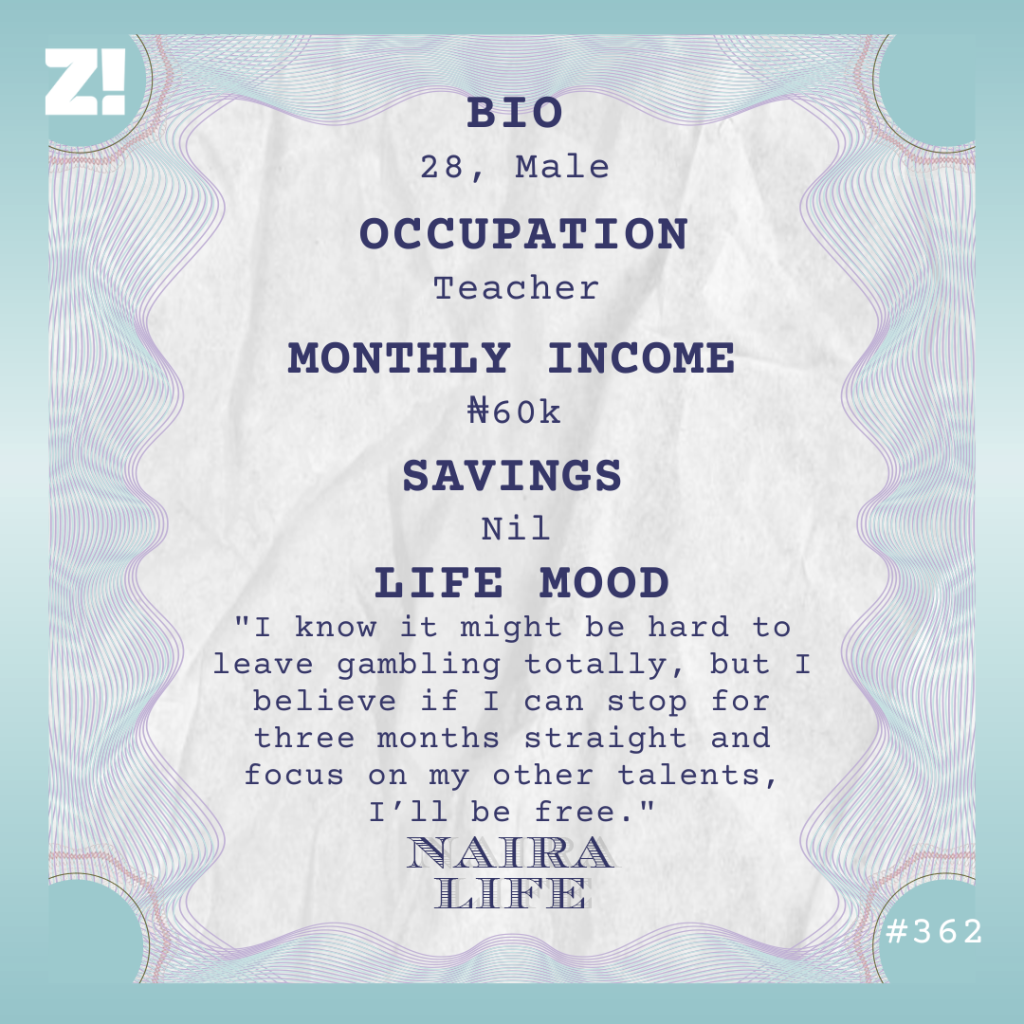

    Nairalife #362 bio

    What’s your earliest memory of money?

    I became conscious of money around the age of 15. I noticed my family wasn’t buoyant, so whenever money entered my hands — mostly gifts from family members — I held onto it like treasure because it didn’t come often.

    Tell me more about your family’s financial situation

    Things were much better when I was a child. Then I lost my dad in 2009, and my mum, a civil servant, had to single-handedly provide for five children on her little salary. 

    My dad was a prominent figure, but he had six wives, and after he passed away, everyone just faced their lives. Sometimes I think that things would have turned out differently if my dad hadn’t married many wives. His reason was that he was his family’s only child, and he didn’t want his own children to be alone. 

    I remember once, after my dad’s death, my mum asked one of his friends to help with my school fees. The friend put three mint ₦100 notes in my hands. Of course, that wasn’t enough for anything, and I sat at home that term. My dad died when I was in primary 6, and I couldn’t go to school for two terms because of school fees. My mum eventually sold most of her jewellery and wrappers to get me back to school. 

    That was one of several situations that pushed me to notice our financial situation and start seeing money as something to hold onto. The minute I finished secondary school in 2015, I took up the first opportunity I found to make money.

    What opportunity was that?

    I got a job helping my dad’s friend sell goods at his provision store. I worked 12 hours every day, and he paid me ₦8000/month. Most times, I didn’t get the full amount because customers owed me. I don’t really know how to confront people, and when customers defaulted on payment, I had to take the loss. 

    I worked for this man for about a year. He also had a son who was my age mate, and had gotten into a college of education. His son introduced me to gambling in 2016.

    How did that happen?

    He came to the shop one day, and I overheard him and his dad talking about how they had staked ₦200 on a bet and won ₦6000. It sounded like big money to me. I mean, they’d just made more than half of my salary in a day. The idea captured my mind, and I thought about it all day. 

    The following weekend, I went to a betting shop and observed the virtual games. I stood there for like 30 minutes, and every result I forecasted in my head came true. I felt like I was already a hero and decided to play. I didn’t have any money, so I asked someone there for money, promising to refund him when I won. The person was like, “That’s now how they do here.” 

    But I was confident I would win, so I ran home, took ₦3000 of my boss’s money, and ran back to the betting shop to play. I played and played until I lost all the money. 

    I should have stopped after I made the first couple of losses, but I kept thinking I could win it all back. I sha lost everything, and that’s how my journey with gambling started. 

    Phew. Did your boss find out about the money you lost?

    He didn’t immediately realise the loss, so I took more of his money back to the betting shop a couple of times to try to win back what I originally lost. When my boss eventually noticed, he sent me to his second store, where he sold alcohol, to work for a few months to repay him. 

    This didn’t stop me from gambling. I was returning home late every night from work and still finding time to gamble. But I was somewhat in control of the urge.

    However, the habit worsened when I entered the polytechnic later that year. My mum gave me ₦1500 to take to school and manage. It was too small to do anything, so I turned to the betting shops again with the hope of making more money. Still, it was loss upon loss. 

    One time, I was returning from the betting shop and got into a car accident. Thankfully, I didn’t get injured. I managed to pause gambling until I finished my national diploma programme in 2018.

    What did you do next?

    I returned home for a while and searched for admission to do my HND programme. Unfortunately, things were very bad at home. My younger brother was in secondary school, and my eldest sister was in school for her HND programme. In my house, the girls’ allowances were prioritised to prevent them from doing what they weren’t supposed to do in search of money. 

    That meant there was no money for me. When I eventually got admission, my mum managed to raise only ₦30k out of the ₦45k fee. She told me to hold on or go to school and manage while she tried to raise more money for me. I couldn’t wait, and I went fully back to betting. 

    I gambled away the entire ₦30k. I was too ashamed to tell my mum I’d lost the money, so I turned to loan apps to borrow money. I gambled away most of that too. When I was left with only ₦6k, I told my mum I was travelling to school to resume. 

    You weren’t, I guess?

    Not really. I just wanted to see if I could work for a while and raise the money back. On the bus to Kaduna (where the school was located), I lied to the driver that I was an orphan and had no money or anywhere to stay. Honestly, I really had nothing. I didn’t even have a mobile phone because I’d sold it and gambled with the money.

    The driver connected me to someone who helped me find work at a popular junction in Kaduna. You know those guys who load buses and control vehicles on the road? That was what I did. During the day, I worked at the park, and at night, I slept in a classroom on the school campus. 

    What was the pay like for loading vehicles?

    I made ₦20 – ₦50 per car I loaded. Sometimes I made more by carrying passengers’ bags and escorting them to the roadside where they’d find buses. The roadside buses were cheaper than those in the park. So, when I found a bus, I’d negotiate with the driver and get a cut out of whatever fare they settled on with the passenger. My share was usually ₦500. 

    I earned ₦600 – ₦1000 per day. I managed to save enough to get a small phone after a few weeks, and my income typically went to food and data. On days when I was extra broke, I’d sneak people’s SIMs (mostly the people I stayed with in school) to borrow data for my phone. 

    Get More Zikoko Goodness in Your Mail

    Subscribe to our newsletters and never miss any of the action

    Were you still gambling during this period?

    I was. I’d even moved to gambling on my phone. It wasn’t as bad as when I was in school, though. I was consciously trying to save for my HND. 

    However, after months of hustling and enduring terrible living conditions, I managed to save only ₦18k. I still had to use that to get a better phone. Ultimately, I decided to just return home and find a better job. 

    I deferred my admission and lied to my mum that I couldn’t complete the registration because we hadn’t completed the fees yet, and it was late. I convinced her that the school held the money she gave me and that I only needed to complete it later to resume school. In reality, I hadn’t even paid anything. 

    While at home, someone helped me get a SIM registration gig. There was no salary; the telecoms company just gave me the registration kit and free SIMs. Whatever money I got from selling the SIMs was mine to keep; I just needed to make sure I sold them so my boss would get his commission from the company. I made ₦15k from the gig and stopped when it stopped moving.

    Next, I worked as a “boy boy” for someone who sold tiles. My job was to load tiles for his customers. I worked there for a month, and he paid me ₦15k. My thinking was that I’d gather all the money and return to school. Unfortunately, I loaned ₦15k to a family friend, but he didn’t pay it back. I was back to square zero. This was now 2020.

    You couldn’t return to school

    I barely had money to survive. So again, I returned to gambling. I won some money here and there, but instead of stopping, I’d think, “Let me just try and make more.” Eventually, I’d lose everything I won.

    Feeding was so difficult. I mostly depended on my brother to feed me. Sometimes, he’d give me ₦1k for two days. Other times, I’d starve all day, then eat bread and soft drinks at night. I did multiple random jobs for money, but all my income still went back to gambling.

    One day, hunger made me remember I had some SIMs I hadn’t yet sold. So, I talked to another guy who was also into the SIM registration gig, and he offered me ₦800 for them. When I took the SIMs to him, I met him sitting in front of his shop, with his phone beside him. When he went inside to bring the money, he left his phone outside, and I quickly pocketed it, intending to sell it to buy food. 

    Unfortunately, I didn’t realise the phone was playing music through a Bluetooth speaker. So, when I quickly walked away, thinking I’d successfully stolen the phone, the speaker disconnected and the music stopped playing. The guy immediately knew it was me. 

    Hmmm

    A crowd quickly gathered, beat me for hours, and then locked me in a public toilet. Fortunately, they didn’t go the jungle justice route; they handed me over to the police instead. I slept in jail that night. My mum and brother settled the police with money before they released me the next day.

    After that, I took a job with a lotto shop, basically helping the owners oversee the shop for ₦10k/month.

    Was that the best decision, considering the gambling problem?

    I actually didn’t play the lotto; I preferred football betting and virtual games on online betting platforms. Ironically, one of these platforms had a shop just beside where I worked. 

    So, I began going there every day; sometimes, I even played without money. They knew I worked close by, and they waited for me to sell before settling them. I also started using my boss’s money to gamble and constantly owed him. After plenty of quarrels and demands from my boss to refund his money, he eventually got me arrested — my second time in jail. Again, I called my brother to bail me out.

    At this point, my whole family was worried. They were like, “What is happening to you? You’re the cool type.” They didn’t understand why gambling had such a hold on me. I didn’t understand either.  

    That wasn’t the last time I was arrested.

    It happened again?

    Yes. While I was working at the lotto shop, I had stolen another phone and sold it for ₦30k to repay a debt to my boss. After the jail issue, I returned to the area where the person I sold the phone to lived. I was there to sell some more SIMs. That’s how his neighbour saw me and asked me to wait, saying he wanted to tell me something. I didn’t know he was going to bring the police. 

    Apparently, the phone’s owner had tracked it, and the person who bought it from me had gotten into trouble. This time, I went to an actual prison. I met multiple people in the cell, and the “boss” beat me and ate my food. 

    Phew. Did your family intervene this time around?

    My brother initially refused to come, saying he was tired of me. It was my mum who did the running around. I spent a week in that prison. 

    The phone’s owner lied, saying I broke into their house to steal the phone and some gold. They claimed the value of everything I stole was ₦600k. I knew I stole just the phone, but I also lied that I didn’t actually steal anything. In fact, when I sold the phone, I’d created a fake receipt online and claimed my girlfriend had sent it to me. To this day, my mum still believes I didn’t steal it.

    After plenty of back-and-forth, they agreed we should pay ₦300k. My mum liquidated her rice business and borrowed money to raise ₦150k before I could leave prison. We were supposed to pay the balance in ₦40k instalments, but my mum paid the first instalment and stopped paying. Thankfully, they didn’t disturb us.

    In 2021, I secured another admission to a polytechnic for my HND programme. 

    What was the plan to fund it?

    I didn’t have money, so I involved my mum. She was reluctant to raise money for me because of all the trouble I’d gotten into in one year. It took a lot of pleading and assurances that I would avoid trouble before she paid my school fees and let me go.

    Since I could only afford tuition, I had to squat with someone in school. I lived on this person’s grace. At first, things went well. He was a praying type who loved reading, and I also started reading. However, he started complaining about the living expenses, since he handled most of them. I was ashamed.

    During that period, my mum sent me ₦4k to help cover food expenses. I felt somehow about only contributing that amount. I needed to do something. I needed to earn money. So you know what I did?

    You gambled it away?

    Yes. I lost everything. I even borrowed ₦10k more from the bet shop owner to play more, believing I would win. Our agreement was that I’d pay him ₦15k back. 

    I still lost, and now, I was in debt. The guy seized my phone, and I told him I could sell it so I’d pay him back. Then I offered my roommate’s laptop as collateral. I didn’t tell my roommate.

    I sold the phone for ₦12k. Yes, I gambled away the money I made from the sale.

    Ah

    See. I forced myself to stop after I only had ₦5k left. I had to lie to my roommate that I had forgotten his laptop at school — thankfully, it was the weekend — while I searched for ways to repay the bet shop owner before Monday. I was unsuccessful.

    My roommate eventually found out and got the school security involved. Those ones held me until my mum came to pay the money. This time, it was ₦20k. She was saving the money to pay for my sister’s ND admission. This delayed my sister’s school plans.

    My roommate sent me out of his room. I had to sleep in the streets and bathe in a friend’s house for a couple of weeks. 

    That’s tough

    I can’t even go into all the things I went through. My remaining time in school was a cycle of gambling and doing random things for money. One of them included washing cars, for which I was paid ₦300 per car.

    Around the time I graduated in 2023, I started making some money from Facebook giveaways. Here’s how it worked: I followed popular pages on the platform, and a lot of them offered giveaways to super fans who shared their content and engaged with their posts. Sometimes, I got gigs to share giveaways on behalf of these pages with other fans. I was making ₦40k – ₦60k monthly. 

    I stopped gambling at this point because I was making regular money. I even had a girlfriend. Then one day, my girlfriend learnt that my younger sister’s boyfriend had bought her an iPhone. My girlfriend got jealous and implied I wasn’t doing things for her. I was triggered. Me too, I wanted to do something for my girlfriend and even upgrade my own phone. So, I returned to gambling.

    Omo

    I had ₦150k in my account and lost everything in the twinkle of an eye. I started begging to feed again. See, it was a terrible time. I don’t think I’ve recovered from that loss. Now, I don’t even make money from Facebook anymore because Mark keeps restricting accounts.

    I got a teaching job in March 2025 that pays me ₦60k/month. In fact, when I joined, my salary was ₦45k; they just increased it to ₦60k in February 2026. I know how much this gambling addiction has taken from me. Since I graduated in 2023, I haven’t gone for my NYSC because I can’t afford ₦45k to travel to school, sort out my JAMB regularisation, and clear my results.

    I’m constantly in debt. I took an advance loan from my February salary before it even entered, and I only collected ₦25k as salary. I’ve done fake transfers a few times because of hunger. I really don’t want to bring shame to my family again, but it’s so hard. 

    All my problems started because I wanted to win ₦6000 with ₦200. The people who inspired me to gamble have stopped and are doing better with their lives, while I’ve been trapped for 10 years. I must’ve lost over ₦2m to this problem.

    I’m sorry you’re going through all this. What do you think makes it difficult to stop gambling?

    I don’t know. Whenever I have money, something just keeps telling me, “Go and gamble.” It’s difficult to ignore that urge, especially when I’m lonely. 

    I don’t have friends or anyone to talk to, mostly because I stopped trusting people after experiencing how my dad’s friends treated us. The only problem is that the loneliness encourages my addiction. I haven’t told anyone the extent of my gambling problem. My family has an idea, but they don’t know it’s this bad. 

    I know it might be hard to leave it totally, but I believe if I can stop for three months straight and focus on my other talents, I’ll be free.

    Tell me more about these talents

    I believe I have what it takes to make money from social media. I also have some musical talent. I recently won a competition a musician hosted on Twitter, but he didn’t pay me. Maybe he got busy. I know I can become someone in life; I just need someone to groom me on the right path. 

    Fingers crossed. What kind of life does your current income afford you now?

    My salary allows me to afford food, and also support my siblings once in a while. At 28, I should be doing more for myself and for my family. My mates are married, but I can’t even think of that. Right now, I’m owing ₦70k. It’s a struggle.

    How much do you think would make you comfortable?

    ₦100k/month would be great. In fact, the ₦60k I earn now is not bad if I manage it well. I plan to arrange it so my mum receives my salary, and I just collect money from her when I have a genuine need until I’m able to stop gambling.

    Let’s break down your typical monthly expenses

    My salary was just increased to ₦60k, so this is how I hope to spend it monthly:
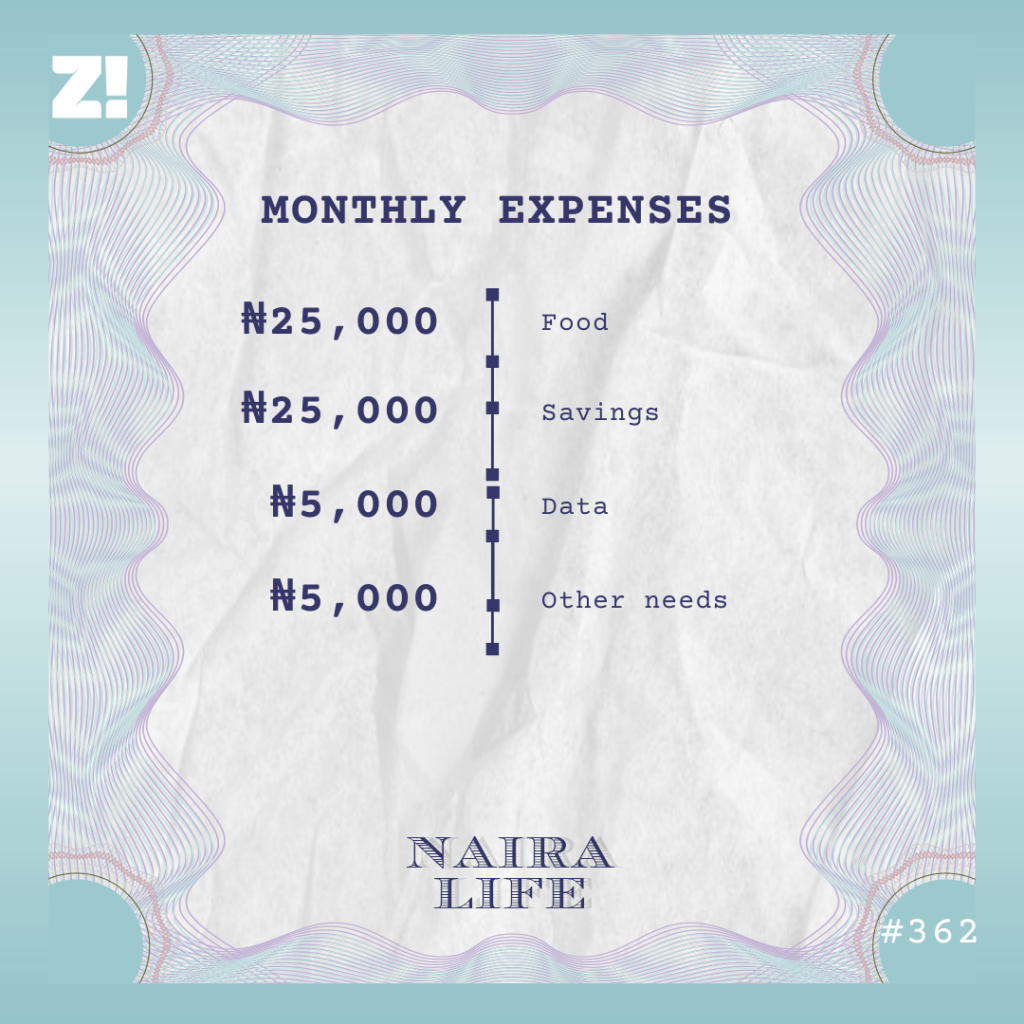
    NairaLife #362 expenses

    I live with a colleague in a room at the school, so that cuts out rent and transportation costs. This savings plan is with the hope that I can stop gambling and stick to saving with my mum. 

    Is there anything you want right now but can’t afford?

    Honestly, right now, it’s just fruits. I’m fasting, and as I speak to you, I don’t know what the plan for tomorrow’s fast is. I just head to the mosque daily to break my fast and collect the fruits they share.

    I hope things get easier. How would you rate your financial happiness on a scale of 1-10?

    2. I can barely afford my needs, and I can’t even tell people because they’ll say, “But you’re working. Where’s your salary?” Where do I want to start explaining from? Anyway, I’m good sha. I’m used to the hard life. I just pray things get better soon.


    If you’re interested in talking about your Naira Life story, this is a good place to start.

    Find all the past Naira Life stories here.
    Subscribe to the newsletter here.
  • The Nigerian experience is physical, emotional, and sometimes international. No one knows it better than our features on #TheAbroadLife, a series where we detail and explore Nigerian experiences while living abroad. 


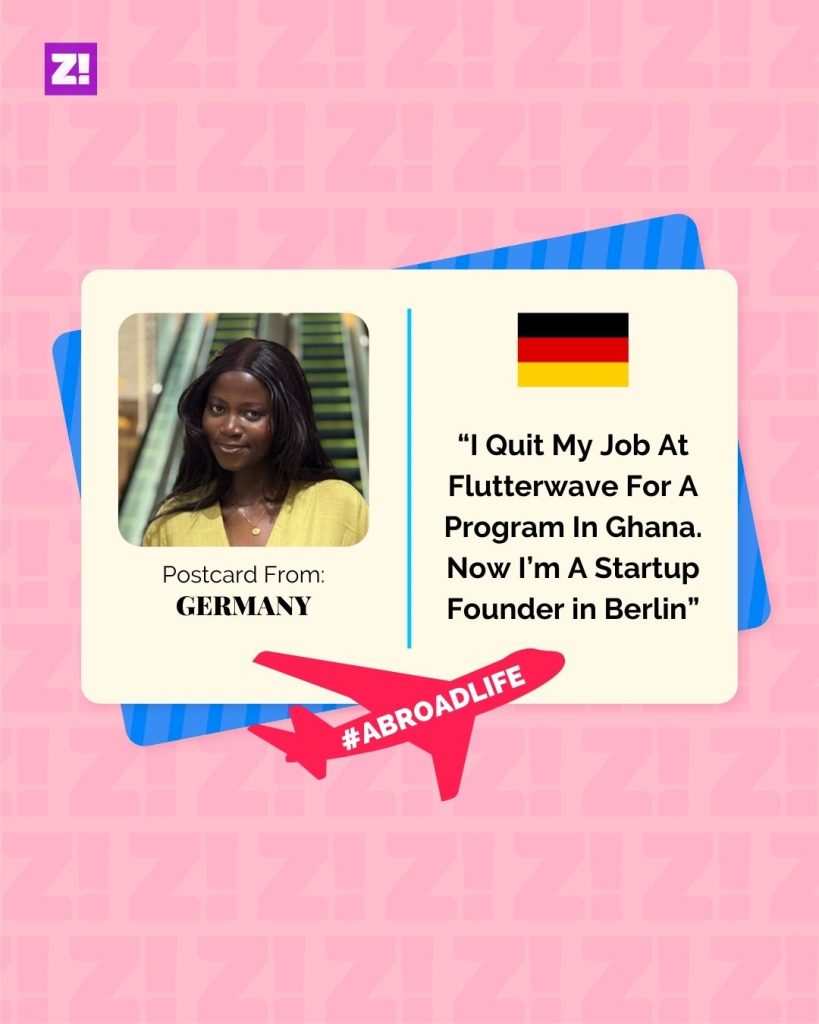
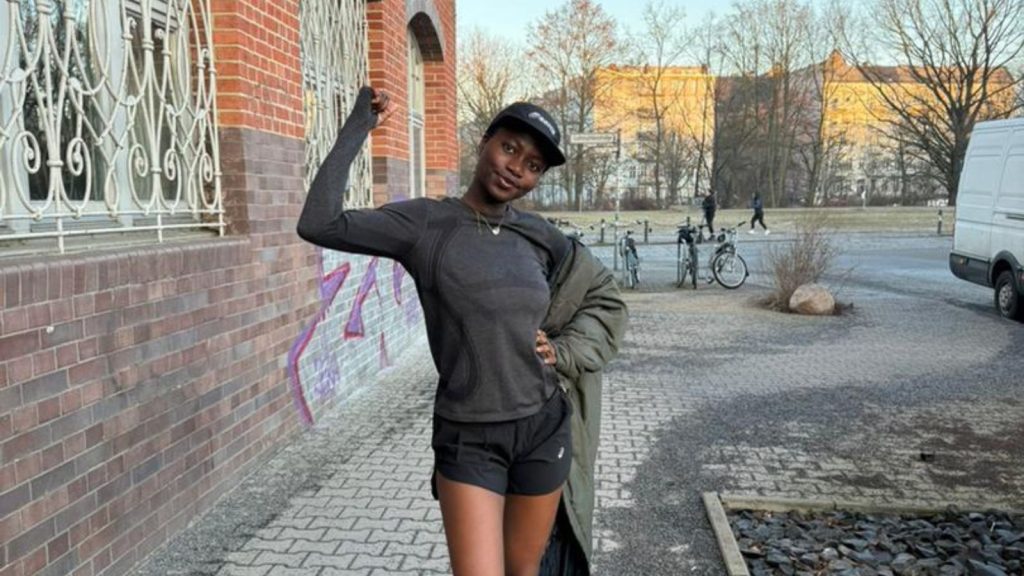
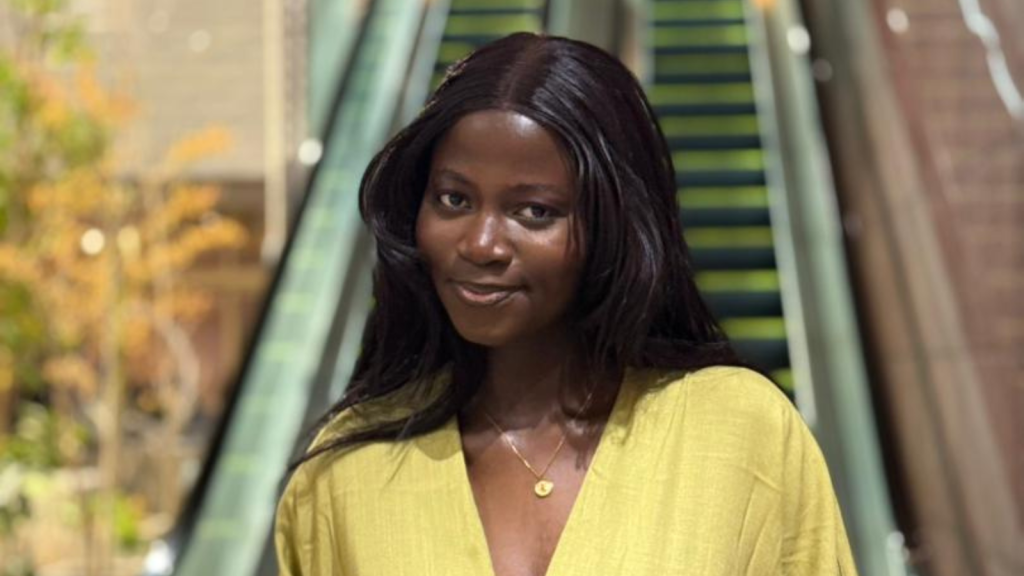
    Precious (25) is a co-founder of Beeva AI, a beauty-tech startup, currently living in Germany. In this story, she talks about quitting a stable job at Flutterwave to chase a tech entrepreneurship dream in Ghana, and how five months of “locking in” led to her eventually finding her tribe within Berlin’s running and tech communities.

    Where do you currently live, and when did you leave Nigeria?

    I live in Berlin. I left Nigeria for Germany in March 2025.

    Was that the first time you left Nigeria?

    No, it wasn’t. In 2023, I moved to Ghana and lived there for a year. Then I moved back to Lagos, stayed for a few months, and finally moved to Germany, where I currently live.

    What made you move to Ghana?

    I had just finished university, and I got into the Meltwater Entrepreneurial School of Technology (MEST) Africa Training Program. I quit my job as a product manager at Flutterwave and went to Ghana for the program.

    Were you working at Flutterwave while in university?

    Yes, I was.

    What made you take that risk of leaving a stable role for an uncertain program?

    It was a huge risk because my career was going very well at Flutterwave. When I submitted my resignation, it was rejected at first, and there were counter-offers to make me stay. Honestly, I never thought I would go to Ghana to be an entrepreneur. I always wanted to work in finance at places like the Bank of America. That’s where I thought my career journey would go.

    But I’ve realised that I’m more excited when I don’t know what to expect. I felt like I knew what my trajectory would be at Flutterwave. It was too linear, too predictable. I needed something more.

    In early 2023, my friends and I made a sort of pact that 2023 would be “our year of international opportunities.” We even created a WhatsApp group and basically pushed ourselves to apply to as many international opportunities as possible. We went on an application spree. I found the MEST Africa application and just applied to see what more there could be.

    Get More Zikoko Goodness in Your Mail

    Subscribe to our newsletters and never miss any of the action

    How was the experience in Ghana?

    Ghana was life-changing. There were about 50 of us from 19 different African countries in the program. I learned so much about interacting with people from different cultural backgrounds. It really changed my perspective.

    Did you get to see much of Ghana outside the program?

    I lived in Accra. To be honest, it was expensive, and I was just a humble student at the time, so I didn’t go out a lot. Still, I don’t think there is much to see in Accra compared to Lagos, for example. But I did like the Kwame Nkrumah Memorial Park. We also went on a trip to the Volta Region, which was super nice. We went to the mountains and did hikes. I love sports and active movement, so hiking was great.

    The only things I didn’t like in Ghana were some of the food and the weather. It was actually hotter than Nigeria.

    What about the people?

    Ghanaians are nice. I was in a bit of a bubble with other members of the program, but the Ghanaians I did interact with were very sweet.

    Did you make new friends during the program?

    I met a lot of amazing people. I still have a relationship with practically everyone from the program. I can pick up my phone now and call them. So having that network is a great benefit of the program. Also, one of my co-founders at Beeva AI is from Ghana, and she was also in the program.

    So you moved back to Lagos after Ghana. What was the plan then?

    Honestly, I didn’t have a plan. At the end of the program, everyone pitches their startup with the opportunity to get a $100,000 investment. But my startup wasn’t selected, so I returned to Lagos with no job, and the stipends from the program had stopped.

    I had a job with a US-based startup lined up as a buffer, but after my first month back in Nigeria, the founder ghosted everyone without paying. It was messy. And I had already used my savings to get an apartment in Lagos, so I was basically stranded.

    Wow. How did you get by?

    I was broke, but I didn’t want to call home because I struggle with being vulnerable like that.

    If I wrote a book about my life, the chapter about those five months in Lagos will be titled “The Great Lock In.” I had no choice: either eat something or get eaten. I had to get a job, or I had to get an investment for my startup. I applied to over 200 opportunities in one month.

    So how did the Germany opportunity come up?

    Interestingly, at one point, I stopped applying for jobs. I am a Christian: I prayed, and God told me to stop applying, which was so weird because I had no money. So, I stopped and put all my focus into finding funding for my startup. 

    Then one day, I got an email from an accelerator program in Berlin. They liked what I was doing, so we started the interview process. In November, I got the final acceptance email. They told me I could join the March 2025 cohort so I would have time to get my visa.

    Thankfully, in January, a former colleague from Flutterwave randomly recommended me for a remote product manager role. I took that because it didn’t require much effort, and it helped me survive until I moved.

    What is the status of your startup and the program now?

    The program ended in October 2024. It came with some grants that helped us stay afloat for a bit, but we are currently bootstrapping, trying to raise funds.

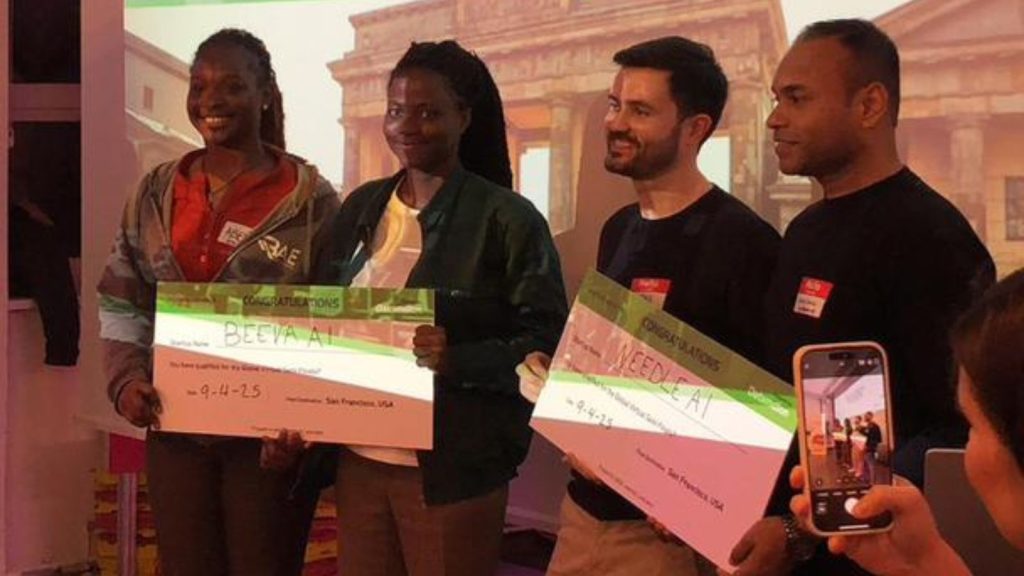
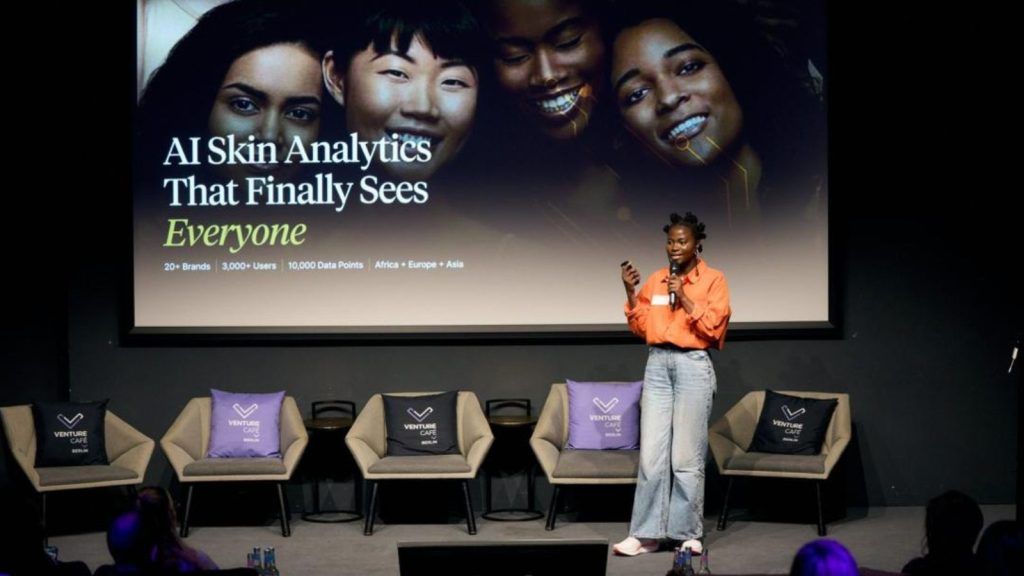
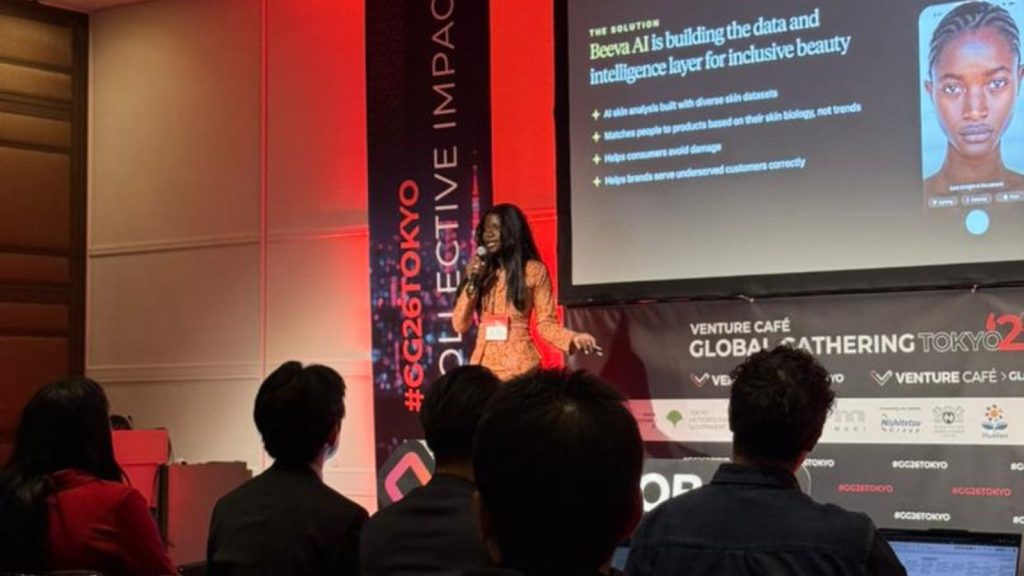
    In April 2025, we won the Datamellon Global AI Ignite Pitch Battle in Berlin, which qualified us to represent Berlin in San Francisco. Then in ⁠October, we won the “Highest Growth Potential” award at the Grace Accelerator Demo Day. In ⁠November, we won the Venture Cafe Berlin Pitch2Tokyo event in Berlin which qualified us to represent Berlin in Japan. And in ⁠February 2026, at the Pitch2Tokyo Finals in Tokyo, we won the “People’s Choice Award.”

    So, good things are happening that make me feel like I didn’t entirely mess up my life, but we still have a long way to go with fundraising.

    The program brought you to Germany. But are you staying there permanently now?

    I am a legal resident of Germany as a self-employed person. I will be here for a while. I’m young and open to growth, even if that means moving elsewhere eventually, but for now, Berlin is home.

    What has the experience in Germany been like?

    I love it. I’ll speak about Berlin because that’s where I live, and I think every city in Germany is different. In my 25 years of life, Berlin is the first place I’ve ever felt at home.

    It felt that way basically from the moment I arrived. On the day I arrived, a friend from university connected me with someone they knew in Germany. He came and picked me up from the airport at midnight. I stayed with him and his wife for a few days, and they made me feel so welcome. That first week, I followed him to his church, Hillsong Berlin. They have this sign that reads “Welcome Home”, and I felt like it was speaking to me. Two weeks later, I also joined a running club.

    I’ve only been here 11 months, but it feels longer because of the communities I have joined. Berlin is often labelled as the “capital of loneliness,” but I never felt lonely because I found my tribe in the running community and at church. I didn’t experience the kind of stories we often hear about people who travel abroad and are lonely and don’t have friends.

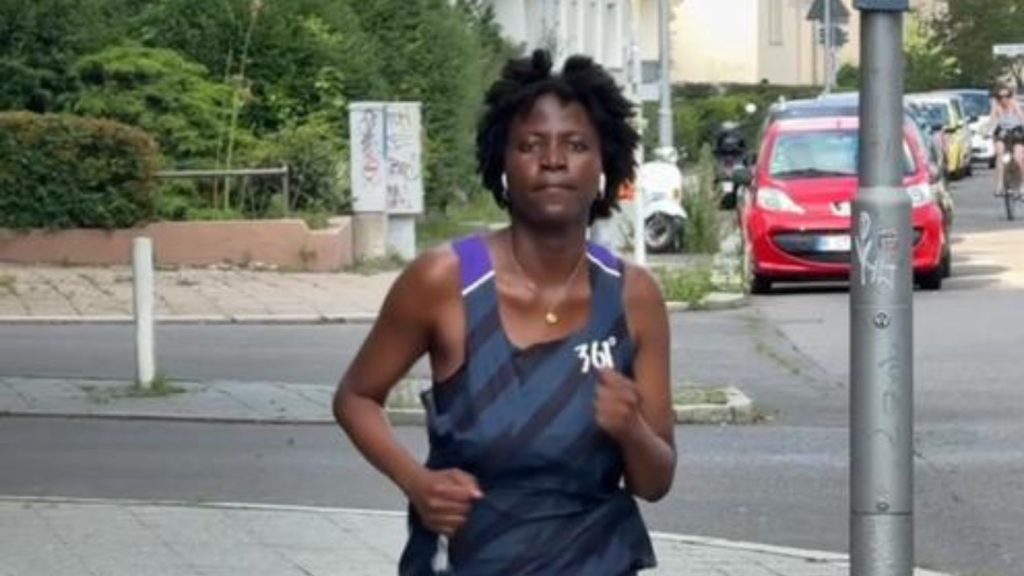
    I’m now a very active part of the Berlin running community; I’m a captain in my running club. I now sing at church. I’ve made friends in the Berlin tech ecosystem. I feel very supported and have great people around me.

    Sounds like you’re having a great time in Berlin.

    Yes. I’ve also realised that location is very important. My life has changed because I no longer worry about the basic things. I’m an ambassador for ASICS, the sportstyle brand. I would not have been eligible for that opportunity if I was resident in Nigeria. Being here has opened doors that were closed just because of where I lived.

    Have you been back to Nigeria since you moved to Berlin?

    No. It’s not that I don’t want to visit, but when you look at the ticket prices, it makes you think twice. I’m a startup founder, not a millionaire. I want to visit when I can maximise my stay.

    How did your family feel about you moving to Germany?

    I’m the black sheep of the family, the rebel. My dad really wanted me to be a chartered accountant, and I even started writing the Institute of Chartered Accountants of Nigeria (ICAN) exams. But after I got the first level certification, I decided I didn’t want to do it. So I just called him and said, “Daddy, I’m sorry, but I can’t do this.” I was already working at Flutterwave then and not taking money from home, so that gave me the confidence. I also didn’t carry my parents along when I moved to Ghana.

    Those acts of rebellion prepared them for the move to Germany. I think now, they just see me as someone who likes to figure things out. I prefer to figure it out and then tell them; if it doesn’t work, they never have to know about the failures.

    What were the biggest culture shocks for you in Germany?

    There were a lot of shocks, actually. Let’s start with the food. German food is mostly based around bread, sausages and cheese. I don’t like to cook, but I’ve had to adjust and cook more than I did when I was in Accra or Lagos.

    I think it’s common knowledge that Germans aren’t really communal people. But it was still a bit of a shock. Once, I saw a lady with a baby struggling to get up a staircase with the baby’s stroller. So, I went to help her, and she waved me off. I later learned that if someone hasn’t asked for help, offering it can be considered rude here.

    I also used to hold the train doors open for people if I noticed they were running to catch it, expecting us to bond over the gesture, but they didn’t even care. They don’t appreciate things like that. Still, it’s about finding your own people. I know many Germans who are really cool.

    I was also surprised by the amount of smoking. People smoke and vape everywhere, even middle school kids. It’s not seen as a big deal here. Also, the music. They do techno and house music with no lyrics, just beats.

    I’ve also had to remove my “African time” mentality. If an event is at 4:00 p.m. and I show up at 4:20 p.m., they’d have already started. They are very on time. I’ve never been to any event here that didn’t start when they said it would. Actually, there was one, but it was organised by Nigerians.

    The winter was also a shock. I arrived with just a hoodie, and even though it was still spring, I was shocked by the cold that hit me. I still get chills just thinking about it.  Then winter came. People told me to get a proper jacket, but I had one I got in Paris that I thought was good enough. It wasn’t.

    One day, I went for a run with thin gloves and almost lost my fingers. They were frozen, black, and swollen. It was so painful. It made me understand that you can never know more than the locals.

    What has been your worst experience in Berlin?

    I honestly can’t think of a really bad experience. The transport system was confusing at first. One day, I entered the wrong train four times. I was so frustrated. But I’ve learned how it works now.

    What has been your best experience in Berlin?

    I’ll say two. First, I ran my first half-marathon here. It was the beginning of winter, and it was freezing. I didn’t expect anyone to show up for me, but when I had one kilometre left, I saw people from my run club screaming my name. At the finish line, my friends from church were also waiting. It moved my heart so much.

    Second, I sing at Hillsong Berlin. Most people in my run club aren’t religious, but they saw a video of me singing on Instagram and asked when I was singing next. And they came to church to watch me sing. It made me so grateful. Also, winning pitches to represent Berlin in Tokyo and being interviewed on German radio for running have been major highlights.

    What is your least favourite thing about Berlin?

    The winter is very grey; there is no sun. You have to take Vitamin D supplements. You learn in school that the early morning sun gives vitamin D, but it feels only theoretical. In Nigeria, where the sun is always out, you take it for granted.

    I didn’t take the supplements seriously at first, and after a few months, I was actually depressed. It was such an ugly feeling that I still cannot describe properly with words. 

    I went to a clinic, and they told me it was likely linked to Vitamin D deficiency. Once I started the supplements, I saw a massive difference in my mood. So yes, I don’t like that it’s always like it’s cold, dark, and grey here. That’s just not a good combination; it’s my least favourite thing about the city.

    It really sounds grim. What is your favourite thing about Berlin?

    It’s the people I’ve met. It’s not the usual narrative for Berlin, but I’ve met amazing people. I love the running culture. I think it’s really cool that people ride bicycles everywhere. I love how much people read on the trains. It’s not like Tokyo, where everyone is on their phone on the train. Seeing people read makes me feel like I’m living the “mountain life” even in the city, and I like that.

    What do you do for fun?

    I hang out with friends, but mostly I have fun being in my room by myself. I read books in the summer.

    What are you hoping for in the near future?

    My goal is to live fully. Right now, that means running, building a startup, and video editing. I’m training for my first full marathon and will be travelling as a sponsored athlete, which I still almost can’t believe.

    I’m hoping my startup gets major funding this year. I also want to start a creative agency team in Berlin. I’m considering further education, too, but nothing is certain yet. I just want to be more involved in the Berlin tech and running communities.

    On a scale of one to ten, how happy are you in Berlin?

    Nine point five. It’s not a ten because I’m currently trying to move apartments, and the Berlin housing market is not great. It’s expensive and hard to find a place, even if you have the money. Other than that, life is great.


    Do you want to share your Abroad Life story? Please reach out to me here. For new episodes of Abroad Life, check in every Friday at 12 PM (WAT).


    How are Nigerians navigating romance today?

    Zikoko surveyed over 10,000 people across Nigeria to get their honest opinions about love, dating, marriage, intimacy and more. Read our State of Love report.


    Click here to see what other people are saying about this article on Instagram

  • Someone you know has left or is planning to leave. 1,000 Ways to Japa speaks to real people and explores the endless reasons and paths they take to japa.


    Franca (20s) has always admired asian culture, so when she was looking for a scholarship, it felt natural to look in one of its countries. In this story, Franca shares how she landed a fully funded scholarship to her dream school in one trial, how she’s faring, and how others can replicate her success.

    Where do you currently live, and when did you leave Nigeria?

    I currently live in South Korea. I left Nigeria in August 2024. 

    What inspired your move to South Korea?

    A huge part of my inspiration was the culture, really. I have always appreciated Asian culture, so when I was looking for a scholarship for my master’s, it felt natural to look in Asia. I tried South Korea, and it worked for me. That’s how I ended up here.

    What course are you studying now?

    I did my bachelor’s in Mass Communication, and I’m currently doing my master’s in International Relations.

    What’s the name of the scholarship, and how did you find it?

    It’s a fully-funded program called the Global Korea Scholarship (GKS), and I believe it’s quite popular amongst people who are into Korean culture or Korean dramas.

    The scholarship is funded by the Korean government through the Ministry of Education and implemented by the National Institute for International Education (NIIED). It opens up each year for graduates and undergraduates alike. Once opened, Korean embassies in various countries publicise the scholarship application period across their social media platforms. I follow the  Korean Cultural Centre, KCC  Nigeria (KCCN) on Instagram and have done so for a long time. I first saw their post about the scholarship in 2023 during my National Youth Service Corps (NYSC) year.

    I started preparing my documents and requirements in 2023. By 2024, I was able to apply.

    So, what was the application process like?

    I wouldn’t say the application process was difficult, but I’ll say it was complicated. Compared to Western countries with online applications, the GKS requires you to do a procedure called document legalisation and authentication. This means you have to take your education documents, like transcripts, degree certificates, and your birth certificate. To the Ministry of Education for legalisation. After that, you will have to take it to the Ministry of Foreign Affairs and the Korean Embassy for the same purpose. After that, you also have to take it to the High Court to get their stamp on it. It’s a long process with complicated steps.

    There are actually two different application routes. You can either choose to do it through the Korean embassy, where documents are submitted at the  Korean Cultural Centre, or you may choose to apply via the university route.

    How does the university route work?

    If you happen to choose the university route, after legalising and authenticating all your documents, you send them via a courier service to the University you’re applying to in South Korea.

    Can you list all the required documents?

    The scholarship usually publishes something called the GKS Guideline. The guideline usually entails all the documents you’re expected to submit. Some universities also request specific documents outside of the ones listed in the guidelines. Some may ask you to submit things like IELTS, an English proficiency test, a portfolio, among other things.

    Overall, the main documents which you must have to apply are your transcripts, degree certificates and birth certificate if you’re a master’s student. For undergraduate candidates, it’s usually a testimonial, a high school transcript and a birth certificate. Additionally, a personal statement and study plan are required for both categories. If you have other documents that show evidence of meaningful extracurricular activities, such as volunteering, that would also boost your chances.

    Can the quality of a person’s personal statement mar their application?

    It does. The embassy application route (which I used) is in three stages, namely document submission/evaluation, interview, and successful candidates selection. The personal statement and study plan are reviewed in the first stage alongside other documents. If you do not make it past this stage, you can’t make it to the second and third rounds.

    Do you have any tips for strong personal statements and study plans?

    Sell yourself as much as you can in your essay. The people reviewing your application will accept it only if they’re absolutely convinced you’re a qualified candidate. Korea spends a lot of money funding this scholarship, so you need to prove that you’re worth the investment.

    You need to project confidence in your essay. You also need to demonstrate that you are skilled and have engaged in meaningful extracurricular activities like volunteering, among others. Most importantly, you need to demonstrate that you have excelled academically in your past studies. This is especially important because you need to score at least a 3.5 on a four-point scale.

    That makes a lot of sense. How many times did you apply?

    I applied once and got in on my first trial.

    Love it for you. How long did the application process take?

    For graduate programmes, applications usually open in February up until early July when the final results for successful applicants are released. Students begin to come to Korea in August.It’s a little different for undergraduate studies; the applications open up in September, and students start coming in by March.

    I understand the scholarship is fully funded; does it only take effect once you’re in South Korea?

    Not exactly. You have to cover your transportation from your house to the airport, and that is all.  They cover your flight to the country and every other thing you’ll need during your studies. This includes our round-trip flight ticket to and after studies, tuition fee, and a monthly stipend. All you have to do is carry your bags to the airport, then study hard when you get to South Korea.

    That’s so cool. So, how much did you spend on the process back in Nigeria?

    I spent money only on getting myself to the airport, getting around to the Korean Embassy, and the two ministries I mentioned earlier for the preparation of my documents. I spent about ₦200,000, and that was in 2024. I know the price has increased now because the cost of preparing those documents was hiked after my time. Those ministries probably hiked it after they saw the demand for those services was increasing; services that cost ₦1,000 per page suddenly began costing about ₦4,000. Things may have increased, but I don’t expect general expenses to exceed ₦500,000 if you leave within Abuja. But if you have to travel to Abuja to get it done, then of course, travelling down to Abuja will definitely mean spending more.

    Awesome. Are students allowed to work under the scholarship?

    Yes and no. We’re not allowed to work in our first year in the country. This is mainly to enable students concentrate on the one-year Korean language programme they are required to do. This stage is particularly crucial because you can be sent back to your country if you don’t pass the programme.

    Once you pass the language programme and get into undergraduate or graduate school, you’ll be allowed to work during breaks. Working may distract you or make things tedious for you, and that’s the last thing you need because studying in another language is already hard enough. The sponsors of the scholarship, the NIIED, also emphasise the importance of good grades in keeping the scholarship. You are expected to maintain a Cumulative Grade Point Average (CGPA) of at least 80% or higher on a 100-point scale.

    You also need to maintain near-perfect attendance. The school keeps track of your attendance and will report to the NIIED if you miss class more than three times; you will get three warnings and will likely be sent back to your country after you’ve exhausted all three warnings. There’s no need to risk it. I advise you put your head down and study.

    Are students expected to leave after their studies?

    Students are not required to leave, and I think it’s an advantage that South Korea has over Western countries, where it’s insisted that you return to your home country after a stipulated time. Things are much more flexible here in that aspect; the decision to stay back is usually up to you. You’re also not mandated to secure employment within a stipulated time. Of course, it’s in your best interest that you get a job so as to sustain yourself, but you’ll not be sent packing if you don’t have one just yet.

    So, what’s studying in South Korea like?

     It’s been an interesting experience full of new learning so far; however, I think the answer to that is highly dependent on who you ask. Some students attend universities where a majority of the courses are taught in complete Korean; I  imagine that wouldn’t be so enjoyable for them. My classes are taught in English, so I enjoy them.

    What university do you attend? Would you recommend it?

    My school is called Sogang University, and I hundred per cent recommend it. This 

    has always been my dream university, and I really enjoy studying here.

    What would you say to Nigerians who are looking to study in South Korea?

    Come ready to learn. I say this because things are a lot different here than they are back home. The culture is different, people’s behaviours are different, and things are done in an orderly manner. No one is pushing to get ahead of a queue or roughing their way into public transportation. 

    My experience here has opened my eyes to new things, new experiences, and new cultures. Also, South Korea is becoming a little like the US in the way that international students flock here. I’ve met so many people here, and I love it.

    South Korea is also technologically advanced and a good place to do business. I encourage people to explore this place.

    Is there racism in South Korea?

    It depends on who you’re asking. I personally haven’t experienced racism here. It might be because I’m in the capital, where South Koreans are much more familiar with other races. You’ll find that it’s the same in some other countries.

    It has been easy for me to settle in here. The only difficult part has been the weather. It gets quite cold here during winter.

    On a scale of one to ten, how would you rate South Korea, and why?

    I’ll rate it an 8.5. I haven’t been here that long, so I’m probably swayed by my good experiences. I haven’t had any dreadful moments here, and I’ve met really nice people here. Overall, I’ll say I’ve been favoured a lot.

    Sounds great. I wish you the best, Franca

    Thank you.


    Want to share your japa story? Please reach out to me here.


    Politics affects your life every day and in so many ways. And you should have a say in who gets to decide things that affect you. Apathy only rewards bad leaders. Your silence only hurts you. So come, let your voice be heard at the second edition of The Citizen Townhall.

    February 28, in Lagos, there won’t be a more important place to be. Come through and join the conversation. Register here.


    Click here to see what others are saying about this story on Instagram

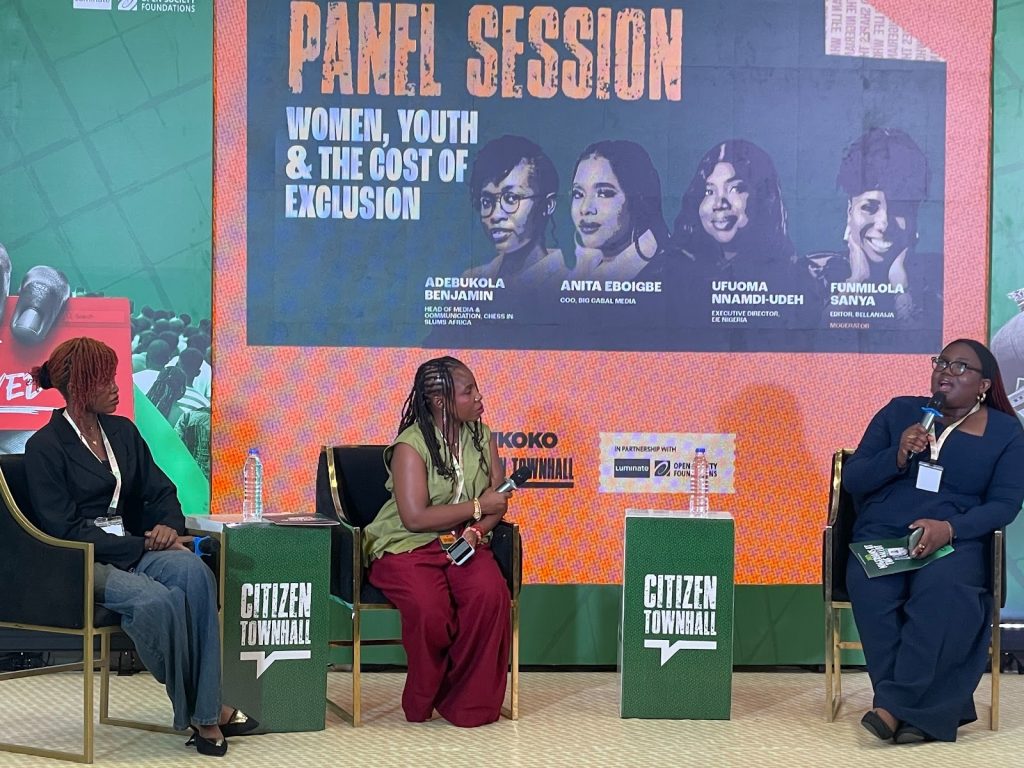
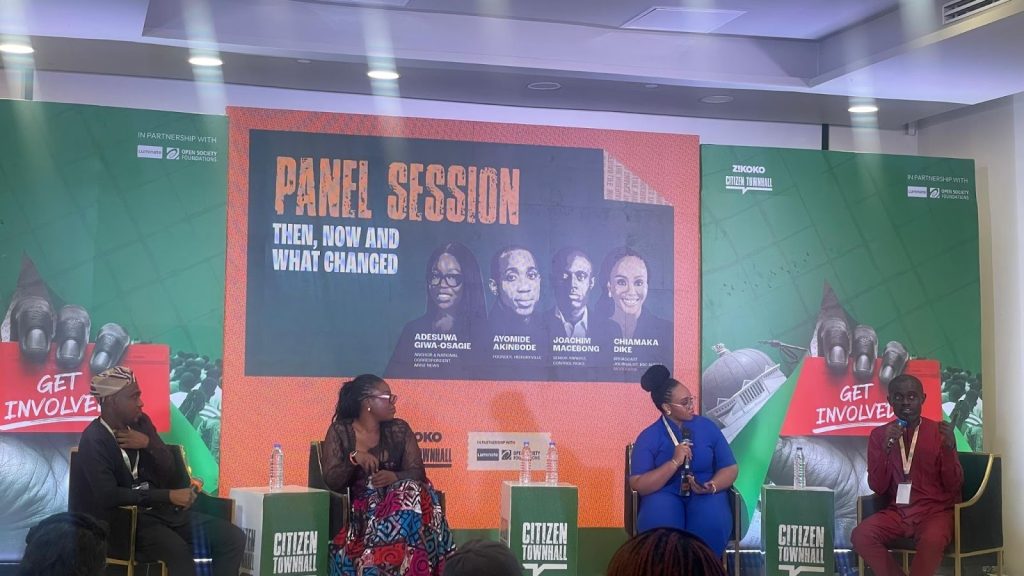
  • The  exclusion of women and youth  from governance in Nigeria was among the important issues  addressed at the Zikoko Citizen Townhall 2026.

    Held on Saturday, February 28, at Four Points by Sheraton in Lagos State, the Town Hall welcomed over 200 Nigerians to examine the question, “Who shapes the Nigerian life?” 

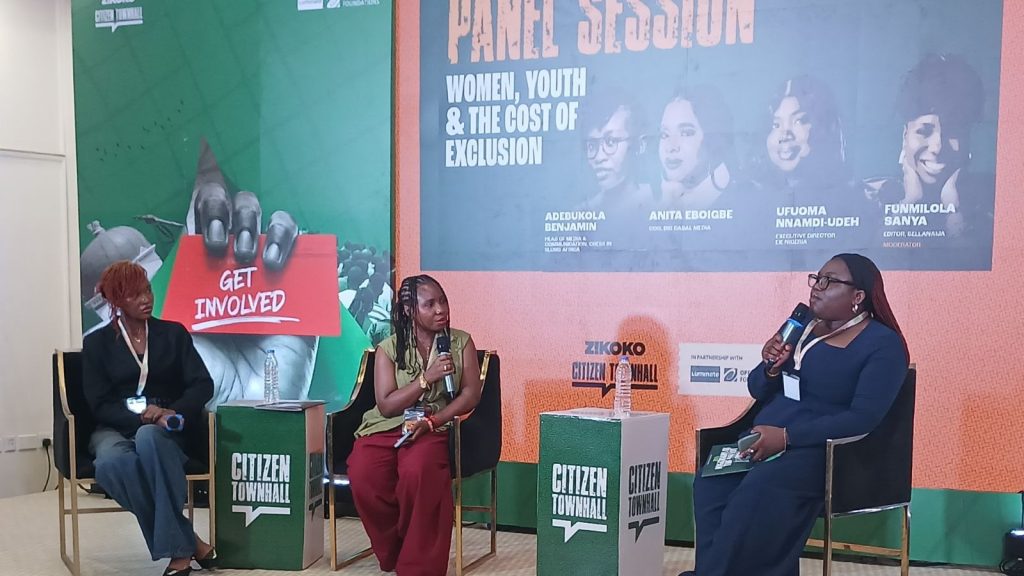
    During a panel discussion titled Women, Youth, and the Cost of Exclusion, experts examined the economic, political, and security costs of excluding women and young people from governance, emphasising that this exclusion is not just a fairness issue but a structural problem with clear national consequences. 

    BellaNaija Editor, Funmilayo Sanya, who moderated the panel, kick-started the discussion by focusing on representation and decision-making. She asked the audience to reflect on policies made without their input and questioned whether the outcomes might have been different and better if the policy-makers “looked like you” or “lived like you.”

    She continued by pointing out that exclusion shouldn’t just be regarded as a moral concern but as a tangible national problem, highlighting that exclusion “actually costs a country real, measurable things” 

    EIE Nigeria Director, Ufuoma Nnamdi-Udeh, noted that exclusion often weakens policymaking because those most affected by policies are often absent from the decision-making process. 

    “The people that make the laws don’t bear the repercussions of those things”, she said, explaining why issues affecting women and youth are not treated as urgent policy priorities. 

    She argued that this disconnect is especially visible in healthcare policy, where decisions on issues such as maternal health and even debates around abortion laws are often made without the participation of the women who can actually relate to them. 

    “Once that perspective is not in the room from the beginning, then there is no way that you can have proper execution or implementation of those policies,” she added. 

    The discussion also highlighted the economic consequences of exclusion. Nnamdi-Udeh pointed to sectors such as banking and fintech, where women are beginning to be recognised and are taking on leadership roles, noting that similar progress is nowhere to be found in political leadership. 

    From a security perspective, she pointed out that women and children are often the most vulnerable during crises and yet, they are rarely included in peacebuilding processes, resulting in policies that fail to address their realities. 

    Head of media and communication at Chess in Slums Africa, Adebukola Benjamin,  expanded the focus of the discussion to marginalised youth, who are often absent from conversations about inclusion. She described a persistent gap between these young people and government institutions: 

    “You will find that there is no trust whatsoever between them and the government,” she said. Many see themselves as pawns in political conflict rather than as stakeholders in governance. “When the system that is supposed to protect them is exploiting them, they create their own system for survival,” she explained. This alienation, she believes, has long-term economic and security implications, as young talent is diverted into harmful pathways. 

    Benjamin continued to emphasise that inclusion cannot be symbolic or left to chance. 

    “Representation cannot be left to charity alone,” she said. “It has to be intentionally planned, funded and enforced as part of governance.” Being in the room, she argued, is just the first step. Marginalised voices must be empowered to meaningfully influence decisions. 

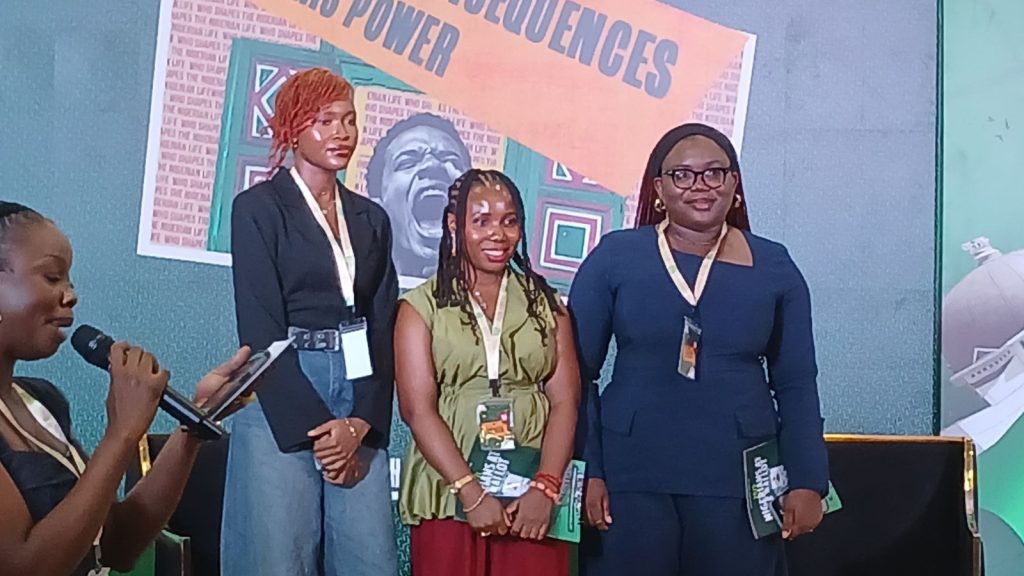
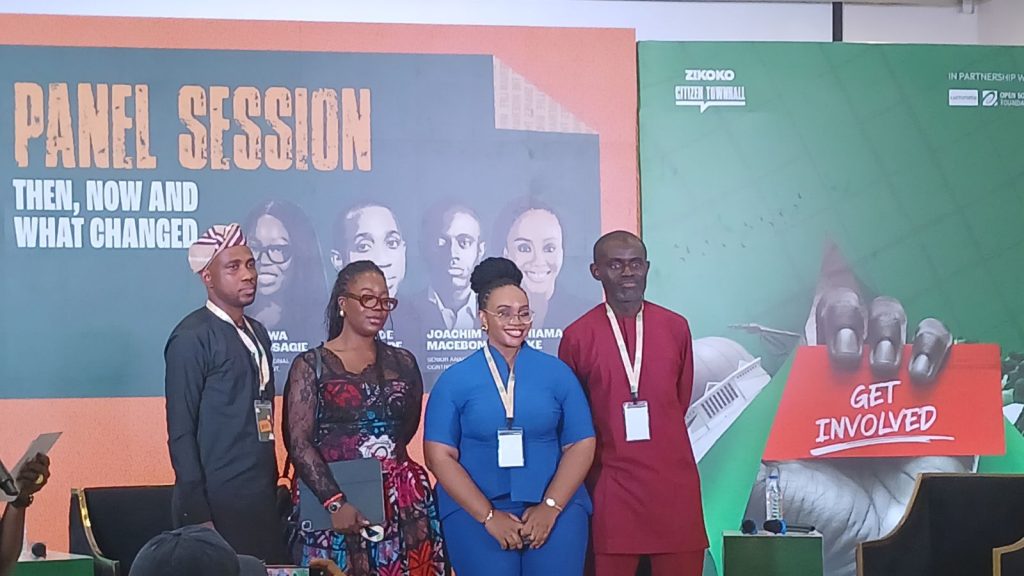
    L-R: Adebukola Benjamin, Funmilola Sanya, Ufuoma Nnamdi-Udeh

    The panel also highlighted practical entry points for participation beyond elections. Local politics was highlighted as the most accessible avenue for engagement. “Politics is local,” Ufuoma Nnamdi-Udeh said, urging citizens to attend ward-level meetings, hold officials accountable, and organise strategically over multiple election cycles. 

    Adebukola Benjamin also emphasised the need for foundational civic education. “We have to go back to grassroots civic education,” she said, stressing the need for citizens to cultivate participation as a habit. She also pointed to early and consistent engagement, as key to ensuring that women and young people can sustainably influence policy. 

    The session concluded with the acknowledgement that meaningful change requires both institutional reform and shifts in societal attitudes, and it was agreed that only through intentional, sustained participation and structural reforms can Nigeria bridge the gap between the population and its leadership.

  • Sometimes, life puts you in messy situations where you’re not sure if you’re doing the right thing or not. That’s what Na Me F— Up? is about — real Nigerians sharing the choices they’ve made, while you decide if they fucked up or not.


    Frank* (54) believed a decision he made years before meeting his wife would stay in the past until an accidental discovery brought it to light. Now, the truth about his real age has shaken his marriage and left him wondering whether keeping the secret was a betrayal or if the reaction has become bigger than the mistake itself.

    This is Frank’s dilemma, as shared with Mofiyinfoluwa

    I’ve always believed  age is just a number. But my wife, Lucy*, thinks otherwise , and I’m still struggling to understand why.

    I finished school in 2000, but spent years job hunting. Despite being a graduate, I survived on menial work that left me frustrated. In 2005, a friend connected me to a promising job opportunity, but it came with the strict condition that applicants couldn’t be older than 26.

    At the time, I was already 32. Passing on the offer because of age restrictions was out of the question, so I took a chance. I altered my official documents and reduced my age by seven years. I pushed hard through the process and eventually secured the job. That decision changed my life. I worked there for a while before moving into a banking role in 2014.

    I met Lucy at that workplace when she joined the office towards the end of 2015. I liked her immediately. Lucy was beautiful and had a sharp personality. By then, I was ready to settle down, and I pursued her for almost a year before she agreed to date me.

    On paper, I appeared about six years older than Lucy, even though the real gap was 12 years. I considered telling her the truth but decided against it. I didn’t want anything jeopardising my chances, and if things didn’t work out, that information could have complicated my professional life. As time passed, I stopped seeing the need to revisit the issue.

    Get More Zikoko Goodness in Your Mail

    Subscribe to our newsletters and never miss any of the action

    We got married in 2017 and now have two children. Our marriage was peaceful, and my real age never came up. I don’t celebrate birthdays extravagantly or talk much about my personal history. I was orphaned young and don’t have close relationships with most of my siblings, so there were few situations where the subject would naturally arise.

    That changed last month when my youngest sibling asked to stay with us for a week. She was ill and had been referred for a scan at the National Hospital in our city. Lucy offered to help her with registration and directions since she was familiar with the facility.

    I later learned that during the process, Lucy saw my sister’s age listed as 49. She questioned it because, based on what she believed, I was 48. To her knowledge, two siblings stood between us, so the numbers didn’t make sense. My sister explained our actual age gaps, and Lucy quickly put everything together.

    When I got home that evening, Lucy was in a bad mood. She confronted me with what she’d discovered. At first, I tried to downplay the situation, but when she pressed, I admitted I was older than she believed. I told her I didn’t think it changed anything about our life together.

    Lucy was furious. She raised her voice and said I’d lied throughout our marriage. The argument happened in front of our children, which bothered me, but she didn’t seem concerned. She repeatedly called me a liar and said she felt deceived.

    What hurt most was when she said she now understood why she wanted more children but couldn’t have them because she was “stuck with an old man”. That comment cut deeply, and we both started shouting. To prevent the situation  from escalating further, I walked away and locked myself in our bedroom.

    Since that night, the situation has only worsened. Lucy has linked this issue to other complaints. She has accused me of being secretive and pointed to how I don’t share certain work information with her. We still work in the same organisation, and I hold a management position, so I’m careful about confidentiality. Lucy is naturally talkative, and I worry sensitive information could spread unintentionally, but she interprets my caution differently.


    HERtitude 2026 is happening this April and the theme is Main Character Energy. Get your tickets here: hertitude.zikoko.com


    She also told her family members. Her mother later called me and questioned how I could hide something so significant. She suggested that if I could conceal this, it meant I was capable of hiding worse secrets. I’ve tried to explain my reasoning, but it feels like no one is willing to listen.

    From my perspective, the situation has been blown out of proportion. I didn’t change my age to deceive Lucy. That decision happened years before I met her, and I don’t regret it because I wouldn’t be where I am today if I hadn’t made that choice.

    I’m upset about how Lucy handled the confrontation and the things she said, especially in front of our children. I’ve always tried to be a good husband. I take care of myself, stay fit, and provide for my family. My age never affected our relationship, and she never expressed concerns before discovering the truth.

    Weeks have now passed, and the tension hasn’t eased. Lucy believes I owe her a serious apology, but refuses to see that I also deserve one for how she spoke to me and for involving others in an issue that should’ve remained between us.

    I’ve grown increasingly  frustrated. I keep asking myself whether what I did was truly bad enough to cause this level of conflict in our marriage. I never intended to hurt her, and I struggle to understand why something that doesn’t affect our daily life has become a huge crisis.


    Read Next: My Addiction to Sex Toys Is Ruining My Love Life

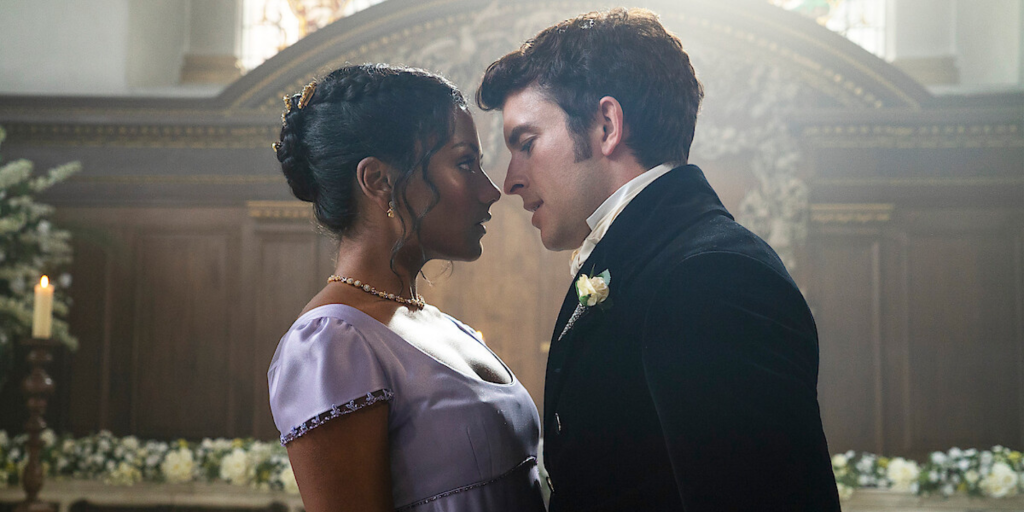
  • Bridgerton might have ruined our collective standards for romance, whether you’re in it for the pining or the gossip.

    If you’ve finished your latest binge-watch of the show, and you’re looking for that same Regency-level drama with a Nigerian twist, you’re in the right place. From village square “Cinderella” moments to the “enemies-to-lovers” wahala of Lagos high society, I’ve made a Nollywood movie watchlist that matches the vibe of your favourite Bridgerton season.

    Season 1 (The Fake Dating Trope)

    1. Flower Girl (2013)

    Running time: 1h 46m

    Director: Michelle Bello

    Genre: Romance

    Kemi (Damilola Adegbite) is a soft babe and florist who believes in two things: fresh flowers and forever. She’s been dating Umar (Chris Attoh) long enough to have mentally picked aso-ebi colours for their wedding. So when he blindsides her with a breakup, her fairytale plan collapses like a poorly tied gele.

    After crying into bouquet orders for a while, Kemi meets a Nollywood superstar, Tunde (Blossom Chukwujekwu), who fakes a relationship with her to make Umar jealous. But their calculated public appearances and curated intimacy quickly grow teeth, and their pretend love story becomes very real.

    Flower Girl is streaming on Netflix, but is unavailable in Nigeria.

    2. Reel Love (2025)

    Running time: 1h 38m

    Director: Kayode Kasum

    Genre: Romance

    Tomide (Timini Egbuson) makes a living telling the internet how to love and handle their relationships. Then a messy video of him arguing with Rachel (TJ Omusuku), a small-business owner who refuses to be talked down to, goes online, hurting his brand. When it’s time for damage control, his girlfriend, Imani (Atlanta Johnson), pitches a bold fix: stage a romance with Rachel, flood the timeline with cute photos and moments, and let the public rewrite the story.

    The plan works, but there’s a problem. The staged relationship begins to feel real. Once Imani clocks that something real is brewing between them, everything switches gears into complications, but love between Tomide and Rachel is already waxing stronger.

    Reel Love is streaming on kava.tv.

    3. Fiancé For a Day (2024)

    Running time: 1h 28m

    Director: Stanley Obi

    Genre: Romance

    In Fiancé for a Day, Emem (Omoni Oboli) and Tobi (Eso Dike) are exes who swear they’re over each other but somehow can’t stop orbiting the same drama. For family peace and breathing space, they agree to pretend they’re still together for just one day, because obviously, two exes can fake a kiss without awakening archived feelings. Obviously.

    When they reunite, the old flame is still very much alive. Their performance turns personal as a lingering desire tangles.

    Fiancé For A Day is streaming on YouTube.


    Subscribe to Zikoko Pop newsletter, The Feed, for the most important pop culture news


    Season 2 (The Enemies-to-Lovers Trope)

    4. Picture Perfect (2016)

    Running time: 1h 13m

    Director: Tope Alake

    Genre: Drama, Romance

    Kumbi (Mary Remmy Njoku) is a high-end fashion designer who lives a somewhat uptight life. Her world revolves around her sewing machine. One late night, when her car breaks down in a sketchy part of Lagos, Jobe (Bolanle Ninalowo), a notorious local area boy (tout), rescues her from a group of thugs.

    Instead of a “thank you and goodbye,” Jobe ends up setting up shop right in front of Kumbi’s workspace, blasting Fuji music and bringing his fights into her organised space. Their worlds collide, and as they spend more time together, they become friends; one thing leads to another, and a nightstand happens. The result of that single intimacy is a bouncing baby between them.

    Picture Perfect is currently unavailable to stream or watch.

    5. Foolish People (2025)

    Running time: 1h 10

    Director: Great Valentine Edochie

    Genre: Romance

    In Foolish People, we meet Phoebe (Bolaji Ogunmola) and Charles (Uzor Arukwe), two people who used to be an item but now can’t stand to be in the same room.  They’ve spent the last four years staying away from each other, until a tragic plane crash changes everything.

    Their mutual friends (who were also Phoebe’s cousins) died in the crash and left a wild request in their will: Phoebe and Charles must move into the same house to co-parent their orphaned daughter, Tabby. This surprising request neutralises the animosity between them and brings them back together as lovers.

    Foolish People is streaming on YouTube.

    6. Promised Affection (2025)

    Running time: 2h 31m

    Director: Austine Onyema

    Genre: Romance

    This movie follows Adaku (Chinenye Nnebe) and Nonso (Michael Dappah), whose mothers were once inseparable best friends. Back in the day, the moms made a sentimental pact that their children would one day marry. Fast forward to the present, and there’s just one tiny problem: Adaku and Nonso absolutely cannot stand each other. They hold deep-seated grudges, and their interactions are defined by constant bickering, yelling, and heavy-duty “side-eye” that masks an attraction that neither wants to admit.

    The drama kicks in when the mothers hatch a desperate plan to force the two together and fulfil that old promise. By the time the walls finally come down, the “enemies” phase has dragged out so much that the final romantic payoff feels like a hard-earned victory.

    Promised Affection is streaming on YouTube.


    READ NEXT: 15 Nollywood Movies To Watch If You Love Great Acting


    Season 3 (The Friends-to-Lovers Trope)

    7. Man of God (2022)

    Running time: 1h 51m

    Director: Bolanle Austen-Peters

    Genre: Romance

    In Man of God, Samuel (Akah Nnani) isn’t just wrestling with religion, career goals, and his father’s strict legacy — he’s also navigating a messy circle of women that starts off as friendly connections and turns into romance. He is friends with Joy (Atlanta Bridget Johnson) and Teju (Osas Ighodaro), two best friends who attended the same campus fellowship. Teju has a crush on Samuel, but he has his eyes on Joy.

    After Joy graduates, their relationship hits a rough patch because Samuel has an extra academic year, and she marries someone else. Samuel falls into a state of sadness, and Teju helps him get his life back on the right track. Teju’s crawl-back and involvement in his life heat up a romance that leads them to marriage and to a new, almost-perfect life as a couple in Christ.

    Watch Man of God on Netflix.

    8. Something More (2025)

    Running time: 1h 20m

    Director: Great Valentine Edochie

    Genre: Romance

    You know that friend who listens to every breakup voice note, drags your ex on your behalf, treats you better than and still shows up with shawarma when you’re crying? That’s the core of this movie. Fubara (Blossom Chukwujekwu) and Ileri (Bolaji Ogunmola) play best friends navigating the messy Nigerian dating scene. Through every romantic disaster, they stay in each other’s safe place.

    But somewhere between comforting hugs and “you deserve better” speeches, the line blurs. Before they know it, that “just friends” tag quietly expires, making room for something softer, deeper, and very real.

    Watch Something More on YouTube.

    9. Kambili: The Whole 30 Yards (2020)

    Running time: 2h

    Director: Kayode Kasum

    Genre: Romcom

    Turning 30 is staring her down, and according to her goal plan and society’s rulebook, she’s supposed to be a CEO and somebody’s wife by now. Instead, her boyfriend John (Mawuli Gavor) dumps her with the classic “not wife material” excuse, and suddenly her life starts to wobble. In her determination to rebrand into a disciplined, put-together babe, Kambili signs up for a full self-upgrade plan designed by her ever-loyal best friend, Chidi (Jide Kene Achufusi).

    There’s a checklist and rules. But while she’s busy trying to prove she’s HER, it dawns on her that she’s been overlooking the one person, her bestie, Chidi, who’s chosen her all along. Love isn’t missing; it’s been standing right beside her.

    Watch Kambili: The Whole 30 Yards on Netflix.


    Get More Zikoko Goodness in Your Mail

    Subscribe to our newsletters and never miss any of the action


    Season 4 (The Cinderella Trope)

    10. Selina (2022)

    Running time: 1h 29m

    Director: Bunmi Akingbola

    Genre: Romance

    Selina (Bimbo Ademoye) is a village food stall owner struggling to keep her head above water, pay off debts, and sponsor her younger brother’s education. When things get tighter, she takes a job as a live-in cook and cleaner for Reuben (Daniel Etim-Effiong), a wealthy guy.

    The setup is peak Cinderella: a low-class hardworking girl moves into a fancy house and starts serving a rich guy who already has a fiancée (though he’s low-key confused about that relationship). Selina brings her loud, comedic personality into Reuben’s quiet home, and naturally, the romantic chemistry begins. This is a classic story of a man who has everything but realises he’s actually missing the spice and authenticity that someone like Selina brings to the table.


    Selina is streaming on YouTube.

    11. A Lagos Love Story (2024)

    Running time: 1h 44m

    Director: Chinazam Onuzo

    Genre: Romcom

    Promise (Jemima Osunde) is an ambitious event planner, constantly juggling the extreme pressure of supporting her family with the “fake it ’til you make it” demands of Lagos high society. She’s the glue holding her world together until she crosses paths with King Kator, a rising Afrobeats sensation (Mike Afolarin).

    The moment they meet, they hit chemistry immediately. What follows is a sweet, lighthearted fantasy that replaced the stress of Lagos with just the right amount of temptation.

    Watch A Lagos Love Story on Netflix.

    12. World Apart (2004)

    Running time: 2h 38s

    Director: Tchidi Chikere

    Genre: Romance

    Uli (Ini Edo) is a village girl who moves to the big city to stay with her uncle, hoping for a better life. She’s just living her regular, everyday life when she crosses paths with Prince Promise (Kenneth Okonkwo). In true fairy-tale fashion, it’s love at first sight, but there’s a massive class barrier standing in the way of their happily ever after.

    Prince Promise knows his elite and royal parents will never agree to his marrying someone they consider local and unrefined. But instead of giving up or hiding her away, he decides to play the long game. He invests in her, upgrades her lifestyle and gives her the kind of exposure that turns a local girl into a sophisticated baddie, all before presenting her to his mother.

    Watch World Apart on YouTube.


    ALSO READ: 15 Nollywood Movies To Watch If You Love Great Acting


  • Panellists at the Zikoko Citizen Townhall 2026 have faulted the lack of active citizenship as a blocker to the collective freedom of Nigerians.

    Held on February 28th, 2026, at the Four Points by Sheraton, Lagos, the Citizen Townhall themed “Who Shapes The Nigerian Life?” featured four panel sessions that shed light on important societal and political issues affecting the average Nigerian citizen.

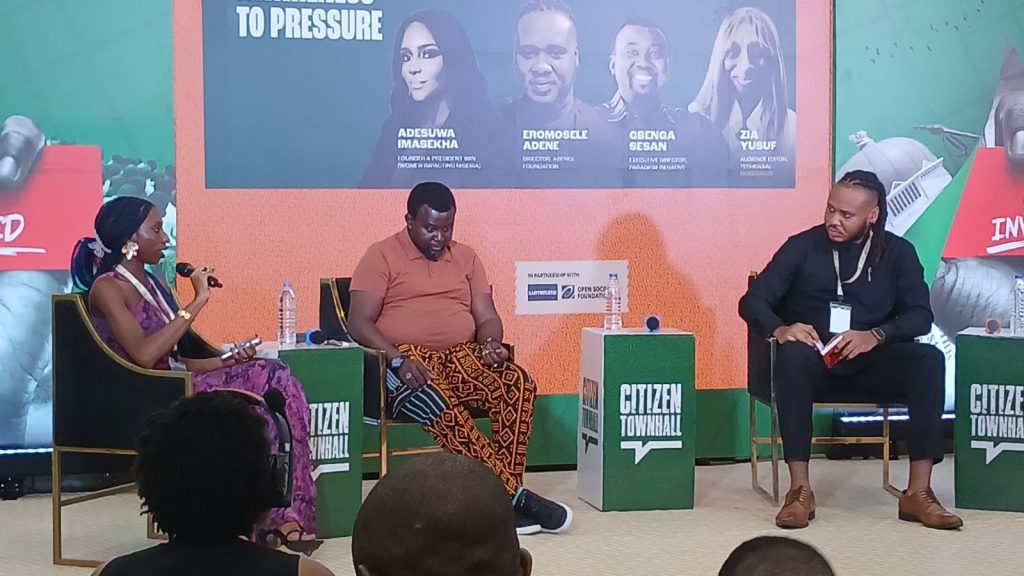
    During a panel discussion titled  “Awareness to Pressure: How Accountability Actually Works In Nigeria,” experts and activists examined why knowledge of societal issues does not necessarily translate into sustained action. Throughout the discussion which was moderated by TechCabal Audience Editor, Zia Yusuf, the panellists highlighted structural and personal challenges and emphasised the need to translate awareness into pressure. 

    One major emphasis of the panel session was the importance of stability before activism. Executive Director of Paradigm Initiative,  Gbenga Sesan, was of the firm opinion that young Nigerians must establish their personal foundations before they can properly influence systemic change in the country. “Be okay first. Nigeria will be okay if you are okay. Because if people who are not okay are trying to make a country okay, when they get their first chance to be okay, they will forget the country,” he said.

    The panel also emphasised the need to focus on a single issue to achieve great results. Sesan recalled historical campaigns that achieved significant success due to their narrow focus. “Almost all of the success stories we have today are from single focus activism,” he said, pointing to the Bring Back Our Girls movement as an example of how effective single-focused activism can be.

    The panellists went on to stress the importance of actionable information and localised civic engagement; according to them, knowledge of the actions that lead to results is as important as awareness itself. “Awareness is only noise until it’s converted to pressure,” Eromz Adene, director, Abenol Foundation, said. Citing the recently passed electoral bill, he remarked that policy makers would have bowed to pressure to change the bill if the number of protesting citizens were enough to “block cars.” 

    The audience was also encouraged to focus on elections at all levels, not just the presidency. Local government, state assemblies, and federal representatives were identified as avenues where young people can exercise meaningful influence. “Change can happen in every other election that is being held. And the more people represent us, the bigger the win for us.” Eromz said.

    The discussion also tied activism to historical precedent, showing how earlier civic actions shaped subsequent outcomes. “Every protest plants a seed,” Gbenga Sesan observed, linking the outcome of the 2015 elections to the Bring Back Our Girls movement of 2014. He also highlighted the same pattern in the 2023 elections to the  EndSARS movement of 2020. These examples, he said,  show that campaigns make a difference despite how they might look. 

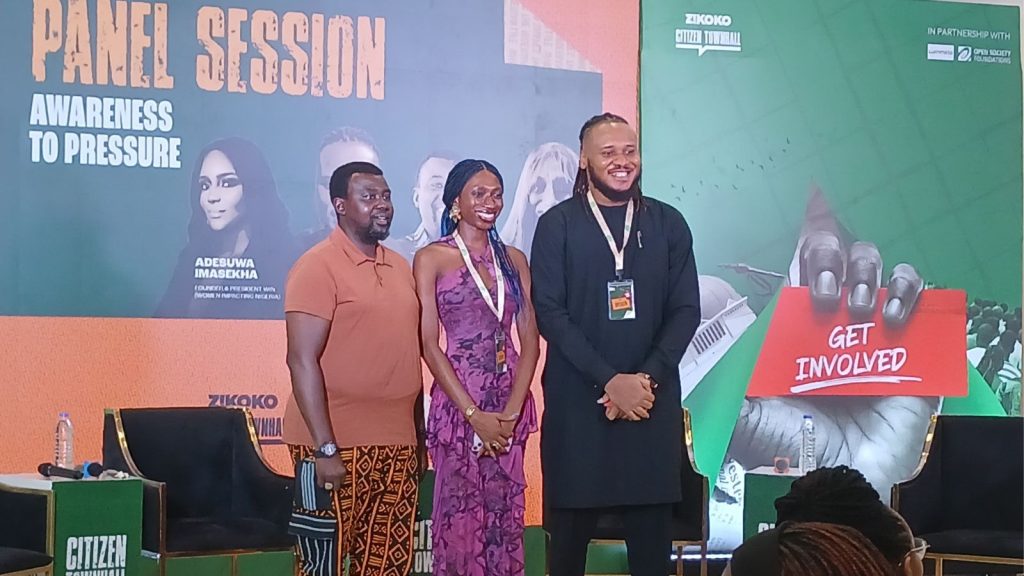
    L-R: Gbenga Sesan, Zia Yusuf, Eromz Adene

    The session closed with a reminder of the systemic challenges that persist in Nigeria, particularly selfishness among the elite. “This elite selfishness is something we need to deal with,” Sesan said, linking such selfishness to the “disdain that we have for participation in processes.” According to him, this practice causes those with influence to detach themselves from civic and institutional processes, ultimately weakening the very systems required for long-term national development. 

    Through these insightful discussions, the panel made it clear that awareness alone cannot be enough. For young and active Nigerians, the road to change requires preparation and pressure.

  • At 24, Andrew* has turned freelance writing into a global income stream, moving from a ₦20,000 factory job to earning $167,000 in five years. What began as a pandemic pivot became his ticket to a six-figure income stream. Here’s how he did it. 

    As told to Aisha Bello

    I didn’t set out to be a freelance content partner for global enterprise SaaS companies.

    I didn’t even know what freelancing meant. 

    Before 2020, I was just a teenager studying mathematics. I’d entered university at 14 and struggled, and the experience was far more overwhelming than I had envisioned. The pressure mounted quickly, and I struggled to keep up with the academic demands.

    By my final semester in 2019, I hit a wall: two carry-overs. My plan to graduate at 18 had vanished. 2020 came and brought the world to a standstill.

    While waiting to rewrite my exams, I took a job at a cosmetic factory for ₦20,000 a month. At the time, I had a work-your-way-up mindset; I figured I’d stay at the factory for 10 years, grinding until I reached the top of the 9-to-5 ladder. 

    Then, one day, in January 2020, management told all staff members to go home due to the pandemic and imminent lockdown. They never called me back.

    It felt like rejection at first. But now I know it was the best thing that could have happened to me.

    Desperate for a path forward, I pivoted to a data science internship with Hamoye. The six-month programme was highly competitive — 2,000 people vied for only 10 spots. The internship itself did not pay a monthly stipend during the training phase, but those who ranked among the top 30 at the end of the programme were eligible for entry-level roles paying around ₦150,000 a month.

    That kind of money felt like a fortune to me, considering I was making ₦20,000 at the factory. However, I didn’t make the top 10. I was somewhere around the 28th position. Something else happened during those six months, and changed my life: I started writing. 

    By the time the internship ended in September 2020, I had documented my learning journey on Medium.

    I had also built a WordPress site, where I wrote about chess. I wasn’t planning to be a writer.b I just loved chess, and I wanted to prove I could build things online.

    My First Paid Gig

    My first real gig came from a random Google search in December 2020. I found a Spanish client who needed an article about chess. When he asked for my rate, I panicked. I had no idea what to charge.

    So I Googled: “How much should I charge for an article?”

    The search results suggested £21. I converted it and asked for $25 (₦8,000 at the time). He agreed instantly. 

    I finished the work in one day. Then the realisation hit: I had just earned in 24 hours what had taken me nearly two weeks to earn at the factory.

    That was the first crack in my old mindset.

    I Asked For More, and I Hit $1,000

    Soon after, in February 2021, I used my data science internship articles as leverage and applied for an opening at a US-based agency I found on LinkedIn. They were looking for a data science content writer.

    This time, I decided to be bold. Maybe even greedy.

    I asked for $35 per 1,000 words and felt guilty, fearing I was overcharging. But they countered with an offer that stunned me. 

    They were going to pay me $200 per 1,000 words. I was eventually paid $300 per 1,500-word article. Within my first three months of freelancing, I had hit $1,000.

    I couldn’t believe anyone would pay that much for words. That was the moment my mindset shifted from “making do” to “going wild.”

    I realised the only thing keeping me small was my perception of what I was allowed to earn.

    I Was Locked in For Good

    I finally sat for my final exams in May 2021 and graduated with a second-class lower degree. But I refused to let the result define my future.

    By the end of 2021, I had made about $7,000 from freelance writing, with all my clients coming through LinkedIn, either through direct outreach or opportunities I applied for. That was when I knew I was fully committed.

    In 2022, I was running my National Youth Service in a remote village in Kogi State — teaching during the day and freelancing for four to five hours every night. I became more intentional about positioning myself on LinkedIn, speaking openly about my journey, and using my portfolio to move into new niches.

    My income began to rise steadily. By 2022, I was peaking at about $3,000 in monthly earnings and ended the year with roughly $15,000.

    In 2023, I secured a contributor role with Forbes Advisor. The credibility associated with the name was a turning point for me. With that leverage, I stopped accepting anything below $500 per article. I ended 2023 with about $35,000 in total earnings.

    The Explosion

    In 2024, I set a goal: make at least $10,000 in the year to fund my travel goals that year. 

    In May 2024, I didn’t just hit it, I doubled it, earning $28,000 in a single month.

    By the end of the year, my total earnings had hit $167,000.

    I was managing 7 to 8 clients at once and working with US-based SaaS companies valued at billions of dollars. These brands have the budget to pay monthly retainers without blinking, but only if you can prove you’re worth it.

    I also used AI tools to scale my workflow, but the strategy and execution were still largely me. The combination only allowed me to move faster than I ever had.

    The UK and What It Meant

    One of my biggest goals was to self-sponsor a Master’s degree in the UK. In 2024, I paid the £18,000 tuition in full.

    I moved in September 2024, completed my Master’s with distinction, and I’m now on a graduate visa that extends my stay in the country for another 2 years.

    Freelancing didn’t just increase my income. It expanded my options.

    My income has remained stable and upwardly mobile. My ambition now is to be one of the top ten names in content marketing — the person who gives talks, travels the world, and helps brands tell stories that drive growth.

    My Advice: Do Something Crazy

    If you are starting out and want to change your life, my advice is simple: do something crazy. The world does not favour people who try to fit the mould or stay silent about their ambitions.

    Doing something bold means being audacious enough to show your work, raise your rates before you feel fully ready. Do your work outside social media, and then use the platform to amplify it. I got to this point because I refused to believe that my background or my degree was my ceiling.

    I plan to continue doing this for another ten years, earn enough to retire comfortably, and then spend my days playing chess and travelling the world. Even as artificial intelligence evolves, the demand for human stories will never be obsolete. It will only become more valuable.


    Also Read: I Went From Earning ₦160k/Month to $7.8k Working Remotely. Here’s How I Flipped My Career and Income


    Get More Zikoko Goodness in Your Mail

    Subscribe to our newsletters and never miss any of the action

  • Wondering what you should watch next on Netflix? Scrolling through Netflix looking for what to watch can feel like digging through a bottomless pit. But no worries, we’ve done the filtering for you. This is a list of the best Nollywood movies to watch on Netflix right now.

    1. Sisi London (2019)

    Running time: 1h 22m

    Director: Omoni Oboli

    Genre: Comedy

    This comedy throws viewers into the middle of a messy war between Philo (Chioma Akpotha), a sharp-tongued, no-nonsense wife, and Cecilia (Omoni Oboli), a flashy returnee from “London” whose fake accent is only the beginning of her drama. When Cecilia decides she wants Philo’s wealthy husband for herself, all hell breaks loose.

    Watch Sisi London on Netflix.

    2. Deja Vu (2022)

    Running time: 1h 27m

    Director: Elijah Tolulope Rotimi

    Genre: Drama

    Deja Vu follows Johnson (Lateef Adedimeji), a devoted husband and father whose world shatters after a routine DNA test reveals that neither of his children is his biological child. Meanwhile, his wife (Adebimpe Oyebade Adedimeji) insists she’s never cheated, forcing the family into a tense search for the truth. 

    Watch Deja Vu on Netflix. 

    3. One Too Many (2022)

    Running time: 1h 30m

    Director: Kayode Kasum

    Genre: Drama

    This film follows Otas (Chimezie Imo), a bright young man on his way to NYSC camp with friends, when a tragic accident leaves one of them dead, and Otas is wrongfully accused of murder. After he’s thrown into prison, his mother, Adesuwa (Dakore Egbuson-Akande), is forced to confront a deeply personal trauma of her own involvement in police brutality years ago. 

    Watch One Too Many on Netflix. 

    4. Ijakumo: The Born Again Stripper (2023)

    Running time: 2h
    Director: Adebayo Tijani

    Genre: Drama

    Pastor Jide (Kunle Remi) is a wealthy, flamboyant pastor who leads a double life. To his congregation, he is a pious man. But behind this carefully crafted image, he is a member of a clandestine organisation called The Syndicate, engaged in sinful acts. Everything is going fine until he falls for an exotic dancer in his congregation who turns out to be his ruin.

    Watch Ijakumo: The Born Again Stripper on Netflix. 

    5. Tokunbo (2024) 

    Running time: 2h 13m
    Director: Tope Adebayo, Adebayo Tijani

    Genre: Drama

    Directed by the acclaimed actor-turned-director, Ramsey Nouah, Tokunbo follows a repentant car smuggler (Gideon Okeke) trying to leave the world of crime behind, only to be pulled back in when he unknowingly finds himself entangled in a deadly kidnapping mission.

    Watch Tokunbo on Netflix. 

    6. The Black Book (2023)

    Running time: 2h 4m
    Director: Editi Effiong

    Genre: Thriller 

    In many ways, The Black Book is Nigeria’s version of John Wick. It follows a deacon (Richard Mofe-Damijo) with a dark military past who goes on a rampage to clear his son’s name after his son is framed and killed by corrupt policemen.

    Watch The Black Book on Netflix. 

    7. Thinline (2024) 

    Running time: 2h 4m
    Director: Adeoluwa Owu

    Genre: Thriller 

    Pastor Raymond Njoku (Uzor Arukwe), a respected man of God, finds himself in a precarious relationship with Annabelle Coker (Uche Montana), a manipulative prostitute. Unable to deal with the guilt, he finally confesses to his wife (Mercy Aigbe). In a shocking turn of events, Annabelle is found dead in her apartment, making the situation a lot more complex.

    Watch Thinline on Netflix. 

    8. Son of the Soil (2025)

    Running time: 1h 46m
    Director: Chee Keoung Cheoung 

    Genre: Thriller 

    Zion Ladejo (Razaaq Adoti), a former soldier who has spent most of his life in the US, returns to Nigeria after the death of his sister, Ronke (Sharon Rotimi), a hotel staff member who mistakenly witnessed a murder. In a bid to discover those responsible, Zion finds himself returning to a past he thought he had left behind. 

    Watch Son of the Soil on Netflix. 

    9. Blood Vessel (2023)

    Running time: 2h 4m
    Director: Moses Inwang

    Genre: Thriller 

    The film is set against the backdrop of the Niger Delta Oil Conflict. It follows six young men trying to flee their troubled town on a cargo ship laden with stolen crude oil, but their bid for freedom turns into a desperate fight for survival against a ruthless captain and the horrors of the sea. 

    Watch Blood Vessel on Netflix. 

    10. A Lagos Love Story (2025)

    Running time: 1h 58m
    Director: Chinaza Onuzo

    Genre: Romance, Comedy 

    Promise Quest (Jemima Osunde) is an aspiring event planner determined to save her family home from foreclosure. When she’s tasked with managing Afrobeats superstar King Kator (Mike Afolarin) for the Lagos Art and Culture festival, their worlds collide in the most unlikely way.

    Watch A Lagos Love Story on Netflix. 


    ALSO READ: 15 Nollywood Movies To Watch If You Love Great Acting

    Get More Zikoko Goodness in Your Mail

    Subscribe to our newsletters and never miss any of the action

  • There is a kind of courage that doesn’t necessarily come with a Wonder Woman costume. It shows up quietly, in a bedroom, in a text message or a voice that’s trying not to shake as they ask the person they like, love or are about to sleep with to go and get tested for sexually transmitted infections. Four women tell us about their experience with this courage.

    1. “I Asked Him While We Were Eating Suya” – Mayowa*, 27

    I had been seeing this man for about six weeks when I decided to have a conversation with him about getting tested before sex. I thought long and hard about it and decided not to do it over the phone. I waited until one night when we were eating suya on the road, and then I asked him like it was the most normal thing in the world (which it is).

    I just said, hey, I really like where this is going, and I want us to be intentional about it. Can we both get tested before we take things further? I said it casually between bites, as if I was suggesting that we try a new restaurant. He looked at me for a second and said, “Okay, where do we go?”

    I believe that the suya must have helped. No one wants to be serious and confrontational when there is meat in their hand. He was relaxed, I was too, and that just worked. My advice is don’t make it a big speech or sit him down with a morbidly serious face. Make it feel like that’s the next step to take naturally, because it is. Testing together is just two adults being adults, and if you talk about it like that, most reasonable people will have no issues with that.

    2. “He Shouted At Me and Said I Had Trust Issues” – Moyo*, 30

    I asked my boyfriend at the time, a man that I had been with for four months, whether he could get tested before having unprotected sex. I even said please, but he wasn’t having it at all.

    He said I was calling him dirty, that if I trusted him, I wouldn’t need to ask. He then swore that he had never had an infection before and couldn’t embarrass himself at the clinic because of my trust issues. I proceeded to ask him why proving it was a problem if he was so sure that he was clean.

    He didn’t have a good answer, but he accused me of being difficult. Honestly, I was just being careful. We went at it for over an hour until he agreed to go, mostly to prove a point. The results came back fine, but I felt different about him.

    I kept thinking… if this is how he reacts to a basic conversation like this, how can we have even harder conversations down the line? He also sounded like all those ‘you’re emasculating me’ kind of men. He was picking his ego over my safety.

    We broke up two months later because I believed that asking for the test showed me who he really was under pressure.

    Get More Zikoko Goodness in Your Mail

    Subscribe to our newsletters and never miss any of the action

    3. “I Couldn’t Believe He’d Be So Straightforward About It ” – Tamilore*, 25

    I genuinely didn’t think it would go well, so I prepared myself for pushback, thought about different responses and a quick exit route if things went south. Turns out, I didn’t need any of that. When I told my man that I wanted us to go for tests before sleeping together, he said, “That makes sense. Let me know when so I can clear up my schedule in advance.”

    I almost didn’t know what to do. I had been so ready for a fight that his response actually stumped me for a moment. I kept waiting for some sort of disagreement, but it never came.” We went together on a Saturday morning, grabbed breakfast after and turned it into a cute outing.

    That day was when I realised that he was different. We’ve been together for two years.

    4. “I Didn’t Ask, So He Didn’t Tell Me He Had STIs” – Sekinat*, 32

    I was 26, and I really believed that being in love meant trust. I took that to mean that I didn’t need to ask uncomfortable questions. The man was gentle and attentive; I didn’t want to ruin the relationship by making him feel accused of something, so I didn’t ask.

    A few months later, I found out that I had contracted an STI. When I asked him about it, he told me that he had known that he needed to get checked but had been avoiding it. I’m not angry at him anymore; I’m just sorry for the younger me who felt like asking for protection was the same as not believing in the person. Those are two different things. I get tested regularly now; I ask every partner, early and clearly, to do the same.

    The conversation may feel awkward for 5 minutes max, but if you don’t ask at all, the consequences are happy to follow you for way longer than that. So please, just ask before your feelings get in the way.

    It’s so common to hear people talking about having chemistry with their partners, having fun and feeling connected, but there’s a version of intimacy that is more important. It’s the intimacy of telling someone that you care enough about both of you to have a conversation about STIs. It’s certainly not romantic in the way movies talk about love, but it’s real, and it matters. Ask your partner to get tested today.


    HERtitude 2026 is happening this April, and the theme is Main Character Energy. Get your tickets here: hertitude.zikoko.com

  • At the just concluded Citizen Townhall 2026, experts strongly challenged the existence of ‘the good old days’ in Nigeria’s history, emphasising critical thinking and active citizenship in creating what many thought had existed.

    The Citizen Townhall, organised by Zikoko Citizen on 28th February 2026, saw over 200 Nigerians gather at the Four Points by Sheraton in Lagos to engage with the theme “Who Shapes The Nigerian Life?”

    During the panel session titled The Nigerian Life–Then, Now, and What Changed, historians, data analysts, and policy experts dissected the structural failings that have led to a perennial sense of crisis. Moderated by BBC Africa Broadcast journalist Chiamaka Dike, the conversation quickly moved beyond simple nostalgia, identifying the 1970s as a pivotal era that established many of the country’s current institutional weaknesses.

    Control Risks senior analyst, Joachim MacEbong, opened the dialogue by identifying the 1970s as the closest approximation to a golden era, though he noted it was a product of circumstance rather than sustainable planning. 

    “For me, I think that as far as Nigeria is concerned, the closest thing that Nigeria has to the good old days is the 1970s,” MacEbong remarked, attributing this sentiment to sky-high oil prices and a smaller population. 

    However, he noted that this period also sowed the seeds of future instability. “The biggest problem is the human capital development crisis… that cycle began in the 70s with the purge of the civil service.”

    Adesuwa Giwa-Osagie, an anchor and national correspondent on Arise News, challenged the very concept of a “golden age,” suggesting that the perception of a better past is merely a reflection of a deteriorating present. 

    “There is no such thing as the good old days,” she said. “It’s been consistently getting worse.” She posited that the issues facing Nigeria today—corruption and lack of maintenance—are not new but are “bad behaviour recreating itself and building on itself over the last couple of years.” 

    Giwa-Osagie further urged citizens to stop personalising institutional failures and start holding local authorities accountable.

    Ayomide Akinbode, Founder of HistoryVille, provided a historical breakdown of how policy shifts fundamentally altered the trajectory of the Nigerian youth. 

    He contrasted the early post-independence era, where “politicians improve the youth [and] see them as the future,” with the subsequent military era. “The military men came and said, ‘you are our boys now,’” Akinbode explained, noting that programmes like the National Youth Service Corps (NYSC) and the War Against Indiscipline (WAI) were designed to “discipline” rather than empower. He argued that this shift led to a modern era in which “present politicians manage” the youth to prevent unrest rather than fostering growth. 

    Akinbode attributed the failure of various government interventions to the lack of institutional permanence. “Institutions should not be based on the mood of the president or the mood of the political party,” he stated, adding that “our policies are good on paper, but to implement them is so hard or maybe impossible.”

    Speaking further, Akinbode called for systemic change through consistent civic participation, as it’s the people, not “lucky technocrats,” who will ultimately ensure the success of policies.

    L-R: Ayomide Akinbode, Adesuwa Giwa-Osagie, Chiamaka Dike, Joachim MacEbong.

    The panel ended with a direct appeal from MacEbong, who warned that the status quo would remain without sustained engagement over multiple election cycles. “If you guys don’t go out to the polls in 2027, nothing is going to change here,” he said. 

    The consensus among the speakers was that while the “good old days” may be a ghost of high oil prices and lower populations, the path to a functional future requires moving away from the “hustle” of managing crises toward the hard work of building institutions that can survive the whims of any single leader.

  • GridLocked is a daily pop culture guessing game built for Nigerians. Every weekday by 9am, you’ll get six clues, sixty seconds, and an answer only a Nigerian would know.


    Today’s GridLocked is a TV show.

    How many clues do you need to get it right? 👀

    Share your result when done, but don’t spoil the answer for others. (Missed yesterday’s GridLocked? Play it here.)

    3 March 2026

    Come back every weekday by 9am for a new grid or subscribe to Z Daily, Zikoko’s daily newsletter, to get new GridLocked puzzles, real Nigerian stories and other fun content in your inbox.


    How to Play GridLocked

    • The Goal: Guess the answer for the day before time runs out. (The answer could be a Nigerian person, place, song, movie, or even slang.)
    • The Lock: You cannot type a guess until you have revealed at least one tile (clue).
    • The Reveal: Tap any tile to reveal a clue. Every clue describes the answer for the day. The fewer tiles you flip, the better.
    • The Clock: You have 60 seconds to guess right. The timer starts the moment you flip your first tile. (You get multiple guesses.)

    The GridLocked Squares: What Do They Mean?

    When the game ends, you see your guess count, total time spent, and the number of tiles flipped. The tiles are shown as white and purple squares.

    • ⬜ (White) = A tile you flipped
    • 🟪 (Purple) = A tile you left closed

    The fewer white tiles you have, the better your result.

    • Best Result = ⬜🟪🟪🟪🟪🟪 | Guesses: 1 (Only needed one clue and one guess to get it right)
  • Mide* (26) didn’t expect dating to get more complicated after moving from an unsatisfying relationship to fully owning her pleasure. What began as curiosity has now affected how she experiences intimacy and attraction.

    In this story, she opens up about her romantic journey and the struggle to find an emotional connection.

    What’s your current relationship status, and how do you feel about it?

    I’ve been single for a while because I’ve become less sexually attracted to people. It’s not a good thing, and it has affected how I approach dating and relationships.

    How so? Walk me through 

    My first relationship started in 2018 shortly after I got into university. I was in my second year when I met Damilare*. I’d never dated seriously before him, so everything about that relationship felt like an introduction to a new world. He was my first sexual partner. At the time, I thought our relationship was perfect because I had nothing else to compare it to.

    But the truth is, I didn’t really enjoy sex. People talked about women having orgasms, but I never experienced that. Foreplay didn’t do much for me, and sex felt painful in the beginning. I liked the idea of lovemaking more than the experience. It always felt like he enjoyed it far more than I did.

    That continued until we eventually ended the relationship during COVID. He was already a bad texter and would disappear for days without explanation, then return with excuses.

    I constantly begged for attention. I’d triple-text just to get a response. Eventually, I became exhausted. Ending the relationship was difficult, but I realised I didn’t want that dynamic for myself anymore.

    Right. What happened next?

    After lockdown eased and we prepared to return to school, I realised I missed sex. I didn’t want to go back to my ex, so I  tried something different.

    I ordered my first self-pleasure toy, a rose. People raved about it on TikTok at the time, and curiosity got the better of me.

    I’ll never forget the first time I used it. I orgasmed for the first time within minutes and almost cried because it was so overwhelming. During the two years I’d been sexually active, I’d never felt anything close to it. That was when I realised I’d been missing out.

    For the first few months, I couldn’t use it often because I was either home with family or in my school hostel, and both places offered little privacy. But once I moved out in my final year and started living alone at the end of 2021, everything changed.

    Living alone gave me control over my body in a way I’d never experienced before. I started using it frequently and eventually bought a dildo as well. I felt sexually satisfied in a way I’d never experienced with a partner, although I sometimes missed the intimacy of a relationship.

    Get More Zikoko Goodness in Your Mail

    Subscribe to our newsletters and never miss any of the action

    Did you eventually meet someone new?

    Yes. In 2022, I met Sam* through a mutual friend. We became friends first, and I liked how calm and kind he was. He felt very different from my ex.

    We grew closer naturally, realised we had feelings for each other, and he eventually asked me out. The early days were sweet, but it didn’t take long to realise we weren’t sexually compatible. After almost a year of exploring my body and understanding what gave me pleasure, I struggled with how mechanical sex felt with him. He didn’t really go out of his way to stimulate or please me.

    Did you talk to him about it?

    Conversations around pleasure or sex toys weren’t very open, so I didn’t know how to express myself without sounding like a freak.

    I indirectly asked how he felt about trying new things together, but he was very conservative about sex. Once, I suggested we watch porn together to explore ideas, and his reaction made me shut down immediately. He interpreted it as me saying he wasn’t good enough.

    I didn’t want to hurt his ego, so I handled my orgasms privately with my toys afterwards. I couldn’t even tell him because I feared he’d cut me off or tell our mutual friends.

    He was also very traditional and talked about marriage and settling down immediately after graduation because his parents married young.

    I wasn’t ready for that. I planned to break up with him, but kept postponing it because he was a nice person. I stayed stuck in that loop until I met John* in August 2022.

    Tell me about John.

    I met him after my final exams when I went home a few months before convocation. He was a corper working at the Medicare across the street. We chatted a few times when I visited, then exchanged numbers.

    John flirted with me, and I enjoyed the attention. What surprised me most was how comfortable he felt discussing sex. I decided to be honest about my experiences, and he was completely open-minded.

    He talked about his experiments and past experiences without shame. It felt refreshing and exciting.

    We started spending more time together and eventually hooked up. Sex with John felt completely different. We used toys, and he paid close attention to my pleasure. We experimented with role play, bondage, and other things. It was intense and addictive.


    Read Also: My Fiancé Abandoned Me During Childbirth


    Were you still with Sam at this point?

    Yes, technically. But emotionally, I’d already checked out. Our communication had faded, and the affection was gone.

    During convocation, about two months after meeting John, Sam and I hooked up one last time. That was when I realised I was done. Ending the relationship was easy after that.

    With Sam out of the way, I developed deeper feelings for John, even though he’d been clear from the beginning that he didn’t want a relationship. Whenever I hinted at it, he’d say that what we had worked perfectly and that a relationship would ruin things. I believed him because the connection felt so intense, but I soon noticed his red flags.

    What red flags?

    He was very controlling. At first, I interpreted it as dominance, which excited me. Over time, it became exhausting. He seized my toys because he preferred keeping them so we’d only use them together.  It was cute at first, but I eventually wanted the toys back because I didn’t want to always wait till we saw each other.

    When he refused to return it, I bought new ones. I mentioned it, and he got upset, asking me to hand them over, or he’d cut me off. That should have been my warning sign, but I liked him too much to leave.

    One day in April 2023, I planned to visit him as usual, but he told me not to come because he had a visitor. I suggested coming the next afternoon instead, but he insisted I come in the evening and refused to explain further. My curiosity won, so I went that afternoon anyway and waited nearby until I saw another woman leave his house.

    When I confronted him, he reminded me that we weren’t exclusive.

    Ouch. 

    He claimed she was just a friend who needed a place to stay while visiting the city. He admitted they’d slept together, though he said it wasn’t planned. We had been seeing each other for almost eight months at that point, so hearing that shocked me.

    I was devastated, but as he said, he never promised commitment or clearly defined our relationship. I cried for days but still stayed, convincing myself that if I couldn’t make him date me, I’d eventually leave once I met someone else.

    A few weeks later, I checked his phone and realised she was actually his long-term girlfriend. What hurt most was seeing how affectionate and gentle he was with her. I realised I was getting a different version of him and serving as his placeholder.

    Did you leave immediately after that?

    No. I stayed another month. When his service year was ending and he was preparing to leave, I decided to end things. He didn’t fight for me to stay, which hurt deeply because by then I was in love with him. I eventually blocked him in June 2023 so I could move on.

    How did you cope afterwards?

    I turned to my toys. They became my comfort, and I hardly went a day without using them. After more than a year of that pattern, I started to worry. 

    I realised I’d become emotionally disconnected. Sex was the only thing I wanted, and I could get it without the complications of relationships.

    Hmm. Did you try dating again?

    Yes, but it hasn’t felt the same. I met a guy through work early last year. We went on a few dates and had great chemistry, but when we finally had sex, I zoned out. I didn’t want him touching me, even though he hadn’t done anything wrong.

    The experience felt underwhelming compared to what I’d become used to. Afterwards, he said he felt I was disgusted by him, which wasn’t true. I just couldn’t explain what was happening to me.

    After reading more, I realised I might have grown too attached to the control and consistency my toys offer. With them, everything works exactly how I want. Human connection isn’t that predictable.

    Since the start of the year, I’ve reduced how often I use them. Now I use them a few times a week instead of daily. I’ve joined dating apps, and I’m trying to connect with people on a more emotional level. It’s difficult because many people still approach dating primarily for sex, but I’m hopeful things will change.

    So, how have these experiences shaped your idea of love and relationships?

    I’ve learned that human connection can’t really be replaced. Pleasure matters, but it isn’t everything. I still hope to meet someone who accepts my openness about pleasure while I work on building a healthier balance.

    Finally, how are the streets treating you these days? Rate it on a scale of 1 to 10.

    I’d give it a 6/10. I don’t hate being single, but I’ve started craving companionship more intensely.


    Zikoko’s HERtitude is back this April 2026. Grab your tickets here: hertitude.zikoko.com