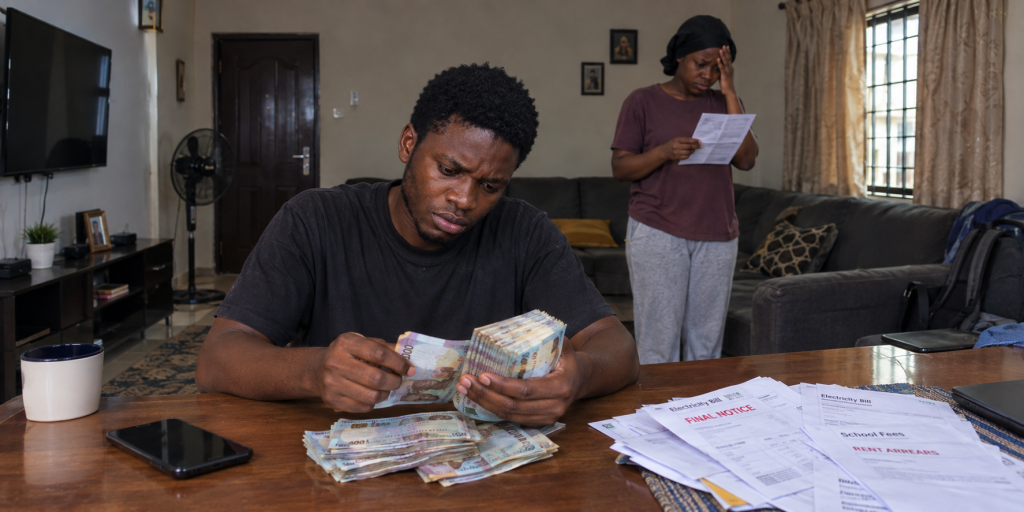
• Every week, Zikoko seeks to understand how people move the Naira in and out of their lives. Some stories will be struggle-ish, others will be bougie. All the time, it’ll be revealing.


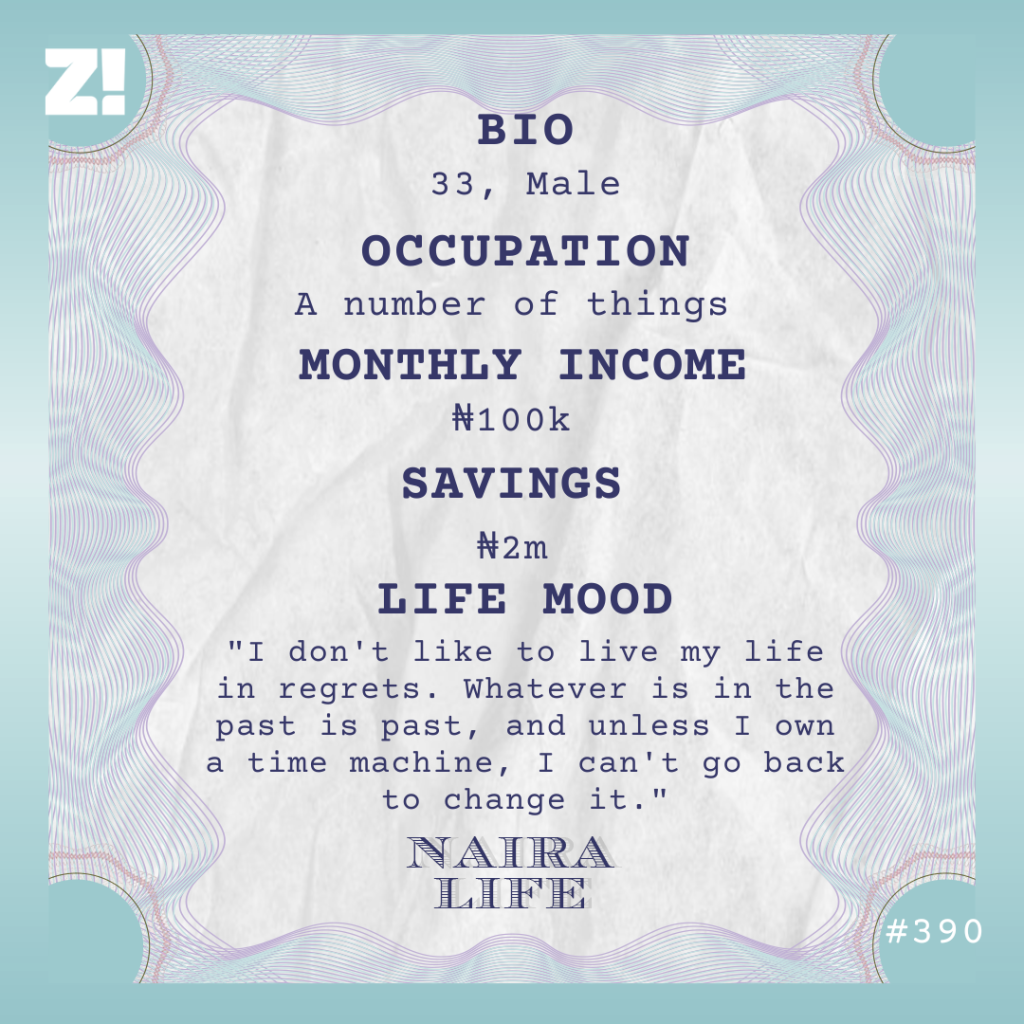
    NairaLife #358 bio

    What’s your earliest memory of money?

    Watching my classmates in primary school buy biscuits and snacks at lunchtime, and feeling left out because I couldn’t do the same. My parents always gave me home-cooked meals to take to school. Whenever I asked why I couldn’t buy biscuits in school, they’d go, “Oh, there’s no money”, or “Money has finished.” 

    What was the financial situation at home like growing up?

    It was crazy. My parents were civil servants and worked with the local government. I have four older siblings, who were in secondary school and university. That meant that the already insufficient money mostly went to their education. 

    For context, my parents’ combined salaries were just about ₦30k/month. This was around 2013/2014, so it wasn’t that far back. We could barely afford the necessities. The most my dad could do was pay your school fees, while each child figured out the rest themselves.

    Tough. Do you remember the first time you did something to earn money?

    Yes. I was 14, and my dad gave me ₦70k for the WAEC registration fee to pay at the bank. He gave me the money on a Friday, so I left the money in my room, intending to take it to the bank on Monday. Monday came, and half of the money had disappeared.

    When I told my dad, he said, “I gave you the money, so go and look for it.” But the money was gone. The only thing I could do was find a way to work and make it back.

    Wait first. How did the money disappear?

    A cousin was staying with us, and he was the only other person with access to my room. We asked him, but he denied it. My dad believed I had spent the money, so he told me to go find it myself. 

    I had to work as a labourer on a construction site for 10 days — earning between ₦3k and ₦5k daily —  to make that money back and register for WAEC. The work was so stressful, and I’m not sure how I survived it. 

    The next opportunity to make money came during the waiting period between JAMB and university admission. I should’ve resumed uni in 2021/2022, but several strike-related delays pushed my resumption to 2023. While I waited, I tried my hand at several things.

    Tell me about them

    First, I taught for two terms in a primary school that paid me ₦7k/month. Next, I worked with an agency that placed me at a hotel. My salary was ₦20k/month, but the agency I came through took half of that for the first three months. Thankfully, I often made close to my salary in tips, so I didn’t really feel the difference. I worked there for 8 months.

    After I left, I took up learning digital marketing and social media management. I found a couple of free courses online and just decided to give them a try. Three months into learning, I got my first client. The person paid me ₦10k plus a ₦2k monthly data stipend to manage their Facebook business page. I did that for about four months and left in August 2022. I resumed uni in January 2023.

    Get More Zikoko Goodness in Your Mail

    Subscribe to our newsletters and never miss any of the action

    Did you try to find other clients when you got into uni?

    I didn’t. I realised digital marketing wasn’t my thing. I didn’t enjoy doing it, so I didn’t push for more work. Instead, I started learning how to code.

    I actually started in November 2022 at a training centre. Tuition was about ₦350k, which I didn’t have. So, I came to an agreement with them instead: I’d work for them as a digital marketing tutor in exchange for my coding classes. 

    They agreed, and I sort of “speed learned” frontend and backend development in two months before I resumed school. I also watched a lot of YouTube tutorials. I learned really fast and actually enjoyed what I was doing. 

    I got to school, and everything changed.

    How so?

    Life happened. My dad had retired, and my brother was paying my school fees. There wasn’t enough money to go around, so I struggled to survive. I lived in a church because I couldn’t afford accommodation. I didn’t starve during that period because I’d help a church member out in her cyber cafe, and she’d buy me food. 

    Since I lived in a church, there was often no light and no internet. My phone, which I’d been holding together with rubber bands, also spoiled during that period. It was a lot. I didn’t even remember coding. 

    Thankfully, I found a ray of hope. I randomly helped a faculty officer fix a notification issue on her phone, and she said, “I’ll give you a job.” Right there, she connected me with her friend looking for a computer teacher for her kids. That job paid me ₦15k/month and was my primary source of income for most of 2023. The pay increased to ₦25k towards the end of the year. 

    Was that good money at the time?

    Not really. It was better than nothing, but transportation costs often took up more than 50% of my pay. To be honest, I began considering learning Yahoo (internet fraud) at some point. I actually took steps to learn it during a three-week school break. 

    I contacted someone who was into it, and he told me to come to his house for lessons. Interestingly, the guy didn’t teach me anything. He left me at his house for three weeks and travelled. He wasn’t even taking my calls.

    While I was there, I thought, “I already know how to code. Isn’t it better for me to go back to that?” So, I started looking for opportunities. Within a week, I saw one on Facebook, applied, and got hired to write backend code. The ₦20k pay was terrible, but I took it. 

    The money funded my trip back to school, and it gave me a renewed conviction: If coding could give me ₦20k, it could give me more.

    Love the energy

    The same client called me a few weeks later to ask how much it’d cost to build a landing page. I didn’t know how much to charge, so I just said ₦70k. After some negotiations, we settled on ₦60k, and he sent the money immediately.

    I remember seeing the credit alert in class. I was so shocked. I couldn’t even hear anything the lecturer said. In fact, I stood up and left the class.

    Skrimm

    After I completed the gig, the client put me on a ₦10k/month retainer for site maintenance. This happened between September and November 2023. That money helped me sort out my accommodation issues. I rented a one-room apartment and stopped sleeping in church. 

    That same November, I got a content writing role for a new web3 platform. The payment arrangement was quite funny. Initially, they agreed to a $150 monthly base pay (about ₦105k at the time) plus $5 per interaction on each writer’s articles. They only kept to that in the first month. 

    In December, they reduced base pay to $75 and the extra incentive for interactions to $2. By January 2024, they removed the base pay entirely and cut down incentives to $1, meaning writers had to hustle for interactions to make money. I eventually left in February — I preferred coding to writing anyway.

    Still, I can’t forget how I felt when I got that first payment from them. I think it was about ₦150k. Crazy thoughts immediately filled my head. I started considering upgrading my phone. Ultimately, sanity prevailed. I settled all my outstanding school bills before doing anything else.

    Thank goodness. What did you do after leaving the writing job?

    I randomly met someone at a workspace, and we talked about some work he was doing. I left that conversation with a job as a full-stack developer for a startup. My salary was ₦70k/month.

    At this point, I was juggling multiple things. I was still tutoring at the training centre occasionally, plus the computer lesson gig, which I fully stopped in February. In March, I took on an additional frontend engineering role at my workspace. I still work there today, but I don’t get paid. It’s essentially a startup, and they can’t afford to pay. 

    I took the job in exchange for free access to the workspace and the co-founders. I’m particular about that connection to the co-founders. They’re doing big things in tech, and I wanted to be in that network. Interestingly, my proximity to them has given me a few opportunities to make money, so that’s great.

    What kind of opportunities?

    I took on another role with an international company in April 2024. I started as an open source contributor and eventually moved to a contract position in developer relations in November. As a contributor, I averaged between $600 and $ 1,000 per month (around ₦1m to ₦1.5m). When they changed it to a contract position, my income increased to an average of ₦2.5m – ₦3m per month.

    This was my primary source of income at this point. I’d left the ₦70k startup role when they folded in August. I still worked at the workspace, but this was the only job paying me.

    I’m sure it helped that the pay wasn’t bad at all

    Oh, it wasn’t. It was good money. I even stopped attending classes because I focused on making money.

    I was relieved from the contract role in January 2025. While I could have continued working as an open source contributor, I decided to leave for two reasons. One, I was starting my fourth year and my grades were crying. I was barely hanging on. So, I decided to take a break from work to improve my grades.

    Secondly, I wanted to learn AI engineering.

    Any reason why?

    I want to be at the forefront of things. There are millions of full-stack engineers in the world, and with the way Artificial Intelligence is going, I’d have more career prospects with AI engineering. Also, it seemed fun, like something I could work on for hours and get satisfaction from my job.  

    So, between January and September 2025, I was an unemployed student, living on my savings and studying AI engineering.

    What did these savings look like?

    My living expenses didn’t really change when my income grew to millions, so I was just saving. By that January, I had about ₦20m saved up. 

    Besides surviving on my savings, I made a couple of big expenses during that nine-month period. I spent ₦700k on moving to a new apartment (rent and agent’s fee), supported my brother’s relocation to the UK with almost ₦10m, and contributed around ₦2m – ₦3m to renovating my dad’s house. 

    I also spent money on a few other things, like new furniture and appliances for my new apartment, a phone, and an international trip in September. I made the trip to attend a three-day gathering of company CEOs, Blockchain founders, VC investors and the like. At 19, I was the youngest person there, but I interacted with multiple people. I was just networking everywhere. 

    On the last day, a company approached me and offered me a role as a full-stack/AI engineer for $250/month (about ₦362k). In December, I got a slight pay increase to $400 (around ₦580k). I also got another $800/month backend engineer job in December. So, I currently work two jobs, bringing my total income to about ₦1.7m/month. 

    ₦1.7m is impressive, but do you ever feel like you took a pay cut to transition?

    Oh, definitely. It feels really weird coming from previous roles where I was paid more to do much less. But I had run out of my financial runway, and I needed to get another income source fast. 

    That said, I do feel like I’m slowly entering my desired field. I work with an impressively cracked team, and my career prospects look promising.

    Love it for you. How has your income growth over the years impacted how you see money?

    Money is a tool to make life better. My income growth has changed the level of comfort I can afford. Coming from someone who used to sleep in a church to being someone who can save enough to afford an international trip. I know money comes and goes, but when you have it, it can literally change your life, as well as everyone around you.

    I’m not going to lie, it has been crazy, though. Achieving all I have at 20, I didn’t know it could happen this fast. My financial situation has now allowed my mindset to grow far beyond most people in my age group.

    For instance, my classmates are mostly thinking about NYSC, what will come next after uni, and what to do with their certificates. My mind is on a different plane. I’m thinking about the next big move for my career. I recently interviewed with one of the biggest AI companies in the world. The only reason I didn’t get the role was that I don’t live in San Francisco.

    Sometimes, my growth feels intimidating. Other times, I have the tendency to think, “I’ve come so far. I’m not your mate.” But I deliberately try to remain humble. I haven’t come this far by my strength alone. Most of the moves I’ve recorded came unexpectedly. I just happened to be in the right situations where favour found me.

    How would you describe your spending habits and relationship with money?

    I live below my means as much as possible. I try to rationalise my purchases by assessing if it’ll be an essential part of my life and if I really need it.

    I also spend money to improve my life. For instance, commuting from my campus to town by commercial transport costs approximately ₦5k. But I’ve been profiled and harassed by police officers a few times, so I prefer to spend ₦35k – ₦40k on private cabs just to avoid that. 

    When I’m not spending on essentials, I’m mostly saving and investing my money. I have a 20% – 20% approach to both savings and investments every month, but the latter is mostly money I can forget. If I look at my monthly expenses and don’t have much left, I forego investments.

    What does your portfolio look like now?

    I have about ₦1.5m in Nigerian and US stocks. I’m just trying to rebuild my savings after exhausting them in 2025, so there’s not much happening there right now. My major focus this year is to build my savings to around ₦40m – ₦50m. It might not happen this year, but I plan to at least be on track for that figure.

    Let’s break down your typical monthly expenses

    Nairalife #358 expenses

    Is there an ideal amount you think you should be earning monthly?

    I want to earn at least $10k/month. That’s another major goal for this year. 

    What do the next few years look like for you?

    Graduating from uni and possibly relocating out of Nigeria. That’ll bring me closer to my goal of working with major AI companies. I also want to travel more.

    Is there anything you want right now but can’t afford?

    A 2022 Honda Accord. It’d cost me about ₦45m.

    How would you rate your financial happiness on a scale of 1-10?

    6. I’m good right now, but I want more. There’s always room for improvement.


    If you’re interested in talking about your Naira Life story, this is a good place to start.

    Find all the past Naira Life stories here.

    Subscribe to the newsletter here.

  • The Nigerian experience is physical, emotional, and sometimes international. No one knows it better than our features on #TheAbroadLife, a series where we detail and explore Nigerian experiences while living abroad. 


    Caleb* (25) moved to the US eight years ago to pursue dreams of making it big in tech. In this story, he shares his experiences, how scary it is to realise you’re the minority in a new country, and why he can’t visit Nigeria until Trump’s presidency ends.

    This model is not affiliated with the story in any way

    Where do you live currently, and when did you leave Nigeria?

    I currently live in Texas in the United States (US). I left Nigeria in 2018.

    What inspired you to leave?

    I had a particular dream for myself. I always wanted to work in tech, and I saw that the best opportunities for me would be to leave the country for the best education. Luckily, my parents were supportive and were able to provide the funds for me to take the Scholastic Assessment Tests (SAT).

    So you chose the US for your bachelor’s degree. Did you consider other countries?

    Yes, I did. Sweden was one country I looked at because they have programmes that are very inclusive for immigrants. I looked at the UK too, but they were very strict with scholarships. I focused mostly on schools that would provide funding because I didn’t want the financial burden to be on my parents. I backed myself and my academic record to get a scholarship.

    How did the application process go?

    When you take the SATs, you apply to four schools. The school I ended up attending was the one I applied to last, just to fill up the list. I had three that I was confident about and needed one more. That last school was the one that actually gave me a full ride. It is crazy how things work; you just never know what God has in store for you.

    Get More Zikoko Goodness in Your Mail

    Subscribe to our newsletters and never miss any of the action

    Was that your first time leaving Nigeria?

    No, I had been to the United Kingdom (UK) a couple of years prior for a holiday. It was during the Ebola virus outbreak, so we actually got an extended holiday and stayed longer than intended.

    I see. Still, moving to the US must have been quite the change.

    It was, but thankfully, I already had family in the US, so finding my feet was not as hard as it is for some. My uncle picked me up from the airport and helped me get the basics like a SIM card and a bank account sorted out. He laid down the rules of what to do and what to avoid. Having him as a guide was super helpful because so many things here are very different from Nigeria.

    How did you find the education system in the US compared to Nigeria?

    I had actually attended the University of Lagos for a few months before I got my scholarship offer. The main difference is the way they foster learning in the US. They encourage you to try new things. No one wants you to fail. If you struggle, the lecturers are very helpful. If they see you’re really trying, they will work with you to make sure you understand the material.

    I also went to a Historically Black College or University (HBCU), so I had a strong community. I met Black people from all over the world and had interesting experiences assimilating and understanding other perspectives. It makes you realise the world is big and we are just a speck.

    Have you been back to Nigeria since you left?

    I’ve been back twice. I came back in 2019 for a burial and then in January 2024 for my grandfather’s centennial birthday celebration.

    What were those experiences like?

    I barely remember the first visit. It was so long ago. Also, it was just after a few months of moving, so there wasn’t much difference. But the second visit was really fun. It was the first time I was in Nigeria as a fully grown adult with independence and my own money to splurge.

    A lot of things had changed since I was last there. The infrastructure seemed better. I was surprised that the Lagos-Ibadan train works as well as it does; I used it three times, and it was very consistent. I hope Nigeria continues to improve transportation, especially the rails, because it’ll help decongest Lagos, which would make life better for everyone.

    Do you intend to visit more frequently now?

    Not really. With the current administration in the US, I worry about being caught outside the country by a new policy that might affect my ability to return to my job. I’ve been erring on the side of caution, so visits might not be very frequent until this administration’s tenure is over.

    Do you see the US as your long-term home?

    Right now, because of the relationships I’ve made and what I’ve built for myself, I do see myself living here long-term. I have a partner here, and I wouldn’t want to leave all of that to start afresh in Nigeria. Unless something drastic happens, I’m looking at staying in the US.

    How does it feel being away from family for years?

    It can be challenging. Nothing beats talking to someone in person. When I went back to Nigeria, I realised how much context I was missing. People are growing up and getting married, and even though they tell me on the phone, it is different to experience it. I feel a bit of FOMO (fear of missing out), but I am proud that everyone is forging their own path.

    What is your support system like in the US?

    I was lucky because many of my friends from secondary school also moved to the US to study when I did. We did our SATs together, so that support system came naturally. Since I went to a HBCU, I also met many people of different African origins that I still keep in touch with. A lot of us ended up settling in Texas. There’s a big community of tech professionals here, so it is easy to meet like-minded people with shared interests.

    You said you felt studying abroad would give you the best chance to succeed in tech. Do you feel you’ve achieved that goal?

    I actually felt like I achieved that goal last year. I graduated, got a job, and started doing well in tech. Last year was actually a time for me to figure out what comes next. When you achieve a major goal you’ve been striving toward, you suddenly have to ask, “What else is there?”

    Now, my motivation as a 25-year-old is to become ruthlessly efficient. I want to become a subject matter expert—the person people have to ask for an opinion because I know the field so well. I’m looking at doing certifications and perhaps a master’s degree in the future to keep building on my expertise.

    What do you do for fun when you’re not working?

    Recently, my girlfriend and I moved in together, so we’ve been doing more things together. We go to the gym together, and she’s making me watch Bridgerton with her. I’m actually starting to enjoy it.

    I love rock climbing and playing soccer when the weather allows, if it isn’t too hot. Texas gets very hot. For holidays, I am an avid lover of theme parks. My girlfriend and I take an annual trip to Disney World. I love roller coasters and can stay on them all day.

    I also love reading fantasy and sci-fi books. Also, my girlfriend keeps me on my toes with random activities. We recently took a cooking class, which turned out to be super fun.

    What were your biggest culture shocks?

    Realising you are a minority is something you can’t mentally picture until you see it. I once walked into a store and realised out of the about seventy people there, I was the only person who looked like me. It was an uncomfortable feeling. In Nigeria, everyone looks like you, so you’re never aware you’re black. Then there is the accent; I didn’t think I had one, but here, when I speak, everyone immediately asks where I’m from.

    Also, Americans don’t use kettles to boil water; they put it in the microwave. My girlfriend does it, and I will never understand it.

    What has been your worst experience in the US?

    Losing friends. I lost a couple of my friends in a car crash. The driver was drunk and angry after an argument at a party. It’s shaped how I live now. I will never get behind the wheel when I’m intoxicated. Another friend got shot. Someone got angry at him and just brought out a gun. Luckily, he survived, but it was a harrowing experience.

    Sorry for your loss. What has been your best experience?

    All the travelling I’ve been able to do to different cities and experience other cultures. America is a melting pot of nationalities and cultures. You can learn so much about people here, and I’ve really enjoyed doing that.

    What is your least favourite thing about the US?

    Gun violence. Also, the media system is weird; it feels like propaganda where they state opinions instead of news. And the ads—you can’t escape them. Everything is just so commercialised; it gets frustrating.

    And what is the US good at?

    Technology and innovation. At my job, I get to see cool stuff all the time. They are also surprisingly good at food because of the diversity of nationalities and cultures. Also, because of the size of the country, going to another state feels like going to another country with its own cultures and way of life. So, travelling around the country, there’s always something to do.

    On a scale of one to ten, how happy are you in the US?

    I would say an eight. The political state of things is a concern, but for the most part, I am happy.


    Do you want to share your Abroad Life story? Please reach out to me here. For new episodes of Abroad Life, check in every Friday at 12 PM (WAT).


    Politics affects your life everyday and in so many ways. And you should have a say in who gets to decide things that affect you. At the second edition of The Citizen Townhall, we’ll be answering the big question: Who gets to shape our lives and what can we do about it?

    February 28, in Lagos, there won’t be a more important place to be. Come through and join the conversation. Register here.


    Click here to see what other people are saying about this article on Instagram

  • The topic of how young Nigerians navigate romantic relationships with their earnings is a minefield of hot takes. In Love Currency, we get into what relationships across income brackets look like in different cities.


    Interested in talking about how money moves in your relationship? If yes, click here.

    How long have you been with your partner?

    My wife, Tolani, and I got married in March 2024. We’d dated for a year prior to that. So we’ve been together for almost three years.

    How did you meet your wife?

    I knew her from a distance for about five years before we started dating. We attended different branches of the same church and saw each other once or twice a year during joint programs or workers’ meetings. I didn’t know much about her. She was just one of the sisters in church.

    In 2022, I was transferred to work at another church branch that had been newly formed. To grow the branch, the church leaders sent workers from a few existing branches to help there. Tolani and I were part of the transferred workers. 

    Working closely with Tolani, I learned more about her, and I liked what I saw. She ticked all my boxes, so I prayed about it and asked her out. She also prayed and said “yes” after five months. 

    Five months?

    She kept me waiting for a long time, haha. She’d just come out of a long-term toxic relationship, needed time to heal and be sure of what God was saying about another relationship. She told me this and even said I was free to let her go if I needed an answer immediately — she didn’t want to delay me. 

    But I was fine waiting. I believed she was the one, and if she needed time to become the best version of herself before we got together, then it was in my best interest to give her time. I also wasn’t in a particular hurry to get married. For one, my income wasn’t stable.

    Why was that?

    I was working as an assistant to a solar technician, learning to install solar panels and CCTV systems. I didn’t have a salary. My boss usually gave me a ₦5k or ₦10k stipend whenever we went for installations. If I did the installations myself, I could make around ₦20k or ₦30k. 

    I also made a little money from occasionally helping people buy inverters and solar panels. Since I didn’t have a specific monthly income, it was tough to plan my finances. I just told myself I couldn’t get married until I finished learning and became my own boss.

    Thankfully, the week Tolani agreed to enter a relationship with me, I got a job with an energy company to work as a solar technician. I still work there today, and they pay me ₦100k/month. A year later — just around the time we got married — I began taking on personal installation gigs on the side, which sometimes pushes up my monthly income to ₦200k or more. 

    Now that I think about it, my finances started to get better when Tolani came into my life.

    That’s cute. How does your wife earn an income?

    My wife does a little of everything. Her main hustle is baking. She bakes cakes and snacks, and sometimes cooks for people. She also knows how to braid hair, sew dresses and do makeup. She often says, “Just tell me whatever service you need, and I’ll tell you whether I can do it.” 

    An enterprising queen

    Oh, she is. Since she does a lot of things, it’s tough to predict exactly how much she’ll earn a month. Also, she doesn’t have a shop, so she does most of her work from home. The lack of a shop limits her ability to advertise, so most of her clients come through referrals. It also means her income isn’t very stable.

    Get More Zikoko Goodness in Your Mail

    Subscribe to our newsletters and never miss any of the action

    How do you both run your home’s expenses?

    We’re very transparent with our earnings and work with what we have. For instance, we use whatever Tolani earns each week to cover small household needs like fuel, gas, and electricity bills, while I handle other expenses such as food and rent. 

    Tolani is our home’s accountant. Whenever I get installation side gigs, I send the money to Tolani to hold for me while we decide what to spend it on. I’m not good with tracking money or spending wisely, so it’s better to let my wife do it. 

    When I get broke before salary enters, I ask her if there’s any money left in the “account” — that is, the money I kept with her — and if there is, she gives me. 

    Also, I get her permission before buying anything. I don’t always make the best financial decisions, so it’s better to get a second opinion before spending money.

    Sounds like you’ve both settled on a working strategy. Do you ever disagree about money, though?

    Most of our money issues happen whenever I spend unnecessarily. She complains, I try to defend myself, and it often leads to quarrels. That’s why I even adopted the habit of telling her before making any money decision, just so we can have peace at home. 

    Another somewhat money-related issue is my decision to delay having kids until our financial situation becomes better. 

    Isn’t your wife on board with that?

    She isn’t. Left to her, she wanted to get pregnant the month we got married. She believes we’ll surely find a way to provide for our child as long as we keep pooling our resources together. However, I don’t think we’re ready.

    My income is the only stable one; we have zero savings, and we only earn enough to comfortably pay rent. I know we can afford the basic necessities and a little comfort, but I’m not financially ready for a baby.

    Our church and family members are already asking why we aren’t pregnant yet and sending us prayers for “fruit of the womb,” but I’d rather they pray for us to make money instead. If I start earning ₦500k today, I’ll think about trying for a baby.

    Tolani isn’t happy with my decision and often complains about it. The arguments have become more frequent as we approach our second year of marriage, but I think my decision is in our best interest. I’d understand if we mistakenly got pregnant. But to deliberately get pregnant in this situation? It’d be too bad.

    That’s fair, I guess. Have you considered what you’d do if your income doesn’t improve in the near future?

    Hmm. I really hope things change soon. But if it doesn’t in the next two or three years, I might have to cave in and let us have a baby. I won’t be happy about it, but I doubt Tolani will wait for much longer than that.

    What’s your ideal financial future as a couple?

    A future outside Nigeria. I’m constantly researching different relocation options; it’s just money that’s still keeping us in this country.

    Interested in talking about how money moves in your relationship? If yes, click here.

    *Names have been changed for the sake of anonymity.


    NEXT READ: He’s Invested a Lot in Me, but I Don’t Want To Be With Him

  • Everyone has that one memory that randomly resurfaces and makes them cringe all over again. Sometimes, it’s not even your own behaviour, but something a friend did right in front of you that you’ll never forget. 

    From awkward lies to sudden personality switches, these Nigerians share the most embarrassing things their friends have ever done in their presence, and the moments they remember that make them sigh.

    “He lied about owning my car” — Yemi*, 34, M

    Yemi still laughs when he remembers the lie his friend told to impress a potential love interest.

    “We were at the club when my friend started talking to this attractive lady. He had recently been heartbroken, so I was happy he was trying to get himself back out there. Later, when it was time to head back home, he slipped me the keys to his Toyota Camry and asked for the key to my own car, a Benz.

    Apparently, he had told the babe he had recently moved back to Nigeria and had to ‘manage’ the Benz till he could bring in his car from the US. I found his lies ridiculous, but I let him have the car for the night. They went to a hotel, and I went back to my flat in Ikeja. They never hung out again after that. I don’t know if she ever found out about the lie, but the fact that he would jump through such hoops unprovoked was too weird to me.”

    Get More Zikoko Goodness in Your Mail

    Subscribe to our newsletters and never miss any of the action

    “Her voice suddenly became high-pitched” — Sarah*, 26, F

    Sarah couldn’t believe it when her friend’s personality transformed right before her eyes.

    “I have a friend whom I really admire. She’s very independent and never waits for anyone before getting the things she wants done. I’ve seen her leap over a fence and even carry a generator all by herself.

    That day, we went out together, and a guy approached her. All of a sudden, my friend ‘disappeared’. In her place was a woman I didn’t recognise because her voice suddenly became soft and high-pitched. I was so shocked I froze. I didn’t know how to react. My shock doubled when she asked this man to help her open a drink because she wasn’t strong enough to. My babe wey dey fly fence? I was too embarrassed to speak for the rest of the event.”

    “I caught my friend using AI to reply to my messages” — Ayomide*, 27, M

    The atmosphere between Ayomide and a friend, John*, grew awkward after  John forgot to delete a crucial part of a text he had sent.

    “At some point in 2025, I was going through a tough transition period between jobs and felt disconnected from my friends. One day, I was talking through my emotions with John and actually felt like he understood my situation. Only for him to send a reply to one of my messages, and at the end was ‘If you want, I can: rewrite this in a more dramatic tone, make it funnier, add more Gen Z slang’. I was too shocked to respond.

    I think he finally noticed it after I didn’t respond, and he apologised. I felt so weird about it that I didn’t respond to his apology either. Things have been weird between us since then. I just think it’s odd to run your personal messages through AI to talk to your friends. It’s the cringiest thing I’ve seen in my life.”

    “My friend turned my breakup into a spoken word performance” — Emeka*, 29, M

    Emeka couldn’t believe his ears when he started hearing his life story in his friend’s poem.

    “I went through a rough break-up in 2024, and. I told one of my friends about it. I didn’t think anything of it. However, in August 2025, he invited me to an open mic where he was performing a poem he wrote. Poetry isn’t really my thing, but I figured I’d show up to support my guy.

    As he performed the poem to the audience, I felt a growing dread in my stomach at how similar the poem’s content was to my past relationship. When he got to the part where he mentioned the cheating that ended it all, I realised that the foolish boy had turned my unlucky love life into a slam poem. I was irritated for the rest of the evening. He even had the guts to ask me about my thoughts on the performance. I just hissed and focused on my drink. It was so annoying.”

    “My roommate lied about having a boyfriend” — Chioma*, 30, F

    Chioma still cringes when she remembers the unnecessarily elaborate lie her roommate told about having a boyfriend.

    “During my university days, I stayed in the hostel and usually had three other roommates. When I was in 200 level, it was all the rage to have a boyfriend to show off. Two of my roommates were in relationships, but my other roommate and I were single to the bone. One day, this single roommate came back to the hostel and told us that she had a boyfriend too. We were all excited and started asking her questions about him. She said they were long-distance and he wasn’t a student at our university. 

    ad


    We asked to see what he looked like, and when she pulled up the photos on her phone, we all just froze and glanced at each other. The picture she showed us was of a fairly popular American actor. We asked if she was sure, and she said she was. One of my roommates had to pull up his Wikipedia page before she admitted that she was just tired of feeling left out. 

    Second-hand shame wore a big gele for me that day; it was so embarrassing. We called her Mrs Jackson (after the name of the actor) for the rest of that semester.”


    READ ALSO: Na Me F– Up? I Refused to Attend My Bestie’s Wedding


  • Tamara* (27) and Lauretta* (26) became best friends after meeting in 2020 and built a bond they believed could withstand anything. But when their romantic lives began to intertwine with their friendship, that certainty began to unravel.

    This is Tamara and Lauretta’s story, as shared with Mofiyinfoluwa

    Tamara: We met in December 2020 when we were preparing to enter our third year at uni. I resumed earlier than most people, and the hostel felt empty. I had seen Lauretta around before, but we weren’t close.

    One day, she knocked on my door looking for someone to braid her hair. I offered to help, and we chatted while I did it. That was the beginning of our friendship.

    Lauretta: I’m naturally introverted and hardly warm up to people, but Tamara was different. She was warm and welcoming. Even after that day, she kept checking on me and eventually pulled me into her social circle. Before long, she became my best friend.

    Tamara: What I loved most about Lauretta was how easily we understood each other. I had other friends, but none of them really got me the way she did. We were always together.

    Then, in mid-2021, I met Gafar* during night class. We became close quickly and eventually started dating. Looking back now, that relationship probably formed the first cracks in our friendship.

    Get More Zikoko Goodness in Your Mail

    Subscribe to our newsletters and never miss any of the action

    Lauretta: I actually encouraged the relationship at the time. Gafar seemed like a decent guy, and as things got more serious between them, the three of us naturally became close. But to be clear, Gafar and I were just friendly.

    Tamara: About a year into the relationship, things started falling apart. During the Christmas break in 2022, Gafar completely ghosted me. He wouldn’t pick up my calls or reply to my texts.

    Lauretta: She was in a bad place, and I hated seeing her like that. I stepped in and spoke to him on her behalf. Eventually, they reconciled, but after that, their relationship was always on and off. I took her side as much as I could.

    Tamara: By March 2023, he admitted his feelings had changed, and we ended things. It hurt, but I accepted it because I didn’t want to beg someone to stay. What I didn’t expect was that Lauretta would keep trying to put us in the same spaces afterwards.

    Lauretta: The breakup was amicable, so I didn’t think cutting him off completely made sense. They had both agreed to remain friends, and I simply followed her lead.

    Maybe I wasn’t sensitive enough, but without Tamara, Gafar and I weren’t even talking that much. Once in a while, he’d invite me out, and I didn’t see a reason to refuse.

    Tamara: I didn’t have a problem with their friendship until months later, when another friend casually mentioned that Gafar had told Lauretta he was already losing interest in me while we were still dating.

    If I had known, I would have walked away months earlier instead of trying to fix something that was already dead.

    When I dug deeper, I found out he had even suggested to Lauretta that both of them might have worked better as a couple. It hurt that she never told me.

    Lauretta: When Gafar made that comment, I shut it down instantly because it was inappropriate. To me, that was the end of it. There was nothing to report because nothing happened.

    I also didn’t want to involve myself in their relationship or influence her decisions. Honestly, I knew how emotional she could be, and I thought telling her would only complicate our dynamic.

    Looking back now, I should have said something. But at the time, I believed I was protecting her.

    Tamara: After I confronted Lauretta, I expected her to naturally create distance with Gafar. Instead, they still hung out, and sometimes she even invited me along.

    I shouldn’t have had to spell out my discomfort like I always did in her case. With time, I gradually got over it, and our friendship stayed strong. Then Lauretta got into her own relationship.

    Lauretta: I met Prince in July 2024 at a rave we attended with mutual friends, including Tamara. He was lively, charming, and everything moved fast. It was my first real relationship, and I gave it my all.

    Tamara: Prince was lively and jovial, just like me, so we naturally became friends. We grew even closer because I sometimes cook for money, and he was a party organiser. So, he often sent catering opportunities my way. 

    Lauretta: A few months into my relationship, I started noticing details that didn’t add up. Prince was hiding parts of his life and seemed emotionally distant. This continued for months before I eventually discovered he had a serious girlfriend in another state.

    What hurt almost as much as that discovery was seeing that Tamara didn’t stand up for me the way I once stood up for her during her issues with Gafar.

    Tamara: I supported her emotionally, but I didn’t want to insert myself without concrete proof while they were still together. When she began to suspect Prince, I advised her based on what I had observed.

    After they broke up, I confronted him, and that was when Prince told me he wasn’t the only one who had crossed a line. He claimed Lauretta had once kissed one of his friends.

    As her best friend, that was the first time I was hearing of it.

    Lauretta: The kiss happened during a rough patch in our relationship. It was a mistake and meant nothing, which is why I didn’t think I needed to announce it.

    I was upset by Tamara’s reaction. She called me hypocritical while still maintaining a friendship with Prince, the same man who had shattered me.

    The dynamic was different. Gafar and Tamara had an okay breakup, but mine with  Prince was ugly. I made it clear I wanted nothing to do with him, so I expected my best friend to take that stance with me.

    Tamara: My friendship with Prince existed outside their relationship. I still had to do business with him and was careful not to bring him into her space or talk about him around her after the breakup.

    Contrary to what she believes, I wasn’t trying to pay her back. When I called her a hypocrite, I was simply being objective. She has always liked to present herself in a good light while keeping things from me, even though I was always vulnerable with her.


    Lauretta:
    I admit I had my faults, but watching her laugh and gist with Prince months after my breakup, knowing how I felt, hurt more than I expected. It made me feel replaceable.

    When I really thought about it, I realised this wasn’t the first time I’d felt secondary in her life. It often seemed like she rotated friendships and returned to me when others faded.

    I didn’t want to grow resentful, so I started pulling away.

    Tamara: I sensed the distance immediately. Every time I asked what was wrong, she’d say nothing.

    Then, in June 2025, I noticed she removed me from her Snapchat best friends list. Our streak disappeared, and she stopped visiting. Every attempt to make plans came with an excuse. Eventually, I read the writing on the wall and gave her space.

    Lauretta: A mutual friend eventually got us into the same room last November, and we finally talked. We didn’t agree on everything, but we chose to be cordial.

    I’m over the relationship that triggered all this, even though I’m not keen on her continued friendship with Prince. 

    Tamara: I still care about Lauretta deeply. We’re cool now, but not as tight as we used to be. If we ever go back to being best friends, she’ll have to be willing to address her secrecy and avoidance problems.


    Read Next: I Fell For a Twitter Banger Boy

  • Every week, Zikoko spotlights the unfiltered stories of women navigating life, love, identity and everything in between. 

    What She Said will give women the mic to speak freely, honestly and openly, without shame about sex, politics, family, survival, and everything else life throws our way. 


    This week, Aisha* tells us how she went from being the sister who funded her brother’s military training to the woman he beat “blue-black” on New Year’s Day.

    What was it like growing up in your house?

    Both men and women did chores when we were growing up, but it changed as we got older. The expectations changed, and the men chose how they wanted to become. I guess they learnt it from society.

    Things were not physical at first. What I think really caused the friction between my family and me was the fact that I do not think my older siblings have any right over me. Not my oldest brother or my sister after him. I am the third, and then there’s the last boy. I have always been a person who clamours for an egalitarian environment. They want a hierarchical environment with an egalitarian relationship.

    Hm. When did things start getting physical?

    I can’t remember the first time, really. The earliest I can remember was between my elder brother and elder sister. My mum ignored them, so my dad could deal with it when he got back, but all they did was tell him what he did wasn’t good. No restitution. No, actually apologising for what he did. You know that brings a sense of responsibility and accountability, especially for children in the developmental stage.

    Did the violence escalate as you all got older?

    Yes. My elder brother has physically assaulted me and my other siblings, time without number. Mine is the highest because I don’t keep shit when things aren’t right, and it bruises his ego. The only way he knows best to exercise the authority he thinks he’s entitled to is to be aggressive.

    Whenever these things happen, my parents always say I should let peace reign, since we all know him for who he is. And I tell you, it never got better as we grew older into adults.

    Can you tell me about one of those times?

    I was home for the holidays, and a day before I would be returning to school, my elder brother asked me to borrow him money, but he never pays me back. So I told him I wasn’t going to lend him because he doesn’t even know how to give his younger ones; he’s always collecting, and he never pays back when he borrows. I thought that was the end of it. I didn’t know he kept this in his heart.

    In the morning, when I was returning to school, I wanted to boil water in the room, and we’ve always done that before, but that morning, my elder brother had an issue with my boiling water. When I insisted I wasn’t going to move to the kitchen, he started beating me.

    I was returning to school, and my elder brother didn’t have one naira to give, nor moral support, but a beating because I wouldn’t lend him money that he wouldn’t pay back.

    What did you do?

    I had to report him to the police station because he threatened to keep beating me and wouldn’t stop. He even said that anywhere he sees me, he’ll beat me. He wasn’t even listening to our parents. My elder brother is the person who no one is ever enough to speak to. I had to go and sleep at a friend’s house, and my friend’s dad helped me get the DPO’s contact to make it easier. All of this happened when I was an undergraduate, 19 years old.

    I’m sorry. What was your relationship with your younger brother like?

    My role didn’t change even when I started supporting him. I wasn’t even a banker then; I became a banker very recently. While he was in training to become a member of the military, I sent this boy money and even significantly contributed to his educational pursuits.

    But my younger brother believes that all there is to him is to earn enough money. I guess it’s a result of taking financial responsibility for yourself too early. He doesn’t even regard the support I gave him in the past, before he started earning. He’s too proud to even ask for my support now, maybe because I’m a woman, I think. So I just let him be.

    Did things change when he joined the military?

    Him joining the military made his pride very obvious, and it’s also hindering his growth because he’s too proud to gather all the support he can get from the family to accelerate his career. He thinks his military position has made him the firstborn, and he’s above everyone in the family.

    In heated arguments, he had always said the day he was going to change it for me was coming.

    What happened on the first day of this year?

    It was quite good for me, and I was happy. I just wanted us to have a family meal together. I decided to cook jollof rice and chicken. I no know who send me message oo.

    We usually cooked separately because I decided not to cook for anyone again. Each time I did, the dishes would be piled up, and if I went to work, I wouldn’t get to meet food at home like they did when I was home.

    My brother had just returned from a night shift. I told him we needed water to cook. He said he couldn’t tell me “no” when I asked him to get water because I would “crash out” (start complaining), but he could raise his hand. I’m still trying to add the puzzle together to make this make sense, sha.

    Get More Zikoko Goodness in Your Mail

    Subscribe to our newsletters and never miss any of the action

    You’ll Also Love: 5 Nigerian Mothers on Raising the Daughters They Were Never Allowed to Be


    What happened when he came back?

    When he got to the water seller, the man rudely told him there was no water. So my brother came back to the house, insulting me. I told him to stop all that nonsense, or I’ll insult him back, but he wouldn’t stop saying all sorts of things. From me being useless to words I will never utter again. The moment I called him stupid for insulting me, he dared me to say it again, which I did. And na there wahala start.

    How bad did it get?

    He beat me blue-black. I had scratches on my back, muscle pain in my leg, swollen face, swollen lips and an eye injury that I had to go treat at the hospital. He’s a military personnel who said he was going to kill me, that I’m not even on the same level as his juniors at work.

    Thank God for a neighbour and my cousin who separated us. I was only able to bite him once, and thank God it was a successful bite…lol

    What did your family say after?

    My parents and older siblings called him to order, and he left the house after the drama. Getting back that night, he apologised and, since then, has been overly careful in the house, doing all the chores he would have waited for me to tell him to do. But I wasn’t saying anything to him. I just respond to his greetings and give one-word answers when he tries to strike up a conversation because I can’t seem to wrap my head around all that happened.

    Did you consider reporting him to his work?

    I didn’t report him at his work because, according to my mum, if he gets dismissed, he’ll come in the future to say I was the one who destroyed his career.

    How did that make you feel?

    I feel humiliated and disrespected because the only reason I believe he could raise his hand against me was that he feels superior to me because I’m a woman. I’m a degree holder and a banker. I sent this boy money when he was in training. This boy feels superior because he has manhood and is a member of the military. If that’s not misogyny, what else could it be? If it’s not femicide, what is it?

    You used the word “femicide” to describe this. Why?

    Because if there had been no intervention on 1/1/2026, I would have lost my life. He was furiously ready to unalive me. He said he didn’t care if I reported him at work. He was so angry that I wondered if it was more than what I had asked him to do, most likely pent-up anger he chose not to discuss.

    How femicide happens, no dey pass like this.

    How do your parents usually handle these situations?

    They make decisions based on their level of knowledge and exposure, and no parent wants their children to be on bad terms with others. I think that’s somewhat selfish and unjust. I even related it to my dad by likening the situation to the Bible, how David would not address what Amnon did to Tamar.

    In their defence, they were never in support of the assaults, but there was no restitution.

    What about your siblings? How do they see all of this?

    Even my siblings think I’m overreacting, and it’s just “normal” for siblings to have altercations. How can you say these things are normal? My elder brother even hid his number to call me recently. He strongly believes I’m overreacting. He even mentioned that “assault is not only physical”, with one funny, sorry, but he also said while laughing, before I just decided to hang up.

    More reasons why I want to share this story are that GBV and physical assault have been normalised in African homes.

    You mentioned your elder sister. How does she fit into all of this?

    My elder sister and I always have issues because of house chores. I personally believe that being older or being a man shouldn’t exempt you from looking after yourself, but my sister is way more traditional. She would prefer that I, who just got back from work, do a chore than ask my elder brother, who has been home all day, to join her to do it. That’s her perspective, which is why I’ve had friction with my sister.

    Our relationship is not great. I was trying to make it better now that she’s married, but this whole issue just made me put everybody out of my life.

    What have you decided to do?

    I’ve finally decided to move out of the house and dropped an epistle in my siblings’ DMs before blocking them. I believe they all think they’re superior to me, one way or the other, for them to keep raising their hands against me. I have never done the same to any of them.

    I’ll also tell my parents about their parts in all of these, but I won’t block them, so they won’t get high blood pressure.

    What did you say in the epistle?

    I just told them how I feel hurt by what they’ve done and how I honestly wish them well. I might have definitely hurt them in a different way, but this assault is not something I would ever do to them. I had to leave, and I have.

    Where are you now?

    I don’t have my own space yet because I cannot afford it, so I’m paying to squat with someone. I’m yet to get my own apartment, and it’ll take me some time to really feel like anywhere is home. I honestly just want my space, and I can get all the safety I want from my relationship with God and the few friends I have.

    How has this affected your relationship with your parents?

    I don’t want them to ever feel bad because of me, and that’s why I’ve always forgiven and just moved on like nothing happened. But after deciding to leave, I don’t really feel like reaching out to them. Even when I miss their call, I don’t feel that urge to want to talk to them like before. There’s just that detachment.

    What do you want people to take away from your story?

    As much as I feel like family is very important and you have to hold your family in high standards, staying away from them for the sake of your peace, mental health, and growth is equally important.

    When you can afford to leave, please do. Do all you can to get that economic power that you need to survive, build those friendships and walking away from an abusive family does not make you a bad person. You can always pray for them as well. Take your time to heal, and just live a happy life.


    Also Read: 5 Nigerians on Their Investment Journeys So Far

  • Someone you know has left or is planning to leave. 1,000 Ways to Japa speaks to real people and explores the endless reasons and paths they take to japa.


    Uzor* (31) left Nigeria through the study route in 2019 to escape the difficulties of Buhari’s Presidency. Now, seven years later, he has settled in and is working a stable job. In this story, Uzor explains why he believes the study route is no longer an advisable way of coming to the UK and what working in the country feels like.

    Where do you currently live, and when did you leave Nigeria?

    I currently live in the UK. I first left Nigeria in 2013, but I returned and left again in 2019.

    Curious… Why did you come back to Nigeria before?

    I thought I could come back and do something meaningful, but I thought wrong. Also, I didn’t like it in the UK at the time, mostly because of the weather; it gets dark very early in the winter, which gets very depressing. More importantly, I thought there’d be a lot more to do back home.

    What inspired your second move to the UK, and what visa did you go with?

    I went back to the UK as a student; It was Buhari’s Presidency that inspired me to go back. I just couldn’t bear being in Nigeria.

    I understand. Did you get a scholarship for the studies?

    Not really. I had a sponsor who paid for it.

    Can you remember how much it cost you to leave?

    Well, things have changed a lot since then. I know I had a ₦3.5 million budget at the time, which covered the flight I took for the visa application, the hotel I stayed at, a school fees deposit, a Tuberculosis test, and my flight to the UK. My memory is a bit rusty now, and I’m not quite certain, but I think this was what it cost.

    What was your visa application process like?

    The visa application took me about three weeks. My case wasn’t anything out of the ordinary. I don’t know how it works now, but when I applied, I got it within three weeks.

    After I paid a deposit to the school, I got a Confirmation of Acceptance for Studies (CAS). It was after the CAS that I applied for my visa. 

    I also needed proof of funds to demonstrate I could afford my education and welfare. The money also had to have been in the account for 28 days. I don’t know what the rules are currently, but this is what it was when I applied. I also needed to have my Tuberculosis certificate, as well as payment for the Immigration Health Surcharge (IHS). I was eligible for the refund of my IHS, even though I never applied for it.

    Why were they refunding the IHS?

    They weren’t refunding everyone; I was eligible for a refund because I was in the health service. You can apply for a refund of the IHS if you work in the health service. People who work in social care are also eligible for it.

    What university did you attend?

    I had four offers from different schools, and I chose the University of Lancashire. 

    Why did you choose the university?

    I had an offer from the University of Plymouth, one from Oxford Brookes, another from Hertfordshire, and, of course, the University of Lancashire, called the  University of Central Lancashire at the time. I chose the school because it offered me the most money.

    Nice. How much were you offered?

    Lancashire offered me £6,000, Oxford Brookes offered me admission, but with zero pounds, the University of Hertfordshire offered me £4,000, while the University of Plymouth offered me £2,000. Obviously, I went to the University with the highest offer.

    Another deciding factor for me was the affordability of Preston, the city where the University is domiciled. Compared to other cities like Oxford (Oxford Brookes University), Plymouth (Plymouth University), and Hartfield (University of Hertfordshire), Preston was the cheapest, and it was also close to Manchester. I like quieter cities as well, so all of these factors helped me decide.

    Get More Zikoko Goodness in Your Mail

    Subscribe to our newsletters and never miss any of the action

    What was it like studying at the University of Lancashire?

    I don’t mean to be rude, and I can’t speak to the current time, but back then, the University was underwhelming. I say this because I had studied at a much better University for my undergraduate degree; lectures were recorded at the school, and people who couldn’t make it to class got access to them, whereas in Lancashire, the lectures were not recorded. The feedback time was also longer in Lancashire.

    I should add that I didn’t consider my experience at Lancashire bad because the school I compared it with is much more expensive. I paid a lot less in Lancashire, so it was alright in its way. I encouraged other people to study there after my time, and I think they had a good time too.

    Do you remember how much your tuition was at the time?

    Yes. I think it was £9,950.

    Did you have a job while you studied?

    Yes, I did. I was a support worker.

    What do you do now, and what perks do you enjoy?

    I currently work as a neurodiversity clinician. In terms of perks, I don’t think there are any perks in particular, except that the sickness policy is very generous; if perhaps I got ill for six months, and wasn’t going to work, for about nine months or 12 months, I’d still be paid my full salary until I return.

    I also like the stability of my salary, even though I’m in public service; My salary comes on the 27th of every month, no matter what.  I know it’s not the same in Nigeria, where public servants are owed for months, and have to protest for it.

    What visa are you currently on?

    I am currently on the Skilled Worker visa.

    What’s the process of upgrading?

    You first need to get a paying job, get your Certificate of Sponsorship (COS), and that’s it. It’s a straightforward process and shouldn’t take you more than five seconds.

    What advice would you give to people looking to japa through the study route?

    It’s no longer how it used to be. There have been a lot of changes to the immigration rules, so spending so much money to come here to study a course when you know you can’t stay back is pointless. Before, you’d get two years post-studies to secure a job, but now, they’ve decreased it to 18 months and then you’d have to get a job that’ll earn you a lot of money.

    I wouldn’t say that coming to the UK via the study route will give people value for their money. A lot of people who came to study, especially in 2023/2024, are currently struggling because their visas are running out, and it’s been tough getting jobs.

    Anyone who wants to come to the UK through the study route has to factor in the things I’ve mentioned because it’s an investment, and you have to get the best out of every investment. With the current exchange rates and high school fees, people will be running into about ₦50 million to come here. Its not wise to spend that money just based on the hope you have about securing a job immediately after your studies.

    Think long and hard before you do anything; what is the cost of study, and what is the employability of the course you intend to study? If you must use the study route, think of other options like Australia, because I can’t even suggest Canada now.

    Do you have a support system in the UK?

    Yes, I have a support system here. But I had to work for it, and I think that’s one thing that many people fail to understand; you have to be intentional about making friends in adulthood because they can no longer be thrust upon you.

    Last year, when I moved to a new city, I joined a local church, even though I don’t describe myself as a Christian. I made friends through the church. I also made friends through an online community of Nigerians living in the UK. I attended events and involved myself in things. While I still lived in another city, I was a part of the community groupchat there, and I commented regularly.

    Support systems don’t just happen; you have to be intentional about building one because you’ll need it.

    On a scale of one to ten, how would you rate the UK?

    Living in the UK? Well, because I can only compare the UK with Nigeria, I would give it a seven. The UK is home, but I won’t lie, there have been times I wanted to move. I’m still harbouring that thought because I feel like my earning potential in other countries would be higher.


    Want to share your japa story? Please reach out to me here.


    Politics affects your life everyday and in so many ways. And you should have a say in who gets to decide things that affect you. At the second edition of The Citizen Townhall, we’ll be answering the big question: Who gets to shape our lives and what can we do about it?

    February 28, in Lagos, there won’t be a more important place to be. Come through and join the conversation. Register here.


    Click here to see what others are saying about this story on Instagram

  • GridLocked is a daily pop culture guessing game built for Nigerians. Every weekday by 9am, you’ll get six clues, sixty seconds, and an answer only a Nigerian would know.


    Today’s GridLocked is a company.

    How many clues do you need to get it right? 👀

    Share your result when done, but don’t spoil the answer for others. (Missed yesterday’s GridLocked? Play it here.)

    04 FEBRUARY 2026
    Guess The Company 01:00

    Title

    Subtitle
    The answer is Chowdeck
    Guesses: 0
    00:00

    How To Play

    The Goal: Guess the answer for the day before time runs out. (The answer could be a Nigerian person, place, song, movie, or even slang.)

    The Lock: You cannot type a guess until you have revealed at least one tile.

    The Reveal: Tap any tile to reveal a clue. Every clue on the grid describes the answer for the day.

    The Clock: You have 60 seconds to guess right. The timer starts the moment you flip your first tile. (You get multiple guesses.)

    The Score:
    ⬜ (White) = A tile you flipped
    🟪 (Purple) = A tile you kept hidden.

    Best Result = ⬜🟪🟪🟪🟪🟪 | Guesses: 1 (Only needed one clue and one guess to get it right)

    Come back every weekday by 9am for a new grid or subscribe to Z Daily, Zikoko's daily newsletter, to get new GridLocked puzzles, real Nigerian stories and other fun content in your inbox.


    How to Play GridLocked

    • The Goal: Guess the answer for the day before time runs out. (The answer could be a Nigerian person, place, song, movie, or even slang.)
    • The Lock: You cannot type a guess until you have revealed at least one tile (clue).
    • The Reveal: Tap any tile to reveal a clue. Every clue describes the answer for the day. The fewer tiles you flip, the better.
    • The Clock: You have 60 seconds to guess right. The timer starts the moment you flip your first tile. (You get multiple guesses.)

    The GridLocked Squares: What Do They Mean?

    When the game ends, you see your guess count, total time spent, and the number of tiles flipped. The tiles are shown as white and purple squares.

    • ⬜ (White) = A tile you flipped
    • 🟪 (Purple) = A tile you left closed

    The fewer white tiles you have, the better your result.

    • Best Result = ⬜🟪🟪🟪🟪🟪 | Guesses: 1 (Only needed one clue and one guess to get it right)

  • Hollywood has introduced us to some of world’s most talented actors, and over the years, Nigerian performers have made their mark on the industry with unforgettable performances across film and TV. Whether they were born in Nigeria or are part of the global Nigerian diaspora, these actors have carried their heritage with pride while dominating the screen.

    From award-winning powerhouses like Chiwetel Ejiofor and Uzo Aduba to rising stars like Ayo Edebiri and Damson Idris, these actors have showcased incredible range, emotional depth, and a magnetic presence that sets them apart. 

    Here’s our ranking of the 10 most talented Nigerian actors in Hollywood today (based on their performances, accolades, and cultural impact).

    10. Adewale Akinnuoye-Agbaje

    Adewale Akinnuoye-Agbaje in Lost
    Adewale Akinnuoye-Agbaje as Mr Eko in Lost

    The gifted Adewale Akinnuoye-Agbaje has built a reputation as one of Hollywood’s go-to actors for intense, commanding performances. Whether playing a killer mutant in Suicide Squad, a complex antihero in Lost, or a ruthless inmate in Oz, the British-Nigerian actor brings an unmatched presence to every role. In 2018, he expanded his talents to writing and directing with Farming, a drama based on his own childhood — starring him and another actor on this list.

    • Best Performances: Simon Adebisi in Oz, Mr. Eko in Lost, and Femi in Farming
    • Notable Awards: 2 SAG nominations  (Lost, Trumbo)

    9. Damson Idris

    Damson Idris as Joshua Pearce in F1

    The charming Damson Idris made a major splash in Hollywood with his career-defining role as Franklin Saint in Snowfall, earning deserved praise for his chilling transformation into a cold-blooded crime boss. Since then, the British-Nigerian actor has brought that undeniable charisma to multiple projects, including the Oscar-nominated sports drama F1, Akinnuoye-Agbaje’s Farming, a thrilling Black Mirror episode, and a standout Twilight Zone episode.

    • Best Performances: Joshua Pearce in F1, Franklin Saint in Snowfall, Enitan in Farming, and Dorian Harrison in Twilight Zone
    • Notable Awards: 1 BET Award win (Snowfall)

    8. Ayo Edebiri

    Ayo Edebiri as Sydney Adamu in The Bear
    Ayo Edebiri as Sydney Adamu in The Bear

    Is there a harder-working newcomer in Hollywood than Ayo Edebiri? Doubt it. Since her Emmy-winning breakout role in The Bear, the Nigerian-American actress and writer has racked up an impressive resume, delivering standout comedic performances in acclaimed films (Bottoms, Theater Camp) and TV shows (Abbott Elementary, Saturday Night Live). She even stepped behind the camera to direct multiple episodes of The Bear, proving she clearly doesn’t operate on the same 24-hour clock as the rest of us.

    • Best Performances: Sydney Adamu in The Bear, Josie in Bottoms, and Paula in Omni Loop
    • Notable Awards: 1 Emmy win, 1 Golden Globe win (both for The Bear)
    • Notable Awards: 1 Emmy win, 1 Golden Globe win (both for The Bear)

    7. Sophie Okonedo

    Sophie Okonedo as Tatiana in Hotel Rwanda
    Sophie Okonedo as Tatiana in Hotel Rwanda

    Best known for her Oscar-nominated turn in the 2005 historical drama Hotel Rwanda, Sophie Okonedo is the definition of a powerhouse performer. With a career spanning decades, the British-Nigerian actress has showcased her considerable talents in everything from Shakespearean adaptations (The Hollow Crown) to intense psychological thrillers (Ratched).

    • Best Performances: Tatiana in Hotel Rwanda, Winnie Mandela in Mrs Mandela, and Charlotte Wells in Ratched
    • Notable Awards: 1 Oscar nomination (Hotel Rwanda), 1 Tony win (The Crucible), 1 Emmy nomination (Ratched)

    Get More Zikoko Goodness in Your Mail

    Subscribe to our newsletters and never miss any of the action

    6. John Boyega

    John Boyega as Fontaine in They Clone Tyrone
    John Boyega as Fontaine in They Clone Tyrone

    Though widely recognised as the first Black stormtrooper in Star Wars, John Boyega is far more than his franchise debut. Since stepping away from the galaxy far, far away, the British-Nigerian actor has been quietly delivering exceptional performances in smaller, critically acclaimed projects like the Small Axe anthology, Breaking, and the underseen Netlfix gem They Cloned Tyrone.

    • Best Performances: Moses in Attack the Block, Leroy Logan in Small Axe’s Red, White & Blue, and Fontaine in They Clone Tyrone.
    • Notable Awards: 1 BAFTA win (the Rising Star award), 1 Golden Globe win (Small Axe)

    5. Wunmi Mosaku 

    Wunmi Mosaku as Annie in Sinners

    A recent Oscar nominee for her standout supporting performance in Sinners, Wunmi Mosaku has been an immensely compelling performer for years. No matter the genre — be it horror (Sinners and Lovecraft Country), drama (Damilola, Our Loved Boy), sci-fi (Loki), or dark comedy (The End of the F***ing World) — the British-Nigerian actress always finds a way to ground her characters, making them feel deeply human.

    • Best Performances: Annie in Sinners, Ruby Baptiste in Lovecraft Country, Gloria Taylor in Damilola, Our Loved Boy, and Rial in His House
    • Notable Awards: 1 Oscar nomination (Sinners) 1 BAFTA win (Damilola, Our Loved Boy)

    4. David Oyelowo

    David Oyelowo as Martin Luther King Jr. in Selma
    David Oyelowo as Martin Luther King Jr. in Selma

    David Oyelowo is a criminally underrated chameleon, effortlessly disappearing into characters across film and TV, no matter the genre. But the British-Nigerian actor shines brightest when playing historical figures, from his career-defining portrayal of Martin Luther King Jr. in Selma (one of the biggest Oscar snubs in recent memory) to his more recent turn as Bass Reeves in Lawmen: Bass Reeves.

    • Best Performances: Martin Luther King Jr. in Selma, Bass Reeves in Lawmen: Bass Reeves, and Peter Snowden in Nightingale
    • Notable Awards: 2 Emmy nominations (Nightingale)

    3. Uzo Aduba

    Uzo Aduba as Crazy Eyes in Orange is the New Black
    Uzo Aduba as Crazy Eyes in Orange is the New Black

    It takes a special kind of talent to be the standout performer in a show overflowing with stellar performances, but that’s what Uzo Aduba did as Crazy Eyes in the Netflix dramedy Orange is the New Black. Since that breakout role, the Nigerian-American actress has shown herself to be one of Hollywood’s most reliable performers, stealing the spotlight in indie films (Beats), acclaimed TV shows (Mrs. America) and the Broadway stage (Clyde). 

    • Best Performances: Crazy Eyes in Orange is the New Black, Shirley Chisholm in Mrs. America, and Dr. Brooke Taylor in In Treatment
    • Notable Awards: 3 Emmy wins (Orange is the New Black, Mrs. America), 1 Tony nomination (Clyde)

    2. Chiwetel Ejiofor

    Chiwetel Ejiofor as Solomon Northup in 12 Years a Slave
    Chiwetel Ejiofor as Solomon Northup in 12 Years a Slave

    Very few actors working today have the range and quiet intensity of Chiwetel Ejiofor. Whether in a period drama (12 Years a Slave), a feel-good comedy (Kinky Boots), an action blockbuster (Doctor Strange) or an animated film (The Lion King), the British-Nigerian actor commands the screen — both big and small — with emotional depth and a magnetic presence that is impossible to ignore.

    • Best Performances: Solomon Northup in 12 Years a Slave, Okwe in Dirty Pretty Things, and Simon/Lola in Kinky Boots
    • Notable Awards: 1 Oscar nomination (12 Years a Slave), 2 Emmy nominations (Dancing on the Edge, The Elephant Man) and 5 Golden Globe nominations.

    1. Cynthia Erivo

    Cynthia Erivo as Elphaba in Wicked
    Cynthia Erivo as Elphaba in Wicked

    If Cynthia Erivo only had her once-in-a-generation voice, she would still be one of the most talented humans on the planet. But as if that weren’t enough, the British-Nigerian star is also a gifted and versatile actor — her expressive eyes pulling audiences in with every performance. She has brought her massive gifts to the big screen (Wicked), the small screen (Genius: Aretha) and the Broadway stage (The Color Purple), with no signs of slowing down. 

    • Best Performances: Elphaba in Wicked, Harriet Tubman in Harriet, and Celie in The Color Purple
    • Notable Awards: 3 Oscar nominations (Wicked, Harriet), 1 Emmy win, 1 Grammy win and 1 Tony win (all for The Color Purple). Erivo is an Oscar win away from achieving EGOT status. 

    ALSO READ: 10 Nollywood YouTube Channels with The Best Movies 

  • Gone are the days when YouTube movies were just for upcoming actors. Well, almost. These days, more established Nollywood actors and producers are embracing YouTube as a credible publishing platform. Some of these films can easily go head to head with cinema releases and even major streaming platforms.

    Here’s a list of YouTube channels with some of the best Nollywood movie offerings right now.

    1. Ruth Kadiri 247

    Primary Genre: Romance/Drama

    Most viewed movie: Better Half 

    A Better Half follows a university student (Chidi Dike) whose romantic pursuit of his teacher (Uche Montana) creates unexpected complications in their life. Once you get over the cheesy acting, it is an entertaining age-gap romance. 

    2. Uduak Isong TV 

    Primary Genre: Drama

    Most viewed movie: Selina

    Selina (Bimbo Ademoye) is a local food stall owner who gets a new job as Reuben’s (Daniel Etim Effiong) cook, in a bid to settle her debts. However, due to her local background, she struggles with Esosa’s demands for intercontinental dishes which she is incapable of making. This sets the tone for many of their comical misunderstandings. The movie is super hilarious especially because of Bimbo’s over exaggerated antics. 

    3. Nollywood Picture TV 

    Primary Genre: Drama

    Most viewed movie: Shades of Shame 

    Shades of Shame revolves around Bryan (Cecil Harry), an expatriate who comes to Nigeria for work and falls in love with Joyce (Ebube Nwagbo). Meanwhile, Joyce is currently engaged to Uno, her toxic fiancé. As romance blooms between them, Joyce must choose whether to bow to family obligations and marry Uno or follow her heart. 

    4. Biodun Stephen TV

    Primary Genre: Drama

    Most viewed movie: Family Hurt

    In Family Hurt, we follow Araola as she pours her heart and resources into securing a brighter future for her niece, Carrie, and her own son, Akin. As Araola grapples with the weight of the financial burden, she still has to deal with the drama of Akin’s estranged father and the ingratitude of her own sister. It is a shift from the traditional romantic comedy, a lot of YouTube movies have come to be known for, as it spotlights real family issues.


    ALSO READ: 10 of the Best Nigerian Actors Working in Hollywood, Ranked


    5. Royal Arts TV

    Primary Genre: Drama

    Most viewed movie: Mutual Benefit

    Lola (Uche Montana), a wedding planner, lands a dream client. While reeling from the excitement, she discovers her boyfriend is cheating on her. In a bid to deal with this, she gets into a friends with benefits arrangement with Henry (Maurice Sam), a charming man she meets at the gym. Even with the excitement of her new fling, Lola still grapples with her lingering feelings for her ex and the fear of repeating past mistakes.

    6. Omoni Oboli TV

    Primary Genre: Drama

    Most viewed movie: Love in Every Word

    This movie tells the story of a starkly contrasting couple: a highflying corporate woman (Bambam) and a “local” man (Uzor Arukwe). When circumstances bring them together, their worlds collide in a touching journey that shows the most unlikely scenarios make for the best love stories.

    7. Uchenna Mbunabo TV

    Primary Genre: Drama

    Most viewed movie: Treasure in the Sky

    Treasure in the Sky follows a group of secondary school students on an excursion to the Alpha E Nature Community. This sets the tone for a lot of the drama that ensues throughout the film. From budding romances to friendship rivalries, and even crises in their teachers. 

    8. iBAKATV

    Primary Genre: Drama

    Most viewed movie: Loving Aduke 

    An average woman, Aduke (Bimbo Ademoye) falls for a man, Craig (Bolanle Ninolowo), who is seemingly out of her league. We follow Aduke as she struggles with self worth and deals with the disapproval of Craig’s mother who believes Aduke is not good for her son. 

    9. Sandra Okunzuwa TV

    Primary Genre: Drama

    Most viewed movie: Risking It All

    Kaden pursues Zara, a focused law student, despite her initial rejection and disapproval of his lifestyle. Their relationship faces its first major challenge when Kaden is involved in an incident resulting in the death of a police officer. Now Zara has to find a way to get him out of prison, while dealing with her father’s approval. 

    10. Bimbo Ademoye TV

    Primary Genre: Drama

    Most viewed movie: Where Love Lives

    This film follows a young couple, Demilade (Bimbo Ademoye) and her husband (Uzor Arukwe) as they navigate married life and the challenges that come with moving up the social ladder. 


    ALSO READ: The 10 Best Nollywood Movies to Watch on YouTube (January 2026)

    Get More Zikoko Goodness in Your Mail

    Subscribe to our newsletters and never miss any of the action

  • Bola Ahmed Tinubu was sworn in as President of Nigeria on May 29, 2023. Since then, the country has experienced significant economic shifts, including the removal of fuel subsidies and naira devaluation, which have directly impacted the cost of everyday items.

    We compared prices from April 2023 (the last full month before Tinubu took office) with current 2026 prices to highlight the increase in the cost of some basic commodities. Official averages are from the National Bureau of Statistics (NBS), where available, current retail or online market listings, and reports from major news outlets.

    1. Petrol

    Price in 2023: ₦254.06 /litre
    Price in 2026: ₦839/litre 

    The ₦254 per litre Nigerians paid in April 2023 has jumped to ₦839 at petrol stations, marking a 230% increase. This spike began immediately after President Tinubu announced the subsidy removal and has compounded over the years. The increase affects everything from transportation costs to food prices, as logistics expenses rise across the board.

    2. Cooking Gas (12.5 KG)

    Price in 2023: ₦10,323
    Price in 2026: ₦13,438

    A 12.5kg cylinder of cooking gas now costs about  30% more than it did in 2023. While prices peaked at ₦17,274 in December 2024, they declined to ₦13,438 as of December 2025. 

    3. Diesel

    Price in 2023: ₦842/litre
    Price in 2026:  ₦909.50/litre

    Diesel has seen relatively modest price movement, rising ₦842 in April 2023, to approximately ₦909.50 — an 8% increase. It is one of the more stable items on this list.

    4. Vegetable/groundnut oil (1L)

    Price in 2023: ₦1,239.58
    Price in 2026: ₦4,745

    Cooking oil has also seen one of the sharpest increases. A litre that cost ₦1,239.58 in April 2023 now sells for ₦4,745. 

    5. Rice (50 kg)

    Price in 2023: ₦41,992
    Price in 2026: ₦68,000

    Rice prices have increased by 62%, but with notable volatility. The current ₦68,000 for a 50kg bag is down from February 2025, when prices ranged from ₦95,000 to ₦106,000. This fluctuation reflects both production challenges and government interventions in stabilising the staple grain market.

    6. Beans 1 kg

    Price in 2023: ₦615.67
    Price in 2026: ₦3,000

    Beans have recorded one of the most dramatic price jumps, rising from ₦615.67 to ₦3,000 per kilogram — a 387% increase. As a primary protein source for many low and middle-income households, this surge has significantly impacted its consumption.

    7. Gaari (1 kg)

    Price in 2023: ₦353.16
    Price in 2026: ₦810

    Garri, a cassava-based staple, has more than doubled in price. The increase from ₦320.98 to ₦810 per kilogram reflects higher costs across the cassava value chain, from cultivating to processing to distribution. As one of Nigeria’s most affordable staples, this 152% increase affects a particularly large segment of the population.

    8. Beef Boneless (1 KG)

    Price in 2023: ₦2,495.69
    Price in 2026: ₦7,900

    The cost of beef has increased by 217%, moving from ₦2,495.69 to ₦7,900 per kilogram. The rise is attributed to insecurity in cattle-rearing regions, the high cost of animal feed, and higher transportation costs. This has made meat a less frequent purchase for many households.

    9. Sachet Water (Per Bag)

    Price in 2023:  ₦300 per bag
    Price in 2026: ₦550 per bag

    “Pure water” bags have risen from ₦300 to ₦550 — an 83% increase. While smaller in absolute naira terms when compared to other staples like beans, rice, and cooking oil, this affects daily consumption for millions of Nigerians. The increase reflects higher packaging, distribution, and general production expenses.

    10. Sardines

    Price in 2023: ₦650 naira
    Price in 2026: ₦2,250 naira
     

    Canned sardines have recorded high price increases, jumping from ₦650 to ₦2,250 per tin, representing a 246% increase. 

    Bottom Line

    In under three years, basic commodity prices have increased anywhere from 8% to 387%. While diesel and some items, such as rice, have shown occasional price corrections, the overall trend is sharply upward. The data reflects the combined impact of subsidy removal, currency devaluation, and broader economic pressures on household purchasing power.


    Next Read: 20 Made-in-Nigeria Products That Are Cheaper Than Their Imported Alternatives


    Get More Zikoko Goodness in Your Mail

    Subscribe to our newsletters and never miss any of the action

  • You’ve probably heard love stories from friends or strangers that sound cliché at first, until the details remind you that falling in love is rarely predictable. Sometimes, people meet in the most unexpected ways. 

    Curious about how some of these moments happen, we asked five Nigerians to share how they met their partners. Their stories are proof that there’s really no defined way to find love.

    “Our introduction was staged” — Doris* 51

    For years after their marriage, Doris had no idea that what seemed like a random meet-up with her husband was completely scripted. 

    “I was nearing my 30s in the early 2000s, and my family worried about my single status. They tried to matchmake, but I resisted because I didn’t want anyone to pressure me into marriage.

    Unknown to me, a friend of my elder sister had seen me during a visit and immediately liked me. He had also seen my photos in her album and kept asking her to introduce us. My sister knew I would likely turn him down if he approached me directly, so they both came up with a plan.

    By 2004, I had been out of school for nearly three years and was actively job hunting. My sister told me she had a friend who could help me find work and asked me to take my CV to him. I went to meet him, believing our encounter was purely professional.

    He played the part well. He reviewed my documents and assured me he would help. We exchanged numbers, and I even visited his office a few more times to follow up. Soon, he began calling me frequently. At first, I entertained the conversations because I thought they were related to the job, but gradually, we became friends.

    One day, he asked if we could go out to eat, and during that outing, we got a little more personal. My feelings grew naturally, and within a year, he proposed. Somewhere along the way, I even forgot about the job I had been chasing.

    Nearly two years after my wedding, my sister revealed everything that had happened without my knowledge. She and my husband admitted the job never existed, and it was all a plan to bring us together. At that point, I couldn’t even be upset because I would never have given him a chance otherwise.”

    “A prophet said we were destined together” — Ezekiel*, 42

    For Ezekiel, a devastating breakup unexpectedly led him to his soulmate.

    “I was at the lowest point of my life before I met my wife. I had been with a woman for over three years, and we were already considering marriage when she left me for someone else. That breakup shattered me. I fell into a deep depression and felt like I was losing hope entirely.

    During that period, I leaned heavily on my faith. Then in 2016, I started visiting a prophetess for prayers and counselling. I opened up to her about everything I was going through, and for many months, those visits comforted me.

    One day, another woman came in for prayers, and after she left, the prophetess told me she had also been jilted by her partner. She said she strongly believed the woman was my future wife.

    At first, I laughed it off, but she insisted on arranging a proper introduction so I could decide for myself. Out of respect for her, I agreed. That Christmas, she invited both of us over and introduced us.

    What started as a simple introduction quickly grew into a friendship. We bonded, supported each other, and before long, a relationship naturally followed. By 2018, we were married.

    Looking back now, I’m grateful I listened. I never imagined that after such heartbreak, I would meet the person I was meant to spend my life with.”

    Get More Zikoko Goodness in Your Mail

    Subscribe to our newsletters and never miss any of the action

    “We fought in my Twitter comments” — Damaris* 28

    The last thing Damaris expected was to fall in love with a banger boy she once argued with on Twitter.

    “I met my boyfriend during the EndSARS protests in 2020. I’m very politically minded and was especially vocal online at the time. After the government announced SARS had been disbanded, I posted a long, angry tweet saying it felt like a rebrand and that things might only get worse.

    A random account replied to my tweet, saying it wasn’t that deep and jokingly asked if I was on my period because I sounded emotional. I was furious and went off on him. He apologised, and when I ignored it, he sent me another DM  saying he realised his comment was insensitive. I left the message on read. Over the next couple of years, he reached out once or twice, but I ignored him.

    Then, in 2024, he sent another message saying he was better informed now and asking if I would be willing to talk. I found it funny and decided there was no harm in replying. Once we started talking, the conversations flowed easily, even though they were on and off for a while. We exchanged pictures, had a few video calls, and eventually agreed to meet in person.

    I was sceptical at first because I’m very committed to what I believe in, but he turned out to be very open-minded. Over time, I realised we complemented each other well.

    We’ve officially been together since last year, and I sometimes wish I had responded to that first apology sooner.”

    “We kept running into each other” — Maliq, 38

    After years of being distant acquaintances, repeated chance encounters brought Maliq and his wife back into each other’s lives.

    “The way I met my wife wasn’t grand. Our story unfolded slowly. We grew up in the same city and attended the same primary and secondary schools, but we were never close. We only exchanged occasional “hellos” and “his.” 

    After school in 2011, we lost contact. I eventually relocated to a relatively small city, so I never expected to see her again.

    In 2021, we ran into each other at a mall, then exchanged greetings and went our separate ways. But less than two weeks later, we crossed paths again at a hospital where she worked. I was there for an official programme, and seeing her felt almost surreal. We spent some time catching up, and that was when we realised we had also studied the same course at university.

    I remember joking about our chance encounters and how it felt like we were somehow tied together. She laughed and suggested we keep in touch, and that was how everything began.

    We started talking more, and after a while, my feelings grew deeper until I was moved to tell her how I felt. She also felt the same way, and what I thought were chance encounters led to a lasting marriage.”

    “We went from enemies to lovers” — Fatima*, 25

    Years after a painful encounter in secondary school, Fatima unexpectedly reunited with someone she once resented.

    “I first met my partner in secondary school, and back then, I couldn’t stand him. He was my senior and the dining prefect. One day, he slapped me in front of everyone for talking during a quiet period, and I felt deeply embarrassed. I cried for days and carried that resentment with me for years.

    I forgot about him after I left the school, but the universe still had an unwritten chapter for us. I got a new job in 2022, and upon resumption, I discovered he worked there too. He wasn’t on my team, but he was senior to me. He approached me warmly, but I responded coldly. Once I realised who he was, I even considered leaving because I still hadn’t forgotten what happened. I avoided him whenever I could and rolled my eyes whenever coworkers spoke highly of him.

    A few months later, he asked to see me privately and apologised. Even though I denied holding a grudge, he admitted his behaviour back then was childish and said he had wanted to apologise for a long time. He asked if we could start over as friends. After that conversation, we started talking more, and gradually, we grew close.

    Over time, I realised he was nothing like the boy I remembered. He was kind and self-aware, and I decided to truly let go of the past so we could move forward. In 2024, our friendship turned romantic, and this March, we’ll be celebrating two years together. Sometimes it still surprises me that I ended up with the same person I once swore I’d never forgive.”


    Read Next: My Ex Used Blackmail to Keep Me for Four Years

  • If you showed up to Zikoko’s Twitter Space on making the most of 2026 expecting generic New Year’s Pep talks, you’d be in for a pleasant surprise. The space was moderated by professional event host, Peace Echeomuha, who led conversations on what it actually means to make 2026 count with Aramide Balogun, Finance Controller at Microsoft; Wamide Animashaun, a career strategist; and Adeife Adeoye, the founder of Remote WorkHER.

    What Does Locking In Actually Mean?

    Aramide kicked things off by keeping it brutally honest. How many people are hitting the gym as they promised on January 1st? Locking in isn’t about that week one energy when you’re convinced that this is your six-pack year. It’s about showing up consistently, even when motivation has left the group chat. She emphasised creating systems, routines, and habits that keep you accountable when the new year excitement fades.

    Wamide shared insights about choosing consistency over intensity. The math is simple. Would you rather hit the gym ten times in a week, then disappear or show up twice weekly all year? She stressed the importance of alignment and execution, making sure that everything you do connects to your why, instead of just doing what’s trending on your timeline. Wamide also shared that she’s not afraid to hire support and pay for tools that make execution easier for her, because burning out isn’t the badge of honour that many people believe it to be.

    Adeife came through with something that everyone needs to paste somewhere they can see it every day: The power of saying no. Locking in means keeping promises to yourself, which means declining things that don’t serve your goals. If you want to lose weight, then you need to stop accepting every food hangout invite. If you want to build your business, stop saying yes to every opportunity that looks shiny but doesn’t align with your vision.

    Get More Zikoko Goodness in Your Mail

    Subscribe to our newsletters and never miss any of the action

    What Habits Are We Leaving in 2025?

    The speakers didn’t hold back when discussing what needs to stay relegated to 2025. Aramide reminded the girlies that not everything is suited to them. Stop overcommitting to look productive, stop joining every challenge because it’s trendy. Know your why, understand the current stage of life that you’re in, and focus accordingly. And please, stop waiting to feel ready because even the people you’re looking up to also battle imposter syndrome.

    Wamide encouraged everyone to recognise that life really goes beyond just career and work. She told us about two important concepts: arming yourself with the knowledge that options exist, and paying attention to what serves you, what drains you, what environments energise you, and which people genuinely support your growth.

    All three speakers emphasised that success in 2026 isn’t about doing more. It’s about doing better. Building routines that support your goals, creating accountability systems, understanding your strengths, logging off when you’re afraid, and showing up regardless. These aren’t just nice ideas. They’re the actual framework that separates people who achieve their goals from those who will still be talking about them in December.


    Next Read: “I Started Investing with ₦150,000 in Equities”- 5 Nigerians on Their Investment Journeys So Far