• Every week, Zikoko seeks to understand how people move the Naira in and out of their lives. Some stories will be struggle-ish, others will be bougie. All the time, it’ll be revealing.


    Tired of the stress of moving money across borders? With Juicyway, you can seamlessly send, receive, and convert fiat or stablecoins like USD, CAD, USDT, and USDC in Nigeria—at great rates. Free multi-currency accounts, instant transfers, and top-tier security? Say no more. Click here to get started!

    Nairalife #319 bio

    What’s your earliest memory of money?

    I don’t have any deep story about money as a child. I just know my parents provided all I needed. I got the usual Christmas money from relatives, and I vaguely remember my mum giving me some cash in primary 5 to buy whatever I wanted at the supermarket. That’s about it. 

    Tell me more about your parents. What did they do for money?

    My dad’s a veterinary doctor, and my mum consults for NGOs. We weren’t rich like that; just middle-class. However, my parents ensured that my siblings and I didn’t lack any necessities.

    For instance, my dad doesn’t believe in allowances. I attended a private university that didn’t allow students to cook — we only bought food — so my dad was worried that if I had to manage money, I wouldn’t eat and risk losing the barely-there weight I had. 

    It was my mum who insisted on an allowance. She said I needed to be responsible with spending money. So, from when I entered uni in 2018, I received a ₦30k allowance. If the money finished before the end of the month, I could call home for the extra ₦5k or ₦10k.

    I survived on my allowance until the second semester of my final year in 2022, when I realised I could get paid for writing.

    How did writing come into the picture?

    I’ve written all my life. At 15, I was writing Wattpad-ish stories for the sake of it. 

    Writing for money happened because some of my elder sister’s classmates relocated to study abroad. Their assessments primarily consisted of essays and articles, and they frequently sought my sister’s help. She decided to monetise it, and she recruited me to join. We had about 10 clients, so whenever it was school season abroad, we made money. 

    How much money are we talking?

    We used to charge based on the length of the essay: ₦10k for an essay of 1k words, and ₦20k if it was up to 2000 or 2500 words. My sister gave me the liberty to decide how much I wanted to charge. So I charged more for topics I didn’t like or those that required a lot of research.

    Even though the clients were abroad, the negotiations and payments were made in naira. I’m not sure which channel they used to send money, but they often sent it to my sister, who then forwarded it to me. One of the clients had a family member in Nigeria, so that person handled the payment for them, as it was more straightforward. 

    During the school season, I wrote an average of two articles per week and earned between ₦20k and ₦25k. The money was bonus income. I used it for things like makeup and final-year week activities. 

    Get More Zikoko Goodness in Your Mail

    Subscribe to our newsletters and never miss any of the action

    Must be nice

    In 2023, the high dollar exchange rate became a thing. Maybe it was just me, but before then, the exchange rate wasn’t something people talked about often.

    But that year, I began to hear that the dollar exchange rate was going up, so we adjusted our pricing. My lowest charge for an article increased from ₦10k to ₦15k. Unfortunately, the gigs ended in 2023. Our clients graduated, and we didn’t get anyone else.

    By this time, I had been mobilised for NYSC. I graduated from uni towards the end of 2022 and went for NYSC almost immediately. My Place of Primary Assignment (PPA) was at a federal polytechnic, and I didn’t do anything meaningful there. 

    I sat in an office collecting files and documenting registrations for ₦6k/month. They often owed, so sometimes I’d go three months without pay, then receive the whole ₦18k in one go. At least the ₦33k NYSC stipend came regularly. The only good thing about the entire year was that I lived at home and went to work from there.

    What happened after NYSC?

    I landed my current virtual assistant job two weeks before I finished NYSC in October 2023. The way the job came was a miracle, actually. It was my first stab at virtual assistance.

    My sister worked with the company, which is a US-based company, and she was planning to relocate. Since I was almost done with my NYSC, she recommended me for the role. 

    The HR was like, “If it’s this person who recommended you, then no problem.” I interviewed on a Thursday and got the offer the following Tuesday.

    Nice. What’s the pay like?

    It’s an hourly payment schedule. When I first joined, I worked only 20 hours per week at $2/hour. Then it increased to 40 hours at $4/hour after a month. 

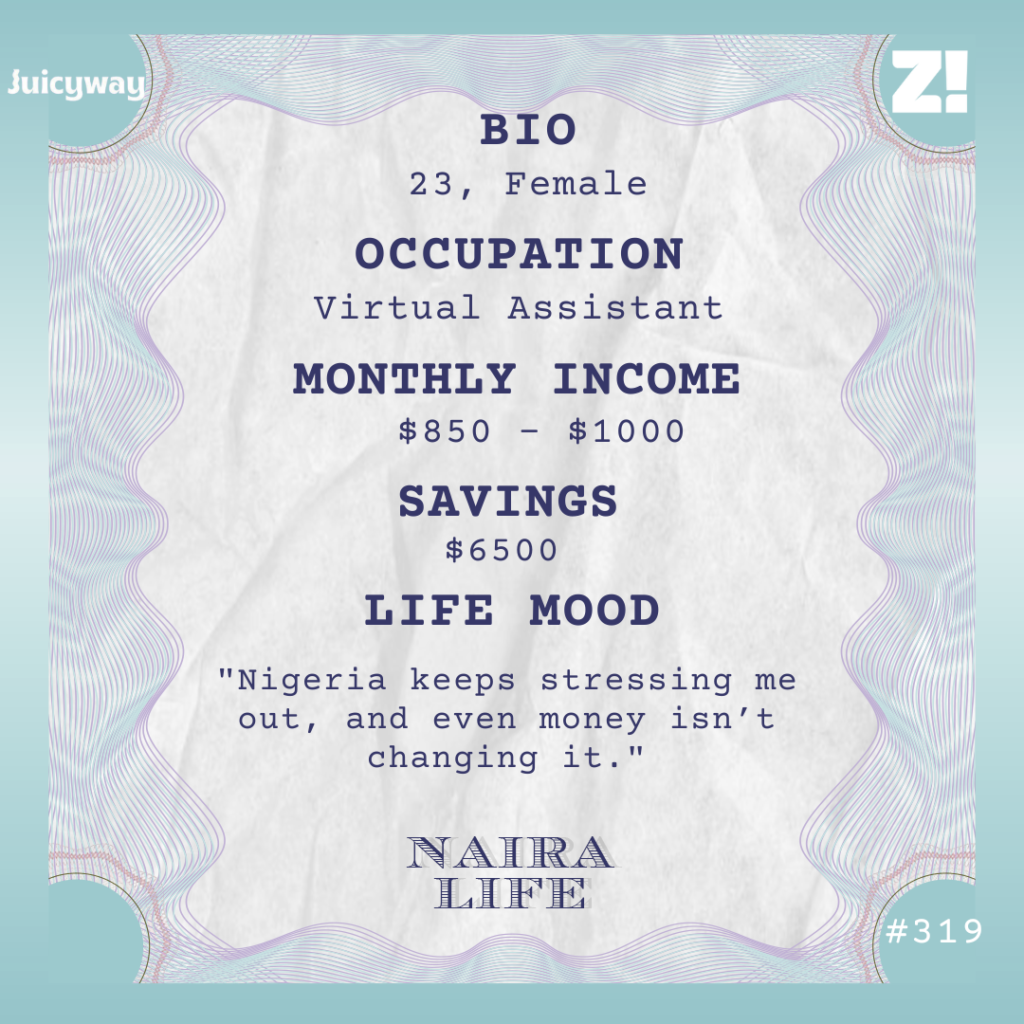
    Then, in 2024, I moved to 50 hours a week at $4 per hour, sometimes $4.25, depending on whether I do extra work. That’s my current pay structure, and my monthly income ranges between $850 – $1k. My last payment was $917.

    But receiving the payment is another thing. The company has an account officer in Nigeria who calculates my salary and sends it to my traditional bank’s domiciliary account. Then, when I need money, I have to go to the bank to withdraw dollars and exchange them at the black market. 

    I do that once a month to avoid the stress of changing multiple times. I used to change $200 – $250 to get me through the month, but with inflation, I now convert $300, which was ₦474k this month. I leave the rest in the bank.

    It feels like a very manual process

    Well, I can’t legally transact with dollars in Nigeria. I am unable to transfer the money due to government restrictions. One disadvantage of this process is the frequent fluctuation of the exchange rate. I can go today to convert dollars and hear two days later that the dollar is now more expensive, so it feels like I’ve wasted money. I can’t say for sure when the best time to convert my money is.

    Also, I have a challenge with investing. Earlier this year, some of my colleagues and I talked about investments, so I decided to look into it. I thought it was just a matter of putting money in one investment application and coming out. But I saw an investment platform that promised 7% yearly interest on dollar savings. So, if I save $100, I only get $107 at the end of the year. It didn’t make sense to me.

    Other platforms required me to convert to naira first to use their dollar savings and investment options. Like, they have dollar options, but I can’t send dollars to them. I have to change to naira, buy dollars at their rate on their platform, get interest, and then convert again to naira at whatever rate they give if I want to withdraw. 

    It’s a whole lot for a constantly changing conversion rate, and I’ll inevitably end up being the loser. So, right now, I’m just looking at my money in the bank.

    Phew. That’s a lot to take in. Let’s go back to how it feels to have gone through such a significant income jump

    It didn’t even initially click that I’d moved from earning ₦33k to earning in dollars. I think it was a delayed reaction because it wasn’t until three months into the job that I realised, “This thing is real.” 

    Maybe if I’d been praying for it, I’d have rehearsed how I’d react in my head when it finally came. But I just found myself in a new financial situation. I was very surprised, but also really happy. 

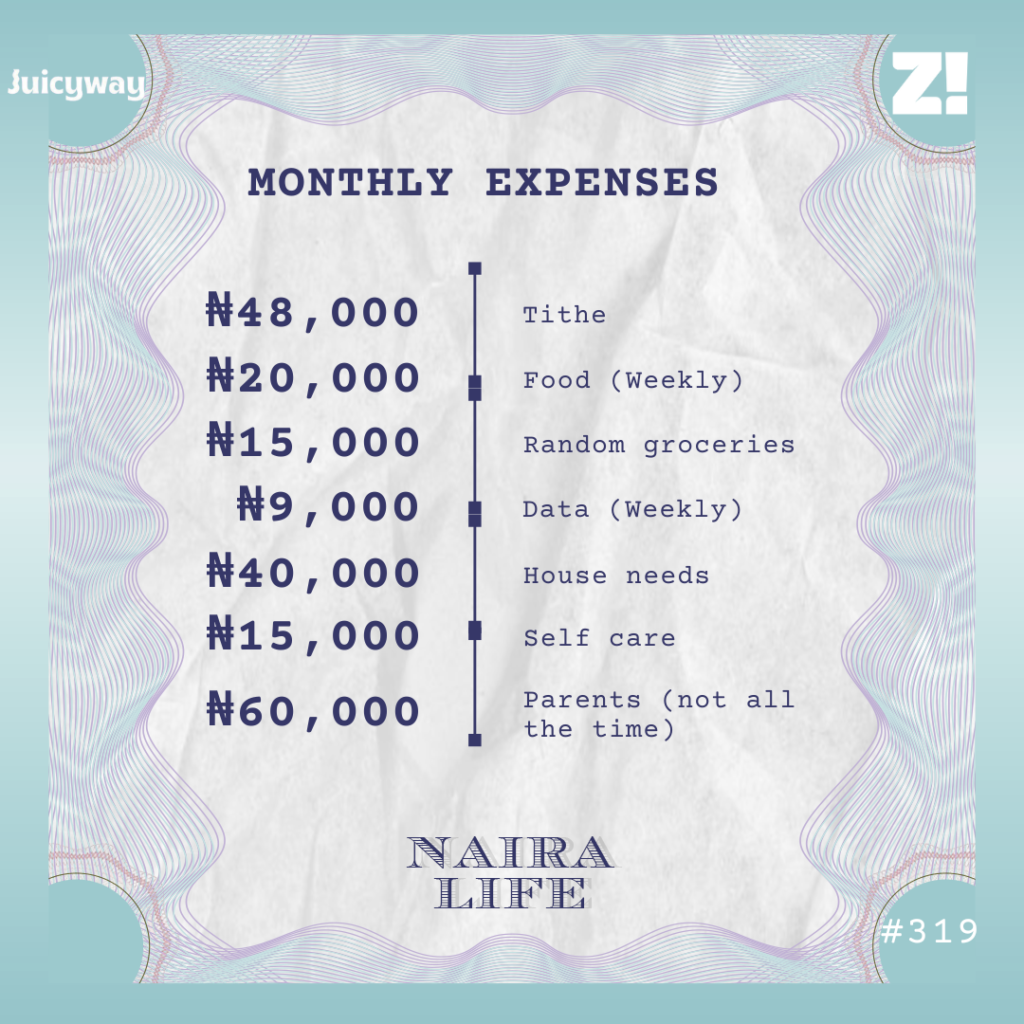
    My income affords me a good life. I don’t live extravagantly, so I can buy whatever I need or want. That’s usually just food, skincare, church offerings, and rent. I moved into my own apartment in August 2024, and my rent is ₦500,000 per year. I also occasionally send money to my parents, but I don’t do it on a monthly basis because then it feels like I’m paying a bill.

    Could you break down these expenses for a typical month?
    Nairalife #319 monthly expenses

    I usually send my sister money, but it’s not constant as it depends on what she asks for. The rest of my money goes to food and data. 

    You mentioned not converting all your salary and leaving the rest in the bank

    Yes. The $300 is just for monthly expenses; the remaining is set aside as savings. Currently, I have $6500 in my savings account. It would have been more, but I started my master’s degree last year and had to pay for school fees and other expenses. So far, I’ve spent ₦700k on the degree, which included school fees and rent. 

    Do you have plans for your savings?

    Most likely japa for my PhD. My sister had saved money when she was relocating, and my parents didn’t have to chip in. That’s my plan too, but I’m sceptical about using all my savings to relocate. Let’s see how it goes, though. I just want to leave this country.

    I feel like I shouldn’t ask why, but I’ll ask anyway. Why?

    I’m not living the best quality of life possible in this country. I know people go, “If you have money, you can still live in this country,” but I don’t think that’s always true. It’s the little things that keep decreasing one’s quality of life.

    For example, I was debited twice for a ₦100k transaction last month, and I’ve dragged the issue since then with no resolution. I said, okay, let me leave these people for God and open a new bank account. The last time I opened an account was in 100 level, I didn’t know it would be this difficult in 2025. 

    I gathered all the required documentation and visited the bank on two separate occasions, only to be told that there was no network available to process anything. When I returned the following day, they said the NEPA bill was old and I would need to come back with a different one, after more than three days of back and forth.

    There are too many examples to give, but the summary is that Nigeria keeps stressing me out, and even money isn’t changing it. 

    What was the last thing you bought that made you happy?

    My air fryer. I received a $50 bonus at work early this year, and I used part of it to purchase the air fryer for ₦53k.

    How about the last purchase that required serious planning?

    I changed my and my sister’s phones in December, and I started planning for it in October. Paying for the phones and receiving them was a very stressful experience. They cost $600, and I had to send the naira equivalent to my sister’s friend’s sister. 

    She bought the phones from a website and then sent them through a family friend who was returning to Nigeria for Christmas. 

    Out of curiosity. What do you think the next five years look like for you?

    I think it’s going to be more work and school for me. I want to earn a PhD within the next four years while also working and making a lot of money. I hope to one day earn enough money to start my own company, allowing me to plan for an early retirement, likely around 50.

    What qualifies as “enough money”?

    Hundreds of millions of dollars. I don’t have long-term plans, so I don’t have a clear path to achieving that right now. It’s not exactly a specific, measurable goal; it’s just a dream, and I think I can afford to dream. 

    How have your experiences shaped your perspective on money?

    I believe there’s nothing free in this life. If you work hard, you’ll have money. This doesn’t mean people who don’t have money aren’t working hard, but I believe it’s a principle that works. If you work hard enough, you will earn money within a specified period of time. 

    I also want to learn to handle my finances better. It’s not enough to sit at my laptop and work and work all day long, and spend money as it comes. I’ve come to realise I need to learn how to take calculated risks and explore beneficial investment opportunities. I believe the first step is to seek out educational resources and update my knowledge, so I know how to manage my finances effectively. That’s one thing I need to fix.

    How would you rate your financial happiness on a scale of 1-10?

    8. I can buy anything I want, and I’m happy enough. It’d have been a 10, but I don’t have money to japa yet.


    If you’re interested in talking about your Naira Life story, this is a good place to start.

    Find all the past Naira Life stories here.
    Subscribe to the newsletter here.

    [ad]

  • Every week, Zikoko seeks to understand how people move the Naira in and out of their lives. Some stories will be struggle-ish, others will be bougie. All the time, it’ll be revealing.


    Hey, it’s money here, and I am tired of working for you. Why don’t you try working with me, so you can save and invest in dollars and access the best rates on your investments? Download the Zedcrest Wealth app, and let’s work together to grow your wealth.


    What’s your earliest memory of money?

    When I was in primary school, my mum would give me money to buy snacks. It wasn’t regular, though. I took homemade food to school most of the time — which I hated because all my friends had money to buy food at school. Now, I appreciate that she took the time to cook for me in the morning, but then, I didn’t understand why she wouldn’t just give me money.

    I was in primary school between 2001 to 2006, and pupils who brought ₦50 to school were considered the rich kids. At the time, ₦10 rice, ₦10 spaghetti and ₦5 meat was the peak of enjoyment. But when my mum did give me money — usually ₦50 too — I didn’t spend it on actual food. I typically spent it on silly stuff like telephone juice and goody goody.

    So, you were a rich kid too

    We were pretty comfortable. Not like “silver-spoon” comfortable, but there was a spoon. I remember growing up in a house my dad bought. We lived in a rented apartment when I was a baby, but I have no memories of living in a home we didn’t own.

    What did your parents do for money?

    My dad was a lawyer, and he was the typical Nigerian father. Once he paid school fees, he was done. My mum was a housewife and was really involved with me and my younger brother. She’d take us to school and back, check our homework and make sure we had good results.

    Did your dad get more involved at any point?

    He did; by trying to force me to study law at the university. I didn’t want to study law because I knew I was creative —I’d been a voracious reader and writer since Primary One, and I wanted to study Mass Communication. This was in 2012.

    We fought about it, but I had my mum’s support. She knew what I wanted and encouraged me to stick to it and not be a pushover. She was like, if I let someone else decide what I  studied in school, at what point would I be independent?

    To show my dad I was serious, I decided I’d rather write JAMB again the following year than go to school for law. At that point, he gave up and let me study what I wanted. 

    I got into a private university for Mass Communication and graduated in 2017. The waiting period between graduation and NYSC call-up was when I started my natural skincare business.

    Was that the first thing you did for money?

    Yes. Making money wasn’t the initial plan, though. Growing up, I didn’t care about what I put on my face, so I didn’t have a skincare routine. Even when I started having breakouts  as a teenager, I didn’t care. All I did was bathe with Imperial Leather and rub cream. My mum was always on my case like, “Don’t you know young girls need to take care of their faces so they don’t break out and have good skin?”

    That period at home after university was when I decided to research and pay attention to my skin. There was nothing else to do with the free time. I watched a lot of YouTube and found several DIY options. Then YouTubers used to recommend the most ridiculous things, like asking you to rub lemon on your face. I tried some but eventually realised that I needed more knowledge. So I paid for classes with skincare professionals — which cost about ₦17,500 in total — and found what worked. That’s where I also learned to make products properly.

    In October 2017, I started posting about the business on my WhatsApp status, and my first customers were my friends and family. I did the entire production with a mortar and pestle at home. The soap was ₦1,500 when I started, and the profit was around 30% on each one I sold. But I got called up for NYSC about three weeks later.

    Did you continue the business?

    I literally carried it with me. I stayed in the Nigerian Christian Corpers Fellowship (NCCF) house for the entire one-year period. I couldn’t take my big mortar with me, but my mum sent a small mortar and some of the needed raw materials, and I stored them under my bed.

    My business was basically marketed by word of mouth. I also started using Instagram, but it was still a work in progress. I usually had one or two orders in a month.

    I also wasn’t getting an allowance from home anymore. From the moment I left for NYSC, it was, “You’re earning money now, so good luck.”

    It’s a good thing you had allawee, at least

    Luckily, I didn’t get posted to a school. I served with a government parastatal and was the highest-earning Corps member in the NCCF house. My stipend was ₦25k when I started the job. Three months later, they reviewed salaries, and I started earning ₦40k. There was also the NYSC ₦19,800 stipend, bringing my monthly income to ₦59,800. That’s minus the small change I got from my business once in a while.

    Staying at the NCCF house meant I could save a lot of money because I didn’t pay rent. At the end of service, I’d saved ₦400k.

    Nice. What did you use the money for?

    I just left it in a savings account. The money is still untouched, and I don’t even have access to it.

    Come again?

    My mum created the account on my behalf when I was little, and she’s the signatory. I let her keep it that way even though I’m grown now — it helps me not to spend my savings anyhow. If I ever need anything, she can help me withdraw it.

    Interesting. So, what did you do after NYSC?

    I finished service in 2018 and came back home to Lagos. My business also started to scale up. I started getting orders from Instagram because I had more time to push what I did on social media. I went for my Masters in Marketing Communications shortly after in 2019.

    What did that mean for your business?

    Like during NYSC, I moved with it too. My parents paid my school and hostel fees, so I was responsible for feeding myself.

    Now, I was averaging between ₦30k and ₦50k in sales from my business and paying myself a salary of ₦10k. I had to increase the price of the soap to ₦2,000 because of an increase in the price of raw materials. I also sold body scrubs, body butter and lotion, but none exceeded ₦3,500. 

    What were you spending on?

    Mostly provisions. I also only spent one semester in school because of the pandemic in 2020. Subsequently, I finished my Masters at home and graduated in December 2020.

    The job market must’ve been waiting

    It stressed me for seven months. I didn’t get a job till July 2021, and I probably wouldn’t have gotten it without the help of my mum’s friend who had connections at an energy company. Although she helped me get a leg in, I still had to pass the interview. That’s how I joined the corporate communications team.

    Nice. What was the pay like?

    ₦206k gross. ₦170k after deductions.

    Not bad for a first salary

    My master’s degree helped since they couldn’t put me on the same scale as a first-degree holder.

    So you had 9-5 and a business. What was that like?

    I started having less time for my business because of the hours I spent on the road daily. I live in Ajah, and my office is at Marina. Just imagine going through that Lekki-Epe traffic every day. I drive, and it takes me about an hour and thirty minutes to get to work on a good day. On a bad day, it starts at two hours and can be infinite.

    So, about a year into my job, I stopped my business. I just couldn’t continue.

    That’s tough

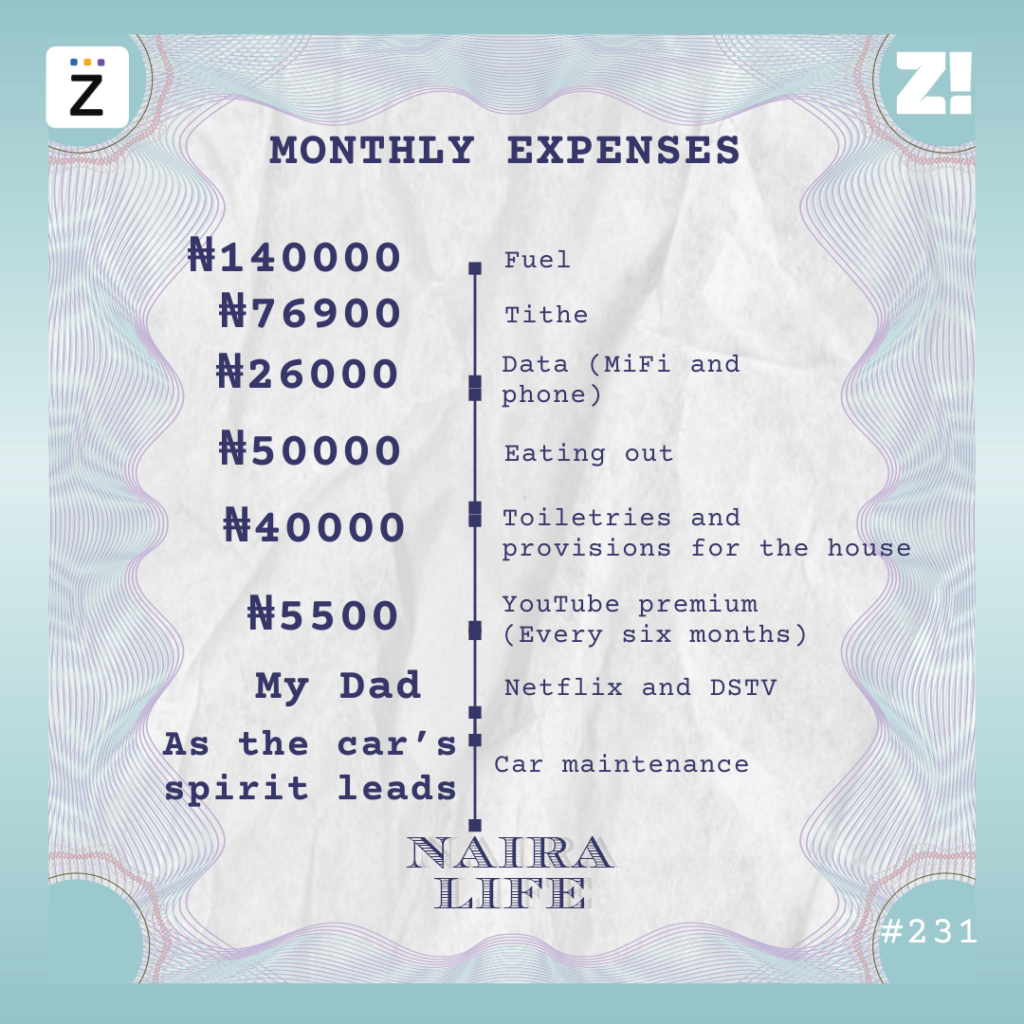
    I lost an income source, but I live with my parents and have minimal financial responsibilities. My money is basically for me. Then, I tried to save at least ₦50k monthly in that account I don’t have access to. The only other things I spent money on were fuel — which cost me about ₦11k weekly and about ₦20k on data monthly. The rest of my money went into hanging out with friends and eating out.

    How was it going at work?

    I got a raise around the same time I stopped my business in 2022. A new MD came in, increased salaries, and I started earning approximately ₦210k net. That’s my current salary because I still work there. For the next couple of weeks, at least.

    You’re leaving?

    I’ve wanted to leave for the longest time. It’s not the money, because I know my salary isn’t bad. But the traffic and the recent increase in fuel prices mean it’s time for me to go. Before fuel subsidy removal, I budgeted ₦40k monthly for fuel. Now, it’s ₦140k.

    I’m not leaving my job to be jobless, though. I’m also a virtual assistant, and I currently have three stable clients.

    Wait. How did you become a virtual assistant?

    This was also in 2022. I really wanted something that’d allow me to make money from home, so I went to YouTube to look for options. I saw options like affiliate marketing, which I tried for a bit and stopped after making about ₦18k in commissions within two weeks. Of the ₦18k, ₦10k was the commission from selling a course, while the 8k was from another site that paid ₦1,600 for every referral. It wasn’t sustainable.

    I eventually took an interest in virtual assistance. The job description seemed simple enough: helping people with tasks, booking flights, and responding to emails and comments. 

    Those are things I already do at my 9-5. If I could do this from home and still earn money, why suffer myself?

    I found and applied for the ALX Virtual Assistant course in May 2022. It’s discontinued now, but it was an eight-week intensive course that provided me with all I needed. The course was worth $750, but it was sponsored, so it was free for participants. I graduated at the end of July and officially launched out as a virtual assistant in August.

    Did you get clients immediately?

    It took me eight months to get my first client. Before then, what I did was put the word out on my social media. I let people know I was open to virtual assistant gigs, and I built my portfolio using the tasks I did during the ALX course. I expected clients to see my content and reach out to me, but it didn’t happen that way. I saw things.

    Pray tell

    I almost got scammed on LinkedIn once. I applied for a job on the site via the “easy apply” option and sent my CV. These people didn’t interview me. One day, I just got a random message on WhatsApp: an offer letter in a PDF file. My first thought was, “What’s going on here?”

    First, the offer letter was badly written with multiple grammatical errors, and I wasn’t even sure who was hiring me. Second, there was no salary. They wanted me to “recruit” candidates for jobs, and I’d be paid based on every candidate I sourced. I just replied and said I wasn’t interested.

    Another time, I  found a “client” who wanted a social media manager and offered to pay ₦40k. It was low, but I thought the extra income wouldn’t hurt. I signed a contract, and we were supposed to start work, but they ghosted me for like two weeks. I had no access to the social media pages they hired me to manage, and they hardly responded to my messages. After a while, I got tired and stopped.

    The ghetto. Let’s talk about your first client

    I got them in March 2023 via Twitter. Someone had tweeted about her friend needing a virtual assistant, so people tagged me under the tweet. I reached out to confirm the service needed and also shared my CV and portfolio. My portfolio includes a link to a discovery call with potential clients, so we got on a call and agreed on the deliverables.

    I work 15 hours a week, and she pays me ₦150k per month. She’s based in Ghana, and at first, she paid in naira through different payment channels, but we kept having conversion issues, so now she just pays in dollars, which is better for me. I take my payments biweekly, so it’s $159 every two weeks, making $318 at the end of the month. In naira, it’s about ₦222k now.

    I guess the naira devaluation has…advantages

    LOL. I got two more clients in June, and one of them also pays in dollars. It’s funny how I got no virtual assistance gigs for so long and then got three in quick succession. In fact, the way the third gig came was funny.

    I’m listening

    I think I made a Twitter thread about virtual assistants, and he just sent me a DM asking, “How much do you charge?”. No “hello”, just straight to the point. I responded, “$30 an hour,” and he said okay. 

    I thought someone was trying to scam me, so I checked out his page and noticed he’s into forex trading. I was sceptical, but he explained that he coached clients and needed someone to help him send emails every week. I calculated the number of hours I’d use per week and charged him $500 per month. He negotiated to $200, insisting the task would just take a couple of minutes per week. We eventually settled at $250, and he signed my contract.

    The time between when he reached out to him and when he signed was less than a day. The Nigerian in me was suspicious, and I kept googling him to confirm he was a real person. I always take the first half of the payment before starting work, so within 24 hours, he paid me, and I started working with him officially.

    Interesting. So, the payment before work is a kind of protection?

    Oh yes. I put my clients on my Selar subscription where they enter their card details. So I don’t even have to send them invoices. It just takes the money from their accounts every two weeks.

    So, you have a 9-5 and three gigs. How much money do all four bring you?

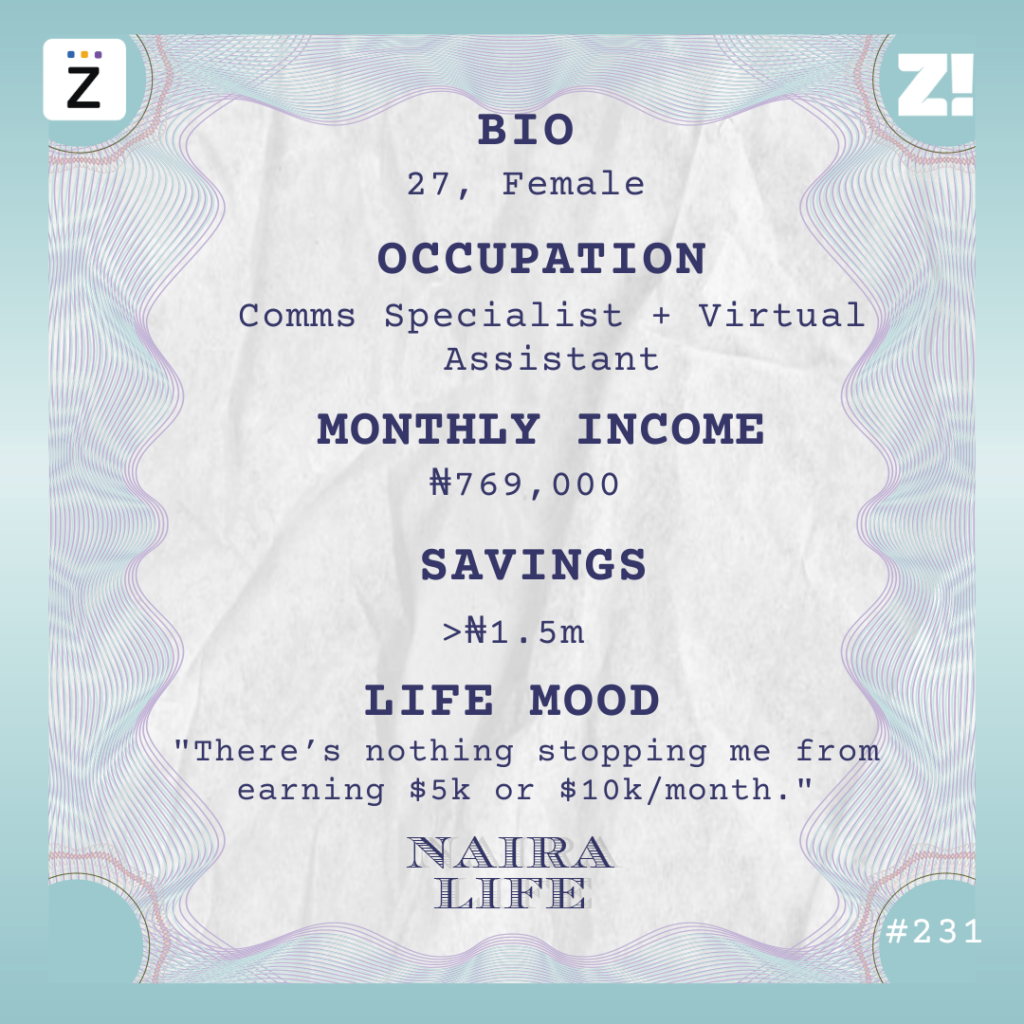
    I actually haven’t thought about this before. But all together, it’s ₦769k per month.

    That’s impressive. What do you spend your money on?

    I spend more on my car than anything else. It’s like the car somehow knows when I have money, and suddenly, something needs fixing. The increase in fuel cost is another reason I want to become fully remote because by the time I spend ₦140k out of the ₦210k my 9-5 pays me on fuel, what’s remaining?

    LOL. What’s something you bought recently that you didn’t plan for?

    I got some wigs, trousers and shoes a few weeks ago that cost me about ₦132k in total. I prefer to buy things in bulk, but I’m also trying to be more regular with my savings since I plan to leave my 9-5 soon.

    How much do you have in savings now?

    About ₦1.5m. I may eventually use it if I ever need to move out of my parents’ and rent my own place, but for now, it’s just there.

    I’m curious. Are you worried about leaving a stable 9-5 to focus on virtual assistance?

    I’m equal parts scared and excited. It’ll be a new phase in my life, but I’ll have the opportunity to do something I want to do. I’ll also have time to scale it even more when there’s no 9-5 dividing my attention. There’ll be more time for content creation and coaching people who also want to be virtual assistants.

    There’s still the fear of the unknown because my 9-5 is my safety net. There won’t be that ease of knowing you’d always have a certain amount of money in your account by month end no matter what. I’ve put in my notice at work, and it’s real now. If I don’t work or get gigs, I won’t get paid. It’s scary, but I’m also excited about what the future holds.

    That’s fair. Is there anything you want but can’t afford right now?

    I’ve always wanted to take a trip to the Benin Republic or Ghana. But I can’t afford that just yet. Plus, my passport has expired, and that’s another expense.

    What’s your financial happiness on a scale of 1-10?

    8. I know there’s still room for improvement, and I have the capacity to do much more. There’s nothing stopping me from earning $5k or $10k/ month. I’m not there yet, but there’s room for that to happen.


    If you’re interested in talking about your Naira Life story, this is a good place to start.

    Find all the past Naira Life stories here.