• The Nigerian experience is physical, emotional, and sometimes international. No one knows it better than our features on #TheAbroadLife, a series where we detail and explore Nigerian experiences while living abroad. 


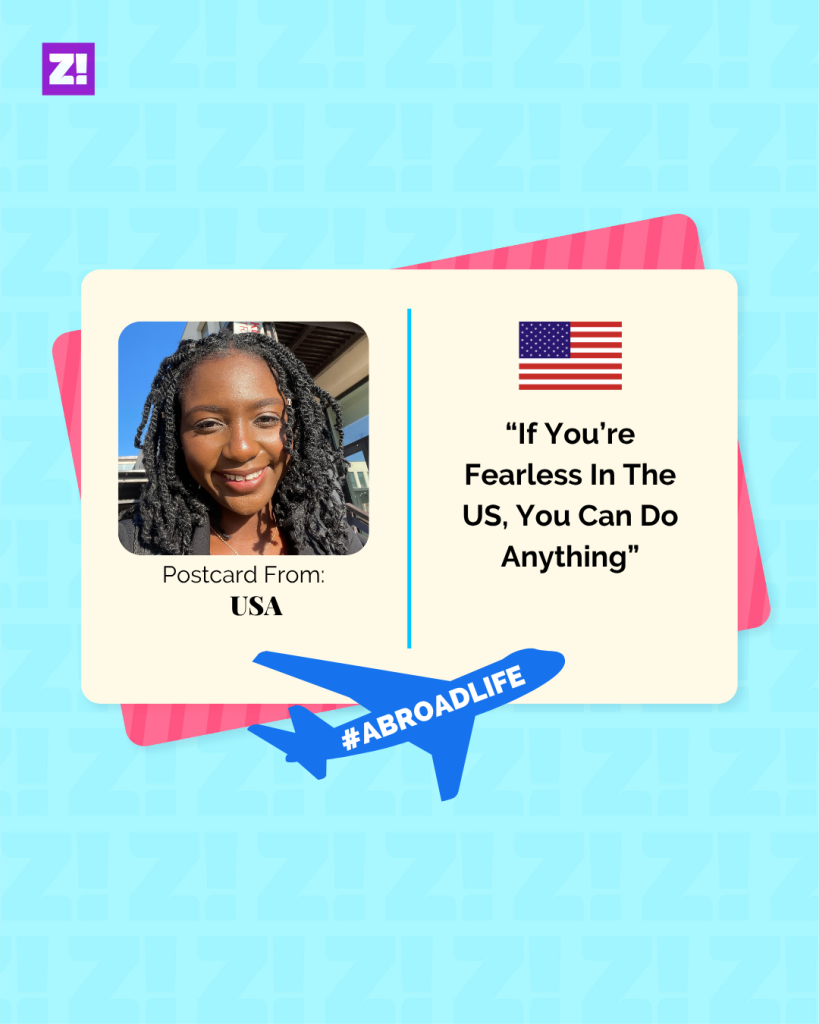
    Aladi Akoh (30), a Nigerian data engineer and YouTuber, moved to the US in 2018 after two visa denials. From three tries at a H-1B visa to dating, marriage, culture shocks and homesickness, she shares the highs and lows of her life abroad, and how she has learned to live fearlessly in the US.
    Where do you currently live, and when did you leave Nigeria?

    I live in the United States of America (US), and I left Nigeria in 2018.

    What inspired you to leave?

    I wanted to get a master’s degree abroad. I actually wanted to go to France at first. I did my bachelor’s degree in Benin Republic, and France felt like the natural destination for my master’s degree. That was where most of my coursemates were heading. So I applied to universities in France, but also to other countries, including the US.

    I got an offer from the US for a Graduate Teaching Assistantship (GTA) with partial funding for my tuition and a stipend. I liked the offer, so I accepted it, and that was how I ended up in the US. 

    But it was not as easy as it sounds.

    How so?

    Well, first of all, I was denied a US visa twice, so it was on my third attempt that I got it. I went to do my master’s, and as I was concluding my studies, I had to find a job that would sponsor a H-1B visa so I could remain in the country.

    As an international STEM student, I had three years after graduation to get the H-1B visa, which is gotten through a lottery system that happens once a year. I had between 2021 and 2024 to get the visa. I started working in March 2021, but my company missed the window to submit my name for the lottery that year.

    They registered me in 2022. I was not selected. Then in 2023, which was my final year before my time would be up, they put my name in again for the lottery, and I was still not selected.

    However, the US government flagged some fraudulent applications, which opened up some opportunities, so they had an unexpected lottery. That was how I got my H-1B visa.

    Incredible. What do you do?

    I work as a data engineer. I am also a YouTuber. I discuss issues about immigration and life as an international student on my YouTube channel, basically sharing lessons and tips I have learnt from my own migration journey.

    What has your experience in the US been like?

    It has been bittersweet, to be honest. It is nice here, but being away from home is difficult. You miss home, the food, your family’s support—everything.

    One of the things I really like about living in the US is how you can plan your day and it goes exactly the way you planned it. You can set up routines because you know everything just works. You know the train will be on time, you know other people will be on time. So if I plan something, I know that it is going to be that way.

    I also enjoy meeting people from different cultures. I think the US is one of the most diverse places in the world. You can meet people of every nationality. I have met people from countries that I did not even know existed until I met them.

    When I was in school, we used to have something called International Student Nights, where we would all come and socialise and share food from our respective cultures. It was there I had Thai food for the first time.

    Interesting. Have you seen a lot of the country?

    I have lived in South Dakota and Utah. South Dakota was where I went to school, and I relocated to Utah for work. But I have been to other cities in the US too.

    Do you have a favourite city in the US?

    I like Los Angeles. I love the beach life there.

    Let us talk about Nigeria. Do you visit?

    Absolutely. I am actually planning a surprise visit to my family in Nigeria, so hopefully I will already be there before this comes out. I last visited in 2023.

    Is there a possibility of moving back to Nigeria at some point?

    I had plans to come back when I was single, but now I am married, it is a decision for two people. We will see.

    What would have to change for you to come back?

    Healthcare in Nigeria. I really worry about healthcare in Nigeria. I have an eye defect, and I was going to eye clinics in Nigeria as far back as I can remember. I got my first pair of glasses in JSS1. All that while, none of the doctors there was able to diagnose me properly.

    The first test I went for when I came to the US, I was diagnosed and referred to a specialist. I had a procedure earlier this year to reduce my eye pressure because if the pressure kept rising, I could go blind.

    It made me think about people in Nigeria you will hear who just went blind suddenly, and I wonder if it could be a similar situation to mine, but they never get properly diagnosed and treated. So healthcare is a really big thing for me.

    What lessons has migration taught you?

    It has taught me many lessons. I think the most important lesson is around fear. I have learnt that fear just holds you back. I feel like in the US, if you are fearless, you can do anything.

    I have also learnt to be okay with being told “no.” Personally, I used to fear rejection. Like when I was applying to different schools, it was a friend that advised me to apply for funding. So I emailed the professor in my college and asked if they had funding for international students. That was how he told me about the graduate teaching assistantship. If I had not asked, I would not have received.

    So a major lesson for me is to always ask for things, even if you think you might be rejected. Do not shut your mouth—always ask.

    Get More Zikoko Goodness in Your Mail

    Subscribe to our newsletters and never miss any of the action

    There has been a lot of anti-immigrant sentiment in the West recently, especially in the US with Trump. Are you worried?

    I think I have gotten to a point where I do not care anymore. I know some people have not gotten to the same place I have mentally because I have friends who are panicking. But I have told myself that my immigration status does not define me. 

    I was denied a US visa twice. It was on the third attempt that I got it. It also took three attempts to get my H-1B visa. I believe that if one path closes, you should go for the next path. So I think I am now numb to it all. I just take it one day at a time.

    I remember when Trump made the announcement about H-1B being $100,000, I was out shopping and my husband texted me. I just texted him back that I would read it later and continued what I was doing. At this point, it feels like they say something new every day. So I have stopped caring. If they say we should go home, then fine.

    What is your support system like in the US?

    I have my husband and my amazing friends. Unfortunately, my friends live in different cities, but we are always talking on the phone. I also have my church as a source of support. I still communicate a lot with my family. We do family video calls, we have a group chat. Really, thank God for technology.

    Congratulations on your marriage. But what was dating like in the US, especially compared to Nigeria?

    In my opinion, Nigeria is the better place when it comes to dating. There are more organic and natural options in Nigeria. It was easier, to be honest. Men approach you in church, at work, everywhere. I think during my NYSC service year, that was when I got the most attention.

    But I was not in the right headspace for that at the time. All my focus then was to travel out for my master’s degree. So I was not trying to tie myself down to anybody. I was not ready to be married, and I had really internalised that typical advice of not dating until you are ready to get married. I took it very seriously and I did not want to waste anyone’s time. So I did not really date intentionally until I was in the US.

    And what was that like?

    Well, I tried dating people on campus when I was in school. I had positive experiences, but nothing worked out. Then I tried dating apps.

    I took it very seriously. My reasoning was that if it was a school I was applying to, I would take it seriously. So something as important as relationships and potentially marriage also needed to be taken seriously.

    I paid for premium features on the apps so I had access to all the features. I set all my preferences. A number of the people I met through the apps did not turn into romantic relationships but actually good friends that I am still in touch with today.

    I did meet one guy I dated, but it was not a good experience and I eventually got rid of all the dating apps.

    What happened?

    He cheated. After we started dating, he stayed on the apps. I found out because he was talking to a friend of one of my friends. It happened by accident. I showed her his picture and she was like, “Wait, I know this guy!”

    Wow. So if you got off the apps, how did you meet your husband?

    I went to a friend’s housewarming party and one of her friends approached me. She asked me if I was single and told me about her friend who was looking to date. She showed me his Instagram page.

    I was reluctant because at the time I did not want any more relationship drama. But she still told him about me and he reached out to me on Instagram. And as they say, the rest is history. We got married about six months after we started chatting.

    Wow. That quick?

    I always had in mind what I wanted. And he checked most of the things on my list. When I talked to him, I was really attracted by his kindness and empathy. I also love how important family is to him because it is very important to me.

    I felt at peace with him in a way I had not with all the other people I had dated. We share so many similarities so everything just felt natural. I did not have to explain myself too much—he just got me. So when he started talking about marriage, I did not feel any anxiety.

    That is awesome. It seems you were both very intentional about marriage. So how are you finding married life?

    It has been good. There are good days, and there are bad days. But overall, it has been good.

    It is great having someone at home to welcome you after a long day. Someone to make you food, someone to calm you when you are angry, someone to just do life with.

    That does sound great. What were the biggest culture shocks for you in the US?

    Something I had to get used to here is calling everyone by their first name. You know how it is growing up in Nigeria, you call older people “uncle,” “auntie,” “sir,” or “ma.” I have gotten used to it now, but when I first came, it felt so strange having to call all these much older people by their first names.

    Something I found very surprising was the rural areas in the US. The town I lived in during my master’s is a very rural town. I was shocked when I first arrived because it is so different from the areas of the US that are usually portrayed in the media.

    But I have been to places like New York and Los Angeles so I understand the difference now. Those cities are usually the ones portrayed, but not all of the US looks like that.

    I was also shocked by the amount of homelessness in the US. Then there is the food. They put too much salt and sugar in everything. I do not think I will ever completely get used to it.

    Let us talk about highlights and lowlights. What has been your worst experience in the US and what has been your best experience?

    My lowest point was when I was put on academic probation. I saw it coming. I knew there was a possibility it would happen because I took this four-credit course on robotics in my first semester and I knew nothing about robotics.

    It was a rollercoaster of a class. The professor was really nice though. He supported me through it and everything, but eventually I was put on academic probation. Though I was expecting it, when I got the official letter, I shed tears.

    Another low point was when I had to find a job. When I was about to conclude my master’s, I started feeling so stressed because you have to find a job or continue schooling. So if I could not get a job, I had to either go for a doctorate or go back home. Mentally, I knew I was not ready to do more years in school, so I just started preparing to go back to Nigeria. That was a really stressful time for me.

    My best experiences were getting a job and then my H-1B visa. I got my job offer before my graduation and it felt so good. And after three tries, getting my work visa made me so happy. I think I called everybody in my life that day to share the news.

    I really celebrated the work visa because it gave me the opportunity to travel back home to see my family.

    That must have felt great. On a scale of one to ten, how happy would you say you are in the US, and why?

    It is so hard to choose between seven and eight. Maybe I should go with seven point five. I would have said a nine or ten if we had our families here with us—my husband’s and mine.

    I would love to have that support around us because I feel like life is more enjoyable with family around. But even just bringing them over to visit is so difficult with all the visa wahala.

    I already talked about the food. I would love to have access to more diverse options, but that probably has to do with the city I live in. I also worry about the gun laws here. You hear the news of school shootings and you realise that it could be your own child. That scares me a lot. So these factors are why I cannot give it ten.


    Do you want to share your Abroad Life story? Please reach out to me here. For new episodes of Abroad Life, check in every Friday at 12 PM (WAT).


    Click here to see what other people are saying about this article on Instagram

    [ad]
  • The Nigerian experience is physical, emotional, and sometimes international. No one knows it better than our features on #TheAbroadLife, a series where we detail and explore Nigerian experiences while living abroad. 


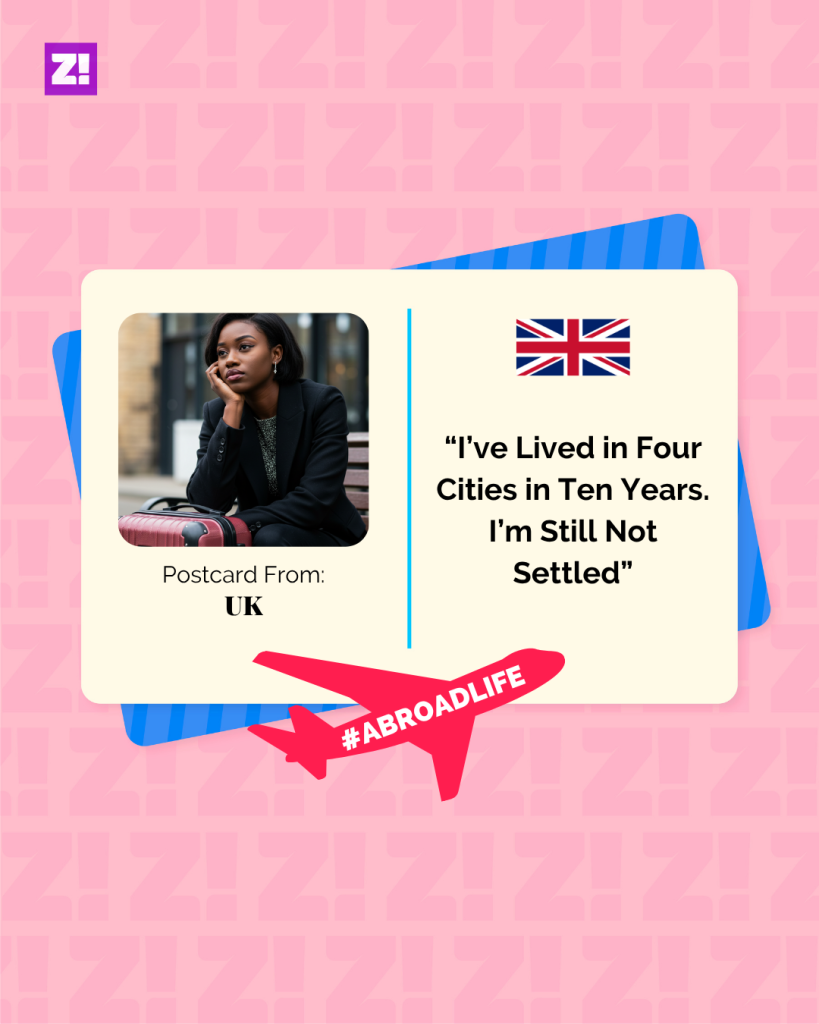
    Obi (27) has lived in four different cities since leaving Nigeria ten years ago, but she is still not settled abroad. She shares her journey of constantly being on the move, unpacking the emotional weight of migration and exposing the hard truths behind the “Japa” dream that many Nigerians pursue abroad.

    This model is not affiliated with the story in any way

    Where do you currently live, and when did you leave Nigeria?

    I currently live in the United Kingdom  (UK), but I left Nigeria in 2015 to go to the US.

    What inspired you to leave?

    It was just what was expected. After secondary school, you go abroad to further your studies if your parents can afford it. So I would not say I was inspired to leave; I was just expected to. Once I finished secondary school, I spent a year doing SATs and applying to various universities in different countries, including the United States (US), the UK, Canada, and Mauritius. But I ended up choosing the US. At the time, I just felt like that was where I needed to be.

    That is very interesting. So, how did you find the experience in the US?

    I had visited a year prior because I have family over there. So I thought I had an idea what life would look like, but living there was a whole different ball game. It was the first time I was really on my own, not being sheltered by my parents. So I had to grow up very quickly.

    I felt very much like a fish out of water during my first semester. I did not do very well academically because I was very homesick and depressed.Like I said, I had visited family there before and I had always absorbed so much American media. So I felt I already knew the culture, but it was very different actually living there.

    How so?

    The US is a very capitalist place, so even as a student, money went fast. I had to get a job and learn how to take care of myself. Within my first year, the exchange rate went up drastically from around a dollar to ₦160 to around ₦300. So I realised I could not expect my parents to keep up with my fees and allowance.

    I tried to get a job, but you are not allowed to do so on a student visa until your second year. And when you do apply in your second year, it has to be within campus and you can only work 20 hours a week.

    I quickly had to learn how to manage money better and live there without getting myself into too much debt.

    Okay, so you struggled academically and financially. What about socially?

    I was a bit of a loner in Nigeria because I am neurodivergent, and Nigerians do not really know how to relate to people like me. But I thought it would be better in the US, that Nigerian-Americans would be better with things like that, but that was not the case.

    I had friends from different ethnicities: Hispanic, white, Black, Asian. But I found it very strange that I was not getting along with the Nigerian-Americans.

    Get More Zikoko Goodness in Your Mail

    Subscribe to our newsletters and never miss any of the action

    Why was that?

    I tried to make Nigerian-American friends in the beginning, but they had subtle discriminating behaviours like saying you’re “fresh off the boat” because you just got there.

    There is a huge Nigerian-American community in Texas and I was immersed in it while I lived there. There is a lot I liked about it, like the fact they really seem to want to have some kind of connection to Nigeria. I really liked that some of my cousins there had a better understanding of Igbo than I, who grew up in Nigeria. I admire that their parents put effort into that.

    While I admired those things about them, I also feel like they have carried a lot of the bad in Nigeria and brought it with them to the US. They worship white people and discriminate against Black Americans and other Africans in an off putting way.

    They are also very materialistic and judgemental. Once, an aunt tried to matchmake me, but apparently when the guy’s mother heard I was studying advertising and not medicine or engineering, she immediately called it off.

    They have just carried all the same prejudices here, including their politics. Obviously, as immigrants you would expect them to support Democrats because that is the party that favours immigration. But because they hate queer people so much, they vote against that, not realising they are harming their own interests.

    I left just before Trump’s second term and looking at all the things he is doing, honestly, I think Nigerian-Americans deserve what they are getting. They lack the social awareness and consciousness to know who their true allies are.

    Wow. I certainly see your point. Did your other friends help you settle into life in the US though?

    Yes, my friends definitely helped me settle.  I think the culture also helped. The culture in the US allows you to be a bit more expressive, so even if you are acting strange, nobody is going to start asking what is wrong with you like they would in Nigeria. People are not as judgy in the US.

    I have dyscalculia, a learning disorder affecting numerical reasoning. In Nigeria, a maths teacher made me stand up and told me I should go to Mountain of Fire Ministries for deliverance because I was very bad at maths.

    It took me a while, but I started to feel more comfortable in the US. I remember early on a Jamaican friend told me I was being very uptight. And that was because I was always anxious, expecting people to act a certain way towards me like they would in Nigeria. But eventually I got used to being able to just breathe and be free. 

    Also, they have a system that is better built to support people. When I started to realise I was getting depressed and it was affecting my academics, I went to the campus mental health services and they really helped.

    It was very one-size-fits-all. Just the generic “we are here for you” type of wellness. But it was still a lot more than I had ever gotten in Nigeria, where when I would tell my family or friends that I was feeling some kind of way, they would either ask me to pray about it or get over it.

    What did you do after school?

    After you graduate, you get what they call an OPT (Optional Practical Training), which allows you to work in the US for one year. Then your employer has the option to sponsor you through an H-1B work visa.

    So during my OPT year, I got to feel what working full time in the US is like, and it made me see that the American dream Nigerians japa to chase is a scam.

    I was earning money, but about 60 per cent was going to bills and rent, so I did not have much left over. In the end, my employer did not want to sponsor my H-1B, so I had to either leave the US or go to school. I decided to do my master’s in New York.

    So you moved from Texas to New York?

    Yes, I did. It was both good and bad.

    It was good because I got some scholarships which helped reduce the weight of the fees.  And of course, the opportunity to experience such a famous city.

    But it turned out to be very expensive. I got a job as a grad student, but this time it was not just 60 per cent of my paycheck going to rent and bills, it was all of it. It is extremely expensive to live in New York.

    Thankfully, after my master’s, I got out of New York. My parents moved to the US to live with my brother in Georgia, so I went to join them and got a job there.

    Wow. That is three different cities.

    Yes. In total I’ve lived in four cities since I moved abroad. I lived in Texas for about five years, then I lived in New York for about three years, then Georgia before moving to London.

    From my experience there, I realised that even though the US is one country, each state is very different. Still, I noticed one common thread, which is that there is not that much difference between America and Nigeria. I have heard people say it as a joke that the US is Nigeria just wearing a Gucci belt. But I genuinely think there is truth to it.

    The biggest differences are the basic public utilities that Nigeria lacks, and the fact that they hold their politicians to some kind of standard, or at least they used to. Other than that, the way things worked and the way people looked at life were still very similar to Nigeria.

    You will see homeless people on the subway in horrible conditions, and people do not care. People just keep going about their own business the same way Nigerians ignore the beggars living under bridges and sitting on the roadside.

    The things they have gotten right in the US made me realise that nobody is handed a good country or a good government. You literally have to fight for it, and I want to see Nigerians fight and hold their leaders accountable. I saw my American friends pick up their phones and call their representatives to let them know how they felt about policies. We need that in Nigeria.

    I do not think I have heard anyone compare Nigeria to the US quite like this. Is that why you left?

    After my master’s, I had another OPT year to get a job that would sponsor my work visa. Like I said, I got the job in Georgia. But the company is headquartered in London, so they got me a UK work visa and transferred me there. That is why I live here now.

    That’s great. How is the experience in the UK?

    It has been good. I definitely miss some things about America. I was there for almost ten years, so I think that is natural. I am still getting used to the system here, but honestly, it has been quite boring.

    One thing I really love here is their transportation. I also love how much closer to Nigeria it is. I can easily hop on a flight and be in Nigeria in five to six hours, instead of the about sixteen-hour flights back in the US.

    I also like how the Black people here are very connected to their places of origin. In the US, Black Americans have their own culture, but in the UK, Black people here identify with their place of origin. They might be Caribbean, Nigerian, Ghanaian, Zimbabwean, and so on. They are very much connected to their roots.

    Generally, people here are not as open or as extroverted as they are in the US. They are much more quiet, much less likely to be very chatty. But I think my social life here is pretty good. Actually, I am probably going out a lot more here than I was in the US. I think people go clubbing so much more here, because it is much cheaper than in the US.

    You mentioned flights to Nigeria. Do you come back often?

    I visit as often as I can afford, but typically at least once a year. Every time I go back to Nigeria, for the first two weeks I start thinking about moving back because of the excitement and happiness of being home, eating Nigerian food again, and being with my family.

    This might sound trivial, but I have gotten used to having electricity and water. So when I open my tap in Lagos and there is no water, I realise I cannot actually live in Nigeria as it is currently. My sister lives in a high-end part of Lagos, and her water runs brown.

    I never actually planned to live abroad for this long. I only wanted to spend four years in the US, get my degree, and go back home. I used to think, “Why would I stay here when I have a house and a family in Nigeria.”

    But every time I visited, it felt like something had gotten worse. Last December, I was shocked that our currency has gotten so bad that even with my little paycheck that I am barely managing here, I am able to live such a good life in Lagos.

    It blows my mind that our currency has gotten that bad. But it also made me think that perhaps Nigerians in diaspora should realise that we have a bit more power to help change things at home.

    So you would consider moving back permanently?

    Certainly. I do not think people really consider what a shock it is not being in your country. Not being with your family, not being with the people that you grew up with in the places that you grew up. It is not normal.

    You become so disconnected from everything, even from your own self, because when you are detached from your people, there is a kind of emotional self-detachment that happens too.

    No matter how long I lived in the US, it never felt like my home and it never would, because it is just not my home. There is nothing like being at home.

    A return to Nigeria would be great, but Nigeria needs to get those basic utilities working.

    What has been the best part about your life abroad?

    The best part has been meeting people from different places. I really enjoy learning from other cultures and seeing how they live.

    That is great. What about the worst part?

    The worst part is all the different ways you are reminded that where you are is not your country. You are basically a third-class citizen. People think money can insulate them, but you will always be reminded that you are not in your country.

    I watched people get opportunities that I was better qualified for, simply because they were citizens, because they had papers. It is like being in a cage of your own making. You cannot even complain because you came to their country.

    For example, getting a job after my master’s was incredibly hard as an immigrant. My family sat me down and advised me to maybe switch to nursing to increase my chances, but I did not want to change my entire life plan just because I wanted to get papers.

    I think a lot of Nigerians that travel have this mindset where the end goal at any moment is how to secure papers. I think it is a daft goal to have, because it is like you are trying to get people in another country to give you papers, and you do not even understand the fact that they do not want you in their country.

    As we are seeing all over the world now, as soon as the economy gets a bit bad, the first people they are going to blame are the immigrants. It has been that way throughout history. In the US, I started to feel like I did not have a future. I felt like all I was working towards was trying to find a way to stay.

    You are always on edge, always calculating how much time you have left on your visa. Then somebody like Trump enters the government and they change the entire laws, and maybe you get deported because of your social media or something else that was not in the laws before.

    It does not make sense to hinge our entire lives and goals on things that we have no control over. It is silly to expect things from another country’s government.

    That makes a lot of sense. What about dating life, how does it compare?

    I think dating is very similar everywhere. I feel like in the US they are a bit more shallow. Surface-level things are quite important to them. And public displays of affection are a big thing there.

    When I would come back home to Nigeria, sometimes I would be open to dating, sometimes it would just happen, because you know Nigerian men do not let women rest. I would say the biggest difference is that Nigerian men are much more persistent. They pursue a lot more than American men ever do. I think that is just our culture.

    But I would say our culture currently does our men a disservice, as it tells them that the only thing they need is money. I am not moved by money because I have my own, as small as it is, so I am not able to understand why they seem to only tell me about how much money they have. I really do not care.

    In the UK, it is a mixed bag. You have some very lazy men just looking to leech off women, and then you get the ones with massive egos who have these long lists of demands about how they want their girlfriend to be.

    Part of moving as much as I have is that it affects relationships. It is very hard to maintain friendships and romantic relationships.

    That must be tough. On a scale of one to ten, how happy would you say you are, and why?

    I would say a solid five point five. I am happy in a lot of ways, and I think it is important to recognise my privilege, but it has also not been easy.

    I feel like my entire life has been in suitcases. Four cities in ten years. It is not a great way to live. I have a long-term visa right now and a really good job, but I still feel very much like I am on a timer. And that is how it has always felt all my time abroad.

    So it is a five point five because I still do not feel settled.


    Do you want to share your Abroad Life story? Please reach out to me here. For new episodes of Abroad Life, check in every Friday at 12 PM (WAT).


    Click here to see what other people are saying about this article on Instagram

    [ad]

  • 1. You to Nigeria, when your student visa gets approved.

    I’m out.

    2. When all the scholarships have “must be a citizen to apply”.

    Is it fair?

    3. When you can’t talk to a Nigerian at home without them reminding you it will soon expire.

    You’ll be fine.

    4. When you can’t work more than 20 hours a week and your bills are just looking at you like:

    Hay God!

    5. Nigerians at home, when you try to give your political opinions:

    No vex.

    6. When your friends want you to come back home and visit.

    This friendship is too expensive, biko.

    7. You, when citizens start shouting “fuck the police.”

    I’m not among oh.

    8. When you try to travel somewhere else with your student visa.

    The pain.

    9. When you can’t do anything without filling a million forms.

    Kill me na.

    10. When you come back home and your parents start stressing you.

    Let me do and go back.

    11. When your friends are talking about skipping class and you remember your visa status.

    I cannot come and go and fail.

    12. When you realize your visa is about to expire.

    Jisos!

    13. When you want to renew your visa and they’ve increased the cost.

    WHY?

    14. When you’re waiting to see if they will grant you the renewal.

    God epp me.

    15. You to the country, when you succesfully renew your student visa.

    Winning!

  • I know you want to leave Nigeria. But before you go for that Visa interview, you might want to take this quiz. Seriously, no stress. Just sit back, answer and let us calculate for you: