Every week, Zikoko seeks to understand how people move the Naira in and out of their lives. Some stories will be struggle-ish, others will be bougie. All the time, it’ll be revealing.
Everyone’s financial journey is different; Piggyvest gives you the tools to plan, save, and invest, so you can create your own money story. Start now with as low as ₦1,000!
What’s your earliest memory of money?
After I completed junior secondary school, I participated in a programme that offered me the option to travel abroad to complete my studies. I had to write an exam, and if I passed, they’d sponsor my travel while my parents paid the fees.
I passed, but couldn’t go because the fees — about ₦2.5m — were too expensive for my parents. That was the first time I realised that money was something substantial and necessary.
Speaking of your parents, what did they do for money?
My dad was a contractor with an engineering firm, while my mum was a retailer and distributor for items like furniture and plastics. I used to think my parents were rich, but the school thing made me realise we weren’t as well off as I thought. We were comfortable, though. We had the basic necessities.
What was the first thing you did to make money?
I actively helped plan several uni communities, associations, and departmental events, most of which were tech and business-related. I drafted proposals and pitch decks to raise money, designed flyers and even hosted some of the events. Whenever we raised money, I got a small cut, around 10k or ₦20k.
I started doing this in 200 level, and noticed there was potential in it. Students wanted to attend life-changing events that provided value, so we could charge for tickets and also get sponsors. That’s how creating pitch decks became my hustle in uni. People knew me as the guy who drafted convincing proposals and designed graphics, and different communities often reached out to me for help.
How were you charging for your services?
I didn’t have a specific rate. The communities would usually say, “We want to raise this particular amount of money. If we meet the target, we’ll give you a particular percentage.” I usually made north of ₦30k when it worked out. I think the highest amount I made from one event was ₦500k when I was in 400 level.
It didn’t always work out, though. Sometimes, we didn’t reach the target. Other times, we raised money, but the cost of running the event exceeded what we raised. It was a win some, lose some situation, but at least I got extra cash here and there to supplement my ₦20k – ₦30k pocket money.
This was my major source of income until 400 level, when I went for the six-month Industrial Training (IT) experience. Interestingly, this period was also when I really discovered what I wanted to do in tech.
Before then, I regularly attended tech events with my friends and fantasised about building startups. I’d also attempted different coding languages and taken product management courses after realising I was better at strategy. I was still figuring out what I wanted to do, and IT gave me some clarity.
Tell me more about that
So, I studied mechanical engineering and did my IT with an FMCG company in 2018. They paid ₦80k/month, which wasn’t bad, but I realised I didn’t want to pursue a career in the industry.
The full-time staff didn’t earn much more, and they worked many night shifts. They had to stay overnight to monitor the power plant and HVAC system. Some didn’t even go home until Sunday. I didn’t think the pay was enough for that level of work and stress.
Since I was already interested in tech, I decided to pursue opportunities in the industry instead. I applied for an internship at a startup and got accepted as a product management intern.
At this point, I was four months into my IT at the FMCG company. There was a two-week period during which I had to combine both roles because the startup let me resume remotely. After two weeks, I had to resume on-site, so I cut short my time at the FMCG.
How much did the startup pay?
They paid me ₦100k/month, and I interned there for six months. When school resumed, I had to return to working remotely, and thankfully, my employers understood.
The internship basically launched my career in tech. After it ended, I kept applying for roles, and I got one at another tech company after I graduated in 2019. I worked in product growth management for ₦150k/month.
Was this good money?
Not really. It didn’t meet my financial needs at the time. I wanted to move out of my parents’ to kickstart my life, but I couldn’t afford to.
I worked at the company for a year. The environment and the work itself became too difficult to handle, so I quit and set my sights on international companies. I aggressively applied for full-time remote jobs. I must’ve sent about 2000 emails within three months. It was a painstaking process, as I had to make sure all my applications were quality leads. I received countless rejections and only seven responses.
Out of those seven, two led to an interview. I reached the final stage in one, and then the location issue came up. Apparently, they thought I was in the US, and when I revealed I was in Nigeria, they said, “We don’t typically hire Nigerians.”
Ah
Fortunately, my application impressed them, and they offered to work something out. Legally, they couldn’t hire foreign nationals full-time unless they sponsored their visa and relocated them.
They told me to find and register with a freelance contracting platform to work around the restrictions. I did that, and they hired me through the platform. So, all I had to do was log the hours I worked with them like a freelancer, and they paid me through the platform.
What was the pay like?
About $1500/month. I worked with them for three months, but the most interesting thing happened. Since I was already on this freelance platform and had done good work for my employer, a colleague referred me to another company that hired me on a freelance contract.
Then, I just kept getting gigs on the platform, making around $1500 – $2000 monthly. I even worked with one company that paid me $7200/month for almost a year. That’s the highest pay I’ve ever received. Contracting was sweet; I didn’t even want to work with a Nigerian company anymore.
I freelanced from 2021 to 2023. I was doing well financially, but I started feeling slightly dissatisfied with the arrangement. I didn’t feel like part of a team. Maybe it’s just me, but there’s this sense of ownership, purpose and job satisfaction that only comes with a full-time job.
So, in 2023, I joined a Nigerian Fintech.
Before you get into that, let’s not brush past you going from ₦150k to $7k. How did that feel?
I mean, it felt great. When I got the first foreign job, I changed my Android phone and old laptop to the latest iPhone and MacBook. I felt like I’d arrived. I finally moved out of my parents’ house in 2021 into a ₦3.1m/year apartment.
I worked with the guys who paid me $7200 between 2022 and 2023, and it was a really good year. I started my investment journey and did a number of things. I might have stayed there longer if they hadn’t tried to move me to their Nigerian team and heavily cut my pay to ₦1.2m. Can you imagine? From $7200 to ₦1.2m.
I joined the Nigerian Fintech at around the same time. At ₦1.4m/month, the pay was even competitively better.
Get More Zikoko Goodness in Your Mail
Subscribe to our newsletters and never miss any of the action
Were you still taking freelance gigs on the side?
Oh yes. I had built a strong reputation on the platform, so clients constantly contacted me.
I made about $70k from side gigs in 2024, but my health suffered for it. I had to cut my weekly hours from 40 to 20 when I realised I was severely burnt out trying to overdeliver. Also, I gained a lot of weight, and my social life was nonexistent because I didn’t have time to do anything besides work. I had to make serious changes.
What’s your income like these days?
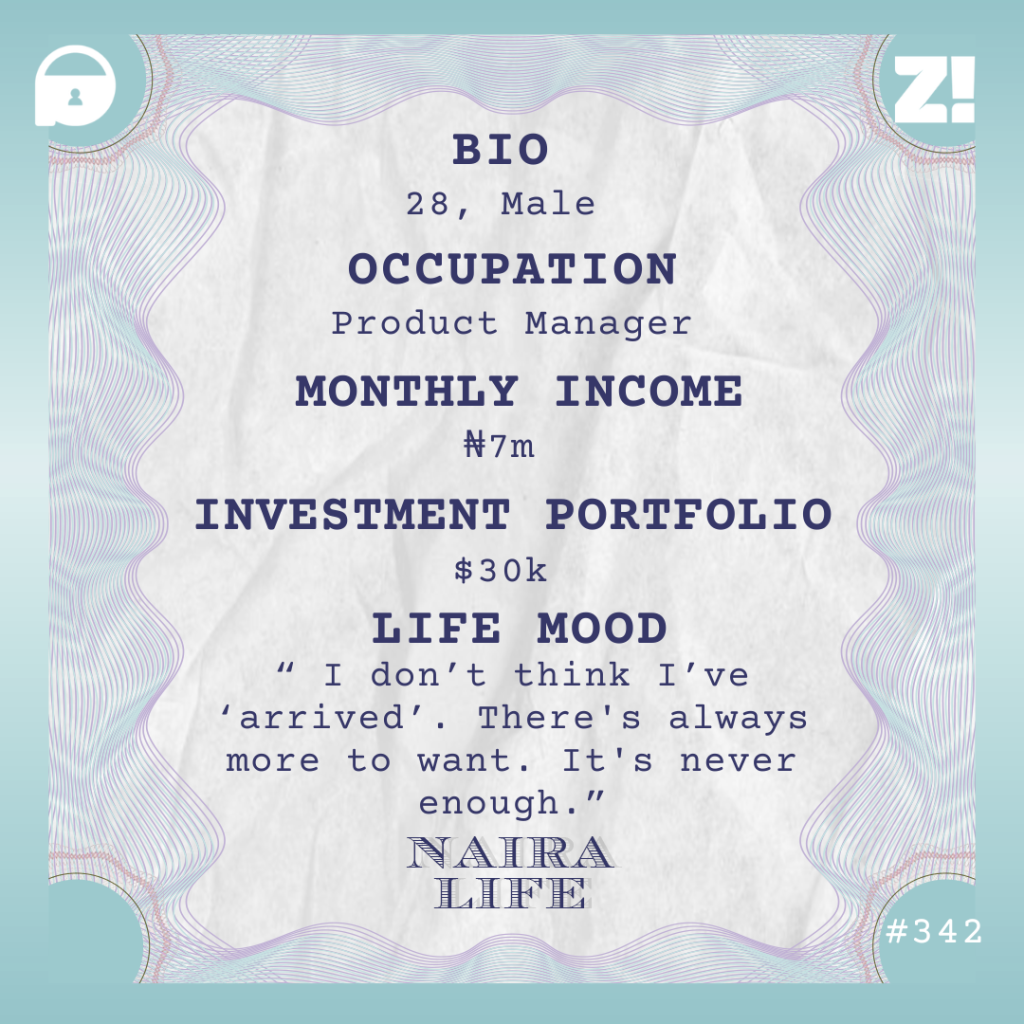
I still work at the fintech, and my salary is now ₦1.7m. However, the bulk of my income comes from my side gigs.
My current rate is $45/hour, and I make around $3500 monthly, which is about ₦5.3m. I’d make more, but I try to stick to a strict 20-hour work week. Last month, I managed to work more hours and made $5000.
I understand why you’re doing it, but do you feel like you’re leaving money on the table by capping your side gig work hours?
I’m definitely leaving money on the table. I’ve questioned myself at several points to ensure I’m doing the right thing, but I understand my long-term goal. I want to work full-time and live a balanced, healthy social life.
I feel good about the work I do at my 9-5, too. It’s not just about the money. I feel like I’ve found a decent balance for all I do. I commit to my full-time work during working hours, dedicate at least an hour each day to my side projects, and then complete them on the weekends.
Sometimes, when I get tempted to take on more side gigs, I outsource to people. However, I’ve had cases where the people I outsourced to didn’t deliver, which made me lose clients. So, I just commit to doing what I can.
What kind of lifestyle does your income afford you?
I’m still far from my dream of financial freedom, but my income has helped me move a step closer to that goal.
I can afford most things I want. I’m not necessarily flamboyant, but I like good things. I also travel twice a year. Earlier this year, I visited two African countries. I plan to go to Asia before the year ends. I couldn’t think about this before, but now it’s within my reach.
My income has given me a new perspective on the affordability of things. For instance, I know everything is expensive now, but I don’t feel it as much as I would have years ago.
God, when? You mentioned financial freedom. What does that look like for you?
It would mean not worrying about bills or emergencies. It’s having enough wealth and cash flow to comfortably support my everyday needs and parents and live a stylish — not flamboyant — life without financial anxiety.
Earning $10k/month from a full-time role would be a massive step in that direction. I say “step” because I feel like when I get to that point, the goal will move again.
How has your income growth over the years impacted how you see money?
Money can never be enough. You’ll always think that if you have a certain amount of money, you’ll “arrive” and be comfortable. But that’s not the truth. Years ago, I used to think that if I earned what I do now, I’d solve all my problems. That’s not the case. I don’t think I’ve “arrived”. There’s always more to want. It’s never enough.
How would you describe your relationship with money?
Toxic. I’m a recovering impulse buyer. I used to want to spend money as soon as it entered my hands, and I learnt the hard way. I looked at my finances last year and realised there was a problem. A lot of money was coming in, but almost nothing went into my savings. I was deceiving myself by keeping money aside, only to return and spend it.
I now put all my dollar income into my investment portfolio and then save 20% of my naira income.
What does your investment portfolio look like?
I split my investments across multiple channels and further diversify with two main portfolios with different risk levels. The alpha portfolio is high-risk, with channels like stocks, ETFs, and crypto. The beta portfolio, which is medium to low risk, consists mostly of real estate and fixed income.
My savings mostly come from my full-time salary. 20% goes to my savings account, and I also have a 10% “spend and save” plan. This means that, for every expense I make, 10% of the amount enters my savings account. Then, I also do flexible savings for big expenses like rent and travel. I budget ₦6m for my trips.
My total investment portfolio is currently worth $30k, and my naira is about ₦12m. My naira isn’t a lot because I use it for immediate needs and expenses.
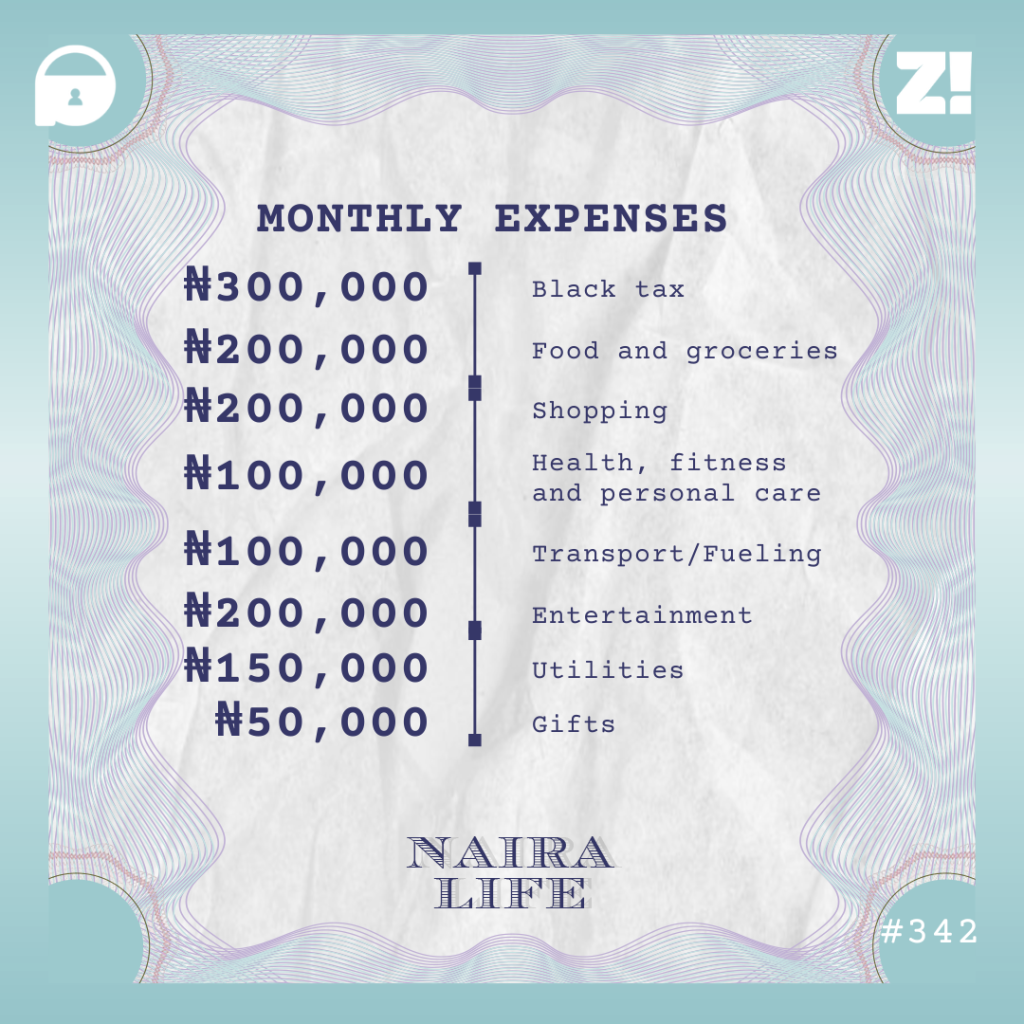
What do these expenses look like in a typical month?
Is there anything you want right now but can’t afford?
Many things, but an MBA is top of mind for me right now. It costs $120k, and I hope to get on it in the next two years.
What was the last thing you bought that made you happy?
I got a new car for my birthday last year. It felt really deserving. It cost me ₦23m, and I had to liquidate some of my investments to afford it.
How would you rate your financial happiness on a scale of 1-10?
7. I’m learning to give myself more credit for my progress, but I’m also honest enough to admit I’ve lost opportunities that could’ve taken me further. It also took me a while to find balance with my social life and mental health, but I’m getting there.
If you’re interested in talking about your Naira Life story, this is a good place to start.
In an economy troubled with inflation and rising costs, it’s not strange that the average Nigerian juggles a 9-5 with a side hustle to maximise cash flow. But what happens when the side gig becomes the main squeeze? What does it take to make the leap?
We spoke with young Nigerian entrepreneurs who’ve successfully turned their passions into full-time ventures. They shared their stories, struggles, and how the switch has impacted their finances.
Emmanuel, 29. Business Consultant
Last income at 9-5: ₦450k
Current average income: ₦600k – ₦1m
I started my career during NYSC as an account executive at an experiential marketing agency in 2018, where I earned ₦50k/month. In the same year, I began a mini side hustle building pitch decks and company profiles for older colleagues and friends. They had seen the quality of my work and trusted me with these projects.
Over time, my consulting gigs became a steady income, and I started an agency to consult for SMEs. In 2020, COVID hit and experiential agencies started struggling, so I made a move to go full-time.
An ex-boss sent me consistent freelance gigs, and I made between ₦100k – ₦350k on each one. I didn’t even have a registered business name yet. Those jobs kept me going for the rest of the year. I returned to corporate work the following year, but the seed had been planted—I could make money from this.
In January 2022, I took the final plunge and became a full-time consultant. I realised I preferred working with multiple clients and projects rather than being tied to one office or sector. Business wasn’t great at some points, and my bills took a hit. I had a social media and content manager who I owed salaries because we didn’t get clients. But that was all part of the journey. Over time, I built a team of ten full-time staff and contractors. We now help businesses with process optimisation, pitch decks, business plans, and, more recently, websites and mobile apps.
The agency generates about ₦2m – ₦2.5m in monthly revenue, sometimes more. 60% of that goes into operations, staff, contractors, reinvestment, and some savings. Then, I pay myself.
I can confidently say my decision to go full-time with my side hustle is paying off — not just financially, but in growth and purpose. I have become a better operator. I own my time, and I’ve figured out how I work best. I can show up for things that matter. I have flexibility, even if the work itself can get intense.
It does get intense. There is no guaranteed salary unless I bring in clients. I’m the CEO, marketer, salesperson and people manager. If I hire the wrong person, the business takes the hit. They will leave and get another job, but I will bear the cost.
Also, dealing with rising costs is a challenge. Many of the tools I use are priced in USD, and the exchange rates affect everything. Contractors sometimes ask for rates I cannot afford. It is a lot to manage at once.
But I’m better off for it. I understand what it really takes to run a business, and the mindset shift helps me treat my clients’ businesses with the same level of care. I pay close attention to the economy, the cost of tools, and currency fluctuations because they all directly affect my work. These things matter when you are trying to build something sustainable.
That said, the real upside has been the relationships. Some clients have grown with me and seen how we have evolved over time. That kind of loyalty, not just from me to them but from them back to me, has been rewarding. It shows that people believe in what we are building together.
Join 1,000+ Nigerians, finance experts and industry leaders at The Naira Life Conference by Zikoko for a day of real, raw conversations about money and financial freedom. Click here to buy a ticket and secure your spot at the money event of the year, where you’ll get the practical tools to 10x your income, network with the biggest players in your industry, and level up in your career and business.
Pearl, 36. Entrepreneur and Instagram Ads Specialist
Last income at 9-5: ₦90k
Current average income: ₦1m – ₦2.5m
Two years into my job at an accounting and auditing firm, I noticed I was good at selling and marketing any product. This was in 2016, and since then, I’ve been selling anything I could on Instagram: sneakers, shoes, fabrics—everything. Then, I took it further by charging people to set up sales pages online.
My first client paid me ₦30k and referred me to others. Between 2016 and 2018, I juggled my 9-5 and side hustle as a social media manager and Instagram ads specialist. Sometimes, I got up to 4 clients in a month.
In 2018, I decided to leave my corporate job and focus on my side hustle. I’d just given birth to my first child and had to resume work after three months. Plus, the creche close to my office cost over ₦200k. It was too expensive, so I took the risk and resigned. I set up a social media agency and added TikTok as another channel to sell my goods.
Today, my agency manages the social media presence of six clients, and I have three remote assistants to help me. My agency makes around ₦500k monthly: ₦300k returns to the business to pay my staff, and I pay myself ₦200k. The sales from my online stores on Instagram and TikTok typically amount to ₦1m/month. It can get as high as ₦2.5m in a good month.
Entrepreneurship hasn’t been all rosy. It’s a round-the-clock job, which can be overwhelming. Then there’s the risk — I almost lost everything between 2020 and 2021 when I sold thrift clothes. I got a bad batch of clothes, which totally destroyed my capital. But I’ve learned from that experience and moved on.
Leaving my 9-5 was the best decision for me. I have two kids now, and I have the time for them and my craft. I recently added video editing to my skills and service offerings. Things can only get better.
Eleojonigwu, 25. Ghostwriter
Last income at 9-5: ₦30k
Current average income: ₦350k – ₦450k
Between 2015 and 2021, I jumped from one secretarial job to another, earning peanuts until I realised I could earn more with a skill I’ve always had: writing.
In 2021, I started getting ghostwriting gigs and making far more than my ₦30k salary. One time, I made ₦75k from a gig. When another gig paid me ₦150k in one month in 2022, I decided it was time to pack my bags. Plus, I didn’t fancy going out, and a physical job didn’t match my personality. Realising I could make more money without leaving my house was all the push I needed.
But going full-time was challenging. My income was inconsistent for about two years, and I was always broke. It was so bad I couldn’t even afford sanitary towels. Also, I’d go hungry sometimes.
I lived with a friend and her family who were from an entirely different tribe, and they had traditional meals that I didn’t exactly fancy. So, they’d make these meals, and being a picky eater, who doesn’t like food adventures due to allergies, I’d stylishly go hungry without my friend’s mum’s knowledge on some days. Because person wey no get money no suppose get choice.
However, I began to hit stability in 2024. I grew confident in my skills and started charging what I’m worth. Now, I earn more than 10 times my previous salary, and I work from home on my own terms, albeit with deadlines sometimes.
The disadvantage of doing my own thing is that I tend to be a workaholic, so work spills into my sleep time. And sometimes, I feel sick from not stepping out for a while. I can’t explain it. So, I’m looking to enrol in a gym soon.
I also function properly when I take occasional breaks from social media, but I can’t do that because most of my gigs come from and require social media.
That said, quitting my job has been beneficial to me. I recently moved states, got my own place, and am settling in gradually. I’ll choose it over and over again.
Sharon, 24. CEO, Personal Branding Agency
Last income at 9-5: ₦83k
Current average income: ₦1m
I started my side hustle before landing a proper 9-5. In October 2023, I began offering LinkedIn optimisation services, which extended to CV writing and social media management after people kept asking for those services.
A month later, I went for NYSC and worked as a social media manager for a management consulting company. The company paid ₦50k/month, in addition to my ₦33k allawee, but the job was stressful. My life flashed before my eyes many times, and I often considered absconding because it wasn’t good for my health. I’m just a baby girl.
So, after my service year in 2024, I didn’t look for another job. Instead, I decided to treat my side hustle like my 9-5. I set up a personal branding agency and slowly built a remote team of social media strategists, writers and graphic designers to offer services ranging from LinkedIn optimisation to social media management.
The income trajectory was like a bullet. I’d spent a lot of time building my personal brand while working 9-5, so people trusted me to help them. In no time, I was making almost 20x my former salary.
Now, the agency makes between ₦1.5m and ₦2m in monthly revenue, and ₦500k goes into settling operational costs. The naira devaluation keeps reducing the value of the money I make, so even though I earn more now, the value just isn’t the same. I can only hope things get better.
My brand is still growing; I know we’ll keep improving. The best thing about entrepreneurship for me has been growing my team. I mostly hired interns, so I’ve trained them, and we’re all still constantly learning from each other and growing. I’m presently plotting how to get us to $4k in monthly revenue.
Ronke, 24. Fashion Designer
Last income at 9-5: ₦60k
Current average income: ₦300k – ₦450k
In 2020, I learnt tailoring and fashion design to pass the time. The pandemic had affected my ₦50k/month waitressing job, so I decided to learn a skill since I was unemployed. My teacher was a family member, so I didn’t have to pay anything to learn.
I didn’t start making money from tailoring immediately. I had no sewing machine, so I couldn’t practice sewing or get clients. I still survived by jumping from one job to another. Then, in 2023, while working as a personal assistant, I decided to take tailoring seriously. My boss was toxic, and I didn’t want to quit without a backup plan.
I was earning ₦60k/month, and I saved for two months to buy a sewing machine. I started by making designs for my sister and myself, and posting them on social media. I’m quite creative, so I usually have a mental picture of what to create. I even started amateur sketching and improved my skills by watching YouTube videos.
Two months after I started posting my designs online, people started placing orders. By the end of 2023, I was making an additional ₦100k/month from my side hustle. So, on New Year’s Day 2024, I texted my boss and told her to hold her job.
That’s how I became a full-time fashion designer, and it’s only been an upward journey since then. The income isn’t always consistent, especially with how expensive materials become every day, and it’s literally back-breaking work, but I’m at peace.
I still work from my balcony, but I plan to get a studio space later in the year. A studio will allow me to hire apprentices, reduce my stress, and increase my earning potential because I’ll be able to accommodate more orders.
Entrepreneurship has already helped me achieve dreams I didn’t think possible, so I’m certain the studio will happen soon. Look at me, I have almost ₦1m in my savings, and I’m largely financially independent. I never believed I’d be at this level before 25.
*The responses have been slightly edited for clarity.
Subscribe to our newsletters and never miss any of the action
[ad]
Every week, Zikoko seeks to understand how people move the Naira in and out of their lives. Some stories will be struggle-ish, others will be bougie. All the time, it’ll be revealing.
Kwakol Markets is a global broker that lets you trade multi-asset financial markets with ease. They aim to provide transparent and innovative technology that gives you a simple, secure and superior experience. Start trading with Kwakol Markets today and create the future you deserve.
Tell me about your earliest memory of money
My uncle gave me ₦100 when I was 11 years old. It was the biggest money anyone had ever given me besides the usual ₦10 I got annually from neighbours and family during Christmas and New Year. Of course, my mum took the money to “keep it for me”.
And you never saw it again
I never did o. But sometime later, when I was in JSS two, I also started making my own money.
How?
A street friend introduced me to a man who made bulk dusters and chalks for blackboards. He provided the wood and rug materials for the duster’s surface, and our job was just to assemble the materials to produce a ready-to-use duster.
We worked after school, and he paid ₦1 for every duster. My friend and I each typically made an average of 50 dusters in the few hours we spent there every day.
Were your parents aware of this?
They were aware, but they didn’t know the exact amount I earned. They just knew I used it to supplement the ₦20 they gave me for snacks. The duster money helped because the ₦20 I got was only enough for a meat-pie, or at best, a plain plate of rice. With the money from my job, I could afford meat and the occasional FanYogo or Tasty Time drink.
I stopped working with the man after a year — he started owing and defaulting even after several promises to pay. Imagine owing ₦1.
Anyway, I had to go back to managing the ₦20 from my parents.
Omo. What did your parents do for money?
My mum sold cement, and my dad was a police officer until he got wrongfully dismissed from the force in 2007.
What happened?
The Inspector General of Police at the time, Sunday Ehindero, had set up a task force to prevent police officers from collecting bribes. They’d randomly stop officers and search them. They even stipulated a particular amount of money expected to be the highest amount found on a police officer at any given time.
While this was happening, my dad was assigned on special duty to guard a bank along with some other colleagues. The bank typically paid the officers a bonus for the protection. One day after my dad and his colleagues got a bonus payment, the IGP’s task force accosted and found the money on them. All efforts to explain the source of the money fell on deaf ears. It wasn’t the first special duty he’d done, and even the bank manager testified to making the payment.
My dad and his colleagues were imprisoned for about three months before they were released and dismissed from the force.
Wow. What was this period like at home?
It was tough. My mum became the breadwinner, but she also lost her shop to a road expansion project. Although she moved her shop to a new location, sales weren’t great at the new place.
This happened after my dad’s dismissal, so things got tougher. We only had two meals a day and couldn’t afford new clothes or shoes. I’m the last born of five children, and I was still in secondary school. I remember always complaining about my tattered uniform and threatening not to go to school until she got me another uniform. I was 15 years old.
Did your dad try finding work again?
He tried his hands at other things. After the dismissal, he started buying multiple kegs of palm oil from our village and reselling them in Lagos. He did that for about three years, including some other side hustles. He also got rent from our tenants, and that was his primary income source around the time I finished secondary school in 2008, and WAEC became my stumbling block.
How so?
I wrote WAEC three times. The first one was a complete write-off. I decided to be serious the second time, but I didn’t make all my papers. The third time was the charm. That was in 2012.
I wrote JAMB the following year, passed and got admitted to study banking and finance at a Polytechnic. Then ASUP decided to go on strike for a year, and I didn’t resume school till late 2014.
So it took you six years in total. What were you doing while you waited?
Between 2008 and 2012, I sold newspapers. Every morning at 5 a.m., I’d leave my house at Ipaja and go to Oshodi to pick up the newspapers. By 7 a.m., I’d be back at my sales stand at Ipaja where I’d stay till I sold all the newspapers. This brought in ₦2,500/week.
When I left in 2012, I went to work at a Coca-cola depot where I offloaded crates of drinks from the truck and occasionally attended to customers. I did this from 8 a.m. to 6 p.m. daily except Sunday — my day off.
My starting salary was ₦8k/month; then it increased to ₦9k after a month because they noticed I was hardworking. Funny enough, they hired someone almost immediately after and paid him ₦10k. I felt cheated and let them know. They tried to match the ₦10k, but I insisted on ₦12k, and they agreed. I worked there till I had to leave for school in 2014.
A negotiation masterclass. What were you spending on?
Mostly on feeding and clothes. I also paid my last two WAEC fees myself —about ₦6k each. My dad paid for the JAMB exam.
Coincidentally, my dad and his colleagues got reinstated into the police force the same year I resumed school at the polytechnic. They’d been appealing the wrongful dismissal since 2007, but our judiciary system kept dragging it. They weren’t financially compensated, as far as I know, but my dad was able to take some exams two years after the reinstatement and got promoted to sergeant from his corporal cadre.
Interesting. Did you do anything else for money in school?
Not at first. My sister was also in my school, so I relied on her and the monthly ₦4k my dad sent me. It was just enough for feeding and nothing else. Sometimes I inflated my school fee figures, so I’d get extra money to buy textbooks.
I was supposed to go for a one-year industrial training placement after I finished my National Diploma in 2017, but it didn’t work out.
What happened?
I heard a bank was paying trainees ₦40k, and I wanted that too, so I went to their Victoria Island headquarters to apply. They told me I needed a guarantor who was a senior staff at the bank. Because I didn’t know anyone, I went to the bank’s branch in my area and started begging the staff to stand in for me.
Let me guess, they said no
Of course. They didn’t know me from anywhere, and my promises to be a good boy didn’t work.
After trying and failing to get another job at a tomato paste-producing company, I abandoned IT and just resumed school for HND in 2018.
What happened next?
I started helping people to make school payments — school fees and acceptance fees — with my phone for a fee. When I was done with the payments, I’d print the receipts at a cafe, and hand them over to my client.
I charged around ₦2,500 per person and had an average of 15 students at the beginning of each session. I did this until I left school.
I also started getting paid to write during my HND.
How did that happen?
I often wrote for fun, and many of my friends knew this. One day, a friend reached out to me and told me I could make money from writing.
Subsequently, he introduced me to someone who paid me ₦10k to edit a 50,000-word novel. When I received the money, I was like, “Ah. This thing that I’ve been doing for fun all this while?”
I didn’t know it was possible. It opened me up to the potential of freelancing. Thankfully, I had a laptop, which my uncle had gifted me, so it made it easier. I started getting more regular gigs. One of them even paid ₦50k, and I used it to buy a new phone.
Sweet
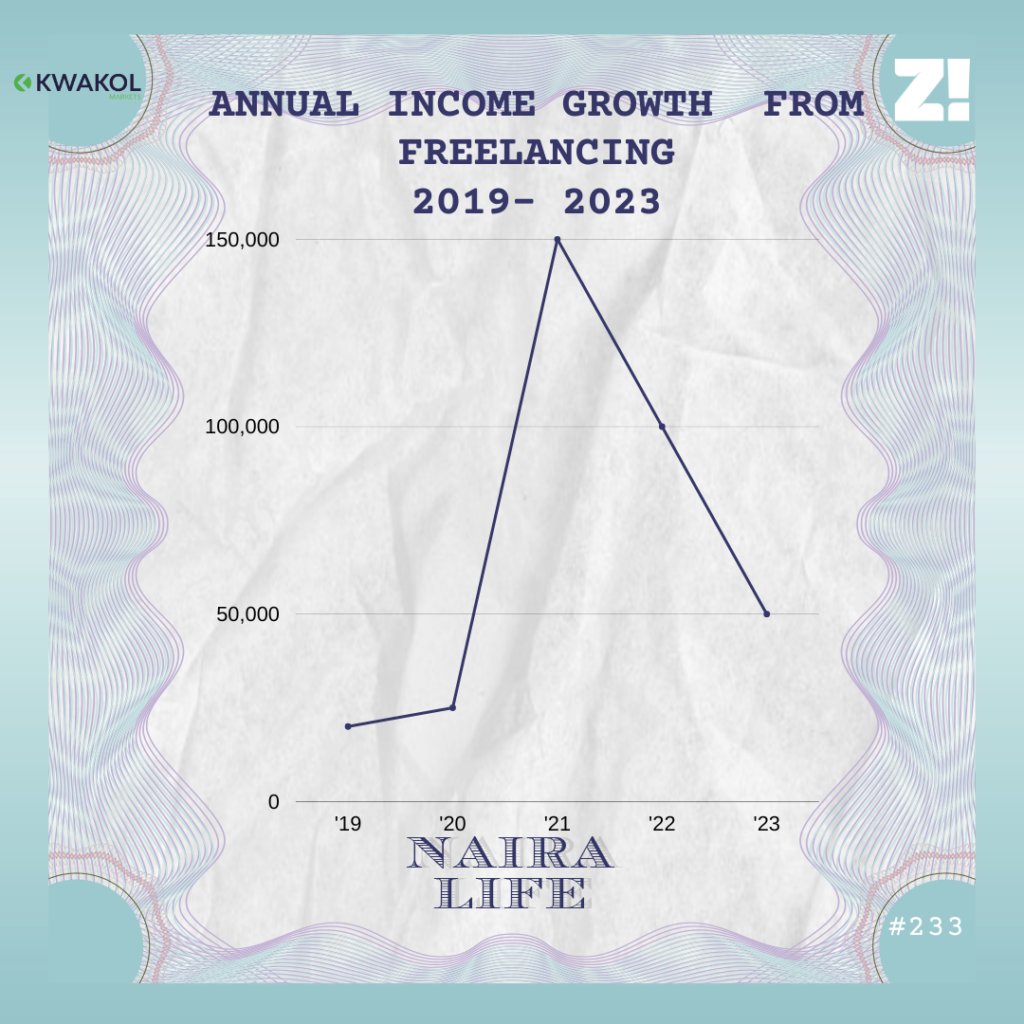
I went for NYSC in 2020 and was part of the set that did most of our service at home due to COVID. So, there was more than enough time to focus on my writing gigs. The well-paying gigs worth ₦50k to ₦60k only came like once in two months during this time, but the small ₦5k 1000-word article gigs came more frequently.
Where were the gigs coming from?
I discovered that my main contact had a Fiverr and Upwork account. So, he was getting the jobs from clients and outsourcing them to me. Many of my other contacts also did the same thing.
What kind of writing were you doing?
All kinds. Even if I didn’t know something, I never said no. One time a client asked if I could write a movie script. I’d never even seen what a script looked like before then, but I said yes and got the gig.
I did my research, and downloaded movie script samples online to study before I even started the job. I delivered it and got paid ₦15k.
How much were you making on average?
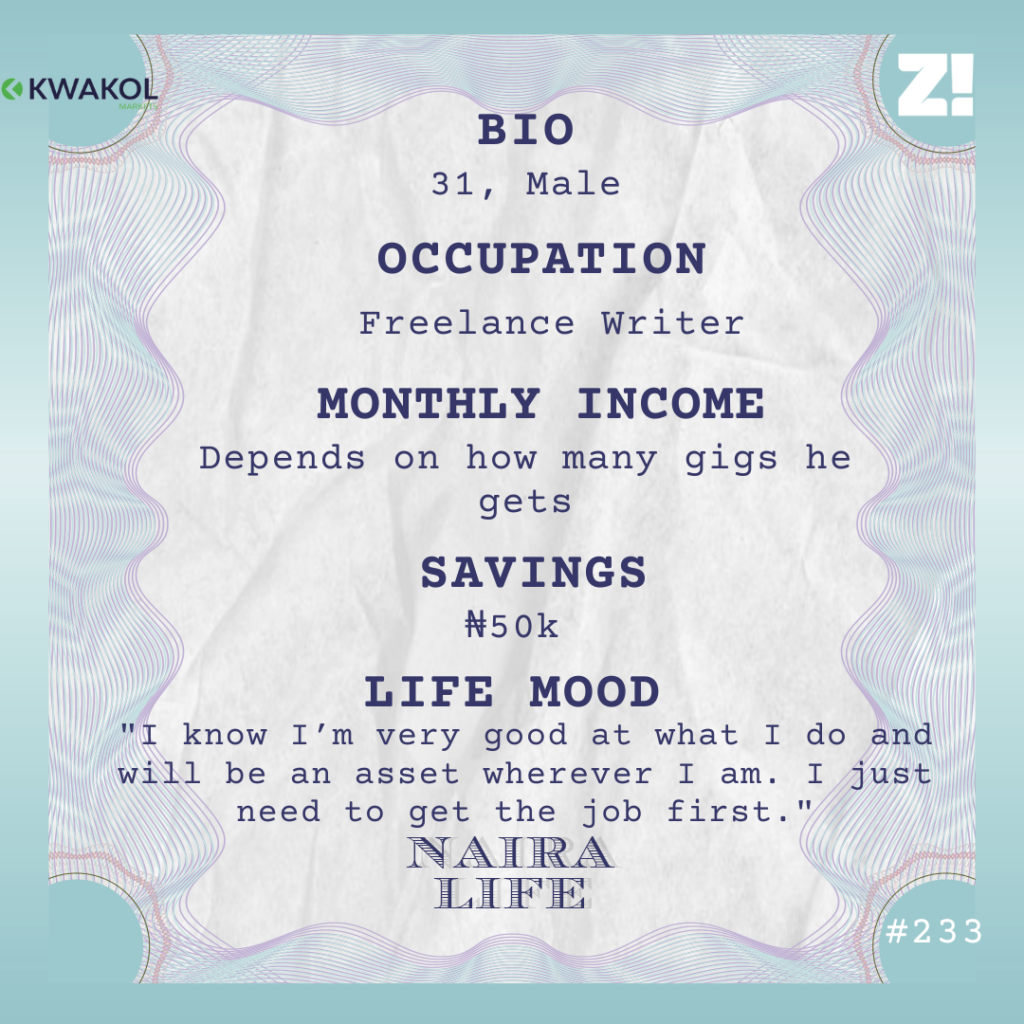
₦25k/month from writing, and ₦33k from NYSC, making around ₦58k monthly. Most of what I earned went into paying my portion of the rent for the apartment I shared with a friend, which was ₦100k. The rest went into buying a bed and other kitchen essentials in the house.
But I had about ₦300k saved up until I lost it all to a Ponzi scheme.
Ah
This was in February 2021. It’s not like I was greedy or looking for quick money. I just thought it was a legit investment scheme. Up until that point, I’d never invested in anything before. So when my girlfriend at the time introduced me to it, it looked promising.
Unfortunately, it crashed soon after, and all the money I had saved up from my gigs, including my NYSC allowance for the previous three or four months, vanished. I almost got depressed, but fortunately, the gigs got frequent right after NYSC, and I didn’t have to mourn my losses for long.
How often did you get gigs?
I had about seven steady contacts, and I started charging around ₦4 per word, which brought about ₦150k/month. At that point, I decided I didn’t need to apply for jobs anywhere. I knew many of my coursemates earning ₦80k at bank jobs, and I was earning much more working from home.
Freelancing was treating you well
It was. In 2022, I published my own fiction novel, but it didn’t turn out as well as I’d hoped.
What happened?
Firstly, it cost so much to publish. I’d initially tried to publish in 2019, but the publisher gave me a ₦300k estimate to print a thousand copies. I didn’t have the money, so I postponed it.
When I returned to the project in 2022, I found out I now needed ₦750k to publish the same number of copies. At the end of the day, I published only 100 copies at ₦220,000 — the way publishing works, it costs more to print a lesser number of copies.
Secondly, I didn’t get as much support as I expected. I expected sales to come from family and friends who had been pestering me to publish a book, but support was minimal. I even had a deal with my alma mater to help sell the book to students in the general studies department. They saw the draft, agreed and promised to support, but in the end, it was just “aspire to Maguire”. When I didn’t have money to publish the 1000 copies, they said they needed at least 500 copies for a start, which I couldn’t afford.
So the school was out of it
I had to take my books home to sell. Maybe I should have done more marketing, but that would have also cost money I didn’t have. So, I relied on my social media to market. I sold them at ₦3k each, sometimes ₦2,500. The cost of publishing each one was ₦2,200, so I made ₦300 to ₦800 as profit. So far, I’ve only sold about thirty copies. The rest are still in my house looking at me.
Did you only publish physical copies?
I also published on Amazon and OkadaBooks, but sales have been very poor. My marketing efforts could have been better, but I’ve also realised that Nigerians hardly read. My money is still in OkadaBooks because they don’t allow you to withdraw until you make ₦10k in profits after their cut. I’ve only made ₦2k. I have other books there as well, but sales have been skeletal. I’m yet to make any profit from Amazon.
What does your finances look like these days?
Honestly, not great. I started noticing a dip in my writing gigs in August 2022. My dad was hospitalised, and I had to stay with him in the hospital for two months. I hardly worked during that period. My dad later passed, and it was a tough period for me.
I’m really sorry
Thank you. By the time I came back to focus on work in October, the gigs stopped. I reached out to my most consistent contact, and he explained that his Fiverr and Upwork accounts had been closed.
Why?
Anyone familiar with these freelance platforms knows how difficult it is to get jobs if your profile has “Nigeria” on it. So, most people use fake foreign accounts to get gigs. But the platforms started clamping down on fake accounts and anyone they found operating in a country different from what their profile stated. Once the account was closed, any money that was still there was confiscated as well. This affected most of my contacts, and many of them are yet to recover.
Damn
It made me decide to open my own Upwork account, but since November 2022 till now, I’ve only got one $25 writing gig. The competition on the platform has become so intense now.
You have to use “connects” to apply for gigs. But people also bid to get their applications seen. So you can use 50 connects to bid for a job now, and someone will bid 100 connects to get to the top of the list. Even that isn’t sure because yet another person can come and bid 200 connects to take first place. It’s like using money to look for money, but not even seeing the money.
Wiun. Are you still getting any referrals from contacts, though?
Yes, but it’s far below 2021 levels. Now, I get about one or two gigs a month. I don’t think I’ve made up to ₦50k all year from freelancing.
How are you surviving?
I started writing final-year projects for students, charging about ₦25k to ₦30k per student. The last session just ended in April, and I wrote projects for about seven students in total.
How are you thinking about long-term career plans?
I’m ready to leave the freelance life behind and work in a structured environment, at least for now. The gigs are no longer frequent, and I want to take a break from working from home. I’m looking for copywriting or content writing positions, and I’ve been applying everywhere. I’ll still take on writing gigs if they come, but I need the security and consistent income a salaried job will provide. On average, I put out at least 10 applications a week.
Any luck?
I’ve only had about three interviews so far, but no job offer. I’m still holding out, though.
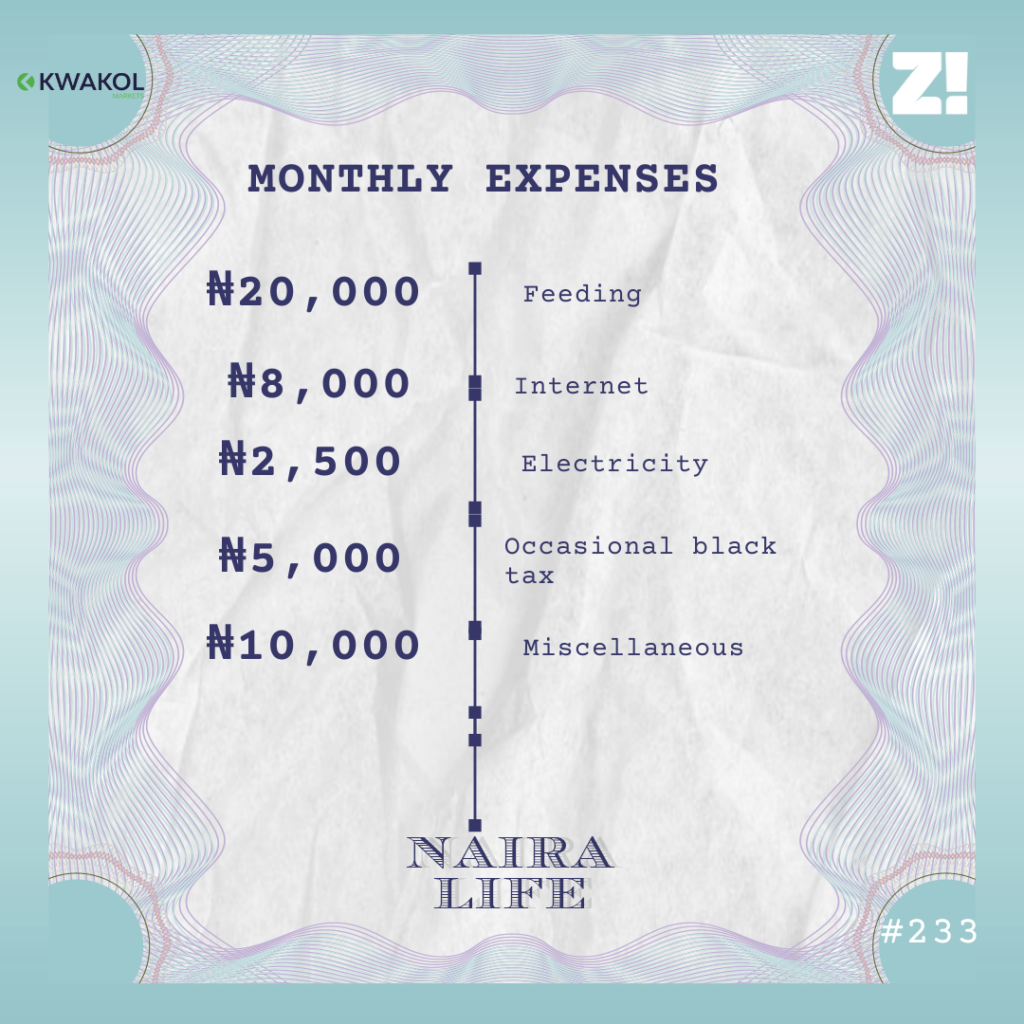
What do your monthly expenses look like?
The miscellaneous expenses include church offering, transport fare, and haircuts. I usually stock groceries that can last 2-3 months at a time, so the ₦20k for feeding goes to buying ingredients for soups/stews, bread and other perishable items that can’t be stocked. When I’m out of food items, restocking costs around ₦50k.
What was the last unplanned expense you made?
This question triggered me because I just fixed my phone’s screen last week for the second time this year. It cost me ₦20k to fix it. Imagine that kind of money going down the drain in this economy.
I feel your pain. Do you have any savings?
I have ₦50k locked up till next month in an online bank, and I’m too sure it’s what will save me by the time next month comes.
How much do you think you should be earning right now?
Anywhere between ₦150k and ₦200k, depending on if I get a job in Ibadan or Lagos, factoring in the cost of living, rent and transportation in both cities. I can even take any amount if it’s a remote job. I know I’m very good at what I do and will be an asset wherever I am. I just need to get the job first.
Is there anything you want right now but can’t afford?
A new laptop and phone. Both would cost about ₦400k — ₦250k budget for the laptop and ₦150k for the phone.
On a scale of 1-10, how would you rate your financial happiness?
3. There’s food on my table twice a day, and my laptop and phone are still manageable, so I can’t complain. But things can get so much better. I hope to get married in the next one or two years, but I’ll need my earnings to improve for that to happen.
If you’re interested in talking about your Naira Life story, this is a good place to start.