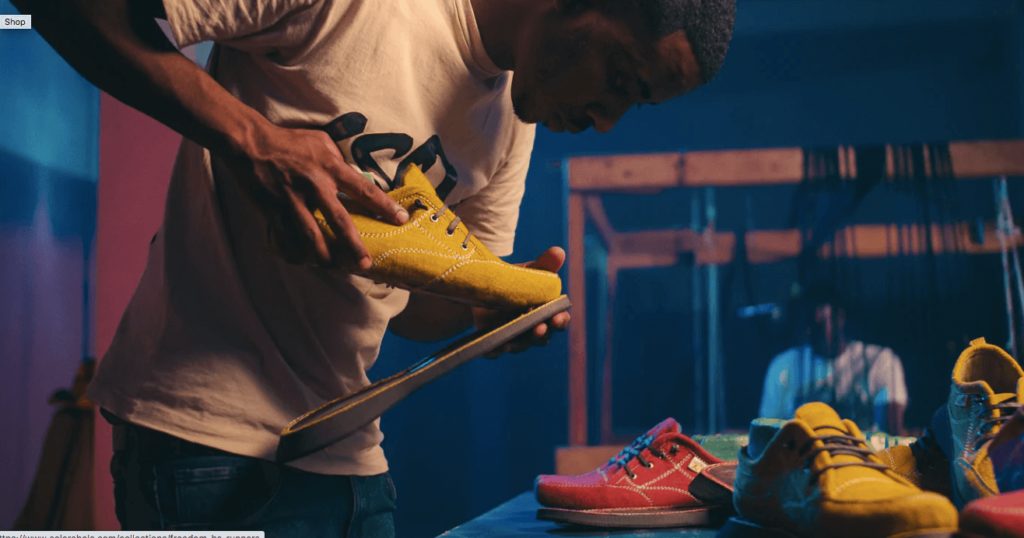
• Every week, Zikoko seeks to understand how people move the Naira in and out of their lives. Some stories will be struggle-ish, others will be bougie. All the time, it’ll be revealing.


    Over 5 million people trust Carbon to reach their goals without drowning in debt. Transparent terms, fast approval, and full control. Turns out, loans don’t have to come with pain. Click here to start.

    Nairalife #347 bio

    What’s your earliest memory of money?

    My aunt, whose place I used to wait at after school until my parents returned from work, usually gave my siblings and me ₦5 or ₦10 to buy sweets. Sometimes, we would take the money home and give it to our mum to keep. Of course, we never got the money back.

    Of course. What was the financial situation at home like?

    My parents were civil servants, and growing up was pretty chill. We weren’t “rich”, but I never worried about what my next meal would be. I don’t think I lacked anything, really. 

    Do you remember the first time you earned money?

    That was in uni. I made money writing assignments for some of my guys. I started it when I first got into uni in 2017, but I was a naive young boy. They’d ask for my help, and I’d do the assignments for free; I only asked for money for printouts.

    However, in 300 level, I realised they were taking me for granted and I needed to start charging for my time. So, I began demanding small payments, usually ₦2k – ₦3k.

    How often did these assignment requests come?

    Not frequently. In a semester, I could do about six assignments. My earnings from that supplemented my ₦10k – ₦25k/month pocket money, so I lived a relatively okay life as a student. At least, I didn’t go hungry even though I rarely cooked.

    Besides the assignments, I also had a couple of volunteering stints with an NGO, where I got a ₦2k stipend whenever we went out for campaigns. It wasn’t an actual income. 

    Fast forward to 2022, I graduated from uni, then I taught at a secondary school for NYSC the following year. My only income was the ₦33k allawee, which I supplemented with money I made from shoemaking.

    I need to give you some context for this shoemaking part.

    Haha. Yes. When did you learn shoemaking?

    2022. The long ASUU strike came just before my final exams, and I was idle and frustrated at home. I wanted to learn a skill that wasn’t already saturated. I’d already learnt graphic design earlier, but I wasn’t getting any gigs. I didn’t want to be a fashion designer because that’s what all my siblings learnt, and it felt like I knew too many tailors. 

    One day, I just thought, “What of shoemaking?” I didn’t know many people who did that, and I felt that footwear was something everyone bought, whether they had money or not. In fact, at the time, my footwear was the most expensive thing I owned. That’s how I came to a decision: I would learn shoemaking.

    My parents were against it, though. They wanted me to continue in graphic design. Some of my friends didn’t like the idea either, mostly because of the “prestige”. 

    They said, “How can you be a graduate making shoes?”

    But I didn’t care. We’re talking about money here, and you’re saying graduate. Is it better to be a poor graduate? 

    Plus, the person I planned to learn from was also a graduate. So, that was extra motivation. I was just like, “Fuck it. This is what I’m going to do.”

    Energy. Did you have to pay to learn?

    Yes. I paid ₦30k. The training was supposed to last a year, but I ended up learning for about four months because ASUU called off the strike, and I had to return to school. 

    However, from the first day of my training, I was already telling people I made footwear. I didn’t know how to do shit, but I was posting, “I’m a shoemaker” on my WhatsApp status. 

    My boss was a very nice woman. Whenever I received orders, I would tell her, and we would make the footwear together. It made me learn faster, while earning small cash on the side. I made like ₦1k profit on a ₦5k pair of palm slippers. 

    I moved to a different state for NYSC in 2023 and didn’t have any way to continue learning. I didn’t even have a machine to work with, so I initially planned to act as a middleman for footwear orders. I’d take orders, look for a shoemaker to make them and charge a little profit. But after making a few findings, I realised the arrangement would make the shoes unaffordable for people. 

    Instead, I decided to talk to the shoemakers and asked them to allow me to work from their shops. Luckily, I found someone who allowed me to do that. He didn’t charge me, but I took the initiative to occasionally buy him bread and drinks, or give his apprentice small money whenever I worked at his shop.

    Get More Zikoko Goodness in Your Mail

    Subscribe to our newsletters and never miss any of the action

    What was your income flow like?

    It was pretty good. I stayed in a corper’s lodge, and sometimes I took the shoes I worked on home to complete them. When people saw me, they’d ask what I was doing, and I used that to spread the word. So, I was getting clients from my WhatsApp status and through word-of-mouth referrals.

    In a month, I was sure of making at least five footwear. Some people also came to me for shoe repairs. My price for new footwear depended on the design. My customers were fellow corps members, and I couldn’t charge much. Plus, the number of shoes I made was more important to me than putting huge price margins on only one pair.

    My only strategy was to add a ₦1200 profit to the cost of materials and transport for whatever footwear I was making. Then, there was a popular restaurant in my area that sold a plate of food for ₦1200. My reasoning was, “If I work, I’ll sha chop.” 

    Real. Did you do this throughout your service year?

    Yes, I did. After I finished NYSC in 2024, I returned to the state where my uni is located, with a plan to double down on shoemaking. I was convinced I could make more money by putting more energy into my craft. 

    My theory worked. I stayed among students and quickly started getting customers. Unfortunately, my parents pressured me to return home to Lagos after three months. I got to Lagos and everything just dried up. 

    Phew. You stopped getting customers?

    Not totally, but there was a big difference. During NYSC and in school, I had a community of people I could talk to and plug my work. But Lagos is like a jungle; no one sends you like that. 

    I decided to use the opportunity to improve my shoemaking skills. I found a shoemaker and paid ₦40k to learn more designs. I even paid the ₦40k in instalments. 

    How long was the training for?

    I only spent about three months there because I secured an internship through a government-funded graduate internship scheme, which places people in various organisations. My internship was with an insurance company, and they paid me ₦60k/month for the three-month period.

    While doing that, I returned to school for my master’s program because my parents wanted me to. They weren’t even in support of my learning more shoemaking skills. They insisted on the master’s until I relented. I’m still on it. I’ve completed my coursework, though; only my project is left. 

    How do you support yourself in school?

    It’s mostly my parents. They don’t give me an allowance, but I tell them what I need for school, and they pay for it. 

    When I’m not in school, I live at home with them, so I don’t have major expenses. I handle petty expenses with the income from the occasional shoemaking orders. I usually pile up the orders for when I return home during the weekends so I can work on them at my boss’s shop. 

    On a positive note, I now have a filing machine, but that’s just one of the many pieces of equipment I’ll need if I hope to stand on my own one day.

    What’s your income like these days?

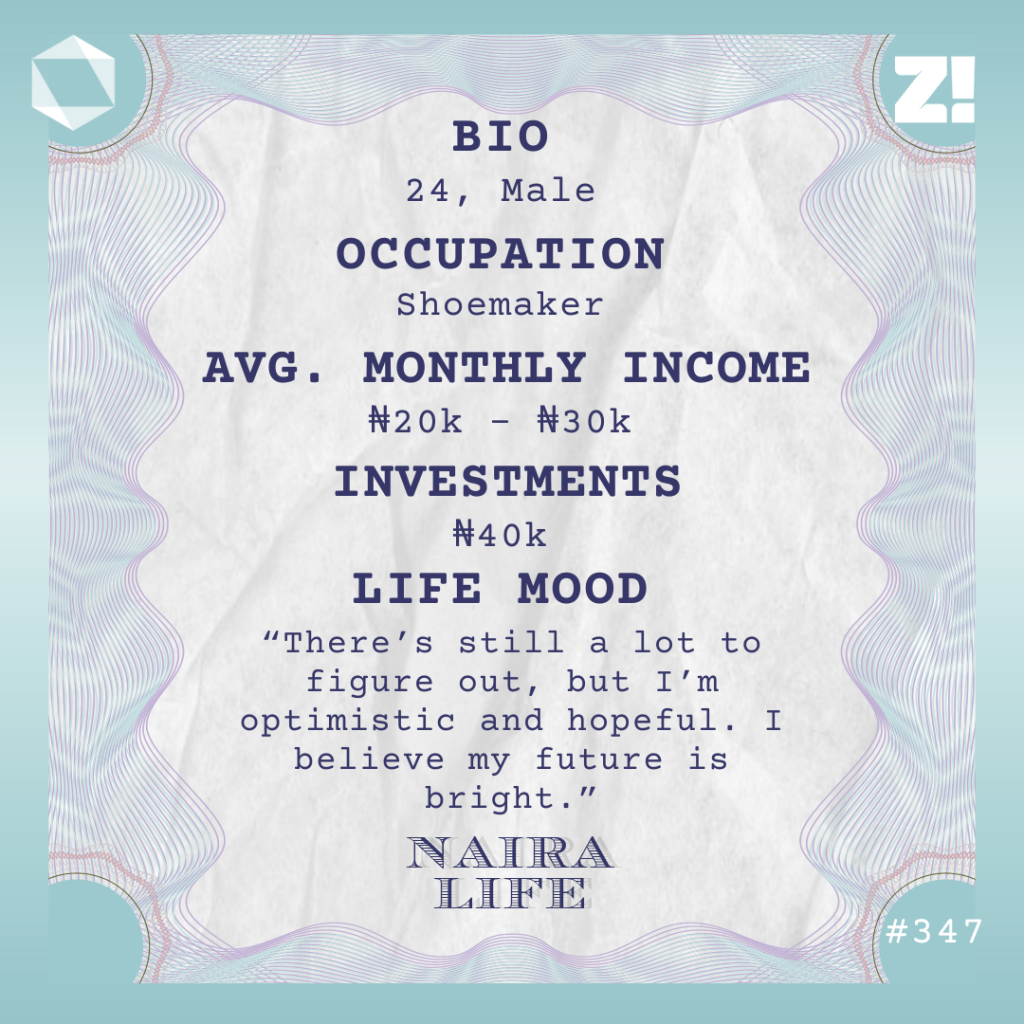
    I make an average revenue of ₦100k/ month, but my profit after deducting the cost of materials and transport only amounts to between ₦20k and ₦30k. It’s not big money, but at all at all na im bad.

    At least, I’ve gone from charging ₦5k to at least ₦15k, and I market my business on my various social media platforms. I know I can earn more from this if I put in more effort and acquire additional equipment. I’m also jobhunting, but nothing has come out of that yet, so I’ll have to hold on to shoemaking.

    If I push harder, I might even make more than whatever a 9-to-5 job would give me. I’m open to every opportunity.

    You mentioned equipment. Have you thought about what you’d need?

    The last time I wrote down a list of machines, it totalled about ₦10 million. But that’s on a full industrial scale. For a start, I estimate about ₦500k for equipment. The most important things I need are shoe lasts and a sewing machine. That ₦500k doesn’t include the cost of renting a shop. I don’t know how much that would be. 

    How would you describe your relationship with money?

    I’m stingy with money like mad because I don’t know where the next one will come from. If I don’t need something, I won’t buy it. My major expenses are data and small stocks that I buy once in a while.

    Stocks? How did you start?

    I started in 2020 with a fintech app that allows you to buy shares from global companies like Apple, Microsoft and Google. I didn’t know much about it; I just put money there that time. I can’t even remember how much. Then, when I was broke, I took it out. 

    It wasn’t until recently, when I started seeing buzz around foreign stocks, that I realised I could’ve made so much money if I hadn’t sold it. The incident drove me to research financial instruments and education. Now, I try to put small ₦1k here and there in stocks. I follow people who talk about money online and try to observe what they’re doing. 

    I currently have like ₦40k spread across both Nigerian and US stocks. The dividends aren’t much because it’s still small money, but I figure it’ll grow as I stay consistent with it through the years. 

    Do you also save, or are stocks your primary financial instrument?

    I don’t typically save. I used to buy dollars to keep my money before, but I stopped because the naira started gaining against the dollar, and it no longer seemed profitable to buy dollar. I should also have some Bitcoin somewhere, but it’s been a while.

    Let’s break down your typical monthly expenses

    NairaLife #347 expenses

    Is there an ideal amount you think you should be earning?

    If I see ₦500k/month right now, whether from a 9-to-5 job or my business, I’ll be chilled.

    What do future plans look like for you right now?

    Honestly, I’m still figuring it out. I want to do more with shoemaking; I also want to get a good job. I’ve been searching for one within the advocacy sector, but I’m fine with anything. There’s still a lot to figure out, but I’m optimistic and hopeful. I believe my future is bright.

    Rooting for you. Is there anything you want right now but can’t afford?

    I’d like to change my phone to an iPhone 11 Pro Max. I don’t even know how much they sell it. Maybe ₦400k?

    How would you rate your financial happiness on a scale of 1-10?

    Happiness? Zero, abeg. I’m not happy at all. I have no cash. That’s not a happy situation.

    Hoping things change for the better soon. What would make you happy?

    Thank you. If I see 100 orders now, I’m sure that rating will change. I believe it’ll happen one day.


    If you’re interested in talking about your Naira Life story, this is a good place to start.

    Find all the past Naira Life stories here.

    Subscribe to the newsletter here.

    [ad]

  • Across the continent, shoemakers are winning fans, accolades and awards. Two Nigerian brothers, chasing their childhood dream, have taken things one step further.

    Shoemaker

    By Dorcas Bello, bird story agency

    A storefront situated between distinctive rock outcrops in the Gwarandok community in Jos reveals a display of locally-made shoes whose perfect stitching is a tribute to hand-crafted luxury wear. Inside, a social-media-led initiative offers Zoom classes to would-be shoemakers from across the globe. Welcome to the brave new world of African footwear.

    “Over 90 percent of the current Nigeria shoe market share is controlled by China and Europe,” said Daniel Dung-Gwom. With their Jmofs shoes, he and his brother Gyang are on a mission to change that with what Dung-Gwom refers to as an “Afrocentric brand with a global appeal”.

    “Jmofs… as a brand, is on a mission to build the foremost appeal brand in Africa within the next eight years with branches across the continent,” said Dung-Gwom.

    The brand, an acronym that stands for “Just men on fire” reflects their passion not only for creating footwear but also for building an African luxury brand. That passion extends from their location in Jos well beyond Nigeria, especially now that the brothers have boosted their virtual presence.

    “It was a cheeky initiative that has over time developed into an academy to expand the continental statement on shoemaking. Our objective is to train aspiring shoemakers to be independent or to have a better chance of being recruited by big companies,” Dung-Gwom said of their wider enterprise, which includes online training.
     
    Daniel, 34, and Gyang,37, both trained as cobblers before turning to shoe design. But their journey goes back much further.

    The two started their first shoe “enterprise” aged just 7 and 10. In Nigeria, as in many other parts of Africa, cobblers are usually older people with little or no formal education, with lowly status and earnings. Little wonder the two budding cobblers were reluctant to tell their father about their new business idea.

    “When my brother and I decided to start fixing shoes, we weren’t sure about how our father would take the news. We were both very happy and shocked when he encouraged us,” said Dung-Gwom.

    For them, their “little mischief” was meant to raise money to satiate their childhood cravings: kuli kuli (a snack made from groundnuts) and garri (cassava flakes).

    The brothers – inseparable in their younger days – are the third and fourth siblings in a family with five children. With their father a professor at the University of Jos and their mother an administrator at Plateau State Polytechnic, the two might well have been expected to follow academic careers.

    But there was no such pressure. Instead, the two primary school children collected old shoes from their friends and placed them under a table they set up as a workstation in front of their house, to attract customers.

    “It wasn’t so hard for us to set up our workplace, Gyang had the shoe-making thread and needle we were using to mend our friend’s shoes, and we soon got into the business,” Dung-Gwom explained with a smile.

    Their rate was ₦2 (around half a US cent) per repair. Almost as soon as the money was handed over, it was quickly spent on kuli kuli and garri. There were no savings.

    27 years later, their shoe business is a very different affair.

    While both brothers did in fact attend university after school, Gyang never lost his love for shoemaking. In 2008 he started buying and selling shoes as a business. He soon realised that he could make some of the shoes he was trading himself, and started a manufacturing company called “J-made”, a name that was meant to imply “made in Jos”.

    “We had this sewing machine in the house and he started making his own shoes,” Daniel said. “We loved the first few pairs that he made.”

    In 2010, Gyang asked his younger brother, by this time a tech enthusiast imbued with an entrepreneurial spirit and a thorough knowledge of shoes, to help him with research.

    “Helping my brother… ignited my love for shoes, and I began to see the brighter picture in shoemaking and ideas on how we can succeed and empower others,” said the younger Dung-Gwom.

    The brothers formed a new business venture — Jmofs.

    Today, the glass-fronted building in Jos is not only their display space but is also home to Jmofs Academy, an initiative that is a result of daring to dream big about what had started off as a “boyish adventure”.
     
    Through the academy, the Dung-Gwom brothers plan to train about 2,000 young people in shoemaking in an effort to create the next generation of African shoemaker — although it is not only Africans who are interested.

     “When I got the idea for the academy, I had the global audience in mind. I wanted to start with Nigeria, but after the advertisement, a lot turned out differently. The videos and pictures of Jmofs’ shoes attracted a global audience, and we are currently training students from seven African countries and India and Canada,” Dung-Gwom explained. 

    The training is not only about how to make shoes but also how to run a successful and globally competitive venture.

    “The fee is between ₦15,000 to ₦30,000 (around $35 to $70) with the latter being in-person training while the former is for online classes. On completion, the trainees are awarded certificates that are recognised by the (Nigerian) government,” he said.

    Many of the trainees are keen to start their own businesses, while others attend in order to develop the skillsets needed to be hired by established firms.

    “Not everyone can run a business effectively, so it is important that younger shoemakers are trained in shoemaking to be recruited by big companies,” Dung-Gwom said of the online courses.

    Jmofs has eight full-time staff and over twenty ad-hoc staff. The company competes locally with brands such as Abba Shoes from the State of Abia, the headquarters of Nigerian-produced shoes. 

    The prices of their shoes range between ₦10,000 and ₦40,000 depending on the style and quality of the materials, which are sourced both locally and internationally. 

    These days, Gyang is a graduate of Plateau State Polytechnic and an Association of National Accountants of Nigeria (ANAN) certified accountant while Daniel is a graduate of Nassarawa State University with a degree in public administration – and Jmofs is on a path that is being followed by more and more entrepreneurs on the continent: creating brands by Africans for Africa, but with an eye on the diaspora and global market.

    To take advantage of the opportunity, local shoe producers have sprung up across Africa to tap into the growing preference for trendy African-made shoes.

    In South Africa, brightly coloured Bathu Shoes, which markets itself with the slogan “By Africans, For The World” and is owned by entrepreneur Theo Baloyi, has taken the country by storm. Baloyi, also a trained accountant, has opened a chain of stores and won a string of local and international awards.

    In Ethiopia, one of the top shoe brands is Sole Rebels., which was founded by Bethlehem Tilahun Alemu, an Ethiopian businesswoman, in 2004. The company specialises in “artisan-crafted” shoes, many made from upcycled materials. The shoes are bright, modern and distinctive.

    “Having grown up watching our family and neighbours struggling, we decided to create the ‘better life’ we were all waiting for by harnessing our community’s incredible artisan skills and channelling them into a sustainable, global, fair trade, footwear business,” Alemu says of her vision.

    Ethiopia today exports some $30m worth of shoes each year.

    In Kenya, a firm founded in 2014 by entrepreneur Chania Lackey manufactures Swaheelies, footwear made of fabric sourced locally and from Tanzania, Uganda, and Nigeria.

    According to Suki Eleuterio, the author of the blog, Found My Light, Lackey was always “interested in fashion, business, and the beautiful, diverse Kenya culture,” and has carved a niche across the region with her trendy shoe products. She is hardly alone.

    According to the Times of Africa, by 2023, Africa’s footwear industry is expected to cross the 1 billion US dollar mark in terms of value and home-grown shoe enterprises have caught the attention of many local bloggers.

    According to youth activist and blogger Friday Bako, “Jmofs is telling a new African story through their shoes competing with international brands.”

    The growing attention on social media has seen Jmofs’ market expand well beyond Nigeria.

    “We sell more through social media and word of referral besides targeting corporate professionals, elites, and schools,” said Gwom-Dung.

    According to Nigerian economic analyst Marshal Bakut, the ventures by young Africans hold great promise in using local materials to creatively manufacture goods such as shoes.
       
    He adds that while some people may look at local start-ups as shoes as “uncool” compared to their overseas competition, in addition to tapping into the “Africa Rising” narrative, they also offer personalised services to the clientele.

    “For instance, the shoe business sector, aside from its capacity to raise recurring income, provides the window for new thinking/initiative. Small businesses provoke hard work on the part of the owners; there is always the sheer need to satisfy the next customer as their referral is integral to expansion,” Bakut said. 

    “There is a great market waiting to be exploited, Young people must be made to understand that. Let’s start with the value chain it develops, I mean, the intermediate materials sourced locally, which invariably contributes to capital formation and improves revenue for the supplier,” he explained.
     
    “Secondly, the local market understands the local consumer better, so the advantage lies with the local producer, not the importer.  The capacity to improve employment is another focal factor.”
     
    The Dung-Gwom brothers are not the only ones seizing that moment. However, in their efforts to nurture the next generation of African shoemakers through their academy, they are also laying the foundation for something far bigger.
     
    “We want to be remembered as one of the leaders of African industrialization in this journey that is now Jmofs Academy whose main objective is to project Africa’s abilities,” said Dung-Gwom.

    “With the clock already ticking on our 10-year expansion vision, we are keeping our eye on the ball to ensure that what we have started at Jmofs Shoe will be part of the story of Africa’s industrialisation success,” he concluded.