
• Someone you know has left or is planning to leave. 1,000 Ways To Japa will speak to real people and explore the infinite number of reasons and paths they use to get to Japa


    Akin (32) was sponsored to attend a South African conference, and his life changed because of it. In this story, he shares how networking, resilience, and 80 attempts at shooting his shot got him a fully-funded academic fellowship in the country.
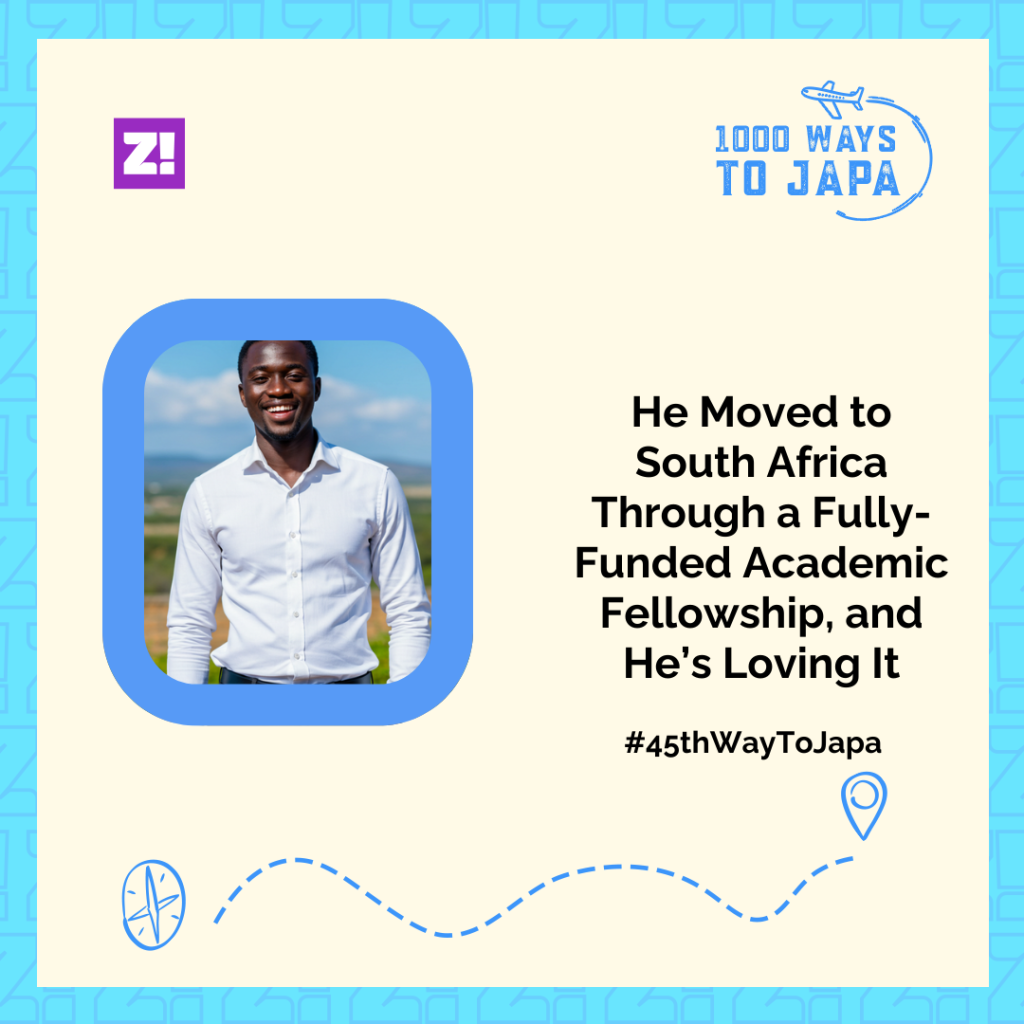
    Where do you currently live, and when did you move out of Nigeria?

    I live in Johannesburg, South Africa. I’ve been in and out of Nigeria for a while, but I officially left in 2024 for postdoctoral research as a postdoctoral research fellow (PDF) at the University of Johannesburg.

    South Africa is a unique choice for most Nigerians. Why South Africa?

    I studied accounting in Nigeria, where I obtained my first, second, and third degrees. I am also a member of the Institute of Chartered Accountants of Nigeria.

    South Africa came into the picture in 2022, when I submitted an application for a conference there but couldn’t attend due to some challenges. I tried again in 2023, and at that time, I got a sponsorship to participate in a conference at Daniels College of Business.

    After attending that conference, I realised there were opportunities for PhD graduates to take on postdoctoral fellowships. If I hadn’t attended, I probably wouldn’t have known. That’s the power of conferences—you meet people, network, and get access to new doors. After that conference, I started applying, and by October 2024, I officially began my fellowship at UJ.

    Get More Zikoko Goodness in Your Mail

    Subscribe to our newsletters and never miss any of the action

    Congratulations! How is the fellowship going?

    It’s very research-focused, but it’s going well.

    How exactly did you apply for the fellowship?

    I started applying when I got back to Nigeria. I sent out over 80 emails to professors and lecturers in my field. I faced many rejections, but I also got good feedback. Eventually, I secured offers from both the University of Johannesburg and the University of South Africa (UNISA). Since UJ gave me the first offer, I chose them and resumed in October 2024.

    And is it a fully funded fellowship?

    Yes, all expenses paid.

    So, how can other Nigerians get similar opportunities?

    You only need three things: determination, exposure, and networking. My own journey started with attending that conference. When I got back home, I began sending emails to professors. I attached my CV, introduced myself, and expressed interest. Consistency is key. You’ll face rejections, but if you keep pushing, you’ll get positive responses.

    Also, start early. Postdoctoral fellowships usually require you to apply within the first five years of completing your PhD. So if you wait too long, your chances get slimmer. My advice to younger colleagues finishing their PhDs is: apply immediately, even before you officially finish. Also, publish as much as you can in international journals, not just local ones. In South Africa, for instance, there’s a list of accredited journals that count towards your credibility. Publishing there increases your chances.

    You mentioned sending emails to 80 lecturers. How do you even find these lecturers to pitch to?

    It’s simple. Go to university websites and check departments in your field. You’ll usually find lecturers’ profiles and email addresses. That’s how I reached out. My first offer came through networking at the conference, and the second came through cold emails. Both strategies work.

    ALSO READ: She Got A Fully-Funded Scholarship After Sending 360 Cold Emails. Here’s How She Did It

    Interesting. So, is this type of fellowship open to people without a PhD? Maybe master’s graduates or undergraduates?

    For a postdoctoral fellowship, you must already have your PhD; that’s the minimum requirement. But South Africa also offers fully funded scholarships for MSc and PhD. In fact, many Nigerians are here doing their PhDs with funding. If you’re in the sciences or technical fields, your chances are even higher, especially if you can provide a good proposal and a host supervisor.

    Do South African universities have a fixed application window, like the UK or US?

    Yes. Applications usually open towards the end of the year, around October to December. By January or February, admissions are released. It’s better to start early. Do your homework by finding potential supervisors, reaching out, and getting your documents ready. The documents should include your passport (valid for at least three years), evaluation of your certificates, certified copies of credentials, medical documents, and a visa.

    Great. You’ve shared a lot of tips already, but do you have any final advice for Nigerians who want to pursue these opportunities?

    Yes. First, don’t get discouraged by rejections. It’s part of the process. Keep sending emails, keep networking, keep publishing, and keep pushing. Money can also be a challenge, but don’t let that stop you. Sometimes help shows up when you least expect it. For instance, someone sponsored my conference trip, which eventually led me to this fellowship.

    Also, even while still in Nigeria, keep yourself active by publishing, collaborating, and building your CV. Opportunities sometimes come at the most random times, and if you’re not prepared, you’ll miss them. And finally, fellowships are life-changing. Beyond funding, they expose you to better research facilities, training, and networks. What takes me two months to achieve in Nigeria, I can finish here in two weeks. Unfortunately, our country doesn’t provide the same enabling environment, and that’s why many scholars leave.

    But I’ll say this, Nigerians have so much potential. Being here showed me I could achieve far more than I ever imagined. 

    On a scale of one to ten, how would you rate your experience in South Africa so far?

    Okay, I’d say around seven or eight. Life is great here.


     Want to share your japa story? Please reach out to me here.

    [ad]

  • Someone you know has left or is planning to leave. 1,000 Ways To Japa will speak to real people and explore the infinite number of reasons and paths they use to get to Japa


    Ayo* (26) realised that audacity was the only thing standing between her present and her future dreams, so she decided to break that wall.  In this story, she shares how she got a full scholarship in the US after sending 360 cold emails to different professors. 

    When did you move out of Nigeria, and where are you currently based?

    I left Nigeria in August 2025. I’m currently in New York.

    Nice! How exactly did that happen?

    I got a scholarship to pursue a master’s–PhD track program. I’ve always wanted to move to the US and become a doctor. During my service year, I learned more about graduate school opportunities in the US, and I started working towards it. When I graduated, I gathered my transcripts and passport and started emailing professors. That’s how I eventually got here.

    Some people believe you need a very high CGPA to qualify for scholarships. Do you agree?

    Aiming for a first-class isn’t a bad idea, but a second-class isn’t bad if you have other strong experiences. I graduated with a 4.19 CGPA, which is technically second-class upper. By US conversion, that came down to about 3.52 on a 4.0 scale, and most schools require a minimum of 3.0. So I was still eligible. To make up for not having a perfect CGPA, I focused on research experience, volunteering, and teaching experience. As someone who wrote JAMB three times in Nigeria, I’ll always advise people to aim as high as they can academically.

    Get More Zikoko Goodness in Your Mail

    Subscribe to our newsletters and never miss any of the action

    Why did you have to write JAMB so many times?

    It wasn’t because I failed. I’ve scored as high as 270 in the exam, but I was trying to study medicine, which is highly competitive in Nigeria. You need 300+ and almost straight As in WAEC. My WAEC wasn’t strong enough, so I was offered related courses instead of medicine, but I was so fixated on becoming a doctor that I refused alternatives. That’s how I ended up writing the exam so many times. 

    Now that you’re in the US, are you still pursuing medicine?

    Not exactly. I studied zoology for undergrad, so I couldn’t go directly into medicine. I switched paths and am now studying biosciences and biotechnology. My goal has changed from being a doctor to becoming a professor and contributing to society through research and teaching.

    That’s amazing. Let’s talk about finding opportunities. If someone is clueless about scholarships, how would you advise them to start?

    First, be clear on why you want to attend graduate school. Then research aggressively. You can use Twitter and LinkedIn to follow people who are active in grad school and scholarship communities.

    Secondly, gather research experience, teaching, volunteering, and skills relevant to your field. You also need to learn how to cold email. That’s when you email professors, express genuine interest in their research, and ask to join their labs. If they like your profile, they’ll interview and possibly accept you.

    You can apply directly for positions in non-science fields, but you still need to be competitive to stand a chance. 

    What step-by-step process did you personally take?

    Thankfully, I worked closely with my supervisors during my undergraduate studies. So I had relevant research and project experience. I also volunteered, added other skills to my CV, got my transcripts and passport ready, and then started cold emailing professors. I sent over 360 emails, did about 20 interviews, and finally got accepted by three professors.

    I also applied to multiple schools, wrote English tests where required, paid some application fees, and prepared my statement of purpose. It was a lot of work.

    There are also organisations that help, like EducationUSA and various mentoring groups. I also reached out to people on LinkedIn in my field, asking them to mentor me. Sometimes, strangers even offered to pay my application fees when I couldn’t afford them.

    Your Statement of Purpose is one of the most important steps during the process, so please take it seriously. Also, get strong recommendations from people who know your work (supervisors, lecturers, etc.).

    You mentioned cold emailing. How exactly do you find professors to pitch to?

     I searched by research interest. For example, since I’m interested in cancer-related bioscience, I looked up professors across different schools, read their papers, and reached out. The strategy is to personalise your email by showing genuine interest in their work, explaining how your skills fit into their research field, and what you can contribute to their lab.

    That’s interesting. Were there rejections along the way?

    People who receive zero rejections during this process are superheroes. I faced multiple rejections from schools and professors, including one of my dream schools. But rejection is normal. You have to keep going. I applied to six schools; I got three rejections and three acceptances, which is interesting because I had the permission of the professors I pitched to submit my application. 

    Crazy stuff. Do these opportunities also exist for arts students?

    They may not do lab work, but they still have research opportunities. If I’m being honest, they’d probably have to work twice as hard and do more research to find those opportunities, but they exist. One of my friends just received a full scholarship to study Creative Writing. All she did was demonstrate passion, show solid experience, and submit a strong application.

    Now that you’re in the US, what’s life like compared to what you imagined?

    It’s quite different from Nigeria. Here, we have multiple exams in a semester, lots of assignments, and constant reading. But the system is very supportive here. Professors and classmates are open, friendly, and willing to help. There are also many presentations, so you can improve as a public speaker. It’s exceeded my expectations so far.

    On a scale of one to ten, how happy are you in New York?

    I’d say eight. I’m a teaching assistant, which is a huge plus. I’m doing meaningful research, making friends from different countries, and building connections.


     Want to share your japa story? Please reach out to me here.

    [ad]

  • Someone you know has left or is planning to leave. 1,000 Ways To Japa will speak to real people and explore the infinite number of reasons and paths they use to get to Japa


    Chinwendu always knew she wanted a world-class education, even before finishing her undergraduate degree. In this story, she shares how she’s now living her dream as a PhD student at an Ivy League university in the USA, on a full-ride scholarship that covers everything from living expenses to books.

    Where do you live now, and when did you relocate from Nigeria?

    I moved to the United States in August 2025 and am studying for a PhD. 

    Congratulations!

    Thank you.

    How did that happen?

    My goal has always been to further my education. Growing up, I dreamed of becoming a university professor, so I knew I needed to pursue postgraduate studies. After graduating last year, I immediately started working toward that goal.

    Right. What degree are you chasing right now?

    It’s a PhD program. Technically, I could earn a Master’s through coursework, but my scholarship is specifically a PhD scholarship. 

    Get More Zikoko Goodness in Your Mail

    Subscribe to our newsletters and never miss any of the action

    Nice. Is it a fully-funded scholarship?

    It’s fully funded, covering tuition, books, insurance, and even living expenses.

    Goals! How did you get the scholarship? 

    There’s no single “format” I followed, but I’ll explain how I did it. 

    First, I started preparing early in my undergraduate days because I knew what I wanted. From my second year, I was already following scholarship pages on LinkedIn and Twitter. I had seniors who also shared opportunities, so I stayed updated. On my part, I worked hard to maintain a strong CGPA because it was non-negotiable. I graduated with a 4.87/5.0.

    That’s insane

    I know! Apart from academics, I attended seminars, career development programs, and even award nights; things most undergraduate students ignore. But those programs motivated me, especially when other students were recognised for their work. I also took up leadership roles because I knew graduate schools don’t just look at academics; they want to see extracurriculars too. All of this shaped my CV and my story to be more than “I graduated with a first class.”

    After graduation, I started applying to schools. I created a spreadsheet of schools, their requirements, whether they had application fees, deadlines, and everything else. It helped that I also had a small circle of friends chasing the same dream — we encouraged each other through rejections.

    Application fees can be quite a large sum, and I didn’t have that. So I emailed schools to request waivers, and surprisingly, many granted them. That’s one tip to keep in mind. Don’t just see a $150 application fee and give up when you can ask for a waiver.

    Thanks for the tip. Do you have more? 

    You should also prepare your application documents: statement of purpose, transcripts, and recommendations. For writing statements of purpose, I took online courses (you can find these on Coursera). I also followed people who shared reliable information on scholarships, like Michael Taiwo Scholarship, Scholarship Café, Banda Khalifa, Mercy OJetunde, and so many others.

    Most importantly, I kept good relationships with my lecturers. Recommendation letters are vital. They’re not written overnight, so I always give them time.

    Finally, I prayed. Honestly, you’ll face many rejections, and sometimes, the only thing that keeps you going despite the rejections is faith. 

    Speaking of rejections, did you receive any?

    Plenty. I applied to several U.S. schools, but not all accepted me. What shocked me was that some Ivy League schools considered me, while other schools rejected me. At first, it felt crazy, but I realised maybe I just wasn’t the right fit for them.

    That’s crazy. What other practical tips can you share for those currently applying?

    You need to understand that graduate school applications are not easy. Nobody will give you funding just because you want it. You must be willing to put in the work. 

    My first tip is to keep a spreadsheet of schools, deadlines, requirements, and funding availability. Without that, you’ll be lost.
    You should also apply strategically. Some schools don’t offer funding, and some schools do. Know what each school offers if you don’t have enough money to self-sponsor.

    Your statement of purpose is a great place to show a genuine interest in the school. Don’t just write “this school is prestigious.” Everyone writes that. Mention specific professors or programs that align with your goals.
    Another tip is to start your search for recommendations early. Don’t bring up your requests at the last minute. Build genuine relationships. Even if all you do is send them “Happy New Month” messages, just do something to maintain the relationship.

    You should also resist the urge to lie in your essay.  Nobody knows your story better than you, so don’t outsource your application to AI or ghostwriters. The people reviewing your application can tell when your story lacks authenticity. 

    Lastly, please follow instructions. If the school says 1,000 words or two pages, stick to it. 

    Quick one about funding. In U.S. schools, is it automatic, or do you apply separately?

    For most U.S. schools, funding is tied to your admission. You don’t apply separately. If they admit you, they’ll offer funding through scholarships, fellowships, or assistantships. That’s why it’s so competitive. Unlike the UK, where many programs are self-funded, Most U.S. schools typically won’t admit you without funding.

    Before we wrap up, let’s talk about your Statement of Purpose. What do you think you did right that made you stand out?

    I still look at my essay sometimes and wonder, “Is this what got me in?” But I think what worked was being real. I told my story, linked my past experiences to my future goals, and followed the school’s instructions. I included my extracurriculars, research interests, and why their program fits me.

    One big tip is not to use the same SOP for all schools. You don’t want to apply to Texas but accidentally write “Florida” in your SOP.

    I hear that! How are you settling into your new school and environment so far?

    It’s been good. I’m adapting, enjoying the summer, and slowly adjusting to this new phase of life. God bless Nigeria, but I’m happy here. 

    On a scale of one to ten, how happy are you in the U.S?

    Ten over ten. I’m so happy here and excited about research. 


     Want to share your japa story? Please reach out to me here

    [ad]

  • Education is a process of gaining knowledge to develop skills, talents, minds, and character. It is the first step for people’s empowerment towards making the world a better place.

    However, many parents are unable to give their children proper education due to a lack of finance. Determined to support the education sector, thereby assisting parents and guardians, Stanbic IBTC has opened an application portal for new applicants to register for its 2021 – 2022 University Scholarship Programme.

    The Stanbic IBTC Scholarship Programme is geared towards encouraging diligence and academic excellence amongst Nigerian undergraduates. This is open to students who participated in the 2021 Unified Tertiary Matriculation Examination (UTME) and have been admitted into any of the universities in the nation.

    The foremost financial institution understands that many individuals may not have the funds for tuition. Hence the scholarship programme was enacted to support the dreams and aspirations of Nigerian youths. The inaugural edition of the scholarship held last year, aided hundreds of undergraduates who applied from all over the country with funding for their tertiary education.

    In the inaugural edition, the total scholarship value awarded to successful candidates amounted to over N40 million naira, spread across four years, and disbursed in tranches of N100,000 per academic session. Subsequent disbursements will be hinged on the maintenance of at least a second-class upper grade and good conduct of the students as referenced by the universities.

    The educational initiative designed to assist hard-working students is now accepting new applications for the 2021/2022 academic session. With this initiative, students aspiring to study in state and federal universities in the 36 states of Nigeria will not have to worry about school fees while studying.

    This is a breath of fresh air for Nigerian youths who require aid with educational funding. It will surely relieve parents and guardians who have financial challenges but desire tertiary education to their wards or children.

    Interested applicants need to have a minimum score of 250 in the 2021 UTME and a letter of admission into a Nigerian university issued by the Joint Admissions and Matriculation Board (JAMB) or the university.

    By applying early, you stand a chance of receiving the scholarship grant, which is contingent upon meeting all the eligibility criteria. To apply, click here.

    The scholarship programme is in line with Stanbic IBTCs commitment to the growth and development of the Nigerian educational sector.