• Every week, Zikoko seeks to understand how people move the Naira in and out of their lives. Some stories will be struggle-ish, others will be bougie. All the time, it’ll be revealing.


    Everyone’s financial journey is different; Piggyvest gives you the tools to plan, save, and invest, so you can create your own money story. Start now with as low as ₦1,000!


    Nairalife 345 bio

    What’s your earliest memory of money?

    My secondary school didn’t allow students to bring food from home; we had to buy our meals in school. So, my parents gave me ₦100 daily. I was 10 years old, and the naira was stronger then. I remember I’d buy food and still have change left to do whatever.

    What was the financial situation at home?

    We were very comfortable. As a child, I thought other people had bigger and nicer things. But looking back now, I had it pretty good. My parents gave me everything I needed, and I lacked nothing.

    In uni too, I had more than enough, and that might have contributed to my problem of not knowing what to do with money to this day.

    How so?

    I didn’t have a monthly allowance. My parents just said, “Here’s money. Use it. When it’s about to finish, let me know.” I had so much money, I didn’t know what to do with it. It just never ran out.

    Also, I usually had a lot of cash from my parents’ visits. So, I’d just keep the cash in my drawers, and I later realised friends stole from me. I never identified the thief because my room was open to everyone. I had multiple friends coming in and out, and because of my money habits, I didn’t notice someone was stealing until it became obvious.

    That’s wild. When was the first time you worked for money?

    This was around 2015, and I was in 300 level. I heard people were making money online, and I decided to try it out of curiosity. I just wanted to see how I could do something for myself.

    I tried a tech/AI platform that needed people from several countries to get data for social media evaluation. Essentially, they wanted to know what search results would look like when people in certain localities searched for specific things. I basically helped them fine-tune their search engines. The platform was similar to Appen, but I can’t remember its name.

    Anyway, I did that for a few weeks, made ₦20k and never went back to it again.

    Why?

    I’m not sure. I knew the system worked, but I didn’t really care for it. Maybe the work wasn’t exciting enough, or maybe it was that the money wasn’t impressive enough. I just didn’t want to dedicate my free time to it.

    The next time I did anything for money was during NYSC in 2017. Even then, it was just the ₦19800 allawee. My place of primary assignment was a government house, and they must’ve only given me ₦5k for the entire year I spent there.

    How were you surviving on allawee?

    I served in my state, so I still lived with my parents. I also didn’t have transportation expenses because we have a driver. Allawee was small, but it was just enough for my basic needs, like data. 

    After NYSC, I stayed home for about two years doing random internships and certificate courses before starting a master’s program. I wasn’t really particular about doing anything, really. I didn’t get an actual job until 2021 after completing my master’s degree.

    Tell me about the job

    It was an internship at an oil company, and the pay was ₦125k/month. It felt nice and refreshing earning my first salary and making my own money decisions. But that feeling didn’t last long. My newfound independence came with responsibilities I hadn’t bothered with before. 

    Suddenly, I was in a different state for work, going to the office daily and paying for my transportation. I mean, I used to pay for my transportation before, but it was usually when I went out with friends or went to get something. Having an actual job meant I had to do that consistently, and it was a major expense.

    I could have relied on my family for support, but I was also at a point where I wanted to do things for myself. So, it was a bittersweet feeling. I liked that I was independent. The expenses part? Not so much.

    Real. How long were you at this job?

    One year. I left because the city I worked in was starting to affect my health. For context, the job was in Lagos, and I didn’t grow up in Lagos. So, I found the city overwhelming. I endured robbery, flooding and the daily struggle to get to work. 

    People might say I was just spoiled, but I felt leaving was the best decision for me at that point. It was a risk. I was leaving my job to go back home and recuperate, knowing how the job market was. But it was a decision I had to make.

    Glad you prioritised your wellbeing. How long did this break last?

    About eight months. During that time, I focused on getting back on my feet and researching and applying for opportunities. 

    Working in Lagos had shown me the work culture in most Nigerian organisations, and I didn’t like what I saw. I knew I didn’t want an office-based or hybrid job, so I focused my search on remote roles outside of Nigeria. 

    What kind of jobs were you searching for?

    I was very open. I studied law, so I was looking for roles where I could apply my transferable skills. So like, project management, operations, admin and whatnot. I should also mention that I wasn’t exactly trying to move away from law. It was just that what I wanted didn’t necessarily fit what law practice looked like.

    That said, I was pretty flexible in terms of what the role would be. The only constant in my search was that it should be a remote role with an organisation that wasn’t based in Nigeria.

    In March 2023, I finally landed a job that fit my requirements — legal research at a US-based organisation. It was my confirmation that my search for opportunities like that wasn’t just a pipe dream; they actually existed. 

    Love to see it. What was the pay like?

    It was a contract role, and I was paid based on the number of hours I worked, but my monthly income ranged between $1800 and $2500. I don’t remember the exact amount in naira, but it was around the ₦2.7m mark.

    Get More Zikoko Goodness in Your Mail

    Subscribe to our newsletters and never miss any of the action

    That’s a huge jump from ₦125k. How did that feel?

    It was very satisfying. During my job search, several people in my life likely felt that I was unserious or just lazy for refusing to go to work and instead searching for opportunities online. So, it was a very gratifying feeling. Like, “Can you see that this works?”

    At the same time, landing that job showed me a part of myself I didn’t realise. I always knew I was an ambitious go-getter, but I didn’t know how much until that first taste of money. I told myself, “There’s no going back. I just have to keep going.”

    I worked there for about six months, and besides research, I did a bit of admin work here and there. That job brought the world to me in the sense that I began to see things with a clearer vision. The kinds of people I met and the types of organisations I suddenly became aware of through my job made it easy for me to secure my next job — this time in operations at an organisation in the advocacy space.  

    Was the pay better?

    It was. $45k/year for an entry-level position, which came down to $3k/month after tax and all the deductibles. This was also in 2023, and I was at this job until two months ago, when I moved to another role in operations in the advocacy space. My new salary is $80k/year and around $6600/month. It’s over ₦9m/month in naira, and it’s the most I’ve ever made. 

    Mad figures. What’s it like doing your job?

    It’s mixed feelings. On the one hand, it’s amazing getting to work with the people and the organisation. Sometimes I feel I’d still be good if I never surpassed this level. I mean, I want more, but I’m also super grateful for where I am.

    On the other hand, it reminds me of what the average Nigerian is losing out on. It’s easy to get lost in the hustle and not realise how much the Nigerian factor is costing us. I didn’t realise how much there was to see until my income changed. And I don’t mean tourism or travelling to places, I mean the kinds of people and minds you can relate with and who can show you that what you think you have is little compared to the opportunities out there. 

    I used to think I wouldn’t need anything else once I earned ₦400k/month. Now I know there’s more out there, and I just need to figure my way into those places. It’s a bitter feeling when I think about how there are so many people with great potential, maybe even more than I have, who will never have the opportunity to live a more comfortable life and have a certain level of fulfilment, both financially and intellectually. 

    That’s a lot to think about. Someone reading this would probably ask: But HOW do we get these opportunities?

    That’s a difficult question to answer, and it’s one I get all the time. Relationships with some family and friends have turned sour because they feel there’s a magic potion to get here. Sometimes it’s insulting when people think what I have is easy to obtain. 

    My last two jobs were global recruitments; I had to compete with people from all around the world. So, it can feel like an insult to my intellectual capacity when people think I can just give them jobs but refuse to do so. But I try to understand that it’s not always deliberate; some just don’t understand exactly what I do and how I navigated my way here.

    To answer the question, it really depends on the person’s field. I always advise people looking for a field to pivot into to choose something that’s globally relevant, not just applicable to Nigeria. Big things can happen in Nigeria, but even bigger things — especially in terms of income — come from outside the country.

    Also, utilise LinkedIn. Don’t just be on LinkedIn, follow the right people in the sector you want to pivot into, and you’d be surprised by the network and organisations that would pop up on your timeline and the vacancies you can apply to. That’s how I got my last two jobs.

    Lastly, if you had to choose, follow the money first. Passion is great, but it’s easier to pursue it when you have a safety net. Once you’re financially comfortable, you can afford to let passion start paying you.

    Interesting. How has your income growth impacted how you think about money?

    The more I earn, the more isn’t enough for me. Maybe this makes me sound like an ungrateful person who isn’t easily satisfied, but that’s something I’ve learned about myself. I always want more, and I’m just trying to strike a balance.

    When I earned ₦2m, I recall telling a friend that my goal was ₦5m, and they asked, “What do you want to use that kind of money for?” I said I didn’t know, I just wanted it. I now understand and accept that money is a spirit, and my needs and wants will increase as my money grows. 

    I just need to manage it; if not, I’ll never get to a point where I’ll want to retire, and that’s not healthy.

    How about your money habits?

    Now, this is one negative I’ve noticed about myself in the last two to three years — I tend to do for others more than myself. I don’t think I’ve done anything for myself in these last few years that I can be proud of, or at least show how my finances have changed. But everyone around me can testify that their quality of life has improved in one way or another. I’ve been prudent to myself — even stingy — but very careless when it comes to other people.

    The other day, my mum was telling me to invest ₦500k in a quality bag so I wouldn’t have to replace bags all the time. I screamed and was like, “Why would I spend ₦500k on a bag?” Tell me why, just last year, I had bought her a bag of over ₦500k without batting an eye. 

    I can see an apartment with a rent price tag of ₦4m and be like, “Where am I going to? I’m in my parents’ house”, but I’ll comfortably bring out that money to help someone else. It’s a problem, and I’m working on it.

    What are some of the things you’re doing to change this?

    I want to be more intentional about savings. I’ve been a bit relaxed about that because I didn’t have specific responsibilities to plan for. But I’ll get married someday and have kids, so I feel I should prepare for that. 

    I know the societal expectation is that the man covers most of the expenses, but I don’t 100% subscribe to that. Why will I manage a tiny apartment because that’s all he can afford when I can contribute to getting something better? Of course, there are limits to it, especially if you’re dealing with someone who’ll drop his responsibilities once you start bringing money. So, I don’t judge people with different views because they know their partners better. 

    That said, I have to be responsible for any little human I bring into this world, so things need to change. I don’t have a specific savings schedule yet because I’m working on relocating, but I hope to have a working savings plan I can implement by the end of the year.

    I want to explore investments too, but I’m a bit lost. I know people do crypto, stocks and whatnot, but I’m not sure where to start. My parents are pretty old school, so they may not be able to give me the guidance I need. They’re from the generation of “buy land and keep it for 10 years.” 

    I know there are newer ways to make money and earn passive income, and I want to explore them because I truly don’t have an entrepreneurial mindset. I just don’t know where to start.

    Do you have a safety net right now?

    Yes and no. No, because I don’t have access to the money right now. I lent about $15k to a family member, and I’m expecting it in a few weeks. Everything is going according to schedule, and it’s guaranteed, so I guess you can say I have money somewhere. Oh, wait, I also got some land last year. I spent $8k on that, so that’s an investment I have to my name.

    It’s insane that I’m more or less living from paycheck to paycheck with how much I’m earning, and I know people will say it’s very careless financial management, but this is like a wake-up call to do better. 

    Also, to be fair, my expenses have still stayed at $3k since I got the pay increase two months ago. So, there’s that extra money in my account. 

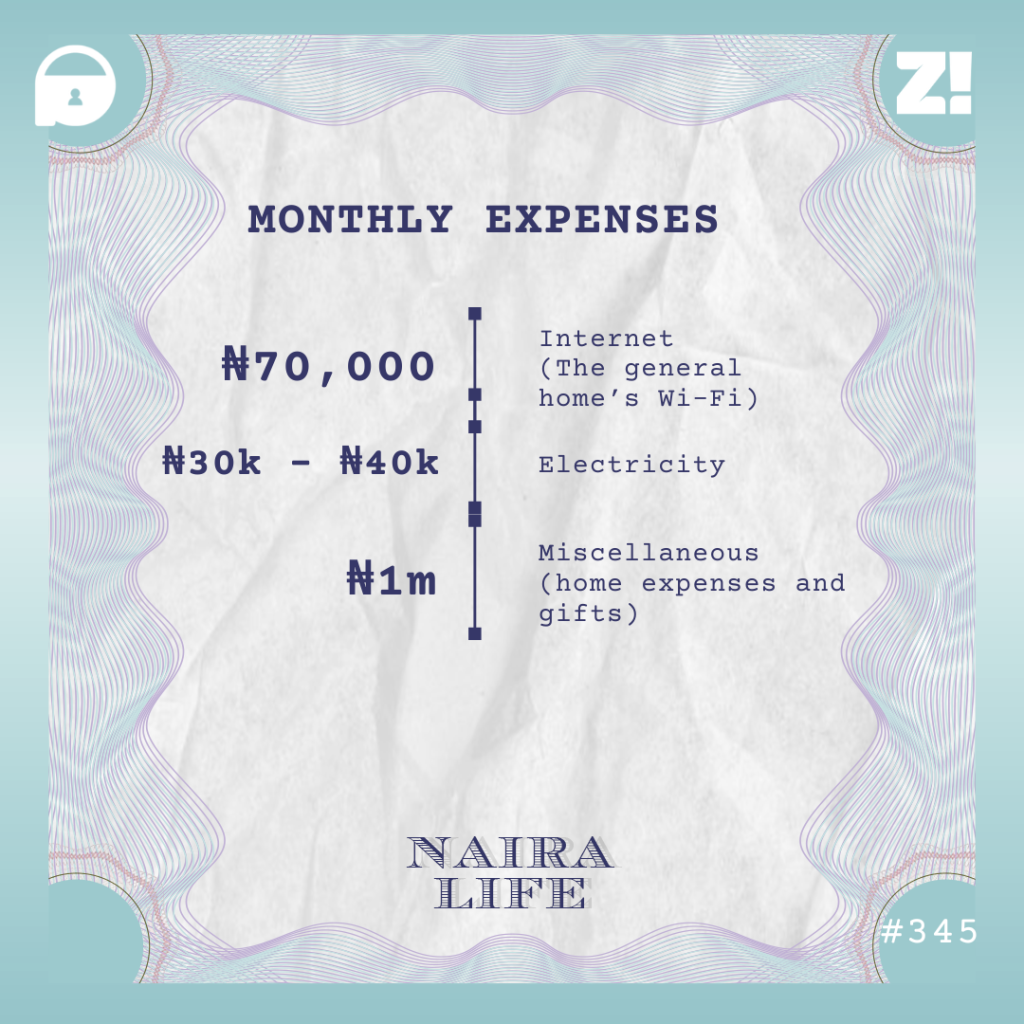
    Let’s break down those expenses in a typical month
    Nairalife 345 expenses

    Honestly, there’s always one massive unplanned expense that depletes my money. My siblings are in uni, and they often need money for something. Sometimes I find that almost my entire salary goes back to them in one way or another.  

    What kind of lifestyle does your income afford you?

    I live very modestly, way below what someone else who earns the same probably lives. If I didn’t have to bring out money for multiple requests, I’d probably live a very luxurious life. Unfortunately, I don’t. 

    Hmm. Is there an ideal amount you think you should be earning?

    I think my current income is pretty good pay. But if I had to answer, I’d say $10k. It’d be nice to earn that monthly. Knowing myself, once I hit $10k, I’ll start saying, “$15k isn’t bad too.”

    Is there anything you want right now but can’t afford?

    I don’t think so. I can afford most of the things I want right now, in terms of lifestyle and travel, I just feel a need to go for them yet.

    What was the last thing you bought that made you happy?

    This is funny, but it was the shortbread I got a few days ago. It was ₦2500, so I splurged and bought two and was very happy with myself.

    I’m really very simple. My family keeps asking me to act and look like what I earn, but I’m not crazy about materialistic things and appearance. I’m actually trying to take the appearance bit seriously, though. Dressing like you want to be addressed is very valid.

    I’m curious. Does your family know how much you earn?

    Yes. I come from a very close-knit family. I also feel comfortable sharing because I don’t come from a family that gives you responsibilities once they hear you have money.

    However, I’m also trying to be cautious. Not because they’ve given me a reason to be, but because I want to be able to say I don’t have money to attend to a need without feeling like they’re silently questioning why I’m saying no.

    How would you rate your financial happiness on a scale of 1-10?

    In terms of my earnings, I’d rate it an 8. I’m happy I earn this much, and I know there’s room to grow. However, in terms of how secure I am in my finances, I’d rate it a 3. I don’t have systems in place to feel financially secure.

    What would make you feel secure?

    Knowing I’ve made good investments and that I’m using my salary to create channels for passive income that’s giving me more money that I don’t have to work a 9-5 for. 

    What stage would you say you are in your money journey now?

    The learning stage. I’m still learning that there’s a lot of money out there. Also learning what to do with money and the various ways to make it without having to “work” for it. Legally, of course.


    If you’re interested in talking about your Naira Life story, this is a good place to start.

    Find all the past Naira Life stories here.
    Subscribe to the newsletter here.

    [ad]

  • Every week, Zikoko seeks to understand how people move the Naira in and out of their lives. Some stories will be struggle-ish, others will be bougie. All the time, it’ll be revealing.


    NairaLife #335 bio

    What’s your earliest memory of money?

    When I was 8, my dad gave my brother and me our first allowance. I can’t remember how much, but it was enough for each of us to buy a carton of biscuits. My brother came up with the idea of spending the full amount on biscuits, and I was down. 

    We had snacks at home, but we had limited access to them. My mum only gave us one at a time to take to school, but the biscuits were ours to do whatever we wanted. My mum didn’t even care that we spent all the money on biscuits. It was like, “It’s your money. You have the freedom to do as you please.”

    Speaking of, what did your parents do for money?

    My dad was a big-shot executive at an FMCG company, and my mum ran a large-scale poultry farm. Growing up, things were super smooth. We had big cars, and I attended nice private schools. The only reason we didn’t travel for vacations was that my parents didn’t like air travel. 

    Our financial situation changed around 2011/2012 though. The classic story: My dad lost his job, which forced us to move to a new city and a new neighbourhood. While it wasn’t exactly a slum, the people were unexposed. I honestly believe moving to that area set us back and impacted our growth. We just couldn’t grow.

    How do you mean?

    So, my mum moved her poultry farm there and also started a school. But she had to reduce school fees to ₦10k because the parents in the area couldn’t fathom paying more than that. It was either ₦10k or they wouldn’t send their kids to school. 

    There was this general nonchalance about education. I was around 10, and I couldn’t play with the other kids because they didn’t speak English. My parents couldn’t even interact with the neighbours because everyone just had a mediocre sense of thinking. I don’t even know how to explain it. The rot in that area was deep, and I genuinely believe it affected our momentum.

    Also, my dad never got his spark back after he lost his job. I don’t remember him having a stable job after that. He still provided, but it was usually through income made from selling his properties. My dad had multiple properties when he was wealthy, so he could sell one today, use the money for a year or two, then sell another if he needed money again. That’s how he sent me and my siblings to school. 

    When was the first time you worked for money?

    After secondary school in 2018, but there’s a funny context to how I started thinking about making money. My older brother and I entered secondary school at the same time, and when we were in SS 3, my dad put forth a challenge: He’d send whoever had the best scores in JAMB and WAEC abroad to school.

    I was so excited and studied so hard that I broke all the academic records in my school. My brother, on the other hand, failed so badly that his results couldn’t have gotten him into a Nigerian university. So, my dad sent him abroad instead.

    Ah

    I’m sure part of the reason was that he’s the first son. You know, standard misogyny. I was devastated. On top of that, I didn’t get an admission offer for my desired course, so I stayed home for an extra year. I decided I’d make enough money to send myself to school abroad if my dad couldn’t afford to send two children. 

    So, I scoured the internet for ways to make money online. I watched YouTube videos and started learning web development, creating websites and blogs. Writing was the first option that paid me, though. I got a writing gig that paid me ₦2k per article. I didn’t have a bank account, so they paid me in airtime. 

    I also started teaching at my mum’s school. She paid me ₦10k/month to teach junior secondary students. I mostly spent the money on lunch and data. I worked there until I got into uni in 2019.

    Get More Zikoko Goodness in Your Mail

    Subscribe to our newsletters and never miss any of the action

    Did you keep trying to make money in uni?

    Oh yes. I got a ₦8k weekly allowance from home, but it never felt enough. Between transport costs and little purchases, the money always finished. I remember being so shocked when I saw ₦18k in someone’s account. It was like, how can someone have this kind of money in their account at once?

    So, I was always thinking about ways to make money. Also, my plan to send myself abroad still fueled my money-making intentions. I once gave a friend ₦6k to gamble for me, but he lost it all. I even tried the Racksterli “double your money in two weeks “ scheme. I made some money from it, but I ended up getting scammed.

    Omo. Sorry about that

    Thanks. Besides trying different things for money, I also applied for international scholarships everywhere. I even applied to a school in China. I just wanted to achieve my goal.

    Then 2020 came. The lockdown was a really transformative period for me. It was when I first got into crypto. The first one I tried was a platform called Electroneum. Their coin was called ETN, and you could rack up points by completing tasks on the app and cash out ETN as airtime. I was steadily cashing out airtime that period.

    I also did a bit of crypto buying and selling for small profits here and there. One day, someone from my school posted on a group chat, asking people who had international passports and bank accounts to DM him for a gig that could pay as much as ₦200k. I had an international passport because of all my efforts to travel abroad, so I reached out to him. 

    What was the gig?

    He wanted me to register on an app, purchase crypto (he gave me the money), and send it to him, then I’d keep the profit. I was confused, but I did it. We tried a couple of times, but it didn’t work because my debit card didn’t work for international transactions. 

    However, I eventually figured out what he wanted to do. It was crypto arbitrage. Here’s how it was supposed to work: There was a significant difference in dollar price at the bank rate and on the black market. If I could get dollars at the bank rate and sell on the black market, I could make money just appear. Crypto was one way to get dollars at the bank rate. I just needed to make the purchase as an international transaction with my Nigerian bank. 

    When I figured out the plan, I went to my friend and we did some calculations. If we bought $500 crypto, we could make ₦200k after selling it on Nigerian crypto exchange platforms. So, we decided to try it. But we had two problems.

    What were these problems?

    We didn’t have $500 capital, and we didn’t have a working card for international transactions. 

    Initially, we considered starting small with $50, but eventually, we convinced ourselves to raise money. I told an older friend about the idea, and he decided to invest in it. He gave me some bitcoin, which was worth about ₦800k at the time, and I was supposed to return it with a 30% interest after a few months. Unfortunately, we lost the money. 

    Yikes. How?

    My friend and I were looking for a cheap place to buy crypto, and the regular platforms had a limit on how much we could buy per day. In our search for more options, we found a coursemate who promised to get us $1k worth of bitcoin for ₦400k. We gave him the money, and he disappeared. 

    It was funny because we were in the same class and would see each other after the lockdown. We eventually tracked him down to his state and discovered he’d spent the money on an iPhone and other things. We seized the phone, but only got ₦190k from selling it.

    Long story short, I couldn’t repay my friend the full ₦800k. We told him the business crashed and returned 50% of his investment. He wasn’t happy, but he forgave me.

    So, the business didn’t last a month?

    We only told him it crashed; it didn’t actually crash. We had a setback because of the money we lost, and had to re-strategise. We agreed it had been foolish to borrow money to start large-scale, so we returned to the original plan of starting small. 

    At the same time, banks had started limiting international transactions, so we built something like a conglomerate of cards. We got friends and coursemates who had cards that could do international transactions to allow us to use their cards, and we gave them a share of the profit. 

    In the first month, we made about ₦100k in profit. In subsequent months, we made between ₦500k – ₦1m/month and my friend and I split the money 50-50. We continued even after school resumed, but towards 2022, more people started to get in on arbitrage, and we stopped making as much. 

    Plus, the government suspended international transactions on naira cards, which affected our business model. Despite the challenges, my friend still kept at it, but I wasn’t too keen anymore. I just contributed passively and made the odd ₦100k – ₦150k most months.

    Why the change of heart?

    I’d taken web development more seriously and started making money from it. The first major earning was from a 2022 hackathon I participated in and won $2k. It was crazy money.

    At this point, I should mention I was terrible at handling money. While we were making arbitrage money, my friend was saving, but I was buying everything fancy that crossed my mind. When I won the $2k from the hackathon, I bought a MacBook for $700, a ₦19k fridge, gave my mum ₦50k and another ₦50k to my siblings. I also bought my parents’ phones, which cost me ₦140k. Then I bought myself an iPhone 11 Pro for ₦300k, a camera and an iPad. In conclusion, I spent all the $2k.

    Wild

    After the hackathon, I worked with the organisers for a few months and earned an extra $2k. When that contract ended, I decided to work with foreign companies instead of Nigerians since they were more likely to pay well for my skills.

    So, I focused on upskilling. I was coding up to 12 hours every day, to the point that I felt school and exams were stopping me from coding as much as I wanted. I was also constantly applying for jobs and started learning cybersecurity on the side.

    In 2023, I attended an event held by the organiser of a cybersecurity course I was taking. I participated in a CTF competition there and won the $200 prize. Beyond the money, it was validation that I really knew this tech thing. Also, I got a cybersecurity internship. I had actually flown to a different state for that event, and accepting the internship meant I’d need to leave school for six weeks to work. 

    I accepted the offer and reasoned I could decide whether to return to school after the internship ended.

    Was it a paid internship?

    It was unpaid, but I was doing it for the experience. Plus, I still had money. I was also working as a technical writer with a company in Europe, and they paid me $150 – $300 per article. I lived in a student hostel for the duration of the internship, and my pay covered the ₦600k rent, and I still had enough left to ball. 

    After the internship ended, the company offered to retain me, but I couldn’t take the offer. First, I didn’t have an NYSC certificate and didn’t plan to finish school. Second, they were offering ₦150k, which was bullshit. 

    Wait. You mentioned not planning to finish school. You had decided already?

    Yeah, after the internship, I decided that I wasn’t returning to school. My parents weren’t thrilled, but it was nothing dramatic. At this point, I wasn’t collecting any money from them or disturbing for allowance. I was independent and able to make my own decisions. 

    I got a job from someone who wanted me to teach cybersecurity at his training school. He was a terrible boss, but he didn’t delay my ₦450k/month salary. I worked there for about three months before returning home to determine what I wanted to do next.

    I was still applying to jobs and getting offers, but I was determined not to work for a Nigerian enterprise again. Two months of job-hunting later, I landed a super sweet position as a security consultant for a US company at $1300/month. They paid weekly, so it was about $300 weekly. This was in 2024.

    Three months into the job, I realised I was being underpaid.

    How so?

    I got the job through a friend, and payment came through him. The pay was actually $900 weekly, but he was sending me $300-ish. We went back and forth on the matter, and later agreed he’d send me $500 weekly, bringing my income to $2k/month. I still work with the company, and that’s still my salary today.

    Early this year, I took on a side job that pays $1200/month, so currently my fixed monthly income is $3200, which is about ₦4.9m. I still do freelance projects and other side gigs that often push my income to over ₦5m. It can be up to ₦6m or ₦7m in really good months. I still want to push more to ₦10m/month. To be honest, I’d be making that now if I didn’t reject so many offers for one reason or another.

    What kind of life does your income afford you?

    A super comfortable one. Right now, I’m looking at my super high-end laptop, which I got for about ₦3m. I spend my money on gadgets the most. I have the entire Apple suite: watch, laptop, phone, everything. I also travel sometimes.

    The biggest thing money has given me is that I no longer think the same way. I think that money is unlimited, and I don’t relate to struggle or hardship. I smile when I hear the price of things because I can afford everything I want. 

    I’m super comfortable, and I’m still super young. In a year or two, I should most likely double my current earnings. If I were in the US, with my experience level, I could easily earn $150k/year. So, yeah, I’m very happy with where I’m at. I’m in the top percentage of Nigerians, and it feels good. 

    Have your spending and saving habits changed since you started earning more?

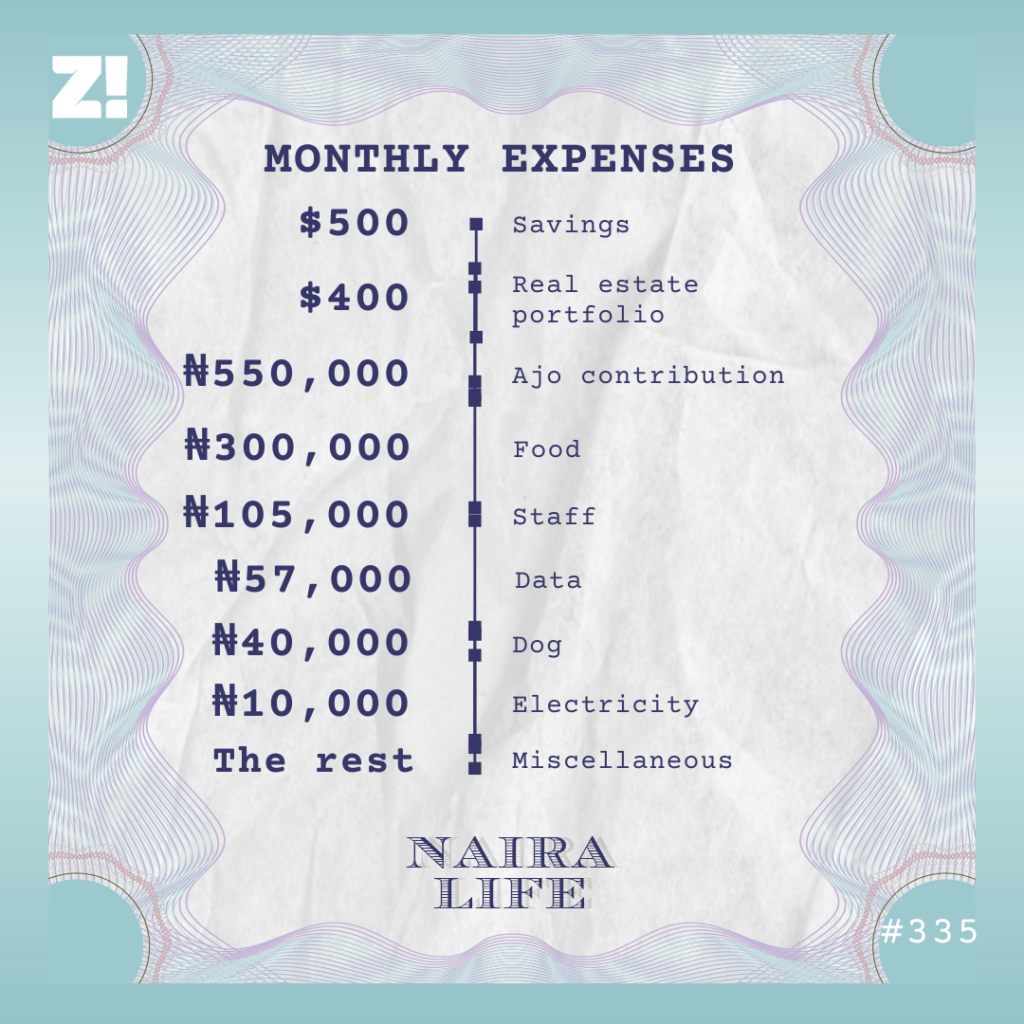
    I’m somewhat better at saving. I’m not as aggressive as I should be, but it’s not too bad. I try to save $500 monthly and do a ₦550k ajo contribution monthly to pack ₦5.5m. I also have $5k in a real estate portfolio with my friend’s company that’s supposed to give me 20% returns yearly. I have $8k in my portfolio: $3k in savings and the rest in real estate. Nothing too serious.

    How would you describe your relationship with money?

    It’s sweet, but also bad. I say sweet because I don’t deny myself of anything. I work hard to reward myself. But it’s bad because I never have enough money after spending on what I want. It’s usually like ₦1m-ish left in my account. I want to get to a point where I have like ₦10m – ₦20m in my account. 

    Let’s break down your typical monthly expenses

    NairaLife #335 expenses

    My expenses typically vary from month to month. For instance, I don’t give my family money regularly, so they’re not dependent on me. But last month, I gave them about ₦200k. I also travel often to see my partner and friends, but it’s not every month. I last travelled in June, and flights cost me ₦600k. I might not travel again until September. 

    I’m most likely forgetting some expenses because tracking them is difficult for me. I get paid weekly, so putting all those expenses together is hard. But it’s something I’m working on.

    I’m curious. How does it feel to have this much success at 22?

    I feel like I’m kind of cheating the system. If I’d stayed in school and graduated, maybe I’d feel like I need to be responsible. But my classmates are still in school, so I feel like a child. Like what I’m making now is just extra, and I’m waiting for my life to finally start. 

    I feel like I can still afford to squander my money for a few more years. Or maybe until next year at least. I can start being responsible then. I sometimes feel like I’d be super comfortable going to zero and starting afresh again. I don’t know why I think that or where I got it from. 

    How has making money so early impacted how you think about money?

    I feel like the world is at my feet and I can do whatever I want. I feel like I’ll always have money. You know that saying, “I’ll never be poor”? That’s how I feel. It’s such a strong conviction in my mind.

    I sometimes get anxious, though. What if I lose my job or no one wants to hear from me again? I think the anxiety comes with the money. I didn’t use to get anxious like this when I was broke, but now the stakes are higher. I’m constantly thinking about how to make more money. 

    Interesting. Is there anything you want right now but can’t afford?

    I want a car so bad. Actually, I’m just manifesting it; I want someone to dash me. The car I want would probably cost me around $10k – $15k.

    Do you have any financial regrets?

    I loan people money a lot, and sometimes, I regret it. I have almost $3k of my money in people’s hands, and I’m not sure I’ll get it back.

    Is there anything you’d like to be better at financially?

    My savings and investments are pretty slim, and I want to improve. I want to invest in stocks, but haven’t had time to study the market. Once I do, I’ll probably get into stocks. 

    How would you rate your financial happiness on a scale of 1 -10?

    6. There’s not a lot of structure around my money now, and I know I can do better. 


    If you’re interested in talking about your Naira Life story, this is a good place to start.

    Find all the past Naira Life stories here.

    Subscribe to the newsletter here.

    [ad]

  • More Nigerians are breaking into the global workforce and earning in dollars while living at home. As remote work spreads across industries, platforms connecting African talent to international companies have never been more accessible. Whether you’re a developer, writer, designer, marketer, or virtual assistant, the opportunities are real — if you know where to look.

    We have curated 15 trusted platforms that consistently offer remote jobs paid in dollars. They’re global-facing, open to international applicants, and worth exploring if you’re looking to build a remote career from Nigeria.

    1.  Wellfound (formerly AngelList Talent)

    Launched in 2012 and rebranded in 2022, Wellfound is a remote job platform focused on startup roles in software, product, design, marketing, and operations. It hosts over 130,000 job listings from early—and growth-stage startups, many offering remote, USD-paying roles. 

    The platform is known for its salary and equity transparency, and users can apply directly without needing cover letters. It works best for people with some experience who are willing to complete profile assessments and tailor their applications to stand out.

    2. Toptal

    Toptal is not your average freelance platform. Founded in 2010, it connects top-tier talent — developers, designers, finance experts, and product managers — with companies like Airbnb, Duolingo, Motorola, and Shopify looking for remote contractors. But it’s also one of the most selective platforms out there: only about 3% of applicants make it through its rigorous screening process, which includes language tests, technical interviews, and a paid trial project. 

    If you do get in, you’ll find high-paying jobs with global clients, flexible schedules, and long-term contract options. Toptal is best for experienced professionals who are confident in their skills and want to skip the noise of lower-paying freelance sites in exchange for quality gigs and serious pay.

    3. LinkedIn

    LinkedIn isn’t just a networking app; it’s one of the most effective platforms for finding remote jobs, including roles that pay in USD. The key is knowing how to use it: tailor your profile to match the roles you’re looking for, set job alerts with keywords like “remote” and “worldwide,” and engage with posts from companies hiring globally. 

    You’ll find opportunities across tech, marketing, design, writing, admin, and more, many of which are open to African talent. Plus, recruiters often contact candidates directly, especially those with strong, active profiles. LinkedIn should be part of your daily routine if you’re serious about building a remote career.

    4. WeWorkRemotely 

    We Work Remotely is one of the most popular job boards for remote work. Launched in 2011, it’s become a go-to platform for companies hiring remote-first teams, especially in tech, product, marketing, and customer support. You’ll regularly see listings from startups and established names, offering roles open to applicants worldwide. 

    The site is simple to use — no account needed to browse — and many listings pay in USD. It doesn’t offer as much candidate support or filtering as other platforms, but its sheer volume of listings and global reach make it a solid starting point for anyone looking to land a remote job fast.

    5. Dribbble Jobs

    If you’re a designer looking to get paid in dollars, Dribbble is one of the best places to start. Originally a community platform for showcasing design work, it also hosts a job board where companies post full-time, freelance, and remote design roles, everything from UI/UX and product design to illustration and branding. 

    Many listings are remote-friendly and USD-paying, especially those from startups and international clients. You’ll need a strong portfolio (your Dribbble profile can double as one), since most companies recruit directly from what they see. It’s ideal for creatives who want to be discovered for their work, not just their CV.


    Zikoko’s first-ever money event is happening this August! Join us at the Naira Life Conference on August 8th for honest, practical conversations about building a high-earning career from scratch in Nigeria. At the Career Growth track, you’ll hear from professionals who have scaled their income exponentially, moving from entry-level salaries to remote roles paying in dollars. Learn how they did it, what they’d do differently, and how you can chart your own path. Get 30% off your ticket when you buy now. Don’t miss the early bird window!


    Join 1,000+ Nigerians, finance experts and industry leaders at The Naira Life Conference by Zikoko for a day of real, raw conversations about money and financial freedom. Click here to buy a ticket and secure your spot at the money event of the year, where you’ll get the practical tools to 10x your income, network with the biggest players in your industry, and level up in your career and business.

    6. RemoteOk

    Remote OK is a straightforward job board with listings for remote roles across tech, design, marketing, customer support, and more. It pulls jobs from various sources and labels each by location, salary, and whether it’s open worldwide or to specific regions. You’ll find everything from early-stage startups to large companies hiring remote workers, many paying in USD. 

    The site also shows how many people have viewed and applied to each role, which can help you prioritise. It doesn’t require signing up to browse or apply, making it a fast, practical tool for discovering global remote jobs.

    7. Outsourcely

    Outsourcely is a remote job platform that connects freelancers and remote workers with startups and small businesses, mainly in the US and Europe. You’ll find customer support, writing, design, admin, marketing, and tech jobs. Many roles are part-time or long-term freelance contracts, and most pay in USD. 

    To get started, you’ll create a free profile, list your skills, and set your rates. What makes Outsourcely different is that employers can contact you directly once your profile is live; you don’t always have to apply first. It’s a good platform for people looking for consistent, remote work without the heavy competition you’ll find on bigger freelance sites.

    8. Remotive

    Remotive is a remote job board that focuses on startup and tech-friendly companies hiring worldwide. It’s well-organised, easy to navigate, and covers various roles, from software development and design to customer support, marketing, sales, and HR. Most companies that post on Remotive are remote-first and open to international talent, with many offering payments in USD. 

    You don’t need to create an account to browse or apply; jobs usually link directly to the company’s application page. There’s also a filter that lets you sort jobs by time zone, which is helpful if you want to avoid night shifts. If you’re looking for remote jobs that aren’t limited by location, Remotive is a solid place to start.

    9. JustRemote

    JustRemote is a remote job board with listings across tech, marketing, writing, customer service, and more. It’s not as crowded as some of the bigger platforms, which means less competition for each role, but you’ll still find a decent mix of full-time and freelance jobs, many of which pay in dollars. You can browse jobs by category or filter by region if you want roles that don’t require overlapping with US time zones.

    10. Contra

    Contra is a freelance platform built for independent creatives and tech professionals: writers, designers, marketers, developers, and more. Unlike most marketplaces, it doesn’t charge commissions, so you keep 100% of your earnings. The platform focuses on project-based, remote-friendly work, with many clients paying in USD. You can create a clean profile that doubles as a portfolio, pitch to roles, or get discovered by clients browsing for talent. It’s ideal for freelancers who want more control over their rates, visibility, and workflow, without getting lost in a sea of low-paying gigs.

    11. Jobspresso

    Jobspresso is a remote job board focusing on tech, marketing, writing, and customer support roles. The platform curates listings from companies hiring remote workers, many based in the US and paying in dollars. You’ll find full-time and contract roles from startups and well-known names alike. 

    It’s easy to browse jobs without an account, and each listing links directly to the application page. While the number of new listings isn’t as high as some bigger boards, the quality is solid, and everything posted is remote by default.

    12. Who Pays Technical Writers

    Who Pays Technical Writers is a crowdsourced database that lists how much companies pay technical writers for articles, documentation, tutorials, and other writing projects. The list is updated regularly and includes details like pay rates (often in USD), submission processes, and the kind of writing each company is looking for. 

    It’s beneficial if you’re pitching as a freelance writer or looking to break into technical writing with fair, transparent pay. While you won’t apply for jobs directly through the site, it’s a powerful tool for finding well-paying clients and avoiding lowball offers.

    13. Superpath Jobs

    Superpath is a niche job board for content marketers, especially those in the tech and SaaS space. Most roles listed are remote and paid in dollars, covering everything from blog writing and content strategy to SEO and editorial work. 

    The platform is part of the broader Superpath community, which offers resources, salary transparency, and a Slack group for networking. It’s handy if you’re a content marketer looking for jobs at startups or growth-stage companies. The listings are curated and relevant, so you’re not wasting time sifting through unrelated roles.

    14. Arc Dev

    Arc.dev is a remote job board built for developers. It features roles in full-stack, backend, frontend, DevOps, and blockchain. Most jobs pay in USD and are open to global applicants. You can apply directly or join Arc’s vetted talent network, which involves a skills assessment and matching process. 

    The extra effort can pay off: vetted users get faster access to high-quality job matches with less competition. If you’re a developer looking for serious remote work without endlessly chasing gigs, Arc is one of the more focused platforms.

    15. Turing

    Turing connects experienced software developers with long-term remote roles at US-based companies. The platform handles the vetting process upfront, including technical tests, coding challenges, and interviews, and only accepts candidates who meet its standards. 

    Once you’re in, Turing matches you with jobs that pay in USD, with full-time hours and competitive rates. Most roles are in web and mobile development, backend systems, and cloud engineering. Unlike freelance marketplaces, Turing offers more stability. The company hires you as a contractor, but you work as part of the team. It’s ideal for mid- to senior-level developers looking for reliable, high-paying remote work without constantly job hunting.

    Quick Tips to Stand Out and Get Hired

    • Tailor your applications: Don’t send the same CV everywhere. Highlight the exact skills each job requires.
    • Show your work: Have a clean portfolio, GitHub, blog, or LinkedIn page that shows what you can do.
    • Work on your timezone game: If you can overlap with US or EU hours, mention it clearly.
    • Use the platform: Some platforms (like Contra or Wellfound) prioritise candidates with completed profiles and assessments.
    • Follow instructions: A surprising number of applicants ignore basic application steps — don’t be that person.

    Editor’s Note: This article is for informational purposes only. We encourage you to do your own research before signing up.


    Also Read: 6 Online Platforms That Pay Nigerians to Train AI


    Get More Zikoko Goodness in Your Mail

    Subscribe to our newsletters and never miss any of the action

    [ad]

  • Every week, Zikoko seeks to understand how people move the Naira in and out of their lives. Some stories will be struggle-ish, others will be bougie. All the time, it’ll be revealing.


    Tired of the stress of moving money across borders? With Juicyway, you can seamlessly send, receive, and convert fiat or stablecoins like USD, CAD, USDT, and USDC in Nigeria—at great rates. Free multi-currency accounts, instant transfers, and top-tier security? Say no more. Click here to get started!


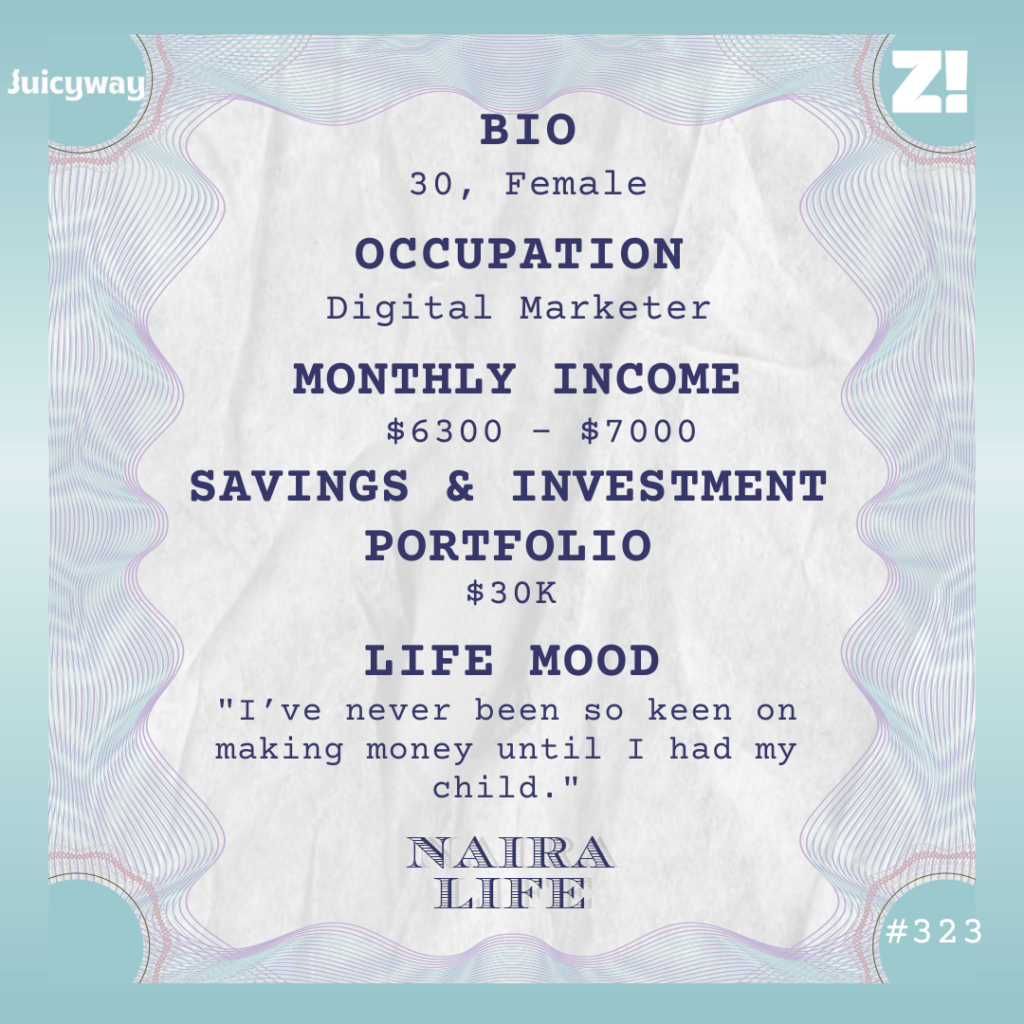
    Nairalife #323 bio

    What’s your earliest memory of money?

    It was 2003 — the year my mother died — and I was 8. My aunt, her boyfriend and I were on the bus, and her boyfriend asked me to read a figure in the newspaper. I think it was 15 million and something-something thousand. When I pronounced it correctly, he gave me ₦15, and I used it to buy sweets. 

    I’m sorry about your mum

    Thank you. The newspaper incident happened because my aunt’s boyfriend was trying to cheer me up. We were going to my aunt’s workplace, and I think he wanted to take my mind off the whole thing.

    I imagine your mum’s passing away led to some changes at home 

    It stirred me into independence. My dad remarried a few years later and had four more children. I had to transition from being an only child to an elder sister to my siblings. Plus, my step-mum and I didn’t get along at all, so I was pretty much independent.

    Things didn’t change much on the financial side. My mum worked at a bank, and my dad was a contractor. I didn’t grow up looking for food to eat or anything like that. Even after my mum passed, my dad still made enough to keep us comfortable. I had a BlackBerry phone at 15. We were above average. 

    Do you remember the first time you earned money?

    I do. I’m really good at explaining stuff, so at uni, people came to me to simplify lecture notes and explain things in a way they could understand. At first, I did it for free until people started becoming entitled. I’d go home during the holidays or school breaks, and people would ask me, “Why weren’t you available to teach us?” 

    At some point, I thought to myself, “You know what? I can charge these people.” So, I started charging each person between ₦200 and ₦500 per lecture. I did that from 200 level to my final year. That said, it didn’t bring serious money, so I lived on my ₦20k monthly allowance, which was enough for whatever I needed in school.

    I also had a few internships during school holidays at an NGO. I only worked there when school was out and got paid ₦15k/month each time. I think I did that twice. Then, after I graduated from university in 2017, I got an opportunity to travel to the US for a five-month work and travel program. 

    How did that happen?

    Someone at my uni organised work and travel programs for students in my department — a student exchange program. I can’t remember how much the process cost, but I know my round-trip ticket was ridiculously cheap. It was just ₦350k, but it also came with insane layovers. I spent three days travelling through different cities before finally reaching my destination. The point is, I got there. 

    A few days after I arrived, I got a job flipping burgers in the food section of an amusement park, earning $5/hour for 30 hours/week.

    Wait. I thought it was an academic program

    They didn’t really send us like that. It didn’t matter where we worked; they just wanted us to meet people from around the world and experience other cultures.

    Plus, each person had to pay for their accommodation from the money they earned. I stayed in an extended-stay apartment with five other Nigerians. I think the rent was $750/month, and we split it equally. So, I had to make money. 

    A few weeks after I started the amusement park job, I found another at a Wendy’s restaurant. The program didn’t allow us to work more than 40 hours/week, so I cut my hours at my first job so I could do 20-20 at each job. Wendy’s paid $7/hour, bringing my income from both jobs to around $800/month, minus tips. The tips were so good. Sometimes, I earned up to half of my income just from tips.

    So the money was good

    It was, but the work was hell. Both jobs had me standing 16 hours every day. At some point, I even broke down.

    To be fair, maybe I didn’t need to work that hard. My aunt had encouraged me to save as much money as possible, but I also wanted to balance it with having a good time. So, one salary was for spending and shopping, and the other was for saving. 

    I returned to Nigeria in November 2017 with about $2k in my account, which I gave to my aunt to keep. For context, I started living with her when I got into uni, and she had sponsored me for the US program.

    What happened after you returned to Nigeria?

    NYSC was the next step. Service year taught me hunger. Allawee was ₦19800, plus another ₦4k from my PPA that was always delayed. It was ridiculous. 

    By this time, my aunt had stopped giving me an allowance because I stubbornly refused to do my NYSC in the same state, so I had to make do with allawee. Thankfully, she paid my rent, but it was a real struggle surviving on ₦19,800. I learnt a new dimension of independence. Interestingly, my service year also changed the trajectory of my life. 

    How so?

    Corp members learned blue-collar skills as side hustles, but it didn’t make sense to me. I thought, “There have to be more lucrative options”. I came across a place where people learnt digital marketing and how to build websites; it intrigued me. 

    I joined them and learnt how to code on Adobe Dreamweaver using HTML and a few other languages. Throughout the service year, I attended weekend classes and learnt even more. 

    After NYSC in 2018, I got a job at a publishing firm. My salary was ₦50k/month to build websites and do digital marketing for them. The job made me realise my skills were pretty basic, so I learned a lot on the job and watched YouTube videos to keep up. 

    I learnt everything from SEO to digital marketing and website building. I was intrigued by the advent of digital marketing and how small businesses were moving from traditional marketing to digital. I knew that was where I wanted to be, so I kept honing my skills.

    Unfortunately, my employer was an asshole who owed salaries and never paid in full. After he withheld my salary for three months, I just left. This was in 2019.

    Did you have other income opportunities?

    Somehow, I found myself offering freelance services. I met my first client at a supermarket, and we entered into a conversation. He said he was a lawyer and also sold books. I mentioned I could build websites, and that’s how he said he needed an e-commerce website for his books. Before I knew it, he sent me ₦100k, and I remember staring at my account balance in shock. 

    I built the website, and he settled the domain and hosting. It turned out super nice. I wanted to do even more, so I got certified in digital marketing and kept learning. I was also applying for jobs and found one on LinkedIn towards the end of 2019. It was an on-site role, so I had to move to Lagos. I moved in with a friend, and we shared the ₦600k rent. My aunt paid for my half. 


    Join 1,000+ Nigerians, finance experts and industry leaders at The Naira Life Conference by Zikoko for a day of real, raw conversations about money and financial freedom. Click here to buy a ticket and secure your spot at the money event of the year, where you’ll get the practical tools to 10x your income, network with the biggest players in your industry, and level up in your career and business.


    How much did your job pay?

    My salary as a digital marketer was ₦125k/month. I also took on the occasional social media management and website-building side gig for anything between ₦50k – ₦150k. I kept my 9-5 job until 2021, when something very funny happened.

    What was that?

    I got pregnant. My job became hard to manage with pregnancy, especially with the late nights, and my partner wasn’t having it. We decided I’d quit, and he’d support me pending when I could get a new job.

    However, he became super distant and annoying after I had my child. He struggled to sustain us as a family, and I knew I needed to find a job immediately. I couldn’t depend on him for money.

    A few months later, in 2022, I got a job heading the digital marketing team in a fintech company. 

    Energy!

    My starting salary was ₦350k, and it increased to ₦420k in 2023. That same year, I took on an additional remote role with a foreign company that paid ₦300k, bringing my income to ₦720k. 

    My new income allowed me to afford nicer things for my child and live independently of my partner. I didn’t have to ask him for the smallest things like data anymore, and I think he couldn’t handle that switch. We eventually separated, so we co-parent now, and fantastically at that. 

    I switched jobs in 2024 to one that paid $800/month, and about six months later, I got a contract offer that really improved my life. I worked with that client for three months, making $3k/month. It was such a fun time. I bought things I needed and even started buying stupid things.

    Within those three months, I bought a car, changed my apartment, and put my daughter in a better school. I even got on Ozempic. Like I said, stupid things. 

    I’m screaming. Curious, how much was your pay in naira at the time? 

    It fluctuated a lot. The $800 from my 9-5 was usually about ₦1m, and the $3k was ₦4m and some change. 

    My 9-5 salary was paid to my traditional domiciliary account, and I often converted it by transferring dollars to the black market BDCs; they also had domiciliary accounts. However, I received the $3k from my client through a payment platform that allowed me to convert the funds to naira on the platform or transfer dollars to my domiciliary account. They had good rates, so it was pretty seamless. 

    I still go through the same process. The three-month contract was extended by a year, so I still work with the client today. 

    What’s your monthly income like these days?

    I currently work three full-time jobs, which is actually crazy. My income from all three is $6300/month. Bonuses sometimes push that to $7k, which is about ₦11m after conversion.   

    Also, I recently founded a marketing agency with a Mexican friend. The agency is based in Mexico, and my friend is white-passing, so she helps us close leads faster. She’s the face of our company, and I’m the brains. 

    We currently have about 7 clients we charge between $2k- $4k per month, depending on the scope of work. We share the profit 40:40:20 — 40% for each of us, and 20% back to the business and to pay staff. I don’t consider the agency as an income source. It’s more like a contingency plan; I save whatever profit I make for my child’s future. 

    I’m still stuck on the three full-time jobs part

    See, I have an obsessive need to work. I don’t ever want to return to a time when I cannot provide for my daughter. 

    Plus, I plan to japa to Mexico to fully scale my agency so I can “retire” from full-time work. So, I need the money from my three jobs as well. I just want to be comfortable to the point where I can afford anything my child wants.

    What do these japa plans look like now?

    It should happen sometime next year. My child will be done with kindergarten and transitioning to primary school, so it’ll be the perfect time to move. I also got her a Spanish tutor, so she already speaks Spanish as a second language.

    I save ₦5m/month from my income and have about $30k in my total portfolio. I have about $5k in investments using online financial services platforms. I also bought about $5k worth of foreign stocks in my daughter’s name in 2024. I get pretty good ROI on my investments, and they’ve helped with my portfolio. 

    So, I’m pretty much set for the move. The cost of living in Lagos and the city I plan to move to is similar. Rent, groceries, and everything else are pretty much the same. So, I’ll maintain my current lifestyle there. 

    Speaking of lifestyle, how has your income growth impacted your relationship with money?

    I used to be really bad with money. I like to eat, so I have this bad habit of visiting restaurants people have reviewed on TikTok just to have a personal experience. I actually have a spreadsheet of all the restaurants I’ve visited in Lagos. I go on these dates with my child.

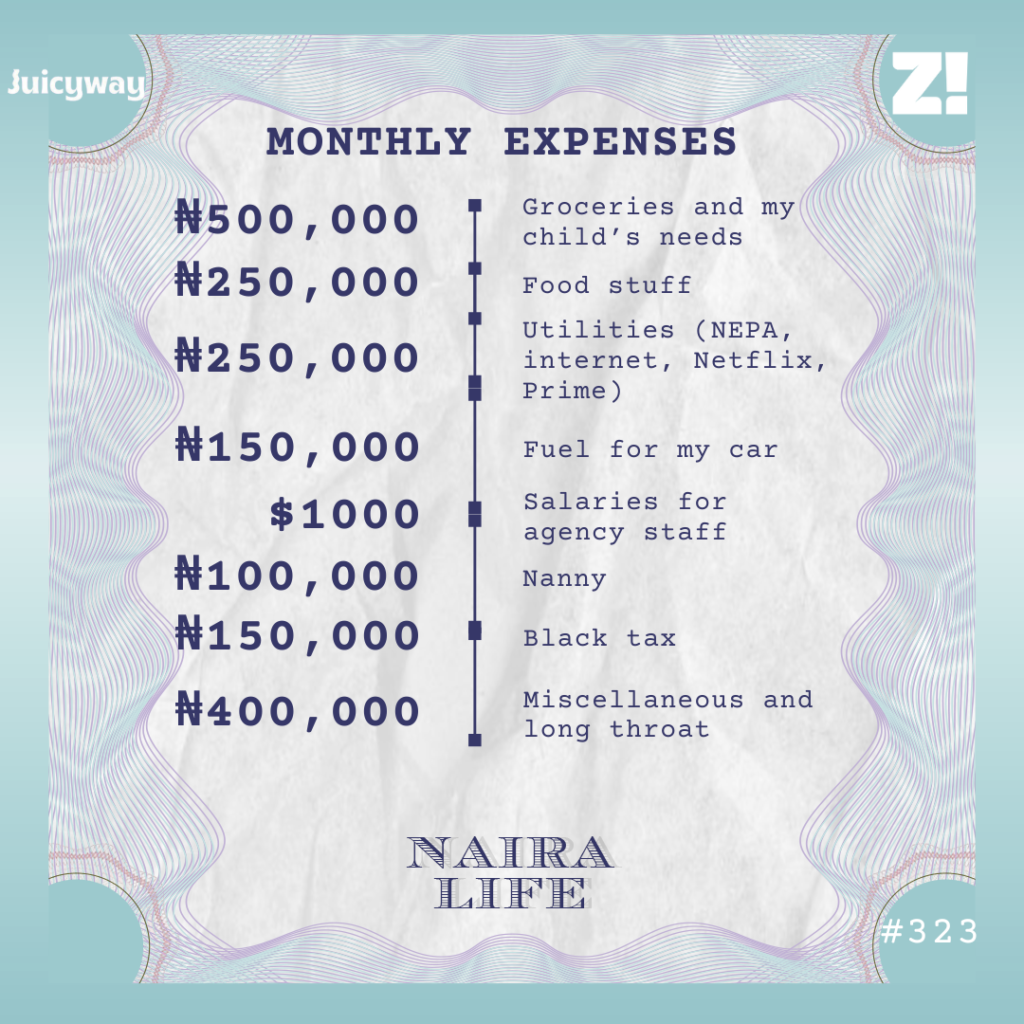
    But now I’m becoming more reasonable. I need to save for the rainy days, so once I go grocery shopping every month, I buy my kid’s stuff, pay bills, pay my staff salaries, and buy the things I need, I save the rest. Now I have like ₦400k budgeted for miscellaneous expenses every month. If e finish, e finish.

    Walk me through your typical monthly expenses

    Nairalife #323 expenses

    This is after I take out my savings. I also sponsor my nanny through university. The black tax is to three of my step-siblings in university. I give them ₦50k each. I also send my dad money occasionally. 

    You know the saying, “more money, more problems”? That’s my life right now. Every time I open WhatsApp, one family member asks me for stuff. But my daughter is why I work so hard. I’ve never been so keen on making money until I had my child.

    What was the last thing you bought that made you happy?

    I got a new phone a few weeks ago. My phone started acting weird, and I didn’t think of fixing it; I just bought a brand new one, which made me really happy. It was an iPhone 15 Pro, and it cost ₦1.7m.

    Also, buying my car last year was one of my proudest moments. I bought it for ₦10m, and it was a birthday present to myself.

    Is there anything you want right now but can’t afford?

    Probably a citizenship by investment in one of the Island countries like St Kitts. That costs $500k. But honestly, I’m very content with the life I have right now. Not bad for a single mum.

    Not bad at all. How would you rate your financial happiness on a scale of 1 -10?

    9. I want to scale even further to the point where I know my child has everything she needs if I’m not here anymore. 

    I have an insane fear of dying. Because I lost my mom at a young age, I worry that my child may not have me for long (even though I know say I gallant until 88 haha) but all in all, once I get to a point where I’ve saved enough for my child — I honestly don’t know when or how much that is — then I’ll finally get to a 10.


    If you’re interested in talking about your Naira Life story, this is a good place to start.

    Find all the past Naira Life stories here.

    Subscribe to the newsletter here.

    Get More Zikoko Goodness in Your Mail

    Subscribe to our newsletters and never miss any of the action

    [ad]

  • Every week, Zikoko seeks to understand how people move the Naira in and out of their lives. Some stories will be struggle-ish, others will be bougie. All the time, it’ll be revealing.


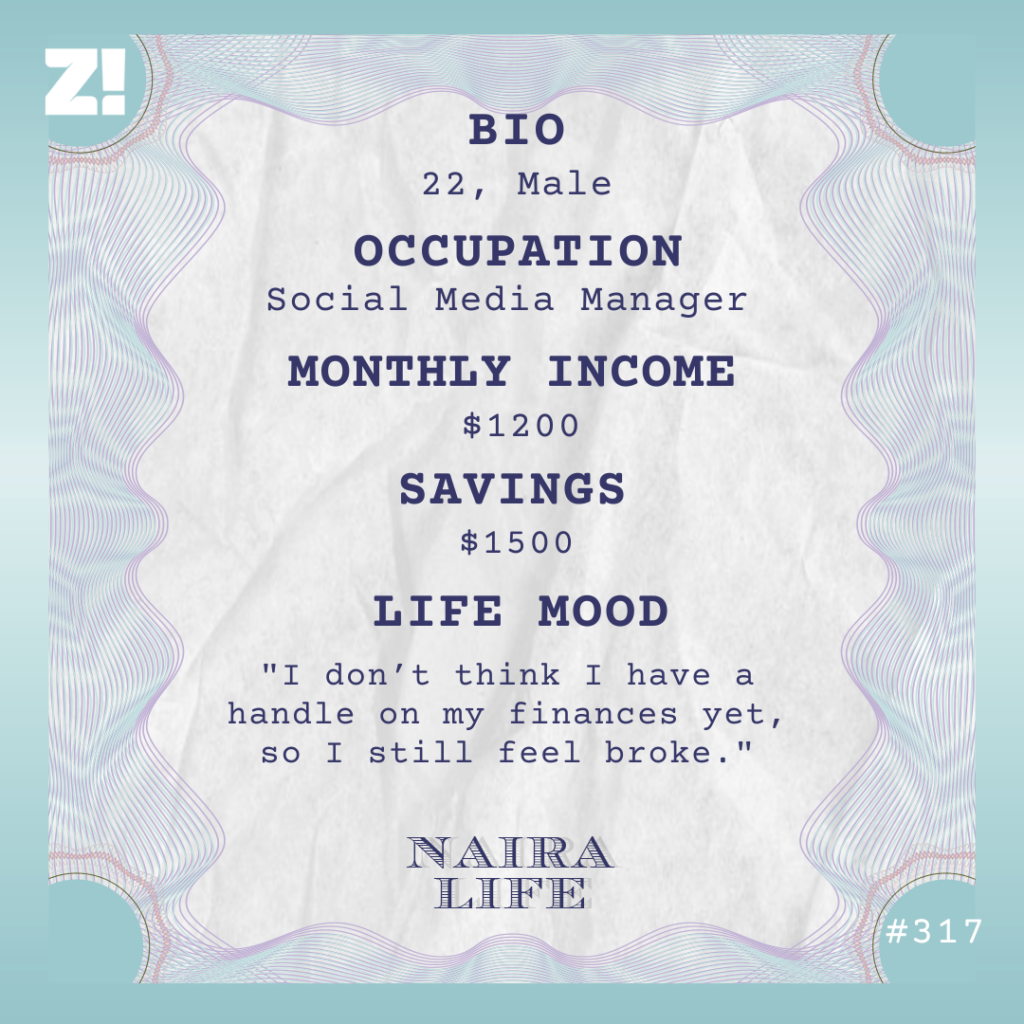
    NairaLife #317 bio

    When did you first realise the importance of money?

    A memory that stands out is from my uni matriculation in 2019. My aunt gave me ₦4k, and I was so excited because it was the closest thing to pocket money I’d ever received. 

    Getting into uni made my financial standing clear. I met people who got pocket money and realised it was normal to get allowances. One guy told me he received ₦20k monthly and often called his parents for more money. I couldn’t relate to the money or the parents, so I felt different from others. 

    That’s why that ₦4k made me so excited. Suddenly, I had money and didn’t feel so left out —  at least not at that moment.

    You said you couldn’t relate to the parents bit. Why’s that?

    My parents had passed away. My mum passed when I was 11, and my dad passed in my first year at uni. I didn’t even live with my dad when he was alive. He worked full-time in the ministry and wasn’t financially buoyant, so I mostly lived with relatives. At the time I entered uni, I was living with my uncle.

    I’m sorry about your parents

    Thank you.

    Money-wise, things were much better for me and my siblings when my mum was alive. She was also in the ministry but had a better financial situation than my dad.

    Also, my parents were separated, so we lived with her. We lacked nothing. When returning to boarding school, she would buy family-size packets of whatever provisions I needed. 

    Her death caused a change in our quality of life. We went from living in a four-bedroom apartment to staying with my aunt in a self-contained apartment. Then my dad moved us to my uncle’s in a village, and we had to change schools. It felt like a decline, but I had to adjust. 

    Living with relatives meant I couldn’t ask for money anyhow, so when I got into uni, I decided to explore options for making money.

    What options did you explore?

    I learnt several skills before and during COVID in 2020: web design with WordPress, coding and social media management. I even took a “fundamentals of digital marketing” course on Google. The idea was just to learn as much as I could. I didn’t have a clear sense of what I wanted to do, so I just kept trying different things.

    I didn’t have a laptop, so I borrowed someone’s laptop to practice what I’d learned. Omo, I collected plenty of insults in the process. The person was younger than me, but always tried to boss me around because I needed their laptop. I endured it because of what I wanted to learn. 

    Eyes on the prize

    In 2020, I landed a remote social media management internship with a media company. It was an unpaid gig —  my employer gave me ₦1k for airtime monthly, which wasn’t enough for anything. I stayed because of the experience and worked there for six months. 

    During my time there, I applied all the new knowledge I gained to building my personal brand. I opened an Instagram account and started posting tips and talking about my work to attract clients. 

    How did that go?

    I got a client pretty quickly. She paid ₦25k to manage her page for a month, and I remember being so surprised someone could cough up that amount to pay for my services. The money was big for me, and I couldn’t handle it. 

    Do you know what I did?

    What did you do?

    I took the money and gave it to my boss, with whom I was interning. I transferred the gig to him because I didn’t think I could do it. I still ended up being the one managing the page, and he didn’t pay me for it, but I didn’t mind it. 

    After the first month, the client ended the contract because we didn’t meet expectations. I wasn’t bothered because I knew I could get someone else. And I did. 

    I started getting a few gigs from small business owners on Instagram. My boss also worked with multiple clients, and I handled some of their pages. That didn’t bring extra income; I just did it for the love of the game and to gain experience. 

    One day, I made a post on my Instagram page and a big design brand reposted it. Then the post got 5k likes on that page, and people started following me. That’s how one woman abroad DM’ed me and said she wanted me to help with her page. When she asked how much I charged, I was about to type $30 when she said her budget was $250/month. I thought I was dreaming. 

    Love it for you. Was it also a social media management gig?

    Yeah. I also had to do the designs and create all the content. The client lived in the US and could only pay through PayPal, so she had to pay me through my cousin who lived in the US. At first, my cousin thought I was into Yahoo. Who did I know that was sending me money from the US?

    I’m screaming

    I worked with her for six months — she even reduced the pay to $180/month after the first few months, but I didn’t mind. I used the money I made from her to buy my first laptop, an old giant Toshiba that cost ₦70k and didn’t fit inside any laptop bag. 

    After I stopped working with her, I took a course on social media management as a business. The course taught me to approach my skills like a business, not just as a creative, if I hoped to make money. I also learnt how to write proposals and grew more confident charging for my services.

    I increased my fees to ₦50k – ₦70k and got a few clients who agreed to pay that amount. Around 2021, I landed a ₦90k gig, which only lasted two weeks because the client wasn’t happy with the work. She only paid ₦45k. 

    Thinking about it now, between 2020 and 2022, I had quite a number of clients with whom I stopped working because of one disagreement or another. I can trace some of the reasons to my laptop, which was always messing up. When I got the ₦90k gig, I took a ₦150k loan to replace the laptop, thinking I’d be able to repay it with my salary, but that gig went the way it did.

    Fortunately, I got a social media management job with a fintech startup shortly after, so I wasn’t stranded for long. This was in 2022.

    What was the pay like?

    My salary was ₦120k/month, and I worked there until the startup pivoted in 2023 and laid off staff. I was also affected and was unemployed for about three months.

    All this time, I was still in uni and living with my elder brother, so I had food to eat. I kept applying to jobs, and towards the end of 2023, I landed one with a startup that paid ₦130k/month. 

    I supplemented my income with a ₦40k/month video editing side gig and sold social media content calendar templates online at $5 each. I didn’t put much effort into marketing the templates and sold between 2 and 10 every month. I also occasionally made vox pop videos to create content for my page.

    Then, in 2024, I got my big break. Someone DM’ed me on WhatsApp and offered me a $1k/month role.

    Get More Zikoko Goodness in Your Mail

    Subscribe to our newsletters and never miss any of the action

    Wait. How did that happen?

    A friend recommended me for the job. The company is an international crypto/blockchain brand that wanted someone to help with its social media and community management efforts in the region.

    The offer came just as I was rounding up uni, and it was like the perfect time because there was no way I’d have managed the job while in school. It’s remote, but I have to work a minimum of six hours daily, and there’s software that monitors my work and takes screenshots every 10 minutes to ensure I’m actively on my laptop.

    I still work there, and my salary is now $1200/month. I’m not even sure how much my salary is in naira because I haven’t converted the full amount yet. My employer pays in crypto, and I leave it in the exchange and withdraw only what I need using their P2P service

    I’ll do the conversion for you. That’s over ₦1.8m

    It was a big jump from my last salary—about a 10x increase. My lifestyle has changed, too. I moved to Lagos after school and went from paying ₦80k/year for rent to ₦1.5m/year for a one-bedroom apartment. I spent about ₦4m on the total rent package and some furnishing. 

    Living in Lagos also means my monthly bills have vastly increased. I probably wouldn’t need to spend as much as I do if I’d stayed back around school, but it was a necessary change of environment for personal and professional growth. 

    What do these bills and expenses look like in a typical month?

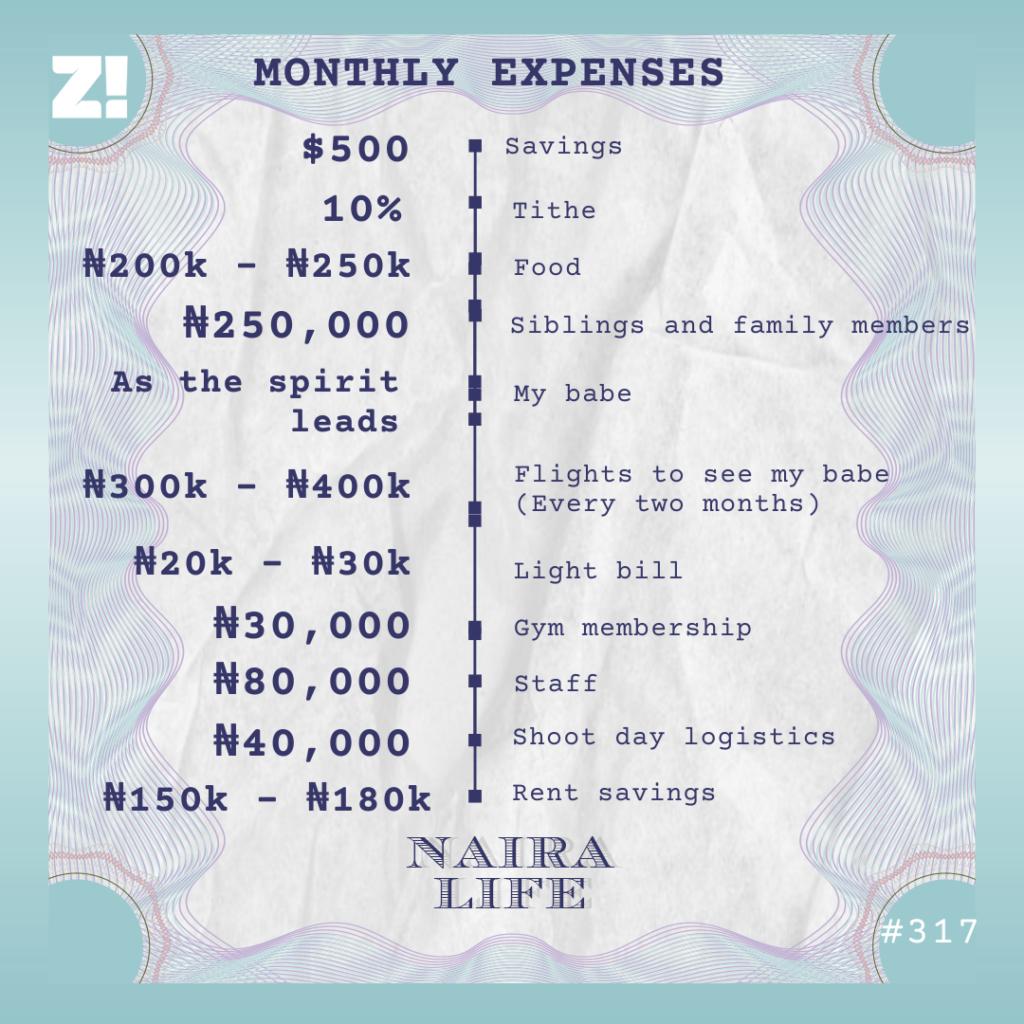
    Nairalife #317 monthly expenses

    My staff budget is for the contract assistants I work with when I shoot videos for content. The videos are gradually progressing from a passion project to an income source. 

    I have a manager who interfaces with potential clients, and we’ve had a couple of people pay us to shoot content for their events. One client paid ₦350k last year, and another paid just last month. 

    I’m not interested in profit sharing right now because I’m more focused on building a business presence and getting standard equipment. Once that’s done, I can consider trying to earn from it.

    What does your savings portfolio look like right now?

    $1500. I had to dip into my savings when I moved to Lagos and set up my apartment. I keep my rent savings in a savings app. The rest are in crypto.

    I’m curious. How has your rapid income growth shaped how you see money?

    My attitude to money has changed to, “This thing is for convenience.” I no longer worry about certain things because I can now afford them. 

    For instance, money has given me the ability to give, and I give a lot. I can afford to pay attention to people’s needs and keep in touch with them because I know if they need something, I can step in. I can just call my friends, ask how far and go, “Send your account, let’s do this thing.”

    I couldn’t do all this before, even when I wanted to. Before, I often had to ignore people’s needs or even limit interactions because of financial concerns. That’s not my problem anymore. 

    Energy. Do you live above or below your means, though?

    I live within my means. I don’t spend so much, except it’s absolutely necessary. Last month, I dropped ₦700k on a laptop because I needed it. This month, I’ll probably need to spend on a few more house furniture needs and set up a Starlink connection. These are basic things that I need. They’re expensive, but they aren’t exactly luxuries.

    I get you. Out of curiosity again, do you ever worry about money?

    I definitely worry about losing my job and not having money for the things I want. But I also feel like I’ll have money when I need it. If anything happens to my job, I’ll just find another one or focus on video production. My mum used to have a thing where her account balance could be zero today and money would enter the next day. 

    I’ve experienced that before, too. Several times, I was almost stranded, and money just came. I’m consciously trying to fix my money habits, so I don’t just rely on money coming in. I plan to read financial books, intentionally manage my money and achieve financial stability.

    Is there anything you want right now you can’t afford?

    Not right now, but a wedding. I know I’m just 22, but I believe I’ve met the person I want to spend my life with, and I hope to get married in the next two to three years. I want a small intimate wedding, but I’ll still need to get my money up, considering how expensive things get every day. 

    How would you rate your financial happiness on a scale of 1-10?

    6. I don’t think I have a handle on my finances yet, so I still feel broke. I want to be able to manage my money strictly, figure out extra sources of income, and make better financial decisions.


    If you’re interested in talking about your Naira Life story, this is a good place to start.

    Find all the past Naira Life stories here.

    Subscribe to the newsletter here.

    Join 1,000+ Nigerians, finance experts and industry leaders at The Naira Life Conference by Zikoko for a day of real, raw conversations about money and financial freedom. Click here to buy a ticket and secure your spot at the money event of the year, where you’ll get the practical tools to 10x your income, network with the biggest players in your industry, and level up in your career and business.

    [ad]

  • Every week, Zikoko seeks to understand how people move the Naira in and out of their lives. Some stories will be struggle-ish, others will be bougie. All the time, it’ll be revealing.


    If you’re looking for the best place in Nigeria to trade stablecoins like USDT and USDC, use Yellow Card.

    Yellow Card is very easy to use and usually has the best rates on the market, low fees, and top-notch security. Join Now!


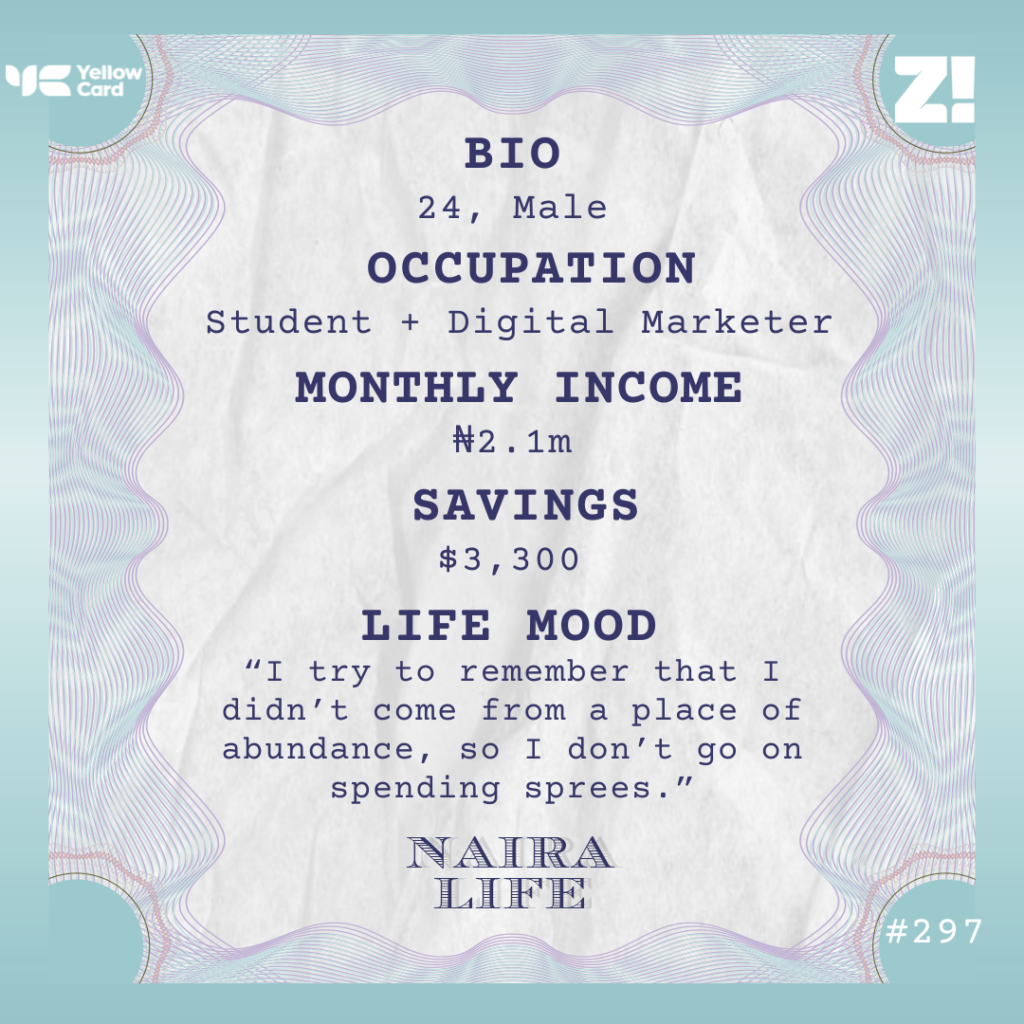
    Nairalife #297 bio

    Let’s start from the beginning. What’s your earliest memory of money?

    I come from an entrepreneurial family — my dad owned a printing press, and my mum was a petty trader — so money conversations were regular. It wasn’t strange to overhear questions about where our next meal could come from. So, I can’t remember a time when I wasn’t thinking about making money. One that comes to mind was when I sold biscuits for extra income in secondary school.

    Tell me about that

    I attended a boarding school, and when I got into the senior class, my parents started giving me a ₦10k allowance per term for feeding and other minor expenses. I’m a natural saver, so I managed my allowance to meet my needs. If I ever ran out of money, I’d call home.

    Then, during exams in SS 3, I noticed my classmates were selling biscuits and other snacks. The snacks were popular among students who didn’t want to walk all the way to the canteen at break time and those who got hungry at night when everywhere was closed. 

    I spoke to a friend whose mum also sold snacks at the school canteen, and we made an arrangement: I’d pay for cartons of biscuits and keep them at their house. Then, I’d take a few cartons at a time to the hostel to sell. 

    How did that go?

    It was very profitable. I can’t recall the actual figures because this was in 2016/2017, but I made enough to afford to recruit my friend’s sister and some junior students to sell my biscuits in their classes for a small commission. 

    The business lasted two terms, and I stopped because my hostel warden wasn’t a fan of students doing business. He tried to report me to the principal and housemaster several times, but I always escaped. I think I just decided on my own that I didn’t want to do it anymore.

    My next hustle happened during the waiting period between secondary school graduation and university admission.

    Another business?

    Something like that. I almost started selling natural health products in 2018. A friend introduced me to it, and I thought it wouldn’t hurt to try since admission hadn’t come — I was pursuing medicine and wasn’t making any money at my dad’s printing press.

    That business didn’t kick off because I couldn’t raise the ₦20k I needed for registration. However, I found digital marketing. My elder brother noticed I had a knack for writing, so he suggested starting an Instagram blog to grow an audience and possibly monetise it in the future. 

    Before then, I only posted my pieces on WhatsApp and Twitter. I started the blog as he suggested and began seeing how the foreign guys did digital marketing. They talked about graphic and brand design, email marketing, social media marketing and management. I read all they had to say, researched, and even took some courses. 

    I involved my brother in my progress, and he helped me get my first social media management job with his friend, who owned a laundry company. This was in 2019.

    Was it a paid job?

    Oh yes. The guy paid me ₦20k/month, and we worked together for six months. His business slowed during the 2020 pandemic because his clients had nowhere to go and didn’t wear as many clothes. So, he had to let me go.

    I also got admission to study medical lab science that period, but the combination of COVID and ASUU strike meant I couldn’t resume until the following year. I took advantage of my free time to hone my skills. I built a brand online as a social media manager and digital marketer, learnt graphic design and became a stronger content writer.

    In September 2020, I got my next gig as an engagement specialist with a digital marketer in the UK. He created most of the content, and my job was basically to engage his social media community and respond to comments and enquiries. The pay was £4/hour, and it was my first big break. I worked at least two hours a day, and my pay at the end of the month was usually ₦250k. 

    Not bad 

    It wasn’t bad at all. I worked with him on and off until January 2023 — sometimes, we worked together for three consecutive months and stopped when he didn’t have money. Then, we’d resume a month or two later. Towards the end of 2022, he introduced me to two of his friends, and I had a two-month stint working with them at the same £4/hour rate. 

    My income comes in very handy for school. I think my dad only paid my first-year school fees. I paid my ₦180k/year accommodation myself and didn’t bother calling home for allowances because I knew their financial situation depended on when my dad got a major printing job. I even started sending money home to help with emergencies or if my mum needed extra money to cook for the weekend.

    But how are you managing school and the multiple gigs?

    A lot of scheduling and sacrificing my free time, but I just have to manage. When I stopped working with the UK guy, I briefly worked with someone who needed help with the content strategy for two brands for a non-profit she wanted to start. 

    We agreed on ₦45k/month for a three-month contract, and I persuaded her to pay me for all three months at once; I had to move to the uni’s medical campus that year and needed money. While working with her, I took on another three-month digital marketing gig that paid $250/month — approximately ₦300k after conversion. 

    By the time the three months elapsed, I had about ₦800k saved from my different gigs. So, I decided to stop taking on gigs to focus on school for a while. The coursework was a lot that semester, and I needed to study. I survived on my savings for the next six months and only took another job in October 2023.

    What job, and how did you get it?

    Social media management. I got it via referral from a friend, and payment was per task completed. For instance, I got $50 to set up an ads account for TikTok and Instagram. The arrangement lasted three months, and I made a total of $200.

    After that, I took another brief break for school before I got my current job on Upwork in July 2024. I work with an editing firm as a book editor. My pay structure was initially an hourly arrangement of $7/hour, which came up to about $1,120 in a month. But I got confirmed after my first month and now earn approximately $1250/month, including bonuses. That’s around ₦2.1m after conversion. 

    That’s wildly impressive. And you’re still in school?

    Yup. I’m currently in 400 level. It’s been very interesting managing school and work. Sometimes, I skip classes. Sometimes, I juggle work and exams. So far, my work hasn’t adversely affected my academic performance.

    Two months ago, I employed someone and delegated some of my work to him. We agreed on $25 per book edited, but he’s not a professional yet, and his work rate was really slow. My workplace gives me a week to edit each book, and it just wasn’t working out with him. We worked together on three books before we had to part ways. 

    I think I’ve pretty much worked out a reliable schedule for work and school. For instance, I know I won’t always have time to cook, so I just accept that I’ll need to order food most of the time.

    You’ve had impressive income growth over the years. How does this impact your perspective on money?

    I consciously try to remember that I didn’t come from a place of abundance, so I don’t go on spending sprees. Even though I have enough to afford almost anything I want now, I don’t see the need to spend on luxuries or things that won’t impact my life. 

    I appreciate that I have more financial freedom, but I feel it’s just an opportunity to save more and provide financial leeway for my family. Without worrying, I can now afford to spend ₦100k on my parents’ medical bills or send ₦150k for food. In addition to the money gifts, my family can also come to me for loans, and I’m happy to help out.

    You mentioned saving. How does that work?

    I live very much below my means and save far more than I spend. I don’t send money to my family every time, so I’m constantly saving. I have about $3,300 in savings now, and I save in dollars to protect my money from inflation and the falling naira. 

    I’m also considering investments, but I’m being careful about that. I once lost over $500 in 2021 trading crypto. I did both futures and spot trading then, but I was new to it and lost that money because I didn’t properly weigh the risks. I plan to return to crypto one day since I have the experience now. About 53% of my savings are actually in a crypto wallet.

    But before that time, I might consider getting a financial advisor or expert to help me select the best investment options to diversify my funds. I have money right now, but I know anything can happen in the future, and I need a healthy safety net that I can fall back on. So, I definitely need to pay attention to how I handle my finances.

    Speaking of, let’s break down how much you typically spend in a month

    Nairalife #297 expenses

    I pay a yearly rent of ₦100k. That’s not a monthly expense, but I feel like I should mention it.

    I’m curious. Have you thought about future plans after school?

    I honestly think crypto trading and social media sales offer the highest earning potential and will continue to pay the highest in the next 10 years. If I can hone my trading skills and continue leveraging what I know about social media ads and marketing strategies, I can earn a lot. My short-term goal is to earn $5k/month by 2025 or 2026. Long term, I hope to earn $10k/month.

    There’s still the question of what I’ll do with my medical lab certificate, but I like that it gives me another option if the others don’t work. I may even consider opening a medical laboratory strictly for business purposes. Whatever the case, I intend to keep saving so I have enough of a safety net for whatever dream I want to pursue.

    How much do you consider a good safety net?

    Maybe $15k, and it’d be fantastic if I could save that by the end of next year. With a safety net like that, I wouldn’t feel too pressured if I didn’t start earning immediately after I left school, and it’d give me room to pursue whatever dream comes to mind.

    What’s one thing you want but can’t afford?

    Nothing.

    You know what? I rate it. How would you rate your financial happiness on a scale of 1-10?

    9. I’d like more financial freedom so I can take more risks. I think I’ll get there in time, especially with my current income and attitude to savings.


    If you’re interested in talking about your Naira Life story, this is a good place to start.

    Find all the past Naira Life stories here.

    Subscribe to the newsletter here.

    Get more stories like this and the inside gist on all the fun things that happen at Zikoko straight to your inbox when you subscribe to the Zikoko Daily newsletter. Do it now!

    [ad]

  • Dating a remote worker might seem like a dream—flexible hours, working from home, more time for cuddles, intense tluf tluf, right? But it’s not always that simple. 

    Between unending meetings and forgetting to eat, people who’ve dated remote workers have stories for days. We asked six of them to share their experiences.

    Hassan*

    The best part about dating my babe is knowing she’s always available. My ex was a banker, and it was probably my worst dating experience in terms of availability. We could go weeks without seeing each other, and I hated that.

    That experience made me appreciate my current girlfriend. She works remotely, and I love that I can pull up at her place on a Monday morning, and she’ll be in bed, taking a call. To be fair, she spends a lot of time working, but at least she’s right there in front of me.

    Jade*

    My husband fully transitioned to remote work after the pandemic, and at first, it was fun because he was always at home, and we spent lots of time together.

    Four years later, it’s not the same. He’s taken on a senior role, so he’s constantly on his laptop, jumping from one meeting to another or working on some urgent document. By the time he’s done, he’s always super exhausted, like he spent the entire day hawking pure water. We’ve tried to find a balance, but it hasn’t worked. Even the kids complain that daddy is always working.

    Ijeoma*

    Remote workers never really get off work. Endless hours, midnight meetings because of time zone differences, and if you work a regular 9-5, your schedules constantly clash. Plus, you can’t call them on a whim because they might be on a work call.

    The upside? They’re usually at home or at their preferred workspace. That’s my dream life, but I’ll try to have structure so it doesn’t feel like we’re both always working.

    Betty*

    Be prepared to go on hunger strikes weekly. My boyfriend never talks about food unless I ask or when he’s starving. He’s always on his laptop, hopping from one Google Meet call to another. It’s so annoying.

    I’ve stopped complaining. When I visit, I bring home-cooked meals or grab his phone to order something when I’m hungry.

    Dami*

    My favourite thing about dating a remote worker is the flexibility. For example, I went on leave last month and decided to spend two weeks in Abeokuta. I didn’t want to go alone, so I asked my boyfriend, who agreed to accompany me. You can’t do that with someone who works a regular 9-5 — they’d have to plan ahead and come up with an excuse to get time off.

    Mariam*

    Get ready for weird questions from nosy neighbours. When we moved to our new place, I left for work every morning before 9 a.m., while my husband worked from home. After two months, my landlady called me for a chat.

    She asked if my husband didn’t have a job because it was strange that I left for work every day while he stayed home. I explained he worked from home, but she wanted to know what kind of job kept him indoors all the time. I tried to explain, but she didn’t get it. I’m sure she’s convinced he’s into internet fraud.

    Read this next: 8 Celebrity Unions That Rocked the Internet in 2024

  • Every week, Zikoko seeks to understand how people move the Naira in and out of their lives. Some stories will be struggle-ish, others will be bougie. All the time, it’ll be revealing.


    Nairalife #285 bio

    What’s your earliest memory of money?

    Nothing specific comes to mind. But growing up, I always knew when my parents had money and when they didn’t.

    How so?

    They were open with me and my elder siblings on financial matters. When there wasn’t much money, my mum would say, “This is a difficult period. You guys should bear with us.” My dad would also call us together after morning devotion to share what things were like and assure us that he was working hard to fix them.

    What did they do for money?

    My mum didn’t have an income as a stay-at-home mum, but my dad worked as an analyst for a political party. I think that’s just code for him being “into politics.” But he was idealistic and rebelled against most of what happened in the party. He contested for the party primaries once in the early 2000s, and they kidnapped him.

    Ah

    They didn’t like him very much. His salary wasn’t great, and he only got extra money when the party shared money for meetings or whatever reason. That wasn’t consistent, and everything combined is why we had periods of financial drought. 

    Were there other pointers as to when there was money and when there wasn’t?

    Oh yes. When there was money, I got expensive clothes and shoes. I didn’t get anything new during the dry periods. My parents tried their best to make these dry periods unnoticeable, but they couldn’t always shield me.

    One time in SS 2, my school fees were delayed, and the principal went from class to class, embarrassing students. It was during exams, and I was writing a paper. The exam was supposed to last an hour and 30 minutes, but I rushed through it in 30 minutes because I knew the principal was coming.

    When she finally did, she screamed my name and was like, “You’ve not paid your school fees!” I had to carry my bag and leave the exam hall. Thankfully, I was done with the paper, but I was so ashamed. My teachers were more empathetic. I was a smart student, and they liked me, so they secretly confirmed I was actually done before allowing me to leave the exam hall. It sounds dramatic now, but that was the most horrible thing that had happened to me at that point.

    When was the first time you worked for money?

    2008. I was 16 and had just gotten admitted to university. A family friend made beautiful handmade cards, and I had the bright idea of taking some of them to school to sell on Valentine’s Day. 

    He sold each card to me at ₦250, and I sold them for ₦800 – ₦1500. I made about ₦8k in profit the first time I sold them. I did the business for the two semesters I was in university.

    Just two semesters?

    Yup. I had to return home after a year. The thing was, I failed Physics in WAEC and NECO, and I was studying Industrial Physics. People had encouraged me to just resume and find a way to work around it. But school authorities said it couldn’t work, and my admission was revoked. So, I returned home in 2009.

    But it wasn’t all bad news. A wealthy aunty told my dad to allow me to come to Lagos so I could prepare for a US school. She wanted to sponsor me. So, I moved to Lagos in 2010, took SAT tutorial classes, and wrote the SAT and TOEFL exams. I passed both. Then, I got admission into a uni in Seattle and they sent my I-20 form. Everything went smoothly until I was about to start my visa application. That’s when my aunty decided she couldn’t afford to sponsor me anymore. 

    What? Why?

    My dad’s siblings talked her out of it. It was like she hadn’t even sent her own children. Why me? It was really disappointing. I’d spent one year on all those classes and exams. I’d even given out my clothes. I was that sure I was leaving Nigeria.

    This woman had already spent so much money on the process — about ₦500k on the tutorials and exams. Anyway, I carried myself back to my father’s house to face my life.

    To pursue uni admission, yeah?

    Yeah. I had to sort out my O’Levels before writing JAMB. I returned home in late 2010, and it was too late to register for GCE, so I waited until 2011 to register. I wrote the GCE again and still failed the damn Physics exam. 

    It was wild because everyone knew I was smart. I didn’t know why Physics was kicking my ass. In 2011, I considered military school and took the exam to join the Navy. One of the officers saw me during the exam and was like, “You want to join the Navy with this your small body?” I even tried the pre-degree path and failed woefully.

    Yikes. Sorry about that

    After I failed the pre-degree in 2012, I took up a teaching job at a school where I taught the JSS 1 class English. My salary was ₦18k/month, and I mostly used it to fix my hair, buy data and look good. I also changed my phone during that period.

    I rewrote GCE that same year and finally passed Physics. I gained admission to uni in 2013 — five years after graduating from secondary school.

    Phew

    I quit my teaching job. But you see that Physics that was kicking my ass in GCE? I got an A in it in my first semester. It turned out it wasn’t even that difficult; I just didn’t understand the teaching style in secondary school.

    Moving on, let me tell you how I stumbled on a business opportunity in my first year.

    I’m listening

    I bought some clothes online from a UK shop but didn’t like many of them when they arrived. My roommates loved the clothes, so I ended up selling most of them. I made almost ₦60k profit from that first batch of clothes, so I decided to make it a regular thing.

    I’d show my roommates and friends the clothes online and then order based on their selections. I shopped from AliExpress or ASOS. Then, I sent the clothes through the Nigerian Postal Service (NIPOST). The clothes arrived within five days. 

    I was a rich student. I often made ₦100k in profits monthly. I was also a baddie in school, so some random man would send me money — between ₦100k and ₦200k —once in a while. My parents also sent me money whenever things were good at home, which usually ranged between ₦20k – ₦30k.

    What were your expenses like?

    Mostly hair and clothes. In 2014, all the it-girls wore Brazilian hair, so my sister and I regularly travelled to Lagos to buy hair. 

    I spent money on a lot of random things. I’d enter town and buy groceries or whatever. I also sent money to my mum and elder brother — ₦30k/month to my brother and ₦50k/month to my mum. They knew I had a business in school.

    I also took on a significant part of the house expenses when I was home from school. My dad was done with politics and was trying his hand at several businesses, so he had almost no income. I felt I owed it to my parents to pick up some of the financial responsibility.

    I ran the business for almost two years until I had to scale it back.

    What happened? 

    My grades began to suffer, so I decided to focus on school from my third year. I was still selling stuff, but not as frequently. In 2015, the dollar rate started shaking, forcing me to reduce the volume of clothes I imported and try other businesses.

    First, I tried sneakers. I also sold cute earrings and necklaces. Then I sold jeans. Ultimately, I stuck with jeans and jewellery for the rest of my time in school. 

    My income dipped to about ₦30k/month due to my focus on school. My parents still sent money whenever they could. My elder sister had also started working, so she sent me random ₦5k once in a while.

    In my fourth year, I did a four-month internship that paid ₦14k/month, but my main income came from my boyfriend. He got a job as a rig worker in 2017 and started making money, so he started giving me about ₦200k/month. This happened until I graduated in 2018.

    What did you do next?

    NYSC. I was called up in 2019 and served in a secondary school. My PPA didn’t pay me anything, and me too, I didn’t ask. There was a lodge, so I didn’t pay for accommodation.

    I started a snail business with my boyfriend during this time. His contract with the rig had ended, so we decided to invest in snails. I think I just wanted to get down and dirty to prove to myself that I didn’t just get handouts from people all the time. 

    He brought in the money, and I did the manual work. I’d travel to Bayelsa and buy 200 snails for ₦18k. Then, I’d clean and process them. We made about ₦200k on each batch.

    We did this for a while and then went into feminine wellness teas. I saw the tea online and did some research about the medical benefits. It was legit, so I convinced him to let us try it. A pack of the tea from China cost ₦700. We repackaged it and sold it at ₦15k. It was a big hit. I advertised to everyone in my lodge and PPA and handled social media management. We comfortably made ₦7k – ₦9k in profits per pack.

    Nice

    I finished NYSC in July 2020 and got a job working the front desk and onboarding clients at an investment company. My salary was ₦100k/month. The job also came with a car. I got the car because I was the only one in the office who could drive, and my boss thought it’d help with my role.

    I should mention that a major reason I took the job was because I wanted to have something of my own. I wasn’t getting anything apart from ₦5k for data from the joint business with my boyfriend — we’d agreed to put the profits back into the business — and I needed to rent an apartment. He started acting insecure the minute I started working, and the relationship pretty much ended.

    I saved my salary for three months and got a ₦250k/year apartment. Things were going well until I had the bright idea to invest my ₦600k savings in the company in December. I thought, “I can’t work at an investment company and not make small money too, abi?”

    It already sounds like it didn’t end well

    It didn’t. I was supposed to get a 20% return on my investment each month for six months. I got ₦120k in January and February. But after the second payment, the company packed up. To make matters worse, I’d been investing the returns and every extra money I got at work in crypto. Then Buhari banned crypto, and I could only get ₦80k out of the trading app I used.

    Damn

    I lost my job, savings and investments, everything. I cried my eyes out. I used the remaining ₦80k to do retail therapy on Shein. At least my company didn’t collect the car back, so that was a plus.

    After two months of unsuccessful job-hunting, I decided to use the car as a cab. So, in May 2021, I registered on a ride-hailing app and became a driver.

    That’s quite a pivot

    The car was just gathering dust, so why not? My siblings were so scared. There was a 7 p.m. curfew in my city because of kidnappings, but I was often on the road till 9 p.m. When police stopped me, I’d lie and say I was just dropping someone. They often pitied me because of fine girl privilege. 

    Driving brought me around ₦30k – ₦40k weekly after fuelling the car and other minor expenses. Riders also tipped me ₦3k – ₦5k because again, fine girl. Me, I was spending money on gourmet meals, facials, pedicures and hair. I really don’t like to struggle. 

    So, when the car broke down in July, I had nothing saved up to fix it. I eventually sent the car to my dad, and that’s how my driving career ended after three months. 

    I’m screaming. What did you try next?

    I remembered that people make money on sites like Fiverr and Upwork, so I created accounts and started looking for jobs. I didn’t get anything until the end of August— $100 for a small virtual assistant gig. 

    In November, I got another virtual assistant gig. It paid $10/hour and was capped at 25 hours per week, bringing my monthly income to $1k— $800 after Upwork removed its commission. 

    Of the $800, I saved half in my domiciliary account and lived on the other half. Sometimes I’d run back to my savings to remove an additional $100 before month’s end because I’d spent all my money on perfumes and shopping at Miniso.

    In May 2022, I got a new $20/hour project coordinator gig for an HR company. My contract was capped at 30 hours weekly, bringing my income to $2200/month after deductions.

    So, you were juggling both gigs?

    Yes, I was. By this time, the virtual assistant gig had increased my pay to $12/hour, so I got $900/month. However, my contract ended in August. By September, the HR company started having issues, and I worked fewer hours. I was getting around $800 – $1k/month. But I wasn’t too bothered because I had $5k in my savings.

    The gig finally ended in January 2023, but then I got another one. It was $25/hour, but they only let me work five hours a week. It didn’t make sense to me, so I left in March. I had a long stretch where I didn’t make any money. My boyfriend was the one paying my bills.

    How about the $5k savings?

    I spent a good portion of it on retail therapy. I went on Zara and Fendi and got bags and other stupid shit. 

    From March to September, I was just coasting. I was applying for jobs, but nothing was coming. Then it was like my eyes opened. How was I comfortable with how things were going? I started fasting in October because God just had to do something.

    Did He?

    Yes! Ironically, I got a gig on the third day of October: $20/hour, 15 hours weekly, which was $1k/month. That lasted a month. Then, in December, I got another $600/month gig — a full-time project coordinator role at a pharmaceutical company.

    At this point, the federal government had started restricting dollar payments, so I had to get a middle-man app. This delayed my payment for about two months, but I started receiving it again in February.

    It helped me become more intentional with my spending. I spent only $300, most of which I sent to my dad and siblings since my dad no longer had an income. The remaining, I threw in another account so I wouldn’t even think of it. I didn’t even recognise the road to Shein again.

    Love it for you

    In May 2024, I landed another project coordinator role that pays $500/week. My other full-time gig also increased to $1200/month. So, both jobs now bring me $3k/month after deductions.

    Let me not lie; I returned to Shein and Zara after getting my first pay in June.

    Girllll

    I mean, I had more income. So, I spent about $1k on clothes, shoes, bags, skincare and perfume. I felt I hadn’t spoiled myself in a while, so I did that to reward myself for all the hard work. 

    But I’m more structured with savings now. The $2k from my second job goes into a different account I haven’t touched yet. Then, from the remaining $1k, I invest $200 in Bamboo stocks and $100 in a savings app for gold. I think gold is a good investment option, so I’m saving for a good piece.

    I also budget ₦100k monthly for impulse purchases, such as expensive perfumes. 

    What do these expenses look like in a typical month?

    Nairalife #285 expenses

    My tithe is essentially what I give to people. It goes to my dad (my mum is late now), siblings and anyone I want to support that month. 

    You’ve had an interesting financial journey. How has that shaped your thinking about money?

    I’ve realised that I can always make money. Money comes and goes, but I can always come back from ground zero. I just think I can be a lazy person. There’s a lot I’m good at, but it feels like a lot of effort to actually go out and be in people’s faces.

    However, I still want more financially. I’m brainstorming ways to move my income to $20k/month and actively considering cybersecurity. 

    Why cybersecurity? 

    I heard it pays a lot of money. Actually, I listened to a TEDx talk that encouraged me to try something difficult, so I guess this is me trying it. I’m honestly not sure if I’m cut out to do computer stuff, but I guess I won’t know until I try. 

    How would you describe your relationship with money?

    I don’t have a money management atom in my body. I live within my means, but my thing is that I must spend all my means until it finishes, which is a bad thing. It’s just not affecting my finances because I earn more now. However, I’m now learning to act like the grown-ass woman I am and be a lot more responsible. 

    Is there anything you want right now but can’t afford?

    A car should cost me ₦15m – ₦20m, but I can’t afford it right now. I don’t want to pack all my savings to get a car. I also don’t like saving for things I want. I should be able to just take money and buy what I want.

    Do you have any financial regrets?

    I try not to live a life of regrets. I used to feel bad about my late start — starting school when my mates had graduated and every other setback I’ve experienced — but I’ve realised that the trajectory of my life has gone exactly how God planned it. Could I have made better choices? Yeah. Maybe I should’ve read harder for that Physics. 

    But at the end of the day, everyone is looking for financial freedom, and I’m grateful I’m not doing badly.

    How would you rate your financial happiness on a scale of 1 – 10?

    7. Despite the inflation, I’m at the most financially comfortable I’ve ever been. It’s not a 10 because I’m still chasing that $20k so I can live a proper baby girl lifestyle and travel whenever I want.


    If you’re interested in talking about your Naira Life story, this is a good place to start.

    Find all the past Naira Life stories here.

    Subscribe to the newsletter here.

    [ad]

  • I kid you not, I’m writing this article with about 20% battery power left on my laptop. 

    For about a week now, the queues have resumed at petrol stations across Nigeria due to another fuel scarcity situation. To make it even worse, the power supply seems to have worsened. No light, no fuel. I asked some remote workers how they were coping because, to be honest, I wanted to steal hacks from them.

    “Work every time you see light” — Dotun, 28

    The truth is, even if you drop your laptop somewhere to charge, the battery will still go down when you pick it up and start working. So, if you don’t have money for a coworking space, carry your work with you wherever you see electricity.

    NEPA has been doing a thing where they bring light for 30 minutes around 2 a.m. Once I feel the breeze from the fan, I immediately stand up and do the work I can do. That way, I can save a full battery for when my actual workday starts.

    “Guard your fuel jealously” — Funmi, 26

    I divide my tasks according to how much time I think it’ll take to complete them, then I try to do as much as possible without using my devices. Of course, that doesn’t always work because I still need to turn on my generator.

    But I guard my fuel jealously. I only turn on the generator for 30 minutes at a time when it’s absolutely necessary. Even then, I only pour small fuel into the generator to somehow trick it into consuming less fuel. What kind of life is this?

    “Bribe someone to stand in fuel queues for you” — Josiah, 30

    I don’t have time to leave work and hustle for fuel, so I bribe my brother to stand in queues for me. I think he charges me five times more than what I should actually pay, but I’m happy to pay. He’s saving me stress and getting me fuel, which is heroic in these times.

    [ad]

    “Befriend your neighbours” — Toke, 24

    I’m the type who likes to keep to myself. I’ve lived in my compound for about a year and have never entered my neighbour’s house — at least until this recent scarcity started. They tend to turn on their generator more because they have kids and their apartment has become my second office. Thankfully, they’re nice about it but I try to only go there when absolutely necessary so I don’t take up too much of their space. 

    “Communicate with your employers” — Detola, 22

    I always tell my employers when I have to be unavoidably absent because I don’t have fuel or power. They can’t say they don’t understand because we’re all in this country together. I try to limit the instances when that happens, but will I turn myself into fuel?

    “Invest in an alternative source of power supply” — Fred, 27

    I had to angrily drop almost ₦1m to install a solar panel system last week when the fuel situation wanted to kill me. Of course, this was only possible because I had the money. But it was my emergency savings and I’m not happy about spending it on something that shouldn’t even be a problem. But I had no choice. My employers aren’t Nigerians and definitely wouldn’t understand. It was either that or losing my job.


    NEXT READ: 7 Nigerians on How Inflation Affects Their Relationships

    Get a free ticket to Strings Attached and enjoy a feel-good evening of music, dancing and games at Muri Okunola Park, Lagos on May 11, 2024.

  • Every week, Zikoko seeks to understand how people move the Naira in and out of their lives. Some stories will be struggle-ish, others will be bougie. All the time, it’ll be revealing.


    NairaLife #251 Bio

    What’s your earliest memory of money?

    My family had an open approach to money; we all knew when there was money and when there wasn’t. My dad always said, “If you return from school and there’s no food to eat, go to the bedroom. There’s probably money on the table”. If there was no money there, I’d check other places he kept money. If I checked everywhere and there was no money, it meant we had no money. 

    There was no such thing as “stealing” your parents’ money because you knew if you took the money for no good reason, it’d affect you since there was no other source. It also helped manage expectations. I’m the firstborn, and when my siblings whined about wanting sweets, it was easy for me to go, “Can’t you see there’s no money in the drawer?”

    What did your parents do for money?

    My dad’s a pastor, and our finances had a lot of no-money and faith moments. My mum’s a lawyer, but she was also a jack of all trades. She sold chin-chin, beads, hats, clothes, and even ran her own practice at some point. Another time, she was legal counsel at a microfinance bank. 

    It was a two-income household, but we mostly lived on my mum’s income because my dad wasn’t the rich-pastor type. He was more of the pastor-struggling-to-make-ends-meet type, and my mum held the family’s finances down.

    Do you remember the first time you made your own money?

    I first made money in junior secondary school by drawing maps of Nigeria and selling them to my classmates. For some reason, I was good at drawing them, so whenever we were given class assignments, they’d pay me ₦20 to draw for them.

    It later progressed to drawing and labelling skeletons for biology class and selling them to my classmates for biscuits. Slowly, my customer base expanded to students from other classes. While I did this till senior secondary school, I didn’t have a standard price. My friends typically paid with snacks, and I’d charge others depending on how much I liked them.

    Here for the nepotism. What about after secondary school?

    In 2014, I got into university in Benin Republic to study law, but I didn’t do anything for money till my second year. 

    My parents moved to the US because my dad was transferred to a church there, and I realised I’d need to make money to support myself. This was because my dad was still getting paid in naira, which wasn’t much after the conversion to dollars. I knew they didn’t have much. So, when my parents sent my ₦15k – ₦20k monthly allowance, which was about CFA 30k – 34k, I’d lend it to people short-term for 10% – 20% interest.

    What were you surviving on while you loaned people money?

    My aunty usually sent me groceries, so I had minimal day-to-day spending needs. 

    The loan business worked until one guy refused to pay me back my money. He’d borrowed ₦30k and was supposed to pay me ₦35k after a month. I didn’t trust him from the beginning, so I had him sign a contract and use his laptop as collateral. 

    Month end came, and he didn’t pay. I told him I’d sell his laptop, but he thought I was joking. After the second-month grace elapsed and he still didn’t pay, I sold the laptop for ₦40k and told him I was keeping the ₦5k change. He couldn’t say anything because it was better than calling the Beninoise police, who didn’t even like Nigerians. He’d have slept in prison. That was the last time I gave out loans. I can do hard guy, but only so much. 

    I graduated in 2017 and relocated with my siblings to join my parents in the US. That’s when I got my first official job.

    Tell me how that happened 

    Since my dad’s visa only allowed my parents to work, I could only get a job that paid me in cash. Our senior pastor introduced me to a lawyer who needed a paralegal and agreed to pay in cash. The pay was $10/hour, and I worked six hours thrice a week.

    Someone else also offered me another job on the side. It was called medical coding, and my job was to change medical diagnoses to alphanumeric codes — like record keeping, but in codes. So, when he got the medical coding jobs, he’d outsource them to me and pay me around 30% of what he was actually getting paid. Payment was $1 per chart, but I was coding as many as 100 charts daily and 1000 charts weekly, and making $1k weekly. 

    I was 19, earning $1,200 a week from two jobs

    That’s not bad at all

    It was good money, and I hardly spent it. I was incredibly frugal and was only interested in saving. My sister was in high school, and I knew university would be expensive as an international student, so I was saving towards that. I was also saving towards a car and the medical coding exam to qualify as a professional because I expected we’d get the green card soon. 

    So after I got paid, I’d remove my tithe, set aside $100 for pizzas and McDonald’s — which was essentially my fuel for the long work days — and save the rest. The other bills that took my money were the few times my parents needed help with rent or groceries and my brother, who would randomly ask me to pay for sneakers, food and just random things. 

    Not spending enough of my money on myself is one of my biggest regrets today. I thought I’d finally start enjoying my money after I took the medical coding exam. The next step would have been an income boost since I’d be able to get the jobs myself. None of it happened because we had to leave the US in 2019.

    What happened?

    My dad was on an L-1 visa, which is mostly for executives. There’s a separate visa category for pastors, but my dad didn’t come in through that because it’s very difficult to get a green card with that visa category. So, his official job title was something like a financial advisor for the church, so he could apply for a green card after two years. 

    Unfortunately, Donald Trump started fighting against immigrants. My sister was just finishing her first year of uni, and my brother had just graduated from high school. I was studying really hard for the exams myself, and we were all hopeful. But we got denied and had to return to Nigeria.

    I’m so sorry 

    Thanks. I couldn’t do any medical coding jobs in Nigeria because it was sensitive information you couldn’t even move houses with. I also couldn’t do the paralegal job anymore. So, I had to start from scratch. I converted my $2k savings into naira, and I don’t remember how much it was now, but it was quite a lot. 

    I eventually lost the money sef. I naively put about ₦300k in a ponzi scheme that promised 40% interest after six months. I didn’t get anything, of course. Then I used about ₦750k to buy some plots of land somewhere I’ve never seen before. Honestly, I just bought it so it’d be like I owned something.

    Then someone who knew my dad introduced me to a real estate company for a job. They didn’t have an opening, but they just wanted to help out, so they put me in customer service. When I met the HR, she asked about my salary expectations. I just laughed and told her to tell me what the role paid. She was still insisting, asking what I earned before. When I said, “$1k/week”, she sat up in her chair in shock. 

    LMAO

    She finally said the role paid ₦50k and explained they couldn’t pay more because I hadn’t done NYSC. I wasn’t expecting much before, so I took it. I was in customer service, but I did everything. If the lawyers weren’t around, I’d draft contracts. If the accountant were unavailable, I’d print receipts. I also did admin work, visited sites, and took videos. 

    I registered for NYSC in 2020 and was at the orientation camp when COVID hit, and we had to go home. I did the rest of my service year with the same company, even though they didn’t pay me for the three months I was home because of the lockdown. They also tried to reduce my salary to ₦20k because I had NYSC’s monthly ₦33k stipend, but I reported them to the person who brought me there, and they fixed up.

    I started looking for a job as I approached the end of my service year in 2021, but I didn’t know what I could do. The only job I was really good at — medical coding — didn’t exist in Nigeria. I also wasn’t planning on going to law school, so I couldn’t practise. Then, a friend told me about a social media management position in an EdTech company. I’d been posting videos on my personal social media for the longest time, and I thought I could try social media management. So, I applied for the role. Honestly, I don’t know how they hired me because I’m not sure what I did in that interview. But they did, and I got my first social media job.

    How much did it pay?

    ₦100k/month. It was remote, and I also got side gigs once in a while from a lawyer in the US who needed me to speak to Nigerian clients and get documents. That paid $10 per hour worked, and I worked two to three hours per week, so that was an extra ₦10k/month. 

    I lived with my parents, had no expenses and even started saving again. I saved ₦20k monthly with my colleagues through an ajo contribution arrangement and another ₦10k on a savings app. I was in a relationship and thought I’d get married that year, so I was saving because everyone says you need to have money to do a wedding. But I later decided I was too young to get married, so I used my savings to buy my dad a new iPhone 11. It cost about ₦350k.

    In December 2021, I had a severe mental breakdown and decided I couldn’t do the job anymore. My team lead and I were the only people in the marketing team. I was hired for social media, but I was drafting copy to drive “leads” and meet “OKRs”. I had no idea what I was doing. 

    So, I left and told my parents I wanted to pursue a postgraduate degree. Really, I just wanted to leave the job, but I needed to give them a plausible reason for quitting, so I chose academic advancement.

    Did you have any source of income while in school?

    I survived on the generosity of my parents and boyfriend for the entire year I spent in school. I lost the paralegal side gig because school wasn’t in the same state I lived in, and most of the errands I did for the lawyer were back home. 

    After graduation in November 2022, I landed two social media management jobs, one for a startup and the other for a homeware store. They paid ₦100k and ₦150k/month respectively, bringing my total income to ₦250k/month. 

    I also started planning for my wedding. So, some of my salary went into getting my clothes and jewellery. I think that cost about ₦300k. We also had to pay rent for our new place, which cost ₦700k, but my husband mostly handled that. The wedding itself was in February 2023 and was paid for by our parents. They wanted 500 guests, so they might as well pay for it. My husband and I just showed up.

    Were you still working both jobs?

    It’s funny you ask because I kinda lost both jobs at the same time in September. To be fair, I quit the ₦100k job because handling both full-time was too stressful, and it felt like I was no longer doing anything impactful there. The second job is a lot funnier. When I started, there was a whole content creation team, but then they sacked everyone one by one and left me to be the videographer, photographer, editor and social media manager all in one. Then a few weeks after I quit the other job, they sacked me and hired another team because they wanted “quality”. 

    Thankfully, I applied and got my current job as a content specialist with a startup in October. This one pays ₦300k/month, better than my two previous jobs combined. However, it feels like I’m still struggling. If I earned this kind of money two years ago, I’d have felt incredibly happy. But with how the economy is, and the fact that my husband had to drop a job recently and is down to a ₦180k/month income, it doesn’t feel like much.

    What are your expenses like?

    My husband and I operate a joint money system, so our expenses are made together based on our joint ₦480k monthly income. To break it down:

    Nairalife #251 Expenses

    The ajo contribution is towards the rent when it expires. Black tax isn’t regular because our parents don’t really disturb us, we just send money randomly. My brother, on the other hand, calls regularly to ask for one thing or the other

    Your income has gone from a sharp drop to a gradual increase. How has this impacted your perspective on money?

    When you start a career with that much money, you don’t really think of it going away. I always thought it was just going to get better. It’s why I hardly spent on myself. I thought I was sacrificing my right now for a better tomorrow. But it didn’t turn out like that. Honestly, it was so depressing.

    Now, I try to consciously spend on myself and buy things I like. Because who did all that saving help? I don’t have anything to show for all my hard work. On top of that, I had to start my career again, pretending like I hadn’t made good money before. It is what it is. I just have to keep moving forward and keep finding better opportunities.

    Is there something you wish you could be better at financially?

    Balancing side gigs. I’ve realised that I’m not very good with splitting my focus, but that’s what most people are doing to augment their incomes. On the other hand, maybe I just need to get my money up by finding a job that pays really well. Business isn’t an option, because I’m not good at it. I just need to find better opportunities; I can’t do anything else for money. 

    What’s an ideal figure you think you should be earning?

    ₦750k/month. I want my one-month salary to comfortably pay my rent without thinking about what’s happening next, or how to plan to make it happen.

    Is there anything you want right now but can’t afford?

    Definitely a car. I’m a soft babe, and jumping buses make my life miserable. If I take public transport two days in a row, I’ll fall ill. When I first started considering it last year, it was around ₦1.8m for a simple Corolla. Obviously, ₦1.8m can’t buy anything now, so let me just focus on getting my money up.

    What’s one thing you bought recently that’s improved the quality of your life?

    We got an inverter as a wedding gift and paid ₦20k for installations a few months after we got married, and it’s made our lives easier. We hardly spend on fuel.

    How would you rate your financial happiness on a scale of 1-10?

    2. I’m not happy. I think about all the things I want to do, but I can’t afford them. If I wasn’t thinking about them, it’d probably be a 6. My day-to-day life is pretty good, and I have the essentials. But there’s still a lot I need to make my life easier. If I want to leave the country now, ₦300k salary can’t do that, so I don’t even think about it.


    If you’re interested in talking about your Naira Life story, this is a good place to start.

    Find all the past Naira Life stories here.

    [ad][/ad]