• The Nigerian experience is physical, emotional, and sometimes international. No one knows it better than our features on #TheAbroadLife, a series where we detail and explore Nigerian experiences while living abroad. 


    Ken (49) left Nigeria almost twenty years ago. In that time, he has lived through multiple waves of anti-immigration sentiment in the West. He shares how having a tough skin helped him navigate racist environments, and why he is not considering a return to Nigeria.
    This model is not affiliated with the story in any way

    Where do you currently live, and when did you leave Nigeria?

    I live in England currently, but I have also lived in other parts of the United Kingdom (UK). I left Nigeria in 2006, 19 years ago.

    Was that your first time leaving Nigeria?

    No. I used to travel around. I had been to the UK a few times for holidays and visiting friends, but 2006 was when I moved here permanently.

    What inspired you to leave?

    I just wanted more for my life, that is the truth. I got my first degree in Nigeria, and I felt like I had gotten a certificate but not an education. I wanted more than just that paper. I wanted global exposure. The idea of being a global citizen was really appealing to me. 

    What was life like for you in Nigeria?

    It was okay. I made money, but it was not fulfilling. I worked in the banking sector, and I invested aggressively during my early days. So by the time I started thinking about moving abroad, I did not need my salary anymore. I was really comfortable, and my investments were yielding more than enough to take care of me.

    So I thought, “Oh, I think I need a lot more for myself.” That was what pushed me to leave. I applied for a master’s in the UK.

    I still remember when I got my visa. I got it in late October, and school had already resumed in September. I was almost too late to resume. After getting my visa, I had to get to the UK within 48 hours.

    Get More Zikoko Goodness in Your Mail

    Subscribe to our newsletters and never miss any of the action

    Wow. How did you make it?

    I basically just left everything. I said to my girlfriend, “Look, girl, I am leaving. You can have my whole house to yourself with everything in it.” I changed my money. I think it was two hundred naira to a pound back then. Then I got on a flight to the UK.

    What was the early experience like?

    I was really focused on school and work. My master’s took about two years to complete. During that time, I had internships with some companies to get “UK experience” because the companies here do not recognise whatever experience you are coming with from Nigeria.

    While I did not like starting from ground zero, I looked at it as coming in on a clean slate. So I just took on every opportunity to learn and relearn. I did not only do my master’s courses, but I also got some other certifications to make myself ready for the UK job market. About six months after I graduated, I got a job at EDF Energy.

    Would you say the move to the UK has been a good decision so far?

    Yes. It was a good move because of the professional exposure I have gotten. My move to the UK took me to a whole new level in terms of what I could achieve technically. I went to places I never imagined I would. Like getting to work underneath a nuclear reactor. I was doing stuff I never imagined I could. It was like my technical capabilities exploded. I was pushing myself beyond my normal boundaries because of the work I did, the people I met, and the opportunities I had.

    But it was tough. It was not a walk in the park. There were good times and bad times, but overall, I would say it was a good move.

    Sounds like you have had quite the career. What are you up to now?

    Like I said, technically, I have pushed myself beyond my boundaries and achieved a lot of great projects in those companies I worked for. So I felt it was time for me to pivot and start doing things for myself. Right now, I consult on a contract basis.

    We have talked about your professional life in the UK. But what about your personal life? What is your support system like?

    My support system is my family. That is my wife and three kids. Due to my continuous travelling, two of my kids were actually born in the United States (US) during the time we lived there.

    After my contracts in the US were completed, we moved back to the UK, and I have built a tight unit of friends who have the same mindset as me in terms of career plans and business, and also socially. So that is my support system.

    Your girlfriend joined you in the UK?

    No. I met my wife in the UK. My relationship with my girlfriend in Nigeria did not work out. We tried long-distance for a while, with me coming to Nigeria whenever I could, but it did not work out in the end.

    After that, I met my wife in the UK. She had also come from Nigeria to study. We met at an event at a mutual friend’s house, and we started a friendship that eventually turned into a relationship. She initially wanted to finish her studies and go back to Nigeria. But after her studies, we got engaged and then married here in the UK.

    She is more Nigeria-focused than I am, but I think along the way, she came to see the value of life in the UK. I think she is starting to see the UK as her home a lot more now, after all these years.

    You mentioned your children being born in the US while you lived there. Where else have you lived?

    Apart from the UK, I have stayed in the US, France, and Germany. Those are the countries I have lived in for work for long periods. I have been to many other countries for shorter periods, too.

    Do you have a favourite?

    I would say the US, Texas specifically. The environment just appeals to me. But my wife does not like it there because of the gun laws.

    While we are talking about different countries, let us talk about Nigeria. Have you been back since you left?

    Yes. I have business there from time to time, so that brings me back often.

    Is there a possibility of a permanent return?

    No, I do not think so. Not in the current state of things in the country. If I am going to retire permanently in Africa at some point, there are other countries on the continent I am considering. 

    There are other African countries that have much better situations economically, and in terms of security and safety, which is very important to me.

    I get contracts to offer my expertise in many different countries. Nigeria is one of those countries. So for me, it is just a place to do business. Whenever I am done with business, I leave.

    Does the current anti-immigration sentiment in the UK make you uncomfortable?

    The immigrant journey is never a straightforward one. I see all this anti-immigration talk in Western countries now, but I have seen it play out before. Back around the time I first moved here, there were all these really frustrating policies imposed on immigrants for no just reason. I passed through all that.

    Also, it was quite an expensive journey, and you find yourself having to depend on people and systems that make you compromise and endure certain things. You might be in a toxic workplace, and because you are an immigrant, you just have to endure it.

    There will be positions you are qualified for and should get, but you will not because they are designated for British passport holders only. I was in a tough spot because my work involved a lot of travel, and that was really difficult when I first came here.

    Documentation at the time limited my ability to travel. So there are a lot of limits to your opportunities as an immigrant, especially in the early periods. But you just have to get through those periods.

    That has to be a little frustrating, right?

    It is frustrating because I feel like they do not appreciate the value that immigration brings to their countries. And unfortunately, the Western media does not help because they feed them wrong narratives. Many people do not think critically and just swallow whatever propaganda they get fed, then run to the streets with it.

    The fact that they do not reason critically, and it leads to this anti-immigration rhetoric being pushed around, is what makes me uncomfortable. But the truth is that they cannot do without immigrants. It is like they do not want us around, but they also need us.

    There are so many occupations, roles, and parts of the economy that would collapse if they stopped immigration. They cannot do without it. So I would just say that immigrants coming to the West have to be prepared for what they are going to face. Do not allow yourself to be surprised by it.

    With some of the new laws and policies making life really difficult, do you think immigrants are getting a fair deal?

    What feels fair depends on each person and what they want and expect. You need to have a long-term strategy.

    As I said earlier, I was comfortable in Nigeria before I came to the UK. I was financially independent, but I still came to the UK because I was thinking long-term. I looked at where Nigeria was, where it was going, and I felt my investments would not be able to sustain the kind of lifestyle I wanted while still being in Nigeria. That was why I decided to pack my bags and come to the UK.

    So, talking about a fair deal, everyone has to think about what they are sacrificing and what the long-term benefit will be. You just have to think about whether or not the value you are getting is worth the pain you pass through as an immigrant.

    Whether you are getting a good deal depends on what you want from the system. It depends on what you want long-term.

    It could be tough, it could be hard, but if you have a long-term plan, you will be able to make the right decision for yourself and your family in the long term.

    Can you remember some of the culture shocks you experienced when you first moved to the UK?

    The first thing that shocked me was the structure of the UK itself. It is four countries: England, Scotland, Wales, and Northern Ireland. And each country has its own distinct culture, its own flag and currencies, even different languages.

    I struggled getting used to the different accents. My goodness, in Scotland, the accent is not a normal English accent. And they have their own language too: Doric. I had to learn it because it is what the local people speak, and if you want to get along with them, you have to know it.

    Let us talk about highlights and lowlights. What has been your worst experience as an immigrant?

    My worst experience was at a time when there was a lot of anti-immigration rhetoric. This was around 2011, the Conservative Party was in power, and they were really clamping down on immigration.

    It was a really bad time for me and my family. Every time you made the application to renew your paperwork, it would take almost forever. And that could affect your work placement. Luckily, my employers were quite understanding. But I have friends whose employers were not so understanding, so they had to stop work for a period of time. And you could not travel around while your visa was being renewed.

    So it was a bad time for me because for almost six months, I was not sure if I would still be a resident in the UK or not. And my finances were also affected because I lost many opportunities for work that involved travel.

    Added to that, the area I was working in was not a comfortable place for an immigrant. It was quite a toxic environment because of all the anti-immigration sentiment. I know some people would not stand what I did. They would have just left. But I realised that if you have tough skin, and you know what you are doing, you will pass through the tough time.

    You mentioned being in a toxic environment. Do you mean racism?

    Yes. In the UK, they are subtle about it, but it is there. You can feel it, you know when it is happening. And it is very difficult to deal with that in the workplace because your visa is tied to your having a job. So you just have to swallow it, shoulder it, and move on.

    My friends and I had this inside joke based on the movie, Twelve Years A Slave. So whenever something happened, we would encourage ourselves by saying, “Do not worry, just do your five years of slavery and get out.”

    That sounds grim. But it must have been good to have that support?

    Yes. One thing that really helped me through that dark time was the support of friends, especially from the Indian subcontinent. So that is my Indian and Pakistani friends.

    They are very resourceful, and they have a very strong community mindset. In that sense, they were actually more supportive than the Nigerian community in the UK. I found that Nigerians mostly did not know how to help, and those who did were asking for money. But my Indian and Pakistani friends just helped freely. They guided me through the whole visa process and never asked for a penny.

    That sounds great. What has been your best experience?

    I do not know where to really start. There have been so many great experiences. I really enjoyed my time working in the US. It felt like a really merit-based system there. If you work hard, you will be rewarded accordingly. That was my experience, so I loved it there.

    I also made some long-lasting friendships there. I am constantly having to fly over because people keep inviting me to events.

    I have become more financially independent in the UK to the point where I have dumped my nine to five and I am now doing my own thing. I have so much more time to enjoy new experiences.

    So I will say I am still building my best experiences here.

    That is amazing. Nineteen years is a long time. Can you sum up your journey?

    If you have a plan or dream, you can make it come true. That has been my journey. Almost everything I have made up my mind to do, I have done. Not everything I wanted has happened, not everything has worked out, but I have hit a lot of the milestones I laid out in my plans.

    Well, let us put a number to it then. How happy would you say you are on a scale of one to ten? And why?

    I will say for me, in the UK as an immigrant after all these years, I will give it a seven point five.

    It is not a higher number because of the weather. I hate the weather here. Let me put it this way: the rich people in the UK do not spend the winter and autumn here. Only poor people stay back. And the fact that I am speaking to you from the UK in the autumn shows I am still poor and I have some ways left to go in the things I want to achieve.


    Do you want to share your Abroad Life story? Please reach out to me here. For new episodes of Abroad Life, check in every Friday at 12 PM (WAT).


    Before you go, help us understand how you and other young people feel about the 2027 general elections by taking this 10-minute survey.


    Click here to see what other people are saying about this article on Instagram

    [ad]

  • Folu*, 19, recalls how her mother gave up the comfort of a stable marriage to move her to Canada when she was just four. By six, her mother had died of cancer, she’d lost all contact with her father, and was living with her white adoptive mother.

    Now a teenager, she recounts the physical, mental, and racial abuse she endured before finally returning to Nigeria.

    This is Folu’s story, as told to Margaret

    Canada was supposed to change our lives, and it did, but not in the way we expected. 

    I was four, and most of my memories from that time are fuzzy, but I still remember the excitement on my parents’ faces when they talked about relocating to Canada. I also remember the disappointed looks they shared the day they found out my father’s visa had been denied.  

    My mother was torn. She had always been more ambitious and confident than most people. I’m convinced God made her that way because she was a wonder. But that day, she looked distraught, much smaller than her 5’10 frame. Behind her beautiful, fair face — usually lit up with a gorgeous smile — was a quiet fear.

    Her visa had been approved, yet that fear stood as a wall between the life we were living  and the life she wanted for us. My mother, who always seemed sure of every step she took, suddenly needed convincing before she could decide our future. Eventually, she did and our lives changed. 

    She said what she thought was a temporary goodbye to her husband and took me to a cold, unfamiliar country.  In that moment, it became clear that we were now a team; my mother and I against the world. She called me her little parrot, and I called her mommy. She spent hours teaching me English and reminding me that Canada was our new home, even though we actually felt like outsiders.

    Unfortunately, our peaceful little bubble burst a year later, when my mother was diagnosed with cancer.

    Get More Zikoko Goodness in Your Mail

    Subscribe to our newsletters and never miss any of the action

    I don’t know how she did it, but she gathered enough strength to carry us both through the darkest season of her life. One day, she dressed me beautifully, gathered my hair into the little puffs she always made, and took me to preschool. I was finally around kids my age, and it felt nice. But my mother’s life got even harder. Cancer got the best of her, and eventually, the hospital became her new home — and I had to find mine. 

    It had been just us for a long time, so when I needed a new guardian, we found ourselves in a tough spot. Foster care wasn’t an option because we weren’t citizens of Canada, and my mother didn’t want me put into the government system. Life eased a little when one of her nurses, who nicknamed her Nigerian queen, offered me a temporary place in her home. I stayed with her for a few weeks, then shuffled between the homes of other nurses in the area.

    My mother’s health got worse, and so did my living situation. Unlike most people, she knew when she was destined to die, and I knew when I was going to become motherless. 

    Even in her distress, my mother put me first, asking a nurse to adopt me so I wouldn’t be sent back to Nigeria. One of them, a white woman, said yes. My mother pleaded with her to take care of me. She put my hair in little puffs for the last time, begging the white nurse not to take them out unless she knew how to care for a Black girl’s hair. 

    Then, she gave me a journal. She didn’t need to say it, but I knew it was a parting gift. In that journal, she wrote her last words to me. My favourite one is the quote, “One of the most calming and powerful actions you can do to intervene in a stormy world is stand up and show your soul. Struggling souls catch light from other souls who are fully lit and willing to show it.” And so, I kept my light alive, even after she died.


    ALSO READ: I Moved to the U.S as an Ivy League Student, But I Ended Up Becoming an Abused Househelp


    She passed away two months after my sixth birthday. They buried her in Canada, away from the people she held most dear to her heart. I never heard from my father again — I was too young to reach out myself, and the only person who knew how to contact him had passed away.

    Then, I moved in with the white nurse in Mississauga, who looked nothing like my mother. That’s when the challenges began.

    First, I noticed the little things, like my adoptive mother taking out the puffs my mother had styled my hair into, even though she didn’t know what to do with them. “Your hair feels like a sponge,” she complained as my hair matted. 

    Then, things got even harder. She had a 21-year-old daughter, who lived in the basement with her boyfriend and son. I was six, yet her daughter reminded me every day that I was not wanted or needed in their home. When her words stopped hurting me, she started to use her hands. One day, she slammed my head against the wall, sat on top of me, and slapped me across the face.

    Child Protective Services eventually found out. Like most adoptive families, we’d been having regular biweekly check-ins for a long time. During one of those visits, I finally spoke up about the abuse, and they opened a case against the daughter. We got multiple visits from social workers, and eventually, my adoptive mother kicked her daughter out.

    We moved into her grandmother’s basement when I was eight. That’s where I first heard racist remarks about me, my country and my family. When my aunts came from Nigeria to visit, the grandmother wouldn’t let them cook because Nigerian food “stinks” and is “disgusting.” My adoptive mother made it clear she didn’t want my aunts around me and backed it up with threats to send me back to Nigeria with them if they didn’t leave me alone. Out of respect for my mother’s dying wish to keep me in Canada, they kept their distance.

    The atmosphere at my adoptive mother’s home became more hostile after that visit. She stopped buying me groceries and clothes; I wore old, donated clothes from the poor box. But to everybody around, she was the good white lady who saved a black child. She would make videos of me and post them on Facebook with captions suggesting that nobody wanted me, but she was kind enough to take me in. Even the hospital, where my mom died, hung her pictures on the walls and gave her humanitarian awards. No one knew how deeply I was being neglected.

    When I turned 14, she decided she didn’t want to take care of me anymore and put me into foster care. My first foster home was with a Jamaican family in Brampton, a city different from where my school was.  Being with a black family was different; we laughed more, shopped more and ate spicier food. It was beautiful, so beautiful that my foster parents wanted me to move to Brampton permanently and transfer to a new school in the city. 

    I wasn’t ready to leave my school because I was doing well there, so I made the long trip every day. But over time, the constant lateness caught up with me, and my grades started to drop. After two months, I moved back to Mississauga to live with an Italian family for a few months. They were kind, but the other foster kids and I always had to keep quiet because there was a baby in the house. Thankfully, it was close to my school, and they made the best Italian food I’ve ever had.

    Eventually, my adoptive mother agreed to take me back, but the threats continued. 

    “I’ll send you back to Nigeria to live with your aunt,” she’d warn whenever she was upset with me.

    When I graduated from high school, I was determined to get away from her. So I applied to study in the United Kingdom and got accepted, but I couldn’t go because there was no one to help me cover the tuition. I was stuck in Canada. 

    Then one winter day in December, she threw me out for the last time. I can’t say precisely why, but if I had to guess, I’d say she was counting down to my eighteenth birthday.

    Thankfully, I already owned a car, which I’d been able to buy with the commissions I earned from a credit card job. It became my home until I moved into a shelter, where I stayed for three months. I eventually got an apartment to stay for five months, but it was too expensive to sustain.

    My aunts eventually found me again after years of searching, ever since my adoptive mother cut off all contact between us. They wanted me to come back home, so when they bought me a ticket to return to Nigeria, I happily bid farewell to Canada.

    My aunts had searched for me for years; it killed them not to know where I was. Even my grandmother missed a grandchild who knew nothing about her existence. 

    I boarded the flight to my new beginning in a Lululemon jacket, sweatpants, and a zip-up hoodie. For the first time in a long while, it felt like I was heading back to where I truly belonged.

    Growing up, people called me “whitewashed” because I had a white parent. I knew nothing about my culture, how to care for my hair, or even how to cook Nigerian food. So when I returned to Nigeria, the first thing I felt was shame. But now, I’m learning that the shame isn’t mine to carry.

    For years, I lived with heavy grief, depression and suicidal thoughts. I was a minority to my racist parent who constantly reminded me to be “grateful” to be there. Now, surrounded by family who actually care for me, I feel wanted, needed, and more hopeful about the future.

    I’m planning to return to Canada to finish my degree, but this time on my own terms, in a different province, and with better support. I will eventually come back to Nigeria to live, work, and raise a family. Landing here this year was all I needed. Nigeria is chaotic but alive and full of community, unlike the cold, isolated life I knew in Canada.

    I’m 19 now, and for the first time in my life, I’m learning what it feels like to be loved.


    ALSO READ: My Religious Parents Wanted a Son-in-law. So I Married a Gay Man and Moved to Canada

    [ad]

  • I’ve always believed that many Nigerian scriptwriters aren’t aware they are sitting on a plot goldmine enough for a dozen seasons of TV. 

    This month, we’ve seen people tear their Nigerian passports and politicians electing themselves into power using voter intimidation and violence— we also learnt that people born in inter-tribal marriages are considered to have ‘tainted blood’. But, the icing on the cake is that some Nigerians are taking sides with a racist against fellow citizens. 

    Racism Nigeria Nasarawa elections

    On March 22, 2023, in a Sapele community in Delta state, a group of youths came out to protest the removal of the Board of Directors of the oil and gas company Seplat Energy PLC. 

    The gist here’s that on March 3, 2023, the Federal Government (FG) and the Ministry of Interior withdrew the work and resident permit of Seplat’s CEO, Roger Brown. This was due to a petition filed against him by the workers over allegations of racism, bullying, discrimination, sacking and retiring of Nigerian workers without due process and favouring foreign workers. An instance was when he refused to promote a qualified Nigerian, Emeka Onwuka, to the Chief Financial Officer (CFO) position. Instead, he hired a fellow Irishman, Mr Alaisdair Mackenzie. 

    Before FG revoked his resident and work permits, Brown received several invitations to address these allegations, but he snubbed them. 

    The Board of Directors, led by Basil Omiyi, has refused to remove Brown from his position as CEO. They, instead, have passed a vote of confidence and accused the media of trying to spread false information. 

    Sadly, it’s 2023, and Nigerians don’t have to japa to experience racism. 

    What else happened this week?

    Women Go Topless to Protest Election Results

    So far, there have been mixed reactions to the results of the gubernatorial elections held on March 18, 2023. In Abia state, there have been celebrations over the victory of the Labour Party candidate, Alex Otti, but the same cannot be said for Nasarawa.

    Racism Nigeria Nasarawa elections

    Abdullahi Sule of the All Progressives Congress (APC) won his re-election bid as governor of Nasarawa. But the women in the state are rejecting this result, accusing him of rigging himself for a second term. On March 23, 2023, they took to the streets topless to express their anger with songs and placards telling INEC to let their votes count as they don’t want Governor Sule, but instead the People’s Democratic Party (PDP) candidate David Ombugadu. 

    In all this, it’s almost funny how despite having four years to prepare for elections, INEC still somehow manages to lose even more credibility every election season. 

    Video of the week

    Question of the Week

    Do you know when your state will hold Local Government elections?

    Ehen one more thing…

    Former Deputy Senate President Ike Ekweramadu and his wife, Beatrice, have been found guilty of organ trafficking charges. Here’s everything that led up to this case.

  • The shocking results of the US elections has sparked several conversations all over the world which would’ve been incomplete without our very own Chimamanda’s voice.

    In an interview with BBC, Chimamanda schooled Emmett Tyrrell Jr, founder and editor of The American Spectator, who blatantly refused to acknowledge Donald Trump’s racist comments during his electoral campaign.

    She basically said, a white person cannot define what racism stands for- which is only right, considering that fact that racism in America was created and perpetuated by white people.

    But Nigerians are just angry about her statement sha.

    https://twitter.com/OgbeniDipo/status/797423037788422144

    When you’re trying to be woke, but sleep is lowkey catching you.

    https://twitter.com/SomiEkhasomhi/status/797352120693522432

    This hater that was speaking plenty oyinbo.

    This person that needs to read the textbook definition of racism.

    And this person that doesn’t even know the actual meaning of prejudice.

    https://twitter.com/akintonmide/status/797355380577812481

    Apparently, shutting down a racist is now a crime in Nigeria.

    This person that was just too pained by Chimamanda’s awesomeness and greatness.

    For the people that still don’t understand, maybe this little lesson on racism will help sha. Don’t forget to share your thoughts in the comments section.
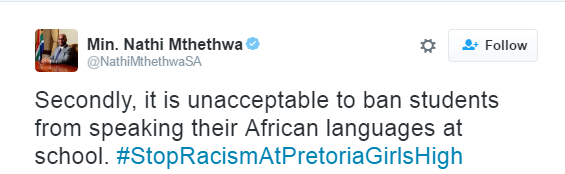
  • Female students at one of South Africa’s leading multinational schools, Pretoria Girls High, have staged a huge protest against its code of conduct which has been described as racist towards its African students.

    According to the protesters, students who have contemporary African hair texture are forced to arrange their hair differently and are often asked to straighten their hair to make it look ‘tidy’.

    The school which was open to white people only during the Apartheid has also banned students from speaking African languages within the school premises.

    This is shocking considering the fact that South Africa has 11 official languages which include some languages.

    The protest has also sparked interesting conversations on the internet.

    https://twitter.com/TerriStander/status/770317643224055808

    Non-Africans need to understand that Afro hair isn’t untidy!

    Because the hair rule obviously doesn’t apply to the white students in the school.

    Unfortunately, this protest hasn’t even highlighted half of the racism currently going on in South Africa.

    Adults from everywhere are showing their support for the young protesters.

    It’s unfortunate that young girls have to start fighting for basic rights at a young age.

    https://twitter.com/WickedBeaute/status/770144987166150656

    Discrimination against a certain type of hair and look has to stop.

    We’re still wondering how and why people are so bothered by black girls’ hair in 2016.

    What do you think of this hair ban? Share your thoughts in the comments section.

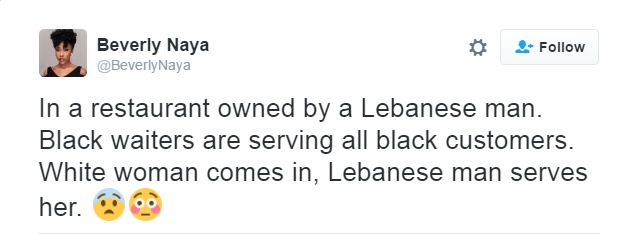
  • We were just minding our business on Twitter when melanin-popping Nigerian actress, Beverly Naya, came to share her experience at a restaurant in Lagos.

    One day, as a pinging baby girl, she went to eat at one Lebanese-owned restaurant. Who no like better thing abeg?

    To her surprise, the black waiters in the restaurant only served black customers while the Lebanese man attended to the the white woman.

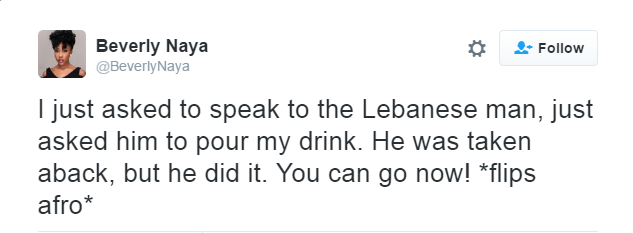
    Instead of shouting, she jejely asked the Lebanese man to come and serve her, as per she’s not eating their food for free.

    Na wa o!

    There shouldn’t be any form of segregation especially on our own soil.

    [zkk_poll post=43913 poll=content_block_standard_format_6]
  • Following the death of the two African-American men, Alton Sterling and Philando Castille, who were both shot by police officers in less than one week, the internet was thrown into major mourning and outrage.

    The Black Lives Matter movement was very much active and many Nigerians shared their concern on this.

    https://twitter.com/busolabiran_/status/750968170530340864

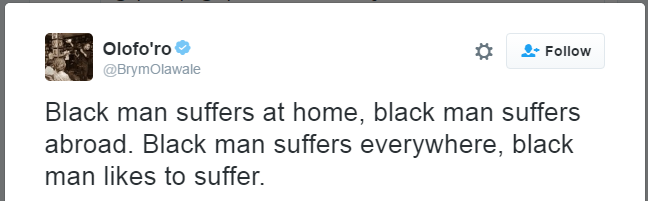
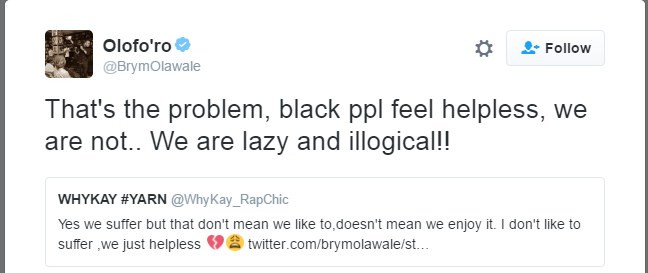
    And it was in this moment that Nigerian musician, Brymo, chose to share another dose of ridiculousness. According to him, the black man ‘likes to suffer’.

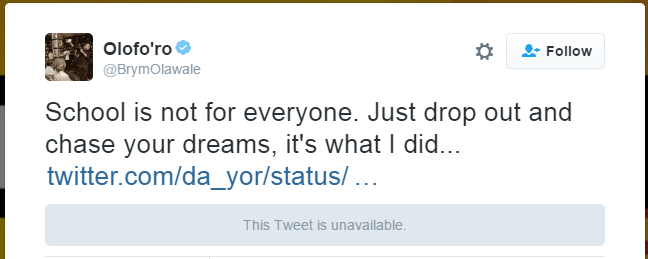
    Just a few weeks ago, he told someone who begged him to help fund his education to drop out of school.

    And in this sensitive moment, he decided to blame black people for these killings.

    Brymo has kuku shown his true colours.

    When someone that says school is important says something shows us the importance of school…

    Brymo needs to probably take history classes and learn what racism is really about.

    And if he was trying to be Fela, he has obviously failed, woefully.

    https://twitter.com/ephynatty/status/751029698541416448

    It’s rather unfortunate that some random Nigerian artist believes black people like the racism and prejudice they face.

  • Only 6 months after getting married, a 36-year-old Nigerian man was murdered during an attempt to defend his wife against a racist attack in Italy.

    On July 5, Emmanuel Nnamdi and his wife Chinyere were walking through Ferno, in northern Italy, when an Italian man, Amedeo Mancini, called her an African monkey and tried to grab her.

    As expected, Emmanuel came to her defence but lost his life from the resulting fight that broke out.

    People who witnessed this horrific event stated how Mancini attacked first and continued to beat Emmanuel with a street sign until he lost consciousness.

    Mancini, who was described as an extremist football fan with links to a far-right political party, claimed he only insulted them because he thought they were stealing a car.

    What makes Emmanuel’s death more unfortunate is, he and Chinyere left Nigeria in 2015 after Boko Haram terrorists set their church on fire, killing both their parents and relatives.

    After embarking on a dangerous journey to Italy through Libya, the couple were housed by a Catholic organisation that joined them in marriage in January 2016.

    Italian interior minister, Angelino Alfano, condemned Emmanuel’s death with a promise to grant Chinyere refugee status .

    Although Emmanuel’s wake was attended by many sympathizers, the political leader of an anti-immigrant party still blamed his death on immigration.

    This goes to show how racism affects every person of colour in all parts of the world. Nigerians are entitled to live in a safe country and shouldn’t have to look for security outside the country.

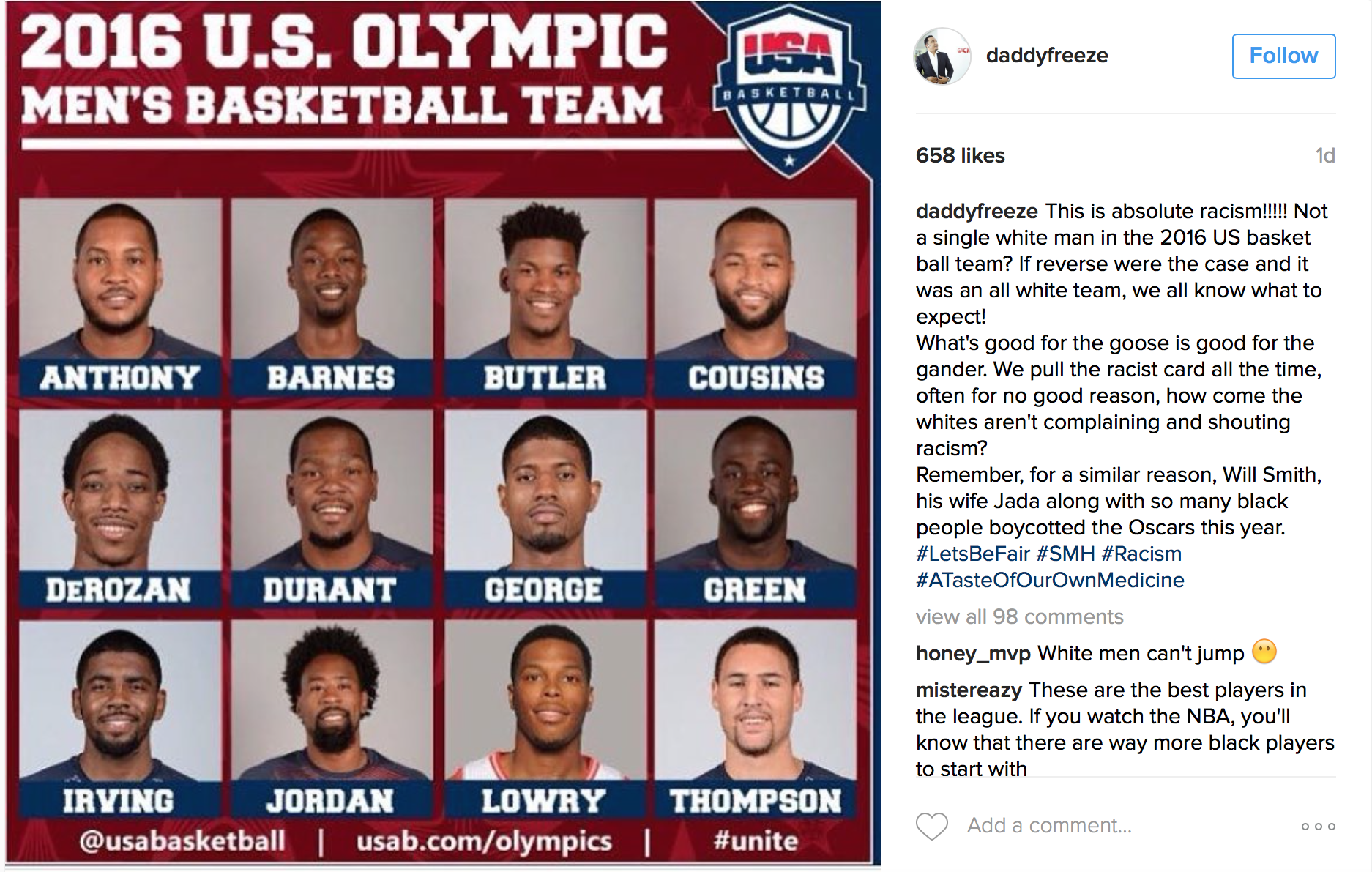
  • According to a particular Nigerian OAP who should know better, this picture of a basketball team is racist.

    This OAP claimed the team’s formation was racist because it excluded white players and was the reverse of what black people complain about.

    Without wasting time, let’s take some people back to class so they can understand what racism is actually about.

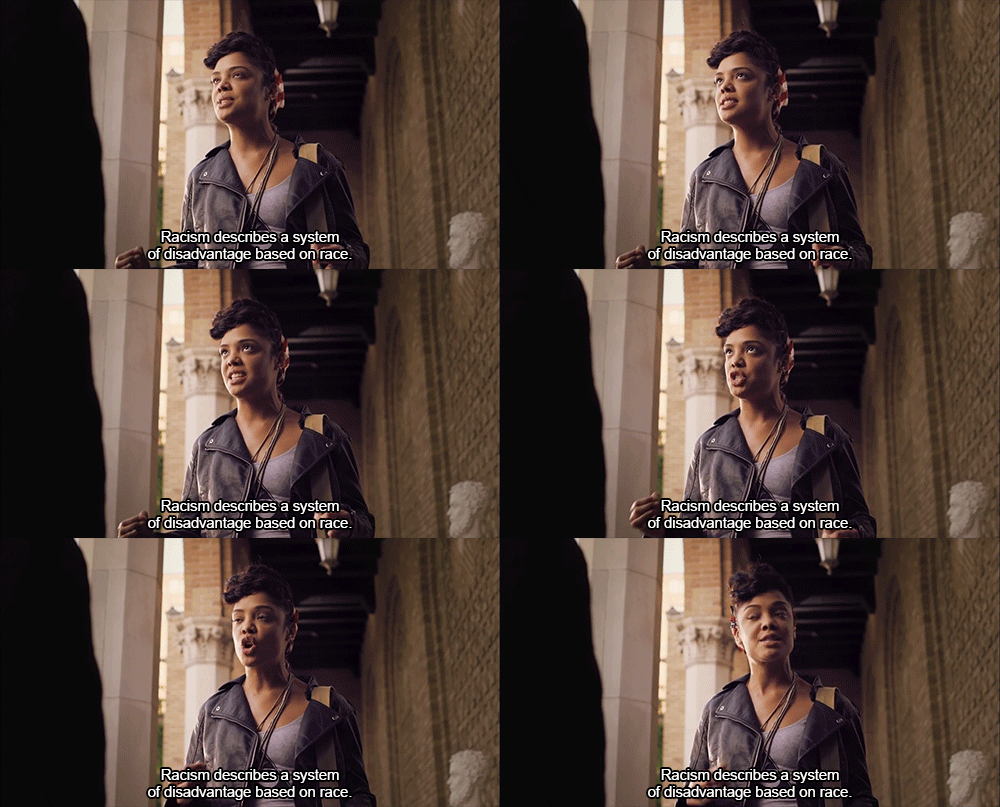
    Racism is when a society has a system in place that puts a certain group of people at a disadvantage based on the colour of their skin, by denying them access to equal opportunities and services.

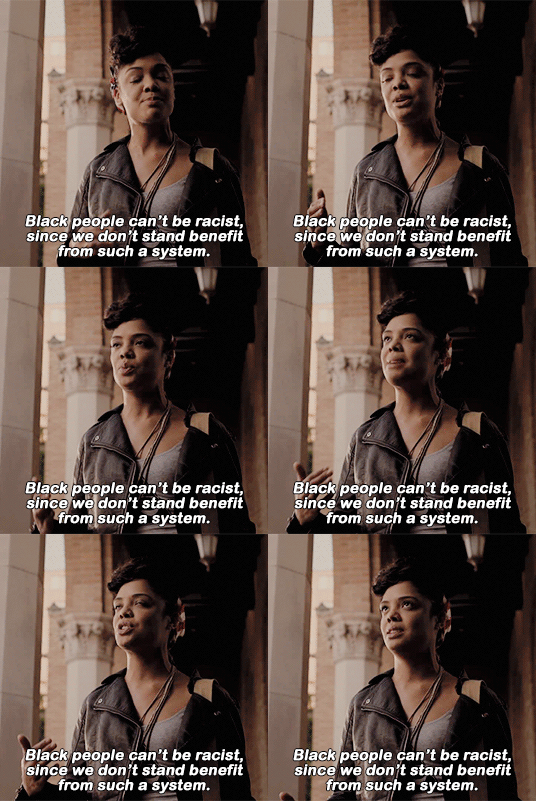
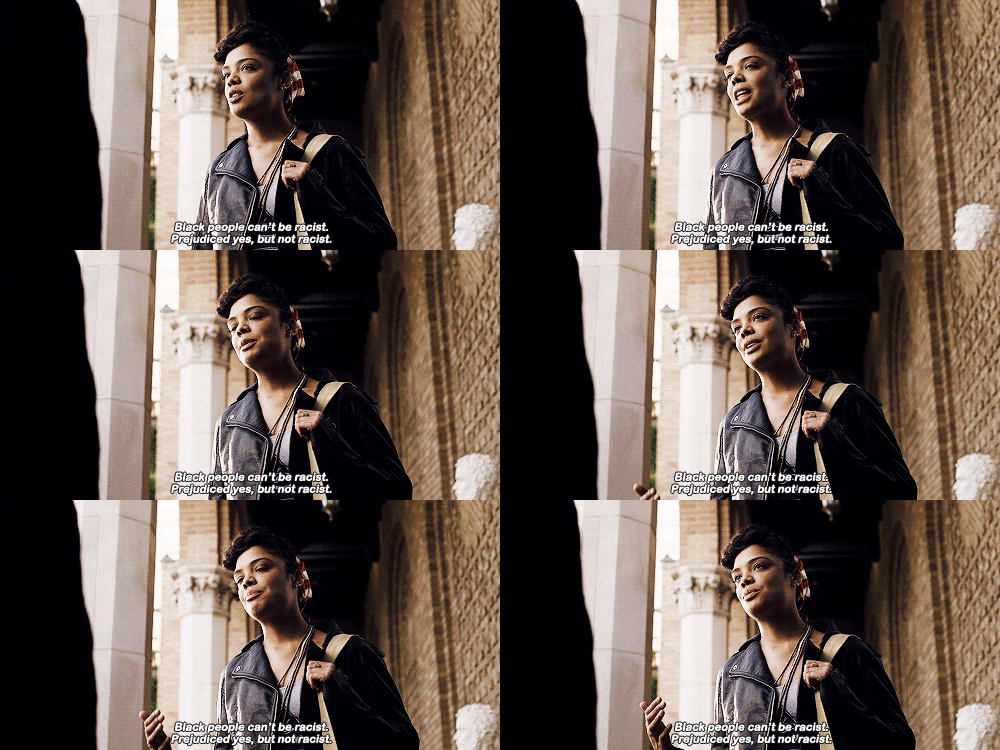
    Therefore, black people cannot be racist because we simply do not have the power to be since we are obviously oppressed by said system. And because;

    So to break it down even further:

    In such a society, the group of people being discriminated against, even when competent are usually not acknowledged for their contribution in mainstream industries.

    For those that don’t get it, when basketball was invented in 1891, it was only accessible to white people even after the NBA was formed in 1946. As a result, most white communities had access to basketball courts and could play the game when they wanted.

    However, when these white people moved to wealthier cities, people of colour occupied their communities and started putting the basketball courts to their own use.

    It’s important to bear in mind that other sports remain dominated by a particular race and basketball is the only game black people have easy access to.

    Before making ridiculous statements about racism, let’s not forget how basketball has become a symbol of cultural expression and social achievements in black communities even in the face of so many social barriers.

    Like Jesse Williams said, “If you have no interest in equal rights for black people, then do not make suggestions to those who do”.

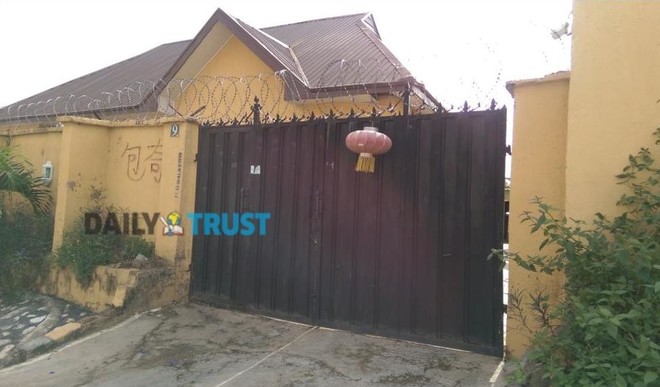
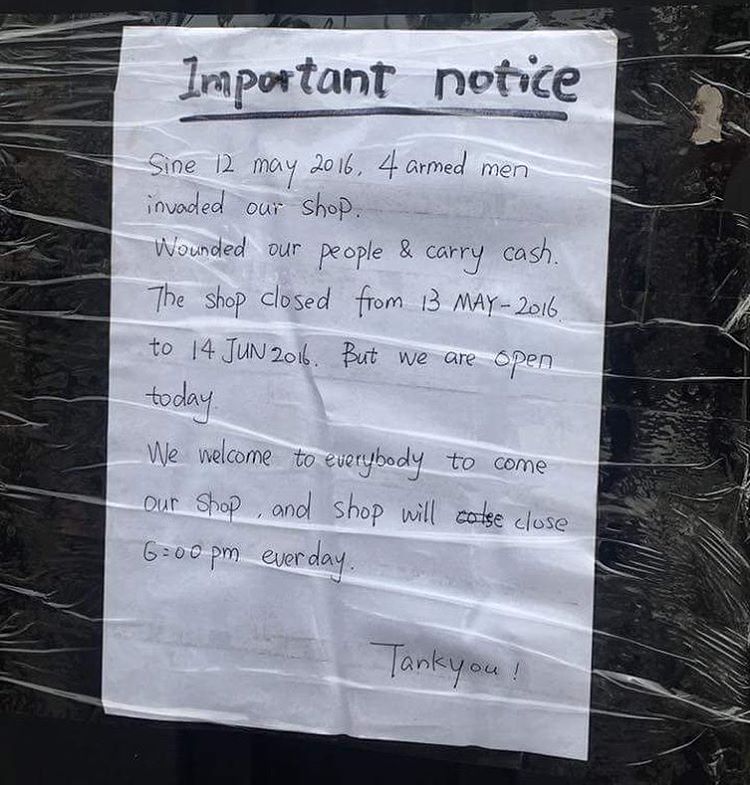
  • Nothing can be more shocking than discovering that the management of a Chinese supermarket has allegedly refused entry to Nigerians in groups, except when escorted by a police officer due to their alleged criminal activities.

    According to the DailyTrust, this decision was reached after the supermarket was attacked by armed robbers who stole over 2.5 million Naira, leaving the owners injured.

    Although the sign above says everyone is welcome to the store, an attendant who spoke with DailyTrust, explained that the alleged decision to bar Nigerians wasn’t discriminatory but a safety procedure to prevent recurrence of such activities.

    The attendant however said Nigerians are allowed to enter the supermarket individually and not in groups except accompanied by a policeman.

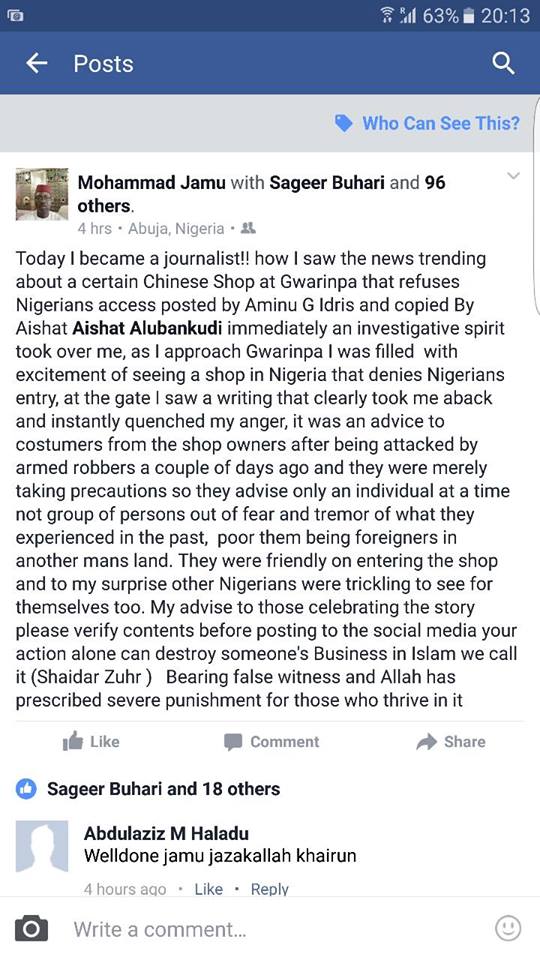
    In a now deleted post, Facebook user, Mohammad Jamu, claimed to have gone to the supermarket and was well-received only that people had to go in one at a time because of the robbery incident.

    But wait a minute…

    It’s not rocket science to know that there are several ways to improve security in any organisation than making only Nigerians go into the supermarket one at a time.

    This development also points out the flaws in the Nigerian security situation and the risks Nigerians and foreigners are regularly exposed to.

    However, the Nigerian police has to make efforts to curb criminal activities all over the country immediately.

    This post as updated on June 16, 2016, includes the alleged account of the Facebook shopper, Mohammad Jamu, who went to check out the supermarket.