• There are two things we struggle to challenge in Nigeria — culture and age-imposed authority. In our culture, our elders are always assumed to be wise. The number of years a person has lived in Nigeria is synonymous with the depth of wisdom they are assumed to possess. For that reason, we’re taught that it’s the height of disrespect to challenge them.

    But Raye did both — she spoke up against bad governance and a 72-year-old president, defying everything culture says young people should be.

    “How brave!” I thought as I watched this brilliant young woman express her displeasure for over four minutes. It was the second time I had seen a young person on the brink of tears while speaking against the effects of bad governance that day. In the early hours, I interviewed Amaka, a 27-year-old lady who blamed the ruling party, All Progressives Congress (APC), for the avoidable death of her mother. For 30 minutes, I heard gaping pain and justifiable anger in her voice. 

    I wondered why I wasn’t speaking up like Raye and Amaka because I’d also bought a crate of eggs for ₦7,000 that week. So, I reposted Raye’s video on TikTok and carried on with my day. 

    Raye’s follow-up video left me in shock. An NYSC official had called her, sternly instructing her to delete the video. In response, Raye asked a question I wouldn’t have been brave enough to ask, “Ma, are you threatening me?” The video went viral in a couple of hours, and an important conversation started: Why is Raye being silenced? 

    If I were Raye, I would most likely have caved in fear, settled into a state of helplessness, and given into silence because that is all I’ve been taught to do. That is what I did when a lecturer locked me out of the exam room where I was supposed to write my final year exam because I was wearing a nose ring.

    I was too afraid to ask him why my nose ring bothered him, so again, I did as I had been taught. — I removed my nose ring quietly, went on my knees and begged until he allowed me to sit for my exam. At that moment, I had no say. The nose ring was mine, and it was on my body and no one else’s, but still, I had no say. It was his exam hall, his rules. With my future at stake, I chose silence instead of bravery. 

    So did Ada* (26), who spoke anonymously to Zikoko Citizen about her experience with a lecturer. “For five years, I was harassed and humiliated by my lecturer,” Ada narrates. “He would call me to sit in his office for no reason. Even when I told him I had lectures, he wouldn’t care. On some occasions, he would ask me to enter his car, drive me around town and return me to where he picked me up. I was helpless, and he seemed to enjoy controlling me.” 

    The power imbalance between Ada and her lecturer would eventually cause her mental health to deteriorate terribly and almost force her to drop out of university. In search of a solution to the constant bullying, she reported her lecturer to the Student Union and the university’s disciplinary panel.

    But it didn’t end well for her because instead of bringing her abuser to justice, she was advised to beg him out of respect for his age and position. “If I had known, I would never have reported him. After I reported, I couldn’t get above an F in his courses, no matter how hard I studied. I couldn’t request to see my script and have it remarked either”, she recounts. 

    After learning that she was at risk of spending an extra year in university, Ada eventually chose silence and begged her lecturer after enduring years of harassment. Only then did she finally get a C grade in his course. 

    Her luck wasn’t any better in the NYSC camp, where she met a soldier who bullied her till she left the orientation camp. “This soldier forced me to join the parade every day, even after I told him I was a member of the Orientation Broadcasting Service (OBS). He said he didn’t like how I spoke to him and forced me to parade. He would force me to stay back after everybody had left the parade ground, and I wouldn’t be allowed to leave until the lights were out. Most times, I went to bed hungry and woke up to the same torture”. Ada experienced the same power play, but this time, she had learnt not to challenge authority by speaking up. 

    Get More Zikoko Goodness in Your Mail

    Subscribe to our newsletters and never miss any of the action

    Perhaps this silence might have “saved” Senator Natasha Akpoti-Uduaghan from another questionable six-month suspension. Or Senator Abdul Ningi, who was suspended for three months because he called out an alleged padding of the 2024 budget. 

    In Nigeria, the cost of bravery is becoming too heavy to pay. And it’s not just Raye, Ningi and Akpoti-Uduaghan who are paying the price; it’s all of us. In December 2024, Olamide Thomas was arrested for cursing President Tinubu, his children, the Inspector-General of Police, Kayode Egbetokun, and Force Public Relations Officer Muyiwa Adejobi for the pain she was going through. On December 21, 2024, Olumide Ogunsanwo was arrested for similar reasons. Despite President Tinubu’s promise to promote freedom of speech and free press in Nigeria, even journalists like Daniel Ojukwu have become victims of illegal arrests. 

    2025 should be the year we all collectively agree that the silence culture is killing us. We learn it at home, school, workplaces, NYSC  camps and on social media. It has become a culture that urgently needs to be countered. Accountability cannot thrive in a country where people haven’t learnt to challenge authority.

    Perhaps it’s time we all took Raye’s advice and collectively challenged bad governance. Nigerian youths make up 70% of the country’s total population, but that number is only as useful as we make it. We could hold over 70% of 2027’s total electoral votes if we wanted. We could vote out bad leaders if we wanted— Anything is possible if we choose bravery instead of silence, no matter the cost.

    [ad]
  • Photo credit: African feminism

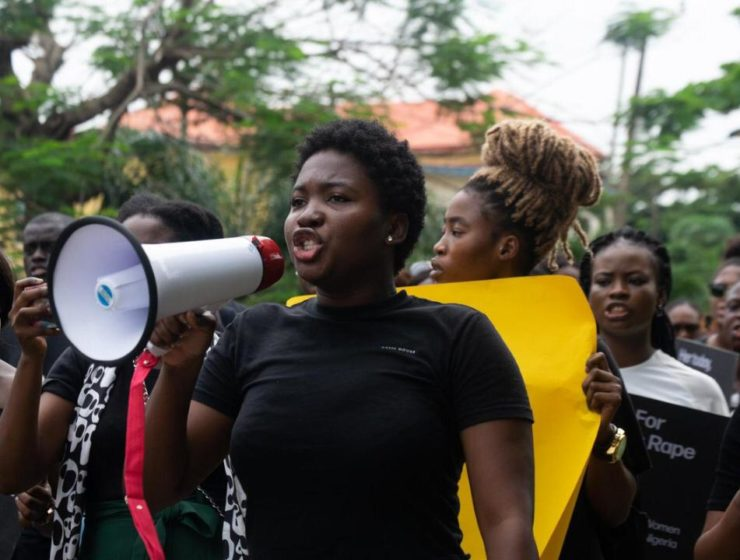
    On Friday, February 28, a Nigerian Senator representing Kogi Central, Natasha Akpoti-Uduaghan alleged that the Senate President, Godswill Akpabio had sexually harassed her and on March 5, she made her allegations official by submitting a pemission to the Senate.

    Instead of a proper investigation, what followed this was backlash from fellow senators and a 6-month suspension.

    Despite her suspension, Akpoti-Uduaghan did not back down or retract her allegations and many Nigerians have rallied behind her since then, demanding that her suspension be lifted and her allegations properly investigated.

    If the Senate heard any of these demands made by Nigerians online and offline, they have paid them no mind because on Tuesday, March 11, the Senate passed a vote of confidence on Godswill Akpabio. Speaking at the Senate that same day, Akpabio said that Akpoti-Uduaghan’s actions could harm women’s chances in politics, appealing also, that her actions should not be used to judge other women, especially his daughters.

    “I have four daughters, and I want to plead with politicians to still give them and other women a chance. The sins of one should not be used to punish others,” he said.

    Akpabio’s comments have sparked reactions and conversations among Nigerians. We asked eight Nigerian women to tell us how they feel about this and they did, in as many words as they could find.

    Simi

    “Akpabio’s comment shows the unfair way women in politics are treated. If one woman makes a mistake, it shouldn’t mean all women lose opportunities. When men in power mess up, no one says men should be banned from leadership, so why should it be different for women?

    Bringing up his daughters feels like a distraction. If he truly wants women to have a fair chance, the focus should be on creating a system where people are judged by their actions, not their gender. Women deserve opportunities on their own merit, not based on what one person did.”

    Esther

    “This is a clearly spelt- out hatred for women who dare to speak up when they’re being assaulted. This also emboldens abusers to keep it going. It’s such a shame that everyone has been silenced from speaking up when such happens

    I feel terrified that if something like this happens again, women will keep being blamed for it. It makes me feel unsafe that the system that is supposed to protect the rights of women are the ones against her.”

    Dolapo

    What Akpabio said is wrong on so many levels. He is essentially saying the Senate is not a place for a woman, especially when she voices her concerns. It is similar to what Senator Ireti kingibe said in that interview, where she implied Senator Natasha Akpoti should have been silent instead of speaking out because the men would no longer want her to be a part of the club. It also feels like he is saying women have to be compliant or be total suck-ups before they can get into that position

    Mmesoma

    “First of all, I think it’s really silly. It reflects a broader issue in Nigeria, where many people still believe that women don’t inherently deserve political positions and should be ‘grateful’ and ‘act accordingly’ when they are ‘allowed’ to hold them. 

    Meanwhile, male politicians have engaged in all sorts of ridiculous behaviour (exchanging blows, faking fainting, etc), yet no one questions whether men should be in power because of it.

    In Nigeria, a Senate President can remain in office despite serious allegations, punish his alleged victim, and he can still make threats with no real consequences. That’s the real problem.”

    Mikun 

    The Senate has the power to limit women’s participation in lawmaking and if the Senate president is making this sort of statement, we can quote him in the future if the numbers drop. However, it wouldn’t be because a woman spoke out against her abuser. It will be because men never truly believed that women should be involved in lawmaking, hence the reason why they want the said women to be grateful and humble even after they are rightfully elected

    Aisha

    “Senate President Godswill Akpabio’s statement is a troubling attempt to deflect from the real issue at hand. By suggesting that holding one individual accountable for alleged misconduct would jeopardise opportunities for all women, he not only misrepresents the situation but also reinforces a harmful narrative, one where women’s progress is conditional on their silence.

    This kind of narrative is not new. It weaponises the fear of lost opportunities to discourage women from speaking out against inappropriate behaviour. The implication that a single allegation could prevent future female vice presidents is both misleading and dangerous. Women are not a singular entity, and their access to leadership should not be tied to tolerating misconduct.

    His plea for politicians to still “give” women a chance, including his daughters, is particularly ironic. A true commitment to gender equity requires ensuring that political and professional spaces are safe for women, not positioning accountability as a threat to inclusion. The real pattern we should be concerned about is one where women who speak up face repercussions while powerful men evade scrutiny.

    If we are serious about equity and justice, we must resist narratives that frame accountability as a risk rather than a necessity. Women should not have to choose between leadership and dignity.”

    Chinecherem

    “First off, suspending a senator because she made accusations was uncalled for. If the matter was already in court, then they should have left it to the court to settle.

    His statement to me feels a bit too condescending to me. On one hand, he insults an entire community of women and, on the other hand, tries to lift them up by asking that they be given another chance.

    I think it’s just power play, to be honest. The bigger dog will always have the bigger bite”

    Mariam

    “Him saying this would create a precedent against women in politics makes no sense at all; men do horrible things all the time, but we don’t see that affecting them. The President of the United States is an alleged rapist and a convict. If Trump can become the President of the most powerful country in the world despite being named in a rape case and as well as the thing that happened at the capitol, then how does what a single woman did, whether right or wrong, have the ability to affect all other women? It makes no sense at all.

    Also, saying that the sins of one should not be used to punish the rest is somehow because this thing that has happened to Senator Natasha Akpoti happens to women across the country, only that a majority do not have the right to speak up, so what Natasha Akpoti is doing is good for us. In speaking up for herself, she is speaking up for all of us and we are happy for it.

    Again, it is ridiculous that he’s saying all of these things because a woman decided to speak up for herself.”

    [ad]
  • Since February, Nigeria’s Senate President, Godswill Akpabio, and the Senator representing Kogi Central, Natasha Akpoti-Uduaghan, have been in the news over allegations of sexual harassment and abuse of power against Akpabio. But beyond the glaring injustice done to Akpoti-Uduaghan, there’s an icky thing going on — everyone refers to the Senate President by his last name (Akpabio) but calls the Kogi Senator by her first name (Natasha).

    Chances are you haven’t noticed this, or maybe you did and thought it was just you. It’s not. The media and the general public are guilty of this, and the reason is simple: gender bias.

    But unlike some other forms of gender bias and discrimination, usually driven by men, both men and women are guilty of reinforcing this habit.

    No, you’re not imagining it

    If this article stopped here, you might begin to notice a pattern in how men and women are addressed in professional settings and be tempted to dismiss it as a coincidence, but it’s not. It’s a real thing, and there is data to prove it.

    It happens across the globe

    The phenomenon of men being addressed by their last names and women being denied the same is one of those things that can be dismissed in arguments as “imagined,” but big-time statistician Edwards Deming said everyone except God must bring data to back their claims. I don’t make the rules.

    A 2018 research by psychologists Stav Atir and Melissa Ferguson titled ‘How gender determines the way we speak about professionals,’ made some pretty interesting findings, and I’ll help you understand them.

    In eight studies which combined archival and experimental methods, the psychologists observed that “Men and women were, on average, more than twice as likely to describe a male (vs. female) professional by their surname in domains, such as science, literature, and politics.”

    Here’s a curious one — after testing and confirming that 4,494 students across several universities were 55.9% more likely to refer to their male professors by their surname than their female counterparts, they did another test to see if male professors described with “stereotypically feminine traits (pretty, cute, helpful, understanding, kind, supportive, emotional, or meek),” would enjoy the same privileges as those described with stereotypically male traits (analytical, easygoing, brilliant, tough, arrogant, or rude). They found that those associated with feminine traits were more likely to be called by their first names, while the ones described with masculine traits were more likely to be called by their surnames.

    If you haven’t been understanding my French, here’s what this study says — being associated with masculinity increases a person’s chances of being called by their surnames.

    Psychologists Atir and Ferguson didn’t stop there; they carried out similar tests in the media and found that political pundits often referred to men by their surname and rarely did the same for women. They found the same thing in science, where male scientists were mostly addressed by their surnames as opposed to females.

    Why is this a thing?

    While the study did not carry out experiments to answer this question definitively, one of its authors, Atir, believes the first-name-for-women phenomenon might stem from the perception that surnames are inherently male. This perception hinges on the reality that men often keep the surnames assigned to them at birth, while women are more likely to change theirs due to marriage. Additionally, surnames are typically passed on from father to child rather than mother to child.

    Atir explains that, while it is yet to be proven, these factors might explain why women are referred to in professional settings by their first or full names instead of surnames  — to properly identify their gender.

    Why is this bad?

    Calling women in leadership, politics, and other professional settings by their first names has far-reaching consequences. Speaking to Zikoko Citizen on the dangers of this practice, Writer/Editor and Communications Strategist Nana Sule referenced Harry Potter author JK Rowling’s lived experience.

    “The first thing that came to me was how J.K. Rowling famously used initials instead of her full name because her publisher believed a book by a woman might not appeal to male readers,” Sule said, pointing out that it is part of the broader issue caused by the disregard and disempowerment of feminine names in professional settings.

    Sule stresses that first-naming women in professional settings while calling men by their last names reinforces subtle power imbalances as the “casual familiarity (that comes with a first name) can diminish a woman’s perceived authority, while men maintain a level of professional distance and respect.”

    Stav Atir expressed similar opinions while speaking to the US-based news site Today.com in 2024. “We know the first name is kind of more associated with familiarity,” Stav said, explaining that it most often conveys informality and familiarity, suggesting that the person is more approachable and less authoritative. In contrast, surnames carry an air of importance and assertiveness, signalling respectability and a level of detachment that commands authority.

    In politics and leadership roles, for instance, referring to women by their first names while using surnames for men can undermine the authority and perceived competence of female leaders, regardless of their actual abilities. This may explain the excessive scrutiny imposed on female candidates during elections — the reason society tosses away their achievements, experiences, certificates and awards while obsessively digging into their personal lives. It may be the reason why awful behaviours and outright physical punches in parliament are excused for male politicians while their female counterparts are over-scrutinised even without wrongdoings.

    All of this, according to Louisville Political Review, widens the already existing gender gap.

    How can it be stopped?

    “What we must do is be intentional about language,” Nana Sule told Zikoko Citizen.

    “Organizations should standardize naming conventions in meetings, emails, and official documents, ensuring that women’s last names are used just as frequently as men’s,” she continued, adding that women should “also assert their preferences by signing emails and introducing themselves formally.” Sule also believes that creating awareness through workplace training and media representation can go a long way to change things.

    “Small changes in how we address women in professional spaces can have a lasting impact on how their authority and expertise are perceived,” Sule said.

    In a similar article for the US-based radio, WBUR, Gender Equity experts Dr. Amy Diehl and Dr. Leanne M. Dzubinski offered a strong pointer for countering the first-name bias: responding with the appropriate surname  anytime a female leader is called by her first name. While their suggestion was specifically in reference to former US Vice President Kamala Harris, this simple exercise can prove effective in similar situations.

    So, the next time someone says “Natasha,” it is your duty to respond with “Akpoti-Uduaghan.” When they say Achebe and then Buchi Emecheta, ask, “Why not Emecheta?” Because while women’s first names may be collectively used to mark their gender, Emecheta’s identity has been established for decades now — yet the continued use of her first name, while her male counterparts are referred to by their surname, reinforces the flawed belief that women are inferior to men.

    And because we are all guilty of this by default, you must also remind yourself it is Okonjo-Iweala, not Ngozi Okonjo-Iweala. It’s Kingibe, not Ireti. It’s Oshoala, not Asisat Oshoala, and more importantly, it is Akpoti-Uduaghan, not Natasha.

    [ad]
  • In what many on social media are describing as “expected,” the Nigerian Senate has on Wednesday, March 5, dismissed a petition brought before it by Senator Natasha Akpoti against the Senate President, Godswill Akpabio.

    Sexual assault accusation

    On Friday, February 28, the Senator representing  Kogi Central, Natasha Akpoti-Uduaghan, accused Nigeria’s Senate President of sexually harassing her. What followed her accusation was two ₦350 billion lawsuits by Akpabio’s wife, Ekaette Akpabio who said the accusation had caused her family emotional distress and harmed their reputation.

    Between February 28 to March 5, about four Senators have publicly spoken on the allegation, all of them heavily supporting and standing by the Senate President, including Senator Neda Imasuen, the Chairperson of the Senate Committee on Ethics, Code of Conduct and Public Petitions.


    Also read: Is the Nigerian Senate Trying to Silence Natasha Akpoti?


    Submission of petition

    Akpoti-Uduaghan’s accusation against Akpabio was made on television alone and therefore informal so on Wednesday, March 5, she formalised it by submitting a petition before the Senate.

    But hours after the Senator submitted her petition, the Senate dismissed it, saying it was invalid.

    Why was Akpoti-Uduaghan’s petition dismissed?

    Senator Akpoti-Uduaghan, who had staged a walkout earlier due to a commotion during the submission of her petition, was absent at the hearing. Explaining the reason for the petition’s dismissal, Senator Neda Imasuen, Chairman of the Senate Committee on Ethics, Code of Conduct, and Public Petitions, who first described the petition as “dead on arrival,” said it was dismissed because it was against Order 40 subsection four of the Senate Standing Orders which states that “no Senator will present to the Senate, a petition signed by him or herself.” This means that Akpoti-Uduaghan has to get another individual to sign the petition before the Senate can attend to it. 

    Additionally, Imasuen said the Senate could not consider the petition because the issues it raises are already in court. Hoever, Senator Akpoti-Uduaghan had already objected to this claim earlier, saying the case was not in court.

    “This matter is not in court. The matter in court is a defamation against the senate president’s special assistant on social media, Patrick Mfon, who accused me of dressing indecently to the senate,” she explained.

    This is a developing story


    News is boring, but we make it fun. Subscribe to The Big Daily to be the first to know the day’s biggest news.

    [ad]
  • On Friday, February 28, Kogi Central Senator Natasha Akpoti-Uduaghan, who has been vocal about her alleged unfair treatment in the Senate, left us all in shock when she accused Senate President Godswill Akpabio of sexually harassing her.

    Many concerned Nigerians have been waiting to hear Akpabio’s side of the story since then, but the senate president didn’t debunk Natasha’s claims till Wednesday, March 5. 

    From defamation lawsuits to calls for apologies, here’s a timeline of all the major events that have raised questions about the Senate’s approach towards Natasha’s claims since the news became public.

    February 28: Senator Ireti Dismisses Natasha’s claims

    Senator Ireti Kingibe has weighed on the controversy surrounding Senator Natasha sexual harassment allegations against Akpabio, denying any direct knowledge of misconduct. In an interview with ARISE NEWS, Kingibe stated that neither she nor the other female senators had experienced harassment, adding that Akpoti-Uduaghan “never discussed it with us.”

    Kingibe also claimed that Akpoti-Uduaghan had received more privileges than the other female senators, saying, “To be honest, Senator Natasha has gotten the most privilege of all the four of us.” Defending Akpabio’s leadership, Kingibe noted that while the Senate is “not gender-friendly,” she has seen improvements. She also expressed disappointment that Akpoti-Uduaghan ignored her calls after the incident, claiming she even reached out to her husband, who said she was in Singapore.

    March 1: Defamation suit against Natasha by Akpabio’s wife 

    Senate President Godswill Akpabio’s wife, Ekaette Akpabio,  sued Senator Natasha Akpoti-Uduaghan for defamation over her sexual harassment claims against her husband.

    She filed two lawsuits at the Federal High Court in Abuja, demanding ₦350 billion in damages, arguing that the allegations have harmed her family’s reputation and caused them emotional distress. Mrs Akpabio also wants the court to declare Natasha’s claims defamatory, stop her from making further statements, and force her to issue a public apology in national newspapers.

    March 4: CAN speaks against calls for Akpabio’s resignation

    The Christian Association of Nigeria (CAN) has called for caution in handling the sexual harassment allegations against Akpabio. While some Nigerians are calling for his resignation, CAN argues that it is too soon to take such action without concrete evidence.

    Reverend Joseph Hayab, the chairman of CAN in Northern Nigeria, described the situation as unfortunate and called for respected elders to intervene. He warned against taking sides and stressed the need for a responsible and peaceful resolution. CAN also urged the media to avoid sensationalism and advised lawmakers to focus on more pressing national issues.

    Get More Zikoko Goodness in Your Mail

    Subscribe to our newsletters and never miss any of the action

    March 4: Call for an independent investigation into Natasha’s claims 

    On Tuesday, March 4, a women’s rights group, Voices for Inclusion and Equity for Women (VIEW), called for Senate President Godswill Akpabio to step down so an independent investigation can be carried out on Senator Natasha Akpoti-Uduaghan’s sexual harassment allegations.

    The group accused the Senate of sidelining female lawmakers and warned that ignoring Natasha’s claims would only encourage more abuse of power. They also pointed out that this isn’t the first time Akpabio has faced such accusations and urged the Senate to take them seriously. VIEW demanded fair treatment for Natasha and called for changes to Senate rules to protect female lawmakers.

    March 5: Call for an apology from Akpabio supporters 

    On March 5, a group of women gathered at the National Assembly to protest against Natasha’s sexual harassment claims and “serial blackmailing”, claiming that Akpabio treated her like a daughter and friend. They also demanded that Natasha apologize to the senate president for making those allegations. 

    March 5: Allegation dismissal from Senator Imasuen

    Senator Neda Imasuen, who chairs the Senate Committee on Ethics (the committee in charge of investigating Senator Natasha Akpoti-Uduaghan’s claims), also dismissed her allegations of sexual harassment against Senate President Godswill Akpabio. In an interview on March 5, Imasuen insisted no female senator had complained of misconduct and suggested that Senator Natasha misinterpreted any perceived familiarity in the Senate.  

    March 5: Resistance to Natasha’s sexual harassment petition in the Senate

    Senator Natasha Akpoti-Uduaghan tried to submit a petition accusing Senate President Godswill Akpabio of sexual harassment on March 5, but other senators shut it down. While Akpabio initially allowed her to speak, Senate leaders quickly objected, claiming the issue was already in court—a claim Natasha denied. A heated argument broke out, and the Senate went into a closed session. When they returned, they moved on without addressing her petition, leading Natasha to leave the Senate building. 


    News is boring, but we make it fun. Subscribe to The Big Daily to be the first to know the day’s biggest news. 

    [ad]