• Gbemi*, 31, thought she could finally breathe a sigh of relief after a new job allowed her to fill in the financial gap left by her husband’s inconsistent income. However, this relief was unexpectedly cut short after she discovered she was pregnant.

    In this story, she shares how pregnancy discrimination at work got her laid off, and how motherhood has led to uncertainty about her career options and financial future.

    This is Gbemi’s story, as told to Boluwatife

    I remember staring at the ₦200 pregnancy test strip as the second line appeared, and my world shifted on its axis. 

    I was unbelievably happy, but also terrified. There I was, holding the answer to five years of prayers and a silent struggle with unexplained infertility. I took the test right at the mall where I bought it —  after so many negatives, I couldn’t risk letting hope balloon inside me by waiting until I got home. But for the first time ever, the strip told a different story. 

    I sank to the toilet floor, not caring that I was in a public bathroom; my legs couldn’t hold me up a second longer. The miracle I’d cried out for, begged for, had arrived at the worst possible time. Yes, my dreams were finally coming true, but it also meant my job was on the line.   

    Eight months earlier, I’d started work at a plastic factory, my first real on-site 9-to-5. Until then, I’d mostly done remote stints in operations, social media management and virtual assistance. But my husband’s income as a freelance consultant had become too inconsistent to plan our lives around. 

    He could make ₦1m one day, then go the next six months without a credit alert lighting up his phone. We needed steady income, so when the factory job came up in June 2023, I jumped at it. The ₦180k salary wasn’t life-changing, but it was consistent. We needed that.

    Get More Zikoko Goodness in Your Mail

    Subscribe to our newsletters and never miss any of the action

    On my first day of onboarding, after I introduced myself to my manager, he looked me straight in the eye and asked, “Do these people still hire women in this place?” I froze, watching him scratch his head and assess me from head to toe, as if he expected my body, not my mouth, to answer his question. 

    It took a few weeks, but I eventually discovered why he’d asked that. Management rarely allowed women to work on the manufacturing side because of the chemicals and the belief that we weren’t as “strong” as the men. Women, they claimed, also took more sick leaves, so they just hired fewer of us.

    Although I didn’t work in manufacturing — I was in admin operations and accounts — the discrimination still found its way to the women in the office. My manager, especially, was notorious for grumbling about female staff who had to rush off a few minutes before closing to pick up their children from school. If it were up to him, he’d only work with men. 

    I was one of just two women under his authority, and I could feel him waiting for me to make a mistake so he’d have a reason to let me go. 

    So, even while I rejoiced at my miracle pregnancy in February 2024, I knew there was a big problem: my manager would never consider maternity leave. The company didn’t even have a policy for it. 

    My only option was to work till the exact day of my delivery and resume one day after giving birth. Anything else, and I knew I wouldn’t have a job to return to.

    My husband and I had only just started to enjoy some stability with my income. By then, he wasn’t even getting consultant gigs anymore and was fully job-hunting. How would we survive without my job?

    I tried to console myself with the fact that I had some time. I figured it would take at least six months for my belly to show, and by then, my husband would’ve hopefully found something.

    It didn’t work like that. Firstly, I had all-day sickness — my symptoms refused to limit themselves to mornings — through the entire first trimester, and it showed in my work. I was constantly fighting headaches and nausea, surviving on nothing but crackers and water. I couldn’t focus and kept missing deadlines.

    Secondly, my belly started to show at just three months. I didn’t think anyone would notice, but my hateful manager immediately did.

    One afternoon, he called me into his office. “You’re pregnant. You didn’t plan to tell us?” The way he said it left no room for denial. I just nodded and smiled, bracing myself for him to sack me on the spot. He gave me a smile I can only describe as triumphant, and asked me to return to my desk.

    He didn’t sack me that day or the day after — not even the week after. Two weeks later, when I’d forgotten our conversation, I resumed work to find an email from HR. The email said the company was “restructuring,” and my role was no longer “feasible” for their new direction. It was a “layoff,” but I was the only employee affected.

    I walked out of the office that morning, my heart heavy with grief and questions. I was the breadwinner in my family, and suddenly I had no job, no income. My husband had been trying his best, but he hadn’t found anything, and we had a baby on the way. 

    The months that followed were a blur of uncertainty. I sent out application after application, but no one wanted to hire a pregnant woman. When we could no longer rely on urgent ₦10k handouts from friends and family, my husband took a security job for ₦80k/month. It was a huge downgrade, but we had no choice.

    The financial strain and uncertainty intensified after the arrival of our daughter, but we were blessed with a lifeline: our church community. They rallied around us, showering us with diapers and baby clothes, as well as the occasional cash gift. For five months, we didn’t have to worry about buying diapers.

    And then there was breastfeeding. Doctors sing the virtues of breastfeeding exclusively for six months, citing the numerous health benefits to the baby. For me, it wasn’t a choice; it was a necessity. We couldn’t buy baby food, so breastfeeding was the only option. 

    It’s been almost a year since our baby came, and our financial situation hasn’t improved much. My husband no longer does the security job — he was sacked for sleeping on duty — and freelancing is still as inconsistent as ever, even though the income trickles in more often now. 

    I haven’t returned to work because I haven’t found any, but honestly, I’m not looking as hard as I should be. I struggle with the idea of being away from my child. I want to earn an income and contribute to my home again, but where do I keep her?

    Sometimes, in the quiet moments when I’m breastfeeding at night, I wonder if I didn’t have this child at the wrong time. I immediately banish the thought as soon as it comes, but it always finds a way to creep back in.

    I looked forward to motherhood for so long, but I didn’t realise how much it would change me. It feels like I’ve lost what it takes to provide for myself and my family. The internet describes a phenomenon called “mummy brain,” where new mums struggle with focus. I think I have that. There’s this fog in my brain preventing me from taking decisive steps to better my life and career. 

    I’m scared and uncertain about the future. Will I ever find a job? What kind of job can I even get? Will I ever be financially free? Will my family ever leave the struggle phase?

    I have to believe I’ll get through this, somehow. I’ll find a way to make it work. I’ll find a way to balance motherhood and a career, so I can make my own money and be the mother and wife I want to be. 

    It won’t be easy, and I don’t know where to start, but I have to rebuild. My story can’t end here.


    *Name has been changed to protect the subject’s identity.


    NEXT READ: I Took Loans to Sponsor My Sister’s Education. Now I’m Fighting Addiction and Resentment

    [ad]

  • Every week, Zikoko seeks to understand how people move the Naira in and out of their lives. Some stories will be struggle-ish, others will be bougie. All the time, it’ll be revealing.


    Grow your wealth in both dollar and naira, earning up to 15% in USD and 25% in naira. With flexible rates that move with the market, you can switch between wallets anytime to match your financial goals. Start here.


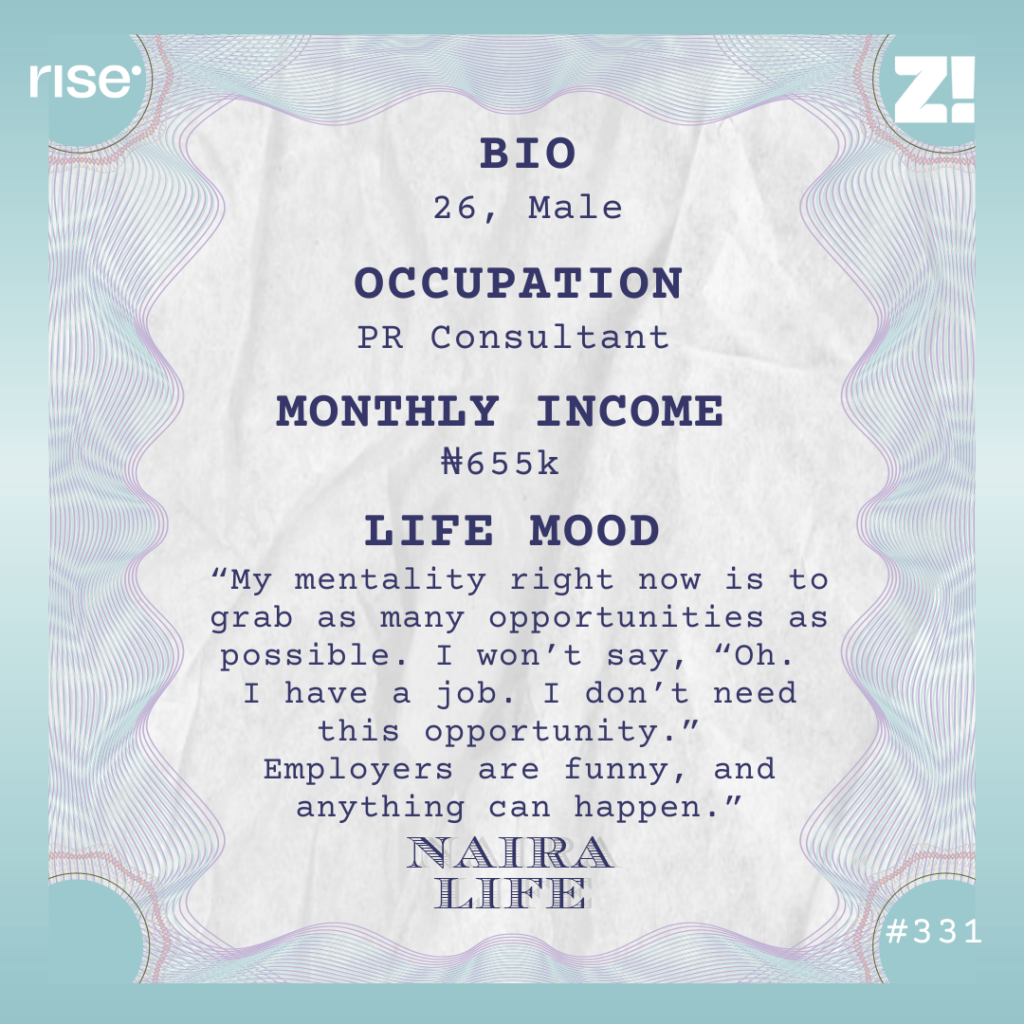
    NairaLife #331 bio

    What’s your earliest memory of money?

    When I was in primary school, my dad would give my sister and me ₦20 daily for school. We always took food to school, so we usually spent the money on Goody Goody and other sweets. 

    My parents also gave our teacher extra money weekly in case we needed anything else. It was more like a safety net. They didn’t want us to handle “big” money because they feared we’d lose it, so they gave it to a trusted person instead. 

    We hardly went to the teacher to collect more money, though. We were too shy to ask, so the teacher bought stuff for us most of the time. That’s the first time I realised you needed money to buy nice things.  

    What was growing up like financially?

    My family was middle-class. My dad was a civil servant, and my mum was a nurse at a teaching hospital. They both had cars, we lived in our home, and I attended private school up until university. There was never a time I felt like we didn’t have money. 

    The only thing was that my parents never wanted us kids to handle money. They preferred to give us money whenever we needed it, but that idea stopped working for me as I moved through secondary school. Asking for money from my parents usually went like:

    Me: “I need money”

    My parents: “What do you need it for? Haven’t you eaten?”

    Haha. Because why do you need money when you aren’t hungry?

    Exactly. They didn’t understand that I needed money as a young boy in secondary school. Sometimes, I wanted to buy airtime for my phone, and other times, I just wanted money to get things without having to explain. 

    This need drove me to do one of the first things I did for money. My parents had a building project near our house. So, whenever the labourers came to work, I convinced them to allow me to assist in pushing wheelbarrows or picking up cement. 

    My parents and other people would look at me like, “What is this boy doing?” I didn’t mind. The labourers gave me ₦500 – ₦1k for my work, and I was happy. It wasn’t much money, but it gave me a sense of self-worth and relief.

    The next time I did a proper job for money was in uni.

    Tell me about it

    I got a transcribing gig by chance during my student internship at 300 level, around 2016/2017. A few other students and I were posted to the same place, and one day during break, one of them just asked, “Which one of you sabi write for here?” 

    The guy was also a graphics designer who used to get random gigs. That day, he got a connect asking for someone who could transcribe interviews. I’d never done anything like it, but I said I could do it. He connected me to the client, and I made ₦5k – ₦10k per gig, depending on the length of the interview. It was a good addition to my ₦30k – ₦50k monthly allowance from my parents. 

    I got my next job during NYSC in 2019. That’s where my career started.


    Join 1,000+ Nigerians, finance experts and industry leaders at The Naira Life Conference by Zikoko for a day of real, raw conversations about money and financial freedom. Click here to buy a ticket and secure your spot at the money event of the year, where you’ll get the practical tools to 10x your income, network with the biggest players in your industry, and level up in your career and business.


    What was the job?

    Public relations in a PR firm. NYSC posted me to a school, but I didn’t want that, so I searched for other placements. I spoke to a friend who served in a creative agency, and he encouraged me to see his boss. 

    When I got there, there were no more spaces left for corps members. However, the boss liked how intentional I was about finding an opportunity, so he referred me to his friend, who owned a PR firm. The man hired me on the spot after looking at my practically empty CV and paid me ₦30k/month to do basic PR stuff: write press releases and a little copywriting. 

    My boss also owned a digital business magazine, and he gave me a few tasks when there wasn’t much to work on the PR side. Three months into the job, he came to the office and said he wanted me to try investigative reporting on the police at the Third Mainland Bridge. He wanted me to find out why they typically stayed there and get them to share their experiences with criminals.

    So, I went there, related well with the officers, and got stories out of them. My boss was so impressed when I gave him the final story that he gave me $100 and said he’d retain me. He increased my salary to ₦50k, and then after NYSC, he promoted me to PR officer. The promotion came with another salary bump to ₦100k.

    Not bad

    It wasn’t bad at all. Within a few months, I got another increase to ₦150k. That job taught me everything I know about PR. My boss also enrolled me in a course with the Nigerian Institute of Public Relations (NIPR) to help me upskill and gain more knowledge. He saw my commitment to the job and was willing to invest in me.

    In 2021, someone on the account management team resigned, and my boss didn’t want to hire someone new. So, he asked if I could manage accounts. I hesitated and said, “I can, but I don’t have the contacts of the different media guys I’d need to work with.” He just hissed and was like, “Is that all?” He sent me different media contacts, and that’s how work started. 

    I became an account manager, interacting with the clients and working on PR and marketing proposals and pitch decks. The new role came with a salary increase: ₦250k. 

    Was that good money?

    Oh, it was. At that point, I was living with my parents and spending money anyhow — I had no responsibilities. 

    I stayed at that job for two more years and left in 2023 when I felt good enough to chase better opportunities. After I left, I took a six-month contract gig with a new real estate development company as their PR and comms manager. 

    My job was basically to set them up, overhaul their website copy, and provide PR and communications strategy for their executives and directors. They paid me ₦1m for the six months, which was technically less than what I would’ve earned at my previous job, but I wanted the experience to boost my CV and LinkedIn.

    I also started living alone in 2023. I rented a ₦500k/year self-contained apartment and furnished it a bit. After the real estate contract ended, I moved to another agency as a PR consultant/account manager. My pay was ₦300k/month. I worked there for a year until I was unexpectedly laid off.

    Darn. What happened?

    I had a minor issue with the founder while working on a client’s brief. We’d travelled to another state for the project, and when I returned to Lagos, I saw the lay-off notice. It was three days to the month’s end, and there was no notice period or severance pay. 

    That’s when it dawned on me how terrible I was with money. I was the “salary is coming, let me spend money” guy. I had zero naira saved, and the money left in my account didn’t last two weeks. It was so bad that I couldn’t afford data and had to rely on the WiFi in my compound. I had to turn off all the lights in the house because I couldn’t buy electricity units.

    I also started asking people for urgent ₦2k. These were people who used to ask me for money. I couldn’t tell people I lost my job; I just said salaries were delayed. I didn’t even tell my parents immediately. They only found out because they came to see me after I switched off my phone for three days, just crying and feeling bad for myself. 

    So sorry you went through that

    Thanks. It was very difficult. I also had to deal with neighbours constantly asking, “You no go work today?” I’d just give them lamba and be like, “Oh. I’m working from home today.” 

    I was jobless for about three months. I kept applying for jobs but didn’t get past the interview stage. 

    To survive, I relied on loans and whatever my parents sent me. I had to turn to loans because my landlord increased my rent to ₦700k, and the rent was due.

    I borrowed over ₦1m in those three months: ₦500k from my bank, ₦300k from a microfinance bank, $200 from my friend in the US and some other small money here and there. It was a whole thing. Thankfully, my unemployed stint ended in February 2024, and I started repaying the loans gradually.

    Phew. You got another job?

    Yeah. One of many applications finally panned out, and I got the role of PR consultant for ₦400k/month. I still work there today.

    My experience changed how I approach my relationship with money and employers. For the latter, I now understand that they can let anybody go whenever they please, so I need to stay prepared for that. It’s one reason I happily took on another ₦255k/month job when the recruiter contacted me on LinkedIn three months after I started the first. 

    So, I juggle two jobs right now, bringing my income to ₦655k/month. Both jobs are hybrid, and they don’t know I work elsewhere. My mentality right now is to grab as many opportunities as possible. I won’t say, “Oh. I have a job. I don’t need this opportunity.” Employers are funny, and anything can happen, so I need to have as many safety nets as possible. I still plan to sue the employer who laid me off, but let me get my money up first.

    So, are you debt-free now?

    I still owe my bank about ₦450k. My biggest challenge with the loans is the interest, especially with the microfinance bank. The interest increased whenever I missed any payment, and I struggled to remain on schedule. 

    Also, when I borrowed $200 from my friend, I got ₦210k after conversion. But the exchange rate keeps changing, so after I finished repaying her, I paid ₦340k in total. I prioritised settling my friend and the microfinance bank first because they were on my neck. My bank has been pretty chill — they just keep adding interest. I’m trying to pay a monthly amount to settle the debt, though. 

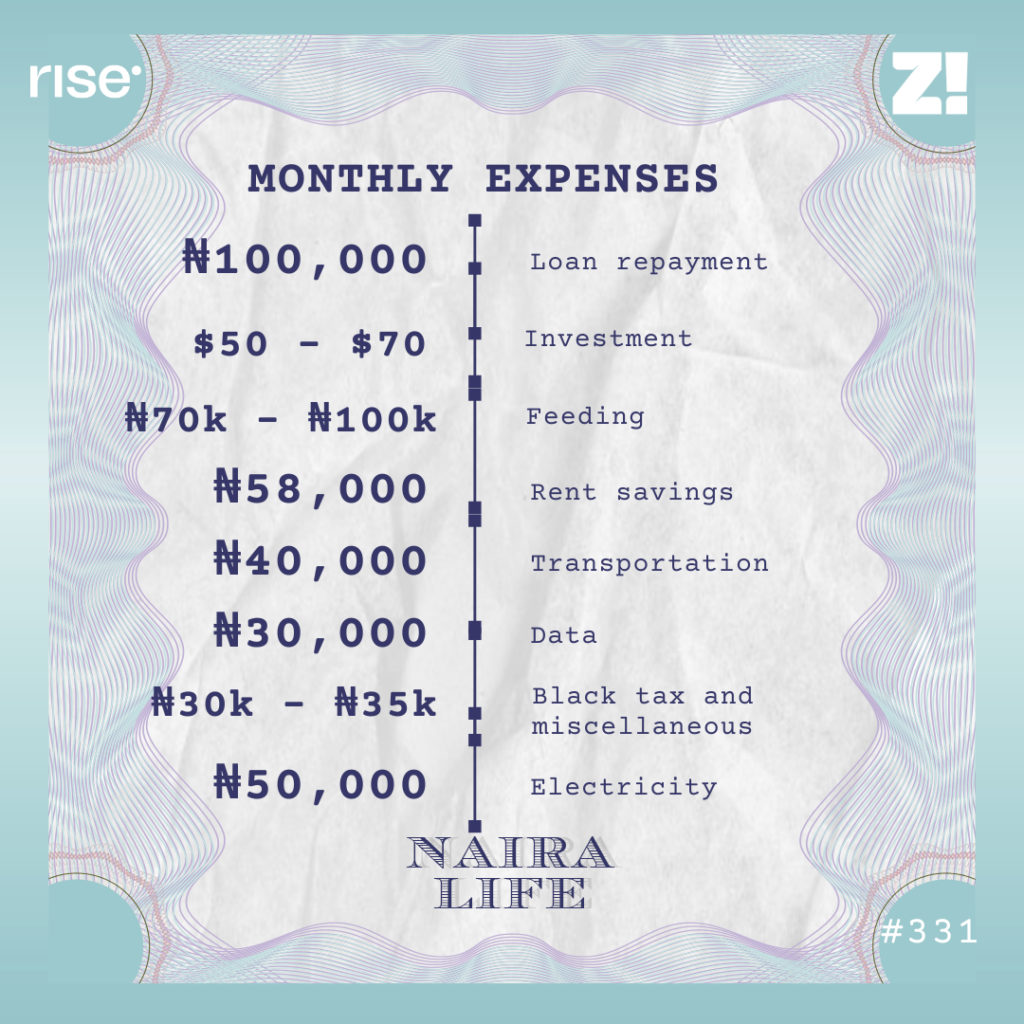
    Let’s break down your expenses in a typical month

    Naira Life #331 expenses

    After making these expenses, I usually leave the rest of my salary in another account as an emergency fund. I currently have ₦150k in that account. I don’t touch it unless absolutely necessary.

    How would you describe your relationship with money?

    I’ve definitely become better. I’ve become more curious about finances. I read other Naira Life stories and seek out resources to improve my knowledge. I now know I’m not supposed to spend everything I earn in a month; I need to leave something aside and prioritise needs instead of wants.

    My priority this year is to get even more serious with my finances. My sister doesn’t earn as much as I do, but she has really healthy savings. Even people who used to tax me for money before are doing well with their finances now. I need to become more intentional.

    So far, I’ve noticed I might be more of an investor than a saver. I currently keep my money in two platforms: one to save for rent and the other for dollar investments. I save ₦58k/month for rent and put around $50 – $70 in my Risevest. 

    What do you invest in?

    I don’t have a particular investment tool in which I put the money. I just indicated I want medium-risk investments, so when I put money in my account, the platform spreads it out for me, and I get monthly returns. My portfolio is worth $250 now. Even if I don’t get returns, I’m happy that my money is in dollars, so it’s safe from inflation. 

    What kind of life would you say your income affords you?

    My life hasn’t changed much between when I earned ₦250k and now that I earn ₦655k. Inflation has messed everything up such that even things I could afford then, I can’t try them now. 

    Before, I could enter Urban Jungle or Mr Price, a clothing store at the mall on my way home from work and get a nice shirt or pair of jeans. I can’t do that now. To be fair, I lived with my parents then. Now I have responsibilities and bills to pay. Still, things are much more expensive.

    That said, I’ll also admit my salary makes me a bit more relaxed. I can repay loans and not worry about how I’ll survive the rest of the month without asking for urgent ₦2k.

    Do you think you’d have a different lifestyle if you didn’t have debt?

    Definitely. My one-month salary would pay most of my rent, and I’d have a little more leeway. I’d also be able to invest more.

    I’m already picturing how my December would look because I’d have cleared my debt by then. I’ve been through a lot, and I just want to relax. I’ll probably buy a new phone and go on a three-day staycation. 

    What’s an ideal amount you think you should be earning?

    I’ll be fine with ₦1m/month. I’m constantly looking for jobs to earn more, partly because of my layoff PTSD and not wanting to ever be in a situation where I’m penniless again. 

    I’m working towards upskilling and getting more certifications so I can get there. Interestingly, I would’ve gotten a ₦1m/month job a few months ago, but they wanted someone with more marketing experience. I intend to build myself so I’m better positioned for these kinds of jobs in the future. 

    Is there anything you want right now but can’t afford?

    A car. This isn’t coming from a “wanting to be a big boy” angle. Living and working in Lagos without a car is very stressful and frankly unsustainable. I can’t be jumping buses every time. A car would just make it easier to move. 

    The kind of car I want costs around ₦15m. It’s expensive, but I don’t want a smaller car. Perhaps when I clear my debt, I’ll explore car financing options where I can pay part of the cost upfront and pay the rest over a few years.

    What was the last thing you bought that made you happy?

    I bought my home appliances in 2023: a TV, fridge, gas cooker, and air conditioner. The whole thing cost around ₦780k. 

    How would you rate your financial happiness on a scale of 1 – 10?

    6. I’m in a better place and no longer need to ask people for small loans. It will increase to a 7.5 or 8/10 when I clear my debt. 


    If you’re interested in talking about your Naira Life story, this is a good place to start.

    Find all the past Naira Life stories here.

    Subscribe to the newsletter here.

    Get More Zikoko Goodness in Your Mail

    Subscribe to our newsletters and never miss any of the action

    [ad]

  • Losing a job can be devastating on two fronts: The apparent loss of a steady income and the not-often-discussed loss of the identity tied to that job.

    For many people, feelings like a sense of self-importance and success are often tied to their ability to keep jobs and earn their own living. What happens when this ability is taken away? These Nigerians talk about it.

    Image by Freepik

    Lolade, 33

    I grew up in a polygamous home, and for much of my younger years, I dreamed of growing up and making money so I could leave home. My first job after NYSC gave me that opportunity. It was in 2014, and I was earning ₦100k. It was good money — enough to get me an apartment and make sure I didn’t have to return home.

    I only enjoyed the freedom for eight months sha. My boss started hitting on me, and when I refused to sleep with him, he influenced my termination on flimsy reasons. It wasn’t just losing my job; I also lost my freedom and ability to change my life’s circumstances. I fell into depression for a long time. 

    I had to return home, and even though I got another job months later, it didn’t pay as well, and I didn’t get the chance to leave home again till I got married in 2020. I feel like I’d have achieved financial independence much earlier if I hadn’t lost that job.

    Sola, 29

    I’ve been fired from work only two times in my life, but the second one was the most painful. It was during the pandemic in 2020, and my job was the only thing going well for me at that point.

    My girlfriend had broken up with me, and my dad was seriously sick with COVID. To make matters worse, I couldn’t even visit him. So, I used my job as a crutch — a way to get through each day. So, when they fired me because of “operational changes,” it felt like I’d lost everything. I suddenly had no purpose, no excuse not to break down and cry. It was a tough time for me. I crashed out for months and didn’t have the energy to job-hunt. My dad also passed away during that period. I honestly don’t know how I survived.

    Akeem, 26

    I lost my job after a company-wide layoff last year, and I’m still unemployed. At first, I thought I’d be fine. I had some savings to fall back on, and I don’t even have that many responsibilities since I live alone.

    However, it’s more than just not having a salary. I’ve begun to doubt my skills. I’ve never had to wonder whether I’m good at what I do — my managers always praised me. But now, I’m realising maybe I’m not that great. I’ve applied to several jobs and done countless interviews, but still no callback.

    It’s so bad that I’m now wondering if the layoff hadn’t been because I wasn’t performing as expected. At least, my previous employers still kept some people on the payroll. Maybe I’m just not that good. It’s a bitter wake-up call. I know I should focus more on improving my skills than feeling not good enough, but it’s difficult not to think about it.

    Nosa, 29

    I became jobless right in the middle of that 2023 cash scarcity when my workplace packed up, and I seriously panicked. 

    I’m the firstborn and don’t have anyone to turn to for financial help. I also don’t know how to beg anyone for urgent ₦2k, so I had to find a solution quickly. I’m not proud of it, but I started looking for “any work.” I’m a human resource officer, but I applied to every vacancy I could find, from cleaner to personal assistant. 

    I was so ashamed because I’ve recruited for people and always badmouthed applicants who applied to jobs very different from their career paths. But I was doing the same thing. I just needed the security that came with a job, knowing that money was coming at month’s end and I could take care of myself. 

    Five months later, I got an admin job, but the whole experience humbled me. I wasn’t above desperately looking for work just so I could afford to live without begging for money. I learned not to be so judgemental about others and the decisions they took. Anything can happen to anybody.

    Evelyn, 22

    I got fired a month ago for calling in sick on my birthday so I could party. Unfortunately, a coworker follows me on Instagram and saw my posts, so they reported.

    The painful part is that I’ve only been at the job for a year, and my dad helped me get a foot in. I feel like I’ve failed him and destroyed his trust in me. It’s like I just threw away the one opportunity I had to show my dad that he could treat me like an adult, and I feel foolish.

    Chinwe*, 27

    I now believe that getting fired from your job hurts just as much as breaking up with a partner or best friend. In 2023, I was fired from one of the best jobs I ever had because the company didn’t think my department was meeting expectations.

    I think I went through all the stages of grief. My work was my wife, and I couldn’t believe it was going away just like that. Then there was the anger at the company. They’d just hired me a few months prior; how could they do that? Ultimately, I had to accept it, but I felt empty all the months I was unemployed. Like I was missing out on something in life. 

    I have another job now, but I’m focusing on filling my life with other interests and building relationships rather than depending on work to fulfil me. The job can go at any time, so it shouldn’t be the only thing that brings meaning to my life.

    *Some names have been changed for the sake of anonymity.


    NEXT READ: I’m a Nurse, and My Job Is Affecting My Mental Health

    [ad]

  • Resignations and layoffs aren’t strange terms in the world of capitalism, and while the latter usually comes as a surprise, it’s not often immediate. There are often a few days or weeks to tie up loose ends — the notice period, AKA that “hanging around” period when you’re not actually working but still “working”. 

    We asked some 9-5ers who’ve been in this situation to share what they did — or didn’t do — during this period. Think of it as a guide.

    “Just go on leave” — Wilson*, 27

    I went on my annual two-week leave and then sent in my one-month resignation notice on the first day of leave. That way, I used half of the notice period to rest before returning to discuss the handover. I thought my bosses would try to cut the leave short, but they didn’t. Everything went smoothly. I advise people to do the same, especially if they’re leaving to join another job. So, they can catch a little break before jumping into the 9-5 life again.

    “Steal everything” — Esther, 23

    I was fired from a social media management job because I couldn’t grow the Instagram followers from 3k to 15k in two months. To make it worse, they kept me for two weeks extra to help hire my replacement. I stayed because I wanted to get my full salary, but I stole all the office milo and milk sachets. At least, I was drinking tea for two weeks for free and no one noticed, or maybe they didn’t care.

    “Stop pretending to work” — Tayo, 29

    My previous workplace was quite toxic and competitive. Even if you managed to finish your tasks early, you still had to make a show of being busy by announcing what you were doing so you wouldn’t look unproductive or be told you aren’t “thinking outside the box” to look for more things to solve. I used to form busy a lot by being all over Slack. 

    But when they laid me off and gave me a two-week heads-up, I just stopped faking it. I did my tasks quietly within a few hours and slept for the rest of the workday. No more announcing on Slack or volunteering to do things outside my duties. I was laid off with a few other people, and those two weeks were the quietest our Slack channel ever was. Work still went on fine. I guess we all just threw busy body-ism out of the window because we knew there was no point again.

    “Tell your employers your mind” — Kay, 31

    When I turned in my resignation, my boss scheduled an exit interview, and I used the opportunity to tell them my mind about everything I thought they weren’t doing well. It’s not like I was fighting with them. I just finally had the freedom to talk, knowing they couldn’t use it against me or become passive-aggressive. Plus, it was up to them to take my feedback or not. It no longer affected me.

    “Remove personal items” — Mariam, 22

    Don’t be like me who forgot to sign out of WhatsApp on my company laptop only to find out weeks later that my account was still linked there. I cringe every time I remember how much I shit-talked my boss on a group chat with my friends or even my personal chats with my boyfriend. Jesus.

    “Show them what they’ll miss” — Detola, 28

    Anytime I resign from a place, I make sure to do my best work during the notice period. Most of it is due to excitement that my days there are numbered. A part of it is also to show them what they’ll miss. Like a corporate version of “You’ll never find another woman like me”. It’s petty, I know, but I absolutely love it.

    “Look for another job” — Ben*, 25

    I was once laid off with a one-month notice, and I used the entire period to job hunt. I’d literally be in a team meeting with my phone, and on a job interview with my laptop. I was still working o, but my priority was securing my future. I also took many sick days to prepare for interviews. The game is the game. If you like, feel guilty. Everybody will move on.

    *Some names have been changed for anonymity.


    NEXT READ: The Cost of Being a Nigerian Bridesmaid, According to 6 Women

    [ad]