• There’s nothing funny about being a broke student. The endless “bro, abeg” texts, checking your account balance like money will suddenly appear, and doing mental maths to see if your last ₦5k can cover data, transport, food, and a little flex.

    But students across Nigeria have also managed to escape this struggle. From managing social media pages to editing videos and even gaming, students like you have figured out legitimate ways to make money online. 

    We spoke to some of them, and here’s what you need to know about how to make money online as a student in Nigeria.

    7 Real Ways Nigerian Students Are Making Money Online

    Good news: you don’t have to be broke when the internet exists. Here are 7 online income streams every student should know: 

    1. Social Media Management 

    Remember when your parents said, “You’re always on that phone”? Jokes on them because some students are getting paid to do exactly that. Social media managers handle Twitter, Instagram, YouTube and TikTok pages for businesses, keeping them active, engaging, and growing.

    This is how Ameen, a 20-year-old third-year engineering student, is making it work:

    “I started doing  Canva designs as a side hustle for extra cash in April 2024. I set up a Fiverr gig, and one day, a podcast brand in Manhattan reached out. At first, it was just small, one-off projects, but they kept coming back.

    After a few months of back-and-forth projects, we took things off Fiverr and started communicating over email. That’s when they put me on a $200/month retainer to handle their Instagram designs and upload content on YouTube, Facebook and TikTok. I have Zoom meetings with my client once a week, where we strategise different ways to expand the brand’s visibility and reach. 

    It’s not been difficult balancing it with my engineering degree. Once I schedule everything, I barely have to think about the workload.”

    How to get started:

    • Build an online presence: Grow your audience and treat your social media account like a portfolio.
    • Get hands-on experience: Manage a friend’s business page, intern for a brand, or offer free services to a small business to build your portfolio.
    • Master the Right Tools: Learn Canva (designs), Meta Business Suite (scheduling Instagram and Facebook posts), and Hootsuite or Buffer to manage multiple platforms simultaneously.
    • Find Clients: Cold pitch your services to small businesses or professionals on Twitter, LinkedIn, or Upwork.

    2. Video Editing 

    Everyone — from TikTok influencers to YouTubers — needs a good editor. If you can turn raw footage into a crisp, engaging video, you’re sitting on a skill that pays.
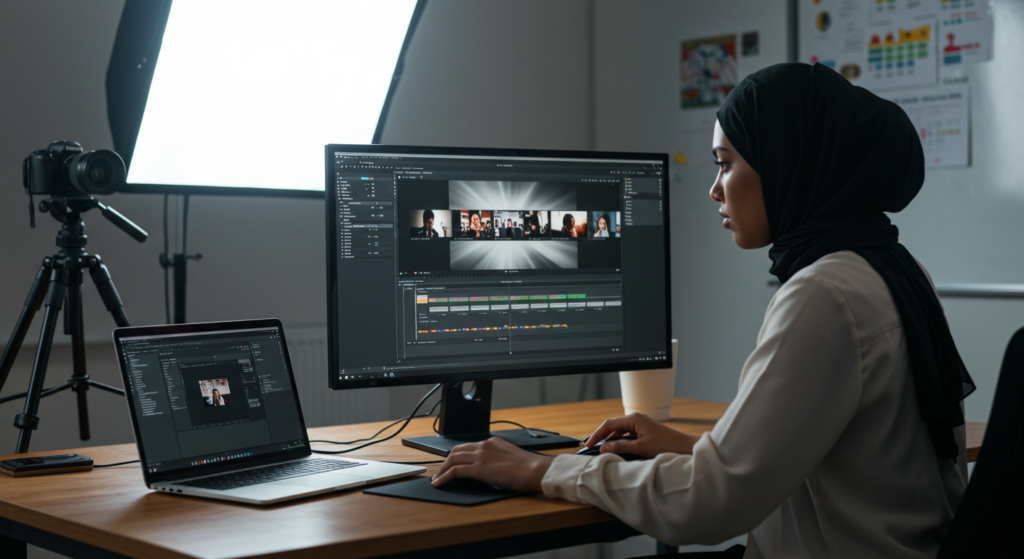
    This is how Khaerat, a 19-year-old fourth-year law student, is making it work:

    “I started creating video content on Twitter, Instagram, and TikTok in my second year in uni, just for fun. But I was building a portfolio without realising it, and it landed me paying gigs.

    I got my first gig in May 2024, about a year after I started editing videos for social media. I get paid according to my rate card. Right now, I have four video editing gigs: three pay me ₦50K each, and one pays ₦100K. I also juggle an ₦80K social media management job, all alongside my law degree.

    Since I work best at night, I batch-edit my videos and designs to stay on top of everything. It’s also my way of unwinding from the demands of studying law.

    I’ve landed all my jobs by simply tweeting about my work or commenting under posts to offer my services. It doesn’t feel overwhelming because I enjoy what I do, and with more experience, I’ve gained the confidence to charge higher and ditch toxic clients.

    I use CapCut for editing, Canva for designs and Buffer to create and schedule content. After school, I plan to continue doing this alongside my legal career, especially since I’m going into corporate or business law—not litigation. I know my earning potential will grow when I have more time to take on bigger projects.”

    How to get started:

    • Learn the basics: Start with free editing apps like CapCut, InShot or DaVinci Resolve before moving to more advanced software like Adobe Premiere Pro.
    • Offer free or discounted work: Edit videos for small content creators or friends for proof of work.
    • Create a portfolio: Showcase your best work on platforms like Google Drive, Behance, or a simple Instagram/Twitter thread.
    • Engage on social media: Post snippets of your work, engage with content creators and offer your services on these platforms.
    • Find paid gigs: Start freelancing on Fiverr and Upwork, and use Twitter and LinkedIn to network.
    • Charge your worth: Set competitive rates based on your skill level, but don’t undersell yourself. Increase your prices as you gain more experience.
    • Stay updated: Video trends change fast. Keep up with editing styles, effects, and platform-specific content demands.
    • Build client relationships: Deliver quality work, communicate clearly, and retain long-term clients by being reliable.

    3. E-commerce

    Some students aren’t waiting for jobs; they’re creating them. From selling thrift clothes to launching skincare brands, e-commerce is thriving.

    This is how Hikmat, a 22-year-old final-year Botany student, is making it work:

    “I sell skincare products and get customers through WhatsApp, TikTok, Snapchat, and Instagram. My Whatsapp catalogue makes ordering easy, and most of my customers are students in my hostel, department, and across campus.

    I stock up on sheet masks, lip and eye masks, pimple patches, and nose pore strips from a Chinese e-commerce website (1688) through an agent. 

    My first order cost ₦70k and included 160 sheet masks, 100 lip and eye masks plus shipping fee. Since I started in June 2024, I’ve made three times that amount in profit. In my first week alone, I pulled in ₦25k. I’ve restocked at least twice since then. However, I use sea shipping, which takes 2–3 months. I find that it’s best to order in bulk.

    On an average month, I make ₦35k to ₦40k; on a bad month, ₦10k. But on a good month, I make ₦50k. Skincare is huge among students right now, so I knew I was tapping into the right market.  My earnings fluctuate because I haven’t been consistent.

    I started this business because my ₦20k monthly allowance wasn’t cutting it, and I didn’t want to burden my family. 

    I recommend starting this business if you have enough capital to buy in bulk. The competition is tough, and many sellers drop their prices just to attract customers. It only works if you’re buying at scale.”

    How to get started:

    • Do your market research: Understand what sells and who your target audience is.
    • Choose a product with demand: Items like thrift clothes, skincare products, accessories, and gadgets are in high demand among students.
    • Source Smartly: Buy from local markets or platforms like 1688/Alibaba.
    • Choose the right channels: Sell on the right social media platforms (TikTok, Twitter, Instagram). By creating engaging content, you get free marketing.
    • Market your business: Build visibility and attract customers.
    • Manage your finances: Track earnings, reinvest and scale your business.

    4. Graphic Design 

    Logos, flyers, business cards, social media graphics; if you can design them, someone will pay you.
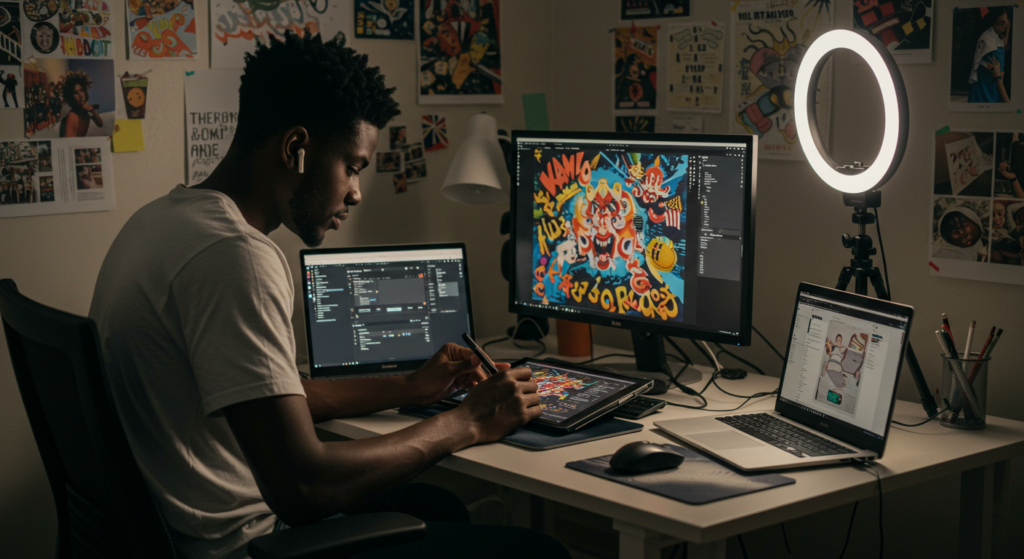
    This is how Korede, a 22-year-old final-year Computer Science student, is making it work:

    Korede, 22 (400 level, Computer Science)

    “I was in 200 level when I realised I could make money from design. We had a class assignment, and my lecturer singled out my work as one of the best. But since what I study is programming-heavy, that one design class wasn’t enough. I wanted more. So, I started practising and sharing my work on WhatsApp, and before I knew it, someone paid me ₦5K for a logo. That was shocking because I survived on a  ₦3k weekly allowance at the time.  

    I grew curious, obsessed and hungry for knowledge, but I didn’t have a laptop. So, I borrowed from friends and installed Corel Draw on a flash drive. A coursemate taught me the basics in a week, and I spent hours sitting behind students who designed after lecture hours, watching them navigate the software. That’s how I found Photoshop. It was tough at first, but I found a mentor on YouTube

    Now, I don’t even have to post my work. Referrals keep me busy, and I make between ₦500k and ₦700k monthly. I design at least 15 graphics daily—party flyers, social media graphics, stickers, logos, banners, etc. I also work a design internship at a Nigerian EdTech company, earning ₦80K/month. On Fiverr, I do photo manipulation gigs and regular designs, making around $250–$300 monthly. Occasionally, I design branding assets for UK wedding and event brands. I won’t lie — I spend a lot of it on food because I never imagined making this much. But the workload is insane. My grades have dropped, and I have no social life. Sometimes, I skip class to meet deadlines. It’s draining, so I plan to cut down on party flyers and new recommendations and focus on my internship and Fiverr. The money is sweet, but I still need to graduate.

    How to get started:

    • Learn a design tool: Start with Photoshop or Illustrator.
    • Build a portfolio: Offer free designs to small businesses and build a portfolio on Instagram and Behance.
    • Show your work: Post consistently on social media.
    • List your services: Sign up on Fiverr and Upwork.
    • Keep improving: Take online courses and study trends.

    5. Ghostwriting  

    If you have a way with words, ghostwriting can be a lucrative hustle. Clients pay well for high-quality, anonymous content, from fiction to nonfiction and blog posts. You just need to know where to find them.

    This is how Catherine, a 21-year-old final-year Human Physiology student, is making it work:

    “I ghostwrite fiction for an international web novel company in the U.S., earning $300 per book. If a book performs well on the app, I get a bonus of $50 to $100, which pushes up my monthly earnings. It’s basically a 9-5, except I don’t leave my house.

    I also take up side gigs on freelance platforms when I have time.

    Before this, I earned ₦60k a month doing outsourced work for Nigerian writers who landed big gigs but paid me peanuts. Over time, I gained confidence and started charging my worth. Now, I source my own international clients on Upwork, Fiverr, and LinkedIn and get paid in dollars directly. 

    The company I currently write for is similar to Wattpad, and they even have a partner company that adapts books into short telenovela films and repurposes them into bite-sized paid ads for platforms like Snapchat. My Nigerian friend, who currently works as a senior editor at the company, recommended me, and it’s been a great experience since I started working there in July 2023. 

    I typically write one book a month, but sometimes I push for two. When I write a full-length novel, the word count is 150,000 per book, while novellas are about 100,000 words.

    Writing romance may seem easy, but it’s brutal. Some clients make me edit the same document 10 times before they’re satisfied. I put in about 80 hours a week, balancing school and deadlines.

    I primarily work between lectures and late at night, but on free days, I wake up, check pending tasks, and grind all day. The workload can be overwhelming — tasks pile up, my head feels full, and sometimes, I just completely shut down. Now that I’m in my final year, juggling my thesis and writing is even harder, so I’m trying to cut back before it burns me out completely.

    Will I keep ghostwriting after school? Yes. Will I do it full-time forever? Hell no. If I could start over, I’d charge my worth from day one. I let people underpay and exploit me at first, but never again.”

     How to get started:

    • Pick a niche: Specialise in a specific area to stand out and attract clients.
    • Create a portfolio: Start small. Write Twitter threads, Medium articles, or LinkedIn posts to showcase your writing style.
    • Find clients: List your services on Fiverr, Upwork, and LinkedIn platforms.
    • Set your rates: Research how much ghostwriters in your niche earn and charge accordingly. Don’t undersell your work.
    • Write your own work: Avoid relying on AI to generate content. Clients pay for originality and creativity.  If you must use AI, limit it to best practices: research, brainstorming, or light editing.
    • Stay consistent: The more you write, the better you get. Deliver high-quality work on time, follow briefs carefully, and build relationships with clients for long-term success.

    6. Crypto Jobs 

    The crypto space is more than buying Bitcoin — it’s a whole economy. Some students trade, some play games to earn, and others take Crypto jobs.
    This is how Fehin, a 21-year-old third-year History & International Relations student, is making it work:

    “I make between $200 and $500 monthly from crypto jobs, but my highest monthly earnings have been up to $1,000. I got into crypto out of curiosity; I wanted to know how to make money online in Nigeria. 

    I started by learning the basics, trading, and immersing myself in crypto communities. Now, I manage social media pages, primarily on Twitter and Discord, for big projects and communities and create content to drive engagement. I also take ambassador roles because I’ve grown my crypto Twitter following to 6000 plus.

    Most of my gigs come from networking on Twitter. I got my current role because I was active in the community, engaging with projects and applying for ambassador programs. I dedicate 15–20 hours weekly to my crypto jobs, depending on my school workload.

    The hardest part is managing time during exams. I schedule tasks in advance and focus on high-priority work. I plan to go into the crypto space full-time after school. If I had to start over, I’d prioritise networking and building a strong personal brand on Crypto Twitter earlier.

    My advice? Learn valuable real-life skills: content creation, social media management, research, etc., be active in communities, and don’t be afraid to apply for roles. Networking and consistency are everything.”

    How to get started:

    • Learn the basics: Use YouTube and online resources to understand the fundamentals of crypto. 
    • Establish a social identity: Build your presence on Crypto Twitter and grow your reputation by engaging in discussions and sharing insights.
    • Penetrate communities: Look for active crypto communities to join on Telegram and Discord.
    • Look for job opportunities: Explore Telegram, Discord, Twitter and crypto job listing platforms for opportunities.  (CryptoJobsList, SuperteamEarn, etc.)
    • Apply and Network Relentlessly: Engage with community members and build connections.

    7. Virtual Assistance 

    If you’re good at handling tasks, replying to emails, or keeping things organised, you can make money as a Virtual Assistant (VA). Entrepreneurs, influencers, and busy professionals need help managing their workload and are willing to pay for it.

    This is how Grace, a 21-year-old third-year Engineering Physics student, is making it work:

    “I make an average of ₦120K monthly as a Virtual Assistant (VA).

    I recently worked with a medical student, helping her source and compile data into readable files for her research. The contract lasted a month and paid well.

    I got the job through a friend after consistently sharing my work and learning journey on social media. Building in public — documenting my training, progress, projects, and wins — helped me get noticed.

    I started earning four months after completing my VA training on ALX Africa in 2024. My highest monthly earnings so far is ₦150K. Before this, I got ₦20K monthly from home — barely enough for transport, feeding, and study materials.

    The job takes about 30 hours a week, which can be intense, but time management helps me balance it with school. I wake up early to complete tasks before class and structure my work hours around my school timetable. I also avoid taking on new projects during exams.

    If you want to become a Virtual Assistant, get proper training, master tools like Trello, Calendly, Google Workspace, Notion, and Canva, and find a mentor. Most importantly, put yourself out there—opportunities come when you stay visible and consistent.”

    How to Get Started:

    • Identify your skills: Stick to what you’re good at, whether it’s email management, data entry, research, customer service, or social media.
    • Learn the basics: Master tools like Google Workspace, Trello, Asana, and Notion with free courses on Coursera, ALX Africa, or YouTube.
    • Set your rates: VAs in Nigeria earn ₦80K₦468K/month (Glassdoor). Start low, gain experience, and charge what you’re worth.
    • Find your first client: If needed, skip Fiverr and Upwork, network on Twitter and LinkedIn, and ask around. Referrals work magic.
    • Create a simple portfolio: Show what you can do with sample emails, calendar schedules, or task management templates.
    • Sign a Contract First: Protect yourself with a contract covering payment terms, tasks, availability, and confidentiality. No contract? Big red flag.

    Bottom Line

    Making money online as a student in Nigeria isn’t rocket science. Pick one skill, start learning today, stay consistent and put yourself out there. Nobody will hand you money for free, but if you put in the work, urgent ₦2k will never be your portion again.


    ALSO READ: 5 Nigerians Open Up on How Relocation Has Shifted Their Financial Realities

    [ad]
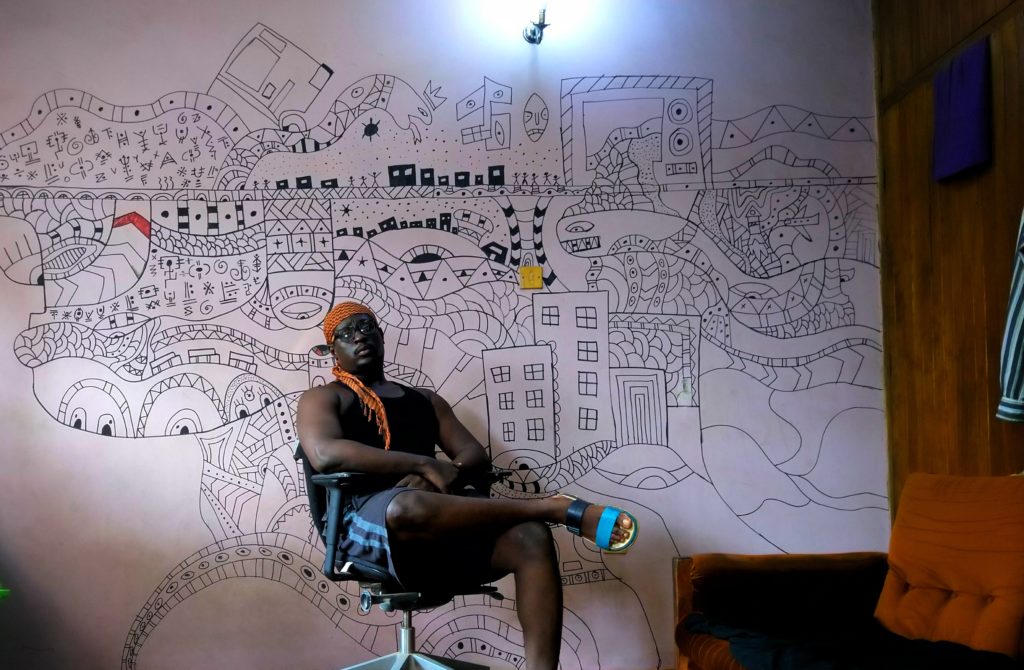
  • Okeoghene (32) knows how difficult it is to rebuild after losing everything.

    He shares how he found a rewarding career in art and graphic design despite his parents’ disapproval, becoming successful, and hitting a creative wall after losing ₦17m. Now, he’s trying to start over.

    As told to Boluwatife

    Image: Okeoghene Efeludu

    I loved cartoons as a child. The late 90s and early 2000s Cartoon Network raised me, and I loved recreating the characters I loved — Samurai Jack, Dexter’s Lab and Courage the Cowardly Dog. 

    My drawings were just a fun hobby. But I stopped drawing when my dad saw a Justice League-inspired comic I drew in JSS 2 and tore it up. For him, drawing had become a distraction and prevented me from improving my studies. 

    I didn’t draw again for a long time. Instead, I focused on doing what my parents expected of me.

    First, it was sports. I ran track and played basketball in secondary school. I was on the path to getting a basketball scholarship to a university in the US when a drunk driver hit me and broke both legs. I was 16, and that was the end of any dreams of a sporting career.

    Since I couldn’t pursue a US university admission anymore — my barely middle-class family couldn’t afford it without financial aid — I focused on getting into a Nigerian university. That took three years of trying out different things my parents wanted.

    Between 2009 and 2012, I was admitted into three different universities to study courses ranging from computer engineering to even almost getting recruited into the Nigerian Defence Academy. I wasn’t interested in them. 

    I wanted to study archaeology, but like typical Nigerian parents, my parents weren’t having it.

    I eventually studied computer engineering, networking, and cybersecurity at NIIT, a talent development institution. By 2015, I was working in tech support, fixing laptops, and working on telecommunication masts.

    In the same year, I had a wake-up call. I asked myself, “What do I really want to do?” I’d spent all these years doing different things, but when would I eventually do something for myself?

    At that time, I was a fan of the Hip-hop culture, and graphic T-shirts were a big part of it. However, the 2015 graphic T-shirts had phrases like “Ama Kip Kip” and “My money grows like grass.” I hated those shirts, and I wanted to create something better.

    There was a problem: I’d stopped drawing for so long that I wasn’t sure how to start. My cousin, Precious, was an artist, so I called him. We agreed that I’d describe what I wanted to draw, and he’d make it happen.

    But there was another problem: How would I convert these drawings on paper to something digital I could print on shirts? 

    I knew a graphic designer at a cyber cafe I frequented, and when I asked how much it’d cost to turn the drawings into digital designs, I decided I was going to learn graphic design.

    I bought Corel Draw tutorial CDs and began teaching myself. It looked like sorcery at first, but I soon got the hang of it. My sister’s boyfriend gave me my first gig, paying me ₦2k to design a small flyer. 

    My parents were pissed when they realised I was spending all my time with graphic design. It took an uncle’s intervention for them to tolerate the fact that I’d abandoned everything to pursue a career in graphic design.

    I also got my first graphic design job in 2015, making ₦10k/month at a printing press. Asides making me a better designer, that job taught me a lot about the T-shirt business.

    After a few months, I left the job and began designing my own T-shirts. I borrowed ₦20k from my sister and printed my first samples; then, I got a gig to supply T-shirts for a street jam party. It didn’t take long before people knew me as the “T-shirt guy.”

    In 2016, I started posting my graphic designs on social media and got a few freelance gigs here and there. Of course, I made some of the obligatory rookie mistakes most new freelancers make. 

    I remember not negotiating for a branding gig because I got it through a friend. After I completed the gig, they asked for my fee, and I said ₦20k. They laughed and sent me ₦5k. Another client told me they got someone else for the job after I’d already gone halfway through the project. 

    These experiences taught me to treat design as a business. So, I learned to draw up guidelines and collect part payments before working on any project.

    Things took off from there. I got regular jobs, and with them came the confidence boost that came with being really good at what you did. I even went viral in 2018 for doing a photo manipulation with King Kong and the UBA building at Marina, Lagos. It was just a random design, but UBA reposted it, and I got tons of followers and even more gigs.

    Digital art gave me my first big break in 2018. Someone contacted me on Instagram and requested a canvas print for her boyfriend. I randomly charged ₦300k, and she negotiated to ₦280k. I honestly thought the most I’d get was ₦50k. 

    After I completed the job and got paid, I used about ₦120k to go on a mini vacation to Ghana. It was my way of coming to terms with the fact that I could live a good life and make good money from design.

    And I did make good money between 2019 and 2021. 

    My designs caught attention online because I had a thing for mixing Afrocentric and urban designs with pop culture. I got a job with a US creative firm that paid six figures and collaborated with several national and international brands.

    Image: Okeoghene Efeludu

    I was on a financial high, and while I initially just spent money as it came, I decided to become serious with my finances and began consistently saving in 2020. That turned out to be helpful because 2020 was a slow year due to the pandemic and some health issues. I quit my 9-5 and went fully freelance.

    However, things picked back up in 2021. I secured a collaboration with an international drink brand and was on retainer for about five other brands. I even formed a small company and got a few young designers to work on the projects I couldn’t take on because of time constraints. I was a proper creative director.

    Then, 2022 came, and that’s when my problems started. 

    I invested some of my money in a friend’s delivery business. One day in February, one of our bikes developed a fault, and the rider got into an issue with area boys. I was close by, so I decided to go there to sort it out. However, rather than de-escalating the issue, a fight broke out when I arrived, and my phone got stolen in the scuffle.

    I wasn’t bothered by the theft at first. I called my network provider and asked them to block my line. The bank account linked to the line was my main savings account, so I also called my bank and deactivated my ATM card — basically everything I was supposed to do after losing my phone.

    I couldn’t retrieve my SIM for about two months because of the NIN wahala. I eventually retrieved it without going to my network provider’s office. It turned out you could just meet a regular person on the street, and they’d link your line to a new SIM card. I was shocked that was possible, but I guess it explains how the people who got my stolen SIM were able to impersonate me.

    When I put the new SIM card into my phone, I started receiving strange debit alerts. Almost immediately, random people began calling and accusing me of defaulting on loans. I didn’t know what was happening.

    I found out that blocking my SIM card didn’t prevent it from receiving text messages. The thieves could still use USSD codes on the SIM, and they cleared my entire ₦17m savings. I didn’t realise earlier because I never touched the money in that account — I had a separate account for everyday use.

    They also used USSD to find my BVN and collected loans—about ₦300k in total. I thought the loan companies disturbing me was the worst part until the Economic Financial Crime Commission (EFCC) flagged my bank account and summoned me.

    Apparently, the thieves had sold my SIM card to a 419 syndicate, and those ones used my details to open different accounts. The next few months involved multiple police station and court visits to sign statements and swear affidavits that I’d actually lost my phone and SIM card. I also had to secure a court cease and desist order and involved the FCCPC to get the loan companies off my back.

    When I eventually sorted that out, I had to face the reality that I’d lost everything. I was in a very wild state of mind. I was suicidal, mentally unavailable and couldn’t work. I couldn’t do anything from June to November except sleep and wake up.

    In 2023, I decided to throw myself into work and try to make all the money I’d lost. It worked out for a bit — I got several gigs, averaging ₦400k – ₦500k monthly. I even got another 9-5 in October.

    But I gradually realised I hadn’t properly processed all that had happened in 2022. I was spending so much because I was scared of saving and losing my money again. I’d also taken that job because I was trying to make money quickly again, but I was mentally drained due to the toxic environment. I was losing my creativity and starting to hate design.  

    I quit my job about two months ago and spoke to a therapist to process everything that’s happened. It doesn’t help that I’m trying to rebuild my life and finances at a time when the country isn’t even balanced. Inflation is literally making it impossible for me to build a safety net again.

    It’s extra difficult because money plays an important role in my creativity. For instance, I like doing passion projects — murals, visual art pieces, and art recreations on the side. Those cost a lot of money, but they help me explore my creativity and create art I love. Sometimes, I sell these pieces, but it’s difficult to take that risk now because I don’t know where the money will come from.

    I’m now focusing on rediscovering myself as a creative person and figuring out how to love design without relying on a financial safety net. It hasn’t been spectacular, but I’m in a better place mentally, and I’ve learned to separate the money from the art. 

    I’m reminding myself that I don’t make art because of the money I want to make from it or what I hope to get. I create and design because I love it. It’s my life, and it shouldn’t stop because I lost everything.


    NEXT READ: I Failed Out of Medical School After 5 Years, but I Don’t Regret It

    [ad]

  • Every week, Zikoko seeks to understand how people move the Naira in and out of their lives. Some stories will be struggle-ish, others will be bougie. All the time, it’ll be revealing.


    The guy in this story has two things going on for him: developing new skills and taking a leap of faith. The ultimate gamechanger for him, though, is a tech hub he joined at uni and a DM he got in 2020.

    What is your oldest memory of money?

    My dad always did this thing for me and my siblings when we were growing up: at the end of each term, he would drive us with his motorcycle to a restaurant in the town we lived in to flex us. We would order yoghurt and meat pie, sometimes we threw ice cream into the mix. At other times, he would drive us to the zoo.

    What did your dad do for a living?

    He ran a computer business centre with my mum. At first, all they did was type and print documents for people. But it grew into a printing press. I should add that my dad has done everything — he used to be a barber and then an electrician. He still runs these businesses to date. 

    What was life like, though,  growing up?

    The family was never hungry. We could be broke, but food was always on the table. For me, though, my childhood was tough. My dad made sure of that. I was the first child, so he thought I needed to be raised with an iron fist. I spent most of my childhood learning how to be a man. My dad always bragged about how he was an employer at 18, so it was like I was competing against him.

    I would wake up at 6 am, say the morning prayers, go to school. There were extra classes after school, and then I would head to the shop to handle the business. I started helping around with the smaller tasks, but as I grew, my responsibilities also grew. I think I started managing all aspects of the business when I was 16. 

    What was it like handing the family business at that age?

    My job was to make sure everything ran smoothly: the computers, printers and generators. I also did the books and made sure the numbers were right. I was paid ₦5k per month, although the money didn’t come to me. It went to a trust fund my parents kept. Subsequently, my salary was increased to ₦7k, then 10k, then ₦15k.

    What was revenue like?

    We averaged about ₦300k per month. But when it was time for elections or other large scale events, the number went up to ₦750k. During the 2011 general elections, I think we did about ₦1.5M to ₦3M every month. 

    Omo. So, when did you get into uni?

    2014. I was supposed to study medicine, but I was offered biochemistry instead. 

    This sounds very familiar. 

    So, the plan was to do biochemistry and go for medicine later. My first year and second year were great. My grades were fine. In 2016, I replicated my dad’s hustle on campus and started a design and printing business. This brought in at least ₦200k in a good month. The best times were during the end of year events when I did about  ₦400k.

    Impressive. How old were you when you started this business?

    19 or 20. The only thing was that this income wasn’t constant, so it was hard to plan around it. I mean, there were months I did only ₦15k.

    I was making money on the side, but something happened in my third year.

    What?

    I was hit with depression and anxiety. I didn’t want to do the whole school thing anymore. I had my sights set on tech, but I didn’t know how to get into it. It kinda spiralled out of control. One day in 2017, I drank an entire bottle of vodka, Moet and Baron. The plan was to go off to sleep and maybe never wake up. I had forgotten that my girlfriend at the time was supposed to visit me later that day. When she came and couldn’t get in, she called my neighbour and they broke my door. They found me on the floor, laying in my vomit and my eyes rolled in. I remember the guy pouring buckets of water on me and pumping my stomach to get the content out. I eventually slept it off. I didn’t wake up until the following night. The pain was mad. 

    I’m so sorry you had to go through that.

    We move. Later that year, my university started a tech hub. I was invited by a friend to join their team that was incubated to be mentored in the tech hub. All of us were rebels of sorts — we were tired of uni and just wanted to do something different. We had a building to ourselves, 24 hours of interrupted power supply and the fastest wifi on campus. Omo, I was sleeping there, just building stuff with my team. We became the cool kids on campus. The VC gave us ₦2M at some point. 

    What did you do at the tech hub?

    My team was building drone technology of sorts. We wanted to deliver blood to cities like Zipline does in Rwanda. When we started, I was in charge of graphic design and marketing communications. I gradually moved into product design and front-end development. I also did a lot of strategy work. It was my biggest strength. People in other teams always wanted to pick my brain on something, and I absolutely loved it. 

    Where do you think this edge came from?

    My dad. He’s a chief strategist. See, that guy didn’t go to uni, but he was a smart man. Also, I’m very curious about stuff. I’m interested in details as well as the big picture. So, when people tell me the big picture, my mind is looking for a million paths to get there. 

    Interesting.

    I basically ditched classes. My classmates and lecturers thought I was a fool. Maybe I was, but I wanted better. Finally, I got to my final year in school and I was supposed to do my project. One day, I woke up and went to my supervisor to tell him that I wasn’t interested in the project anymore and needed him to refund the ₦30k I had paid for it. 

    This next person I saw at the hub was my dad. My supervisor had called him. This man came with a chain and he said: “I know an evil spirit has possessed you, so we will chain you and take you to the psychiatric hospital, then carry out some spiritual deliverance for you.” I was arrested and detained at the school security post for most part of the day. The school asked my dad to go home and that I would join him later, so we can settle our issue. This was in 2018, and we still haven’t settled it. 

    What happened after your “deliverance”?

    They actually took me to see about three pastors. I sat through the whole process thinking of how to leave home. After everything, I lied to them I was going to school to fix a few things. It’s been two years now. 

    So, you came to Lagos.

    Yup! A tech bro I met on Twitter bought me my ticket. I stayed at an uncle’s place for a while.

    Wait, was a job waiting for you in Lagos?

    Nah. There was no job waiting for me. I had sent applications before I came, but nothing clicked. I roamed the streets of Lagos for three months before I got my first job. I saw a tweet where someone said you could message recruiters at companies you applied to on Linkedin. So, I sent a message to a recruiter and she asked me to mail her my details. Two days later, I got an interview. 

    What role were you applying for?

    A Creative Designer at a software company. 

    And you got it?

    Yup. This was May 2019. My net salary was ₦145k. 

    Nice. How did that go?

    That job got me settled in Lagos. But damn was it challenging. It was a lot of sleepless nights. The biggest challenge was navigating the commute. Where my uncle lived was too far from where I worked. After trying to wing it for two months, I started sleeping at the office. I would wake up early to go have my bath at a friend’s who lived close to the office. The work was crazy, but I didn’t do badly.

    In 2019, the company flew me and a few other people to Dubai. That was my first time out of the country. 

    How did that feel?

    Omo, it was mad. On the day we were leaving the country, I called my mum on my way to the airport and she broke down in tears — tears of joy and fear. 

    Lmao. Why fear?

    It was that panic parents feel when you’re travelling. She has never been on a plane, so I guess I understand how she felt. 

    2020, how did that go for you?

    It started with some massive gbas-gbos. I left the company where I worked because I got an offer to do something different in another company. This one was an actual product design job. And it came with a bump to my salary: ₦250K.

    The company was on the Island, so I paired up with a friend and got an apartment together. I was also getting a few side gigs, so I was doing ₦400k-₦500k every month. Then Covid happened, and I got fired. 

    Whoa!

    I didn’t adjust very well to working from home — with poor power, internet, and the emotional side of things. I got back to back queries before they terminated my appointment. It was a fair decision, sha. 

    The sad part about this was that my contract did me dirty. By the time they finished picking out the small details in the contract, my salary for that month came down to ₦160k. Naso I take broke oh. 

    Damn. How did the subsequent months go?

    I had no job from May to August. What kept everything together was a few side gigs I got. Towards the end of August, I got another job. The salary was ₦300k monthly. It was actually one of the best places I worked. I quit at the end of last year. 

    Sometime in October 2020, I got a DM from someone wanting to know if I was interested in a job. I looked at it but the application process was too long, so I left it. One night, I went back to it and sent in an application. Two weeks later, I was invited to interview. A design test followed and a series of more interviews. In November, I got an offer from them. 

    *Drum Roll*

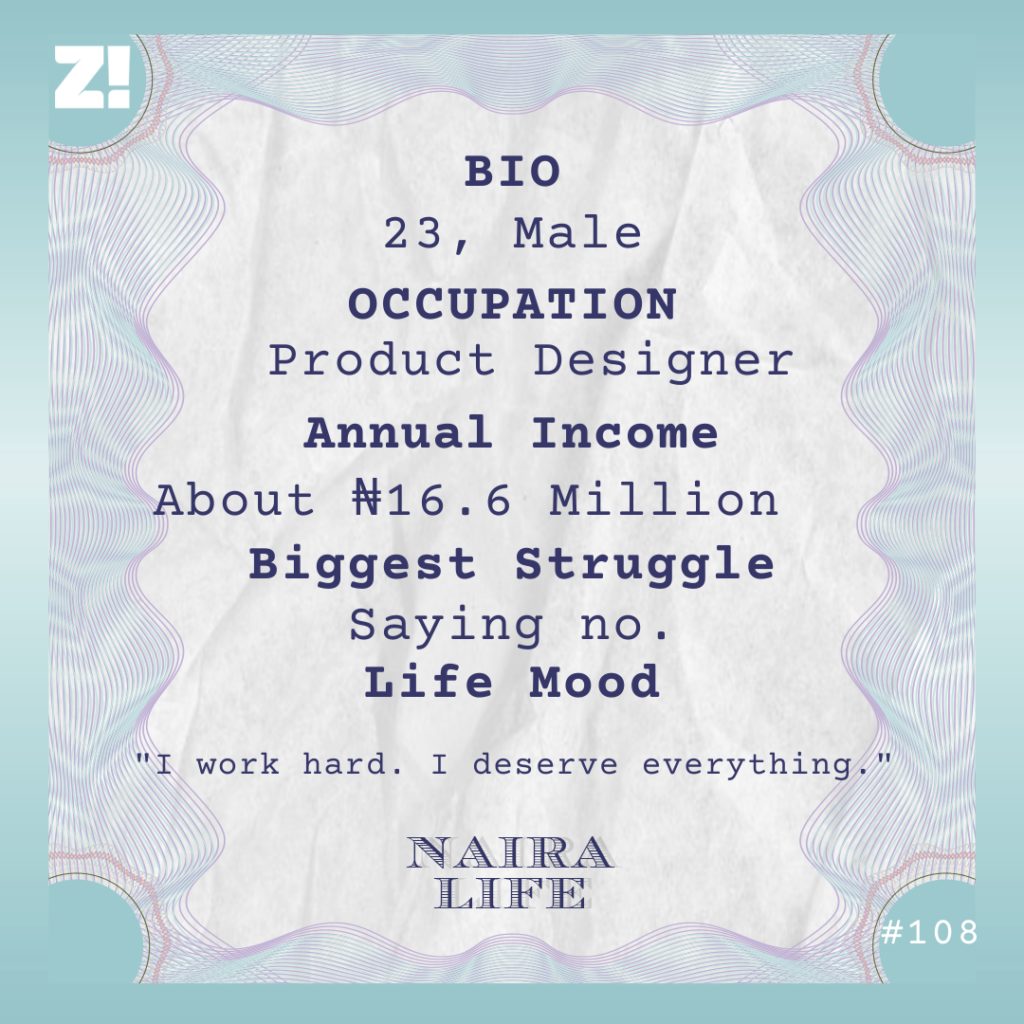
    It was ₦16.6M per annum. $35k in addition to $4k in gadget, insurance and internet allowance. That’s ₦1.4M per month. Also, it’s a fully remote job.

    Omo. What has this jump meant in this little time?

    It feels good. It is more than any validation I could have gotten about my work, and it’s not even all about the money. Throughout every stage of the hiring process, they kept talking about how impressed they were with my work. See, I work hard. I deserve it. 

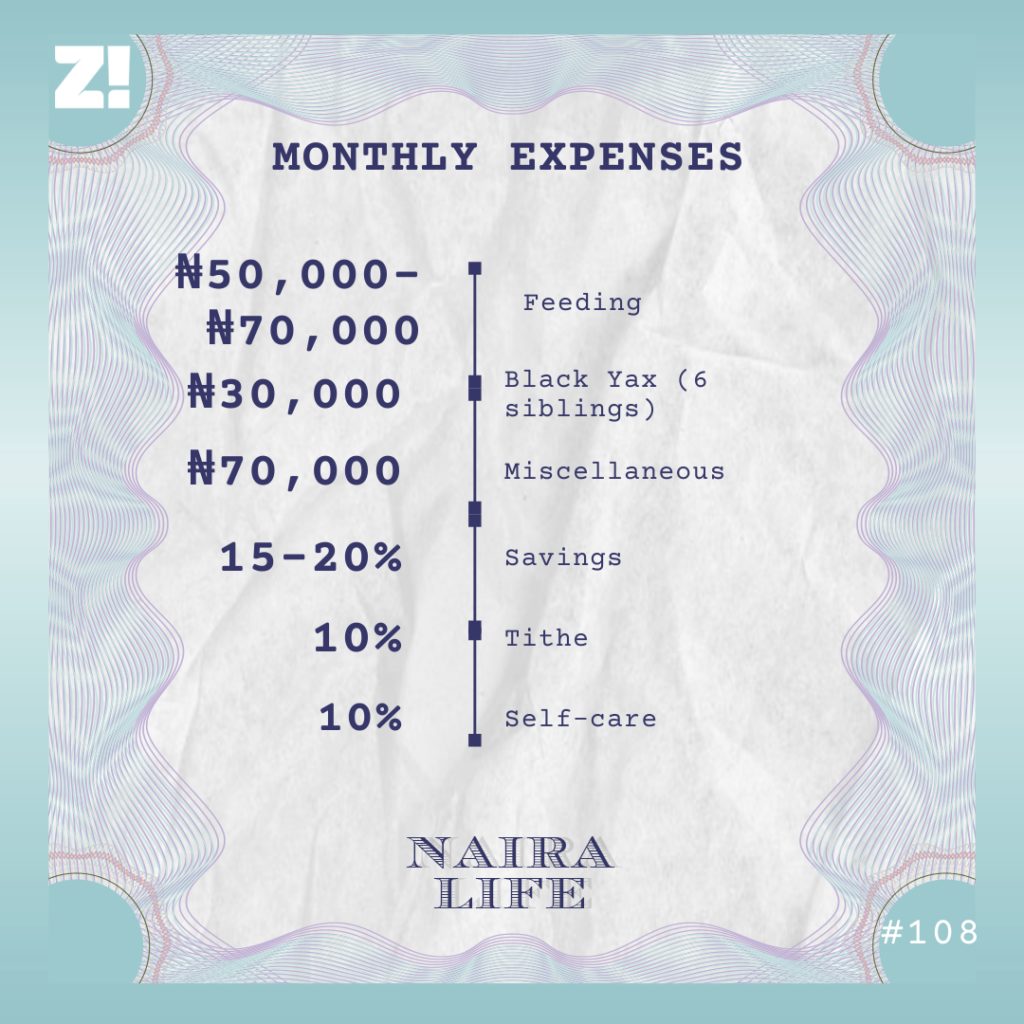
    Energy. Let’s break down your monthly expenses now.

    I have this tradition, any lump sum I make, I spend at least 10% getting myself something 

    Is this break down pre-new bump or based on the new bump?

    Pre-bump. Oh, I didn’t mention; I make about ₦500k-₦600k every month from side gigs. 

    What do you do for people on the side?

    Product design as well. I used to do WordPress but stopped for a while. I also get gigs to help prototype products launch into full products. Then people pick my brain for a price. 

    Walk me through how your skill sets have evolved over the past decade.

    I started designing with CorelDRAW 9 and Adobe PS 7. After that, I went into print production. I don’t think there’s a printer out there I don’t know how to operate. In uni, someone I met online taught me brand identity and strategy. At the time, coding was the rave, so I learned a bit of frontend technologies (HTML, CSS, JS), but computer engineering wasn’t something I wanted. UI/UX and product design were the perfect alternatives, so I explored and grew in it. I dropped graphic design totally and moved on.

    The years you picked them up?

    2010: I was already typing faster than my mum.

    2012 – 2013:  My design skills were getting better. By 2014, I was solid

    2014 – 2017: I picked up most of the skills set. Brand Identity design and strategy was key at this time.

    2017: I picked up UI/UX.

    Growth. So, what do you imagine the next 5 years will look like?

    I should have one or two products in the markets. I have enough resources to start — human capital and funds. I’m currently enrolled in a university in the UK and will be starting classes this year for a degree in computer science. And yes, getting married to my girlfriend is also top of the list. 

    Back to the present. What’s something you want right now but can’t afford?

    A collection of media production equipment for my church. It cost about ₦36M. This is very personal to me. With my current bump, I think I can afford most things I want. Last last, I’ll  save up for it. 

    What is something you wish to be better at financially?

    Saying no, maybe. I’m very reckless about giving people money.

    What’s the largest amount you’ve given away at once?

    ₦330k. I was the president of an organisation in 2017, and we were planning an event. However, we were low on funds. I borrowed ₦200k, but it wasn’t enough. Then I started dipping into my personal funds. By the time we were done, I had spent ₦300k. I never got it back. 

    Lmao. What’s the most annoying miscellaneous you paid for recently that cost a lot?

    Maybe my trainers? Got them for ₦25k after searching for months for my size. I am a size 50. The annoying thing was not the price but the fact that it had to be shipped from Germany, and I have been searching for three years for a size 50.

    SIZE WHAT?

    All my shoes are custom made.

    Haha. When was the last time you felt really broke?

    My first four months in Lagos. I trekked to places a ₦100-₦150 bus ride could have gotten me to. There’s this lady on Twitter that shares food in my area. One day, I joined the line to collect rice oh. 

    Wild. Have you ever imagined how life would have turned out if that Tech Hub didn’t get built in your school?

    I would have found another way to survive. I may not have gotten to this point, but I definitely would have survived. I believe that the places we go to and the people we meet are all paths to a destination. Taking a different path might mean having a different experience, but they all lead to a result. Now the uncertainty is, nobody knows how good or bad the result will be. 

    What’s a purchase you made recently that significantly improved the quality of your life?

    Ah, that trainers oh. In one week, I have lost 6.5 kg.

    On a scale of 1-10, how would you rate your financial happiness?

    A solid 7.

    What would get it to a 10?

    $140k/annum.

  • We want to know how young people become adults. The question we ask is “What’s your coming of age story?” Every Thursday, we’ll bring you the story one young Nigerian’s journey to adulthood and how it shaped them.

    The guy in this story is a 19-year-old graphic designer who lives in the office where he’s employed because living at home is not an option. He left home at 17 after a clash with his stepfather.

    The day I raised my fist to defend myself from the insults and continuous abuse of my stepfather — a man who never let me and my mother forget how he helped when no one would — was the day it dawned on me that I was an adult. This was just before I turned 17. I left home the same day and never looked back. I gave my mother an option and she made him her choice.

    She hurried towards me after I walked away in anger. I was enraged but I had made my decision: I was leaving. I didn’t have anywhere to go; my friends didn’t know my situation. I keep everything close to heart. That’s what happens when you’re used to promise–and–fail from family members. That’s what happens when they gossip right in your face about how your mother is a failure and can never do well, especially with you, the bastard child she had when she was 20.

    I don’t know who my father is. Living in a family house in Mushin was the most shitty thing ever, but that’s where I spent my formative years. I was always on my guard because I didn’t know who I might offend with my presence. In the beginning, I was trusting of family. I believed anything they said until I realised they (my aunties and uncles) were deliberately taunting me with promises they knew they wouldn’t keep.

    We left Mushin when I was 11. I was so glad when my mum told me we were moving even though I wondered where we would go. I knew she didn’t have a lot of money. She packed our things in the middle of the night and sat up till dawn. We had a room to ourselves, thankfully. She must have thought I was asleep because it was easy for me to read the expressions on her face from the glow of the lantern. When we started living with my “stepfather” and he started abusing her, I often thought back to that sad expression. I preferred it, preferred the house in Mushin, to what living with my stepfather did to her, to us.

    He didn’t raise his fist at the beginning. It started out as intense emotional and psychological abuse. I didn’t even know that was what it was until I read up on it some months ago while doing research for a design project I was working on.

    By the time I left home, I was damaged from the inside but no one knew. My mum stayed because she didn’t feel like she could go back home. I understood, but that wasn’t how I wanted to continue. I left in the middle of the afternoon; I walked out with no reassurance to her that I would keep in touch because I wasn’t sure I would be able to. My only option was sleeping on the streets and that was better than continuing to live under my stepfather.

    I didn’t sleep on the streets though. An uncle of the adugbo helped out. He saw me sitting on a fence and asked me what happened. I didn’t say a thing, couldn’t say a thing. Perhaps, God told him something because he asked me to follow him and I did. It was either that or I stayed where I was on the street.

    Fast forward to about three months later. My guys gave tutorials on how to work a computer and I began exploring my options. I have a phone, so I could Google anything. I started looking for a job while working and living with my guys. I learnt a lot from them, Google and YouTube.

    I got a job in 2018 as a graphic designer. I didn’t know shit and I felt really overwhelmed by everything. It was one of my guys who helped me do my first six design projects. Practice is different from theory and there was only so much I could learn when managing data. That led to me living in the office. I would leave when everyone was leaving at closing hours, go hang out in a spot for a few hours until I was sure that everyone had gone. Then I would go back to the office. The first time I did this, I told the security guard that I forgot my phone in the office and later told him I had decided to work all night because of deadlines. I did this until we both developed an understanding that I was sleeping in the office.

    I have a small bag stashed in the security gatehouse from which I discreetly pick up a change of clothes. My company has a bathroom and kitchen and I have an option for picking any of the offices to sleep in but I always sleep in the meeting room because of the space and great WiFi connection. At first I would sleep in a chair all night but now I sleep on the floor. I also spend some of the night watching video tutorials of how to use CorelDraw and Photoshop; I’m still learning. In fact, I’m the lowest paid staff but I have no complaints because of the comforts the work provides. I know this is no way to live, but it’s better than where I’m coming from.

    I finally spoke with my mother in May — exactly two years after I left home. She was happy to hear my voice. I cried after I spoke with her. She now comes to visit me at the office on Tuesday afternoons. She always comes with a meal. She told me that my stepfather has been calm since I left. Apparently I was “good riddance”. She didn’t say so but I got the drift.

    I’ve always been an adult. The increase in age is no different. Adulting is a survival, and I’ve been surviving since I was eight. I can only look forward to a better means of survival. But, for now, I make do with what I have. Am I scared that someone will discover I sleep in the office and I will be thrown out on my face with no source of income? Yes.

    Do I still have plans to go to university after dropping out from secondary school in SS2? Yes. I’m saving up part of my salary of 40k to achieve that.