The Nigerian experience is physical, emotional, and sometimes international. No one knows it better than our features on #TheAbroadLife, a series where we detail and explore Nigerian experiences while living abroad.
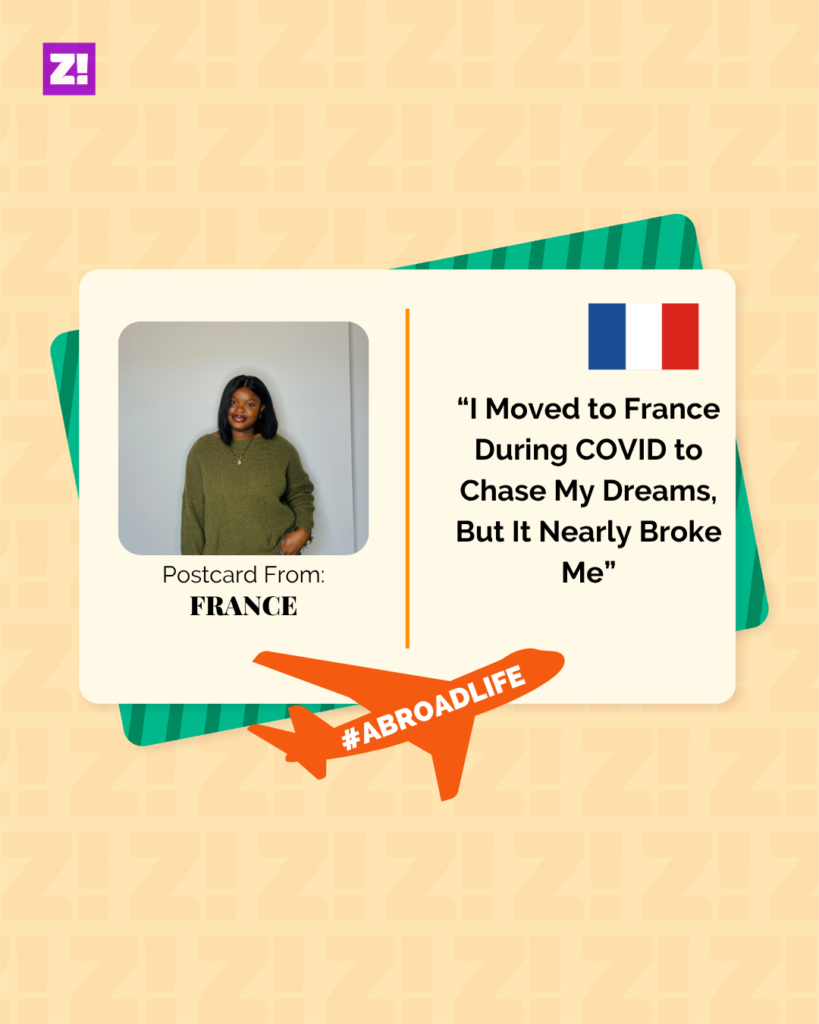
When Phoebe* (28) got her heart broken by the partner she thought she would build her future with, she fell into depression and knew it was time to seek a fresh start. In pursuit of new beginnings, she moved to France through a shady scholarship that ended up becoming her new source of anxiety and tears.
Where do you live, and when did you move out of Nigeria?
I presently live in France, and I moved here in August 2024
Why France?
I had been trying to relocate via the study route to the United Kingdom (UK), but it never worked out because of financial constraints. In 2023, I started trying other European countries because they seemed cheaper and eventually settled for France.
How did that happen?
One day, I was scrolling through Twitter and stumbled upon a French scholarship. The comments under the post suggested it was a scam, but that didn’t stop me from clicking on the link and applying anyway. I turned in that application in December 2023. Then, sometime in June 2024, I got an email informing me I was being considered for the next stage of the scholarship. I had totally forgotten about the scholarship, but when that email came in, I started praying to make it through the interview stage.
A few days later, I got the scholarship, and it was as full as they come. It covered my flight, tuition, and everything else. I told a few family members that I was moving, but I didn’t tell others until I arrived in France. On getting there, I received one of the biggest surprises of my life.
Get More Zikoko Goodness in Your Mail
Subscribe to our newsletters and never miss any of the action
What happened?
It turned out the scholarship didn’t cover my tuition fee of €3500. At the time, its naira equivalent was about ₦6 million, and the school required that it be paid in full. The scholarship only covered another kind of fee, which wasn’t related to the main school fees.
I reached out to the scholarship program coordinator, and she sent me a very harsh message, saying I would have to return to Nigeria if I couldn’t pay the money before the 14th of September; it was already the end of August then.
Oh my God, that’s horrible
It made me seek help from the family members I initially kept in the dark about my relocation to France Every member of my family contributed, and we somehow managed to raise the money by the deadline.
It was horrible, but in a way, it was also a blessing in disguise: the scholarship kept its word and paid for my flight and everything else. If they hadn’t done that, I wouldn’t have been able to afford to relocate at the time I did. Plus, if I weren’t already in France, it wouldn’t have been easy for people to rally around and crowdfund for me. They probably would have told me to try again next year, but seeing that I was already in France, nobody wanted me to return to Nigeria empty-handed.
I hear that. I hope life is kinder to you now…
I can’t say it’s perfect, but it’s much better than where I came from. I’m still very grateful for how it worked out because I was tired of being in Nigeria. I prayed to God that I needed to leave Nigeria without paying a dime. God didn’t answer the prayer how I wanted, but He answered it anyway.
I’ve been here a few months, but my health has improved. The government pays part of my health insurance. The scholarship helped me to secure accommodation before moving to France, but they don’t cover any subsequent costs. The government is covering half of my rent, andI also get free groceries every week. Is it perfect? No. But is it better than the life I was living in Nigeria? Definitely.
What was your life in Nigeria like, and why was it important to leave?
I was an event decorator and personal shopper. I would often be stuck in the market at 11 pm midnight carrying a heavy load on my head. Sometimes, there would be no sight of taxis or motorcycles on the road, and I’d have to walk to the bus stop. There were times when the stress landed me in the hospital. I was also in a relationship that ended in a bad breakup. We had planned to leave the country and build a life together, so when we broke up, I was in a bad place mentally, and it led to some health complications. I subconsciously started comparing myself to friends who had found love and got married.
On the other hand, I was a personal shopper going through a heartbreak. I fell into depression and started seeking a fresh start. That’s mostly what made me want to leave the country.
Does France feel like that fresh start?
Yes, it does. I have some plans for the future already, and I’m happy that I get the chance to experience world-class education here.
On a scale of one to ten, how happy are you in France
Eight. It would be higher if my family members were here with me. I miss them so much.
Do you want to share your Abroad Life story? Please reach out to me here. For new episodes of Abroad Life, check in every Friday at 12 PM (WAT).
[ad]
The Nigerian experience is physical, emotional, and sometimes international. No one knows it better than our features on #TheAbroadLife, a series where we detail and explore Nigerian experiences while living abroad.
Mide has always wondered what kind of future awaits her as a foreign language student in Nigeria, so when she got the opportunity to move to France during COVID-19 as a teenager, she took it. In this story, she shares how that decision pushed her into depression and changed her life forever.
Where do you live, and when did you move out of Nigeria?
I currently live in France, and I left Nigeria in 2020.
France is an interesting choice
It is, but I studied French at the university, and I minored in German. I saw some of my senior colleagues move to Germany, so I’ve always known Europe was an option because there are more options for me there as a foreign language student.
I’ve always wanted to practice what I learnt in school, even if that meant furthering my education outside the country to perfect it. I planned to go to Europe, study there, and return to work at the French or German embassy in Nigeria.
But my plans changed when someone sent me a French teaching assistant opportunity on WhatsApp. At first, I thought it was fake because people don’t just send opportunities that will change your life to you on a platform like WhatsApp. I thought it was a child trafficking tactic. But I didn’t have anything to lose, so I applied. It was during COVID, but the organisers got the approval to bring everyone chosen for the opportunity to France as long as we could prove that we had gotten tested and vaccinated.
What was it like moving across continents during COVID?
It was scary, even for my parents. I didn’t meet the others selected for the opportunity before I left, so I had to travel alone. I was still a teenager then, so it took a lot for my parents to let me make that decision, but they let me go since my visa was only valid for eight months.
So, how did you end up staying in France?
There were fifteen of us chosen for the opportunity. Most of us returned to Nigeria after our contract expired, but my contract was renewed, so I returned to France. I spent another year as a teaching assistant and decided to pursue my master’s degree because that was the original goal—maybe even get a PhD.
You were doing all of this as a young adult. What was that like for you?
It was a lot, but there were some exciting parts. I was breaking down a lot during my first months here. I was in a small village that barely had black people. Movements were also prohibited because of COVID, so it was depressing. That was my first time experiencing depression. I was grateful that I was living my dream life, but I still couldn’t stop feeling depressed. I appreciate the journey because it has made me stronger now. I’ve gone through some difficult things here that I would never have if I hadn’t built some strength from that experience.
Get More Zikoko Goodness in Your Mail
Subscribe to our newsletters and never miss any of the action
I’m sorry you went through that. I hope life is better now
I’m still figuring it out. But life has gotten better. I have an apartment and some friends. Sometimes, I feel like I haven’t achieved anything, but I’m grateful for where I’m at. Things are never entirely the same when you’re not in your own country.
How so?
Honestly, I don’t even know where to start. For instance, the emotional side is the lack of a real sense of belonging. From the outside, people think I’m doing great. I’ve had people tell me they see me as a role model. Some have even moved to France because they saw my story online, but I’m just like everyone else; I struggle too. I had big dreams: move abroad at a certain age, finish my studies, and build a life. When those dreams keep getting delayed or feel out of reach, it weighs on you.
Another struggle here is that you’re constantly reminded you’re an immigrant, no matter how long you have stayed. You’re reminded that you’ll always be at the bottom of the ladder. It’s frustrating, but returning home is not a solid option either. I studied French, so I don’t have many options if I return home, except probably teaching French in a secondary school. Most of us who study French dream of working at the embassy, but the embassy isn’t recruiting, and even when they are, they often bring in their own people from abroad. You can’t just show up and become an ambassador.
So yeah, going back means starting from scratch. That’s why I’m here, just pushing through.
I’m so sorry. I hope you have friends who are supporting you in this phase
I’m still figuring that part out, to be honest. I still don’t feel like I have a solid group. I’m someone who knows many people. I’m friendly, like to host, and say “come over, let’s hang out,” but I’ve learned that not everyone you call a friend sees you as one.
I used to call people my friends quickly, but over time, I realised I was more like their go-to person. When people need help or information, they remember me, but I’m not really at the top of my mind in terms of emotional connection or friendship. I’ve come to accept that.
I go to church, where I’ve found maybe two or three people I can call friends—people who actually care. Outside of that, I’m part of Nigerian groups in my city; I even organise some of them. But it’s not a big deal because I like being alone.
What were some of the culture shocks you experienced when you first moved to France?
The first was realising that someone could decide not to like you for no reason. And worse, you could greet them, and they wouldn’t respond. It made me sad when I first arrived, mainly because it was during COVID, and I was already feeling isolated. I kept thinking, “Why are people not nice?”
Now that I’ve been here for five years, I can say that there are friendly people in France, but there are also people who are just not nice, and they don’t care. They’ll maintain their nasty attitude, no matter how kind or respectful you are. I had to learn to adjust.
Another shock was the fake smiles. You see people smiling at you on buses, trains, everywhere, but you know it’s not genuine. It used to scare me, but now I do it too.
Another cultural thing that shocked me was how French people are around money. They do not play with money. Even if they invite you for lunch or coffee, always come prepared to pay for yourself. I experienced this on my very first day. My supervisor came to pick me up from the train station.
Before taking me to my apartment, she said she wanted to stop at the store and asked if I wanted to buy anything since it was a weekend.I said yes, thinking I’d just grab a few things for the noodles I brought from Nigeria and planned to cook that night. When we got to the store, she put her groceries down first at the checkout, and I put mine down behind hers. I didn’t even realise I was supposed to use that demarcation tool to separate our items. Next thing I knew, she picked it up herself and told the cashier our payments were separate.
The stuff I picked didn’t even cost up to five euros. I had my cash and wasn’t expecting her to pay, but how she rushed to clarify that she wasn’t paying for my items shocked me. Back home in Nigeria, if my mum was hosting someone who had just arrived, even if she wouldn’t be responsible for their finances long-term, she’d at least try to help them settle in.
That day was a wake-up call. The next day, I had to meet another supervisor at a café, and I carried my money in my purse. Lesson learnt.
LMAO. On a scale of one to ten, how happy are you in France right now?
That’s a tricky one. I don’t want to sound ungrateful and say something like a 1 or 2 and have people say, “Why don’t you just go back home then?” But if I’m being honest, it depends on when you’d ask me.
When I first moved, I’d probably have said 7 or 8, mainly because I missed my family and felt lonely in the middle of nowhere. Later, when I moved to a bigger city, I might’ve said 8.
Considering everything I’ve been through, how much I’ve grown, and all the challenges, I’d say maybe a 5 or 6. I’m grateful for how far I’ve come and for God’s help, but I wouldn’t say I’m at a 10. Not yet.
Do you want to share your Abroad Life story? Please reach out to me here. For new episodes of Abroad Life, check in every Friday at 12 PM (WAT).
[ad]
Someone you know has left or is planning to leave. 1,000 Ways To Japa will speak to real people and explore the infinite number of reasons and paths they use to get to Japa
Stephanie (26) moved to France in 2023 and never looked back. In this story, she shares how Nigerians can study in France for as low as €150 and enjoy other benefits like discounted rents and subsidized cost of living.
Where do you currently live, and when did you move from Nigeria?
I live in France, and I left Nigeria in September 2023.
France is so random. How did that happen?
I moved through the Language Assistance Program. It’s an opportunity for language students with a solid background in French to spend seven months in France teaching French people how to speak English. The program is open to people from different African countries like Kenya, South Africa, and others. Nigeria joined the program in 2020.
Tell me more about this program
Language assistants work hand-in-hand with teachers in French schools. Our job is mainly to assist students by communicating with them in English. It’s not a full-time role since the program only lasts seven months.
How were you able to stay back in France?
I initially applied to renew my contract but later changed my mind because teaching English wasn’t my long-term goal. I wanted something better, so I applied to universities in France. Thankfully, I got accepted into a university where I’m now pursuing a master’s degree.
Congratulations! Can you describe the process of applying to study in France?
First, I wouldn’t recommend the language assistant program as a relocation strategy because it’s short-term and requires a strong background in French, which many Nigerians don’t have. Instead, I recommend applying directly to universities. France offers English-taught programs, and while you can apply to schools on your own, it’s easier to go through Campus France, which acts as an intermediary for students in Nigeria.
To apply, visit the Campus France website, browse the school catalogues, and find the perfect program. If you get admitted, Campus France will help with your visa application process. A lot of people think they can skip Campus France, but French universities aren’t like UK schools, where you can apply independently. At some point, you’ll need to go through Campus France.
Applications typically open between October and December, and most public schools charge around €250 as school fees. You’ll also have to attend a physical interview in Lagos or Abuja, so keep that in mind.
My case was slightly different because I applied through Mon Master, a platform for foreigners already living in France.
What are some perks of studying in France?
Students in France enjoy several benefits, like scholarship opportunities. Financial aid is also provided upon request for students facing financial challenges. The French government also provides housing assistance through a system called Caisse d’Allocation Familiale (CAF), which covers up to half of your rent. You can apply for CAF once school starts; once approved, the government helps pay your rent.
Schorlaship plus rent? Woah!
Yes. Some schools also offer free healthcare. Plus, there are discounts for students, especially for groceries. My friends and I signed up for a grocery store called Esope, where students get major discounts. You can spend just €5 buying a lot of items. However, you can’t spend more than €12 per week, and some items have limits. There’s also Resto du Cœur, which provides free groceries for students who can prove financial hardship. Once approved, you get a card that allows you to collect food once a week.
Get More Zikoko Goodness in Your Mail
Subscribe to our newsletters and never miss any of the action
How different is the French education system compared to Nigeria?
It’s very different. I attended a federal university in Nigeria, and we barely had access to projectors. Here, all classes are taught with projectors—it’s the standard. Most students use their computers in class, downloading notes instead of writing them down in actual books. The academic calendar is also much faster than in Nigeria.
Let’s break down the costs for Nigerians interested in studying in France.
Public university tuition in France is relatively cheap. Undergraduate programs cost around €150 per year, while master’s programs, which typically last two years, cost €250 annually. However, if you’re coming from Nigeria, you need to prove you have enough funds to support yourself. The French authorities usually require proof of at least €6,000 in your account for your first year.
Securing accommodation from Nigeria can also be tricky. If you have a friend in France, it’s best to ask them to help you sort this out. Otherwise, you might need to book an Airbnb for a month and explain in your visa application that you’ll find permanent housing upon arrival. Showing proof of accommodation is so crucial for visa approval that not having it could lead to rejection.
Is life in France as fancy as it sounds?
It can be, especially in Paris, where there are many English speakers. Paris is not the only cool place in France. The country has other beautiful cities that international students often overlook, like Lille and Strasbourg. Unfortunately, I spent my first year in a small city where most people were either very old or really young, so I barely had friends my age. It was boring.
Has anything surprised you since moving to France?
Oh yes! French people are very open—they have no problem asking personal questions within minutes of meeting you. They’re also very sporty. I learned how to ride a bike here because everyone seems to use bikes for transportation. When I was still a language assistant, I used to ride my bike to school.
Another culture shock is kissing. French people love to kiss on the cheek as a greeting, even to people they’re meeting for the first time. I’m still not a fan because I never know which side to go for, and I’m always scared of accidentally kissing someone on the lips instead of the cheek.
Also, your classmates are just your classmates. In Nigeria, you can make solid friendships in class, but here, people rarely hang out outside school. You can talk in class, but if you see them outside, they might act like they don’t know you. They also won’t invite you to anything social.
LMAO. How hard is it for monolingual Nigerians to fit into the French community?
I know a few Nigerians who don’t speak French, and they survive using Google Translate. It’s possible to figure things out. You can also register for French classes as soon as you arrive.
Have you made friends with other Nigerians in France?
Yes! It was easy for me because I started as an assistant and met other Nigerian assistants. Some of them stayed back, and we maintained our friendships. Luckily, some even got into the same school as me, so we stuck with each other. As I mentioned earlier, French students aren’t very open to friendships outside class, so having Nigerian friends has been a lifesaver. I hope to make more French friends in the future, though.
On a scale of 1 to 10, how happy are you in France?
I’d say a 7. It could be higher, but the administrative process here is frustrating. Whether it’s renewing your visa or job hunting, there’s a high chance you’ll get stressed out dealing with the French process of getting things done.
Want to to share your japa story? Please reach out to me here.
[ad]
The Nigerian experience is physical, emotional, and sometimes international. No one knows it better than our features on #TheAbroadLife, a series where we detail and explore Nigerian experiences while living abroad.
Today’s subject on #AbroadLife is the main character in a tale of three countries. After deciding to study abroad nine years ago, he was finally able to in 2021. He talks about being the only black person in an English town, having a fun time living in Greece, and dealing with the language barrier in France.
Where are you right now?
I’m in Nantes, France.
How did you get there?
I got an Erasmus Mundi scholarship to study for my Master’s degree in Europe, and it’s taken me through three countries so far. It’s a joint Master’s degree programme and it’s administered by three universities in three different countries, with full tuition paid.
Wild. When did you decide to leave Nigeria?
In 2013. I got into a federal university in 2012 and was admitted to study Fishery and Aquaculture. I wanted medicine, but that’s what they offered me instead. So, I spent my first year trying to be serious and get good enough grades to help me cross into Pharmacy at the very least.
I didn’t know anything about scholarships at the time. The people who ran printing centres in school would come to class and tell us to apply for scholarships. But I always thought it was a scam just to collect the ₦1,000 registration fee.
The following year, I started seeing my friends get some of the popular scholarships at the time; MTN, NNPC, Agbami, etc. These people didn’t have grades as good as mine, but they still got scholarships worth around ₦100,000 to ₦200,000 every year.
That’s when it really hit me that scholarships were a thing. I made the decision that I would get a scholarship to study abroad for my Master’s degree. The first reason was that I wanted to become an expert in my field, and the second reason was that I knew I could do it. I started researching and documenting things in my final year.
When did you start applying for scholarships?
In 2019, during my NYSC in Akure. I applied for two scholarships in the Netherlands and the UK. I was actually hopeful because my grades were stellar, but I was served breakfast on both sides.
LMAO. What did you do next?
I got a job upon completion of my NYSC, and I started thinking about ditching my scholarship dream because I was making enough money from it. On the other hand, I had nothing to lose if I didn’t get a scholarship, so I decided to try again. The only difference was, my motivation wasn’t as high as it was before. Money can distract you from your dreams, to be honest.
The next year, during COVID, I applied for two more scholarships. One of them was the Commonwealth scholarship administered by the UK government, and it was the one I eventually got. I was selected to get funding to study in the UK, but sadly, it didn’t happen then.
Why?
Because of all the economic damage COVID caused, the UK government decided to cut funding for that year. So, I received an email saying I still had my scholarship, but I’d have to defer my scholarship till the next year. The following year, I reapplied for the other scholarship that rejected me. This time, I was successful. Now, I had two scholarships and could weigh my options.
The commonwealth scholarship offered me full funding to study in the UK for a year, after which I must return to Nigeria to develop it. But the other scholarship didn’t have that clause. Even better, it was for a joint Master’s programme to be administered by three schools in different countries: Scotland, Greece and France. This meant I’d get to see more of Europe. I chose the second scholarship and started the process of migrating.
What was the process like?
Even though it was my first time leaving Nigeria, I found the process pretty easy. I got a letter from the scholarship office stating that the scholarship would cover 100% of the tuition and a monthly stipend. I didn’t have to worry about providing proof of funds and other things like that. I was granted a visa within three weeks of applying, and I moved to the UK in September 2021.
Walk me through your journey across Europe
I arrived in London first. COVID was still on at the time, so I couldn’t move to Scotland immediately, and my classes were online. I had many friends in the UK already, so I stayed with one of them. I was there for about three months before I moved to a town called Oban in Scotland.
I expected the UK to be cold, and it was. I expected it to be beautiful; it also was. But my God, the apartments are tiny! My room was smaller than my room back in Nigeria, and I had to pay £450 every month in rent, my yearly rent back in Nigeria.
To make things worse, I had to share a kitchen with other people in the building. So all I really had to myself was a room and toilet. And the buildings weren’t so modern because they try to preserve their architectural history. To top it all up, I was the only black person in the town.
Wait, what?
It’s a really small town. If there were any other black person there, I’m very sure I’d have met them at some point. But I never saw any other black person throughout my stay.
It wasn’t weird at all though. The people were very welcoming, and I’d sometimes go to bars and get them to play afrobeats. They loved it. I had a good time, but I only spent three months there before I had to move to Greece for the next part of my programme.
What was Greece like?
Honestly, Greece is like Nigeria Pro Max. When I got there, I thought, “Did they bring me to Lagos by mistake?” People were blaring horns so loudly, and no one respected zebra crossings. It was giving Ojuelegba-level chaos.
One time, I tried to use a zebra crossing, thinking the cars would wait for me the way they would in the UK. Come and see swerving. I was the one dodging cars. At that point, I knew I’d found Nigeria’s twin. It’s a very interesting country and naturally beautiful too sha.
I lived in a city called Heraklion, and it has a beautiful landscape, beautiful beaches and many historic sites. Things were also cheaper in Greece than in the UK. Their economy was worse, which meant the stipend I was getting translated into a lot more cash for me. The buildings were not that pretty, and you could tell the country was battling sapa at the time.
Tell me about the people
The people in Greece are friendlier and more laid back than those in the UK. Back in London, everyone was about their hustle and didn’t really give a shit about you. But no one knows how to have fun as much as the Greeks.
About 70% of the people in Greece speak English, so I could get by very well in social circles without knowing any Greek. The families are bigger because they don’t migrate very often.
How long were you there for?
Six months, before having to move to Nantes in September.
Where?
Nantes, in France. It’s a student city, so I met more people from different parts of the world there. For the first time since London, I saw a lot of black people. It’s a lot like the UK actually. But the main difference is language. One annoying thing is how snobbish French people are about their language. It’s almost as if they have a long-standing beef with English speakers.
The first thing I learnt to say in French was, “I don’t know how to speak French”. The whole point was to get the person to speak English with me, but nine out of ten times, their countenance would change the minute I said it. French people aren’t as friendly as the Greeks, but they’re even less friendly if you don’t speak French. They’ll say they can’t speak English and air you, even when they actually can.
It’s so bad that even in the hospitals, the doctors only talk to you in French. The country is also very bureaucratic; there’s a lot of unnecessary paperwork you have to deal with, and they’re all in French. Emails from the authorities come in French, and when you call to ask for clarity, they’ll speak French. So, language is a real social barrier for me here. The lucky thing in all of this is that my classes are in English. If not, I’d be in trouble.
How are you dealing with it?
I’m currently learning French sha, so these people can stop airing me anyhow. I have French classes twice a week, and it’s helping. The good part is my coursework across the countries has been in English, so language isn’t affecting my studies in any way.
What do you love about France?
First of all, it’s very multicultural. In the other countries, the diversity came from the people in my own class. But we’ve been the same people moving together from place to place for the past year. In Nantes, there are people from all over the world. One time, I went to a church and saw so many black people, I thought I was back in Benin, Nigeria.
Another thing I love is the fact that it’s a welfarist state. The government cares about the people who don’t earn very much. My stipend is around €1,000 per month. But because I’m a student, I get up to 60% off my €450 rent, financed by the French government. The same goes for food and a bunch of other things I need to stay alive.
And what’s school been like so far?
Moving from school to school across different countries is very tough. Not only is the system of education different from Nigeria, but each country has a different system of their own. In the UK, we didn’t have proper exams; we wrote essays that would count towards the assessment grade. Most of my classes were online, and there’s only so much one can learn without being in a classroom. In Greece, I had proper exams and the classes were in-person. It was a better learning environment for me as I could interact directly with my classmates and ask questions in class. I’d say my semester in Greece has been the easiest so far.
France basically combines everything. Essays, exams, assignments, field trips, you name it. We do everything.
So, where will you go from here?
Back to Greece to finish my programme. It’s a two-year master’s programme. I did the first semester of my first year in the UK and the second one in Greece. The third one is what I’m currently doing, and the last will be in Greece. I can’t wait to leave the stress of this place and get back to my second Nigeria.
LMAO. Your love for that place is really something
Yes. It’s like Nigeria but with constant light.
Hey there! My name is Sheriff and I’m the writer of Abroad Life. If you’re a Nigerian and you live or have lived abroad, I would love to talk to you about what that experience feels like and feature you on Abroad Life. All you need to do is fill out this short form, and I’ll be in contact.
The Nigerian experience is physical, emotional, and sometimes international. No one knows it better than our features on #TheAbroadLife, a series where we detail and explore Nigerian experiences while living abroad.
Today’s subject on Abroad Life talks about how her love for French from a young age helped her decision to move to France 8 years ago. She talks about the culture shock she experienced her first few months there, how the French society is classist and the similarities between the French and Nigerians.
When did you leave Nigeria?
I left Nigeria in 2013. I moved straight to France.
Why France?
My relationship with French grew over the years. I remember being interested in the language straight from primary school even though it was just “Bonjour” and “Ça va”. In secondary school, I was one of the few people that chose French as my elective. Though I didn’t really like my French teacher, we used a projector and had media elements like music and movies, so the classes were less boring. I became more interested in the language over time and started summer lessons.
I never really thought about moving to France.
What changed?
I worked in a telecommunications company shortly before I left Nigeria, and we had some clients in Brazzaville. Everyone knew I could speak French to some extent so when we had to send a representative for a two-month program, they sent me. When I was there, I realised that my knowledge of French was better than I’d imagined and decided to move to France for my masters in telecommunications. The culture shock when I did move was… well, shocking.
How so?
My expectations of “abroad” were the things I’d seen on TV about the UK and America, so I expected lights and loud noises and bling-bling everywhere. I was wrong. I moved to Paris, and once I got past the awe of the Eiffel Tower and all the other stuff and settled in, I realised that the French are classy. No loud colours or over-energetic scenes, just people going about their business.
How was settling in?
It was hard. It took me a few months to transition from my expectations to my reality. Learning things about the new culture was tough. For example, in Nigeria, you go to a bank and someone attends to you. Even if they’re not solving your problems immediately, they’re making you feel important because you’re a customer. Here, you get to a bank and they tell you to book an appointment with your account manager before you can be attended to. If you don’t know who your account manager is, they’ll tell you to book an appointment on the website to find out who your account manager is.
Here, the customer isn’t king. The service provider is king and the customer adjusts to whatever they do.
In restaurants, they take their sweet time. You can’t go to a French restaurant and expect to get food quickly like you would in a Nigerian restaurant. And you have to wait. If you complain, you could be asked to leave.
Ouch…
All of these new experiences helped me understand that I was seeing the entire world through the same lenses. I had to quickly learn that different countries have their different behaviours, cultures and accepted ways of doing things. I couldn’t say “Oh, this is how Europeans behave.” or “This is how Africans behave.”
Was it easy for you to integrate into society after your master’s?
After my master’s, I had to quickly unlearn the Nigerian “go-getter” attitude. People don’t want you to be in their faces, introducing yourself, throwing around your CV and putting yourself out there. You have to do things subtly. They’re not even friendly with people they don’t know in the first place, so you have to build their trust.
What did that mean for you in the job market?
It wouldn’t have changed much because there’s already a system in place that decides the types of jobs you get based on the school you went to. In France, the school you go to and the course you study are two major important things that every employer takes into consideration.
No matter how skilled you are in a field, if you don’t have a university degree in that field, nobody will hire you. If you like, show them all the amazing things you’ve done, they’ll ask for your CV that shows you got a university degree in that field. If you can’t provide one, you’re wasting your time.
Wow.
That’s not even the most interesting part. In whatever industry you are, there are top three to five schools that are recognised. What this means is that if you didn’t go to one of the top five schools that offers your course, you probably won’t get a good-paying job.
What?
It’s a society run very largely on classism. Everybody already knows where they stand based on the school they went to. So you know that if you went to a top-five school, your salary falls within a specified range. If you went to the next five rated schools, you can’t get jobs in certain places, and it’s impossible to earn a salary as big as the people who went to better schools. These things aren’t probabilities. It’s the official way things are done. Years of working experience in France also count for better pay.
How did that play out for you?
I didn’t go to the top 3 schools overall in the country. However, lucky for me, I went to the top 3 in my field but even at that it was a difficult 3 months looking for an internship.
In the three months when I was searching, I considered a change in career paths but that wasn’t possible as I had to have studied whatever career I wanted in school.
In the end, I got my first job – a compulsory internship when a friend took my CV and dropped it on her boss’ table and told him to hire me. Nepotism is also big in France.
How’s the Nigerian community there?
Although there aren’t as many Nigerians here as there are in Germany and even Spain, the Nigerian community here is growing. When I came here in 2013, I didn’t meet many Nigerians. But now, more of us are choosing France as a study destination. There’s also the older generation of people that do informal jobs like selling stuff like hair extensions.
It’s been eight years since you moved. Are you now a permanent resident?
I’m a citizen. France isn’t big on permanent residency. They’ll give you one-year extensions on some visas, talent visas and 10-year stay visas but not permanent residency. You have to go through a long process to apply for citizenship. I did, and now I’m a French citizen.
What’s the best part about living in France?
The beauty and peace that comes with living in Paris is pretty nice. People have a romantic idea of France about Paris and a lot of it is true. The food? The food is top tier especially the pastries. I’m at the point in my life where I can’t imagine living without access to a nice croissant or a nice baguette.
What about the people?
I think the French are very similar to Nigerians. Hearing their H-factor makes me laugh. It just jumps out.
Another thing is respect culture. The way some Nigerian languages have words that indicate that you’re speaking to someone older than you, French has the same, and the French take it very seriously. They demand respect for both age and class difference.
The French are also very proud of their country. You hear them complain about the government and the country all day every day, but the day someone from outside tries to trash-talk them, they’ll attack the person. It’s the same way Nigerians always complain about Nigeria until someone from another country says the same thing.
Is there anything you don’t like about living in France?
There’s a lot of pretences especially with issues like racism. People say, “You can’t say ‘Blacks’” or ‘Asians’, just address everyone as human”, but there’s a lot of lowkey racism that goes on.
I don’t like that people don’t have room to diversify; they can only stay in career paths they’ve chosen. It makes us feel like robots.
People say Paris is the capital of love and sex. Is that true?
Omo, there are streets where you see rows and rows of sex shops– both shops that sell sex toys and shops where “things” go down. The French are very romantic and sensual. Even in French movies, the sex scenes are much more real than in American movies.
It was in France I first saw a gay couple expressly displaying love. The Nigerian in me was shocked, but I soon realised that things like that are normal here.
What’s your social life like?
I like experiencing things, so I go to museums, exhibitions and all that kind of stuff. Sometimes, I go to restaurants and theatres. The highlight of my social life in France was when Falz came here to perform, and because my friend was close to him, we all went out after his show. It was fun club-hopping and having a nice time. Falz is a fun guy.
Must be nice. What’s one French experience you can’t forget?
The day the Notre-Dame cathedral caught fire. I was headed to the metro station when I saw the smoke. Everyone thought it was a terrorist attack but then we started hearing some banging. We ran towards the sound and when people saw that it was the Notre-Dame on fire, they threw themselves on the floor and wept. It was so painful to see. For me, it was a tourist attraction that had caught fire, but it was much deeper for them. We stood there for a couple of hours and just watched. It was truly heartbreaking.
Want more Abroad Life? Check in every Friday at 9 A.M. (WAT) for a new episode. Until then, read every story of the series here.
We can all say that Croatia played the game of their lives against France. But the thing about football is this;
If you like play with your heart and soul, if the ball doesn’t enter the post, there’s no point.
So, Croatia might have played a great game, but France scored more goals. Now, what I have to say might sound a bit wild.
But I want to point out the fact that France didn’t really win the World Cup.
When half of your team consists of Africans, who does the cup really go to? Be honest o.
Africa? Yes! Africa. All of us.
I could decide to give an analysis of every single African player on that team.
But we are going to sleep here. I promise you.
The most important thing you need to know is that from Mbappe to Pogba to Kante and Lemar, Mendy, Matuidi, Rami, Umtiti, Mendy, N’zozi, and many others are all Africans.
Infact, Lemar is half Nigerian. I’m so emotional right now
So we can also say that somehow, Nigeria won this Cup too.
Oh, I’m so proud to be Nigerian.
Infact I’m sure if we dig deep, we would find out that Pelé has African genes somewhere somehow.
Just think about this, what is Pele in Yoruba? I won’t say more than that.
Let me tell you the bitter truth, it’s okay to disagree. But just know that almost every legend in the history of legends comes from some part of Africa.
I can start mentioning names, but I don’t want us to divert.
Let’s place our focus on what is important for today. Africa borrowed France the World Cup.
Not only are we skilled, we are also generous. Wow. A whole continent.
On a serious note, whether we like it or not, Qatar 2022, Nigeria is bringing that cup home. I’m saying it with my chest.
Okay maybe just half of my chest.
I think before we end this, it’s important that we congratulate France properly.
So dear France, congratulations. You have done well.
But if you actually think Africa deserves all the accolades raise your hand.
Now let us know your reason below.
1. Visit the queen
Do we even have to tell you this?
2. Feed the pigeons in Trafalgar Square
Do it for world peace, sir.
3. Take a train to Paris and go to Disneyland
Age is just a number, no one is too old for Disneyland, please.
4. Marry an English wife for papers
So you can escape the wahala that is Nigeria, forever!
5. Go for a short internship with the English parliament to see how things actually get done
Since we’re all being childish.
6. Go to Oxford Street and do shopping for all of us
All I want is a fine handbag, please and thank you sir.
7. He shouldn’t forget to go out and catch some good old British fun
Don’t let your aides keep you inside the house to be eating jollof.
8. Enter the buses and trains and let’s compare notes with the rubbish we’re doing here
Shebi you too can see the difference?
9. Watch plenty TV before he comes back and NEPA starts showing him pepper
They don’t care if you’re president or not o, you will still use generator.
10. Not worry too much about us
In fact, if you like don’t come back sir. VP is taking care off us. Kisses!
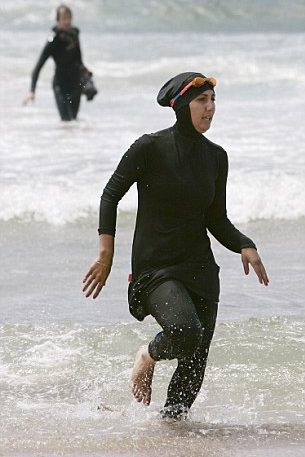
In the light of the terror attacks that have plagued France in 2016, the French government decided that banning a piece of clothing, the Burkini, is the most brilliant way to end terrorism in the country.
On August 23, some armed police officers in France went as far as making a Muslim woman take her clothes off which resembled a Burkini, while she was on the beach with her little son.