• Before my mother passed away, I thought I understood what it meant to be the eldest daughter: extra chores, keeping my younger siblings in line, and generally being more responsible. My immediate younger sisters were just a year and three years younger than me, so in some ways, we shared the load. But the day they told us she was gone, everything shifted. The adults said, “You have to be strong now. You’re the mother.”

    At her funeral, I wasn’t allowed to cry. Aunties and Uncles pressed my shoulders and whispered, “If you break down, what will your siblings do?” From then on, people stopped asking how I was and started asking, “How are the children?” as if they were mine. My mum’s best friend once pulled me aside to ask what would happen to our youngest, who was only five at the time, if I left the country for university. I was sixteen.

    That was when I learned that being the eldest daughter wasn’t just about responsibility; it was about always being the one to swallow the difficult pill quietly.

    Across Nigerian homes, the first daughter is often given a title before she even knows she has a choice. At birth, we are seen as ‘second mother’. We are Ada. Ìyá Kéjì. Adiaha. The name is different for each tribe, but the cultural role and expectations remain the same. We are caretakers, peacekeepers, and even guinea pigs, long before we understand what any of it will cost.

    Globally, studies show that eldest daughters experience higher levels of anxiety, burnout, and guilt than their siblings (University of Bath study). In Nigeria, where caregiving is deeply gendered, that pressure often starts in childhood.

    “Being the eldest daughter felt like being a lab rat: trial and error, but mostly error.” – Chiamaka, 22.

    From a young age, we learn that to be loved by others, we must serve. That our worth is tied to how much we can carry. We manage chores, raise siblings, absorb our parents’ emotions, and hold the family together, very often at the cost of our own needs. 

    For 29-year-old Ernest from Abuja, she was automatically the second parent. “There were so many responsibilities and standards that I don’t think I even had formative years. I just became an adult overnight and never stopped.”

    But increasingly, eldest daughters are breaking their silence. We’re no longer talking about exhaustion alone, but the resentment and rage that quickly follow. And beneath that rage: grief for the childhood many of us never had, and the women we were never allowed to become.
    The Invisible Labour 

    The weight that first daughters carry starts early. Sometimes, before memory even forms.

    When Godsgift was seven, she and her siblings were locked in their family’s face-me-I-face-you apartment while her parents were away. The banging on doors, the shouting, it was chaos. She had a baby sibling, not even a year old, crying from all the noise, and another sibling just as frightened as she was.

    ‘I don’t know how, but I remember acting like I was their mother and ignoring my own fears,’ she says, now 20.

    That moment, a seven-year-old girl pushing down her terror to comfort others, is the eldest daughter’s experience refined to its purest form. You learn early that your fear comes second. That someone has to hold it together, and that someone is always you.

    Oiza, 25, remembers it too: “It was so tiring. It’s like being the small mummy of the house. In our home, the girls were literally the slaves of the boys. We would be woken up earlier than they are, cook for them, and do almost everything for them. Yet anything that goes wrong, you get yelled at.”

    Her words echo across other eldest daughters’ lives, like 25-year-old Dani, who says,  “From day one, I had heavy responsibilities. I raised cousins as well as my siblings because I was also the first grandchild. I lost my identity in the process.”

    The Perfectionism Trap

    Over time, the pressure calcifies into something harder to name. Every choice is scrutinised, every action sets a precedent for everyone watching. And when you’re never allowed to fail, you stop trying to be good. You become obsessed with being perfect.

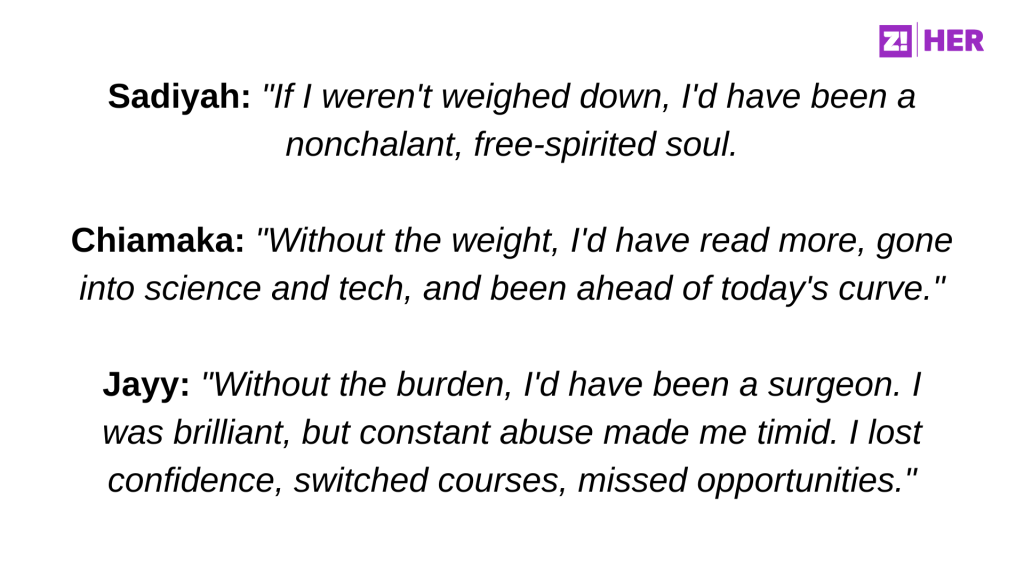
    Sadiyah, 21, from Kaduna, knows this intimately. “I never had the chance to just be myself or do the things I loved, because my family always had to come first. Every decision I made was filtered through: ‘Will my parents be proud? Will my siblings still respect me?’ The pressure turned me into a toxic perfectionist; the typical ‘serious, perfect daughter.’”

    “I sacrificed my childhood. Every action was branded ‘responsibility.’ It’s probably why I’m so reclusive now. I resent my family a lot, especially because my siblings get more grace than me. I was a serial bed wetter as a child, and my parents used that to vent their frustrations. I still remember my father beating me with a huge stick, calling me filth, telling me I’d live in shame forever. 

    My siblings now do the same things I was punished for, but they’re excused. Later, I found out bedwetting was hereditary. They knew. My mum was also a first daughter. She tells me how lucky I am that my father isn’t as abusive as hers was, but she trauma dumps on me the same way,” adds Chiamaka.

    According to clinical psychologist and founder of Ndidi Mental Health Clinic, Amanda Iheme, this perfectionism is engineered through one of Nigerian parenting’s most effective weapons: guilt.

    But for eldest daughters, the guilt is amplified tenfold. “Anything your siblings do is your fault,” Amanda explains. “You are the first child. You’re supposed to do this and that. There’s a lot of ‘you should have, you’re supposed to,’ and very negative experiences follow.

    The conditioning is relentless. Nigerian parents, Amanda notes, struggle to manage their own emotions, so they project them onto their children, especially their first daughters. They make them responsible for everyone’s emotional state.

    “When you are responsible for your parents’ emotions, responsible for your siblings’ emotions, responsible for the day-to-day operation in the house, you’re going to feel a sense of guilt that if you don’t do what you’re supposed to do, things are going to fall apart,” Amanda says.

    “When your being is tied to responsibility, if you’re not responsible, you’re not going to feel worthy,” Amanda explains. “My worth is very much tied to my capacity to do this. So if I don’t do this, then who am I?”

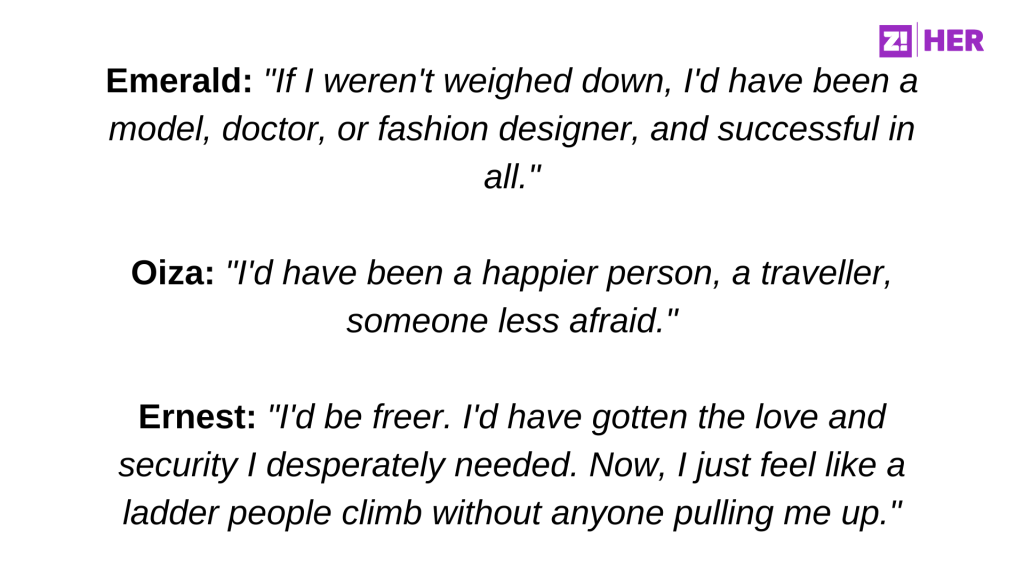
    That question—who am I without this burden?—haunts eldest daughters well into adulthood. And the burden only grows heavier.

    Get More Zikoko Goodness in Your Mail

    Subscribe to our newsletters and never miss any of the action

    What She Said: I’m the Eldest Daughter Who Chose Herself, and I Make No Apologies


    Childhood conditioning is one thing, but adulthood is where the weight becomes unbearable. Now we’re paying black tax, pausing our own dreams, watching our bank accounts drain while our efforts go unacknowledged. Somewhere between the forgotten sacrifices and being taken for granted, something breaks.

    The Financial Drain

    For 25-year-old Oiza in Abuja, that breaking point came on an ordinary night: “I was sending money home while still in school. I even took loans and overdrafts just to cover bills. I remember restocking the house one day and still being told by my mum that all I’d achieved was giving her access to paid TV subscriptions. Something broke in me that night.”

    The financial burden starts early and never really stops. Oiza’s story isn’t unique; it’s the norm.

    Jayy, 30, remembers her NYSC year with bitter clarity. On a ₦19,800 monthly allowance, she made sure one sibling got into university. Later, earning less than ₦100,000, she somehow put two more siblings through school. When she mentions this now, her parents insist it was her duty. “My parents only sponsored three out of six of us to university. The rest were left as “my responsibility.”

    For 25-year-old Blessing in Osun State, the pattern is suffocating. “I’ve had to sacrifice my money for the family’s financial issues. It’s like I’m working for them. The moment I don’t have, I get subtle insults. The moment I have, you are the most amazing child again. I’ve wanted skincare for years now, but have never been able to buy it because of this family.”

    It’s not just the money. It is the way their own needs become luxuries they can’t afford. It’s wondering when, if ever, it will end.

    Manuella*, 27, remembers being blamed for an ICT error during her sister’s school registration, something completely outside her control. Her sister humiliated her, exaggerated the story at home, and their mother called her wicked. “No apology came even after my dad discovered it wasn’t my fault.”

    The cruelty isn’t always loud. Sometimes it’s quiet and insidious, the assumption that if something went wrong, the eldest daughter must have failed somehow. 

    The Snapping Point

    Eventually, something has to give.

    For 32-year-old Deborah in Ilorin, this year was that moment. “I snapped. I lashed out at my parents and cut them off. I only speak to my siblings now.”

    Tife*, 23, in Lagos, carries a different kind of scar. When her younger sister stole money, everyone assumed it was her. She was punished for weeks until her sister finally confessed, years later. The apology never came, but the memory remains.

    The resentment doesn’t just come from the sacrifices themselves. It comes from the invisibility, the way our efforts are forgotten, minimised, or worse, expected. It comes from being punished for things we didn’t do, blamed for outcomes we couldn’t control, and told we’re selfish the moment we hesitate to give more.

    But here’s the question that haunts many of us: if we know this is destroying us, why can’t we just walk away?

    “If your identity and your worth are built on your capacity to help, and someone is saying that you should drop that… It then says, Okay, if I’m not this person, if I’m not helping all these people, if I’m not saving all these, then who am I?” Amanda explains.

    It’s not just about breaking a habit. It’s about confronting an existential question that has no easy answer.

    And even when first daughters recognise the dysfunction, even when we see how much it’s costing us, we often return to the same patterns. Amanda says this isn’t a weakness, it’s human nature.

    “We will always go back to what is familiar, even if it’s painful, because in familiarity we have control. In familiarity, we can predict what is about to happen.”

    The guilt is familiar. The burden is predictable. Freedom? That’s terrifying.

    And when you dig deeper, you find this isn’t just one generation’s story. It’s a cycle passed down like an heirloom no one asked for.

    The Generational Cycle

    Dani, 25, sees it clearly now: “I see the same cycle in my mum and grandma, what I call the ‘Messiah complex,’ the need to carry everyone’s burdens, even outsiders.”

    Mother to Daughter

    Oiza looks at her mother and sees her grandmother’s shadow. “She reminds me of my grandma, neglectful and manipulative, even though she once swore not to repeat those cycles.”

    Chiamaka’s mother was also a first daughter. Instead of shielding her daughter from what she endured, she uses it as a measuring stick. “My mum was also a first daughter. She tells me how lucky I am that my father isn’t as abusive as hers was, but she trauma dumps on me the same way.”

    The first daughter role doesn’t always go to the biological first daughter. Sometimes, it goes to whoever is willing or forced to carry it.

    Emmanuella, technically the second daughter, stepped into the role when her older sister couldn’t. “My mum was also the second daughter who filled eldest duties, and she still carries her siblings’ burdens.” The weight doesn’t retire. It doesn’t age out. It just keeps going.

    It’s presented as an honour. As duty. As what good daughters do. And so it continues.

    The Darker Side: Abuse & Punishment

    Chiamaka was a serial bedwetter as a child and was brutally punished for something she later learned was hereditary and that her parents knew.

    Jayy carries a memory that still makes her voice shake. At nine years old, her mother rubbed ground pepper in her vagina as punishment. Her mother starved them often, always positioning herself as “God’s favourite” while destroying their childhood.

    And then there’s Emerald*, 26, whose words are so incredibly sad: “I sacrificed my childhood, my virginity (I was raped coming back from work), my sanity, and what was left. If I could come back again, I’d never be an eldest daughter.”
    Breaking the Cycle

    The problem, Amanda explains, is that this burden isn’t seen as trauma; it’s seen as a “right of passage,” a thing of honour. “If we already have a whole system that celebrates that sense of responsibility… it would be very difficult.”

    We’re talking about dismantling a cultural expectation woven into Nigerian families.

    If change is going to happen, it has to start with parents. And the first thing they need to understand is this: “Your first children are not your assistant parents. They can support you with siblings, but it doesn’t have to be seen as a responsibility where the child feels like, ‘Mommy and daddy won’t love me if I’m not doing this.”

    Amanda emphasises another critical point: “Just because your kid comes across as self-sufficient does not mean they’ve stopped being children. They still need someone to tuck them in at night. They still want to be hugged and told that they’re beautiful.”
    The Path to Healing

    So what about the eldest daughters living this reality right now? What does healing look like when you’re already in the thick of it?

    Start Small

    Amanda’s advice is simple: “Start small. Start taking care of yourself first and doing the self-awareness work to know yourself.”

    She recommends a 30-day self-love exercise—just 30 days where you only think about yourself. “For first daughters, one of the things you have to do is recognise you have a self first that you can return to because that is the thing that you lose as a first child, that awareness of self. Oh my god, I’m actually a person. I exist.”

    Learn to Sit with Guilt

    But self-awareness alone isn’t enough. The real work comes in learning to tolerate the discomfort of saying no.

    “Simply because she’s able to manage the emotional complexities of her home life does not mean that she’s capable and skilled at doing the same thing for herself,” Amanda explains.

    The work involves learning to say no and sitting with uncomfortable emotions, especially guilt, without doing anything about them. Then make decisions that benefit you while you’re going through that discomfort.

    Deborah, who cut off her parents this year, says she’s finally sleeping through the night. Emmanuella, who moved out, describes it as “the first time I could breathe.” The healing isn’t linear, and it’s not easy. But it’s possible.

    When Everything Must Burn

    And then Amanda offers her most radical advice, the kind that might terrify as much as it liberates:

    “There will be a time when what is required of you to truly free yourself is to let everything burn. When that time comes, even if it burns your own life, let it. What it does is that it just lays everything out in the open. Do not hesitate. If you hesitate, you only keep yourself in prison.”

    “This time around, it’s not the prison of your parents’ construction. It’s the prison of your own making.”


    When Amanda is asked what she wishes African parents knew about first daughters, her answer is immediate: “Just leave us alone.”

    She expands on it, and the emotion in her voice is unmistakable. “There’s just so much… the weight of the expectations of your parents and others… I wish I didn’t have to go through the experience of having to shed that. I wish I were in a place where I could just be and whatever it was that I was choosing to be, my parents would just understand that it is just the experience of life.”

    The desire isn’t complicated. It’s not about abandonment or rejection. It’s about space. Room to breathe. Permission to exist without the constant weight of expectation.

    And then she names something crucial: “Our parents want our lives to look a certain way, but it’s not because it’s what makes us happy, it’s because it’s what makes them happy.”

    The eldest daughter’s life becomes a stage for the parents’ unfulfilled dreams. And that’s not love. That’s projection.

    “Just because I care about my siblings and I look after them does not mean that it has now become a responsibility. Why can’t it just be what it simply is? I’m just doing it because I’m a fucking human being, and it can be reciprocated. Why does it have to be something I have to take on, as my life purpose and duty?”

    That’s what we want: To be seen as individuals. To have our care recognised as an act of love, not a burdensome duty. To be released from the expectation that our existence is only valuable insofar as it serves others. We want to be loved for who we are, not for what we can do.

    And we want people to stop assuming we have it all together.

    “That we have it all figured out. We don’t. That we always have money. We don’t. That we always make the right decisions. We don’t. That we know everything. We don’t. That we’re perfect. We’re not. That we don’t have feelings. We do. We can be vulnerable. We are.”

    “We’re just girls, you know, who are scared.”


    Click here to see what people are saying about this on Instagram.
  • The pressures placed on first daughters in Nigerian households can be crushing. Whether they are taking over parenting duties or performing hard chores in the home, finding time for themselves can sometimes be difficult.

    We spoke to 5 Nigerian women who are first daughters about what makes them burn out in their families and how they manage it.

     “You’re somehow supposed to take care of your parents and act like a second mum.” — Adebusayo

    What makes you burn out?

    The expectations. Whew. You’re expected to be the golden child, the responsible one, the one who knows better, whether you’re 13 or 30. You’re somehow supposed to be the perfect example for your siblings, take care of your parents (even emotionally), and basically act like a second mum. Then you add black tax on top of that — the financial responsibilities you didn’t sign up for but feel guilty about if you don’t fulfil.

    The pressure to always be available emotionally, mentally, and financially. The black tax is draining, especially when you feel like you can’t even breathe before someone needs something from you. But what really pushes me to burnout is being treated like the deputy parent. Like when my mum calls and says, “Talk to your sibling, they’re misbehaving,” and I’m just like… ma’am, I’m not the parent here. Why is it my job to fix it? Little things like that — stacked on everything else — make you feel stretched too thin.

    What do you do when you’re burned out?

    Honestly? Choosing peace. If I’m not in the mood to talk, I won’t answer calls. If I need space, I take it. I don’t over-explain anymore. I just leave and recharge on my own terms. That might look like ignoring calls from home, saying NO when it’s not convenient for me, or simply delaying the “fix it” until I feel ready. Because if I keep saying yes to everyone else, I’m saying no to myself — and I can’t do that anymore.

    “It’s not by force to become a mini mummy.” — Damilola

    What makes you burn out?

    The idea that I should suddenly know what to do and start taking care of everyone. Like, we’re all living life for the first time — let my siblings figure it out the same way I did. It’s not by force to become a mini mummy.

    What do you do when you’re burned out?

    I sleep. I don’t let it get to me. Nothing special about it. Why should I be worrying unnecessarily? If you ignore everybody, you won’t burn out.


    This content is sponsored by In Bloom, an MTV anthology of short films about gender-related issues women face. Watch “Afefe,” a short film from the anthology, which tackles unpaid labour.


    “You don’t own your life till you’re in your twenties.”  — Bolu

    What makes you burn out?

    When you’re the first daughter and the only daughter, it feels like you’re carrying a lot, in terms of being overprotective and also shouldering the chore. You’re not free. You don’t own your life till you’re in your twenties.

    There are sometimes that you see people — your friends — doing some fun stuff but you don’t have the time to participate in it because you have so much work to do at home. That was how I was living my life for a long time. Even after I went to university, I had to school in Lagos so I could be close to home.

    What do you do when you’re burned out?

    I cry. I talk to my mother about it, but I also can’t tell her everything. I also speak to a friend of mine to just speak, release, because if I don’t talk to anybody about it, I might just crash out.

    “It’s mad, stupid expectations.” — Aaliyah

    What makes you burn out?

    Expectations. It’s mad, stupid expectations. It’s not even the expectations that your parents set for you. It’s the one you set for yourself. It’s very crazy. Like you’re always expected to do really well. That makes you burn out.

    It’s not having anyone to rely on. Your younger siblings have someone to fall back on. You have no one. And you’re doing everything and your parents are trying to use you as test run. And they are not doing it on purpose. You always feel like you have to do it, there is no emplate. 

    What do you do when you’re burned out?

    I create my own space. I spend time with myself alone and I don’t do anything related to work. I just rest or spend bastard money on myself.

    “I keep postponing it and sleeping basically.” — Adebola

    What makes you burn out?

    The fact that I had to be a parent at a young age. The fact that I cannot ask anyone for money because they think I have and they think I should be the one giving them instead. By them, I mean my mom and siblings. The responsibility that comes with it, the fact that you can’t fuck up, and the expectation that you’d have to be the one to lift the family.

    What do you do when you’re burned out?

    I haven’t handled it. I keep postponing it and sleeping basically.


    Get More Zikoko Goodness in Your Mail

    Subscribe to our newsletters and never miss any of the action

    ALSO READ: 7 Nigerian Women on The First Time They Had Their Period and How They Were Treated

    [ad]

  • *Amaka, (26) was content with her role as first daughter to her parents and big sister to her three younger siblings. But after losing both of her parents within a year, she had to learn how to become the head of the house while also protecting her siblings from leeching family members. 

    This is Amaka’s story, as told to Itohan

    When people ask what I define as couple goals, I always think of my parents. They didn’t just love and care for each other, they genuinely liked each other. You could see it in the way they planned our family life.

    After they had me, they waited six years before having  my younger sister. Four years later, they had my second sister, and by the time I was 15, they had my brother, the last born. I remember asking them why they spaced us out so much, and my mum said it was because they wanted to make sure they had enough money, time, and attention to offer each child. When they felt they could handle another child, they went for it. Growing up, they never made decisions alone. You couldn’t get my mum to agree to something if dad had already said no. They were a team in all the ways that mattered. That’s why when my mother fell ill, I knew my dad wouldn’t last long without her. 

    She was diagnosed with ovarian cancer in February of 2022. She had been complaining about stomach pain, and my dad and I kept begging her to go to the hospital. Ever since I was a little girl, my mum had always avoided hospitals; bitter leaf and bitter kola were her go-to remedies for everything. When she eventually decided to get tested, I knew it was really bad. 

    It took several tests before they discovered it was cancer, and by then, it was already advanced. My siblings were so young, and I had to be the one to tell them. My d ad could not mention her name without breaking down. I had to be strong for everyone in the house, including my dad. I had just finished NYSC and was transitioning between careers, all while splitting hospital shifts with my dad. Sometimes, I’d shower in her hospital room because I was heading straight to work. I was stressed, but there was nothing I could do. I was the first child, and I loved my mum. I wished I had someone to talk to. My dad  became a shadow of himself. My younger sister was 18 and in university, the third was still in secondary school, and the last born was in primary school. I felt alone, and that  feeling lasted throughout her hospital admission. 

    She  passed on  a weekend in April of 2023. We were all in the hospital with her. My dad was singing her  favourite hymn, she liked it but was unresponsive as usual. However, as the hymn ended, she whispered, “I love you all,” and passed. It was the first thing she’d said in days. I like to believe she wanted us to hear  how she felt about us and say goodbye. 

    That was the day the spark left my dad’s eyes. Leading up to her burial, he did not speak to anyone. He spent most of his time alone in his room, in tears. I had to console my siblings and plan the funeral because he  was too heartbroken. When he passed in August, I was not surprised. He was not sick, he was not in the hospital, he just went to bed and didn’t wake up. I found him lying next to a picture of my mum. My siblings screamed and cried endlessly, but me? I didn’t shed a tear. I think I had already done most of my grieving while watching my mum die, and deep down, I think I was preparing for my dad’s death too. I had just turned 25 in June, and suddenly, I was an orphan responsible for three children.

    Planning his funeral felt a bit funny because I had used the same vendors  from  my mum’s  burial, so they  gave me  a lot of discounts. I could tell they pitied me, and honestly, I pitied myself too, but I just  kept repeating, “Get through this, then you  can  move on with your life.” Maybe, finally afford myself the grace to breakdown and cry like I know my body and soul needed, but I was so wrong. After the burial, new problems surfaced. 

    Get More Zikoko Goodness in Your Mail

    Subscribe to our newsletters and never miss any of the action

    My parents had done well financially. They could afford to send us to private universities, and they had a couple landed properties scattered around the country. Plus, from the brief meeting I had with my dad’s  lawyer, I knew he had kept some money aside for schooling for my siblings for a few years. Unfortunately, I was not the only one concerned with the finances of my parents. 

    A few weeks after the burial, some of his “brothers” came to our house one day and demanded to see me. They said they would be moving into the house so they could oversee certain things because the only man of the house was less than ten years old. They started pointing at things they planned to sell and asked me to bring out property documents my dad had. I don’t know if they thought I would hand it over to them willingly. Clearly, they didn’t know I’m my mother’s stubborn daughter. I told them to sit and make themselves comfortable while I searched for the documents. Then I called a friend whose dad is in the military. When I told her what was happening, she called her father, and he agreed to send some of his men to the house. I also called my dad’s lawyer, who had said he was on the way with some documents he needed me to sign. I told him not to bring any documents until the situation was under control. 

    When the military men arrived, they first cleared out the truck outside that was meant to move my parents’ belongings, then entered the house. I wish I could record the look on my uncles’ faces. It was a mix of disbelief and shock. When the soldiers asked what I wanted them to do, I said, “If they’re not gone in the next minute, take them to the barracks and teach them a lesson.” At first, my uncles didn’t move, but when the soldiers started counting, they ran out of the house shouting that they’d “be back.” 

    After that incident, I didn’t see them again until January of 2024. My younger brother had fallen incredibly ill at the time and was on admission in the hospital, so I was barely at home because I had to keep an eye on him while one sister was in school and the other was home for the holidays. One day, while I was at the hospital, my sister called crying that there were some people at the gate of the house shouting and demanding to be let in. I had to leave my brother and rush home, but not before calling for backup. On getting home, I met my family members there once again, but this time they were more than the last time. They were shouting that it was an abomination for me to have used soldiers to threaten my elders. “This is what happens when a woman tried to be head of the house,” they said. Honestly, I was not in the mood for it. I was tired, my sister sounded distressed when she called me, and I needed to go back to see my brother. When I tried to push past them to enter the house, someone dragged me by my hair, and I fell to the ground. They were insulting me and telling me I had no right to stay in their brother’s house without their permission. The same house I’d lived in for years? A house my parents built together? 

    Luckily for me, as I was on the floor, the police I had called showed up with my mum’s younger brother. He saw me on the floor and told the officers to bundle all the people present. That’s how the police arrested about 5 of my uncles. He went with them to the station, and I went into the house to make sure my sister was okay. When she saw how I looked, she offered to be the one to stay with my brother that night. I usually wouldn’t allow it, because she was just a child, but I was too tired to say otherwise. That night, I got so many calls from my dad’s relatives calling me a shame, a disgrace, and other things. These people who watched my uncles try to bully me without interfering suddenly remembered that family should not treat each other badly. I wanted to switch off my phone so bad, but I couldn’t. I needed to be reachable in case of emergencies with my siblings. 

    After I showered, I went to lie down in my parents’ room. And for the first time since all of this began, I cried. I woke up with red, swollen eyes and a sore throat. My body was weak, and I was in so much pain, but I needed to be strong for my siblings. My brother was  discharged a few  days later. And then,  I was the one on the hospital bed. The doctors said I was stressed, dehydrated, had high blood pressure among many other illnesses. I was ready to leave the next day, but my siblings made me stay, just for about three days. My mum’s  younger brother stayed with them in the house so I could rest. And honestly? I liked being in the hospital. It was the first time in almost two years that I felt taken care for. 

    It’s been almost three years since we  lost our parents, and almost two years since all of the drama with my uncles happened. No one has come to disturb us again. Maybe sleeping in police custody for a couple of days was what they really needed to straighten up. My siblings are doing well in school, and my younger sister is about to graduate from university. I miss my parents every day. I open my eyes and honestly, all of this has been tough and stressful, but my siblings are amazing. We help each other however we can. 

    We’re all we have, and somehow, we’re making it work.

    READ ALSO: What She Said: I Don’t Feel Safe at Home Anymore

  • Being the first daughter in a Nigerian home comes with a lifetime of responsibilities, work, and hurt that sticks with you long after you’ve left.

    In this article, 12 women talk about their experience as first daughters and how it has affected them.

    Kimmy, 23

    Growing up as the first daughter in my family, I automatically became my dad’s favorite. That didn’t help much, though. Even though I have an older brother, my status as the first daughter made me responsible for everybody. They’d come to me first if they needed something or if something went wrong. I had to take responsibility for everything — from caring for my siblings to doing the chores around the house. I had to become their mother, never mind that I was a child myself. 

    It was fun before it became very stressful, and I started to dislike all of them. 

    Now that I’m older and in school, I don’t like people in my space and prefer to be left alone. It’s why I hardly go home. Also, I’ve learnt to stand up for myself a lot more now, and they’ve given my brother back most of the firstborn duties.

    Nnenna, 21

    I will blame my parents for everything. I grew up taking care of everybody at home for some odd reason. Because of this, I gravitate towards partners that are super caring and don’t stress my life. I get enough stress from home already. 

    Also, I was in charge of all the money in the house when I was younger, and we weren’t financially stable. Making money decisions at that age taught me how to save. Now, I’m a compulsive saver. I stick to my savings plans and won’t touch the money, even if I’m dying of hunger.

    Perhaps the biggest consequence of being the first daughter is that I hold things until I can’t anymore.  It’s a bad habit that I’m unlearning, and I feel like I have to break my back before I deserve appreciation. 

    Shalewa, 20

    It’s like a trinity thing for me  — I’m the first daughter, the only daughter, and the last born. 

    Growing up wasn’t a worthwhile experience. I got the “ only daughter” treatment more than the “last born” one.

    Things took a turn when I was 12, and decided I wanted to do the dishes. From that day, my parents decided I would be responsible for all house chores and put all the homemaking business in my hands.  Since that day, I’ve cooked, cleaned, and picked up after four grown men (my three brothers and my dad).

     I’m fine doing it, but I hate that they make me do it cause I’m a “woman” if I was a man, they wouldn’t move all the work to me and turn me into a mini housemaid. 

    Besides the daily homemaking chores, I maintain the peace in the house so my brothers don’t remove each other’s heads, put medication on wounds, and do the grocery runs. I’m barely 21!

    Yomi, 22

    I’m the first daughter in a family of 4.  I got my first taste of the first-daughter treatment when my parents were dealing with some issues in their marriage. I was closer to my mum, so I became her adviser and shielded my sister from everything. 

    As I get older, I’ve realized that  I don’t know how to rely on people to provide for me I’m used to helping people. and it takes everything to ask for help. b 

    I look out for people the same way I did for my sister. Right now, all I think about is shielding my sister from the harsh realities of life.

    My life as the firstborn and first daughter means feeling choked by responsibilities — the ones I have already and the ones that are yet to come. 

    GET YOUR HERTITUDE TICKETS HERE

    Nma, 25

    I’m my mum’s first child. But my dad had his kid when he was in secondary school — a daughter. When my parents got married, she lived with us. She was way older than my siblings and me, SO first-daughter duties didn’t start for me until my mum died when I was nine years old.  and I moved in with an aunt. 

    When I hit my 20s, I started to help out the family financially. I currently pay my youngest brother’s school fees and drop money for groceries. 

    As the first child, I rarely had anyone to confide in or had the luxury of people babying me, so I seek that in my romantic relationships. I enjoy being taken care of emotionally, and I sometimes micromanage my man because he’s a middle child, and you know how they can be.

    Princess, 20

    I had to take care of my junior siblings at 9 because my parents were busy with their businesses, so I act older than I actually am. My parents expected a lot from me because of my younger siblings, and I won’t lie; it wasn’t fun. 

    My siblings ended up being spoilt by my mum as I was the only one doing everything. 

    Now, my parents look up to me as the only person they can trust — my siblings can’t do anything, and they’re very stubborn.

    I still do most of the house chores and errands at home. It’s so bad that I don’t like going home.

    Jane, 20

    I just realised it, but I have a lot of trauma to unpack from growing up as the first daughter. 

    I had to be the “good and proper” child, which meant bearing a lot for the sake of my siblings. I still try to behave in a certain way so I’m not leaving a “bad example” for my siblings, but I’m consciously trying to be free from those demands and discover what  I want.

    Claire, 20

    Growing up as a first daughter and first child was a lot.  I was blamed for everything and anything, even if I wasn’t there when it happened. 

    There was immense pressure to be a good leader and set a good example for my siblings. I feel like I wasn’t allowed to make mistakes. 

    Even till this day, there’s a never-ending urge to be there for my siblings emotionally and financially. I never think of myself. Also, I can’t live alone. I grew up with five siblings and got so used to the chaos that came with it.

    Thankfully, I don’t have many responsibilities yet since I’m still a student. But I have it drilled into my head that I can’t mess up, and I need to do things right regardless of the discomfort.

    Martha, 23

    As the first daughter, I had to grow up too fast. There’s a considerable age gap between my sister and me, so it’s not like I was in charge of her that early. I was in charge of my parents. 

    Their marriage was an abusive one, and I had to play the role of an intermediary. I was constantly picking sides, begging for my mummy, and occasionally getting thrown around. If I wasn’t the first child, I wouldn’t have had to bear the brunt of such dysfunction.

    Also, I was responsible for everything in that house. My mum, my sister, and even my father came to me for every little thing they needed. However, nothing I did was ever enough, and it seemed like I had to know what they wanted before they even said it. 

    Now that I’m older, it’s affecting my relationships because I put everyone before myself. I’d rather experience some discomfort than let a friend or acquaintance, or even a stranger, feel it.

    Nevertheless, it’s helped me build some leadership skills — I’m proactive, fair in judgment, and easy to talk to.  me proactive, fit for leadership positions, fair, and easy to talk to. I’m the queen of empathy. 

    I’m 23 years old now, and I’m still responsible for so much.  Nothing is ever good enough. I always have to prove myself. Sometimes, I feel like a 42-year-old father of three, and it’s wild because I’m just 23.

    Doyin, 31

    Growing up as the first daughter was demanding for me because my parents expected more from me than my age allowed me to be. It has really affected me now that I’m older because whenever I remember that I’m the firstborn, I remember all the responsibilities I have and how my siblings are looking up to me — it makes me want to work harder.

    Maureen, 25

    Honestly, I’ve decided the stress of being the first daughter is never going to change. The trauma is a whole lot. Out of all my siblings, I’m the only one working, and whenever I ask my brother to get a job, he’ll ask me to tell him what he needs one for.  Honestly, I’m thankful I negotiated my salary very well. I’d have been borrowing money or doing something illegal just to survive.

    Adaorah, 24

    My dad and I had this really sweet relationship when I was a child. We’d go out together and listen to highlife music every Sunday evening, and he’d take me to the site where he worked whenever he could. It was interesting. 

    I think the weight of being a first child hit me when I became a teenager, and my parents thought it was time to let our househelps go. I suddenly became responsible for five children.  It was chaotic at first, but I got used to it. 

    Being a first child made me independent; I can do anything myself. But there are the disadvantages too. Some people say I don’t know how to love because I’m always trying to be strong. They want a vulnerable girl, but you can’t be that way if you’ve always had to be strong for your siblings.

    My siblings love me a lot, and I work as hard as I can to get them nice things, but since I can’t afford most things I want to get them, I drift away.

    It isn’t the best feeling.


    Still on the topic of first daughters: Watch this first episode of Zikoko for Her, in which Chigozie Obi talks about the pressures and struggles of being a first daughter.


  • Being a Nigerian first born daughter comes with a lot of expectations. 

    Here’s a list of things Nigerian firstborn daughters can relate to: 

    1. Being the experimental baby

    The one they test everything on — from baby food to schools. Your clothes will be passed down for years. 

    2. Being the scapegoat child

    When something goes wrong in the house and your parents need a scapegoat, it’s always you because you should have been watching them in the first place. 

    3. Being the backup parent

    When your parents are not around, your siblings turn you to their parents. They won’t give you the same respect but they will definitely accost you with responsibilities even though you are just two years older. 

    4. Taking the fall for your siblings

    Sometimes, your siblings do something wrong and you know that they will be in so much trouble and you decide to take the blame for it, knowing how angry your mum can be. 

    5. Fearing your parents more than your siblings

    After being the scapegoat for beating a couple of times, you develop a sense of fear around your parents. You would rather lie to them than tell them the truth but your siblings stay doing their own thing. They didn’t experience the things you experienced so wetin concern them? 


    6. Being shocked that your parents are calmer

    After using you as an experiment baby for parenting style, your parents become calmer over the years. Your younger sister will say she is going to see her friend and your parents will agree like it’s nothing. Mad o. 

    7. Being the first black sheep of the family

    Being the firstborn daughter means you have to fight for your rights so you will be the first black sheep. Your siblings may not even need to overthrone you if you rebelled hard enough. 

    7. Having the urge to take care of everyone

    The firstborn urge to take care of everyone around you is real. Don’t play. You should probably see a therapist sha and learn how to draw boundaries. 

    9. Knowing how to cook but hating it

    Years of cooking and washing plates for everyone in the house so you can be a good wife will make you dislike cooking. 

    10. Body clock on point

    Waking up early to get everything ready is one of the duties of a firstborn daughter aka wife-in-training. If you missed this, you are one of the lucky ones. 

    Subscribe to our HER newsletter for more stories about African women and how they navigate life.

  • Being a first daughter in African homes is a different kind of pressure, responsibility and work. These twenty African women share what being a first daughter is like.

    Anna, 22

    From a young age, I was expected to take care of my siblings while receiving no care or attention from my parents at all. I was raised by help, uncles, and aunties which basically allowed them to molest me as a child. I was not protected or even considered by my parents, and when they were around they would punish me for the simplest of things. Even to this day, I get berated and emotionally abused for little things like not cooking. My brothers however get gentle treatment for stealing and committing fraud. There has been an inequality in patience, punishment, and love when it came to me and my brothers. That’s why as an adult I have started to neglect my parents and my brothers as they neglected me as a child. I make good money, but I don’t share and I don’t do anything for them because they never did anything for me.

    Amaka, 31

    Growing up as the first daughter and first child in my home is hard. I have to be the perfect example to my 4 younger siblings, and it’s exhausting. My dad is retired, my mom is a full-time housewife, and my younger siblings are in school. I earn so little, yet, I’m required to give up at least 60% of my salary to my family. I recently stopped giving my salary to my parents because I realised I have a life, and I should take care of myself first. I do not know if this is the biggest mistake I have made because my mom has not given me a breathing space ever since, and my siblings do not talk to me, especially my younger brother. They feel I earn so much, even though they know my current salary is N89,000 monthly. Sometimes, I just want to run away and never come back. My immediate younger brother and sister are in relationships, and my mom never fails to let me know this. She used to say that maybe I have a spiritual problem. I wish I was living far away from my family, but house rent in Lagos isn’t something I can afford. I Had surgery recently and had to reach out to a close friend to help sort my hospital bills. It’s not like my dad couldn’t pay, but he simply refused because I’m the first daughter and should be able to navigate through life on my own. He kept asking what I use my savings for, but I don’t even have savings in my life at the moment. I took a loan last year and I’m still trying to pay it off.

    Beth, 19

    My parents were horribly strict when I was growing up. I barely went out and did not go to any big parties or raves. They always forced me to go to church as early as them and also be involved in church activities. They freaked out at everything I did wrong, from the small things to the big things like liking a boy to talking to guys. They were very controlling, always wanting to know where I was, what I was doing, and who I was doing it with. They would ask for my friends’ full names and numbers as well as their parents before ever letting me out of the house. Now life is different because I fought them. I hated them for a long time, so once I left the country I just stopped talking to them all together and they hated that. I was very distant and hated being called by them.

    Hafiza, 25

    I remember as early as possible, anything I did my parents would remind me my younger sisters are watching so I had to be on my best behaviour. My upbringing was pretty strict compared to my younger ones. There are things that they’ll do that I’ll be scared to even try. Now everything I do in life I hear my dad’s voice in my head saying “you’re setting an example for your younger ones”. I’m trying to break from the fear, and am currently like 30% a rebel.

    Yinka, 19

    In a way, I’m jealous of my younger sister. She’s not under as much pressure as I am. She’s free to wear what she wants, talk to who she likes, and study what she wants. I didn’t have that luxury. I didn’t get a phone until I was in SS3 because they didn’t want me ‘distracted’. My sister on the other hand has learnt to demand her things. She’s getting an allowance when I was too scared to ask for money at her age. I’m learning assertiveness from her.

    Hi there! While you are here do you want to take a minute to sign up for HER’S weekly newsletter? There’ll be inside gist from this series and other fun stuff. It’ll only take 15 seconds. Yes I timed it.

    Cynthia, 21

    Some days are easy, some days are hard. I’m not just the first daughter, I’m also the firstborn. I have 5 younger siblings under me so there’s a lot of pressure. Everyone is looking up to me and sometimes I wish I was born last. There are so many things that don’t come naturally to me, but everyone expects me to do it. I’m an excellent cook, but I don’t love cooking. In fact, I hate the kitchen. My parents always try to remind me that as a woman, I should always be there, but that’s not me. These people also expect me to get a Masters degree and a Ph.D. I will complete my Bsc and maybe get a Masters, but not a Ph.D. Everybody wants me to graduate fast so I can get a job and start taking part in the bills. Some days, I just don’t care about all these and do the things I want to do. After all, I won’t be with them forever.

    Samantha, 24

    Life as a first daughter means you are an experiment. Every day you’re reminded of what and what not to do because of the “husband’s house”. My siblings can get away with making grave mistakes but I make smaller ones and my head is almost cut off. You’re extra responsible for the younger ones because you’re constantly reminded that you’re going to be their parent when your parents are gone. I love my family members to death, but I could do with a lot less stress.

    Evelyn, 25

    Being a first daughter means being a third parent to your siblings, whether you want it or not. If your parents work full time, you become their caregiver as well. I have 5 brothers all still under 13, and though I love them and would do anything for them, it feels like I spent my entire life taking care of kids. I’ve been a babysitter, nanny, cook, cleaner, and everything in between. I’m now convinced I do not want kids, as I’ve done my fair share of child-raising and have none left in me. My parents think it’s your duty, that since they took care of me I should take care of my siblings.

    Fola, 20

    Growing up was draining. I’m the first daughter and only girl with three brothers. My parents were really busy people then and my mum’s cousin stayed with us. She made my life hell. I started cooking at 6 years, and if she was in the kitchen, I always had to be there with her. If she wasn’t satisfied with the house after I’d swept it, she’d slap me 10 times. I grew up thinking my place was serving my brothers and being quiet and reserved. School and books were my escape. I always felt like my mum hated me because she’s a social worker, and I was being abused under her roof and she didn’t know. I’d always lie about whatever scars I had from the beatings. I guess I found my voice in secondary school because I started refusing to do things I didn’t want to do, and assigning them to my brothers. I am not a slave.

    Paulina, 26

    My mom was very difficult when we were growing up. She had expectations for her daughters and since I’m the first of two girls (we have an older brother), it fell on me. I had to follow her to the market, be in the kitchen with her when she was cooking, all that crap. I hated it and mt house chores so much, and I couldn’t believe I was supposed to do this everyday of my life. The crux of it was that you had to be able to do these things to land a husband.

    One incident I can never forget happened when I was about 14 I think. My mom bought pepper and because there was no light, she wanted me to use this stone mortar to grind it with my hands. She had never taught me how to use it, but that day she said I should do it. I couldn’t. My mom called me all sorts of names. She said I was useless, compared me to a neighbour’s niece that was always doing house chores, and said a lot of hurtful things that I don’t remember. I remember standing there, crying. My little sister was crying too. It’s a really painful memory. Anyway as I got older, and learnt the wicked ways of feminism, I decided that I just won’t do it anymore. My brother wouldn’t even wash the plates he uses to eat, but I was expected to cook, and mop, clean and do all these things. I was resentful. When we moved to our house, space was much bigger and sometimes I would still do it, but only when I wanted. This was after university. Now, I don’t care what happens in the kitchen. I don’t help out, and I only cook when I feel like it. It was a long, hard road but I like where I’m at right now. Apart from a few things, my parents are pretty great.

    Adaeze, 20

    Being a first daughter is really a lot. It was all fun because I was born with a silver spoon but as the years passed, the colour of the spoon changed. We’re just 2 kids, and it’s been my responsibility to take care of the house generally including visitors and friends. I’ve been an adult since I was 8 and now that I’m 20, I want to be a child. My grades must be up, and I didn’t even have a phone till I entered university because I had to be “serious” and not get distracted by social media.

    At 19, I told myself that I’ll stop asking for money from my dad. So I started a small business and luckily I can foot some of our bills. I couldn’t even visit my friends except for when I snuck out, or a family member went with me. Being a first daughter is all bills and responsibilities. Sometimes, I wish I had a senior brother.

    Hi there! While you are here do you want to take a minute to sign up for HER’S weekly newsletter? There’ll be inside gist from this series and other fun stuff. It’ll only take 15 seconds. Yes I timed it.

    Ronke, 27

    Growing up, I was reminded at every opportunity about how I am the anchor that my siblings are holding on to. I didn’t have the luxury of making mistakes and when I did, I was disciplined thoroughly for it no matter how little. It was very painful for me because my siblings didn’t get that kind of treatment when they misbehaved too. At some point, I questioned if I were born by my parents and not adopted. For every decision I made, I had to think of family first before making. This really limited me in every possible way. I was a very intelligent girl growing up, but I didn’t take or know about risks or opportunities available because of the shielded life I lived. I am older now and I try on a daily basis to live life now thinking about me first. The keyword is TRY. It’s a daily struggle trying to do things that give me comfort or grow me.

    Nana, 23

    I find it hard to believe my age because of the things I do. Being a first daughter in an African household, you are actually the one that makes the decisions in the family because both your parents seek your opinions first. It’s being responsible for your siblings and your parents. That’s why some of us may come off as controlling or strong-willed in relationships because we are used to making all the decisions. I’m blessed to have a job that pays well, but I can’t do the things most people my age do with their money. While my friends are trying to spend on the latest gadgets and hair and how to travel; I’m thinking about how to pay rent, take care of household items, send money to my parents, and take care of my siblings. I’m broke all the time because I’m also trying to save for my personal goals too. Being the first daughter is actually a lot of sacrifices. Please, send money to any first daughter you know today.

    Odion, 27

    I am the first daughter, yeah and as far as my mother is concerned that means the second mother. Since I was little, I was responsible for my siblings and everything they did was on me. I have an older brother, but it is still somehow my responsibility. Even now, my mum calls me to report my siblings to me. It has some perks, like them assuming I have sense so anything I say goes. So I use that opportunity to slide in what my siblings want, but can’t tell them.

    Janet, 24

    Ever since I was a child, I’ve always been expected to be an adult. I have had to take care of everyone. It could be really tiring because everything I do is supposed to be an example to my other siblings. I am expected to carry the responsibilities of a son but have none of the privileges. I have a 15-year-old brother, and I don’t want to say he’s useless but I know that at 15 I was already an adult. In fact, my adulthood came when I was in primary 3! I dare not do half of the things he does now.

    Kiki, 23

    It was cool being the first child and daughter up until I was 7. That was when they found out my brother wasn’t well and everything went bad. It put a strain on their relationship, and they eventually got a messy divorce. I got back from boarding school didn’t get to see or speak to my mum for years.

    My dad remarried, so that began a new life with a new woman and a new state for me. I basically raised her three children (my beautiful sisters). So a lot of things had to be held back because of them. I was always so happy when I was going back to boarding school because I never really felt seen at home except when it involves the kids. Thankfully, I was lucky to get into University after secondary school so I thought that would help me escape living in that house. My cousin who lived with us and I would do basically everything in that house and I hated it. That probably explains why my love language is Acts of Service. I have gone through a lot and right now I only seem to gravitate towards people who make my life easier. Even when I gained admission to the university, my dad didn’t let me go to the hostel even after I had paid for accommodation. That affected my studies because I’d wake up early to cook, clean, and make sure the kids were ready for school before getting ready for my own school. While in school, I would literally shuffle from one campus to another because I was struggling with my clearance and still trying to attend lectures. I’ll then head home to make food for the house and take care of the kids. I used to doze off in buses.

    I finally put my foot down in the middle of my second semester, when I reflected on the fact that my results were not great. That was when I learned that my step-mom was actually the one convincing my dad to keep me at home so I could take care of the children. This just made it a priority for me to ensure nothing kept me in that house for long. So before I graduated, I worked on getting a job in Lagos and left. Now they just call me to talk about serious stuff or consult me on some topics but otherwise, I can’t be with either of them for more than a week and not be irritated.

    Jumoke, 25

    It is hard raising kids I did not sign up for. I have 3 siblings ages 7, 5, the youngest one is almost 2 years old. 2 years ago, my father threatened to kill my mother if he came back to the house and found her there. This would have not been the first time he had hit her, because his beatings have cost her one pregnancy. Her family members shunned her because they all warned her not to marry him, so she had nowhere else to go but with me. My mother had me when she was 14, so we are very very close. Everything that affected her affected me too. I couldn’t work for a long time because I couldn’t concentrate at work. I became the primary caretaker of 3 kids and a mother. My salary is not enough for that so I’ve had to take loans, ask friends for money, and do things I’m not very proud of all because I want to make sure they’re okay. I’m happy for the little things like being out of that evils man’s life and that’s very important to me. I’ve crossed the really hard part. The rest will be fine too.

    Gina, 23

    As a younger child, it was actually awesome. I already had two older brothers, and even though they hated my guts because I was the “favourite child”, my dad loved and pampered me to bits. It was all rosy until I was about 10. My parents got separated and it became hell for me, both mentally and physically. The maids we had didn’t really like my dad, so they all left when my mum left, so it was just me. I had a sister but she was still too young to help out around the house. Every one became my responsibility, from my dad to my youngest sibling. I didn’t have a social life as a teenager. When I was in secondary school, I had to get my siblings set for school, then after that, I still had to help my dad get set for work too. I couldn’t leave for school until I’d given him breakfast and packed lunch for him. I hated my siblings so much because they never bothered to help out. One night, I was the the back of the house doing the dishes and started crying.

    It felt like I was invisible and all I was alive to do was take care of everyone else. I used to wish for a major illness just so I could get a really needed break. When I got to university, I had to school from home for the first 3 years because everyone still depended on me. I never got any form of appreciation from my siblings. I eventually had to learn to stand my ground and refuse to do things I knew would inconvenience me. Even when I got my own apartment at the university for the last 2 years of school, it wasn’t really different because my dad expected me home EVERY WEEKEND. The rest I thought I could get, I wasn’t having it. My siblings only started showing gratitude for how much I take care of them as they got older, especially my younger siblings, they call me their second mother. My siblings and I have a better relationship now, they now see me as human. I think they thought I was a robot before. I had to sacrifice a lot of time and personal frivolities to cater for my family and I always wonder what my life would have been like if that was different.

    Joan, 22

    I have three younger ones and they don’t help out like they should, but my folks don’t feel the need to correct that. They always come to me to tell them to get things done. When I’m not around, they can’t function properly. One day before I went out, I cooked food for then. Since I did not tell my sister she was supposed to put the food in the freezer, it went bad. My mum didn’t shout at her, she came to shout at me. I had to remind her I wasn’t home so instead of shouting, she just complained and dropped it. My dad eats breakfast as early as 8 every day, and I have to get up all the time to make food for him. If I don’t do it nobody will. When I oversleep, he goes out without eating and then it becomes an issue. They never shout at my sister for not waking up early to make his food, it’s always me. I’ve confronted my mum severally about it and she tells me she’ll change the way it is, but it’s still the same way and I’m tired of complaining.

    Chika, 23

    It’s a lot of expectations. From how I look to what I studied in school. By the time I got to my final year in school, my mother was already talking about marriage. It’s suffocating. I made a run for it and haven’t been home since I left. I recently got a stable job, and while the salary isn’t bad, it isn’t great either. I’m paying rent and taking care of myself without any support from home, but every time she calls it’s to make demands. She guilt trips me if I can’t make something happen. At some point, I struggled with how I looked because my mom was constantly nitpicking at my weight. Even now she still does, but I just don’t care. She’s said so many hurtful things to me over the course of my life and now she’s trying to friends. Recently I clocked that a lot of the decisions I’ve made we’re subconsciously getting me away from my family.

    For more stories about women and women like things, please click here


    [donation]

    .