• What does failure mean to people, and how do they handle it? Zikoko seeks to understand this by telling the stories of everyday Nigerians and their experiences with failure in different aspects of life. This is a limited weekly series.


    I was looking to speak with people with a history of academic brilliance who have, at one point or another, faced failure in school when I found Ini’s tweet.

    In this story, he talks about failing for the first time in his life in medical school, spending 12 years in university and why he’s no longer scared of his future.

    As told to Boluwatife
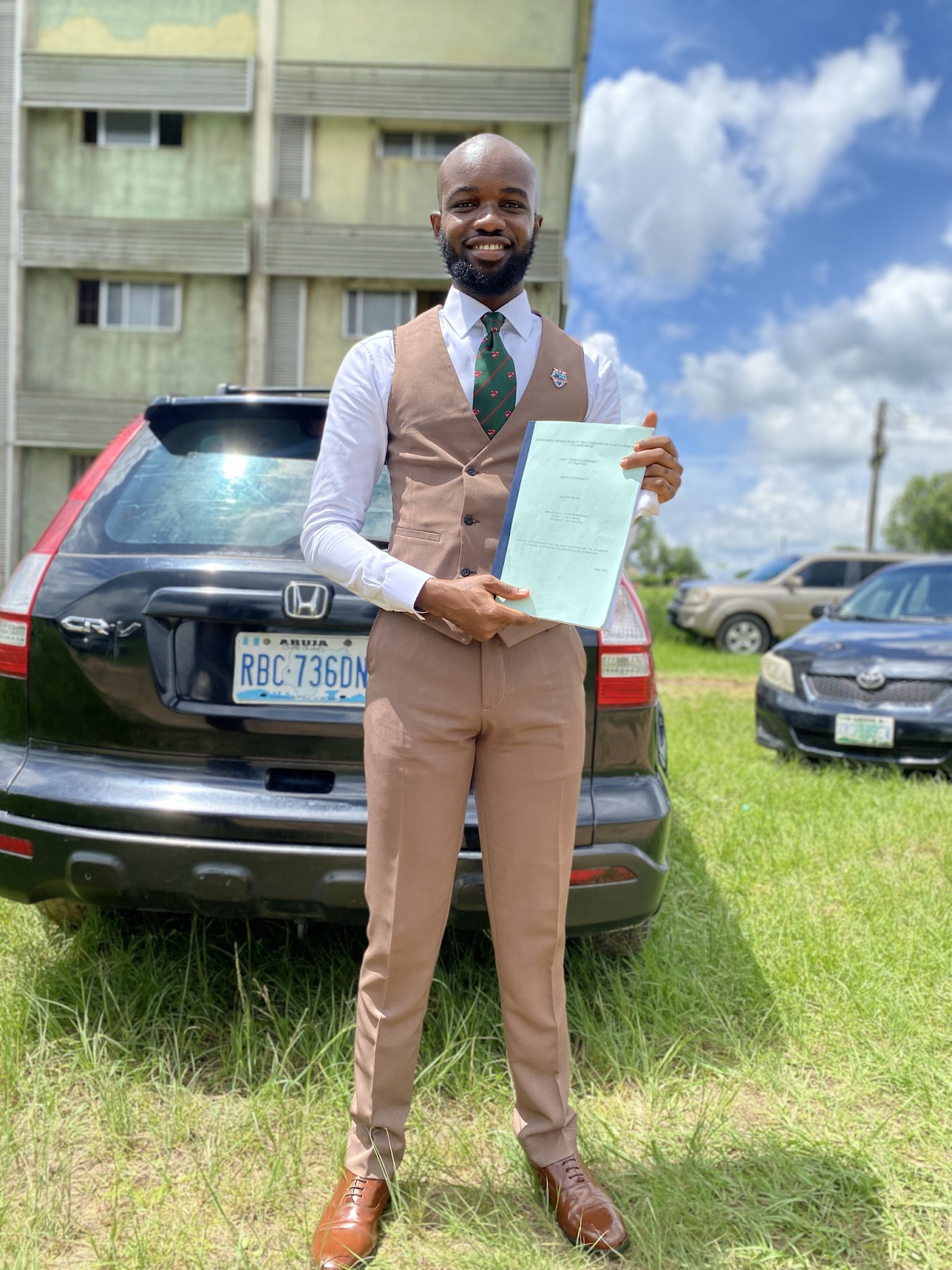
    Image credit: Ini Amah/X

    I was a smart kid growing up.

    The first time I got the first position in school was in Primary 1. I was a well-known menace in my class of 20-30 students, and my name was always on the noisemakers’ list. But even with all those distractions, I still got the first position. That was when my intelligence first dawned on me, and I became cocky.

    After that, I regularly got the first position, and I took it for granted that I’d always come first. I expected it, and my parents expected it, too. The only subject I wasn’t great in was Mathematics, much to my mum’s dismay. She’s a teacher and was particular about my performance in maths.

    I came first all through primary school, but my maths skills didn’t improve until Primary 5. I figured it’d make my mum happy, so I paid more attention to the subject. I studied more, and fortunately, a cousin came to stay with us around that time. He was good at maths, and he tutored me and helped with my assignments. He played a vital role in my improvement.

    My first position streak ended in primary school. I attended a federal government college, and there was more competition. My first result placed me second out of about 70 students, and I thought I’d failed. I remember sulking about it when another classmate found me. He asked why I was frowning, and I said, “Because I don’t like my result.” The guy just started laughing. His own position was 20-something. What did I expect him to do if I came second and still felt bad about it?

    Still, I resolved to land the first position, so I studied more than ever. I read into the night with candles — literally burned the midnight candle — but it never happened all through secondary school. I always came between the second and fourth. There was always someone better.

    However, mathematics gave me a chance to shine. I got even better at it in secondary school. In JSS 3, I became one of the two students selected from my school to compete in Cowbell’s Secondary School Mathematics Competition (Junior category) in 2007/2008.

    The competition is televised now, but it was a written examination then. It had two levels—the state and national levels. At the state level, schools sent at least two students to participate. The student who scored highest at the state level got to represent their state at the national level.

    It took almost a month of preparation and tests before my school selected me. The school administration first selected students with good maths results, gave us extra maths teachers and put us through extra lessons. Students were dropped after each test until they got the top two — me and one other student.

    I eventually came second overall at the state level. Unfortunately, I couldn’t represent my state nationally, but I got a ₦15k cash prize and a certificate.

    That same year, I participated in a maths olympiad organised by the National Mathematical Centre. The olympiad was even more intense than Cowbell’s competition because the questions were more advanced than my JSS 3 level, and a negative marking system removed marks for failing an answer. I also came second overall at the state level and got a certificate.

    In 2011, I wrote WAEC and had one of the best results in my school. I was in the top 10 out of 300+ students, with seven Bs and two Cs. All was set for me to pursue my dreams of studying medicine and becoming a doctor.

    My medicine dream started at age 7 when I read “Gifted Hands” by Ben Carson. I wouldn’t say I had a passion for it. I just bought the Ben Carson dream and looked forward to also becoming a doctor.

    I wrote JAMB first in 2011. I passed but didn’t get medicine, so I tried again in the second year. I still didn’t get medicine, but I decided to apply for supplementary admission into microbiology so I wouldn’t just stay home.

    I still didn’t give up on my dream, though. I wrote JAMB again in 2013 while in my first year of microbiology and finally got medicine. It was at the same university, so I just switched departments. 

    I started medical school without any expectations. I just knew I had to be serious because everyone kept saying that anyone who failed a course in the first year would be instantly withdrawn. I studied hard as usual and passed all my courses — 17 altogether.

    In year two, we started learning medical courses: anatomy, physiology, biochemistry, and community health. Just four courses, but each had about three to four sub-courses. 

    I enjoyed anatomy, particularly gross anatomy, but I struggled with physiology and biochemistry. The latter was worse; I just couldn’t grasp the subject. 

    The thing with studying medicine is that discipline will always beat intelligence. 

    There was A LOT to study, and you needed discipline to sit down and read. I understood this, and I tried. I’d study for hours, go to night class until 5:30 a.m., rest for an hour and then start preparing for an 8 a.m. class. My whole life was a reading cycle. If I wasn’t in class or reading, I was at fellowship.

    I first noticed I was struggling in the second semester of year two. I was studying a lot but still wasn’t meeting the workload. I consulted friends and colleagues, and they helped me study. I managed to pass that year.

    The problem started in year three. This was in 2016. Medical students take their first professional MBBS exam in the third year, and all our results from the first year up to then are averaged as part of our continuous assessment (CA) and scored over 40. The professional exam was to be scored over 60 and combined with the CA to make 100 marks. The pass mark was 50.

    There was no particular pass mark for the CA, but it’s advised that you score at least 20 on your CA so you can work towards scoring 30 or more in the exam and increase your chances of passing. My CA for anatomy was 20, but it was between 14 and 15 for physiology and biochemistry. I tried my best in the exam, but I ended up failing those two subjects.

    The professional MBBS exams allow students to attempt to pass thrice before being asked to leave medical school. Four months later, I made my second attempt and passed physiology. But I still failed biochemistry. That meant I had to repeat year three and resit all the exams, even those I already passed. 

    My third and final attempt was in 2018. I failed all three courses. I still remember the day I saw the result—14 June 2018. My school posts the results on a noticeboard with a one-word remark beside each name: pass, resit, repeat, or withdraw. 

    I’d checked the noticeboard the night before, but it wasn’t there. Another classmate checked early the following day and saw it was up. So, they snapped the results and sent them to our class WhatsApp group. The remark beside my name was “withdraw”. 
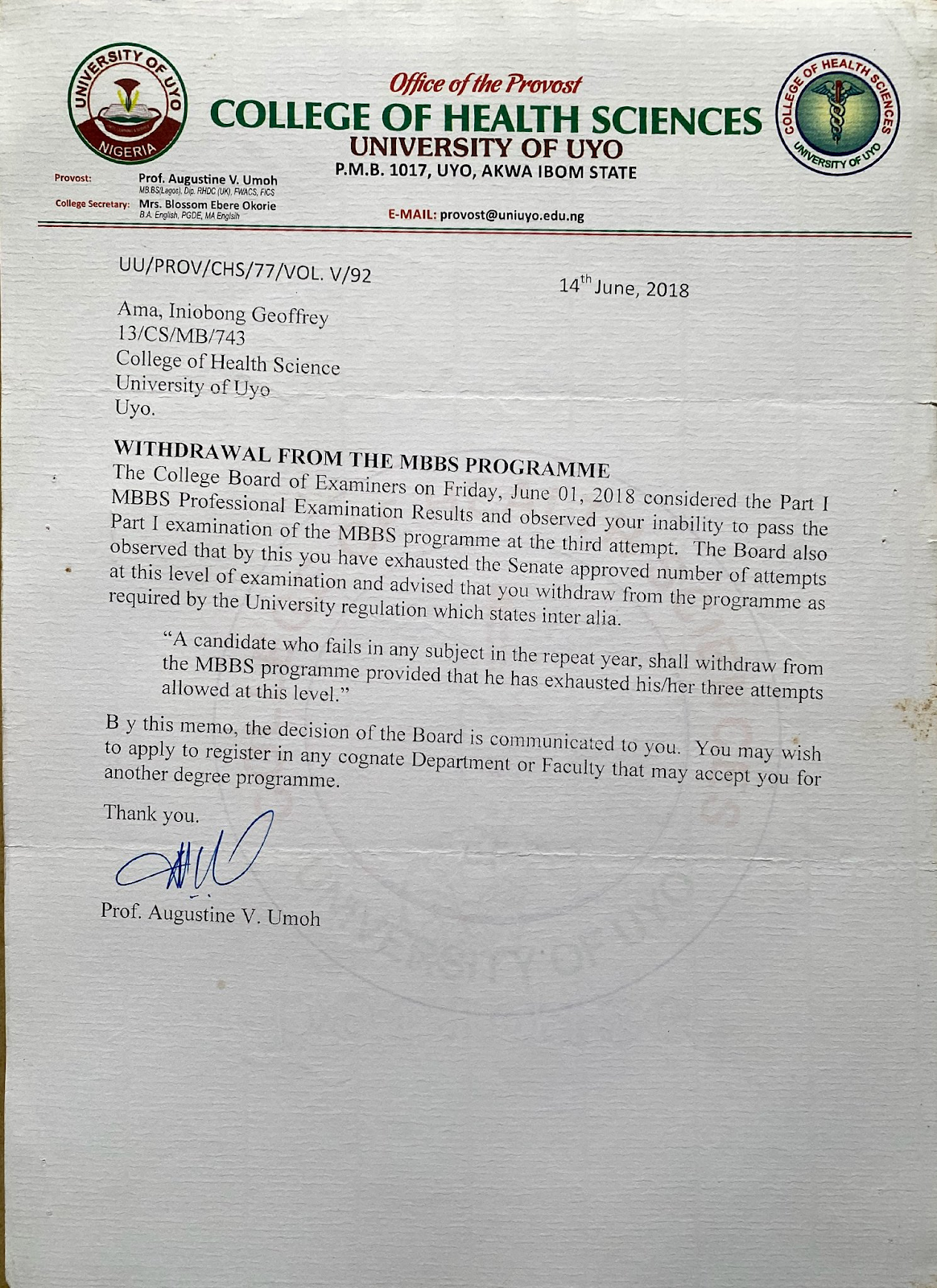
    The withdrawal letter

    It was tragic. The first person I told was my younger sister because we lived together in school. We both cried so much. Then, I informed my fellowship pastor. We were supposed to go somewhere together that day, so I texted him to share the news.

    I didn’t know how to tell my parents. I decided to tell my uncle to help me inform my parents, but he worked offshore and wasn’t in town. I travelled home and stayed with my parents for almost a month but couldn’t say a word. It was eating me up, but I didn’t let them suspect a thing. I didn’t know how to tell them the last five years had gone down the drain.

    I kept hoping that my uncle would come to our town so he’d help me. When I couldn’t bottle it any longer, I told my dad and begged him to help inform my mum. She was understandably upset. It was terrible. She lashed out, and her health even declined. All those years of school fees, pocket money and anticipation had just gone like that. She’d even started making plans for my induction. It was obvious I’d shattered her hopes.

    My dad took it better. He didn’t say anything in anger and did his best to reassure me of his confidence in my academic skills. But I still felt terrible. Everything I’d ever imagined I wanted to be in life was connected to medicine, and I didn’t see any reason to live after losing that opportunity. 

    It was a period of severe depression for me. I lost hope and even attempted suicide twice. I’m just grateful that God raised people to help and pray for me. Some didn’t even know why they were praying for me, but those prayers kept me alive.

    When I returned to school, I started looking for other departments to join. The school administration had given me a withdrawal letter, which I could take to other departments. If they accepted me, the school would just process my transfer.

    I first went to the faculty of pharmacy — I was still hoping for a big-name course — but the dean outrightly refused. I had to return to the microbiology I’d previously run away from. They accepted, and I started 200 level in the 2018/2019 session.

    Even though I didn’t make it, I don’t regret the five years I spent studying medicine and surgery. The discipline and training I got in medical school helped me in microbiology. Studying was easier, and I did much better. I even had time to become active in my campus fellowship. I took my final exams in 2022 and officially graduated in 2024 with a 4.34 CGPA — the gap was due to internal delays in processing students for clearance. 
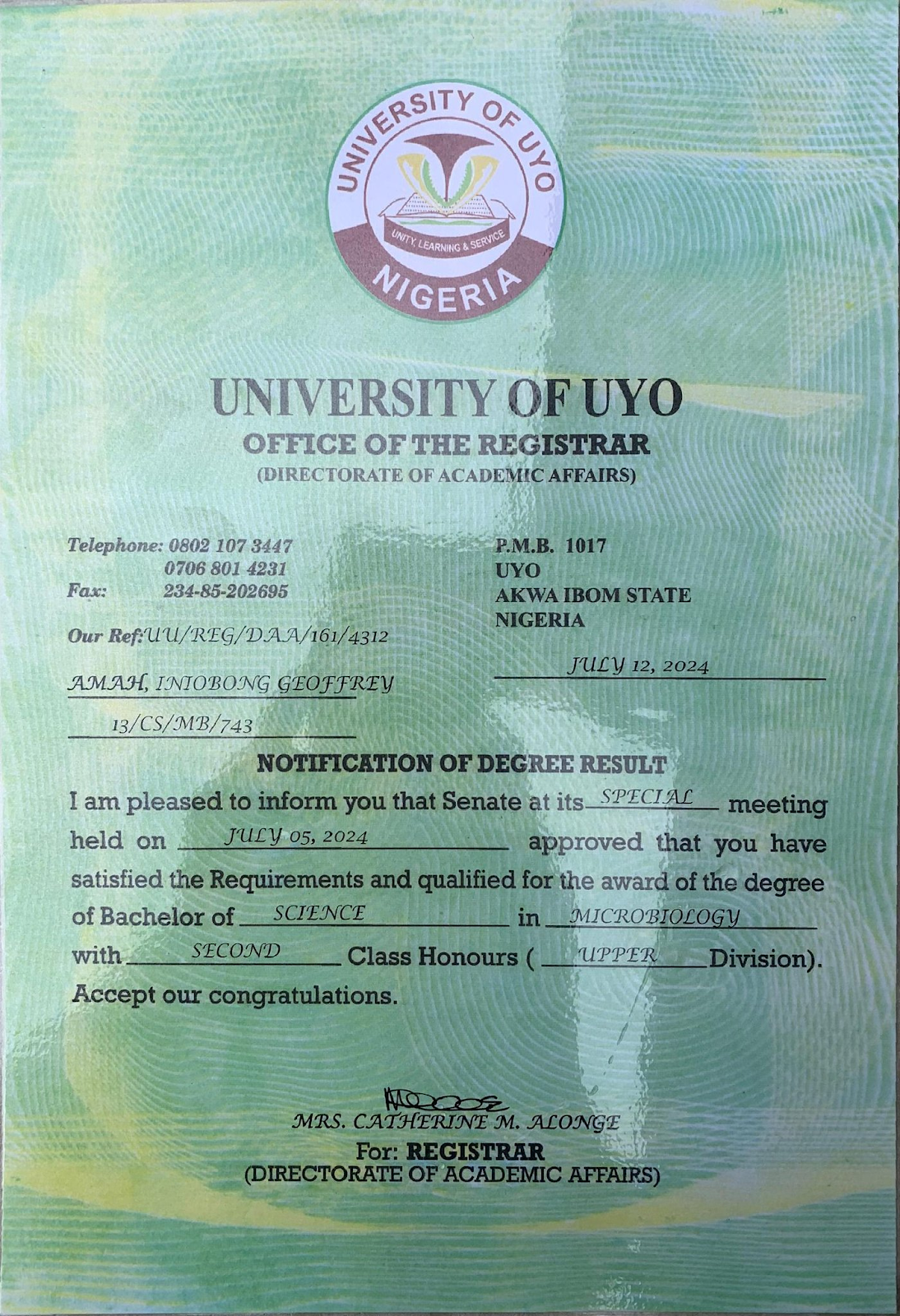
    Ini’s result notification

    It took me 12 years to earn a degree, but I like to see my experience as a preparation for life. I didn’t make it as a doctor, but I learned lessons I’ll never forget. It was the first time I’d ever failed anything in my life. I literally went from winning awards in school to struggling to pass. Thankfully, I didn’t drown.

    My fellowship pastor told me something after I shared the news of failing medical school, and I still remember it. He said, “Okay. This thing has happened now. What will it make of you? Will it make a chicken or a beast out of you?”. I responded and said it’d make a beast out of me.

    That question he asked stuck with me over the years. Through the months of depression and through other challenges, I kept telling myself I’d come out as a beast. I’m glad I’ve moved on. 

    I’m not afraid of my future. I can look at tomorrow with hope and faith. The Bible says, “The path of the just is like a shining light which shines brighter and brighter unto a perfect day,” and I stand by that. I’ll never have any doubts about my tomorrow again.

    NEXT READ: It Haunts Me That I Never Got to Make My Parents Proud


    [ad]
  • I was looking to speak with young men navigating failures in their lives when I found Sunkanmi*.

    The 33-year-old opens up about how his inability to start a family due to Nigeria’s harsh economic conditions makes him feel like he’s failed his ageing parents, who toiled to give him a better life.

    As told to Adeyinka

    In the version of my early thirties that I spent my twenties dreaming about, I should be married with two kids by now. I should also have a nice house and cars for my wife and me, be able to take vacations abroad and have a bank account with savings that guarantee peace of mind. I’m 33, pushing 34, and I’ve not achieved any of these things.

    I’m usually not one to let these delays weigh me down because I’ve always believed that it’s never too late for life to pleasantly surprise you. But recently, it’s started to bother me. My dad is a good example of “It’s never too late to start”. Let me explain.

    Until I graduated from secondary school, things were tough at home. My dad was out of a job because he was ill — doctors could never come up with a diagnosis for all the six years he was sick. So, my mum, a frozen foods trader, was the family’s sole provider. We never lacked, but we only had enough for the necessities. My sibling and I learnt early enough never to ask for money for anything deemed unimportant.

    After I completed secondary school, my mum became increasingly worried about the expenses of funding my university education. It was a constant talking point in the house. Her frozen foods business only generated enough income to cater to our small family of four and tend to my ailing father. Funding a university education on that income just wasn’t feasible. My mum even considered approaching family members to crowdfund. I hadn’t even gained admission to a school, but she didn’t want to wait until the last minute.

    Call it a miracle or coincidence, but my mum’s sadness and desperation at the time reawakened something in my dad. He started recovering, and the illness left as mysteriously as it came. He reconnected with old friends and business associates who were kind enough to return his calls and help him find his feet again. 

    After my dad turned 50 in 2012, he launched his automobile sales company, bought my mum’s first car, and I gained admission into a private university with higher tuition than the government university my mum wanted me to attend.

    I left uni in 2016, and eight years later, I can’t say that life is looking up. I don’t know what the future holds.

    Honestly, things started to go downhill right after graduation. I left uni with a third class and kept it from my parents. I couldn’t bear the thought of sharing the news and breaking their hearts. I came up with all sorts of lies about my result until they stopped asking. Thankfully, I went for NYSC soon after graduation, which erased their doubts about whether I truly completed university.

    After NYSC, my dad resumed asking for my certificate and CV so he could send them to friends who had promised to help with a job. But with a third-class degree, I was sure I’d make myself and my dad laughing stocks to people who held him in high regard. So, I stalled and came up with more excuses whenever he mentioned the topic.

    Fast-forward to two months later, I talked my parents into letting me move to my uncle’s place in Lagos, where I was certain I was going to hit it big. 

    As someone who spent most of his teenage years in Ogbomosho, I’d seen friends and relatives move to Lagos and seemingly have things go well for them. I was especially convinced because some of them didn’t attend uni. If they could make it, I felt I had a better chance as a graduate.

     [ad]

    Lagos wasn’t all I hoped it would be, but after weeks of submitting job applications, I struck gold with manufacturing factories. Most didn’t care about my third-class degree as long as I had the physical strength to work. I landed a factory job that paid ₦65k for an eight-hour shift and threw in a bonus for people willing to work weekends. 

    Six months after my first job, I changed jobs a few times and landed a supervisory role at a beverage production factory in Ijebu. The role came with free accommodation and paid ₦150k.

    I left the factory job in 2021. My body could no longer take on the physical demands and long shift hours that were required. Also, the ₦150k salary that had seemed like a big deal in 2019 was barely enough in 2021. 

    I returned to my uncle’s place in Lagos after I left the job. A friend told me he was making a killing from Uber and Taxify as a cab driver, so I gathered my savings and bought a second-hand Camry 2004 Le for ₦1.8m. I could’ve bought it from my dad or asked him to help with the car, but I wanted to do it myself. At 28, I didn’t want to be seen as depending on my parents for handouts. Moreover, I’d given them the impression that my life was on track in Lagos.

    I started the cab service fully in early 2022. On the side, I took on private driving gigs for companies and individuals, worked as a part-time driver with a catering company, and even enrolled as an apprentice at a private mechanic workshop.

    More than three years after “hustling”, as the streets would call it, I can’t say I’ve done much with myself. It’s as if Nigeria swallows up your efforts no matter how hard you try. You think you’re earning a cool sum or have saved up enough to consider settling down, and the economy suddenly takes a dive, reducing your savings to nothing and leaving you uncertain. I should also mention that I lost ₦2.5m of my savings to relocation scam. 

    In all of this, my love life has been non-existent. I’ve gotten into on-and-off relationships, but nothing serious. I’m constantly afraid  I’ve not made enough to start a family or fend for one. 

    I once had a lady who almost pressured me into marriage. She wasn’t bothered about my finances and used every opportunity to mention that her parents would support us in every way—they’d foot the wedding, help us with an apartment, and even sponsor our relocation abroad. As much as it sounded like a good deal, I wasn’t comfortable with the idea of depending on her parents. I eventually broke things off.

    Last year, my mum was diagnosed with glaucoma and partially lost her sight for some months. I remember almost breaking down in tears when I visited her at home. At that moment, I realised there was a possibility she’d never see my face again, my children, who I choose to spend life with, or what my wedding ceremony would look like.

    I’ve watched my parents travel miles for wedding ceremonies or naming parties of friends and relatives. I’ve watched them tend to the neighbours’ children like their own. I’ve watched them babysit for relatives who needed support. In their old age, I’ve realised that these things give them a deep sense of joy and fulfilment. Even though they never pressure me, I feel like my inability to settle down and start a family deprives them of the joy they derive from outsiders.

    Sadly, I don’t know what the future holds or if they’ll be alive to witness it. I’m still out here hustling and doing my best to create a soft landing for the family I don’t have yet. I’ve accepted that I might be a late starter, just like my dad.

    Read this next: My Parents Once Ignored Me for a Year

  • From a young age, Omotola* (32) anticipated growing up to make money to care for her struggling parents. However, her parents passed away before she could actualise her dreams, and Omotola can’t help feeling like she failed them.

    As told to Boluwatife

    Image by Freepik AI

    “Mummy, I’ll buy you a car when I grow up.” According to my parents, that was my favourite catchphrase as a child. It was my go-to whenever they caught me causing trouble and trying to avoid a beating.

    I may have said those words playfully at first, but they became more than mere words as I grew older. 

    You know the expression “to be as poor as a church rat”? That was my family’s reality. We weren’t broke. To be broke means you don’t have money right now, but you had it at a point in time. We didn’t. We were simply poor.

    My dad was a welder, and my mum worked as a cleaner— the type who walked around university hostels shouting, “Any work?” But even joining their small incomes together didn’t do much to make our lives easy. We lived in a one-room apartment separated by a curtain so my parents could sleep in the “bedroom” area while the four of us kids found sleeping positions on the floor. 

    The best spot was the one closest to the door, as it meant easy access to the breeze that came in through the net covering on a windy night. As the first child and automatic third parent, I often gave up this spot so my younger ones would be more comfortable. Even when we ate together, I learned to take small bites so they’d eat more.

    Sacrificing small comforts for my siblings was something I learned from my parents. Even with how tough things were, I could see the lengths they went to make sure we all went to school and didn’t go hungry. 

    I remember when my secondary school gave us a week’s deadline to pay our WAEC fees or risk not being part of those who’d write the exams. I knew there was no money and didn’t bother telling my parents, but my mum noticed my sad expression and made sure I told her the problem. When I did, she just told me not to worry.

    That weekend, my mum washed so many clothes that her hands blistered. She just asked me to rub ori (shea butter) on them, and off she went to look for more people to give her dirty clothes to wash. My dad also went to everyone he knew asking to borrow money. I eventually paid that WAEC fee with plenty of time to spare. 

    That’s just one example of how much my parents were willing to sacrifice for their children. What about the time my mum carried my sick sister on her back and screamed in front of the teaching hospital after they initially didn’t want to admit her because there was “no bed space”? My mum knew she had no money for a private hospital and also knew that my sister would die if no one attended to her. So, she stood there and screamed till a doctor came out to treat my sister.

    Or is it the period when my dad started helping clear soakaways on our street so he could make extra cash to buy me the medical kit I needed for nursing school in 2010?

    Honestly, my parents sacrificed a lot. All their lives, they gave of themselves— not just to me or my siblings but to people around us, too. For poor people, they were really the most generous people ever. 

    So, yes, my “I’ll buy you a car” catchphrase became more than words as I began to see and appreciate all their sacrifice. It became a promise. My parents just had to reap the fruits of their labour. My grand plan was to finish school, make money, build a house and put them there. They’d never have to struggle again.

    But life has a way of spoiling plans. 

    My dad suffered a stroke and passed away two weeks after I graduated in 2013. I felt like there was a giant hand inside my chest that was squeezing all the blood from my heart. I wanted to die. I couldn’t break down outwardly because of my mum and siblings, but I kept asking myself questions. Why was life so unfair to good people? Couldn’t my dad have waited a bit? 

    Most of all, I felt like I’d failed him. I had promised to take care of him and repay his sacrifices, but I wasn’t able to do either, and now he was gone forever.

    I tried to console myself that I could still provide for my mum and make her proud. She became my new focus, my new driving force to make money so I could spoil her.

    I got my first nursing job in 2014 and started sending my mum ₦5k monthly out of my ₦25k salary. I desperately wanted to send more, but the ₦20k left hardly covered my transportation and feeding. I was living from hand to mouth, but I made sure I sent something home.

    Things started to look up in 2016. After squatting with a friend for so long, I got a new job that paid ₦80k and could finally afford to rent my own apartment. The plan was to move in with my mum. She always complained about her troublesome neighbours, and I wanted her away from their wahala.

    But my mum fell ill shortly after she moved in with me. Family members said it was “ofa” — a spiritual attack and warned me not to give her an injection or she’d die. We went from one prayer house to the other and got different agbo (concoctions) for her, but she didn’t get better. I even secretly treated her with normal medicine against people’s advice, but that didn’t work either. She passed away in 2017.

    I was numb for weeks after my mum died. I couldn’t think or feel anything. I don’t remember if I even cried. When it finally registered in my head that she was gone, it was like I’d lost two things: my mum and my purpose.

    All my life’s decisions up until that point had been towards making enough money to make my parents proud of me and never have to struggle again. With them gone, what was I working for?

    It took me years to get out of that headspace and find purpose again. I have children now, and they motivate me to work hard. But I can’t help feeling like I failed my parents.

    Those people sacrificed so much for me, and I never got to repay them. They suffered their whole lives without a moment of rest. I was supposed to give them that rest, but I couldn’t. I know it’s not my fault that they died, but it doesn’t make it better. I’ll never get the chance to appreciate them like they deserve, and it haunts me.


    *Name has been changed for anonymity.


    NEXT READ: My Grandkids Are My Second Shot at Parenting the Right Way

    [ad]